Tag Archives: hijab

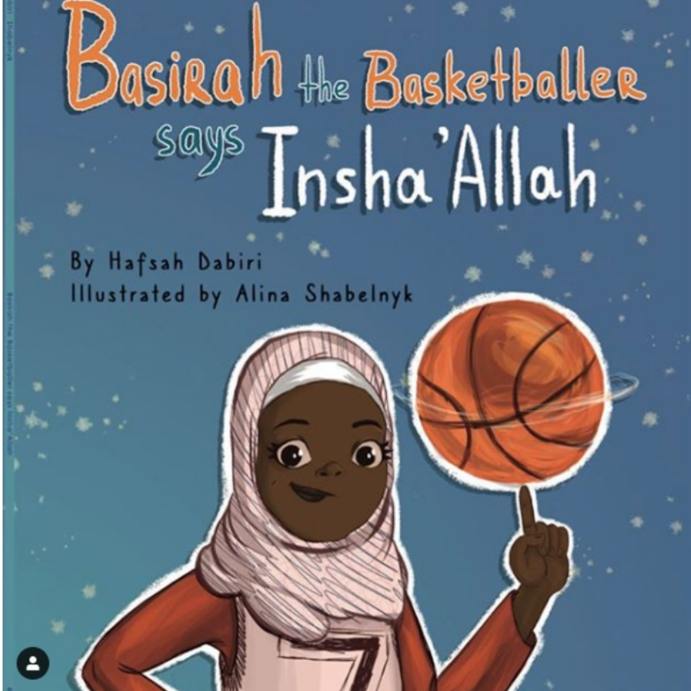
Basirah the Basketballer says Insha’Allah by Hafsah Dabiri illustrated by Alina Shabelnyk

Standard
Basirah the Basketballer says Insha’Allah by Hafsah Dabiri illustrated by Alina Shabelnyk

basket.jpg

Another sports book starring a smart girl with a supportive father, seems like a trend, and I like it.  The book is relatable to ages 5 and up whether they play basketball or not, and will remind even slightly older children how “insha’Allah” really works.  It features a girl, but boys will gain a lot from the book as the lessons are for us all.
basirah1

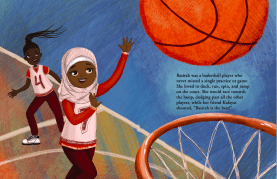
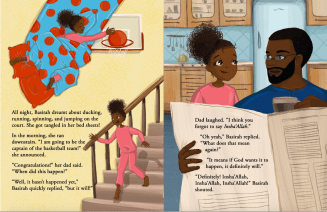
Basirah loves basketball and with supportive teammates and mad skills, she should be a shoo-in for team captain.  But when her dad reminds her that if it hasn’t happened yet she needs to say insha’Allah, she realizes the power of leaving things to God.  

Testing out her new knowledge of asking God to make happen things she really, really wants, over many of the 30 pages in the story, makes the climax that much stronger and her dad’s wisdom that much more memorable. I’m trying not to spoil the story, even though it is a children’s picture book, it isn’t without a bit of tension and resolution that really makes the book shine.
basirah2

This book can be taken at face value with a little bit of a lesson for little ones, or a lot deeper for more reflective readers.  Understanding that things we ask God for often come or don’t come to test us, is a lesson we all need. I hope if read with an adult, the adult will also push the listener to consider why we should do things in the first place, what are intentions are, as Basirah leaves the door open for that discussion at the end, but doesn’t quite articulate it for independent readers.

basirah3

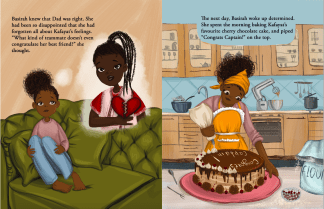
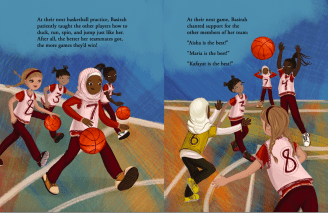
I love that at home Basirah is not covered, but is when she is out.  I love that her school is diverse with students of different colors and head coverings and that her coach is female and a muhajaba as well.  I love that Basirah and her father seem incredibly close, and that she listens to him, and he to her, before lessons are espoused and course of action plotted.  The book is not preachy, but lessons are there and the reader will get “it” right along with Basirah allowing her strength to radiate off the page and inshaAllah empower the reader as well.
basirah4

I find it interesting that the book doesn’t mention Allah and uses the word God, given that the phrase the book focuses around is insha’Allah.  I would imagine the intended audience is Muslim, but there is not specific mention of Islam.  It would work for non Muslims, but I think they would wonder why she says such a phrase and where it comes from.
basirah5

Basirah is presumably in middle school, as she has multiple classes and can bake a cake independently, her age seems a bit fluid, but many 11-14 year olds do tend to be independent in some areas and rather clueless in others, so while I did notice that she seems very naive in knowing what insha’Allah means and how it works in some parts of the story and very mature, and hijab wearing, and willing to grow from her situation in others, I’ve concluded it is plausible.

The book is 8.5 x 11 vertical, well bound, shiny glossy full color pages with clear and easily readable font.  The sentence length and amount of text on the page is not too overwhelming and the spacing keeps it inviting for new fluent readers.  

I love that Ruqaya’s Bookshelf (https://ruqayasbookshelf.com/) has new books out, three to be exact.  Whether the stories work or don’t work for you, I think their presentation and quality, give the books a longevity and find themselves being pulled out for different kids, at different times, when different lessons are needed.  They are well packaged in terms of illustrations and colors and size for the most part, and when I hear they are publishing new stories, I find myself ordering them without even reading the content synopsis.  Thank you for helping get these stories out, may Allah swt reward you!
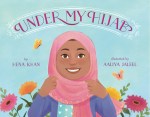
 

Under My Hijab by Hena Khan illustrated by Aaliya Jaleel

Standard
Under My Hijab by Hena Khan illustrated by Aaliya Jaleel

UNDER MY HIJAB final front cover JPEG.JPG

I know, (sigh) another hijab book, but I promise it is good and you won’t be sad you bought…”another hijab book,” and  alhumdulillah, it’s a Hena Khan book, so public libraries will have it or at least they should be willing to order it if requested.  

IMG_2878

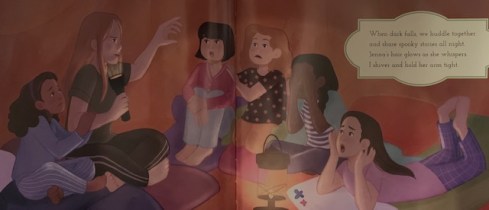
Written in rhyming four line stanzas the story is told from a young girl’s perspective about the women in her life.  The first two page spread shows the strong female as she interacts in the world and covers her self, with the following two page spread, showing her in her home, uncovered.

IMG_2879

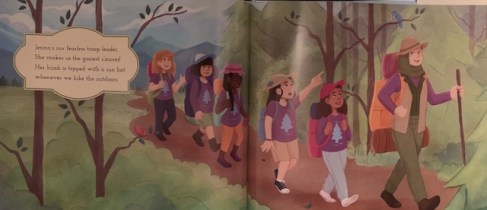
From Grandma, to Mama, to Auntie, to troop leader, to siblings and friends, the reader sees hijabs wrapped in styles as different as the person wearing them.  They also see Muslim women as doctors, artists, Tae Kwon Do students, bakers, leaders, and everything in between.

IMG_2880

The illustrations are beautiful and perfect.  They radiant warmth and familiarity, while adding details to make the pages hold your attention a few minutes longer and smile with the diversity presented. The martial art scene is spot on!
IMG_2876

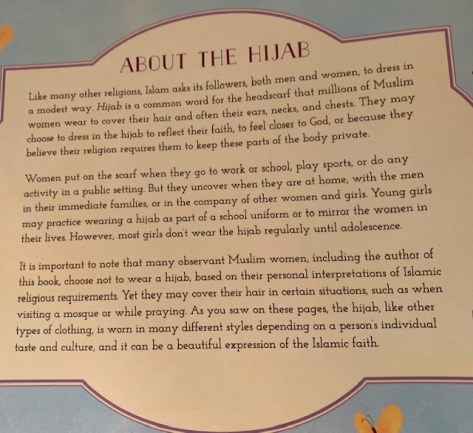
I wish they showed a niqabi, and maybe someone that doesn’t cover all the time, but at certain times of prayer or entering a mosque, like the author, who talks about herself and hijab in general in the afterward entitled: About the Hijab.  

IMG_2882

I love that the book is for children and I desperately hope adults will read it too.  It breaks down so many stereotypes, and answers so many questions in a seemingly effortless presentation.  How many times have all hijabis been asked if we sleep in our scarves or shower in them.  I love that there are shades of brown skin tones, and blond haired hijabi’s too.  

IMG_2877

And most importantly I love that it shows Muslim women to be strong and varied and to have full, independent beautiful colorful lives.  That hijab is a choice and it is strength and beauty and personal.

IMG_2881

The book does not talk about the reasons for wearing hijab, or get into the religion.  The book is a great size for story time and bedtime at 10 x 8 horizontal, hardbound, and 32 pages.  Ages four and up will enjoy this book repeatedly,  and older kids, especially girls considering covering or just starting to cover will enjoy it as well.

Alhumdulillah! Well done!

Forgive the glare in the pictures, they aren’t in the book 🙂

Boy vs Girl by Na’ima B. Robert

Standard
Boy vs Girl by Na’ima B. Robert

9781847801500.jpg

I read this book a few years ago and was blown away that Islamic fiction could explore these topics compellingly in a YA package.  I remember loaning out the book to a mom with middle school kids to see if she could tell me how accurate the storylines were.  Yeah, I never got the book back, and never got the feedback, and the book slipped my mind and thus I never wrote a review on it.  Fast forward to last month and I’m trying to find a middle school book club selection and I can’t believe that I don’t have a blog entry of this book to look back on.  Clearly, this shows why 1- I don’t loan out books anymore and 2-Why I have a blog, cause I remember nothing about the flags, relevance or appropriateness of the book, thus I bought another copy, read it, and am now documenting my thoughts.

The book is 260 pages and an AR 5.3, but the drug use and violence I’d say would warrant an older reader, 9th grade and up perhaps.  And while by the end, the book leaves a pleasant taste in your mouth and you would place it back on the shelf in a contented manner, I would be misleading if I didn’t confess that it took much self motivation to pick the book up and keep reading more than once, that it honestly took me a month to read.  The last third was hard to put down, but you have to get through a fair amount of frustration, stereotypes, and extremes to get there.

SYNOPSIS:

Sixteen year old twins Farhana and her brother Faraz live in London and are incredibly different from one another.  Farhana goes to a school where she excels both academically and socially.  She is queen bee, beautiful, and articulate.  Faraz on the other hand, goes to a different school and doesn’t really fit in anywhere, but in the art studio.  One thing that unites them, however, is their determination to grow and learn about Islam this Ramadan, and their home environment of a large extended Pakistani family that places culture above religion.

Both twins are close with the “black sheep” of the family, their Aunty Najma, a niqabi rebel set on marrying a white convert.  But, both twins have their own stresses as well.  Farhana has recently called it off with a boy named Malik, but isn’t really over him and Faraz has gotten himself involved in a street gang to find a place to belong, but the stakes are getting higher.  Both twins on the eve of Ramadan and with the coaching of their Aunt are determined to get their lives straightened out, fast properly, reconnect with their faith, and with each other.  They do, alhumdulillah, however, the spiritual high only lasts so long, as earlier decisions come back to haunt them.

Farhana makes the bold decision to start wearing hijab, but once the novelty wears off, she starts to question her choice.  It isn’t helped by her mom who is very, very against the need to veil and makes it difficult for her daughter.  Faraz meets some street artists at the masjid and while it looks like he could find a place to excel, his alliance with a gang, also comes with enemies from rival crews.  Physical fights and drug runs have him out at all hours of the night and the priority of fasting and praying fade as the the pressures of not getting killed or caught prevail.

As each kid has their ups and downs, and the parents prove to be out of touch with the lives of those in their homes, tidbits of Islam come through, but unfortunately so does a lot of cultural dogma that isn’t always clarified or pushed back on, making there a lot going on in this book, and making me wish it was a just a bit longer and more fine tuned.

WHY I LIKE IT:

The book, I could argue set the foundation for the amazing pieces of literature currently available.  Published in 2010, the book really was a first of its kind.  Written by a Muslim, unapologetically written for Muslim and non-Muslims, and available in the mainstream.  The book tackles real issues, but seems to fall into stereotypes too.  That Farhana covers and is so beautiful, she looks like Aishwariya Rai, the Bollywood actress, why would she cover.  Malik decides to figure things out and wait for her, ahhh, so sweet.  There’s the rebel Asian girl who gets a lot of page space early on for her incredibly minor role, going on about Asian Girl Bachelor Parties and hooking up with everyone and anyone. There is the best friend who is religious and the Imam’s daughter and is also chubby.  The nice brother at the masjid who saves the protagonist.  I don’t know, they all seem predictable.  What I like about fiction is it allows Muslims to be seen in shades of gray not just black and white, and while this book tries to do it, I feel like only the main characters are allowed to grow and change, the minor characters hold on to their positions so resolutely that, they kind of seem dry.

I like that the tables on hijab are switched up, it isn’t the parents that want the girl to cover, but rather the girl her self, and some of the conversations about hijab and Farhana’s choice to do it compared to her friend who is forced allow for some powerful moments.  I also like, that she has doubts soon after opting to wear it.  I wish some religious reasonings were brought in to her understanding of hijab, but the aspects of choice and how to wear it, are present.  I’m grateful that Faraz’s storyline takes most of the action, so that it isn’t a romance novel, with Farhana pining relentlessly for Malik.  I had hoped for a little growth from the gang head, Skrooz, especially after Aunty Naj sheds some light on him, but his criminal act at the end after showing Faraz his cousin or maybe it was his brother seemed a bit off.  Again, it was only to benefit the protagonist, not to show that we all have our own battles.

The parents and extended family are irritating to say the least. To the extent of delaying iftar to get the food to the grandmas house and then serving the men first, like really? I don’t think so.  There is nothing that says the women have to eat after serving everyone else in religion and that is never challenged.  Yes, Farhana challenges her mom’s notion of women not going to the mosque, but the food bugged me.  I am Pakistani American, and the culture has its flaws, but the presentation in the book, is one big wide stripe of female oppression, which isn’t fair either.  Absolutely, their are families that the women cook all day and then eat in a corner, but I feel like the staging of this book as “authentic” either needs to show variation, or account that this is how one family views it, not that it is universal.

FLAGS:

There is talk of casual sex, physical violence with knives and fists, details about drugs: cocaine and heroin.  None of it is celebrated, but it is present and very much the norm in how it is presented.

TOOLS FOR LEADING THE DISCUSSION:

I still sway back and forth on if this could be done as a book club selection, and in the end I would opt that no it can’t.  Not for the drug use, or boy girl relationships, but ultimately for how the backwards and closed minded the Pakistani culture is presented as being.  If the group was high school Pakistani heritage kids maybe, but I think Arabs and non Muslims in general will not think very highly of the culture after reading this book, and I think that is a disservice to be promoting in a book club selection.  


My Name is Fatima. Mine Too! by Fatima D. ElMekki illustrated by George Franco

Standard
My Name is Fatima. Mine Too! by Fatima D. ElMekki illustrated by George Franco

IMG_1926

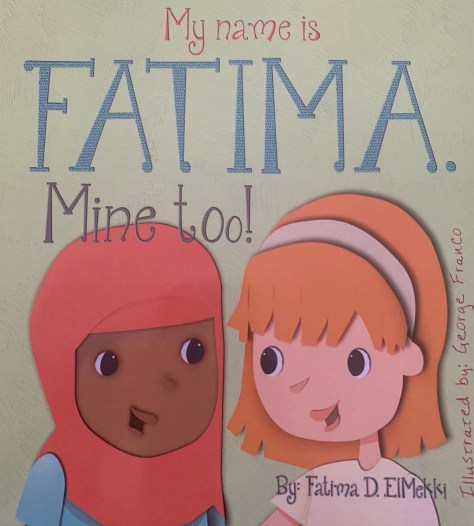
This book is interfaith, and learning your own roots, and asking questions about your heritage and faith all rolled in to a cute little package for children.  But despite it’s length, 28 pages, and cute little girls on the cover, the book is for more first grade/second grade and older children, rather than toddlers. 

IMG_1927

The message that we are more alike than different is a great message, even for the littlest of readers, but this book goes a little deeper, and the didactic approach will bore them a bit.  Older kids for sure 2nd and up will benefit from the exchanges between Fatima and Fatima and learning both valuable religious lessons about their namesakes as well as respect and friendship for those with different beliefs.

IMG_1928

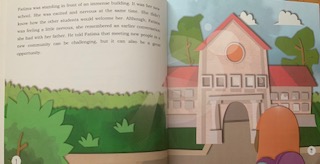
Fatima is from the Democratic Republic of Congo and on her first day of school in a America she tries to remember her father’s advice, that meeting new people can be a challenge, but also an opportunity.  

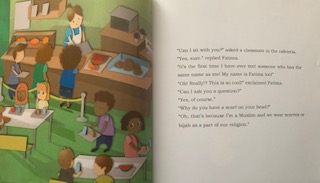
At lunch a little girl asks to sit with her, excited to meet someone with her same name.  Fatima asks her why she wears a scarf, and listens to her explain it is because she is Muslim and the hijab is part of her religion.  

IMG_1929

At recess, Muslim Fatima tells non Muslim Fatima that she is named after Prophet Muhammad (saw)’s daughter and asks her who she is named after and if asks she is Muslim, too.  The other Fatima says that she is Catholic and that she doesn’t know why her parents named her Fatima, but that she will find out and let her know.

IMG_1930

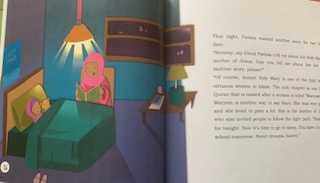
That night Catholic Fatima learns that her mom had gone to Fatima, a city in Portugal, a famous city for all the miracles that have happened there and the apparition of Mary, the Mother of Jesus.  Fatima’s mom had gone there to pray for a baby and promised if she got pregnant that she would name the baby Fatima.

IMG_1931

The next day Catholic Fatima tells Muslim Fatima and also asks her if she has heard of Mary, the mother of Jesus.  Muslim Fatima says she has heard of her, but doesn’t know much and that she will ask her parents and let her know.

Muslim Fatima learns that Mary is one of the four virtuous women in Islam and that there is a chapter in the Quran named after her.  When she tells Catholic Fatima the next day at school, the girls marvel at how much they have in common.  They are BFFs despite their differences and beautiful ones at that.

IMG_1932

I love that the book is framed in opposites to show similarities.  I also love that it shows women in our respective faiths with similar values, similar names, and Mary’s role in both our traditions.  So often, when we are building bridges we discuss how Yusuf is Joseph and Musa is Moses, Yahya is John and we go through the old Prophets, this was a nice change in perspective.

IMG_1935

The illustrations are nothing to get excited by, but they do show smiling warm characters and family members.  They serve as a distraction from the text heavy pages that do nothing to grasp the reader with their plan font and majority white backgrounds.

IMG_1933

This book would work for Muslim children, Catholic children, really all children.  It talks about faith, but as the characters view it, not in a one is better or more right than another.  There is a second book in the series about Fatima inviting Fatima to an Iftar party  that I look forward to checking out soon.  I hope it is a little more rich in dialogue and character building instead of just a foil to disseminate the information between the two faiths, but even if it isn’t I still think the book has value and you should check it out.

IMG_1934


Sadia by Colleen Nelson

Standard
Sadia by Colleen Nelson

sadia.jpg

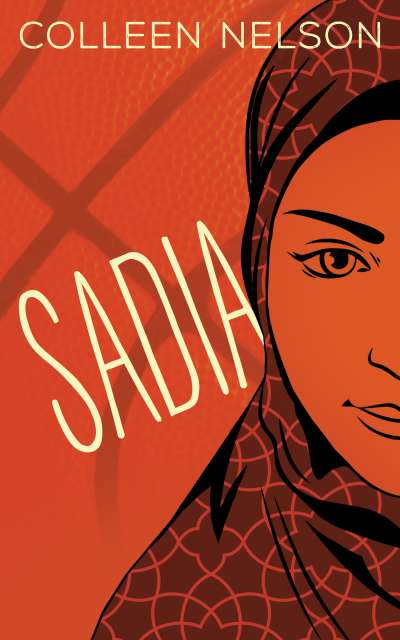
A middle school sports book with a female lead who wears hijab written by a non muslim.  The book could really go a lot of ways, I held my breath for all 239 pages waiting for something to go totally awry, and thankfully it never did.  In fact I read the book nearly straight through and while meant for ages 12 to 15, I quite enjoyed it.

SYNOPSIS:

Ninth Grader Sadia Ahmadi is an immigrant from Syria, her family left before things got “bad,” and while she has adjusted to life in Canada, High School is testing her in other ways.  Her best friend Mariam, an immigrant from Egypt, has started dejabbing, taking off her hijab to fit in it seems any chance she gets.  This is taken as a betrayal by Sadia and their friendship waxes and wanes throughout the book as each girl has to figure out who she is in relationship to hijab, and how to judge and/or accept each other and their choices.  Throw in a new refugee girl Amira from Syria who doesn’t speak English, a co-ed basketball tournament that doesn’t allow any headgear to be worn during games, a cute boy on the team and an awesome teacher with interesting assignments and you have the book in a nutshell.

WHY I LIKE IT:

I like Sadia, she is believable and strong.  She is well liked, athletic, she has a good relationship with her parents, brother and teachers, she prays and fasts and owns who she is, but she isn’t perfect.  She is hypocritical at times, and acknowledges it, she is tempted by parties, and boys and taking off her own hijab to play ball, and has to confront it about herself.  She doesn’t do things like pray on time, like she knows she should, but there she is and I am so impressed that the author picked up on so many nuances of Muslim life in her research or in her own observations as a teacher.  Yes, Amira has an awkward observation about Miriam being Muslim and not wearing hijab that seems really one dimensional considering large numbers of Muslims in Egypt and Syria don’t cover, but I don’t know if that was the author’s attempt to draw the issue to the light or if it was just a misstep.  

I like that there is a cute boy that accepts Sadia and who she likes as well, but they don’t do anything.  So often, these books become overrun by the romance story line and this one doesn’t, thankfully.  It seems to find a realistic balance, that she has feelings, but isn’t going to act on them, and based on her mom figuring out when she is lying that she won’t try and sneak behind her mom’s back.

Issues of halal food are mentioned in passing and it fleshes out that the girl is Muslim, not just going through the motions.  At times it is hard to know if her choices are based on belief and faith or expectation, but for an early YA/Middle School book, I think it suffices.  She mentions modesty as a reason for hijab, but also a lot of parental and cultural expectation.  One central theme the reader just has to go with, is that Sadia and the rest of the characters in the book, and there are a fair amount of Muslims, don’t know about any other ways to wear hijab for sports.  I get that Mariam and her sewing ability is a huge arc in the story, but they have smart phones, and its a contemporary piece, they have to know about Ibtihaj Muhammad in the Olympics, Bilqis Abdul-Qaadir, and Nike making athletic hijabs.  So, to make the story work you do have to turn a blind eye to the fact Muslima’s have taken to sports in the mainstream and that there is no way they can all be that clueless about her fabric, style, and covering options.

I love that the issue of refugees is addressed in the periphery, and the issues are given a human face.   I love that Sadia’s parents are religious, but not left as simple stereotypes, they deal with Islamaphobia, but aren’t looking for sympathy.

There is always the case, that the hijab becomes a stereotyped item as the story involves characters torn to wear it or not, but I loved how judgements were called in to questions and there wasn’t an easy answer.  The side friends in the story are all way too good to be true, but I think the whole book has a bit of a pollyanna feel to it, and in this case it was ok to error on the side of kindness than become overtly sensationalized and whiney.

The biggest hurdle this book faces is, is it the author’s story to tell. And I don’t know, I review a lot of books, and many are by Muslims and they get stuff wrong in my opinion, or they go so extreme to be accepted.  So, I don’t know, I think the book had heart, I didn’t know if the tournament would let Sadia play, I didn’t know if she would sneak off to the party, I didn’t know if she would cross the line with Josh, and I was curious, and invested and sucked in to it all.  Is it a book to teach others about Muslims or a book for Muslims to see themselves? I think all of the above.  Muslim’s should control their own narrative, but I think when author’s get so much right, we have to take some reassurance in the idea that we are being accepted by the larger society, and our stories are being told with love by other’s too.

FLAGS:

There is romance and lying, but no kissing, just hints at emotions or an errant arm flung over a shoulder during a huddle or photo.  There is mention of drinking at the parties, but Sadia doesn’t end up attending.

TOOLS FOR LEADING THE DISCUSSION:

I don’t know that I would do this as a book club selection, but if I met the right group of kids, I would definitely reconsider.  There is a lot of basketball, which I quite enjoyed, but I could see other’s maybe getting bored by the play-by-play.  I’ll make my daughter read it in a few years, and I look forward to discussing hijab and how she feels about it after.  It does raise the subject, and ask you to check your judgements on yourself and on others.

Author’s Website: http://www.colleennelsonauthor.com/


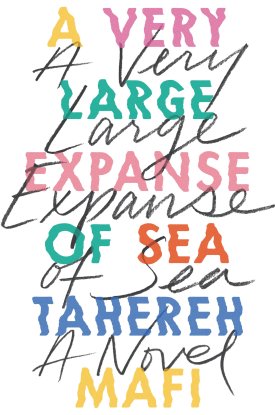
A Very Large Expanse of Sea by Tahereh Mafi

Standard
A Very Large Expanse of Sea by Tahereh Mafi

avleos

The book is often marketed as a Muslim coming of age story in a post 9/11 world.  The contemporary work is semi-autobiographical, but really I think the positioning is a bit misleading.  It’s a love story, and the main character is Muslim, and her environment is awful and she is angry. Its an engaging read, I read all 310 pages in one sitting, but I don’t know that the take-away will enlighten anyone about Islam, or really what it was like to be Muslim in the years after 9/11, I think people will remember how sweet the couple is and wonder how much of it mirrors the author and her husband, author Ransom Riggs (Miss Peregrine’s Peculiar Children), but not suddenly become knowledgable about more than what the main character experiences and endures.   I appreciate that the book challenges the stereotypes of Muslim women, there is authenticity as it comes from a writer who lives it, and I do think it shows evolution of attitudes that teens can benefit from.  The book is not yet in the AR database as it just came out, but I would imagine high school and up.  

SYNOPSIS:

Shirin’s Persian-American family moves a lot.  Her and her older brother are incredibly close as their parents are rather aloof to the day-to-day experiences the kids endure.  That isn’t too say her parents aren’t around, they eat two meals a day together and the parent’s are warm, but Shirin’s brother Navid is a much more present.  The story starts with 16-year-old Shirin starting her 12th new school.  Conditioned to not make eye contact, remember faces, or get affected by the trivialities around her, the reader sees how angry she is as she curses at a teacher that assumes she needs ESL not Honors.  Knowing how fleeting her time in any location can be, as her parents are constantly trying to find better jobs, Shirin doesn’t feel compelled to make friends or get attached to anyone or anything.  This intimidating vibe similarly keeps offers at bay, for the most part.  When she gets paired up with Ocean to dissect a cat, he tries to talk to her, and this throws her off her game.  Most every interaction she experiences at school are people making racist comments and being very one dimensional and bigoted.  Ocean tries to be nice, an attitude so foreign to Shirin that it begins to force her to change.  Simultaneously, Navid, who is charismatic and has no problem finding friends wherever they go, decides to put his and his sister’s dream into action and they start a break dancing club at school.  Three other kids join, and start becoming, not just Navid’s friends, but Shirin’s as well.  

Shirin and Ocean fall in love, despite Shirin fearing what the backlash will be for ocean.  She doesn’t really know anything about him, but feels strongly that all the racial slurs thrown at her on a daily bases will effect him and ultimately make them wish they didn’t pursue a relationship. She draws line after line in the sand, and crosses them all.  Only then does she learn how blind she has been, he is in two of her classes, not just one, he is a year older than her, and he is the golden star of the high school basketball team.  Being that the story is told from Shirin’s perspective, this is surprising to the reader as well.  The town turns on the pair and things get really ugly for Ocean who is willing to risk it all for Shirin.  Threats by the basketball coach, pictures of Shirin without her hijab being taken, accusations of terrorist ties and sympathies all challenge the couple and shape Shirin.

WHY I LIKE IT:

I really like the twist of having the relationship be difficult for the non Muslim, rather than going with the assumed Muslim girl having to sneak around.  Not saying that I support it, but interestingly she never mentions that what she is doing is going against anything religious.  She mentions twice that her parents wouldn’t like her with any guy, and that they view her as a child still, but she doesn’t explore Islamically any boundaries regarding their relationship.  She hides talking on the phone to Ocean, because her parents are adamant she gets enough sleep at night.  That is about it.  Shirin discusses that she wears hijab like an armor that she gets to pick who she shows her hair too.  I love the strength in that, but wish there was a bit of doctrine to back it up too.  At one point a Muslim, non hijabi, at school calls her out for wearing hijab and having a boyfriend, but she essential tells her it is none of her business, which it isn’t and who is to say that one sin is worse than another, but still it befuddles what exactly Shirin believes and why.  The book just paints her as a Persian Muslim, but never explores what that means other than the superficial outward appearance.  They do fast in Ramadan, no explanation about why is given, just that they not eat or drink during daylight hours, and right near the end, Shirin remarks how her mom asks her and her brother every morning if they have prayed and they lie and say yes, their mother sighs and tells them to make sure they pray the afternoon one, to which they lie and agree, only to have their mother sigh again.  AstagfirAllah, that is awful lying, and lying about Salat, but it is so real, I audibly chuckled.  

I like that the parents aren’t harsh, they just seem disinterested.  I didn’t want to read another book about the parent’s being the gatekeepers and bad guys, so that was really refreshing.  They mention they don’t celebrate Christmas, but they have an open door policy on Thanksgiving for any friends wanting to come.  I did hope for a bit more about them, why they don’t talk to the kids about moving, what makes them tick, because really they seem to have a solid relationship with the kids, they are just clueless to their social experiences and school environment stresses.

I love the growth and self reflection of Shirin, she holds a mirror to herself and she and readers are better for it.  She has to realize that she is doing so much of what she is accusing others of doing.  I love the support and genuine concern of the breakdancers and her brother.  It resonated to me as a girl with an older brother and the relationship feels very genuine. I just wanted to know more about Navid. 

FLAGS:

There is a lot of cursing. kissing, hand holding, romance, lying, and ditching school.  There is a brief mention of graffiti being sprayed.  There is racial slurs, threats of violence, violent physical outbursts by people of authority.  When a student throws a cinnamon roll at Shirin, Navid and his friends beat the kid up severely, it isn’t detailed, but it is mentioned.  Ocean  also gets suspended for a few games for a fight he engages in, and there is some detail of Shirin getting jumped in a previous city for wearing hijab.

TOOLS FOR LEADING THE DISCUSSION:

I don’t think I could in good conscience present this to a group of Muslim students.  I wouldn’t want them to think I was endorsing the violence and language and romance.  Like so many books of the genre though, if someone found it and read it on their own, I’d love to chat with them about it, as it is well written.

Youtube video about the book by the author: https://www.hypable.com/tahereh-mafi-a-very-large-expanse-of-sea-tour/

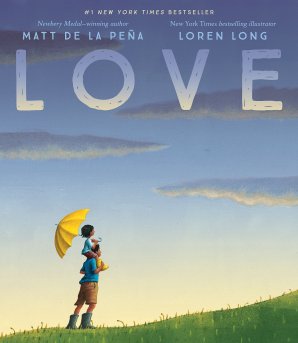
Love by Matt de la Pena illustrated by Loren Long

Standard
Love by Matt de la Pena illustrated by Loren Long

love.jpg

This 40-page-book may have a simple title, but most of us know, there is nothing simple about love, and this book shows love in many forms from a child’s perspective as they grow.  Sometimes picture books are basic and inspired to teach, or simply entertain.  Sometimes when picture books try to do more, the audience is confused when the pictures and amount of text on page don’t seem to align.  And sometimes, large pictures, with thoughtful poetry make the pages come to life and sing.  The book is written on an AR 3.7, so people thinking this book is for preschool aged children seem to be upset by the concepts hinted at and illustrated, but for older kids, this book has amazing power, and beauty that can show just how complex this universal feeling is.  

Love is your parent’s voice, love is burnt toast, love is the stars after your house burns down, love is in your grandpa’s wrinkles, love is staring back at you in the bathroom mirror.  But sometimes love also burns out and love is shielding you from things that might hurt you, and love separates people too. 


As humans, we can all relate to the same emotions, whether we give and receive love the same, the book shows the value and meaning it has to us all.  Hurray for illustrator Loren Long, because page after page, shows diversity of color, mobility, socio economics, age, and religion.  On a page where the love of the child is keeping her from seeing the TV that the family is crowded around a cross is present, and then a few pages later,bam, there is a girl in hijab looking up at the trees and listening to the love shared in their rustling. 

IMG_1901

I had no idea this illustration was present, and gasped aloud.  I said nothing to my daughter, finished the book, and handed it to her to read.  She turned the page and gasped aloud as well saying, “there’s a muhajaba, haha, we are in it too.”  Granted she is my daughter, so environment and genes account for something, but EVERY PAGE I think resonates with someone, and that gasp in my living room from me, from her, could come from anyone who turns a page in this book and bam suddenly feels represented, feels included, feels validated.  That my friends, is LOVE. 

IMG_1900

We are more alike than different.


Digging Deep by Jake Maddox text by Wendy L. Brandes illustrated by Katie Wood

Standard
Digging Deep by Jake Maddox text by Wendy L. Brandes illustrated by Katie Wood

IMG_1855

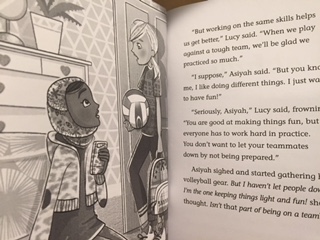
It is great to see a beautiful hijabi on the front of a sports book, written by a non Muslim, published by a major publisher, and having the story have nothing to do with the cloth on her head, but rather the skills on the court.  Teaching lessons about teamwork and self-worth, there is a whole series of these books about different sports with different main characters, and this one focuses on volleyball and a girl named Asiyah Najjar.  I’d maybe recommend this 63 page book to kids starting to feel confident with early chapter books, but more on that later.

SYNOPSIS:

Asiyah plays rec volleyball and enjoys it, but when her friend Lucy convinces her to try out for the traveling team, she has to not just be good enough to make the team, but focused enough to not let her teammates down.  With daily practices, comedian Asiyah feels like everyone is taking the new team way too serious and she questions if she wants to continue.  She loves playing the piano and with school work, her time is being consumed by volleyball.  When she overhears her friends doubting her commitment to the team, she, with the support of her brother, decides to dig deep and give it one last, serious, try.

WHY I LIKE IT:

I love that Asiyah mentions in the first chapter that she is nervous about the traveling team, because of her hijab and that people in town know “what it is, and why I wear it,” she says.  She never mentions that she is Muslim or why she wears it, just states that the people around her know. Religion and faith are never brought up again.

IMG_1856

There are some slightly off things in this book for me.  According to the publisher, the book is meant to appeal to 8-11 year olds,  but to me, the style of the book is aimed for 6-8 year olds.  Those who need pictures and a large font and big spaces between lines and short chapters.  The illustrations, however, in the book make the main character and her friends seem like high school students, with their heavily makeup looking faces, or at least middle school with the main character wearing hijab.  After reading the book, twice, I still don’t know how old the main characters are.  They seem pretty independent, but then when Asiyah’s parents have to run some errands, her brother Rad walks her and Lucy to volleyball practice, like an escort.  

That’s another thing, of all the ethnic or religious names that could have been chosen, Rad seems like an odd choice in that it will come across as funny to readers and kind of mitigate the amazingness of having a socially accepted female Muslim athlete on the cover, again, just my opinion.

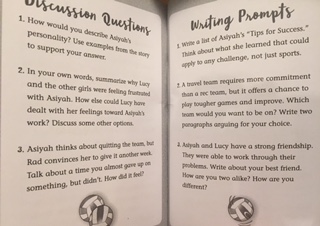
Another slightly confusing thing for me is that the book is a “Jake Maddox book,” but he isn’t really the author.  After looking in to it, I think it is more like a series or type of sports book that other’s write for and include his standards, “each of his stories is stamped with teamwork, fair play, and a strong sense of self-worth and discipline (http://www.capstonepub.com/consumer/products/digging-deep/).” The book is ok for 2nd graders, the lessons learned will resonate in the moment and teach a point, but the characters will be quickly forgotten.  The book has questions at the end and a glossary of volleyball terms which would be great for kids interested in volleyball.  

IMG_1858

FLAGS:

Clean, the characters listen to music and Asiyah plays the piano.

TOOLS FOR LEADING THE DISCUSSION:

I wouldn’t do this for a book club book, but with the standards of sportsmanship and the integrity I’d probably have it in my classroom.  The book is a super short read, so reading it would help boost struggling reader’s confidence, and with so many books in the series, if the child likes sports, they will have lots of options with positive messages to engage with.

IMG_1857

Tilt Your Head, Rosie the Red by Rosemary McCarney illustrated by Yvonne Cathcart

Standard
Tilt Your Head, Rosie the Red by Rosemary McCarney illustrated by Yvonne Cathcart

rosie.jpg

This book is nearly the mirror of Nanni’s Hijab, just told from a different perspective and swapping out the heroine.  Written in 2015 this book definitely came out first, and while the 24 page book is targeted for  4-8 year olds, if your teaching point of view, this book and Nanni’s hijab could be used for older kids to make for a great lesson.  

IMG_1753

I love that this book is written by a non Muslim and the main character is non Muslim.  The binding the pictures, the size, all make this a wonderful addition to any library in showing that differences can and should be celebrated.

IMG_1752

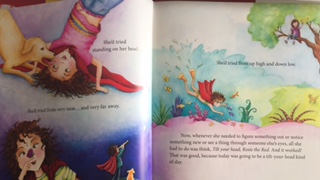
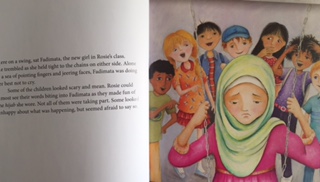
Rosie loves wearing her red cape, and she loves looking at things from all angles and perspectives.  One day at school she arrives at school to see kids making fun of the new girl, Fadimata and her hijab.  

Unable to stop the kids she reaches out to Fadimata, and transforms her cape into a hijab in solidarity.  After the teacher also talks to the class about being kind, the next day is a surprise for Rosie, when many of the girls are wearing scarves and hijabs in a variety of manners to show acceptance and celebrate differences.

IMG_1751

This is the first book in a Rosie the Red Series, and I kinda really love that in the second book, Being Me, about volunteering at a food pantry and helping a friend, Fadimata is minor character.  She is now one of Rosie’s best friends and is both mentioned by name and illustrated.  This is awesome to me, because while books about Muslims are great, having us be in books as supporting characters solving other problems, learning lessons, and going on adventures, makes us more mainstream and inshaAllah part of the accepted landscape.

rosie1

*Side note, if you look at this book on Amazon, and read the comments you can see how truly upset many people are by this book calling it “indoctrination” and criticizing it for not encouraging assimilation.  If you read the book and like it, and like the tone and message it promotes, maybe write a review, and make the world a little warmer.

Magnus Chase and the Gods of Asgard: The Sword of Summer by Rick Riordan

Standard
Magnus Chase and the Gods of Asgard: The Sword of Summer by Rick Riordan

The_Sword_of_Summer.jpg

Yes, that is a Rick Riordan book cover you see.  Yes, it is about Norse mythology.  Yes, the whole book is about fake gods and fictional demigods.  Yes, you are on the correct blog. 

Brace yourself, if you haven’t heard about Magnus Chase, son of the god Frey, whose series is now on book three, it is ok, Rick Riordan has brought a lot of mythology back to pop culture in a fairly short amount of time.  But this series stands out because get this, the Norse god Loki, (yeah the one featured in popular Marvel Avengers movies), in this series, has a daughter…named Samirah Al-Abbas…who wears hijab…and is a valkyrie…and is an Iraqi immigrant, and is a main character, and is really awesome.

The book is 497 pages and is also a pretty fun audio book.  It is an AR 4.8.

SYNOPSIS:

So, the basic plot is much like Percy Jackson, in that a young boy, in this case a homeless orphan, Magnus Chase, finds out that he is demigod and has to basically find some friends and save the world while learning about the given mythology that they belong to.  For Magnus, he learns about his father, Frey, the god of spring and summer, when he dies and is taken to Valhalla, a paradise for warriors in the service to Odin.  The whole book is about Magnus, who is now an einherjar, a member of Odin’s eternal army , trying to prevent ragnarok from happening.  Among his group of friends are Jack, the sword, Blitzen, a dwarf, Hearthstone, an alf, and Samirah (Sam).

WHY I LIKE IT:

By and large, Sam is pretty well developed as a practicing Muslima.  She is being raised by her grandparents and feels bad sneaking out to perform her valkyrie duties.  She is not at all comfortable being alone with males one-on-one, nor being seen with males as she has an arranged marriage to Amir Fadlan, her second cousin, when she gets older.  She wears a green hijab that doubles as a camouflage cloak, and she mentions going to the mosque with her grandma.  (In later books, according to my daughter, she also talks about fasting, how she is a practicing Muslimah and the daughter of Loki who handles all that Norse mythology throws at her.)  She is proud and strong, and really the only thing that makes no sense to me is why she takes off her hijab so freely when not in life threatening scenarios, I get when she uses the camouflage to hide in emergencies.  She apparently explains later that she considers the einherjar her extended family, but that wouldn’t make them her mehram, so it is still a bit sketchy.

Here is an interview question from Entertainment Weekly to Author Rick Riordan about Sam, and his answer: (http://ew.com/article/2015/10/14/rick-riordan-magnus-chase-interview/)

Speaking of Loki, one of my favorite characters in the book is Sam, or Samirah Al-Abbas. I think she’s a great example of a diverse character — not a white man, not a woman who’s there to be a love interest. She’s also seamlessly woven into the history of this myth. Can you talk about the conception of her character?

The idea for her started with the primary sources. The story that Sam tells in The Sword of Summer about an ambassador from the Caliph of Baghdad visiting the Vikings in Russia – that’s true. It really is one of our best sources because the Arabs of the time were reading and writing when nobody else was. That connection back then – that the world was a whole lot more connected even back then than we think of, that these cultures did not exist in these hermetically-sealed little bags, they were blending together all the time – that fascinated me. I thought, what would it be like to have a modern Muslim-American character who still had that connection to the Viking world like the Caliph of Baghdad did all those years ago?

And then again I started pulling on stories from students I’ve had in the past. One very powerful memory I have was being in my American history classroom on 9/11 and one of my students was a Muslim-American girl. She burst into tears when she heard the news, because she knew that her world, her life, had just changed, and had been defined for her in a way that she did not want and could only do so much to control. That really was powerful for me, and it inspired me to learn a lot about Islam and what the tradition actually was, as compared to what we hear about in the media and how it’s often distorted, and to honor her experience. Samirah kind of came out of that confluence of things.

FLAGS:

Obviously the whole story features multiple fake gods.  I don’t think it is celebrated though, they are beyond ridiculous, but if your kids can’t understand the idea of mythology or you think it is beyond the scope of fiction, that is your call. 

There is a ton of violence, as they prepare for ragnarok and just killing in general, some is gruesome. The book is not dark at all, however, it is in fact laugh out loud funny.  

There are some giants that get drunk, mention of mead, some jokes about Hel in reference to Helheim and the goddess of Helheim, Hel.  There are some “damns” scattered in as well. 

The stories of some of the gods is a bit scandalous, but for the most part the book doesn’t give much detail.  It does discuss Freya marrying dwarves for a day for their jewels and having kids with them.  There is flirting and mention of kissing.  There is also some mention of males being moms and animals and monsters being born of human parents, it is all very confusing.  But it is there. Also, my source, my 11 year old daughter, mentions that the rest of the series does have a gender fluid character named Alex.

TOOLS FOR LEADING THE DISCUSSION:

I doubt I’d do this as a book club book, but as any teacher or librarian knows, Rick Riordan fans are committed and enthusiastic.  I still keep in touch with many kids that weren’t big readers until the read Percy Jackson, and once they read the series multiple times, they then jumped to his other series.  So, while I wouldn’t use this as a book club book, there is a ton of kids that would love to discuss it with you, so read it, the bonding as a result will be well worth it.