Tag Archives: friends

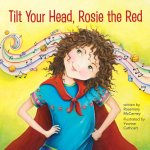
Tilt Your Head, Rosie the Red by Rosemary McCarney illustrated by Yvonne Cathcart

Standard
Tilt Your Head, Rosie the Red by Rosemary McCarney illustrated by Yvonne Cathcart

rosie.jpg

This book is nearly the mirror of Nanni’s Hijab, just told from a different perspective and swapping out the heroine.  Written in 2015 this book definitely came out first, and while the 24 page book is targeted for  4-8 year olds, if your teaching point of view, this book and Nanni’s hijab could be used for older kids to make for a great lesson.  

IMG_1753

I love that this book is written by a non Muslim and the main character is non Muslim.  The binding the pictures, the size, all make this a wonderful addition to any library in showing that differences can and should be celebrated.

IMG_1752

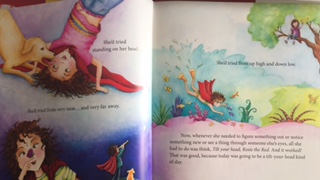
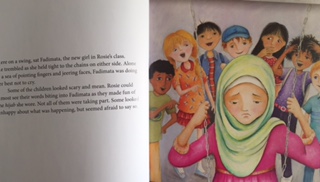
Rosie loves wearing her red cape, and she loves looking at things from all angles and perspectives.  One day at school she arrives at school to see kids making fun of the new girl, Fadimata and her hijab.  

Unable to stop the kids she reaches out to Fadimata, and transforms her cape into a hijab in solidarity.  After the teacher also talks to the class about being kind, the next day is a surprise for Rosie, when many of the girls are wearing scarves and hijabs in a variety of manners to show acceptance and celebrate differences.

IMG_1751

This is the first book in a Rosie the Red Series, and I kinda really love that in the second book, Being Me, about volunteering at a food pantry and helping a friend, Fadimata is minor character.  She is now one of Rosie’s best friends and is both mentioned by name and illustrated.  This is awesome to me, because while books about Muslims are great, having us be in books as supporting characters solving other problems, learning lessons, and going on adventures, makes us more mainstream and inshaAllah part of the accepted landscape.

rosie1

*Side note, if you look at this book on Amazon, and read the comments you can see how truly upset many people are by this book calling it “indoctrination” and criticizing it for not encouraging assimilation.  If you read the book and like it, and like the tone and message it promotes, maybe write a review, and make the world a little warmer.

A Moon for Moe and Mo by Jane Breskin Zalben Illustrated by Mehrdokht Amini

Standard
A Moon for Moe and Mo by Jane Breskin Zalben Illustrated by Mehrdokht Amini

IMG_1514Based on the release date of this book (August), I preordered it in the Spring with the Peg+Cat book thinking they were both about Eid al-Adha.  Oops.  As someone who reads a lot, I really need to learn how to read.  This book is not about Eid al-Adha, it actually mentions Ramadan, but just as a context point, so rather than wait til next Ramadan to post the review, I though, lets do it now and celebrate how much we all have in common and build bridges of friendship across religious lines during this blessed month of Thul Hija.

Set in Brooklyn, New York, Moses and Mohammed live on opposite ends of the same street.  One day they accompany their moms to a store in the middle of the street, and when the boys start touching things they shouldn’t their mothers’ reprimands reveal their shared nickname, Mo/Moe.  

IMG_1520

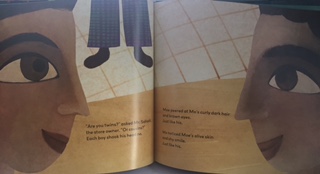
The boys then pause to look at each other and notice the same dark hair, brown eyes, olive skin, and shy smile.  Add in to the mix that one of them has a bouncy ball, and the boys become quick friends, while their mothers shop.

IMG_1519

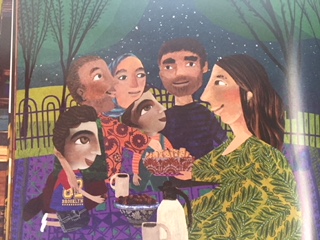
The boys hope to see each other again, but don’t.  Weeks pass, and the Feldman family is busy getting ready for Rosh Hashanah and the Hassan family is preparing for Ramadan.  Another chance meeting happens at the park, and the boys are thrilled.  The mom’s are seen chatting and then, the boys are missing, and the moms are panicked.  They are found playing in the dirt, but the relief from the moms, bonds the families who plan an evening picnic together.

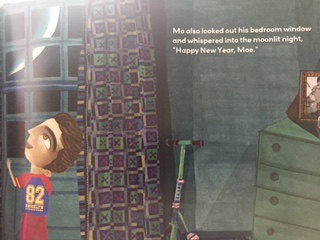
The book concludes with the boys in their own homes looking at the same moon and wishing each other a blessed Ramadan and Happy New Year to themselves.

IMG_1516

The book reminds me a lot of Yaffa and Fatimah, Shalom, Salaam, in the way the two characters, one of Jewish faith, and one of Muslim, occupy the same environment and come to know and appreciate one another as friends.

IMG_1517

The illustrations are by the same artist that illustrated Hena Khan’s color and shape books, and they are vivid and fun.  I’ve read the book a few times, and flipped through it a few more times just to marvel at the pictures and the world of these two sweet families.

A great book, that I hope to use in an interfaith story time when the opportunity arises!

IMG_1518

Sidenote, the shop keeper is the nicest one ever, he gives the boys taffy, and warm falafel, and doesn’t scold them.  The book mentions a few foods and at the end of the book there is a factual paragraph about the holiday and a recipe to try.  There is also an Author Note and Illustrator Note at the end of the 48  page book.  The book would be perfect for 5-8 year olds, but younger kids and older kids will enjoy the book as well.


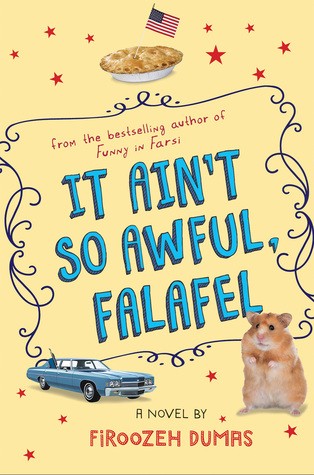
It Ain’t So Awful, Falafel by Firoozeh Dumas

Standard
It Ain’t So Awful, Falafel by Firoozeh Dumas

it aint so awful

Islamaphobia is rampant in today’s America, but it isn’t the first time that a minority group has had to face extreme persecution.  Often us Muslims need to look around and be reminded: Blacks are still targeted, Japanese once were interned, Italians, Irish, Hispanics, really every minority group has, and continues to struggle to be accepted as part of American culture, unfortunately.  Today’s middle school students didn’t live through 9//11 and often they think they are the first to be ostracized for their faith or their parent’s countries of origin.  So I picked up this book to see how well the book would serve as a way to discuss prejudice and persecution with Muslim kids, in a way that they could relate to, but be removed enough from that hopefully they could offer their own insights and experiences.   This book takes place in the 1970s and the climax is the Iran hostage situation as the book is told from an 11-year-old Iranian girl’s perspective. 

Similarly, most Persian penned books that I’ve read fight against Islam and the way it was forced upon them by their government, so I also wanted to see how the author would paint the faith in her semi auto-biographical-middle-school tale.  Alhumdulillah, I was happily surprised how Islam was handled in this 378 page, AR 4.7, book, and I think, like the inscription reads, “To all the kids who don’t belong, for whatever reason.  This one’s for you.”

SYNOPSIS:

Zomorod has lived in America before.  She was born in Iran, moved to California, moved back to Iran, back to California, and now from Compton, California she is moving to the much wealthier Newport Beach and hoping to start middle school fitting in more with her new Brady Bunch inspired name, Cindy.  Establishing early that she is the translator for her mother, who doesn’t speak English and doesn’t want to learn, and that she is somewhat embarrassed by her parent’s thick accents, lack of American snacks, Iranian food, and conversation topics, the book will appeal to most middle schooler’s who can relate.  Her parents, however, are pretty chill about letting her go out with friends, and doing whatever she wants, so really its more about the age and being angsty and awkward, then it is about her parents and their lifestyle and culture.  The basic point of the book is a growing-up tale of making friends, finding real ones that care about you, finding the balance between family and the outside world, cultures that conflict, the past and the future, and ultimately finding acceptance and pride in who, and what you are.

The political climate in Iran and in America amplify what it is like when people hate your country, but can’t find it on the map, and manifest in the story with bullying at school, Zomorod’s father losing his job and not finding a new one, and some hateful acts occurring at the Yousefzadeh’s home. 

WHY I LIKE IT:

The book could be heavy and dark, but it’s not.  The voice of Zomorod really stays in the persona of an 11-year-old girl and is poignant, clever and light-hearted, I even laughed out loud a few times.   The 1970’s backdrop isn’t too alienating for today’s readers, as there aren’t a lot of cultural references that would turn them off.  The historical significance, is very likely one they will not have heard of before and the book, through Zomorod’s eyes, will shed light on Iran in the late 70s and early 80s without boring the target audience.  They might even learn something and remember it.  

The stereotypes about Iran are addressed, the concept of a single person having to represent every one of that minority group is felt first had through the main character, and many misconceptions about Iran are clarified.  Yet, the book doesn’t get preachy, it maintains its lightness, and while I read it in a few days, it was just as easy to put down as it was to pick up.  The characters felt real and developed for the most part, so even though it was a tale about life, it was compelling enough to stick around, and you are invested enough to care how the characters are doing. There are a lot of really great supporting characters in the book as well: neighbors, friends, teachers, friend’s families, and a few not so nice characters that surprisingly aren’t painted with a singular condemning evil stroke.  The author is very careful to reserve judgement of all her characters and the sub groups they represent.

Which brings me to how Islam is handled in this book.  Her family doesn’t practice, but her reference for Islam is shia, as evident by her mentioning 12 imams.  I took pictures of most of the pages where Islam is mentioned, less than 10 in all, but where it is mentioned it is handled very politically correct and powerfully.   She talks about how they don’t celebrate Christmas or most holidays as they aren’t Christian or really American, but when the pool key is lost she does pray to a Christian Saint after a suggestion that such an act will help it be found.  It isn’t really presented as a religious act, more of one done in desperation. Here are the most applicable and relevant passages regarding Islam.

  • Dr. Klein shakes his head in sympathy.  “Do your wife and Cindy have to wear those cover-ups if you go back?”  “Yes, and I cannot believe this.  When we lived in Iran, my wife, my sisters, all the women I knew wore western clothes.  No tennis clothes like you see here, but regular clothes.  Only religious women chose to wear hijab, it meant something.  Imagine if everybody in America had to wear a cross around their neck or a Star of David-what would those symbols mean? Nothing. If you have to wear it, it means nothing.  If you choose to wear it, it means something” (168).
  • “The Ayatollah is Muslim, right? So is, like Allah, his God?”  “Allah is the Arabic word for God,” I say.  “It’s the same God. (154).”
  • We don’t have Saints in Islam, just a Prophet with twelve imams, and they don’t preach to animals or help find lost items,  My family, like most Iranians, is Muslim, but we never do anything religious.  I’ve never even been in a mosque, which is like a church (40).
  • “Being Muslim means different things to different people,” I say.  “My family doesn’t do anything officially religious.  My dad says religion is kindness and that’s what everyone should practice” ((184-5).
  • “…even though we belong to three different religions. We are alike in so many more ways than we are different.” 

FLAGS:

The book is fine for middle school readers, there is mention of Cindy’s dad trying alcohol at one point in the past and not liking it.  Cindy’s friends tease her once or maybe twice about liking a boy and Halloween is celebrated.  There is a lot of lying in the book, but it is made clear why, even if she doesn’t always feel bad about it: she is embarrassed by her mom’s food and lies that she shared it, she withholds information a lot, she pranks the neighbor lady who left a dead rodent on their porch, etc.  Hopefully the demographic won’t be inspired by Zomorod’s antics and just find them as her way of dealing with life.

TOOLS FOR LEADING THE DISCUSSION:

This would be a fun book club book to discuss being new to a country, minorities, how to handle conflicting cultures, and how to be and have good friends.

Educators guide: http://firoozehdumas.com/wp-content/uploads/2016/03/ItAintSoAwfulFalafelguide.pdf

https://www.floridamediaed.org/uploads/6/1/4/2/61420659/ms_-_it_ain%E2%80%99t_so_awful_falafel.pdf

https://www.bookmovement.com/bookDetailView/49051/It-Ain’t-So-Awful,-Falafel-By-Firoozeh-Dumas

Author’s page: http://firoozehdumas.com/books/it-aint-so-awful-falafel/
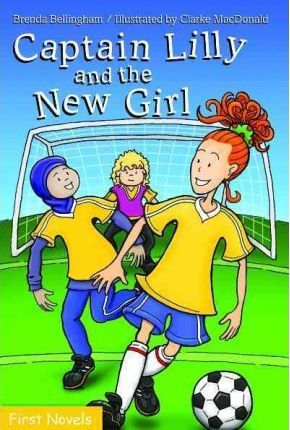
Captain Lilly and the New Girl by Brenda Bellingham illustrated by Clarke MacDonald

Standard
Captain Lilly and the New Girl by Brenda Bellingham illustrated by Clarke MacDonald

lilly.jpg

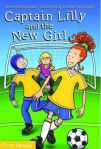
This book is part of First Novels, a collection of books in Canada that focuses on easy to read early chapter books that encourage kids to transition from leveled readers, while getting to know a single character in a realistic contemporary world.  There are a lot of Lilly books, but this one caught my attention because of the hijab wearing girl on the front, presumably the “new girl.”  At an AR 2.8 this 64 page book is great on so many levels, and really does meet the First Novel goal of presenting a simple theme and showing the main character grow.

SYNOPSIS:

Lilly is changing soccer teams, and only finds solace when many of her school friends will also be joining.  While each of the girls has different opinions and levels of enthusiasm about the team, they all are committed to one another as the “Wolves” stick together in a pack.  This loyalty is tested when a new girl is brought in to fill in for an injured wolf.  The foreigner, from America, wears a scarf, and just like with soccer, there are a lot of differing thoughts on the matter.  The reader see what Lilly feels as it is told from her perspective, which makes the issue not so much about the hijab itself, but about how a 9 or 10-year-old thinks and processes new concepts.  Ultimately, the Wolves as individuals and a team, have to decide what to do when an opposing team says that Sara has to take off her hijab if she wants to play.  

WHY I LIKE IT:

I love that the book is real, with strong independent girls.  The side characters aren’t cookie cutters of each other, they all have personalities and quirks, and I love that they don’t all agree, yet they all can make it work.  The book’s catalyst is the hijab, but it isn’t preachy and it is presented and understood through a non-muslim elementary-age character.   I don’t think Islam or Muslim is even mentioned, nor any culture, she is American, and the book takes place in Canada.  It addresses safety regarding the hijab, comfort in wearing sweats and not shorts, and being hot in a long sleeve shirt, issues that any reader can understand and ponder about.  The book isn’t gripping, but for the age group and the intent, it is spot on.  The font, spacing, size of the book, and simple illustrations, urge kids to read a “chapter book” and think about something they may not have ever thought about before.

FLAGS:

Clean, it does say words like “suck,” but it isn’t disrespectful.

TOOLS FOR LEADING THE DISCUSSION:

I wouldn’t use this as a Book Club book, because the kids can read it fairly quick, but I would probably read it aloud to kids and have them discuss, or have them somehow read it in groups and discuss.  There are a few websites that can help facilitate the discussion, but kids would definitely have opinions on how the situation was handed, how they might handle it, and what they think of the team’s sponsor.  

https://www.teachingbooks.net/tb.cgi?a=1&tid=40533

Click to access FirstNovels_Series_ActivityGuide.pdf

http://www.formac.ca/firstnovels


I Promise by Zanib Mian illustrated by Maria Migo

Standard
I Promise by Zanib Mian illustrated by Maria Migo

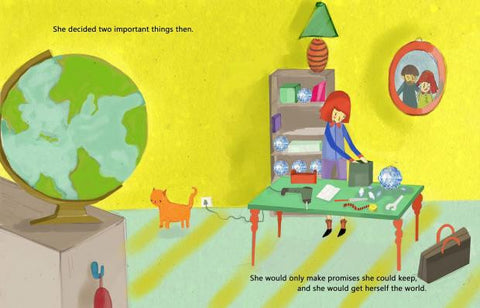
Don’t let this 32 page book with minimal text fool you in to thinking that big ideas, strong emotions, and tremendous self empowerment are not effectively conveyed, because despite my initial feelings toward the book, they really are.  I would say the target audience is 4 to 8 year olds, but I know plenty of adults that could use the reminder that promises should be kept, especially ones made to one’s self. 

On my first reading of the book, I didn’t love the pictures, and while I loved the way the emotions were conveyed when the little girl had to deal with the broken promises, I thought that the jump to being promised the world by another, was a bit abrupt and mature.  However, the ideas stayed with me, and the whimsical pictures grew on me, and the more I thought about how so much of our culture revolves around messages of, “happily ever after” and being “saved” that it can never be too early to articulate that we can be in control of our dreams, our happiness, and our futures.

There isn’t anything Islamic in the book, so that caught me off guard as this was the first Zanib Mian book I’ve read that didn’t have at least a main character illustrated as Muslim.  It doesn’t articulate if the boy who promised her the world is a husband or a boyfriend, or even what happened to him, as this isn’t his story.  He is just one more example of someone who broke a promise.

Overall, a nice large book with a good strong message that shows how if you want the world, you have to go get it yourself, and only make promises you can keep.


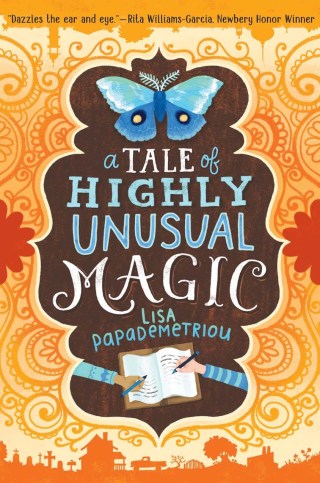
A Tale of Highly Unusual Magic by Lisa Papademetriou

Standard
A Tale of Highly Unusual Magic by Lisa Papademetriou

a-tale-of-highly-unusual-magic-L.jpg

For a book about magic, featuring a girl who admittedly knows very little about Islam, a surprising number of tidbits sneak through and work to introduce Islam and Pakistani culture to those unfamiliar, while similarly exciting Muslims readers who can see a major climax point a mile away and get to feel “in” on the unavoidable “aha” moment.  Written on a 4.9 level this 297 page book, is clean and engaging, a rare combination, especially for advanced readers who are having a hard time finding books that are content appropriate.  I’m fairly confident that anyone, of any age, who reads this will learn something, whether it be about lepidopterology, violins, occupation and partition of the subcontinent, Rudyard Kipling, caskets, friendship, Islam, and finding a place to belong.

SYNOPSIS:

There are three main storylines in the book, Leila’s, Kai’s and The Exquisite Corpses’.  Leila is a Pakistani-American girl growing up in America who decides to visit her Pakistani dad’s family in Lahore for the summer.  Unfamiliar with the language and customs, she has a good attitude of learning as much as she can, and absorbing new things.  Her dad’s family speaks English, is not very religious, is wealthy, and pretty modern.  They have servants, and drivers, and while she gets to go to museums and landmarks, the lifestyle is partially simplified for reader understanding, and partially to not take away from the real point of the story: Leila moving out of her sister’s shadow, and finding comfort in her own multi-cultural skin.  

Kai is spending her summer with a great paternal Aunt in Texas that she has never met.  Her father passed away and her mom has recently lost her job, so a change of scene is what she is presented with.  Her Aunt is a character in and of herself, but by and large leaves Kai to her own devices and supports her adventures from a distance.  The real story for Kai is a budding friendship with the neighbor girl, Doodle who is determined to find and save a rare moth no longer found in the area.  Nervous to make friends Kai learns sometimes the value of things isn’t in the winning, or being the best, but in doing something because you enjoy it and it is the right thing to do.

The two girls story is tied together by them finding two parts of a magic book, The Exquisite Corpse.  The old book tells the story of Ralph T. Flabbergast and Edwina Pickle, in bits prompted by the girls’ own writings.  Like the game of writing a few sentences, folding over the page and having the next person add to the story, the book connects the girls and the readers in a tale that is as much about the two long ago sweethearts, as it is about families, overcoming obstacles, and believing in happy endings.

WHY I LIKE IT:

I like that it is told from various voices, and as much as the story is plot driven, I truly felt connected to the main characters.  The only magic is the book, so the realism is very critical to gaining the readers interest and thankfully once you read about 70 pages or so I feel like the book does suck you in and take you for a fun ride.  The first few chapters are a bit confusing and I wasn’t sure where the story was going, Finally, at my 11-year-old daughter’s prompting I had to just barrel through without asking and wondering too much.  You don’t find out about Kai’s mom and dad or how Rudyard Kipling and “Kim” tie in to it all, almost until the end.  I like that the author doesn’t talk down to the reader, and as a result I learned a bit about so many things.  The twists and interweaving of stories and characters, and things as random as moths and music and saurkraut, remind me of well written adult novels that often aren’t found in books for fourth graders.  

Their isn’t much religion in a doctrine or even practicing sense, but through culture some is learned and shared, and I like that it isn’t completely washed out or removed.  The main character’s father says that he wasn’t religious in Pakistan so when he came to America he wasn’t about to start.  Leila mentions that her mom wants him to take the girls to the mosque or to see Eid, but again, they don’t, but do celebrate Christmas.  So, when she is in Pakistan and sees masjids, and fakirs, and people feeding birds as a sadaqa it is a nice inclusion.  Especially because the vocabulary is used and explained.  She mentions that her extended family goes for Jummah, yet doesn’t pray five times a day, she also touches on Ramadan as being a time of fasting but doesn’t know that there are two Eids.  As she learns, the reader does too.  It definitely isn’t how any practicing Muslim would want Islam portrayed, but it isn’t disrespectful and it is realistic.  Again, because the author doesn’t seem to talk down through her characters, there doesn’t seem much judgement and thus, hopefully also shows most readers some diveresity to the Pakistani stereotypes in the media.

FLAGS:

None, the book is clean, the love story between Ralph and Edwina, is just that they love each other. Nothing more than a sweet sentiment.

TOOLS FOR LEADING THE DISCUSSION:

I would definitely use this book as a Book Club selection because I think there is so much to connect to and discuss.  It would be fun to do as an interfaith book club with kids for the same reason.  While the main characters are girls, I think boys would enjoy it as well, there is some spying, sleuthing, action, and a whole goat debacle, that I think would be a blast to explore with students.

I don’t see any online reading guides, but there is so much to discuss it won’t be a problem.  Enjoy!

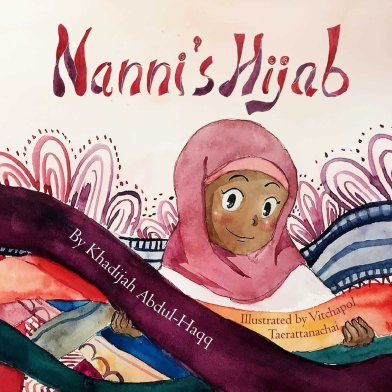
Nanni’s Hijab by Khadijah Abdul-Haqq illustrated by Vitchapol Taerattanachai

Standard
Nanni’s Hijab by Khadijah Abdul-Haqq illustrated by Vitchapol Taerattanachai

Nanni's Hijab

MashaAllah, there are so many things to like about this 36 page, brightly illustrated, elementary aged story.  Nanni, the main character, is spunky.  Not only is she strong enough to wear hijab to school, but she also is brave enough to confidently handle a bully on her own.  Surrounded by a supportive teacher, friends, classmates, and her mom, Nanni’s creativity and understanding that Allah swt will help her find a way to handle her predicament results in a happy ending, and many empowering messages.

nannis-hijab-childrens-book-review-L-Yo6YBS

The book would work for most children, but I think second grade and up would get the most out of it.  The girl might be young to be wearing hijab, but it seems like she wears it because she wants too.  I like that the illustrations have her and her mom uncovered at home, and that there is a glossary at the back, opening up the book to muslim and non muslim kids alike.

DVBz_rcVwAILbLM

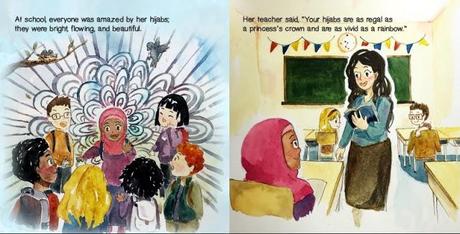
I also really like the larger messages of acceptance, trying new things, and doing better when you know better.  The supporting cast in the book resonates with muslims who go to schools where they are the minority, but have support and encouragement to practice their faith none-the-less.  Nanni’s teacher remarks that her “hijabs are as regal as a princess’s crown,” and the other students like seeing what color or design she is wearing each day.  Although a children’s book, the author does very clearly explain that the hijab is part of Nanni’s faith, although not mentioned by name, and that it is an act of worship. Nanni wants to handle the problem on her own, and for as bad as she wants to punch Leslie, she knows it isn’t the right thing to do.  As she wrestles with what is the best approach, she puts her trust in Allah, swt, which perhaps is the greatest lesson for us all in the book, alhumdulillah.

The Lines We Cross by Randa Abel-Fattah

Standard

LinesWeCross.jpg

It is kind of remarkable now that I look back on the book, that before reading it, I knew exactly what was going to happen based on the jacket flap synopsis, yet somehow the book held my interest and I finished it easily.  There were no surprises, no plot twists, not even any amazingly poignant passages, yet, I kept reading, so there is some merit, perhaps in ideas, even if the story line wasn’t meticulously crafted.  At 390 pages, this 4.8 level AR book is not for elementary or even middle school readers, it is a high school and up for content understanding and appropriateness.

SYNOPSIS:

The dual storylines are told from the intertwined perspectives of Mina, a Muslim refugee to Australia who fled Afghanistan in a boat, and Michael, an Australian upper middle class high school student whose parents run an anti-immigration group and oppose the arrival of refugees.  The two see each other on opposite sides at a protest, and reunite when Mina earns a scholarship to a prestige posh school, and the family moves so that she can attend.  Naturally the two clash, then fall in love.  Along the way there are slight changes as the characters grow, some side stories about friends and family members, and like the title suggests, crossing of lines, so to speak.

WHY I LIKE IT:

I like that the book in terms of its political plot is actually pretty nuanced.  You could say it is framed as a good vs. bad, but it isn’t that simple, and I think the characters shed light on the gray area in between.  In many ways Michael changes and grows and challenges himself to go out of his comfort zone created by his family.  He forces himself to see where immigrants live, he steps foot in a mosque, he researches the detention centers and what not, to learn that he doesn’t agree with his parents.  I wish, however, that all of these scenarios would have been slightly more memorable, maybe an interaction at the mosque, or follow-up by talking to Mina about it.  The lack of reflection made his journey seem like he was changing his views for a girl, and not because of a deeper understanding.  At the end his mom even asks him about it, and I kind of had to side with her in wondering about his motives.  Mina’s personal growth is more in that she learns to trust new people, and let them in.  Her growth is not as obvious as Michael’s and I think some would put her on the “good” side and see her as a stagnant character.  She is greatly shaped by the death of her father and brother, by the escape and journey to Australia, and then having to move again for school, but in the course of the books timeline, she really doesn’t change much.  Her Islam is really culture, she doesn’t pray, or mention anything about her belief or faith.  Halal is not explained, but is just seen as a political tool to protest and argue about.  Mina never goes to the mosque, and even for religious reasons never questions if she should have a boyfriend, but worries what her mother will say and thus does keep it secret.  For all realistic purposes, she is portrayed as a Muslim as a political identifier that illicits stereotypes and assumptions by others, not as a description of what she believes, behaves, or thinks.  Michael’s parents are where the real meat of the story for me was.  Understanding how they see themselves as “not racists” ordering ethnic foods from all over, but actively working to keep non-assimilating foreigners out.  Their organization claims to promote the idea of upholding Australian values, not of disliking other countries values, and I think this is really what so much of the world is facing right now. The ethnocentric idea of being so great and understanding in words, but not in behavior and policy making.  Michael’s dad goes overseas and feels sad, but doesn’t feel compelled to help, rather than to keep those people from changing, “his” world.  As the book mentions a lot, his parents in other ways are kind, good people.  It really isn’t good against evil in all facets of life.

I think my favorite part in the book are the female relationships.  I love Mina’s friend Paula, who quotes Oscar Wilde and while on the outside has it all together, lets Mina see the real her.  She is smart and feisty and seems to stay genuine throughout.  I like that Mina’s friends from the “old neighborhood” are still in her life and I even like how close she and her mom are.  It’s nice to see females helping each other, there is power in that, that fiction helps remind readers about.

FLAGS:

There is mention of sex, nothing explicit, but side characters hook up, are accused of being sluts, and it is definitely there.  The main characters kiss regularly.  There is some swearing and lots and lots of lying.  Mina can’t go out after library hours because that is where she says she is, when she is elsewhere.  There is fighting, alcohol, clubbing, and smoking mentioned throughout.  None of the aforementioned flags are glorified or even praised, but all are there.

TOOLS FOR LEADING THE DISCUSSION:

I wouldn’t do this as a student book club, but I think it could be done as an adult book club.  The politics need some background and understanding, that I think some discussion would be enlightening in a community or larger society setting.  Sometimes even in the real world, meeting people different than ourselves does wonders for changing preconceived notions and stereotypes.

The Muslims by Zanib Mian

Standard
The Muslims by Zanib Mian

the muslims.png

After reading this book, I really, really want to meet (and be friends with) the author, she writes from the point of view of Omar, a nine year old boy, and his perspective and voice are so authentic and relevant that while the book targets 3rd through 5th grade, I am certain kids and adults, Muslims and non-muslims, boys and girls, and everyone else, will all thoroughly enjoy this laugh-out-loud 164 page book.  

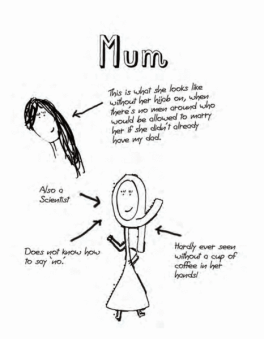
muslims mum.png

SYNOPSIS:

Omar is starting at a new school, we don’t know why, and while he is nervous, he has a good attitude about it.  His parents are supportive scientists and he has an older sister, Maryam who can be a bit mean in a big sister way, and a little brother Esa, who he secretly loves.  All are practicing muslims who remind me a lot of the people I know.  We say our duaas, we pray, we laugh at the funny stereotypes and just try and be good neighbors and people.  Omar’s neighbor is hilarious, Mrs. Rogers, doesn’t like Omar’s family, or “the Muslims” as she calls them, but they just keep being themselves and when she falls and gets hurt, she starts to realize they are good people who care about her.  She even starts showing up for iftar every night in Ramadan and counts down like a space ship launch until it is time to eat. 

Using his Islamic upbringing, and seeing how is family handles problems, gives Omar a lot of tools for starting at a new school.  But Omar is the protagonist, the hero, so he also has a super imagination that involves H2O, his dragon, that shows up to help him out when things get rough.  And unfortunately, a bully by the name of Daniel makes things rough for Omar.  He tells Omar that all Muslims and all Asians are going to be kicked out of the country, and this really sticks with Omar.  He verifies it with a cousin, and learns it could be a possibility.  So, the underlying anxiety is there, but most of the book that focuses on the bullying aspects involve the day-to-day comments, physical pushing, and efforts of Omar to avoid Daniel.  When they do meet up, however, the result is often comical, as Omar and H20 confidently navigate the situation at hand.  Between visiting a different mosque in London each week, learning to read the Quran, celebrating Ramadan, and just being a kid with new friends and a fun family, Omar eventually does win Daniel over after the two of them get lost in the London Underground.  And all of us that came along for the ride are better for it, alhumdulillah.

FullSizeRender (46)

WHY I LIKE IT:

There is so much to love about this book.  Seriously.  The accuracy of family life depicted is spot on and the Islamic elements are so interwoven that non Muslims would truly learn about Islam through learning about Omar, but not in a preachy way, and Muslims will see themselves on every. single. page.  I love that Omar doesn’t ever seem embarrassed to be who he is.  He is a cool kid for his confidence alone, and being able to laugh at a bully and not have it shake your core belief and self image is so powerful.  The characters are well developed, from little Esa to Omar’s teacher, by viewing them through his eyes, you see enough of their personality to remember them, and appreciate them.  The only exception to this was Maryam, I really didn’t feel like I got much on her, but I have a feeling there will be more books, and she will develop too.  The book reads like a diary, until a tinge of foreshadowing of the changing relationship between Omar and Daniel pops up to setup the climax.  The chapters are short, the fonts and doodles endearing and engaging, and the size of the book, really makes it fun for elementary aged children.  The only possible gripe for American children, is that it is a British book, and you might have to google or ask what a few things are, yeah we are selfish like that, but its good for us to learn what pains au chocolate are, or crumpets, or nappies.  

FullSizeRender (47)

FLAGS:

The book is clean. 

TOOLS FOR LEADING THE DISCUSSION:

Oh this should be required reading for every kid.  I know I will be trying to implement this every where I go.  This would be awesome for a elementary book club, and especially great in Islamic schools for struggling readers.  In much the same way that teachers use humor to engage students, this book has heart and humor and a surprising amount of information, that I can see it being connected to a lot character building supplements in various curriculums, at least I hope it is, we need voices like this, both within our community and to serve as a representative of us to the larger society.

Book Trailer:  https://www.youtube.com/watch?v=AIKtoxt3InM

Author’s website: http://www.muslimchildrensbooks.co.uk/


The Gauntlet by Karuna Riazi

Standard
The Gauntlet by Karuna Riazi

the gauntlet

Take Jumanji, turn it into a chapter book, flavor it with steam punk, set it in a Middle Eastern inspired marketplace, and have the protagonist be a Bengali-American, hijab wearing Muslim on a quest to save her little brother with her two BFFs from New York. Bam, you now have a 298 page AR 5.4 reading level booked called The Gauntlet.  

Published by Salaam Reads (Amina’s Voice) this book is written for all kids, the main character’s religion and culture just add depth and a connection to the game they have fallen in to.  I found this book on Scholastic, and when I got it, I handed it to my daughter to screen for me.  I asked her once she finished if it had any Muslims in it and how were they presented, to which she gaped at me and said, “umm mom the whole thing is about a Muslim girl and it is awesome!” So naturally I moved it higher up in the “to be read pile” and while I agree with her assessment, the book is more plot than character driven, and there isn’t a lot of theology in it, just a race against time to get out of the game alive.

SYNOPSIS:

It is Farah Mirza’s 12th birthday and while she should be downstairs visiting with her guests from her new school, she is holed up in her bedroom with her little brother Ahmad and her best friends from the old neighborhood, Essie and Alex, playing board games, the Mirza family’s favorite pastime .  When Aunt Zohra tries to coax them from the room she mentions a gift for the birthday girl is in her room, and the kids sneak off to get it.  Only it isn’t the book she brought to give Farah that they find, it is a bewitched game called the Gauntlet of Blood and Sand that lures kids in, and keeps them if they cannot out play the Architect.  When Ahmed falls in, the trio has no choice but to follow him in to try and rescue him and escape, before time runs out.

Once inside the game, they are in a city called Paheli. It resembles an old Middle Eastern city with large souks, market places, even a small masjid, surrounded by sand and levels absolutely breathtaking in both their beauty and in their threat to the children.  The inhabitants are those that played the game and lost. The challenges the kids must face range from a life size game of mancala to a taste test of Bengali/Indian sweets.  As they rush from challenge to challenge they meet a kind tea shop owner, giant lizards, spies and police of the architect and see fairly detailed descriptions of different parts of Paheli. The gamemaker/designer known only as the Architect senses that the kids will win, so he starts to cheat, and then feels bad and arranges to meet the players.  When the children meet him, and hear his story, they feel some sympathy for him, but not for the Jinn that holds the ultimate power over the game.  Obviously they do escape, but I won’t spoil the fun the process is, nor the sweet surprise of the reunion.  

WHY I LIKE IT:

I like that at the core, the story is driven by love for a sibling and requires the teamwork and cooperation of friends.  The rest is just frills from this central and clear message that is woven throughout the book.  While it is idealistic, there are hints that it isn’t overly so.  Yes Ahmad with his ADHD is a lot to handle at times, and the friends do have their squabbles, but ultimately both friends and family are worth risking it all.  I love that Farah is Bengali, many of the foods are Indian, and they are set in the Middle East, but yet somehow it seems interchangeable, this made me laugh, and while in other instances might have annoyed me, I liked how connected it made everyone seem, more alike than different.  Essie and Alex know some of the foods and cultural lexicon from growing up in New York.  They don’t find things different, they had lots of kids in school that wore hijab. Readers unfamiliar with some of the words and names found in the subcontinent and Islamic history might be put off a bit by the regular use of these words and the lacking glossary, but if you identify with any of it, you will celebrate seeing yourself in this book, just as Farah relished in seeing something of familiarity in Paheli.  

The book is fast paced and the detail given to the setting and cultural aspects are fun, but I really don’t feel like I connected much with the characters as a result.  There is very little character development and I actually had to look back in the book for some of the names to write this review.  There also isn’t much religion in terms of belief or practice.  The buildings and the food and the tone all hint at Islam, but I would have loved to hear an athan, or even her pausing to pray.  Not even that is there.  She wears hijab and that is about it in terms of religion.  

Ultimately I love that it is a mainstream book, with a strong storyline that is action packed and fun for older elementary and early middle schoolers that is clean and familiarizes and thus normalizes a culture not often seen in young adult fiction.  

FLAGS:

None, it is clean, at times possibly a bit scary with human bones, but not anything overly haunting.

TOOLS FOR LEADING THE DISCUSSION:

This would be an amazing book for a book club, and I would play the games that they play in the gauntlet at the meeting.  There isn’t a ton to discuss in terms of introspection and growth, but there is enough, and it is fun.  Plus, there aren’t a lot of books like this for Muslim kids to see themselves in, that I think it would be a blast for them to read, and enjoyable for the adults to watch them get swept away.

Interview with the Author: http://ew.com/books/2017/03/27/karuna-riazi-gauntlet-jumanji/