Tag Archives: Family

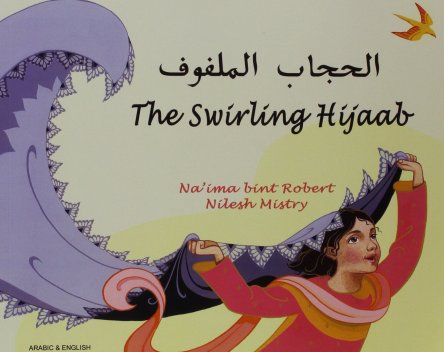
The Swirling Hijaab by Na’ima bint Robert illustrated by Nilesh Mistry

Standard

81fjfxOGmNL

Written in 2002 I’m not sure why this book isn’t in libraries or easy to find, it is wonderful.  We all got so excited when Mommy’s Khimar came out, and for good reason, it is great, but I feel like this book is very similar and somehow not appreciated.  The book is written in verse, with just one line on each page, there are 20 languages that this book appears dual language in, and the author is incredibly well known (Ramadan Moon, From Somalia With Love, Boy Vs. Girl, Going to Mecca, She Wore Red Trainers).

The large pictures show a small girl using her mom’s hijaab to play pretend with as a fort, a boat’s sails, a cloth for her tea party, a comfort when mom isn’t there, and most of all as a covering as a part of one’s faith.  The book shows the little girl as a desi bride, an African warrior queen, a beduin, and a relatable little girl having fun.

The book works well for little ones, with its simple text and large pictures, and is perfect for story time and bedtime alike.  The pictures aren’t bold and vibrant, but are colorful in their muted state and engaging as the swirling hijaab transforms into so much more than a piece of cloth.

It doesn’t mention Islam or Muslims, but just that the hijaab is worn as a sign of faith.  It depicts the girl praying, but doesn’t offer and text regarding it.


Amal Unbound by Aisha Saeed

Standard
Amal Unbound by Aisha Saeed

amal unbound.jpg

This book was suggested to me and I was thrilled to find it at the public library so quickly after its May 8, 2018 release date.  I love that it is an AR 4.2 and 226 pages about a girl standing up for her self, determined to be educated, and facing whatever society, and culture, and circumstance throw at her.  The protagonist is 12, but I think most middle school readers will find the story a bit too idyllic, perhaps even too simplistic and neat.  I really think the AR level of 4.2 is spot on in terms of writing level, interest, and story telling: 3rd through 5th graders will benefit the most from this inspiring, memorable and informative tale.

SYNOPSIS:

Amal lives in a small Pakistani village.   The book opens with her begrudgingly having to take time off from school, as the oldest, to help her mother who is about to deliver her fifth daughter.  The stage is quickly set to show a supportive father, but the cultural stress involved in educating a girl is incredibly strong.  The priority is to care for the home when push comes to shove and this fight is simplified in the book, but not completely belittled.  Right away we also see some class divisions with servants and landowners and the various positions in between.  It is easy to judge those with money as being evil, but the author does show some nuances in character aside from wealth and position.  As Amal’s mom struggles with recovering after the baby, it is decided that Amal will miss more school.  This devastates Amal who dreams of being a teacher.  Burdened by keeping up the house and carrying for everyone’s meals, laundry, and watching her younger sisters constantly, frustration mounts and she snaps when an arrogant man tries to take her pomegranate in the market.  Her simply saying no, is the catalyst that changes her life as the man she stands up to, Jawad Sahib, is the wealthy land owner everyone in town is indebted to.  Saved by his mother, Nasreen Baji, who is in need of a personal servant, Amal is now forced to pay off an impossible debt to a cruel powerful family. 

In  many ways the story doesn’t really get good, until Amal enters the Khan family’s world, about 50 pages in to it, but obviously the character building and detail is necessary, so if you find your kid is getting a bit bored, encourage them to keep going.  

Once, she arrives at the Khan compound, she begins to make friends, and enemies, and similarly see just how ruthless Jawad Sahib is, and can be.  As she finds her own voice and realizes her own role in determining how others treat her, what her future holds, and what power she does have, she is forced to wrestles with the choices in front of her. Ultimately, the reader will cheer for her to take a stand and be bold in doing what is right, no matter the cost.  And while one can guess, because of the target demographic, that it has a happy ending, I won’t spoil the climax, the resolution, or outcome of the young heroine.

WHY I LIKE IT:

I love that despite the themes, the story isn’t depressing, in many ways it is informative and inspiring. I think the fact that things are not left to ponder but clearly articulated, has its merits in a book for elementary children who might be overwhelmed by the cultural aspects to think critically on their own.  At the beginning, with the birth of yet another daughter, the biggest concern is that the mom is depressed because she hasn’t had a boy.  The mom even apologizes to the dad about this.  The neighbors, friends, everyone seems so upset about it, but Amal doesn’t understand why the women particularly seem disappointed, when they themselves were little girls once, and this simplistic point of view on such a complex and real issue, is so spot on and obvious, I loved it.  The mom and dad point out that it is God’s doing and they clarify that they are not sad the baby is a girl, and to me it seems obvious the mom is suffering from postpartum depression, but the book only describes it, it doesn’t identify it.  I also love that there is perspective on how while Amal is in forced servitude and thus not free, either is her female boss, who is unable to go visit her family, or to garden.  This helps amplify that even the wealthiest woman, is still limited to be truly free in the context of the character’s world.  

I like that the book is culturally authentic and not judgemental.  There are strong females, supportive male friends, and plenty of details to show that the author is writing about what she knows, and that she loves her culture.  Islam is mentioned only a few times with regards to prayer time, but nothing more.  There is nothing about praying for anything specific, or covering, or religious beliefs, practices, or traditions.   The book like the author’s first book Written in the Stars, almost oddly leaves religion out, and stresses culture.  Because this book is for a younger audience, it isn’t as obvious, and if I didn’t write reviews about books I probably wouldn’t notice.  

The presentation of culture, the idea of indentured servitude, and females being educated is balanced and explained pretty well.  At most many of the readers will know little of Pakistan, but may have heard of Malala, and the author talks about her in the Author Note.  I like that this book shows a fictional strong female in a similar vein as Malala, but also shows that it isn’t an outside force, the Taliban, preventing her from an education, but in some ways a whole societal view.  I think this expansion of paradigm is really the most powerful thing about this book.  It is important to understand that people may want their daughters educated, and opportunities may be available, but sometimes more is needed.   A lot more to change tradition, on a lot of different fronts.

The book also does a good job of showing some of the paradoxes that exist in developing countries as well: Amal rides in a car for the first time, but also is handed a cell phone from her mom, she knows all about email but has never used a computer.  For readers to see that somethings are very similar to their own lives, and some things are foreign, will make Amal and what she stands for have staying power and relevance, long after the end of the book.

FLAGS:

There is talk of physical violence when people are murdered, crops burned, and Amal is slapped.  There is some lying, but the truth comes out. Overall: clean.


TOOLS FOR LEADING THE DISCUSSION:

I would absolutely present this book as an Elementary Book Club selection and I would encourage teachers to use it as a novel study.  There is a lot of perspective to be had from this book, and its clean simple style will keep the keep points in focus.

Author’s website: http://aishasaeed.com/amalunbound/

Q & A with the Author: https://www.publishersweekly.com/pw/by-topic/childrens/childrens-authors/article/76814-q-a-with-aisha-saeed.html

Discussion Guide: http://www.penguin.com/wp-content/uploads/2018/05/AmalUnbound_Brochure.pdf

An Acquaintance by Saba Syed

Standard
An Acquaintance by Saba Syed

acquaintance.jpg

A young adult Islamic fiction romance novel, yes its a genre, albeit small one. I braced myself for stereotypes, cheesiness, over simplifications, sweeping condemnation, and preachy reprimands.  They never came.  I think this book is different, because from what I felt while reading it, and from what I’ve read the author say, this book is written for us: Muslim females, raised in the west, devout, strong, involved, and vulnerable.  It isn’t trying to convince anyone of Islam, or prove our place in America.  It isn’t trying to justify relationships or make us hide in our houses, rather it is taking us up to the line, showing us our strengths and weaknesses, and leaving us there to think.  In 282 pages, I saw myself crystal clear in the protagonist, the vilifying community, the determined best friend, and the steady parent.  It is easy to judge, but this book gets the nuances, the temptation, the justification, the internal battles, and it does it all without resorting to extremes that would make it inappropriate for upper middle and high schoolers. Yay!

SYNOPSIS:

Sarah Ali has grown up in small town Wickley, Pennsylvania, her whole life.  Her dad owns the local hangout, she is well known and well liked ,and very involved at school and in the masjid that her father helped start.  She has a best friend who is Muslim and although her mother has passed away, her home life with her dad and older brother is solid and supportive.  Senior year, however, is where the book takes place, and with Islamaphobes protesting and a new boy, Jason, in town coming to her rescue, the stage is set for her to have to decide how much their “friendship” crosses her internal boundaries of right and wrong, and when feelings are on the table, what choices she will make.

Throughout the book, there are numerous supporting characters that have their own roles in shining light on the situation from the outside and adding context to the world that Sarah lives in.  But this is ultimately Sarah’s story, told from her perspective, and the internal conflicts are believable because they are hers, the reader can see a mile a way what is going on and what will happen, but to see it unfold within her is at times a little naive, but considering her age, plausible.  It is her denial and acceptance of the situation at hand and what her role and hopes are that make the story very hard to put down.

The book in many ways is subtle, I don’t want to give to much of the plot away because it is obvious, it is a love story between two teenagers that can’t have a future based on the fact that she is Muslim and not willing to compromise that.  But that doesn’t mean there aren’t real feelings involved and real consequences to the choices that are made.  Throw in the gossip mongers at the masjid, an older brother who is concerned, an ever patient father, and a handful of others and the book feels incredibly real. 

WHY I LIKE IT:

Things are never black and white in real life, nor does reality prevent emotions and desires from breaking out.  There is no shaming in their tale (other than by the judgemental aunties), but there are consequences that are also given their time and spotlight.  From a parenting perspective it shows how a few questionable decisions can really get you in a heap of trouble and heartache, even if on the outside you can argue you did nothing wrong.  Even in the book Sarah remarks that they didn’t do anything, but yet, they did so much, this understanding is really powerful, and so needed for the teenage demographic. The book does not celebrate Sarah and Jason’s relationship, although I must admit I did kind of cheer for them at some points (I know, haram).  It shows that they are good people, but that there is a bigger picture.  It also shows there is life and hope, and forgiveness after, in the healing.

I love that Sarah’s dad is awesome and that his ultimate weapon is dua.  Not the stereotypical immigrant father trope, he is awesome.  I also love that Sarah’s best friend, Jasmine, is a person of color, so diversity gets a bit of a shout out.  The masjid politics is spot on, and the hypocritical aunties are as annoying in the book as they are in real life.  Yes, there are times where the dialogue is a little syrupy and long-winded, but overall, this book is calm and reflective and so, so important for high school and college girls to read.

Islam is the religion practiced, from praying, to how they talk, to how they dress, the subtlties there are brilliant as well.  You can tell the author is Muslim because it is natural and real, not researched and blotched.  The message is ultimately that Allah knows all, and that we do things for His sake alone.

FLAGS:

Truly the most Jason and Sarah do is hold hands, but the masjid ladies constrew that they do a lot more, and that Sarah ends up pregnant and gets an abortion. All untrue, but this revelation, that this is the gossip going around, is explored at the end of the book.

TOOLS FOR LEADING THE DISCUSSION:

Oh how great would this book be as a book club for high school or even college age girls.  But, alas I’m not involved in anything like that so I will have to just recommend this book to anyone that meets that criteria looking for a good book. 

Having said that, part of me really thinks this book doesn’t need to be discussed.  Saints and Misfits was a book that needs to be read and discussed with our youth, this book, I kind of like it to stir and fester within each reader.  The lessons are there, and are clear, and some days I could see a girl really feeling one way and switching another.  Like the father in the book, our kids, inshaAllah, have been taught right and wrong, we have to see what they do when tested.  And this book can really speak to them, and offer them a bit of conciousness when faced with a seemingly small decision that could have big consequences.  This book will stay with a reader, and that’s a good thing.  I just don’t know if it will manifest the same with everyone, and I think that is a great thing.


Book trailer: https://www.youtube.com/watch?v=fraVJZI1xNU

From the Author: https://muslimmatters.org/2017/11/10/an-acquaintance-a-young-adult-novel/
 

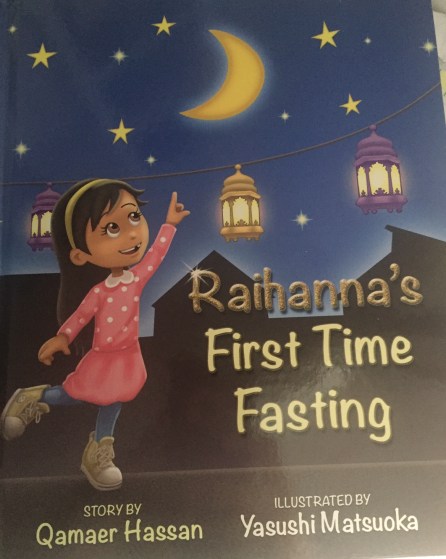
Raihanna’s First Time Fasting by Qamaer Hassan illustrated by Yasushi Matsuoka

Standard
Raihanna’s First Time Fasting by Qamaer Hassan illustrated by Yasushi Matsuoka

FullSizeRender (94)

By this time in Ramadan I’ve read a lot of very similar books that all seem to have slightly different takes on presenting the basics with various degrees of turning them into a fictionalized story.  Each have their own flavor and approach and this story in many ways is for mature little kids and works to bring a slightly deeper understanding to Ramadan and helping the less fortunate.  At 36 pages long, most of the pages are heavy on text, but not overly preachy or dense.  Dialogue and emotion fill the paragraphs, and the book works to establish Raihanna as an actual character, not just a foil to move from one Ramadan fact to another. This is also apparent, as a new Riahanna book has just come out, Raihanna’a Jennah, in making her the lead in a series.

FullSizeRender (95)

Raihanna is excited to be fasting this year, after establishing that the crescent must be sighted and that suhoor is the meal to start the fast, Raihanna puts on her hijab to pray.  She asks for forgiveness for being deceitful to get another cookie and asks Allah to make her and her friend able to go ice skating.  At bedtime it also mentions that she says her three kuls before going to sleep.  

FullSizeRender (98)

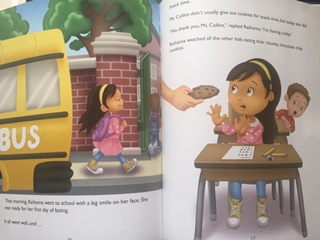
All her excitement starts to falter at school, however, when the teacher hands out chocolate chip cookies for snack and Raihanna has to explain she is fasting.  By the time she gets home from school she is not sure she even knows why she is fasting as her stomach rumbles and her mood is pretty sour.  Mom jumps in to action and takes her to a soup kitchen where the two of them, along with others, serve food to the homeless. 

FullSizeRender (97)

At iftaar time Raihanna understands how blessed she is to be surrounded by family and food, and makes a more heartfelt dua.  The book ends with letting the reader know that Raihanna spends the next 29 days loving Ramadan and being appreciative.

I love that it really picks one specific aspect of Ramadan and focuses on it in a tangible way, the poor and hungry.  Yes, she prays and recites Quran and all, but establishes that she probably does that every day out side of Ramadan as well.  I like that the author also shows that it is ok that Ramadan is hard.  There is a bit more insight and understanding in this book than just the typical list of facts.  I think ages kindergarten through 2nd grade, kids that are starting to fast will get the most of it, and relate the most to Raihanna.  It could work for non Muslims, with a bit of context of belief or just read a different Ramadan book first, but the target audience is Muslim kids.

FullSizeRender (96)

The beautiful cartoonish pictures are bright and engaging.  I have no idea why it bothered me that the characters wore the same clothes everyday, or at least the two days that the story covers, but it kind of did. I like that the dad sets the table and helps in the food prep and parenting.  The list of family members and all the dishes seems unnecessary, but with the glossary at the back it does offer a bit of culture to be conveyed.  There is also a little reader response at the end.   

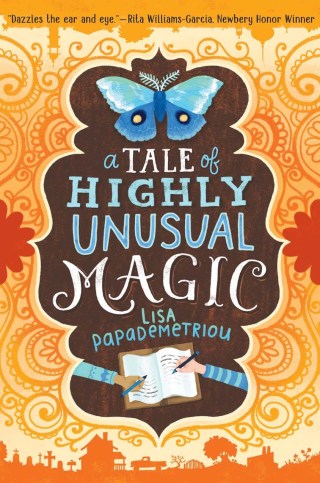
A Tale of Highly Unusual Magic by Lisa Papademetriou

Standard
A Tale of Highly Unusual Magic by Lisa Papademetriou

a-tale-of-highly-unusual-magic-L.jpg

For a book about magic, featuring a girl who admittedly knows very little about Islam, a surprising number of tidbits sneak through and work to introduce Islam and Pakistani culture to those unfamiliar, while similarly exciting Muslims readers who can see a major climax point a mile away and get to feel “in” on the unavoidable “aha” moment.  Written on a 4.9 level this 297 page book, is clean and engaging, a rare combination, especially for advanced readers who are having a hard time finding books that are content appropriate.  I’m fairly confident that anyone, of any age, who reads this will learn something, whether it be about lepidopterology, violins, occupation and partition of the subcontinent, Rudyard Kipling, caskets, friendship, Islam, and finding a place to belong.

SYNOPSIS:

There are three main storylines in the book, Leila’s, Kai’s and The Exquisite Corpses’.  Leila is a Pakistani-American girl growing up in America who decides to visit her Pakistani dad’s family in Lahore for the summer.  Unfamiliar with the language and customs, she has a good attitude of learning as much as she can, and absorbing new things.  Her dad’s family speaks English, is not very religious, is wealthy, and pretty modern.  They have servants, and drivers, and while she gets to go to museums and landmarks, the lifestyle is partially simplified for reader understanding, and partially to not take away from the real point of the story: Leila moving out of her sister’s shadow, and finding comfort in her own multi-cultural skin.  

Kai is spending her summer with a great paternal Aunt in Texas that she has never met.  Her father passed away and her mom has recently lost her job, so a change of scene is what she is presented with.  Her Aunt is a character in and of herself, but by and large leaves Kai to her own devices and supports her adventures from a distance.  The real story for Kai is a budding friendship with the neighbor girl, Doodle who is determined to find and save a rare moth no longer found in the area.  Nervous to make friends Kai learns sometimes the value of things isn’t in the winning, or being the best, but in doing something because you enjoy it and it is the right thing to do.

The two girls story is tied together by them finding two parts of a magic book, The Exquisite Corpse.  The old book tells the story of Ralph T. Flabbergast and Edwina Pickle, in bits prompted by the girls’ own writings.  Like the game of writing a few sentences, folding over the page and having the next person add to the story, the book connects the girls and the readers in a tale that is as much about the two long ago sweethearts, as it is about families, overcoming obstacles, and believing in happy endings.

WHY I LIKE IT:

I like that it is told from various voices, and as much as the story is plot driven, I truly felt connected to the main characters.  The only magic is the book, so the realism is very critical to gaining the readers interest and thankfully once you read about 70 pages or so I feel like the book does suck you in and take you for a fun ride.  The first few chapters are a bit confusing and I wasn’t sure where the story was going, Finally, at my 11-year-old daughter’s prompting I had to just barrel through without asking and wondering too much.  You don’t find out about Kai’s mom and dad or how Rudyard Kipling and “Kim” tie in to it all, almost until the end.  I like that the author doesn’t talk down to the reader, and as a result I learned a bit about so many things.  The twists and interweaving of stories and characters, and things as random as moths and music and saurkraut, remind me of well written adult novels that often aren’t found in books for fourth graders.  

Their isn’t much religion in a doctrine or even practicing sense, but through culture some is learned and shared, and I like that it isn’t completely washed out or removed.  The main character’s father says that he wasn’t religious in Pakistan so when he came to America he wasn’t about to start.  Leila mentions that her mom wants him to take the girls to the mosque or to see Eid, but again, they don’t, but do celebrate Christmas.  So, when she is in Pakistan and sees masjids, and fakirs, and people feeding birds as a sadaqa it is a nice inclusion.  Especially because the vocabulary is used and explained.  She mentions that her extended family goes for Jummah, yet doesn’t pray five times a day, she also touches on Ramadan as being a time of fasting but doesn’t know that there are two Eids.  As she learns, the reader does too.  It definitely isn’t how any practicing Muslim would want Islam portrayed, but it isn’t disrespectful and it is realistic.  Again, because the author doesn’t seem to talk down through her characters, there doesn’t seem much judgement and thus, hopefully also shows most readers some diveresity to the Pakistani stereotypes in the media.

FLAGS:

None, the book is clean, the love story between Ralph and Edwina, is just that they love each other. Nothing more than a sweet sentiment.

TOOLS FOR LEADING THE DISCUSSION:

I would definitely use this book as a Book Club selection because I think there is so much to connect to and discuss.  It would be fun to do as an interfaith book club with kids for the same reason.  While the main characters are girls, I think boys would enjoy it as well, there is some spying, sleuthing, action, and a whole goat debacle, that I think would be a blast to explore with students.

I don’t see any online reading guides, but there is so much to discuss it won’t be a problem.  Enjoy!

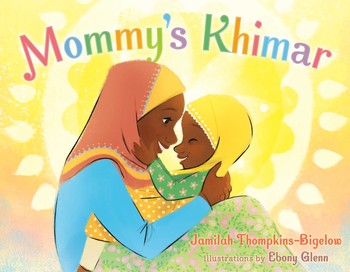
Mommy’s Khimar by Jamilah Thompkins-Bigelow illustrated by Ebony Glenn

Standard
Mommy’s Khimar by Jamilah Thompkins-Bigelow illustrated by Ebony Glenn

mommys-khimar-9781534400597_lg

Children playing dress-up with their mother’s clothes is a universal activity, that most can relate to.  Playing dress-up in your mother’s khimar is what makes this book both familiar and stereotype breaking in a way that is actually pretty powerful.

mommy3_grande.jpg


In this 40 page hardback book targeting 4-8 year olds, Salaam Reads, once again brings Muslim characters to the masses, without alienating or talking down to either Muslim or non Muslims readers.

mommy2_grande.jpg

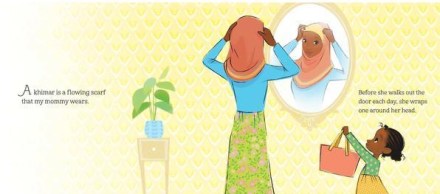
The story starts off with a little girl explaining that “A khimar is a flowing scarf that my mommy wears.  Before she walks out the door each day, she wraps one around her head.”  She then marvels at the variety of scarves her mother has, commenting on the colors, and prints, and designs, that by the time she is ready to use them as her favorite make-believe accessory, readers will be wishing they too could have such an assortment.

download

From using a khimar to be a queen with a golden train, to being a shooting star, the reader also along the way learns that she loves the connection the khimars offer her of her mother, when she isn’t near.  The ladies at the masjid are also part of that connection so that when she dreams of all the fantastical pretend things she can be, she also knows they too are with her.  Even her grandma, Mom-Mom, who exclaims “Sweet Jesus” when she sees her in her yellow khimar, and loves her although she doesn’t go to the mosque like the little girl does, is a part of the love and support the little girl feels by those around her when she is wrapped up in her mother’s khimar.  download (1)I love that it stresses even though her grandma is not Muslim they love each other because they are family.  Muslims and Islam are never mentioned outright, just the mosque and the ladies saying Assalamu alaikum, hint at the khimar being worn for religious reasons.

download (2)

Perhaps the best part is the pictures.  The illustrations with their yellowish hues radiate warmth and the faces and smiles are good for the soul.  You can feel the love the little girl both receives and gives to those around her through the pictures that perfectly compliment the simple text.

The diversity of the book in the main character being a girl, a child of color, and a Muslim, is such a beautiful thing to see.  Stories like this are powerful tools when children see themselves in books with positive messages, and remind us all how much more diversity it needed in literature to both highlight our differences, and celebrate our similarities.


Ticket to India by N.H. Senzai

Standard

In terms of plot and and believability, this 274 page 6.3 reading level book has moments of unrealistic twists, but the historical flashbacks and context make up for it as it delves into Pakistan, India partition without getting overly bogged down in politics and bitterness.  You can tell that the author writes from a place of love and warmth, as she talks about all sides involved: Pakistan, India, Great Britain.   The stories, fictional and historical, that weave through the novel make it informative and entertaining irregardless of one’s prior knowledge.

SYNOPSIS:

Maya is 12, and a little shy, especially compared to her older sister Zara.  The book starts with her writing a journal entry about her visit to Pakistan in an airplane somewhere over the ocean.  Maya, her older sister Zara, and their mother are heading to Karachi from America because of the death of Maya’s beloved grandfather.  Frequent visitors to Pakistan, Maya is familiar with the sights, traditions, and language.  As other family members arrive, Maya and Zara overhear their elderly grandmother planning to runaway to India to retrieve family heirlooms that were left during partition.  The plan had been in the works for the whole family to go, visas were already obtained, but with the unexpected death, the urgency is amplified.  Grandma wants to find a ring to bury with her husband.  In Islamic custom burials happen very very quickly, often the same day, so the delay and sending the body to America, is something you just have to go with as the reader.  Rather than convince Grandma to stay, the girls threaten to tell their mother if she doesn’t take them along, and the next thing you know the trio are off to India and on a treasure hunt.  There is a map at the beginning of the book, which is very helpful.  However, the adventure isn’t straightforward, not only in the trio’s adventures, but in that grandma ends up in the hospital, Zara and Maya decide to pursue the lost items on their own, and then Zara and Maya get separated.  Twelve-year-old Maya then is forced out of her shell as she is kidnapped, and running for her life, trying to keep her promises, and also in desperately trying to save her family from having to pay a ransom to save her.  A lot happens, and the intensity amplifies as it starts out as a elementary aged family story and turns into a middle school adventure.  A long the way are beautiful passages about the scenery, amazingly simplified, but factually and emotionally accurate explanations about partition and ultimately, through Maya, about finding your voice. 

WHY I LIKE IT:

The framing of the fictional story and the historical context is wonderful.  Partition, is such a pivotal moment for those that lived through it, but has less and less relevance to today’s generation that lives abroad.  So, to find a book that makes the gist of the events come through, is why I love using fiction to connect people and ideas.  I am making my daughter read this tomorrow, no question. She needs to know what her own grandmother endured, what decisions her family had to wrestle with, and this book allows us to have those discussions in an informed way.  I’m sure many would disagree and say that the reader should know about partition before reading the book, but I think the tidbits and delicate way the author convey the horrors, the agony, the manipulation, and the struggles in todays time, is far better than I could do to a sixth grader. 

Maya’s abilities seem to grow overnight, so while she was an ok protagonist, she might annoy some.  I actually had to google in the middle of reading how old Maya is, at times she seems like she is eight or nine and at other times like she is 15.  I do like that Maya constantly remarks how alike India and Pakistan are, a reality that today’s generation definitely agrees with, but is often afraid to voice to their parents.  I also like that there are good and bad everywhere, a theme that doesn’t get old, especially in books that deal with cultural and religious elements as presented to a wide audience.

There isn’t much religion in the book, the characters don’t stop and pray or wear hijab, but the setting does allow for mention of masjids, and a kind Imam back in California, the characters identify as Muslim and they discuss Muslims as a minority and political entity regularly.  One of the treasures the grandma is looking to retrieve is an old Qur’an with the family tree drawn within.  The book talks about how intertwined the two countries and many religions of India are, and Maya’s name articulates many of these crossroads.  In the end, perhaps the best lesson from the book, is how much alike we all really are.

There is a wonderful Author’s note in the back, along with a glossary.

FLAGS:

The book has some violent images as it discusses trains coming from India to Pakistan with only a few living aboard and vice versa.  The intensity as Maya is robbed, and then kidnapped, and then held hostage, could also be jarring for some younger readers. 

TOOLS FOR LEADING THE DISCUSSION:

Like all her other books, I would absolutely include this in a Book Club, there is a lot to discuss, lots to understand, and lots to enjoy.

Author’s website: http://www.nhsenzai.com/ticket-to-india/

Reading Group Guide: http://www.nhsenzai.com/wp-content/uploads/2017/09/Ticket-to-India_ReadingGuidePDF.pdf

YouTube book trailer:

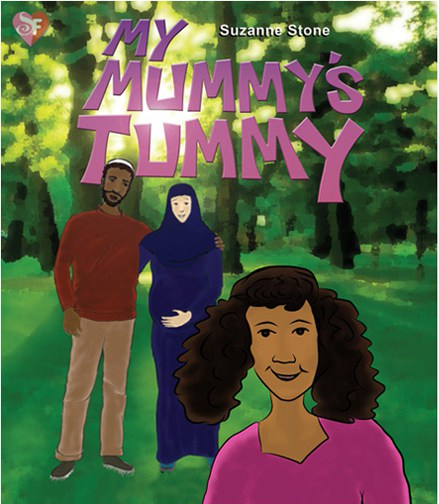
My Mummy’s Tummy by Suzanne Stone illustrated by Suzanne Stone and Omar Faruq

Standard
My Mummy’s Tummy by Suzanne Stone illustrated by Suzanne Stone and Omar Faruq

mummy-tummy.jpg

The copy I have is called My Mummy’s Tummy, but the binding says My Mummy’s Fat Tummy, I would assume that they are the same book except for this one word, and I’m hoping they opted to remove it at the last minute.  Actually, while on the title, it only  works well for the first four pages and yes, it sets up the story of a new sibling, by page five, the baby is born and mom’s tummy is the least of big sister, Maryam’s worries.

mummy tummy

The 24 page rhyming book, is a good introduction to what kids ages 3-6 can expect with a new sibling.  From Mummy’s large tummy, to having to stay with an Aunt when Mummy’s tummy starts hurting, Maryam is excited to have a new baby sister, except it ends up being a baby brother.  And while she is promised someone to play with, initially all he does is cry and sleep.  With gentle prodding by her parents and islamic reminders of patience and kindness, by the end of the book the baby is nearly one and his favorite person is his big sister Maryam, alhumdulillah.

mummy tummy

I love the diversity of the parents, and the acknowledging that changes are hard without being condescending or dismissive.  The book stays positive and hopeful and reminds us to keep Allah close to us when dealing with challenges and dreaming of the future.


The Lines We Cross by Randa Abel-Fattah

Standard

LinesWeCross.jpg

It is kind of remarkable now that I look back on the book, that before reading it, I knew exactly what was going to happen based on the jacket flap synopsis, yet somehow the book held my interest and I finished it easily.  There were no surprises, no plot twists, not even any amazingly poignant passages, yet, I kept reading, so there is some merit, perhaps in ideas, even if the story line wasn’t meticulously crafted.  At 390 pages, this 4.8 level AR book is not for elementary or even middle school readers, it is a high school and up for content understanding and appropriateness.

SYNOPSIS:

The dual storylines are told from the intertwined perspectives of Mina, a Muslim refugee to Australia who fled Afghanistan in a boat, and Michael, an Australian upper middle class high school student whose parents run an anti-immigration group and oppose the arrival of refugees.  The two see each other on opposite sides at a protest, and reunite when Mina earns a scholarship to a prestige posh school, and the family moves so that she can attend.  Naturally the two clash, then fall in love.  Along the way there are slight changes as the characters grow, some side stories about friends and family members, and like the title suggests, crossing of lines, so to speak.

WHY I LIKE IT:

I like that the book in terms of its political plot is actually pretty nuanced.  You could say it is framed as a good vs. bad, but it isn’t that simple, and I think the characters shed light on the gray area in between.  In many ways Michael changes and grows and challenges himself to go out of his comfort zone created by his family.  He forces himself to see where immigrants live, he steps foot in a mosque, he researches the detention centers and what not, to learn that he doesn’t agree with his parents.  I wish, however, that all of these scenarios would have been slightly more memorable, maybe an interaction at the mosque, or follow-up by talking to Mina about it.  The lack of reflection made his journey seem like he was changing his views for a girl, and not because of a deeper understanding.  At the end his mom even asks him about it, and I kind of had to side with her in wondering about his motives.  Mina’s personal growth is more in that she learns to trust new people, and let them in.  Her growth is not as obvious as Michael’s and I think some would put her on the “good” side and see her as a stagnant character.  She is greatly shaped by the death of her father and brother, by the escape and journey to Australia, and then having to move again for school, but in the course of the books timeline, she really doesn’t change much.  Her Islam is really culture, she doesn’t pray, or mention anything about her belief or faith.  Halal is not explained, but is just seen as a political tool to protest and argue about.  Mina never goes to the mosque, and even for religious reasons never questions if she should have a boyfriend, but worries what her mother will say and thus does keep it secret.  For all realistic purposes, she is portrayed as a Muslim as a political identifier that illicits stereotypes and assumptions by others, not as a description of what she believes, behaves, or thinks.  Michael’s parents are where the real meat of the story for me was.  Understanding how they see themselves as “not racists” ordering ethnic foods from all over, but actively working to keep non-assimilating foreigners out.  Their organization claims to promote the idea of upholding Australian values, not of disliking other countries values, and I think this is really what so much of the world is facing right now. The ethnocentric idea of being so great and understanding in words, but not in behavior and policy making.  Michael’s dad goes overseas and feels sad, but doesn’t feel compelled to help, rather than to keep those people from changing, “his” world.  As the book mentions a lot, his parents in other ways are kind, good people.  It really isn’t good against evil in all facets of life.

I think my favorite part in the book are the female relationships.  I love Mina’s friend Paula, who quotes Oscar Wilde and while on the outside has it all together, lets Mina see the real her.  She is smart and feisty and seems to stay genuine throughout.  I like that Mina’s friends from the “old neighborhood” are still in her life and I even like how close she and her mom are.  It’s nice to see females helping each other, there is power in that, that fiction helps remind readers about.

FLAGS:

There is mention of sex, nothing explicit, but side characters hook up, are accused of being sluts, and it is definitely there.  The main characters kiss regularly.  There is some swearing and lots and lots of lying.  Mina can’t go out after library hours because that is where she says she is, when she is elsewhere.  There is fighting, alcohol, clubbing, and smoking mentioned throughout.  None of the aforementioned flags are glorified or even praised, but all are there.

TOOLS FOR LEADING THE DISCUSSION:

I wouldn’t do this as a student book club, but I think it could be done as an adult book club.  The politics need some background and understanding, that I think some discussion would be enlightening in a community or larger society setting.  Sometimes even in the real world, meeting people different than ourselves does wonders for changing preconceived notions and stereotypes.

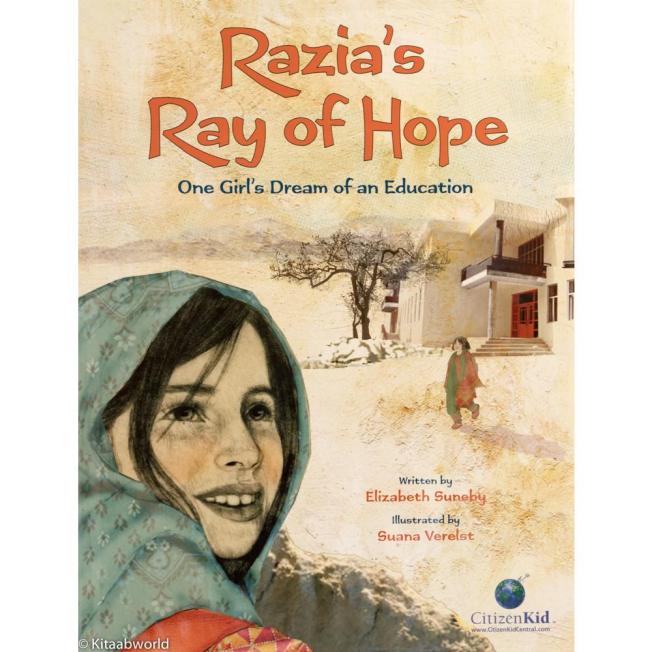
Razia’s Ray of Hope: One Girl’s dream of an Education by Elizabeth Suneby illustrated by Suana Verelst

Standard
Razia’s Ray of Hope: One Girl’s dream of an Education by Elizabeth Suneby illustrated by Suana Verelst

razia

I usually love books about girls, and education and hope, but for some reason, I didn’t love this book.  I really like the pictures with their mixed media feel and textures, but I found small things annoying in the book, that based on other online reviews really put me in the tiny minority.  Most people seem to drool over this 32 page AR 4.1 picture book, I, however, think there are a lot of inspiring books about girls in Afghanistan dreaming of an education that one needs to do something different, and do it well to win me over.

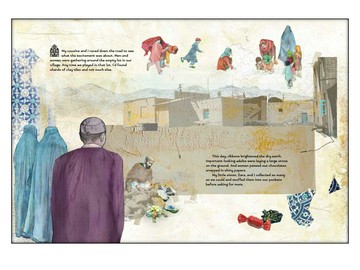
So the basic premise, in this text heavy, tiny font, book, is that Razia learns they are building a new school close to her home in Afghanistan for girls, and wants to go.  Her grandfather also wants her to go, but one of her older brothers, Aziz, won’t allow it, so she isn’t allowed to go.  No historical lead up explaining why her grandfather talks about days when women were educated, and now it is a rarity.  No summation on the Taliban or the 17 years of war that the grandfather mentions.  So, unless the reader knows some background on Afghanistan, the story may not resonate with them or provide needed context for connection and appreciation.  Even the afterward, about the real founder of the school, offers very little context.  The brother’s decision is final until one day he falls ill and can’t read the medication directions, and Razia can, eventually he relents and she is allowed to go. The story hints that the rocks around the school are from the quarry he works at so he now feels confident she will be safe, and that his initial refusal was a concern for safety.  They hug and seem loving, and once school starts Razia has to learn as much as she can to be able to go home and teach Aziz and her mom.

razia1

I like that when she initially is told no, she doesn’t sit and assume a helpless manner, but rather goes to the school and meets the founder herself.  I find it odd, and irksome that the head of the school is also named Razia and it isn’t even noted. I get that is her real name, but why have the two main characters in a book have the same name and then not even acknowledge it? I didn’t get why the little girl couldn’t have a different name, seems distracting to me, and imply that every girl has the same name in Afghanistan.  I also didn’t get the hierarchy. The grandfather wants her to go, the father and uncles have legit concerns of where she is needed in helping the family farm and orchard, but why did the brother’s opinion trump them all? There is no mention of Islam, but they wear hijabs and burkas, so I think the stereotype is implied.  And that was another thing, they made it seem like she would be corrupted if she went out alone or without the burka on, but then Aziz shakes the headmistress’s hand, as if that isn’t against religious and custom norms. I felt that the kindness of the brother at the end was disjointed too, a bit too forced. The grandpa seemed kind, but the rest of the family seemed cold and rigid and not overtly concerned with Razia’s well being and growth.  Yes, they did have a jerga, to discuss and consider it, but I felt like Razia never had a voice, and while education is important, having a voice is too.  More has to change in society and in literature to give me real hope, and this book sadly fell short.

razia2