Tag Archives: faith

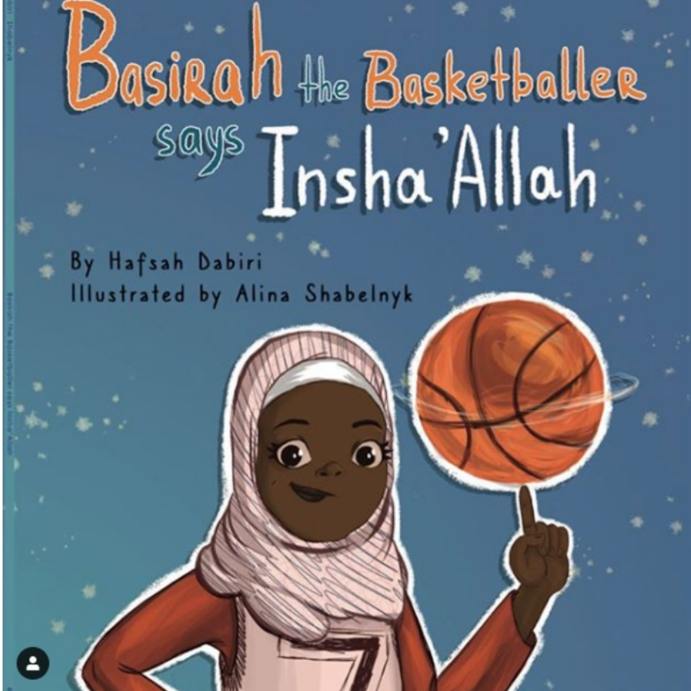
Basirah the Basketballer says Insha’Allah by Hafsah Dabiri illustrated by Alina Shabelnyk

Standard
Basirah the Basketballer says Insha’Allah by Hafsah Dabiri illustrated by Alina Shabelnyk

basket.jpg

Another sports book starring a smart girl with a supportive father, seems like a trend, and I like it.  The book is relatable to ages 5 and up whether they play basketball or not, and will remind even slightly older children how “insha’Allah” really works.  It features a girl, but boys will gain a lot from the book as the lessons are for us all.
basirah1

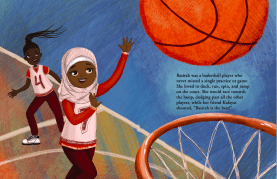
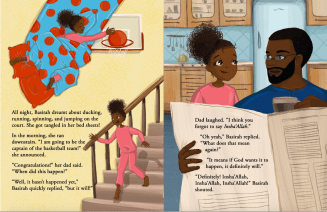
Basirah loves basketball and with supportive teammates and mad skills, she should be a shoo-in for team captain.  But when her dad reminds her that if it hasn’t happened yet she needs to say insha’Allah, she realizes the power of leaving things to God.  

Testing out her new knowledge of asking God to make happen things she really, really wants, over many of the 30 pages in the story, makes the climax that much stronger and her dad’s wisdom that much more memorable. I’m trying not to spoil the story, even though it is a children’s picture book, it isn’t without a bit of tension and resolution that really makes the book shine.
basirah2

This book can be taken at face value with a little bit of a lesson for little ones, or a lot deeper for more reflective readers.  Understanding that things we ask God for often come or don’t come to test us, is a lesson we all need. I hope if read with an adult, the adult will also push the listener to consider why we should do things in the first place, what are intentions are, as Basirah leaves the door open for that discussion at the end, but doesn’t quite articulate it for independent readers.

basirah3

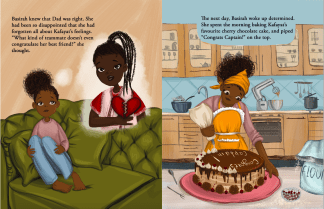
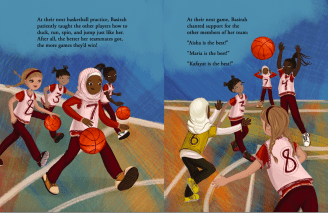
I love that at home Basirah is not covered, but is when she is out.  I love that her school is diverse with students of different colors and head coverings and that her coach is female and a muhajaba as well.  I love that Basirah and her father seem incredibly close, and that she listens to him, and he to her, before lessons are espoused and course of action plotted.  The book is not preachy, but lessons are there and the reader will get “it” right along with Basirah allowing her strength to radiate off the page and inshaAllah empower the reader as well.
basirah4

I find it interesting that the book doesn’t mention Allah and uses the word God, given that the phrase the book focuses around is insha’Allah.  I would imagine the intended audience is Muslim, but there is not specific mention of Islam.  It would work for non Muslims, but I think they would wonder why she says such a phrase and where it comes from.
basirah5

Basirah is presumably in middle school, as she has multiple classes and can bake a cake independently, her age seems a bit fluid, but many 11-14 year olds do tend to be independent in some areas and rather clueless in others, so while I did notice that she seems very naive in knowing what insha’Allah means and how it works in some parts of the story and very mature, and hijab wearing, and willing to grow from her situation in others, I’ve concluded it is plausible.

The book is 8.5 x 11 vertical, well bound, shiny glossy full color pages with clear and easily readable font.  The sentence length and amount of text on the page is not too overwhelming and the spacing keeps it inviting for new fluent readers.  

I love that Ruqaya’s Bookshelf (https://ruqayasbookshelf.com/) has new books out, three to be exact.  Whether the stories work or don’t work for you, I think their presentation and quality, give the books a longevity and find themselves being pulled out for different kids, at different times, when different lessons are needed.  They are well packaged in terms of illustrations and colors and size for the most part, and when I hear they are publishing new stories, I find myself ordering them without even reading the content synopsis.  Thank you for helping get these stories out, may Allah swt reward you!
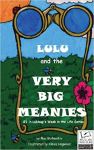
 

Lulu and the Very Big Meanies by Mac McGooshie illustrated by Alexis Hogwood

Standard
Lulu and the Very Big Meanies by Mac McGooshie illustrated by Alexis Hogwood

Lulu.jpg

I don’t know what is more frustrating: quality books that are poorly packaged (binding, illustrations, font, spacing, etc.) or beautiful books that miss the mark in storytelling and basic writing skills.  Both are equally annoying, and while yes, a good story should be the basis, this book is really well written that the presentation of it just makes me sad.  At 116 pages, the book is perfect for 3rd graders.  My daughter and son read it a few years ago when I first picked it up.  I made them read it.  And last week when I pulled it out to read myself, both remarked that it was a good story.  The fact that they remembered it and remembered liking it are huge pluses, and made the fact that I had to make them read it all the more disheartening.  I’m certain if you can get your kids to read eight maybe 10 pages they will zoom through the rest of the book.  It is the getting them to pick it up and start, that is the tricky part.  The book is paperback, thick and glossy, but the cover looks homemade almost.  If you thumb through it the font is too small, spaced too tight and the illustrations mean well, but don’t deliver.  Unfortunate, because like my children, I too think the story is fun and I’m disappointed that the book was published in 2013 as #1 in the Lulubug’s Week in the Life Series, and no further books have come out.

SYNOPSIS:

Laila (Lulu), and her family are American Muslims living in Southern Virginia.  Lulu’s mom is a lawyer and a convert, her dad is from Egypt and owns an Italian restaurant, and her older twin brothers are 12 and keep an eye on her.  Being incredibly bright Lulu has skipped third grade and is having trouble with some bullies in her new fourth grade class: Veronica B. and Veronica C.  aka the Veries.  Using help from her brothers, her neighbor and friend Toni, and some friends in class, a trap is set to get the bullies to confess to their evil mischief, but that unfortunately isn’t the only thing Lulu is going through this week.  Throw in her parent’s sudden decision to move closer to the masjid in another city, a litter of kittens abandoned on the side of the road, and some weird noises coming from the woods behind their house, and Lulu has a lot to deal with.

WHY I LIKE IT:

I love that it shows the day-to-day of a typical Muslim family in a normal presentation.  They pray together, they watch what they eat, they know their neighbors and worry about each other.  It doesn’t idolize the family, making them better than anyone or preachy, but makes them very relatable and likable in a realistic way.  When bees are discovered or the kittens need carrying for, sunnahs and ayats are identified, but very seamlessly, that non Muslim kids will learn a bit about Islam and Muslim kids will be excited to see themselves.  My favorite scene regarding this is when the mom finds out there will be a middle-school dance, and even though the boys are not planning to go, know that it isn’t for them, and don’t even seem tempted by it, they still have a family meeting about it, to discuss.  I also like that at one point Lulu meets another Muslim girl and they don’t hit it off right away, the girls work through it, but it is nice to see some diversity in even the way Muslims are presented and possibly misunderstood even amongst one another.

There is a lot going on in the book in terms of action items, but there still is a lot of character development and dimensions to Lulu.  Lulu has to navigate relationships with her family and friends that ring true and aren’t over simplified.  Her friend and neighbor, Toni, expects Lulu to act different at school now that they are in the same class, but returns to her silly self once they are home.  Lulu clashes a lot with her mom, but can smile and get her way super easy with her dad and manipulates that a lot.  She has to balance her sassiness with her teacher and principal, pick her battles with the Veries, and abide by other adults’ rules and expectations.  The book reads in a similar vein as Junie B. Jones, or Clementine, just maybe a more mature and less obnoxious reincarnation.

I wish the adventure involving the backyard noises, was a bit more dramatic, and maybe even the unveiling of the trap involving the dye was more resolved.  At times the book seemed rushed to wrap up all the stories introduced and I think they deserved a little more time to be explored and enjoyed.  If the font and spacing and pictures could be tweaked I think the book would really speak to kids in a fun way.  Third and fourth graders can easily handle a 150-160 page book that has good pacing and is packaged in a tempting, non intimidating way.  I’m holding out hope that maybe the author will write some more, tweak this one, and give it the chance at reaching an audience that would benefit from the smart, fun, grounded life of Lulu.

FLAGS:

Clean, it does mention that Toni likes a boy, but Lulu thinks that boys are trouble.

TOOLS FOR LEADING THE DISCUSSION:

If I still did an elementary book club, I think this book would work.  I think kids need a nudge to give it a try, but once the book gets going, girls and boys alike will enjoy it.  I may read it for a Lunch Bunch choice (I read once a week to 4th and 5th graders while they eat their lunch).  Kids will love seeing themselves, their stresses, their families, and their faith presented well.

Hassan and Aneesa Go to Masjid by Yasmeen Rahim illustrated by Omar Burgess

Standard
Hassan and Aneesa Go to Masjid by Yasmeen Rahim illustrated by Omar Burgess

IMG_1911

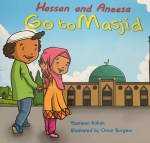
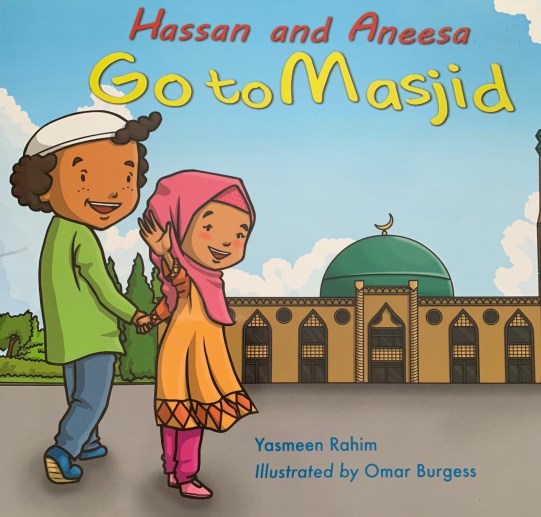
I don’t often do two books in the same series, let alone three, but for as much as I enjoyed Hassan and Aneesa Love Ramadan and Hassan and Aneesa Celebrate Eid, I was a little disappointed in this story.  For starters, the title seems like it should read, Go to “the” Masjid, no? 

IMG_1912

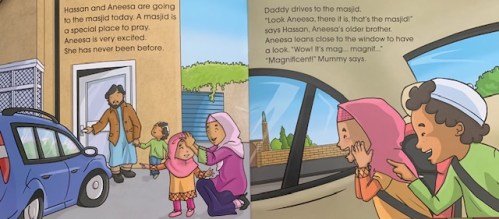
The story starts off with the notion that this is Aneesa’a first time to the masjid, which seems bit off.  Presumably mom and Hassan have been before, but mom’s excitement, and Hassan’s questions through the book, and knowledge about masjid etiquette make you wonder if it is their first time too.  A little odd, if you’ve read their other books, but ok, I’ll accept it and move on.

The family starts by marveling at the exterior architecture.  They enter and separate, Hassan going with his dad and Aneesa going with her mom, as it points out that men and women pray in separate areas.  It is a good tidbit of information, but again, it just seems a bit off in the way it is phrased that Aneesa wouldn’t know this.  

IMG_1913

The tone of the book is almost negative, again, a striking contrast to the other stories.  Aneesa splashes and wastes water when making wudu, doesn’t she make wudu at home? And the mom gets her clothes ruined in the process making her upset.  The illustration shows her to look really mad!

I would think a little context about not wasting water or even sharing the hadith about not wasting even if making wudu in a river, would have been a great lesson to convey, but instead the pictures show a lot of water by others also being wasted, and only mom looking really frustrated.

IMG_1914

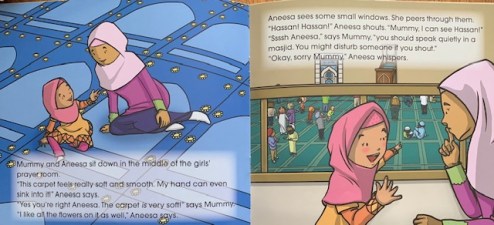
The two of them, put their shoes up and marvel at the dome and the soft carpet.  Aneesa then sees that the ladies prayer area over looks the mens and she begins screaming for Hassan.  Her mom corrects her and points out that “you should speak quietly in a masjid.  You might disturb someone if you shout.”

IMG_1915

Hassan turns and waves, and then rushes off to see a school friend.  But, first he is reproached for nearly walking in front of someone praying.  Again a good tidbit, but the phrasing of how the information is shared is rather negative, and these repetitive reprimands don’t make the book joyful.

IMG_1916

Hassan then learns about he mihrab and the mimbar before the athan is called and they all pray.  After salat they put some sadaqa in a box and the family heads home.

The illustrations are as sweet as ever, and the price very reasonable, but this book, compared to others in the series, is really wordy and there is a lot of text on EVERY one of the 20 pages.

IMG_1917

The framing of the book is awkward, thus making some of the behavior issues come off as negative, it is a minor thing that keeps the book from being great.  If the premise would have been maybe the kids talking about their favorite things about the masjid and reminding themselves to talk quiet and not waste water, the tone overall would have been lighter while still being really informative.

IMG_1918

If this is your first Hassan and Aneesa book, you might not be bothered, but if you find it a little off putting, try the other two.  The books says for ages 2 and up, but I think it would be better for 4 and up.  The younger kids you could tell them the story while showing them the pictures: what to expect at the mosque and how to behave, but there are too many words, and they will probably have a hard time staying focused.  Older four and five year olds, will enjoy seeing things they recognize and maybe learning some of the vocabulary for the architecture and being reminded on proper behavior at the masjid.


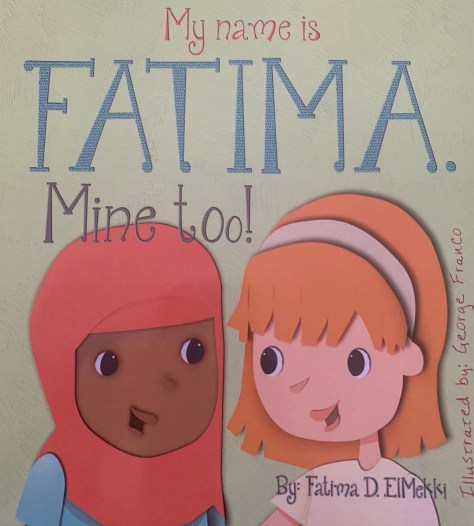
My Name is Fatima. Mine Too! by Fatima D. ElMekki illustrated by George Franco

Standard
My Name is Fatima. Mine Too! by Fatima D. ElMekki illustrated by George Franco

IMG_1926

This book is interfaith, and learning your own roots, and asking questions about your heritage and faith all rolled in to a cute little package for children.  But despite it’s length, 28 pages, and cute little girls on the cover, the book is for more first grade/second grade and older children, rather than toddlers. 

IMG_1927

The message that we are more alike than different is a great message, even for the littlest of readers, but this book goes a little deeper, and the didactic approach will bore them a bit.  Older kids for sure 2nd and up will benefit from the exchanges between Fatima and Fatima and learning both valuable religious lessons about their namesakes as well as respect and friendship for those with different beliefs.

IMG_1928

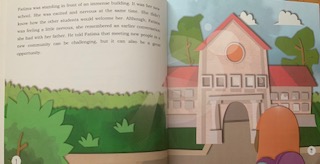
Fatima is from the Democratic Republic of Congo and on her first day of school in a America she tries to remember her father’s advice, that meeting new people can be a challenge, but also an opportunity.  

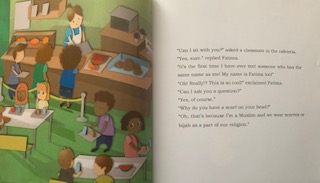
At lunch a little girl asks to sit with her, excited to meet someone with her same name.  Fatima asks her why she wears a scarf, and listens to her explain it is because she is Muslim and the hijab is part of her religion.  

IMG_1929

At recess, Muslim Fatima tells non Muslim Fatima that she is named after Prophet Muhammad (saw)’s daughter and asks her who she is named after and if asks she is Muslim, too.  The other Fatima says that she is Catholic and that she doesn’t know why her parents named her Fatima, but that she will find out and let her know.

IMG_1930

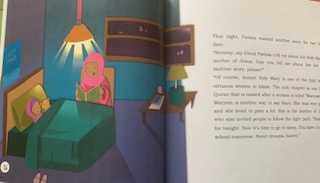
That night Catholic Fatima learns that her mom had gone to Fatima, a city in Portugal, a famous city for all the miracles that have happened there and the apparition of Mary, the Mother of Jesus.  Fatima’s mom had gone there to pray for a baby and promised if she got pregnant that she would name the baby Fatima.

IMG_1931

The next day Catholic Fatima tells Muslim Fatima and also asks her if she has heard of Mary, the mother of Jesus.  Muslim Fatima says she has heard of her, but doesn’t know much and that she will ask her parents and let her know.

Muslim Fatima learns that Mary is one of the four virtuous women in Islam and that there is a chapter in the Quran named after her.  When she tells Catholic Fatima the next day at school, the girls marvel at how much they have in common.  They are BFFs despite their differences and beautiful ones at that.

IMG_1932

I love that the book is framed in opposites to show similarities.  I also love that it shows women in our respective faiths with similar values, similar names, and Mary’s role in both our traditions.  So often, when we are building bridges we discuss how Yusuf is Joseph and Musa is Moses, Yahya is John and we go through the old Prophets, this was a nice change in perspective.

IMG_1935

The illustrations are nothing to get excited by, but they do show smiling warm characters and family members.  They serve as a distraction from the text heavy pages that do nothing to grasp the reader with their plan font and majority white backgrounds.

IMG_1933

This book would work for Muslim children, Catholic children, really all children.  It talks about faith, but as the characters view it, not in a one is better or more right than another.  There is a second book in the series about Fatima inviting Fatima to an Iftar party  that I look forward to checking out soon.  I hope it is a little more rich in dialogue and character building instead of just a foil to disseminate the information between the two faiths, but even if it isn’t I still think the book has value and you should check it out.

IMG_1934


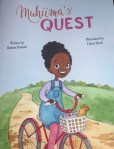
Muhiima’s Quest by Rahma Rodaah illustrated by Daria Horb

Standard
Muhiima’s Quest by Rahma Rodaah illustrated by Daria Horb

IMG_0976

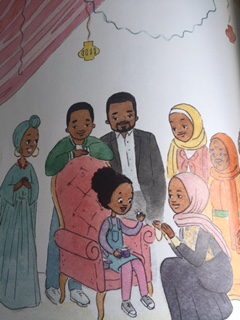
This picture book for ages 7 and up, reads incredibly smooth for the amount of text on each page, and the pictures are warm and expressive in this large (8.5 x 11) 32 page book.  Clearly the author is talented in writing and passionate about empowering her character to hold on to her culture and faith, however it seems overly forced at times.  

muhima

The premise is that it is Muhiima’s birthday, but that she doesn’t celebrate birthdays, her family only celebrates both Eids.  So when her mom hands her a surprise on the morning of her birthday and Muhiima asks if it is a birthday gift and her mom says, “kinda” it seems a bit like she is walking back from the premise. The tie-ins throughout the book as she journeys from location to location on her quest as a result seem forced.

muhima1

The map first leads her to her father’s book store to get wisdom and love and a gift that she can’t open until the end.  She also journeys to her Grandparent’s house, her Uncle’s basketball game, her Aunt’s beauty salon, and oddly her Masjid Quran Class, which apparently she is skipping, but stops to get the wisdom and gift from her teacher at, none-the-less.  Oddly enough, but at least noted, she reaches home to find everyone on her quest already there.

muhima3

On her way home, she sees her non-muslim friend Rosie celebrating her birthday and wishes she could have a birthday gathering with gifts and family too.  When she opens the door to her own home, she gets just that.  The passages detailing why it is hard to be different are incredibly relatable and poignant, but to then have Muhiima get the same thing with a different name, again seems like the author is walking back on her premise.

muhima2

The wisdom and advice the family gives to Muhiima is wonderful and powerful. I love that the character is a strong girl of color, and that her family is supportive and consistent.  They say Salaam, they pray, they go to the mosque.  Some of the little details were jarring, like why it didn’t specify what prayer, why it was her class that she visited at the mosque, how all the people got to her house before her, etc.  This minor glitches with the forced premise of relating the quest to her birthday, make the book overall a bit awkward.  This is so unfortunate because the advice and the quest are so endearing, while not being judgementat or preachy.  I don’t know how to fix it, I just hope, like really really really hope, that the author keeps writing and that her next book is a little more revised and editted.


An Acquaintance by Saba Syed

Standard
An Acquaintance by Saba Syed

acquaintance.jpg

A young adult Islamic fiction romance novel, yes its a genre, albeit small one. I braced myself for stereotypes, cheesiness, over simplifications, sweeping condemnation, and preachy reprimands.  They never came.  I think this book is different, because from what I felt while reading it, and from what I’ve read the author say, this book is written for us: Muslim females, raised in the west, devout, strong, involved, and vulnerable.  It isn’t trying to convince anyone of Islam, or prove our place in America.  It isn’t trying to justify relationships or make us hide in our houses, rather it is taking us up to the line, showing us our strengths and weaknesses, and leaving us there to think.  In 282 pages, I saw myself crystal clear in the protagonist, the vilifying community, the determined best friend, and the steady parent.  It is easy to judge, but this book gets the nuances, the temptation, the justification, the internal battles, and it does it all without resorting to extremes that would make it inappropriate for upper middle and high schoolers. Yay!

SYNOPSIS:

Sarah Ali has grown up in small town Wickley, Pennsylvania, her whole life.  Her dad owns the local hangout, she is well known and well liked ,and very involved at school and in the masjid that her father helped start.  She has a best friend who is Muslim and although her mother has passed away, her home life with her dad and older brother is solid and supportive.  Senior year, however, is where the book takes place, and with Islamaphobes protesting and a new boy, Jason, in town coming to her rescue, the stage is set for her to have to decide how much their “friendship” crosses her internal boundaries of right and wrong, and when feelings are on the table, what choices she will make.

Throughout the book, there are numerous supporting characters that have their own roles in shining light on the situation from the outside and adding context to the world that Sarah lives in.  But this is ultimately Sarah’s story, told from her perspective, and the internal conflicts are believable because they are hers, the reader can see a mile a way what is going on and what will happen, but to see it unfold within her is at times a little naive, but considering her age, plausible.  It is her denial and acceptance of the situation at hand and what her role and hopes are that make the story very hard to put down.

The book in many ways is subtle, I don’t want to give to much of the plot away because it is obvious, it is a love story between two teenagers that can’t have a future based on the fact that she is Muslim and not willing to compromise that.  But that doesn’t mean there aren’t real feelings involved and real consequences to the choices that are made.  Throw in the gossip mongers at the masjid, an older brother who is concerned, an ever patient father, and a handful of others and the book feels incredibly real. 

WHY I LIKE IT:

Things are never black and white in real life, nor does reality prevent emotions and desires from breaking out.  There is no shaming in their tale (other than by the judgemental aunties), but there are consequences that are also given their time and spotlight.  From a parenting perspective it shows how a few questionable decisions can really get you in a heap of trouble and heartache, even if on the outside you can argue you did nothing wrong.  Even in the book Sarah remarks that they didn’t do anything, but yet, they did so much, this understanding is really powerful, and so needed for the teenage demographic. The book does not celebrate Sarah and Jason’s relationship, although I must admit I did kind of cheer for them at some points (I know, haram).  It shows that they are good people, but that there is a bigger picture.  It also shows there is life and hope, and forgiveness after, in the healing.

I love that Sarah’s dad is awesome and that his ultimate weapon is dua.  Not the stereotypical immigrant father trope, he is awesome.  I also love that Sarah’s best friend, Jasmine, is a person of color, so diversity gets a bit of a shout out.  The masjid politics is spot on, and the hypocritical aunties are as annoying in the book as they are in real life.  Yes, there are times where the dialogue is a little syrupy and long-winded, but overall, this book is calm and reflective and so, so important for high school and college girls to read.

Islam is the religion practiced, from praying, to how they talk, to how they dress, the subtlties there are brilliant as well.  You can tell the author is Muslim because it is natural and real, not researched and blotched.  The message is ultimately that Allah knows all, and that we do things for His sake alone.

FLAGS:

Truly the most Jason and Sarah do is hold hands, but the masjid ladies constrew that they do a lot more, and that Sarah ends up pregnant and gets an abortion. All untrue, but this revelation, that this is the gossip going around, is explored at the end of the book.

TOOLS FOR LEADING THE DISCUSSION:

Oh how great would this book be as a book club for high school or even college age girls.  But, alas I’m not involved in anything like that so I will have to just recommend this book to anyone that meets that criteria looking for a good book. 

Having said that, part of me really thinks this book doesn’t need to be discussed.  Saints and Misfits was a book that needs to be read and discussed with our youth, this book, I kind of like it to stir and fester within each reader.  The lessons are there, and are clear, and some days I could see a girl really feeling one way and switching another.  Like the father in the book, our kids, inshaAllah, have been taught right and wrong, we have to see what they do when tested.  And this book can really speak to them, and offer them a bit of conciousness when faced with a seemingly small decision that could have big consequences.  This book will stay with a reader, and that’s a good thing.  I just don’t know if it will manifest the same with everyone, and I think that is a great thing.


Book trailer: https://www.youtube.com/watch?v=fraVJZI1xNU

From the Author: https://muslimmatters.org/2017/11/10/an-acquaintance-a-young-adult-novel/


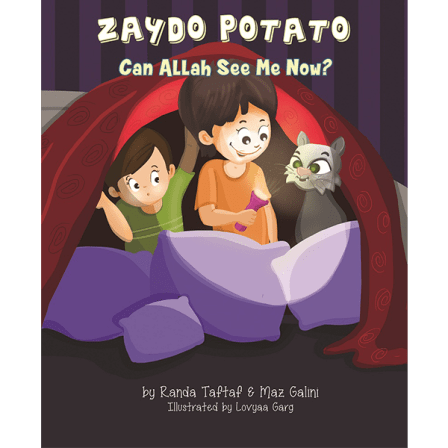
Zaydo Potato: Can Allah See Me Now? by Randa Taftaf and Maz Galini illustrated by Lovyaa Garg

Standard
Zaydo Potato: Can Allah See Me Now? by Randa Taftaf and Maz Galini illustrated by Lovyaa Garg

zaydo

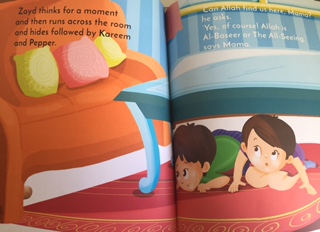
The book starts off simple enough with a little boy, Zayd playing hide-and-seek with his friend (or maybe cousin), Kareem, and his cat Pepper, when the challenge of hiding where they can’t be found, spawns a lesson in how Allah (swt) is always watching and watching over us.  As the kids hide in different places, the mom uses the names of Allah (swt) to emphasize the point.  The story presents the names of Al-Baseer, the All-seeing, Al Aleem, the All-knowing, Al-Khabeer, the All-aware, Al-Raqeeb, the Watchful, and Al-Shaheed, the Witness.

FullSizeRender (53)

The book is 32 pages, with the story taking up 24 of those pages. An ayat from the Quran, surah Hadid verse 4, starts the story and there is a glossary of the names of Allah at the end.  There is also some suggested activities for the book.  Hidden on each page is Pepper the cat and a potato.  There are other activities of finding shapes, counting blocks, finding different animals, etcetera,  that encourage children to go back to the book to engage in the pictures, and inshaAllah the message presented.

FullSizeRender (52)

There are two books thus far in the series and one E-book, the order doesn’t matter, as each is a standalone book.  The husband and wife authoring team also have a publishing company, Rummana Publishing Inc, and based on their website seem to have plans for more in the future.  This book came out about six months ago, and with its Glossy cover and large colorful pages, children will enjoy the story and activites.  The pictures are warm and engaging, and overall they are very well done.  The sentences are short, and the amont of words on the page is appropriate for the target audience.  There seems to be some arrant spacing on new text lines, but I doubt anyone would notice, and a few sentences are awkward either in their wording or lacking commas, but again, it is minor.

FullSizeRender (54)

A good story premise, easily conveyed to younger Muslims, makes the book an asset for Muslim children establishing a foundation and building a relationship with Allah swt.