Tag Archives: culture

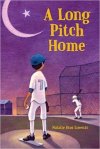
A Long Pitch Home by Natalie Dias Lorenzi

Standard
A Long Pitch Home by Natalie Dias Lorenzi

a long pitch

The correlation between baseball and cricket provides the foundation for detailing the relationship of  Bilal’s first year in America after having to leave Pakistan in a hurry: the same, but different.  This 248 page book written on an AR 4.6 pivots around sports, but has a lot of heart as themes of family, friendship, and longing, take center stage.  Throw in a whole new culture, the English language, Ramadan and prom and you have a whole lot to cover in this well crafted story.

SYNOPSIS:

Bilal has a good life in Karachi, Pakistan.  He is the oldest of three kids and at 10 years old, his world pretty much involves Cricket, friends, and his dad.  When his father disappears things get frantic, and when his father returns, the family decides to move to America.  Unfortunately Bilal’s dad can’t come.  As Bilal, his mom, his younger sister Hira and younger brother Humza, board a plan to Virginia, everything Bilal knows is left behind.

Virginia is home to Bilal’s maternal Uncle, his wife, and their teenage son, Jalaal.  Jalaal plays baseball and arranges to have Bilal join him at baseball camp for the summer.  Learning the new sport, and a new language, and the nuances of life in a new land are frustrating and often comical as Bilal points out how confusing navigating American life can be.  He also keeps an ongoing list of new things in America to share with his dad over Skype, as they swap memories of an old life in preparation for a new one.  The supporting characters on the field are generally kind and accepting of Bilal, because they have a bigger problem then a foreign boy, there is a girl on the team, Jordan.  Jordan is new too, and the coaches niece at that, naturally they become friends, but its not easy, Bilal has to learn what being a friend really means.

The majority of the book stems from the tension of waiting to hear from Bilal’s father, and to see if he can come to America.  The passing of time with baseball games and school are anecdotal to the larger arc that sets the pace of the book.  Will Baba be able to come, and if so, when?

WHY I LIKE IT:

Interestingly religion has a pretty big role in Bilal’s life and the author does explain some tenants in Islam.  He wakes up for fajr (although he does miss it occasionally), he only eats halal zabiha, the family fasts in Ramadan, and they celebrate Eid.  Bilal wants to fast, but him mom tells him he is too young when they are coming to America, and the following year he doesn’t because of baseball, which is unfortunate, because a lot of kids fast and play sports all over the world.  They go to the mosque on Eid only, and it mentions that the women in his family do not wear hijab like some of the women at the mosque.  His older cousin Jalaal wants to take the neighbor girl, Olivia, to prom, which the family explains awkwardly as something that Muslims don’t really do until they are older, or at least that is how Bilal understands it.  In the end, they let Jalaal go with Olivia and a group of friends, and the whole family Skype’s the family in Pakistan and sees them off.  Even more funny is that they don’t join their friends for dinner before the dance, because Jalaal is fasting and can’t eat until later.  I don’t know if this will confuse 4th and 5th grade readers, but as an adult I found it hysterical, because these cultural contradictions are more common than not.  I did like that nothing was done behind the parent’s backs.  Things were discussed and worked out instead of lied about.

Another thing that I found interesting, but since finishing the book, I have come to appreciate, is that there is no Islamaphobia in the story, or even xenophobia.  The kids are accepting of Bilal’s faith and culture.  He is far more self conscious about being different or not understanding than those around him are.  Its idealistic perhaps, but at the same time, I think it would distract from the core of the story.

While the book focuses on sports, I think even non sports fans will be able to enjoy the story.  The author doesn’t get too technical and it moves steadily with mini climaxes and triumphs through out.  Girls and boys will enjoy the book, Muslims and non Muslims too, the readers might even learn something about baseball or cricket or Pakistan, or even about themselves along the way.

FLAGS:

The book is remarkably clean and what you would expect for a good quality, solid 4th grade and up story.  There is the “prom” issue, but there is no hugging, kissing, longing etc.  They “like” each other, but it isn’t more explicit than that.

TOOLS FOR LEADING THE DISCUSSION:

I don’t know if I would use this for a Book Club.  One could, but I think it would require a lot of coaxing to get kids to give a book about baseball/cricket a try.  I have no doubt if they started it, they would finish it, but it might be a tough sell.  The confusion in American life would make for an awesome discussion after being read, because everyone can relate to some of the oddities of the English language, and challenges of learning a new language and culture.  I think how Islam is handled would also make for some good discussion in addressing how each family handles things differently as they arise.  Although written on a 4.6 level if I were to do it in a school setting, I would probably do it for middle school kids who could articulate their own life parallels to the story.

An interview with the author:

http://wordspelunking.blogspot.com/2016/09/a-long-pitch-home-blog-tour-interview.html

Overall a solid decent book about an immigrant Muslim boy making his way in America, while not losing or giving up on who he is, alhumdulillah.


The Storyteller by Evan Turk

Standard
The Storyteller by Evan Turk

the-storyteller-9781481435185_hr

Set in Morocco a long, long time ago near the edge of the great Sahara, a young boy goes in search of water.  But just as the city grew and grew and people forgot about the threat of the desert, people forgot about storytellers too.

This 44 page book weaves a tale of story within a story within a story, and combines different times in the past to illustrate how vital stories are to our existence.  Much like the thirst that only water can quench, the human soul needs connections.  With a Djinn threatening to cover the town in a sandstorm and the mysteries of the blue water bird, can a well told story really restore water and safety?  Written on a 4.9 level this book could get a bit confusing to a struggling reader, or a child trying to keep everything straight.  I found this book works best with kids that can get caught up in the story and the imagination of it all, without over thinking all the layers. It, like the story within the story suggests, works best to be listened too.  There is a lot of text, but it is very soothing and engaging.  The pictures are splendid, but in a dream like manner.  The book works well with sleepy children listening to your voice and getting lost in the pictures, making a storyteller out of the reader, and proving the engaging power of a story.  Second graders and up will enjoy listening to the story, and learning about desert life, and oral storytelling in lyrical way.  There is no Islamic element other than the hijab wearing women in the pictures, and the mention of a djinn.  There is is an author’s note at the end telling of the resurgent efforts of public storytelling in Morocco.

When a storyteller dies, a library burns-old Moroccan saying

A Tale from Turkey The Hungry Coat by Demi

Standard
A Tale from Turkey The Hungry Coat by Demi

the hunger coat.jpg

It really bothered me that I didn’t love the version I read of  The Parrot and the Turkey about Nasreddin Hodja, especially after finding out how entwined he is in Turkish culture, and reading some of his tales online.  So, when I found that Demi had also rewritten and illustrated a tale from his collection I was anxious to check it out.

hungry-coat

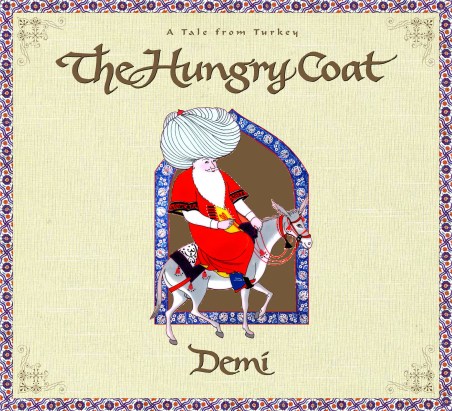
The  Hungry Coat is a charming story and Demi does a great job of bringing it to life with her pictures and storytelling abilities.  The book is 36 pages and a 4.1 on AR.  The text isn’t overwhelming in volume, but to read it definitely requires a bit of an older child’s vocabulary.  Words like caravansary, hostel, banquet, frisky, and commotion are scattered through out.  However, to listen to the story and to understand the message Nasrettin Hoca (an alternate spelling) is conveying, is easily enjoyed by children four and up.  The story flows very smoothly and the catch line of “Eat, coat! Eat!” makes the story absolutely delightful.

hungry-coat1

Nasrettin Hoca always keeps an apple in his pocket for any goats he might pass while he is out and about.  One day he helps round-up a goat that has gotten lost, and in all the commotion had become quite a mess and lost too much time to go home and change his clothes before heading to a friend’s house for dinner.  Deciding to go in his patchy, smelly clothes, Nasrettin soon finds that none at the dinner party will sit by him, or even sit facing him.  He slips out quietly from the gathering and has an idea.  He goes home and preens himself, and returns to the party where he is greeted with attention and kindness.  At dinner he begins placing the food in his coat, rather than eating it.  Each time he opens his coat he commands it to eat.  After he fills his coat he pats his belly to the bemusement of all around him as they ask him what he is doing.  He makes his point that when he came in his old coat he wasn’t fed, but when he came dressed so beautifully he was, and thus clearly the coat was invited to dinner, not him.  Everyone cheered and learned the lesson.

“A coat may be fine, but a coat does not make a man.”

The illustrations are rich and detailed, but I did find myself a little put off when Nasrettin seemed to go from looking like an old little man, to being very effeminate.  The inconsistency bothered me a bit, which surprised me for a Demi illustration.  Also, it is worth noting that there is mention of wine in the story, that many may find off for a children’s book, particularly one about Muslims (Nasrettin was an Imam and a Dervish, so he may have drunk, I’m just saying it surprised me).  The last two pages of the book are an afterword about Nasrettin Hoca in real life and the influence of his folk tales and lessons.

The Sky of Afghanistan by Ana A. de Eulate illustrated by Sonja Wimmer

Standard

sky-of-afghanistan_book-cover

An Afghani girl dreams of peace in this illustrated 24 page poem.  She soars and flies like the kites against the wind and giggles and learns and hopes with her feet on the ground.  The book is written on a third grade sixth month AR level, but even at that the poem is hard to follow for elementary age children.  The voice doesn’t sound like a child’s, it is far more reflective and mature for how she is presented.  The text, not really a story, wanders and alludes to what obstacles face Afghani’s but doesn’t detail them.  The author assumes the reader knows that Afghanistan has been under war for decades, that war is painful and gloomy and gruesome.  Adults maybe can find the hope for peace and the struggles inspiring, but I don’t think children will really have a clue as to what the text is about. Luckily the pictures are AMAZING.


The illustrator does an amazing job in keeping the story light and hopeful and showing the culture without judgement or despair.  The domes of the masjids, the hijabs, the mendhi on the hands and even the smiling faces beneath the niqabs are done with lightness, kindness and beauty.  There is even a touch of whimsy that reminds the reader that this is supposed to be from a child’s perspective.

The sky can be full of kites, I think to myself,

but it can also be full of dreams…

And mine flies up high, high into the sky,

towards the stars…

The book overall is poetic and artistic.  I can see children enjoying the illustrations and maybe falling asleep to the melodious words, even if they can’t really make sense of them. The book says that profits go to charity, and that the book was translated from Spanish.   For the illustrations alone, the book has merit and older children may be inspired to take something difficult and turn it into something beautiful with their words.


Sitti’s Secrets by Naomi Shihab Nye illustrated by Nancy Carpenter

Standard
Sitti’s Secrets by Naomi Shihab Nye illustrated by Nancy Carpenter

sitti

Sitti’s Secret was published in 1994 and given the events of the week, I’d say it is more relevant today than it was when written.  And if by some chance the events of the week haven’t affected your children, then the poetry and soul of the book still makes it an amazingly powerful story.

Mona travels from America to Palestine to visit her grandma, her Sitti.  Without the ease of speaking the same language, Sitti and Mona learn to communicate and build a tight bond cut too short by a vacation coming to an end.  When Mona returns she sees the news and writes a letter to the President, telling her Sitti’s secrets, telling him they would be great friends, and telling him they only want peace.

Truly Nye is a poet, even in Turtle of Oman her words transport you to a place where time slows down and the connection between a child and a grandparent make you nostalgically yearn for a simpler time.  Having spent my summer’s abroad visiting my grandma I could relate to so much of this book and truly had to still my heart.  The little things, like examining your grandma’s hand, or hanging out laundry, or brushing her hair. Even that dreaded final hug as you prepare to leave,  I could relate and it was enchanting.

No where in the book does it mention the Middle East or Islam, only at the beginning does she hint at it by dedicating the book to her 105 -year-old Sitti in Palestine, it mentions that she speaks Arabic and a few words are sprinkled in. And the Grandma does wear a scarf.  Other than that the book is by and large not political.  If you know that Nye has a Palestinian father and American mother and often writes semi auto biographical pieces, the book can take a bit of a different role to the reader.  Many reviews criticize the activism upon her return (the letter to the President), and found it disjointed to the rest of the story.  But in today’s climate I found it empowering and hopeful.  The world will only find peace when we put a face to those that are different to us, and even children can change our stereotypes.  I love that my children are seeing that they can make a change in the world today, and to see it reinforced in literature was gratifying.

The book is 32 pages and written on an AR 3.9 level.  The illustrations are beautiful.  They bring the words to life in a tender and heartfelt way.  The detail is subtle but deep and i have found myself thumbing back through the pages to get lost in the illustrations multiple times.  I think the book works on different levels for different age groups.  If you have a family that has to overcome great distances to be together, even younger readers will be able to identify with the story’s tenderness.  If you are in 3rd-6th grade and are aware of what is happening in the world you will be inspired.  If you just are looking for a sweet book, subhanAllah it manages to fulfill that category too.

Broken Moon by Kim Antieau

Standard
Broken Moon by Kim Antieau

Broken Moon.jpg

I didn’t initially think the premise of the book was terribly original: a poor scarred girl in Pakistan working as a servant, cuts her hair to look like a boy and be free to move about and rescue her brother.  But the weaving in of the One Thousand and One Arabian Nights stories into the larger story, and the plot of kidnapping children to be camel jockeys in the Middle East, made the story good.  Really good, but not the book.  I really struggled with the format of the book.  It is written as letters by the main character Nadira to her young brother Umar.  The information seems too forced in this style, she is telling him how old he is, or retelling him things he said a few days ago.  Once they are together she has to clarify that now she is writing it to their mother, and then again alter it to be writing to those following her story.  It presents too many characters, that are awkwardly introduced because presumably he knows who they are, the reader does not, and bridging that gap makes the book halt the reader from diving head first into a really compelling story.  I feel like the book’s editors let the characters down, it would have been an easy fix to tell the story as Nadira told it to the Sheikha, and then when the story caught up with the present to continue it from there as written, without the guise of it being shared in letters or a diary format.  But, alas no one asked me.  Luckily the book is only 183 pages and written on a AR 4.2 level so it is a speedy read.  Do not let the fourth grade level, however, trick you into thinking it is content appropriate for a 10 year old. There is a lot of abuse, in every sub category of the word.

SYNOPSIS:

When Nadira was 12 years old she was attacked by a group of men seeking to avenge an alleged crime Nadira’s older brother committed against their daughter.  By this girl’s reputation allegedly being ruined by Nadira’s brother, the village decides that a female in his family should in exchange be ruined.  Nadira manages to fight and ends up with some external scarring, including a moon shaped scar on her face, a lot of internal scarring, but the book points out quite often that she got away from being sexually abused.  In her culture she is assumed to be ruined, and will never be married.  She begins to work as a servant to help the family financially as her older brothers have more or less disappeared and no longer are of any help to her family.  When her father dies, her mother and younger brother, Umar, rely on Uncle Rubel who is a horrible man who covertly sells Umar to the smugglers to become a camel jockey.  The family that Nadira works for seem kind, they stick to the norms and don’t include her in their fun and frivolity, but they don’t abuse or belittle her either.  They offer her, her mother, and Umar a place to live on the property, and assist her in finding someone to locate her brother.  Nadira, however, is strong and determined and takes matters into her own hands by cutting her hair to look like a boy, finding the smugglers, and convincing them to take her.  Once in the camp she wins over all the boys, by becoming Sherazad and telling a story to delay her being beat.  Her wit, tenacity, and perseverance is infectious and you find yourself cheering her on.  As she prepares for the races and to broaden her access to camps to find her brother at, she meets a western vet, a Sheikha who essentially owns her, and discovers that all the boys she lives with know she is a girl and love and respect her.  The climax involves her racing in the Sheikha’s Race where the winner is granted a wish by the Sheikha.  Can Nadira win? Can she find her brother? Can she save all the boys at the camp that she has taken in as her brothers? I won’t spoil it this time.  You’ll have to read it.

WHY I LIKE IT:

I like that the author did not cast judgement on a group of people.  Not all Pakistanis are bad, not all women are helpless, not all men are oppressive, not all employers are abusive, etc..  similarly, there is a western character, but she doesn’t swoop in and save the day, in fact I read her to be complacent in what she knew were obvious human rights violations.  I loved the relationship that Nadira had with her father.  The love of learning and love of his daughter is so sincere and beautiful that I think readers can see that the stereotype of daughters not being prized jewels in a family as being false.  I wish the mother would have been further developed.  She seems defiant, but not fleshed out, which is unfortunate. I also like the subplot of the gardener boy, Saliq.  A boy who completed some of his education in England, only to be made crippled by a horse, and sent back to be a servant.  He’s role and respect of Nadira furthers the notion that her scar does not define her, as he proposes marriage and pledges to support her in her efforts to continue rehabilitating kidnapped children and stopping the cycle.  I also like that the author doesn’t share her response, as if to emphasize that she is liberated and with or without a husband she is a complete person.

The characters are Muslim by culture, but there is no real mention of Islam or Islamic practices.  Before Nadira cuts her hair she wears a scarf, but that is neither her nor there.

FLAGS:

The premise of the book is an accusation of a sexual crime.  One of the stories she tells at the  camel camp to delay the beatings,  is the story of the lady who traps a merchant, a king, a carpenter, and a Kazi to free her lover.  She offers her body to the men and traps them in a cabinet naked after obtaining their signatures.  There is some kissing and some innuendos and references to sexual acts.  There are also references to the sexual abuse at the camps as well as descriptions of the physical ones that take place.  Not for the faint of heart or young and innocent. The boys at camp also discover that Nadira bleeds like their sisters, as a clue to them figuring out she is a girl, but compared to the sexual crimes, menstruation seems hardly like a flag, and I only mention it because the AR level is so low, not because there is any reason for shame or shyness in discussing an act all women endure.

TOOLS FOR LEADING THE DISCUSSION:

I think high school students could handle the book, and would allow a plethora of discussion options from child labor, civic responsibility, abuse, justice and the power of literature as a coping mechanism.  I wish the author would have included some information on camel racing and how they are regulated and jockeys are obtained, and maybe thrown in a recipe for masala chai as well.

There are no online websites or guides that I could find to accompany the book.

King For A Day by Rukhsana Khan illustrated by Christiane Krome

Standard

King-for-a-Day1.jpg

Its time for Basant, the Lahore, Pakistan kite flying festival, and Malik and his siblings are ready.  Ready to launch Falcon into the sky, ready to set other kites free, and ready to put the bully next door in his place.  While some kids have huge kites, and some have many, Malik has just Falcon, a speedy little kite that Malik prays can get the job done.

King for a day inside

Once again Rukhsana Khan does a remarkable job of taking a universal theme, adding some culture, and finding artists to empower minorities without making it an issue, all in a 32 page children’s book.  Written on an AR level of third grade ninth month, readers see characters handling a bully by beating him “on the court” so to speak, a character having confidence in his abilities, yet still asking Allah swt for help, and a boy in a wheel chair celebrating a fun spring time festival with his family.

king 1

The illustrations are rich with texture and angles, which contrasts the font and text presentation.  Little kids probably won’t be tempted to pick this book up, but as a read-a-loud first and second graders will enjoy the story and the kite flying action.  Third and fourth graders will enjoy reading the book independently, and find themselves cheering for Malik, appreciating his kindness, and wanting to pick up a kite and head out themselves.  The author includes a note at the back which provides more information about Basant and how it is celebrated.  Although it takes place in Pakistan and is a festival not celebrated in America, there isn’t a “foreign” feeling to the book, as kids can relate to bullies, wanting to be the best and the satisfaction of succeeding and feeling like a “king for a day.”

king2

The Secret Message: Based on a Poem by Rumi by Mina Javaherbin illustrated by Bruse Whatley

Standard

The Secret Message

Once again Mina Javaherbin retells a Rumi story in a fun, charming way to children that probably have never heard his stories before.  The illustrations bring this 32 page tale written on an AR 4.6 level to life.  While written for older elementary children, this book works well for kindergarteners and 1st graders in story time as well.  The pictures and descriptions make for an engaging story for all levels and the twist at the end make you want to go back and read it again and again.

A wealthy Persian merchant brings a parrot from India to call and sing to those passing by to come in to the shop.  The parrot helps make the merchant famous and before long he has completely sold out of all his wares.  He plans to return to India and asks his family what they want him to bring back, he even asks the parrot.  The parrot asks for nothing but a message to be delivered to his friends about how he misses them and about his new home and cage.  The story follows the merchant to India and through it, showing and telling about the sites and goods.  On the way back the merchant stops in a tropical forest to deliver the parrot’s message.  The birds listen carefully and then one by one, fall off their branches with their backs on the ground and their feet in the air.  When the merchant returns he delivers the message and the same thing happens to his parrot.  (SPOILER). Sad that he has caused his parrot to die, he takes him out of the cage where in an instant the parrot flies out of the hole in the domed ceiling all the way home to his friends in India.

The-Secret-Message-2

Islam isn’t shown, and I debated including it, but culturally it is relevant with the character journeying from Iran to India and the author being from Iran.  Plus it is based on a Rumi poem.  There is nothing un Islamic in the book, and there is plenty of little places in the book to get kid’s opinion on the action, thus making it a book definitely worth your time.


Silly Chicken by Rukhsana Khan illustrated by Yunmee Kyong

Standard

silly chicken

Silly Chicken is a story about sibling rivalry, except there isn’t a sibling, there is a chicken.  Rani feels that her mom, Ami, loves a chicken, Bibi, more than she loves her.  Rani is jealous of the attention Bibi receives and finds the chicken in general, silly.  One day when Rani and Ami leave their home by tonga to visit her father’s grave, a dog gets in and when they return, Bibi is no more.  Ami is devastated and Rani is sure she closed the gate.  It isn’t until Bibi’s egg hatches by surprise, that the story comes full circle and Rani responds to Ami’s chiding that she loves the baby chick more than her mother, that the reader and Rani realize how silly that would be.

I really liked this 32-page, brightly and playfully illustrated book.  It is written on a AR 2.3 level and is fun out loud or at bed time.  The story takes place in Pakistan and a lot of reviews online remark that it is a good book about Pakistan or for showing Pakistani culture, critiques that I both agree and disagree with.  Every kid, everywhere, through out time, can probably relate to being jealous of something or someone occupying their mother’s attention.  The concept of a pet and loving it and being sad and feeling guilty, are all universal themes.  That being said, both the author and illustrator do a remarkable job of breaking stereotypes without drawing attention to them.  Ami and Rani are relatable and are clearly Pakistani, subtly removing an us and them stance.   Rani’s dad has passed away, but Ami and Rani seem to be doing well.  Ami seems very self-sufficient in daily activities and brave when they think a burglar may be present.  The two chat with neighbors and travel independently breaking down the erroneous stereotype that women cannot go out or be recognized without a male.  The mother wears hijab and traditional Pakistani clothes while Rani being young obviously does not cover.  Their clothes are bright and colorful and their expressions relatable and inviting.  The way that Bibi’s death is handled is age appropriate and a child could possibly think she simply was run off rather than killed, either interpretation would allow the reader empathy for Ami and be a great topic to explore with a child.  Enjoy!


Malala: A Brave Girl from Pakistan/Iqbal: A Brave Boy from Pakistan by Jeanette Winters

Standard

Malala Iqbal

Again I break from my fiction preference to review another book about these two remarkable individuals: Malala and Iqbal.  In this beautiful book linking two brave children from Pakistan, Jeanette Winter’s brings their stories to a young audience in a powerfully simplistic way.  Written on an AR 3.6 level, each story is 20 pages and presented in a flip book format.  Before each story there is a brief Author’s Note about each character in a broader view, for context to be given as needed to the adults to share with the children listening to the book, or for older children to read and deepen their understanding and appreciation.  The sentences are short and the font and presentation is inviting to even early readers.  The pictures are wonderful and do a tremendous job showing the intensity of the environment Malala and Iqbal face, while not frightening the reader.

The Malala portion of the book starts with the Taliban asking for her on the bus and like her biography, then takes the reader to the threats and deterrents they made to girls in school, but on an audience appropriate level.  It tells how they stopped wearing uniforms so that they could be harder to identify and how even burning the girls school didn’t stop them. It then returns to her being shot and going from the hospital in Swat to one in England.  It concludes with her speaking to the U.N. on her 16th birthday.

Malala

The story of Iqbal is a bit harder I think for children to understand as they may not know what a loom is or have ever thought about who makes carpets.  Also the words bondage, Peshgi, outlawed, and mourners are not in their vocabulary .  They should understand that he is sold for an unpaid $12 debt, but that too may need to be stressed and explained. If the kids can grasp this, I really think children as young as kindergarten can appreciate his story.  I love that the author didn’t shy away from the fact that he was shot and killed.   Even if they do not understand all the facets that make Iqbal’s work so incredible.  They will feel inspired that someone so young was so brave.  Iqbal