Tag Archives: cricket

Aarzu All Around by Marzieh Abbas

Standard
Aarzu All Around by Marzieh Abbas

I was hesitant starting this 384 page middle grade novel in verse, because the stereotype of having to disguise yourself as a boy to make things happen, seems like a western performative troupe that reinforces stereotypes, and has been done a fair amount in literature.  Pushing down my disdain, I opened the book to numerous pages of cricket terminology and rules, which further served as a barrier.  I do not understand the info dumping, literally, at the start of the book, and to top it all off it is not needed.  The book is blurbed as being a cricket loving, girl dressing as a boy in a patriarchal society, but really those are the most forced aspects of the all over the place narrative.  Cricket is underdeveloped and her actually playing is very minimal and lacking. Aarzu disguising herself as a boy is a blip that she admits to a few pages after she gets the job, and thus the story that remains is an orphaned girl with a mean uncle trying to find a way to help pay for her younger sister’s medical bills. Which isn’t a bad story it is all just so very disjointed.  And the verse is not written well, there are no beats or flow, it just seems to be a few decent poems in a sea of jumbled ones.  About 40% when the Islam starts to shine, I felt a brief connection to the book and the characters, but the loose threads and telling over showing, found skimming the pages to find out if the sister survived, if Aarzu got in trouble, and how cricket fit into it all.  The weak climax and sloppy resolution, combined with the premise, marketing, and info dumping, makes me recognize that I am not the target audience as a cynical Pakistani American reader, but truly makes me wonder who is.  I don’t know that the words on the page or the story at hand are going to resonate with middle graders.  I appreciate that Islam and culture are separated, that the mean uncle is confined to him and him alone, not a label on Pakistani men, but it feels like the editor took a day off or didn’t want to help the author make the story cohesive, which is unfortunate.

SYNOPSIS:

Aarzu and her younger sister have come to live with her poor maternal aunt’s family in Karachi after her parents are killed in an earthquake.  She is treated like a servant by the family, not allowed to watch cricket let alone play, and her government public school is hardly a challenge.  When Sukoon’s kidney failure worsens and dialysis is needed, as they wait for a kidney transplant match, Aarzu decides to find a way to make money.  She starts frying onions and selling them at the local market, the labor intensive and odorous job helps, but not enough.  When a nearby bungalow preparing for a wedding, needs laborers, her friend Nazia encourages her to cut her hair to look like a boy and apply.  Lying to her aunt about where she is, she spends her time after school getting to know the kids that live at the bungalow, confessing that she is a girl, and playing cricket.  The money helps her sister and things are starting to look up, until the truth comes out, Sakoons health worsens, finances at home hit rock bottom, and friendships frazzle.  Luckily though SPOILER the wealthy family likes her and solves all her problems and bribes the right people for her to make the cricket team.

WHY I LIKED IT:

Some parts, mostly the Islam, really spoke to me. I love that distinctions were made between religion and culture, that she taught the wealthy girl how to pray, that Aarzu is Muslim and loves her faith and relies on her relationship to Allah swt in handling every aspect of her life. The rep feels real and sincere and while it made me force a friend to read the book, it also highlighted how weak the other aspects were.  We, the reader, see so little of what Aarzu’s world is, we are just told. There are no flashbacks to her life with her parents juxtaposing her current situation that would have connected us to her.  The poverty, the mean uncle, the cricket, the sick sibling, they all just seem like plot points, not pieces to this girl. She compartmentalizes them in a way that make it hard for the reader to see the overlap, or that she is keeping all of these parts close to her heart at all times.

The resolution was disappointing, it felt half hearted. Why have wealthy saviorism? Dreams coming true from bribery? It took the grit out, and made the messaging fall less on hard work and perseverance, and more on, don’t be poor.

I did appreciate the kidney disease representation, having seen a loved one endure failure and daily dialysis, I appreciated the mention of dietary changes, and swelling, and lethargy, it was well done.  I wish the emotional impact, though not just the sibling love, but the fear of demise, could have come through stronger.

FLAGS:
Lying, physical abuse, theft, fear, illness

TOOLS FOR LEADING THE DISCUSSION:
I don’t know of a kid I would recommend the book to, but I would shelve it, let nine and up read it, and happily discuss with whoever wants to chat about it.

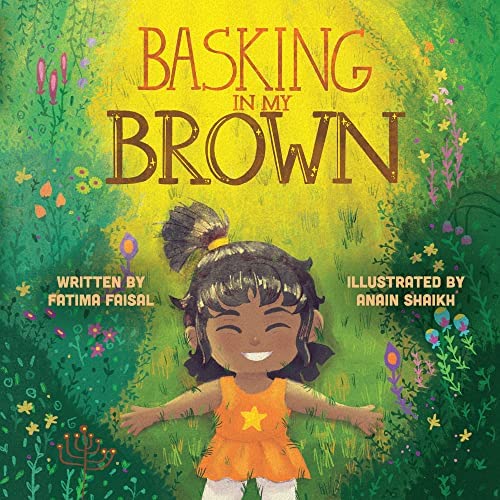
Basking in My Brown by Fatima Faisal illustrated by Anain Shaikh

Standard
Basking in My Brown by Fatima Faisal illustrated by Anain Shaikh

This picture book celebrating brown skin, particularly in girls, and specifically from a Desi culture point of view, takes on the notion of dark brown skin not being as ideal as compared to lighter skin.  If this is not a concept you are familiar with, I don’t think that the book will hit home, but as someone who has heard this refrain of staying out of the sun to not get darker since childhood, aimed at my friends and cousins (I turn red and burn in the sun), I do appreciate this owning and pushing back on a ridiculous colorist mindset. I don’t love the “magic” diction choice, and there is nothing Islamic in the book, save some covered heads that could be religiously inspired, or culturally, or even weather related, and I’m not sure if the author or illustrator identify as Muslim, but I’m sharing anyway because I know young Pakistani girls particularly, hear this colonial mindset messaging still, and I support undermining it.  This book is not about systemic oppression and racism and taking up space, this book is internal cultural acknowledgement of a pointless beauty notion.

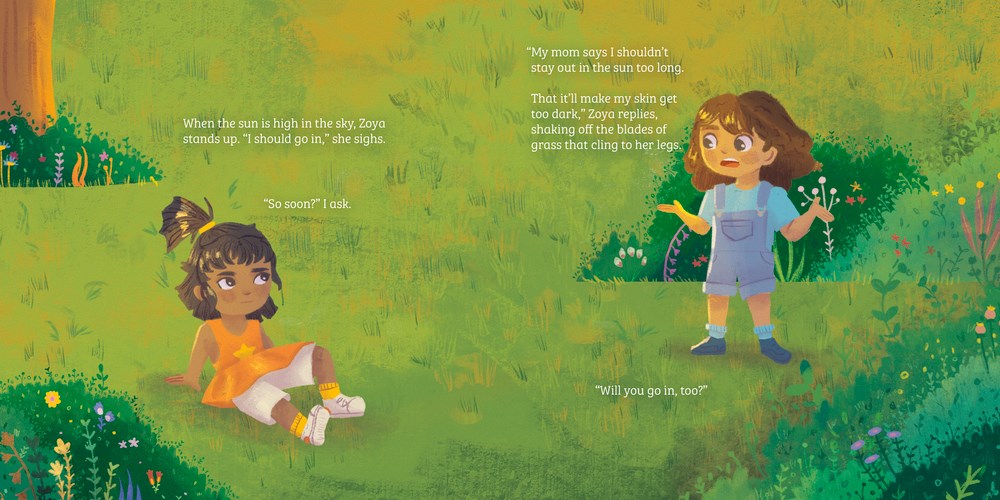
A young girl begins the book telling of things she loves: trips to Pakistan to fly kites with her Dada, her mother’s dinner parties, swimming, climbing trees, but most of all she loves basking in the sun.  One day while playing with her friend Zoya in the warm sun, Zoya abruptly says she should go in before she gets too dark.  The protagonist counters that she loves all the shades her beautiful brown turns and equates it to magic.

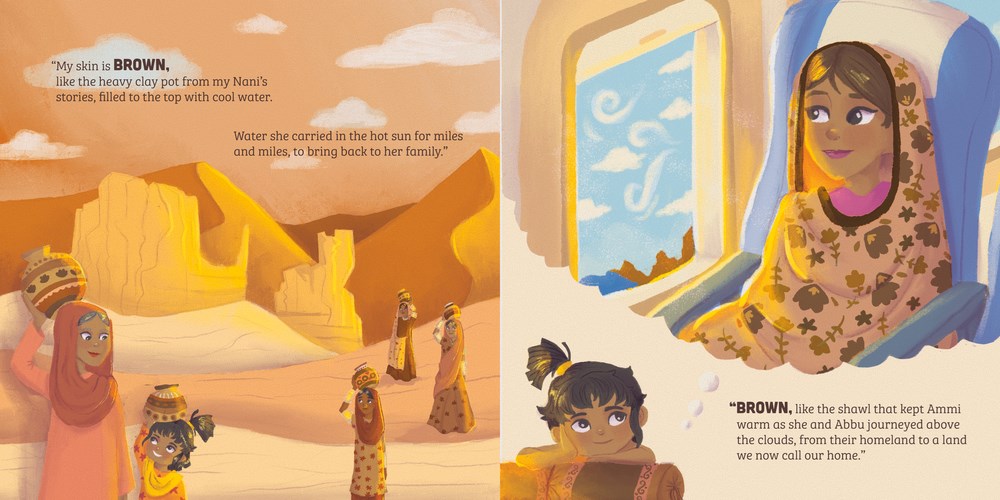
She holds out her hand to show her magical brown skin shimmering, and connects the beautiful brown to the brown clay pot her Nani used to carry water in, the brown shawl her mother wore when coming to a new home, the brown of the henna her sister puts on, etc..  She says her brown skin has its own story of being proud, brave, courageous, soft, sweet, and fearless.

Zoya decides she likes the magic and decides to stay and bask in the sun. The author on the final spread raches out to brown girls to own, embrace, and celebrate their brown skin.

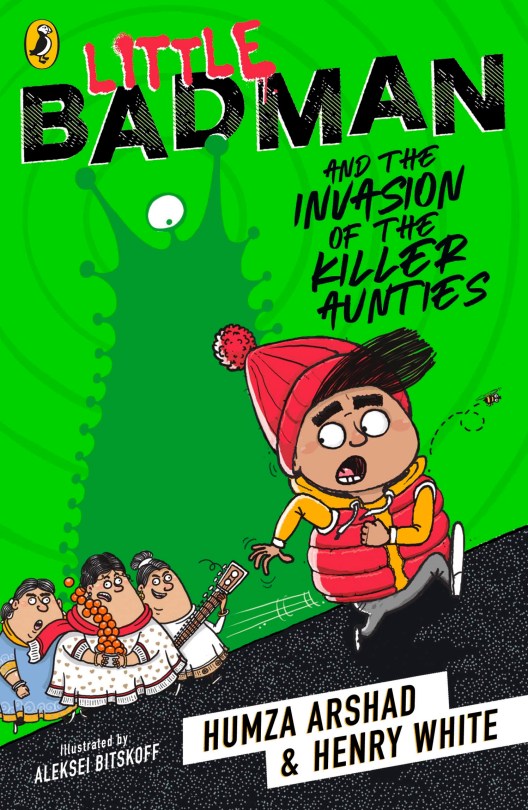
Little Badman and the Invasion of the Killer Aunties by Humza Arshad & Henry White illustrated by Aleksei Bitskoff

Standard
Little Badman and the Invasion of the Killer Aunties by Humza Arshad & Henry White illustrated by Aleksei Bitskoff

badman

It’s been a while since I’ve read such an over the top silly book that has a lot of heart.  It is 352 pages that remind me of the the My Teacher is an Alien book series of my youth smashed up with the Weirder School/Diary of a Wimpy Kid series of today.  Meant for upper elementary with some bad words (hell and damn), the story is Pakistani-British representation with many Muslim named characters, a Muslim author, and a shout out to a KFC in another town that is halal.  Don’t read it if if you want to learn anything, but definitely pick it up if you want to roll your eyes, giggle, and ponder a world where Desi aunties are the perfect disguise for force feeding an entire community delicious food as part of their evil plan to take over the world.

aleksei-bitskoff-little-badman-1

SYNOPSIS:

Humza Mohammed Khan is an 11 year old Pakistani kid in Britain who thinks of himself as the next big rapper, Little Badman.  He dreams big and talks even bigger as he struts around primary school getting in trouble and trying to film his music video on his friend Umer’s extremely old Nokia flip phone.  With a normal enough mom, a hyper exaggerating father, and a handful of their friends known as Aunties and Uncles, Humza gets in trouble regularly enough, but overall seems to have a good heart.

Things at school slowly start to change after their teacher gets stung by a bee named Mustafa, that Umer brought to school to be his pet.  Weird as that might be, it is even more odd, when their teacher is replaced by a volunteer auntie.  Every day it seems like a teacher goes missing, and is replaced by some asian kids’ aunt.  When the supper ladies are replaced and the food improves, no one is complaining.  When every volunteer starts bringing snacks to school, no problem.  Who doesn’t love gulab jams, and samosas, and butter chicken all day long every day?  Well, as the school puts on the pounds and all the teachers and staff are officially missing, Humza, Umer and their former nemesis Wendy, start to get worried.  Humza’s Uncle who he calls Grandpa, claims his wife Auntie Uzma is not really his wife, and helps Humza investigate.

Secret meetings in supermarkets, teachers and grandpa vanishing, and Humza seeing a giant slug coming out of the substitute librarian, means that Little Badman is going to have to run away from cricket practice, not get sent in a crate to Pakistan, face his stage fright, and save the day from the aliens taking over the aunties.

little-badman-inline

WHY I LIKE IT:

I like that it is cultural rep and own voice in its telling.  Humza is Pakistani and his cultural baggage is hilarious and part of him, and no explanations are needed.  In his world people are from lots of places and they all live and play and learn together and they eat caramel apples and toffee and jilabies.  The diversity is great and not articulated, it just is what it is, and they all have to work together to save the day. I think my favorite character is Grandpa, who Humza has to learn to appreciate and not just see as an old almost dead guy and Humza’s dad who exaggerates everything and takes his cricket very seriously.  At the end Humza has to have a heart to heart with his dad and his uncle, Grandpa and it makes this over the top nutty story really kind of sweet too.

There is no “Islam” in it aside from Muslim names and mention in a rap of a halal KFC.  I kind of like that they are Muslim kids and it appeals to a larger audience, sure something praying or something at some point might have been nice, but it isn’t a book that you’d be expecting spiritual nuggets from, so it is ok.

aleksei-bitskoff-little-badman-3

FLAGS:

The words damn and hell are used.  There is disrespect of authority, parents, and teachers as well as lying.

TOOLS FOR LEADING THE DISCUSSION:

I had my ten year old read it and he thought it was ok, but was uncomfortable with the language, which I was glad, but I told him I thought he could handle it, and know what is appropriate to use.  That being said, school libraries should have the book, maybe not classroom libraries though, and I probably wouldn’t do it as a book club.  I will have my other kids read it though, cause like I said, it is silly and fun.

Interview with comedian author Humza Arshad: https://www.booktrust.org.uk/news-and-features/features/2019/march/meet-little-badman/


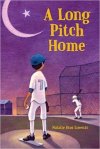
A Long Pitch Home by Natalie Dias Lorenzi

Standard
A Long Pitch Home by Natalie Dias Lorenzi

a long pitch

The correlation between baseball and cricket provides the foundation for detailing the relationship of  Bilal’s first year in America after having to leave Pakistan in a hurry: the same, but different.  This 248 page book written on an AR 4.6 pivots around sports, but has a lot of heart as themes of family, friendship, and longing, take center stage.  Throw in a whole new culture, the English language, Ramadan and prom and you have a whole lot to cover in this well crafted story.

SYNOPSIS:

Bilal has a good life in Karachi, Pakistan.  He is the oldest of three kids and at 10 years old, his world pretty much involves Cricket, friends, and his dad.  When his father disappears things get frantic, and when his father returns, the family decides to move to America.  Unfortunately Bilal’s dad can’t come.  As Bilal, his mom, his younger sister Hira and younger brother Humza, board a plan to Virginia, everything Bilal knows is left behind.

Virginia is home to Bilal’s maternal Uncle, his wife, and their teenage son, Jalaal.  Jalaal plays baseball and arranges to have Bilal join him at baseball camp for the summer.  Learning the new sport, and a new language, and the nuances of life in a new land are frustrating and often comical as Bilal points out how confusing navigating American life can be.  He also keeps an ongoing list of new things in America to share with his dad over Skype, as they swap memories of an old life in preparation for a new one.  The supporting characters on the field are generally kind and accepting of Bilal, because they have a bigger problem then a foreign boy, there is a girl on the team, Jordan.  Jordan is new too, and the coaches niece at that, naturally they become friends, but its not easy, Bilal has to learn what being a friend really means.

The majority of the book stems from the tension of waiting to hear from Bilal’s father, and to see if he can come to America.  The passing of time with baseball games and school are anecdotal to the larger arc that sets the pace of the book.  Will Baba be able to come, and if so, when?

WHY I LIKE IT:

Interestingly religion has a pretty big role in Bilal’s life and the author does explain some tenants in Islam.  He wakes up for fajr (although he does miss it occasionally), he only eats halal zabiha, the family fasts in Ramadan, and they celebrate Eid.  Bilal wants to fast, but him mom tells him he is too young when they are coming to America, and the following year he doesn’t because of baseball, which is unfortunate, because a lot of kids fast and play sports all over the world.  They go to the mosque on Eid only, and it mentions that the women in his family do not wear hijab like some of the women at the mosque.  His older cousin Jalaal wants to take the neighbor girl, Olivia, to prom, which the family explains awkwardly as something that Muslims don’t really do until they are older, or at least that is how Bilal understands it.  In the end, they let Jalaal go with Olivia and a group of friends, and the whole family Skype’s the family in Pakistan and sees them off.  Even more funny is that they don’t join their friends for dinner before the dance, because Jalaal is fasting and can’t eat until later.  I don’t know if this will confuse 4th and 5th grade readers, but as an adult I found it hysterical, because these cultural contradictions are more common than not.  I did like that nothing was done behind the parent’s backs.  Things were discussed and worked out instead of lied about.

Another thing that I found interesting, but since finishing the book, I have come to appreciate, is that there is no Islamaphobia in the story, or even xenophobia.  The kids are accepting of Bilal’s faith and culture.  He is far more self conscious about being different or not understanding than those around him are.  Its idealistic perhaps, but at the same time, I think it would distract from the core of the story.

While the book focuses on sports, I think even non sports fans will be able to enjoy the story.  The author doesn’t get too technical and it moves steadily with mini climaxes and triumphs through out.  Girls and boys will enjoy the book, Muslims and non Muslims too, the readers might even learn something about baseball or cricket or Pakistan, or even about themselves along the way.

FLAGS:

The book is remarkably clean and what you would expect for a good quality, solid 4th grade and up story.  There is the “prom” issue, but there is no hugging, kissing, longing etc.  They “like” each other, but it isn’t more explicit than that.

TOOLS FOR LEADING THE DISCUSSION:

I don’t know if I would use this for a Book Club.  One could, but I think it would require a lot of coaxing to get kids to give a book about baseball/cricket a try.  I have no doubt if they started it, they would finish it, but it might be a tough sell.  The confusion in American life would make for an awesome discussion after being read, because everyone can relate to some of the oddities of the English language, and challenges of learning a new language and culture.  I think how Islam is handled would also make for some good discussion in addressing how each family handles things differently as they arise.  Although written on a 4.6 level if I were to do it in a school setting, I would probably do it for middle school kids who could articulate their own life parallels to the story.

An interview with the author:

http://wordspelunking.blogspot.com/2016/09/a-long-pitch-home-blog-tour-interview.html

Overall a solid decent book about an immigrant Muslim boy making his way in America, while not losing or giving up on who he is, alhumdulillah.