Tag Archives: acceptance

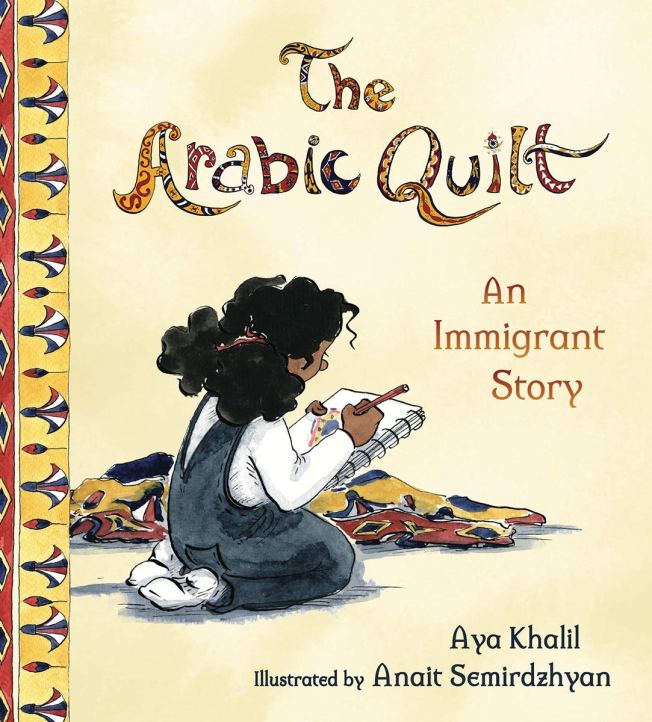
The Arabic Quilt: An Immigrant Story by Aya Khalil illustrated by Anait Semirdzhyan

Standard
The Arabic Quilt: An Immigrant Story by Aya Khalil illustrated by Anait Semirdzhyan


arabic quilt

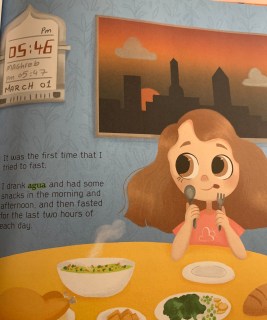
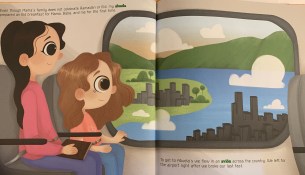
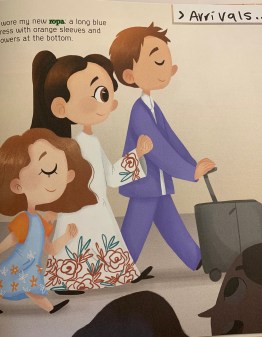
This 36 page picture book tells a beautifully presented story that incorporates events from the author’s real life that convey a story of loving your culture, finding similarities and giving people a second chance.  Ideal for students between 2nd and 4th grade, younger children will enjoy having the story read to them, and older kids will benefit from the message as well.

7C03525B-A26D-427F-A7EA-591BB3095F10

Kanzi is about to start her first day of 3rd grade in a new school.  It doesn’t specify if she has just come from Egypt, but being she seems to speak English well, knows that she’d rather have peanut butter and jelly instead of a kofta sandwich and mentions that she got a quilt when she visited her grandmother, in Egypt, she possibly is just starting a new school, not her first in America, but it is considered an immigrant story, so I’m not certain. E403D261-438B-4263-A2FB-C3F8693C9D3E

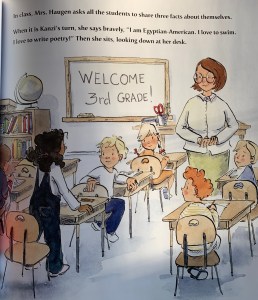
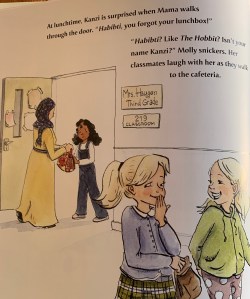
When she arrives in class and introduces herself she bravely says that she is Egyptian-American, but on the way to school she turns down the Arabic music in the car, so the reader sees that she is a little nervous about being seen as “different.”  When her hijab wearing mom brings her forgotten kofta sandwich and calls Kanzi ‘Habibti,’ classmate Molly teases her that she is being called a hobbit.

A crying Kanzi tells her teacher and Mrs. Haugen reassures her that “being bilingual is beautiful.”  That night Kanzi asks her mom to send her a turkey sandwich for lunch the next day, and before beds she writes a poem as she snuggles in her beloved quilt.

76FCD440-0D81-4893-80F3-1CC6033E8461

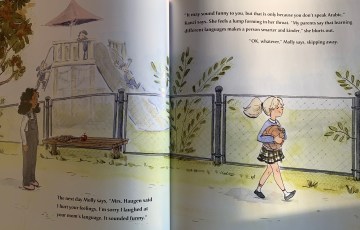
At school Molly apologizes to her and says that it just sounded funny.  Kanzi tells Molly it is because she doesn’t speak Arabic and that her mom says that “learning different languages makes a person smarter and kinder.”  Molly dismisses the comment and smugly walks off.

Mrs. Haugen sees Kanzi’s poem about her quilt from her grandma in Egypt and asks her to bring her quilt to school. The kids love it, and Friday Kanzi’s mom shows up to help with a special project: an Arabic quilt with the kids names.

98E875AE-0FD1-4827-BF39-1CA7B1172843

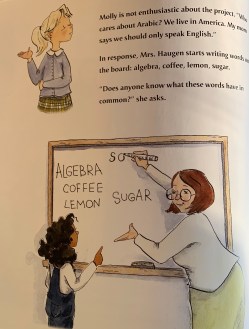
Molly is not enthusiastic and Mrs. Haugen writes English words that come from Arabic on the board: coffee, lemon, sugar, algebra.  Telling the kids that “we can speak non-English languages and still be American.”

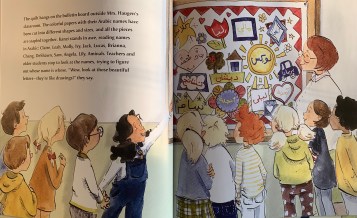
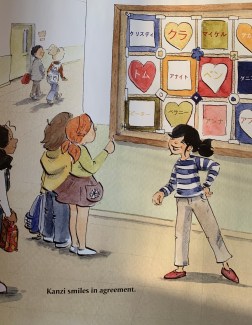
Kanzi and her mom write the kids names down and the children copy them.  The teacher cuts them out and makes a quilt to hang in the hall.  On Monday when everyone sees the quilt, they love the beautiful letters and colors.  Even Molly sincerely apologizes and asks Kanzi to write her mom’s name in Arabic as a gift.  The two hug and seemingly will become friends.

832244F2-1F7E-4C4A-9778-40E0EEC6BE82

Across the hall another quilt is hung with names in Japanese, as another student and teacher were inspired by Kanzi and her quilt.  The last page of the story is a letter Kanzi has written to her parents telling them how grateful she is that she has two languages and that she will speak them without guilt.

BB6797A4-05C9-4CDC-AC70-88273ED3997B

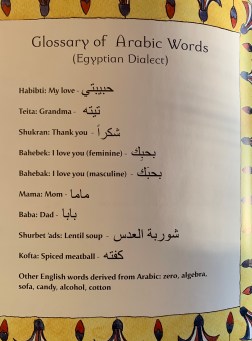
The story is beautifully told and exquisitely illustrated on well-sized 9.5 x 10.5 pages in a hardback binding.  The mom wears hijab and it mentions it, but there is nothing religious about the text.  It is a universal story of coming to be proud of your roots and inviting those around you to learn and grow.  There is a Glossary of Arabic Words at the end and a bit about the author and illustrator.

9AF3D465-F5DA-4F25-8FC1-5BEE16FD9B21

My kids favorite page by far was reading the names written in Arabic and they all enjoyed the story (ages 13, 10, 9, 4).  I actually had an issue when Molly apologized the first time, feeling that Kanzi’s response was a bit pretentious to what seemed like an 8 year old being told to go say she was sorry, but my older three unanimously and fervently disagreed with me, saying that she was obviously insincere and Kanzi knew it.  I’d love to hear from other readers if they felt like Molly was sufficient in saying sorry and admitting that it sounded funny and that Kanzi was arrogant in saying that people that know two languages are smarter and kinder, or if Molly was being rude and racist and Kanzi was sticking up for herself.

CF16ACA2-8EC4-443B-AA8B-2B9EA3D05D6D

Irregardless, the book is well done, enjoyable, and will get repeated reads by a large range of readers.  My children keep pulling it off the book shelf, and for that I need to thank Gayatri Sethi (@desibookaunty) who generously sent me the book the same day I checked it out from the public library.  Her generosity once again is a gift that I hope to pay forward in the future.  This book also highlights how amazing teachers can be and often are in facilitating inclusion, understanding, and respect.
ED8D19BC-96FE-4B8F-8B35-87A1AA885B7F


Badir and the Beaver by Shannon Stewart illustrated by Sabrina Gendron

Standard
Badir and the Beaver by Shannon Stewart illustrated by Sabrina Gendron

badir and

This 92 page early chapter book is a great linear story for 1st through 3rd graders.  The size, font, spacing, illustrations, chapter length, and content make it a fun read that incorporates diversity, environmental action, teamwork, information about beavers and acceptance all through the efforts of young Badir, a recent immigrant from Tunisia during the blessed month of Ramadan.

SYNOPSIS:

Badir is new to Canada and while he misses Tunisia, he is joyful and upbeat as we meet his older brother Anis, young twin siblings and classmates.  Out one night before iftar, he sees what he thinks is a giant rat swimming in a lake, but no one believes him.  When he sees it a second time, a lady at the park explains to him that it is a beaver, not a rat, and pulls out a Canadian coin to show him there is a connection between beavers and Canada.  With new knowledge about the difference between a lake and a pond, a rat and a beaver, Badir is fascinated with how beavers build homes, mate for life, and benefit the environment.  He even likens the beaver eating at sunset to his families own Ramadan schedule.

But all is not well for the beaver, as a petition is being circulated to relocate the rodent and save the trees in the park from his sharp teeth.  With new friends, a supportive teacher and classmates, Badir is determined to prevent the beaver from having to leave his home as Badir and his family had to do.

WHY I LIKE IT:

I love that this book is subtle in highlighting the welcoming of immigrants into a community, about having the main character be Muslim and it being Ramadan, and showing that diverse people can come together for a bigger cause and even become friends.  The main story line is naturally to save the beaver and the trees in the park, so the information and facts about beavers is appreciated and well presented.  I think most everyone of every age will learn something new about the common rodent.  But, by the main character being genuinely like-able and infectious, the reader will also realize that any negative stereotypes about Muslims or immigrants really aren’t a factor.  Badir’s family is really nice, the parents prepare food together, they feed their kids’ friends, and invite them over. The author does a good job at accurately making them seem like any other family.

IMG_4808

There isn’t much stress on Badir being Muslim or what that means outside of it being Ramadan, praying, and going to the mosque as a family at night.  The illustrations show the mom in hijab. The book tells a tiny bit about Tunisia, but not why they left, and definitely makes the foods they eat sound delicious.  Overall, it really does a good job of keeping the book about the beaver and finding a solution.

The book is for both non Muslims and Muslims and seems to be written by a non Muslim, and while set in Ramadan it is definitely not limited to being a “Ramadan story.”  There are small pictures on many pages and a full page picture in each of the 12 chapters.

IMG_4806

FLAGS:

None

TOOLS FOR LEADING THE DISCUSSION:

I think this book should be in classrooms and school libraries.  It really is well written, informative, and fun.  I don’t do a story time for the target audience of this book, but I think it would be a candidate for my “Lunch Bunch” meetings, when I read aloud to 4th and 5th graders once a week while they eat lunch.  Even if it is slightly below a 5th grade level, I think even older kids who pick it up and read it, or listen to it being read, will find it interesting, entertaining, and worth their time.

Publisher’s page: https://www.orcabook.com/Badir-and-the-Beaver-P3992.aspx


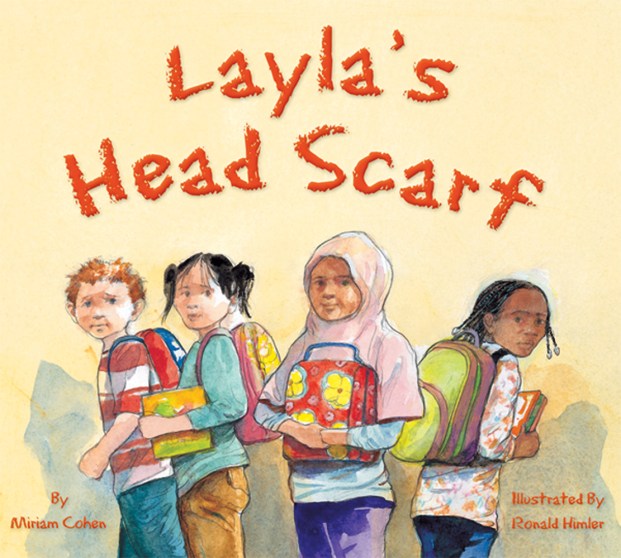
Layla’s Head Scarf by Miriam Cohen illustrated by Ronald Himler

Standard
Layla’s Head Scarf by Miriam Cohen illustrated by Ronald Himler

cover layla

It isn’t often that I feel compelled to list all the things I like about a book and all the things I don’t like about a book and count them up to see what I think about a book.  Especially when the book is only 32 pages and an AR 3.2, but this book has me on the fence.

layla2-e1543798774981.jpg

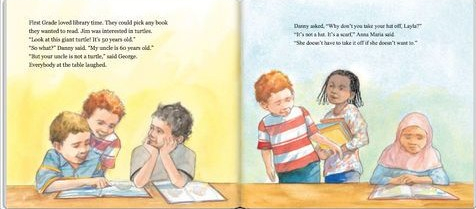
It is Layla’s first day of school and presumably she is shy.  That’s what the other kids say at least.  The story follows her and the class throughout a typical first grade day, there is no climax or problem, there is just her and her classmates moving from circle time, to the library, to lunch, to recess, to art, and then her joining in at circle time the next day.  

Along the way the kids comment on her scarf, the librarian brings her a book about her country with pictures of sun and sand and veiled women.  The lunch lady looks at her rice and pea pie and says it looks yummy, the kids tell her to take off her hat to play easier, other characters stick up for her and try to correct other classmates that it isn’t a hat, it is a scarf. 

layla

During art time, she paints her family and the women all wear hijabs, a few kids say they look funny, a few others stick up for her, she ends up crying, but the kids come together to make her feel better and to articulate that in America people can wear what they want.  Some kids talk about family members wearing yarmulkas and others about braiding their hair, but there is no reason given for why Layla wears a hijab.

I don’t think any of the kids are intentionally mean or malicious, they are curious and not given any answers by Layla or any of the adults.  As a result when the book is over, the reader similarly has no answers.  Despite that though, I think readers will get the power of kindness and with some (a lot of) discussion, understand how we can help people feel comfortable and celebrate differences.

layal

Here is my pro and con list about the book:

PROS:

Book about hijab is included in a mainstream series meant for 1st graders (We Love First Grade!) 

Kindness comes through.

Kids stick up for each other.

Librarian found a book about Layla’s country and read it to the kids.

Kids include Layla while playing.

Illustrations are soft and realistic.

Diversity in the classroom.

CONS:

The book is about hijab, but nothing is learned about hijab.

Lots of stereotypes: girl doesn’t speak englishF from the desert, different food. 

Focus is on differences not similarities.

1st graders aren’t required to wear hijab.

Islam isn’t mentioned, but the Jewish kid mentions his faith.

Don’t learn what her lunch is called or what country she is from.

If she doesn’t speak English how did she label everyone in her picture?

Clearly she understands English, she is just shy, so why does she mess up the song at the end?

layal1

Luckily the book was in the public library, so I don’t feel like I bought something that I am unhappy with.  I don’t know that I would recommend it to anyone, but it is always nice to see a muhajaba in a story, and there isn’t anything “wrong” with the book, it just lacks a lot of detail unfortunately.

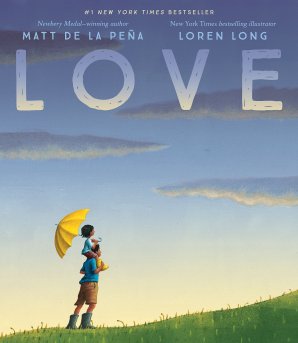
Love by Matt de la Pena illustrated by Loren Long

Standard
Love by Matt de la Pena illustrated by Loren Long

love.jpg

This 40-page-book may have a simple title, but most of us know, there is nothing simple about love, and this book shows love in many forms from a child’s perspective as they grow.  Sometimes picture books are basic and inspired to teach, or simply entertain.  Sometimes when picture books try to do more, the audience is confused when the pictures and amount of text on page don’t seem to align.  And sometimes, large pictures, with thoughtful poetry make the pages come to life and sing.  The book is written on an AR 3.7, so people thinking this book is for preschool aged children seem to be upset by the concepts hinted at and illustrated, but for older kids, this book has amazing power, and beauty that can show just how complex this universal feeling is.  

Love is your parent’s voice, love is burnt toast, love is the stars after your house burns down, love is in your grandpa’s wrinkles, love is staring back at you in the bathroom mirror.  But sometimes love also burns out and love is shielding you from things that might hurt you, and love separates people too. 


As humans, we can all relate to the same emotions, whether we give and receive love the same, the book shows the value and meaning it has to us all.  Hurray for illustrator Loren Long, because page after page, shows diversity of color, mobility, socio economics, age, and religion.  On a page where the love of the child is keeping her from seeing the TV that the family is crowded around a cross is present, and then a few pages later,bam, there is a girl in hijab looking up at the trees and listening to the love shared in their rustling. 

IMG_1901

I had no idea this illustration was present, and gasped aloud.  I said nothing to my daughter, finished the book, and handed it to her to read.  She turned the page and gasped aloud as well saying, “there’s a muhajaba, haha, we are in it too.”  Granted she is my daughter, so environment and genes account for something, but EVERY PAGE I think resonates with someone, and that gasp in my living room from me, from her, could come from anyone who turns a page in this book and bam suddenly feels represented, feels included, feels validated.  That my friends, is LOVE. 

IMG_1900

We are more alike than different.


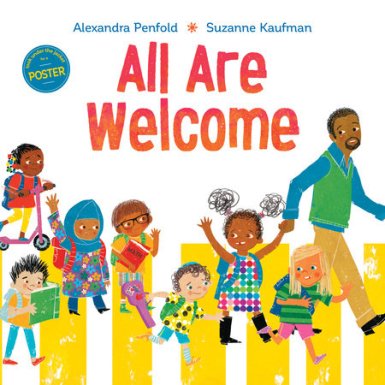
All Are Welcome by Alexandra Penfold and Suzanne Kaufman

Standard
All Are Welcome by Alexandra Penfold and Suzanne Kaufman

all are welcome

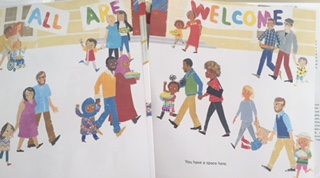
This is the perfect book for back to school.  It can set a beautiful tone of letting all children know that they are welcome, that they are accepted, that they are safe, that they are wanted and that they have value in your classroom.  It could also work to allay children’s fears heading in to a new environment, assuming of course that the environment is as fabulous as the one presented in the book.  

IMG_1788

The large, hardback 44 page book with a poster and large pullout concluding page, is fantastic for ages preschool and up, but would have value as part of any grades back to school message.  

IMG_1789

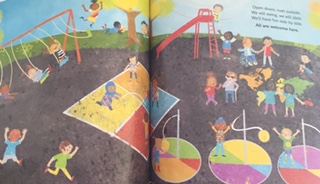
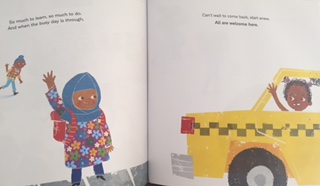
While the rhyming couplets are sweet and sincere, the real beauty of the book are the illustrations.  Bringing all that diversity to life in smiling kids faces, children with hijabs, and yarmulkes, patkas, baseball caps, glasses, curly hair, straight hair, every color of the rainbow, various physical abilities, all show what a day of inclusion can look like.  No one culture or background is articulated or placed higher than another and the coming together of the kids and then their parents and community is inspiring.

IMG_1787

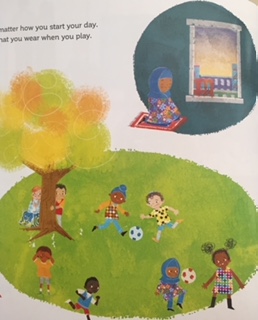
I love that their is a little muhajaba on the the cover and included in the cultural acceptance of the book.  It shows her praying in one picture and then joining in and smiling with the rest of the diverse group of characters in the other pictures.  Feeling included and accepted whether in a classroom, or in a children’s book, feels good, at any age, alhumdulillah. 

IMG_1790

A special shout-out to all the educators and people in positions of power who go the extra mile to create a safe and accepting space, thank you.

IMG_1791

Tilt Your Head, Rosie the Red by Rosemary McCarney illustrated by Yvonne Cathcart

Standard
Tilt Your Head, Rosie the Red by Rosemary McCarney illustrated by Yvonne Cathcart

rosie.jpg

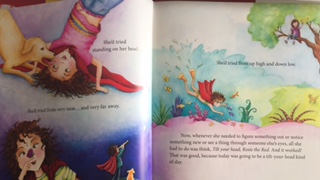
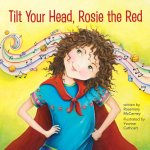
This book is nearly the mirror of Nanni’s Hijab, just told from a different perspective and swapping out the heroine.  Written in 2015 this book definitely came out first, and while the 24 page book is targeted for  4-8 year olds, if your teaching point of view, this book and Nanni’s hijab could be used for older kids to make for a great lesson.  

IMG_1753

I love that this book is written by a non Muslim and the main character is non Muslim.  The binding the pictures, the size, all make this a wonderful addition to any library in showing that differences can and should be celebrated.

IMG_1752

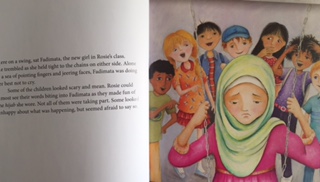
Rosie loves wearing her red cape, and she loves looking at things from all angles and perspectives.  One day at school she arrives at school to see kids making fun of the new girl, Fadimata and her hijab.  

Unable to stop the kids she reaches out to Fadimata, and transforms her cape into a hijab in solidarity.  After the teacher also talks to the class about being kind, the next day is a surprise for Rosie, when many of the girls are wearing scarves and hijabs in a variety of manners to show acceptance and celebrate differences.

IMG_1751

This is the first book in a Rosie the Red Series, and I kinda really love that in the second book, Being Me, about volunteering at a food pantry and helping a friend, Fadimata is minor character.  She is now one of Rosie’s best friends and is both mentioned by name and illustrated.  This is awesome to me, because while books about Muslims are great, having us be in books as supporting characters solving other problems, learning lessons, and going on adventures, makes us more mainstream and inshaAllah part of the accepted landscape.

rosie1

*Side note, if you look at this book on Amazon, and read the comments you can see how truly upset many people are by this book calling it “indoctrination” and criticizing it for not encouraging assimilation.  If you read the book and like it, and like the tone and message it promotes, maybe write a review, and make the world a little warmer.

I’m New Here by Anne Sibley O’Brien

Standard
I’m New Here by Anne Sibley O’Brien

Im-New-Here-by-Anne-Sibley-OBrien-on-BookDragon

Three new kids, not just at school, but to America as well. Maria is from Guatemala, Jin from Korea, and Fatimah from Somalia.  All three telling about what they are faced with as they settle in to their new life and routine, and all tell a bit about how things were back home.  FullSizeRender (48)

This book is not entertaining or fun, it is educational.  Written for ages 5-8 this book is very straightforward as the three characters stories are interwoven to show the growth and settling in that they experience.  The simple sentences, allow the reader to learn real, tangible ways that this children are finding the transition hard.  It also alleviates any sense of pity as it shows the full lives they had before coming to America. 

FullSizeRender (49)

I love that the other kids in the class are involved in real life ways to help welcome the new kids to class. Sometimes we are harsh on kids that don’t show empathy or compassion, forgetting that often they don’t know how.  This book works for adults and children in all situations.  We all need to put ourselves in other peoples shoes and see what struggles they are facing, we all need to help one another, and we all need to facilitate environments where these actions can take place.

FullSizeRender (50)

The book in many ways would fit well with One Green Apple, as it gives the perspective from the character who is new and articulates some of the obstacles they are facing, while also showing the interactions that help one to feel welcome and comfortable.

The pictures are crucial to the story as they show the feelings of the children and give context to the simple storyline.  I love that their is so much additional diversity in the illustrations: children of all body shapes, there is a student in a wheel chair, Fatimah wears a hijab, and there are male and female teachers in the book.

FullSizeRender (51)

The Author’s Note at the end of the 32 page story tells of her experience as a white American child living in South Korea, and some of her feelings and thoughts of being in a new country.  There is no mention of Islam, just implies Fatimah is a Muslim based on her dress, her mother’s clothing, and her country of origin.