Category Archives: ramadan

Hamza’s First Fast by Asna Chaudhry

Standard
Hamza’s First Fast by Asna Chaudhry

hamza fast

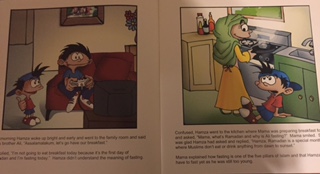
Hamza’s First Fast starts out a bit wordy as the author tries to explain what Ramadan is and who is required to fast and why, before getting to the actual story line of the book.  The premise that Hamza’s siblings are fasting and that Hamza doesn’t know why or that it is Ramadan is a little questionable to me, but I doubt most 2-6 year olds are as cynical as I am.  Once the story gets going, however, the amount of text on the page drastically decreases to fit the younger demographic and the point of the book is charmingly exposed.

hamza4

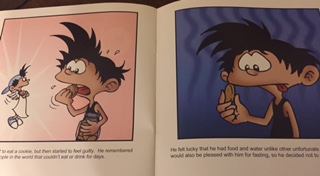
Hamza understands that he doesn’t “have” to fast, but decides he “wants” to try. He prays with his dad, his sister helps him to understand how fortunate he is to have food, he goes outside to play, and he even tries to get lost in some video games.  But, it still isn’t time to break his fast and he is hungry! As his frustration mounts he decides to sneak a cookie, but when he gets it, he will have to decide to eat it or not.

I like that it is realistic that fasting for kids is hard, and can be really frustrating. It still encourages them to try, and the family members support him which is nice.  It also stays positive framing it that Allah will be pleased if he fasts, not that Allah will be disappointed if he eats the cookie.  Overall, there isn’t much religious rationale for why we fast and the Islamic traditions celebrated as the book stays on age level in what Hamza does.  This leaves the door open for discussion, lessons, insights, and interpretation, but does not weigh the book down with it.

hamza3

Perseverance is the theme of the story and that it feels good to do something hard.

Welcome Ramadan by Lila Assiff-Tarabain illustrated by Gurmeet

Standard

welcome ramadan.jpg

As many of us are setting out our Ramadan decorations and pulling our Ramadan books from the shelves, or realistically browsing Amazon, the quality and presentation of Islamic picture books is impressive.  And with this new expectation, there is also an increase in price, this book however, is the opposite.  Ranging from .97 cents to $3 online this little 6.5 inch by 9.5 inch 24 page book is a lot of bang for your buck.welcome ramadan1

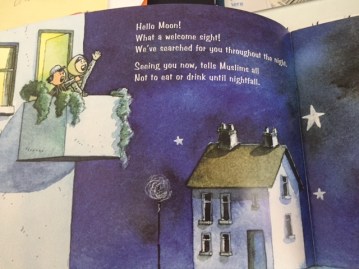
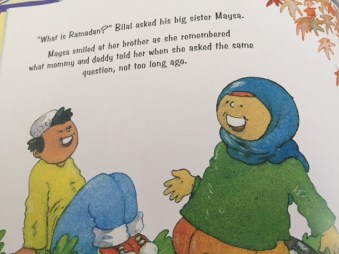
Starting with finding the moon, big sister Maysa tells her younger brother Bilal all about Ramadan, in (mostly) rhyming couplets none the less.  She tells him about walking up before dawn and explains that yes that means no lunch.  She also explains that because they are little they aren’t required to fast. They then explore breaking the fast, going to the mosque to pray, having good manners, and learning that a full moon means that Ramadan is half way over.  Reading the Quran is discussed as well as how we have to be generous with what Allah swt has given us. It concludes with Eid and a Parent/Teacher guide at the end to help Muslim and non Muslims alike learn about Ramadan.

welcome ramadan3

The pictures are cute and comical, albeit small given the overall size of the book.  It covers Ramadan on a level kids of all ages can understand, and because of its easy reading style even older kids can skim through it and find it enjoyable.  There isn’t really a story, it is just a fun way to share the “facts” but a welcome addition to any book shelf both at home and in a classroom setting.

The Shapes of Eid According to Me by Samia Khan illustrated by Maria Ahmed

Standard
The Shapes of Eid According to Me by Samia Khan illustrated by Maria Ahmed

shapes of eid

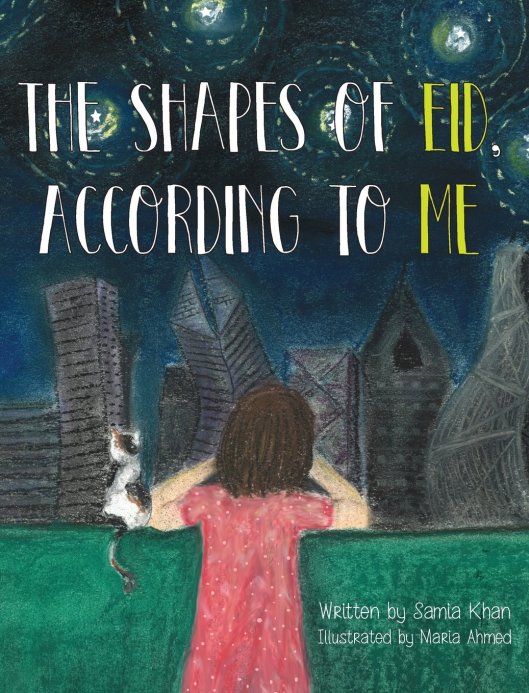
A new Eid book that talks about the religious aspects of Eid, such as praying and going to the mosque, as well as the cultural fun of getting henna done and eating samosas, presented through the shapes a little girl finds all around her.  I liked the idea of presenting Eid through a different lens so to speak, and finally gave in and ordered the $17 hardback 28 page book.  I had touched base with the author before I ordered it to see if it would work for little kids at a masjid story time and she thought it would.  The text is one to four lines per page and rhymes, which allows the little ones to stay engaged.  Some of the lines are forced or seem to break the rhyme scheme, but overall a book about shapes with rhyming lines makes sense.

The-shapes-of-Eid-According-to-me1

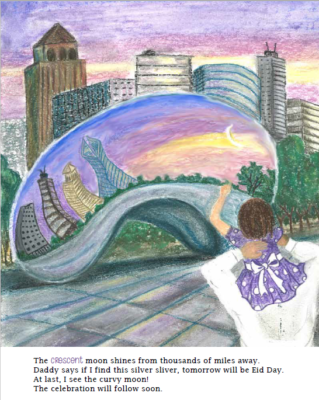
The part that I was underwhelmed with was the illustrations.  A book with such a visual concept at its core, to me would require breath taking pictures.  But alas, the pictures seem done with crayon and colored pencils, and on many pages finding the shape is almost difficult for little ones.  The detail is lovely, but the presentation seems lacking. They aren’t bright and shiny, they are muted and flat.  The disconnect of the text and binding with the pictures seemed jarring to me. Perhaps it was just the price point made me expect more, I don’t know.  I like the book, but I don’t love it.  I will be reading it to a group of kids and if they love it I will take back my criticism of the pictures, happily.

shapes 3

I think the book works up to about 2nd grade, as the geometric shapes are both flat and 3-D, plus getting excited for Eid is something everyone enjoys.  There is no reason this book is limited to Muslim children, but non muslims might be left with more questions after reading it about how Eid is celebrated and what aspects are religiously required and which are just fun customs.  There is a small intro at the beginning to what Eid is, but no glossary or further info is included.

Drummer Girl by Hiba Masood illustrated by Hoda Hadadi

Standard
Drummer Girl by Hiba Masood illustrated by Hoda Hadadi

drummer girl.jpg


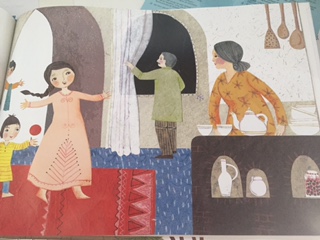
Before she was Grandma Najma, she was just Najma.  A girl in Turkey with a secret dream of being a musaharati, the person who walks the streets waking up the neighbors for suhoor in Ramadan.  But, a girl had never done this and thus the dream stayed hidden until she was 12 and the neighborhood musaharati was feeling ill.  Confiding in her baba, his love and support makes her dream come true against cultural norms and naysayers.  The line from her Baba, “Girls can be anything they like,” is so clear that her one girl revolution grabs the hearts of the reader and turns readers into cheerleaders.  The added beauty is her father’s support is not limited to his words, he accompanies her out every night almost challenging anyone to say she can’t do it.  Overtime she becomes the pride of the area, and her brothers accompany her if she doesn’t want to go alone, and then eventually her husband and her children.

drumemrgirl2The book warms the soul and uplifts the spirit.  The text seems geared to 7 year olds and up, as there is a lot of it, and at 26 pages does require some ability to focus. But with minor tweaks and condenscing the story appeals to children 4 and up and the pictures help hold their attention as they create a mood of wonder and whimsy.
drummer text

Structurally the book is hardback and dust jacket free, yay! the cover is printed on and thus easier to maintain.  The book is longer horizontally with most illustrations on the left side making it great for story time where the kids can see the pictures and the reader can hold and easily see the text without blocking the children’s line of sight.  There is a glossary, an author’s note telling where the story comes from, and a little biography of the author and illustrator and publisher in the back.

drummergirl1

A beautiful, beautiful book to share with children this Ramadan and all year long, alhumdulillah.

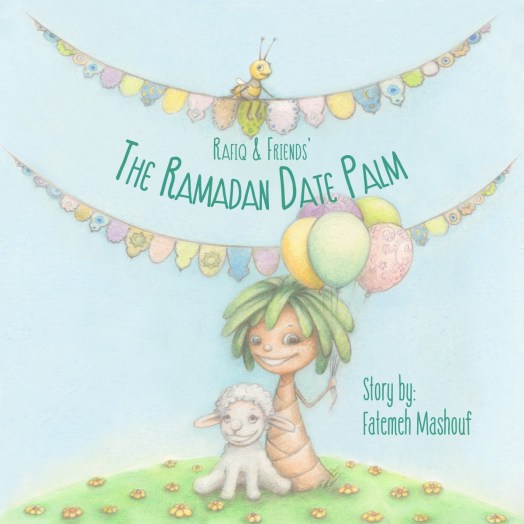
Rafiq & Friends’ The Ramadan Date Palm by Fatemeh Mashouf illustrated by Vera Pavlova

Standard
Rafiq & Friends’ The Ramadan Date Palm by Fatemeh Mashouf illustrated by Vera Pavlova

datepalm-cover

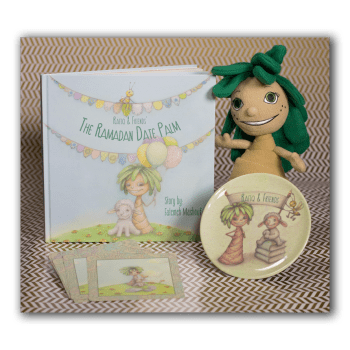
It is nearly Ramadan, inshaAllah, the most blessed time of year.  I don’t normally do product endorsements and thus I didn’t review this book that comes with a whole Ramadan kit last year when my cousin gifted it my children.  However, as I look for Ramadan Story Time books, I reread this and while it references the activity cards, it really offers a lot as a stand alone book too.  So, yes I am going to review it and plug the kit as something your kids up to age 9 or so will really enjoy, at least mine did and even went searching last week for all the components….without being asked! That’s a pretty strong endorsement right there.

rafiq-_-friends-5

Rafiq is a date palm tree that is so excited for Ramadan and is going to get you excited too.  He starts off by mentioning the fun you will have with the daily activity cards, and the role you will play in serving iftar dates on the special plate. The reader is then introduced to the cast of characters, Najjah the sheep, and later Asal the bee.

rafiq-_-friends-sample-2

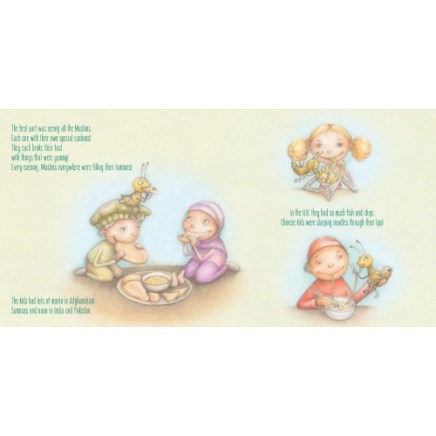
The middle of this 36 page book are my favorite, the illustrations are so sweet and welcoming you want to hang them up in your children’s rooms.  This is where the “story” begins, it talks about Ramadan and how the Quran was revealed to Prophet Muhammad (saw), and fasting, and praying and patience and having fun with friends and playing too.  It then moves on to Eid and all the different yummy foods that are eaten all over the world.  It ends on a note of community and how we all pray the same with our families and use the word salam.

rafiq-_-friends-sample-4

The book is visually beautiful from one hard back cover to the next.  It is written in rhyme and most of it flows without feeling ridiculously over forced, but there are definite sentences that are awkward, and the rhythm seems to vary a bit that you have to stay alert when reading it out loud or you will get tongue tied.  I think if you just skip the lines that reference the cards at the beginning and end, the book can work without the kit and accessories.  Kids might be confused, but I think the bulk of the book is engaging and the pictures are stunning, that kids will be able to grasp on to the overall message of the book and forget about the “product placement” so to speak.  There is a glossary at the back, and it works for ages 3-10.

Rafiq-Product-Set_dropshadow-350x350

(I wasn’t paid or asked to do this review, I wish I was, but it really is fun for multiple aged children, and gives a bit of daily Ramadan connection for those of us that want to make every day in Ramadan a craft and spiritual extravaganza, but know realistically we just won’t be able to do it all https://www.rafiqandfriends.com/)

A Long Pitch Home by Natalie Dias Lorenzi

Standard
A Long Pitch Home by Natalie Dias Lorenzi

a long pitch

The correlation between baseball and cricket provides the foundation for detailing the relationship of  Bilal’s first year in America after having to leave Pakistan in a hurry: the same, but different.  This 248 page book written on an AR 4.6 pivots around sports, but has a lot of heart as themes of family, friendship, and longing, take center stage.  Throw in a whole new culture, the English language, Ramadan and prom and you have a whole lot to cover in this well crafted story.

SYNOPSIS:

Bilal has a good life in Karachi, Pakistan.  He is the oldest of three kids and at 10 years old, his world pretty much involves Cricket, friends, and his dad.  When his father disappears things get frantic, and when his father returns, the family decides to move to America.  Unfortunately Bilal’s dad can’t come.  As Bilal, his mom, his younger sister Hira and younger brother Humza, board a plan to Virginia, everything Bilal knows is left behind.

Virginia is home to Bilal’s maternal Uncle, his wife, and their teenage son, Jalaal.  Jalaal plays baseball and arranges to have Bilal join him at baseball camp for the summer.  Learning the new sport, and a new language, and the nuances of life in a new land are frustrating and often comical as Bilal points out how confusing navigating American life can be.  He also keeps an ongoing list of new things in America to share with his dad over Skype, as they swap memories of an old life in preparation for a new one.  The supporting characters on the field are generally kind and accepting of Bilal, because they have a bigger problem then a foreign boy, there is a girl on the team, Jordan.  Jordan is new too, and the coaches niece at that, naturally they become friends, but its not easy, Bilal has to learn what being a friend really means.

The majority of the book stems from the tension of waiting to hear from Bilal’s father, and to see if he can come to America.  The passing of time with baseball games and school are anecdotal to the larger arc that sets the pace of the book.  Will Baba be able to come, and if so, when?

WHY I LIKE IT:

Interestingly religion has a pretty big role in Bilal’s life and the author does explain some tenants in Islam.  He wakes up for fajr (although he does miss it occasionally), he only eats halal zabiha, the family fasts in Ramadan, and they celebrate Eid.  Bilal wants to fast, but him mom tells him he is too young when they are coming to America, and the following year he doesn’t because of baseball, which is unfortunate, because a lot of kids fast and play sports all over the world.  They go to the mosque on Eid only, and it mentions that the women in his family do not wear hijab like some of the women at the mosque.  His older cousin Jalaal wants to take the neighbor girl, Olivia, to prom, which the family explains awkwardly as something that Muslims don’t really do until they are older, or at least that is how Bilal understands it.  In the end, they let Jalaal go with Olivia and a group of friends, and the whole family Skype’s the family in Pakistan and sees them off.  Even more funny is that they don’t join their friends for dinner before the dance, because Jalaal is fasting and can’t eat until later.  I don’t know if this will confuse 4th and 5th grade readers, but as an adult I found it hysterical, because these cultural contradictions are more common than not.  I did like that nothing was done behind the parent’s backs.  Things were discussed and worked out instead of lied about.

Another thing that I found interesting, but since finishing the book, I have come to appreciate, is that there is no Islamaphobia in the story, or even xenophobia.  The kids are accepting of Bilal’s faith and culture.  He is far more self conscious about being different or not understanding than those around him are.  Its idealistic perhaps, but at the same time, I think it would distract from the core of the story.

While the book focuses on sports, I think even non sports fans will be able to enjoy the story.  The author doesn’t get too technical and it moves steadily with mini climaxes and triumphs through out.  Girls and boys will enjoy the book, Muslims and non Muslims too, the readers might even learn something about baseball or cricket or Pakistan, or even about themselves along the way.

FLAGS:

The book is remarkably clean and what you would expect for a good quality, solid 4th grade and up story.  There is the “prom” issue, but there is no hugging, kissing, longing etc.  They “like” each other, but it isn’t more explicit than that.

TOOLS FOR LEADING THE DISCUSSION:

I don’t know if I would use this for a Book Club.  One could, but I think it would require a lot of coaxing to get kids to give a book about baseball/cricket a try.  I have no doubt if they started it, they would finish it, but it might be a tough sell.  The confusion in American life would make for an awesome discussion after being read, because everyone can relate to some of the oddities of the English language, and challenges of learning a new language and culture.  I think how Islam is handled would also make for some good discussion in addressing how each family handles things differently as they arise.  Although written on a 4.6 level if I were to do it in a school setting, I would probably do it for middle school kids who could articulate their own life parallels to the story.

An interview with the author:

http://wordspelunking.blogspot.com/2016/09/a-long-pitch-home-blog-tour-interview.html

Overall a solid decent book about an immigrant Muslim boy making his way in America, while not losing or giving up on who he is, alhumdulillah.


Snow White: An Islamic tale by Fawzia Gilani illustrated by Shireen Adams

Standard
Snow White: An Islamic tale by Fawzia Gilani illustrated by Shireen Adams

snow-white_cov

A lot of the twists that I was surprised by and endeared to in Fawzia Gilani’s Cinderella, seemed lacking in her re-telling of Snow White.  Perhaps it is the mere fact that Cinderella has a legacy of being re-told from different cultural perspectives and in different time periods, where Snow White doesn’t, that made this book stumble where her other sailed much more smoothly.

The basic premise of this Snow White version is naturally the classic tale.  Snow White is the envy of her stepmother, in this case however, it isn’t a magic mirror, but a jinn who answers her questions. Once the huntsman is convinced not to kill her, and a boar’s heart and liver are taken instead,  Snow White finds the companionship and shelter of the dwarves.  In this re-telling, it is a female crew with countless skills that they are happy to pass on to their newest friend.  When the evil stepmother finds out Snow White still lives she concocts poisonous dates to present in disguise to Snow White who is awaiting the appointed iftaar time.  The dwarves arrive home too late to save Snow, but see who has done the evil deed.  The Prince makes his brief appearance as he arrives at the cottage, makes dua’a for Snow and then sends his mother to nurse her back to health.  In fairy tale tradition a wedding soon follows, but the evil step mother has one more trick up her sleeve, she poisons a comb that Snow is surely to use as she prepares for the big day.  The dwarves cannot thwart the stepmother and Snow is only saved when the stepmother in all her vanity accidentally picks up the comb to fix her own hair.  Over time she recovers and Snow forgives her and they all presumably live happily ever after.

snowwhiteanislamictalepage2

Perhaps it isn’t fair to compare the two books, but I would imagine they are often purchased together and I feel like there are some notable differences that are worth mentioning.  In Cinderella, the setting is Andalusia and they are all about the same skin tone.  Snow White seems to resort back to old stereotypes and the stepmother seems to be the only one with a darker complexion with all the others being more fair.  Granted her name is Snow White, but it is established on the first page that her mother prays for a child with a “heart as pure as snow,” so really that doesn’t hold up.  Also, where I felt that Cinderella could work for Muslims and non Muslims alike, I think this one would be a hard sell for non Muslims.  There are a lot of references to dua’as of Noah and Job, there is Ramadan, the role of the jinn, she even does tayammum at one point and readers may be confused why sometimes she is in hijab, and when home with the women she is not.

Like Gilani’s Cinderella, the book is very thorough in being Islamically appropriate.  The sisterhood is a nice twist and the Prince has a really small part.

snow-white-1-300x286

The illustrator is the same, yet for some reason the pictures seem a bit dull in this book.  The bottle of poison is shimmery, but the other illustrations seem muted and almost rushed.  The book is 41 pages with a glossary and Reference for Quran in the back, and is very text heavy.  Probably 3rd or 4th grade level with some assistance on the Islamic concepts.

Better Than a Thousand Months: An American Muslim Family Celebration by Hassaun Ali Jones-Bey

Standard
Better Than a Thousand Months: An American Muslim Family Celebration by Hassaun Ali Jones-Bey

Better Than a Thousand Months.jpg

To be honest, I didn’t get the book.  I mean I understand that it was derived from stories the author told his children, and I’m guessing it was written to show similarities between Muslims and Christians, but I don’t understand how the 168 pages with lots of photographs and text from the Qur’an got published as a book.  That is not to say it isn’t without merit, it just leaves a lot to be desired.  The teacher in me really, really, really, wanted to pull out a purple pen and start editing.  I checked twice to see if I had an advanced copy or uncorrected proof, I even Googled the book to see what I was missing.  It doesn’t work for me as a completed book.  To me, however, it is a wonderful outline that is desperately wanting to be fleshed out.

SYNOPSIS:

A man in San Fransisco is sitting on the train when there is an earth quake, thus delaying his trip home.  As he dozes off he imagines interactions with his children that share his knowledge of Islam with them, and thus the reader.  The first interaction is with him and his young daughter discussing Christmas, and how Muslims view Jesus and the power of Allah the creator of all.  They jump in the “time machine” truck and drive through the hills of San Francisco reflecting on the concept of patience.  As Ramadan comes and the narrator dreams we get bits of how Muslims in America celebrate Ramadan, and some of the tenants of faith.  When he is awake we get some story about his family, how he came to Islam and his Grandma passing away.  But nothing is explained or even connected.  I have no idea how many children he has, what the story is with the step children and the confusion from having two daughters with the same name.  The story goes back and forth with his dreams being more “real” then his awake time, and both kind of moving in the same direction of explaining how Islam is practiced as a family in America (praying together, waking up for suhoor), the questions that arise from the children (how to pray at school, why Ramadan decorations don’t decorate the city), and how we are all more alike than different (same Prophets, similar stories).  The final dream sequence is sweet with the father and daughter showing, not just talking, about giving and charity, that I really want to send the author back to finish writing the book.  There are so many tangents that would give it depth that are stated in a few sentence paragraph that could so easily be developed in to whole chapters.  Unfortunately, as is, the reader is just left disjointed and confused.

WHY I LIKE IT:

I really like the premise, I like the literary flip of telling the story in the dream.  The ideas are just not presented smoothly.  I don’t think that a tween would get it, and the choppiness of the ideas bouncing around from short paragraph to short paragraph would dissuade even the most seasoned middle school reader.  The book has some good tidbits, but they are lost in the short glimpses of story and long passages of meaning of the translations from the Quran.  The Arabic Calligraphy is nice, but it isn’t stop in your tracks beautiful, and the font of the English translations are difficult to read.

FLAGS:

None, the book is clean.

TOOLS FOR LEADING THE DISCUSSION:

I tried to get my daughter to read it, but she was so lost and even asked if it was a collection of stories or a chapter book, that I couldn’t force her to finish.  If you can get through it, one could discuss how to “fix” some of the struggles the book has, thus emphasizing what the reader liked and imagining the back story for all the questions that arise but are ultimately not answered.

Bestest. Ramadan. Ever. by Medeia Sharif

Standard
Bestest. Ramadan. Ever. by Medeia Sharif

Bestest.-Ramadan.-Ever.-by-Medeia-Sharif

This book fails on so many levels: the writing quality, the title, the representation of Islam and Ramadan, messages about weight and beauty, and female self-worth to name a few.  This 299 page 5.0 AR book looked great as I was skimming through the library book catalog.  I knew it was young adult romance and saw that it would involve crushes and boys, and “typical” teenage stuff, but really this book has so few redeeming qualities for any demographic, I’m not sure why it was written, why it was published, and why the library shelves it.

SYNOPSIS:

Almira is a 15-year-old girl of Persian-Syrian descent living an all American life in Florida. She has good friends, is a good student, and is financially well off.  She is Muslim, but doesn’t really know what Islam is, “I’ve been to a mosque exactly twice in my life” she says.  She doesn’t pray, her parents only do on occasion, yet she feels “different.”  This over stretch is the first of many plot holes, that make the tone of the book more whiney and shallow, than the premise requires.  Having tried fasting the year before and been found cheating by her culturally strict grandfather, Almira is determined to fast this Ramadan to lose weight and prove she has willpower.  There is a glimmer that her shallowness will fade, but the weight issue is mentioned every few paragraphs and thus there is no pushing it away.  The author presents Ramadan as one giant weight loss program.  There is no mention that Ramadan as a spiritual time or reflective time.  Nope.  She is fasting to lose weight, and everyone around her is supporting it, by constantly commenting at how much better her size 8 is looking as the month progresses.  The biggest storyline in the book is that Almira wants a boyfriend.  Again, this is contrary to Islamic practices, but naturally crushes and crossing rules is a reality.  However, even to girls not faced with a religion that forbids boyfriends, the messages in this book regarding boys is pretty pathetic.  Almira changes her self to impress the boy, pretending to have interests that she doesn’t have.  She is willing to sacrifice her best friend since Kindergarten to get said boy, and while they mention that everyone treats them superficial based on their looks, they too treat each other the same way.  Almira and her friends get so much of their self worth and confidence from how boys ogle them that I found myself often cringing with disappointment.  Now, granted it is a YA book, and 15-year-old romances probably are pretty shallow, but again the whininess just starts to be too much.  There is a brief glimmer of hope when the family goes to the mosque and prays and breaks fast together, but it is short lived as Almira finally gets the boy, finishes Ramadan, and celebrates in a bikini on the beach, “And look at us, half naked on Eid,” she says to her Muslim friend, Shakira, as if that is the epitome of making it in America.

I don’t expect all books to have a message, but if you are going to have a moral message in a book, I would hope that a book written on a 5th grade level would have a good one.  This book’s lesson is to lie and lead a double life.  And no that is not me over simplifying and putting my own bias on the author’s storyline choices.  “I’ll sneak out with Peter whenever I can, while I show my parents a goody-two-shoes facade that will be impenetrable.  I can keep this secret,” thinks Almira as the book concludes (page 287) and everything is right in her world. She feels a tinge of guilt that she can’t talk to her parents, not guilt at her actions, which is really the epitome of my confusion to why the book has an Islamic implied title.  Ok I get maybe she wants a bit of cultural layers to add depth to the characters, but why structure the book on religion when religion is made to be such a joke by failing to give it any substance? Had she made it more cultural and the characters culturally are Muslim, even that would have worked better.  But, they aren’t.  The parents are really really one dimensional.  Mom is “hot” and even when the family is talking she is in the corner doing crunches.  She loves karaoke and doesn’t like grandpa is about all we know about her.  Nothing about her dreams, her family, her life growing up, her fears, her education.  Dad similarly is pretty flat.  He is a dentist and just looks at people’s teeth. He goes from being uber mellow and cool, to deleting pictures on her computer and yelling at her that she can’t date.  Neither trait seem to define him, and make an already shaky premise, more awkward.  Almira whines and complains about her parents, but they overall seem supportive and kind, again a plot hole that makes the book lose traction.  Grandpa is the scary old-world stereotypical character, that calls everyone a prostitute that doesn’t dress modestly, but goest out of his way to teach Almira to drive.  The grandma fades into the back ground, but oddly enough the author takes time to mention that recently she started wearing a scarf and used to wear heels and make-up, so did grandpa call her a prostitute? Again things don’t line up and once again the female characters are defined by their looks, and the males as being hot tempered and judgemental.  It is unfortunate that the foundation of the book is so weak.   Additionally, all the pop culture references, already start to date the book (it was written in 2011), most 15 year olds today probably are not obsessed with Robert Pattinson and Angelina Jolie. The author tries really  hard to sound like a teenager, that at times it seems overly forced.

WHY I LIKE IT:

Obviously I’m not a big fan of the book, so finding things I like is a bit of a stretch.  I have more hope that girls can be strong and independent and not completely boy and appearance obsessed.  And while I know that is wishful thinking, this book just validates the sad idea that self worth is tied to looking good in a swimsuit and having a boyfriend.  I feel like our daughters deserve more, are capable of more.  I like that Almira is willing to try new things, like fasting and going to the mosque. And I do like that she more or less puts up with her grandfather in a kind manner, even though they disagree about most everything.  In terms of the “romance” aspect at least the author didn’t go overboard.  The characters kiss and hold hands, it does stay within the PG-13 guidelines. So, Alhumdulillah, if a young Muslima picks it up thinking she might actually read about an amazing, spiritual Ramadan experience, she will be terribly disappointed, but at least she wont be exposed to something R-rated.

FLAGS:

The flags are with content, presentation, and writing style. There is no language.  The idea of violence, if her grandfather caught her with her boyfriend stoning her, seems out of place and not a realistic threat.  There is nothing negative per se about Islam, as there really is no Islam in it. I doubt even someone with no Islamic knowledge would equate anything in the book with Muslims.  They may wonder if in fact we lose weight during Ramadan, but that is about it.

TOOLS FOR LEADING THE DISCUSSION:

There isn’t much to discuss in the book, just criticize unfortunately. The author’s blog reveals that Islam and cultural characters seem to be a common back drop in her books, but I doubt I’ll muster up the desire to read any other novels of hers to see if they ever serve more than that.

Max Celebrates Ramadan by Adria F. Worsham illustrated b y Mernie Gallagher-Cole

Standard

Max Celebrates Ramadan

Max is a character in a series of leveled readers that explores familiar topics to build reading confidence (Max Goes to the Doctor, Max Goes to School, etc.), and introduces new ideas as the reader’s skills build (Max Celebrates Cinco de Mayo, Max Learns Sign Language, etc.).  I love that Ramadan was included and this 24 page AR 2.0 book is spot on, in what a new reader can handle without getting frustrated or bored in terms of content, and ability.

max

Max goes to his friend Omar’s house to celebrate Ramadan.  He learns a little about the month, what the Quran is and about Eid al Fitr too.  The foreign words are explained in the text and there is no explanation of belief or doctrine.  There are just simplified, age appropriate, descriptions of what a Muslim does and what you might see during Ramadan.  Very level appropriate for Muslim and non Muslim children.  Omar’s family is inviting and kind, and the illustrations show them to probably be of Indian decent as the mother and other females are wearing saris.  None of the women cover, but the males all wear kufis.max1

The book doesn’t stand out in any way, but most leveled readers, in my opinion, don’t.  If you have young readers check and see if your library has the book, the kids will enjoy it.  It works ok in small groups, but not for story time so well, as it is rather repetitive in a dry, not predictive way.  If you are a kindergarten through 3rd grade teacher, I think this book would be a great addition to your book shelf, as well as the others in the series as a way to learn about other people in an independent way.  My son going in to first grade read it by himself fluently and enjoyed the pictures.  Someone new to the concept of Ramadan, i think, would also be able to grasp the concepts without much outside help.