Category Archives: preschool

Eid Breakfast at Abuela’s by Mariam Saad illustrated by Chaymaa Sobhy

Standard
Eid Breakfast at Abuela’s by Mariam Saad illustrated by Chaymaa Sobhy

breakfastThis book is the first in a series (hopefully) called Trilingual Sofia, where English is the predominant language, and Spanish and Arabic are interwoven to tell the story.  Focusing on Eid and spending the holiday in Mexico with her non Muslim grandmother, the story with bright illustrations is a celebration of diversity, acceptance, family, and Eid.
DBFF1967-9421-47C8-B88C-4AAF8703E31F

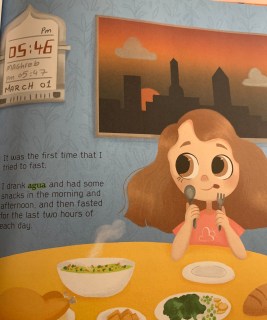
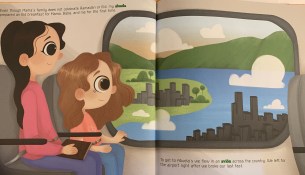
Sofia has had a special Ramadan.  She tried fasting for the first time and now that the month is over, they are breaking their fast and then getting on a plane to Mexico to have Eid breakfast with her Abuela.

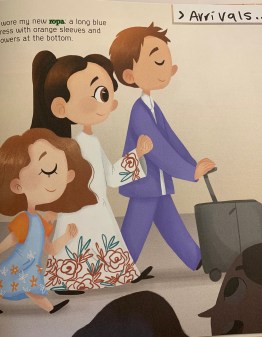
On the plane she keeps her pretzel bag to add to her scrapbook and then they get changed into their Eid clothes before they land.  Once in Mexico they go straight to the mosque to meet their friends and then to Abuela’s house.
2CA2CEE1-B699-4E8E-A829-C25E3E313FBC

Abuela’s house is decorated for Eid and all the family is there.  They eat breakfast together and the kids play games and sing songs and take pictures.

084D716E-6D5D-448E-A580-95E48C73FDD0

The 32 page 8.5 by 8.5 inch hardback book claims to be for toddles and preschoolers, but I think it is more for kids in early elementary with the small and ample text.  The Spanish words are highlighted in green and Sofia teaches some Arabic to her Mexican cousins.  There is a glossary of all three languages at the end.  
0DA1427C-192E-4E78-B3DE-A564B98A4327

The book is not meant only for Muslim children, but it doesn’t explain Ramadan or Eid, so while Muslim’s might be able to connect the dots of why she only fasted the last two hours of a day or why they went to the mosque before they went to Abuela’s, I wish the book explained it.

00BE02BE-79D1-4753-BA92-A48C7311B4C3

I love that their are subtle connections between the three languages, like Angel Gabriel/Jibreel and the name Yusuf/Joseph.  The book is a great example of Islam outside of the Middle East and the Asian subcontinent and I truly hope there are more books in this series and more books like it to show the diversity of Islam and the commonalities we all share.

We are Muslim, Al-Hamdu Lillah! by Kathy Fannoun

Standard
We are Muslim, Al-Hamdu Lillah! by Kathy Fannoun

we are muslim

In digging through and pulling out board books for my nine month old to chew on, I realized I never reviewed this staple.  Published in 1994, this 16 page 4 x 5 book does a good job in rhyming verse discussing the universal bond of Islam for our littlest ones.

72F3DEAA-A0DD-4BEC-9667-E782A5AFE53E

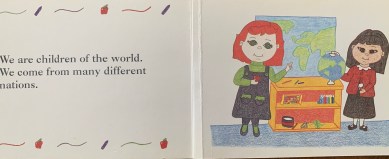
It starts out by stating that we are children form many different nations, and are different shapes and sizes, but that Allah swt created us all.

B32A82CC-61BC-47CE-94F4-D302669CAFB4

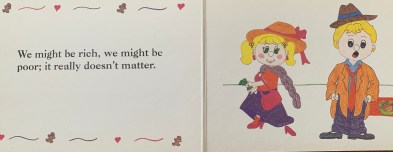
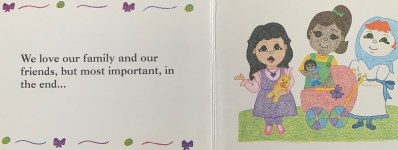
It reminds us that even though our words are different, and some of us are rich and others poor, we still enjoy God’s gifts and love our families, because in the end we all praise Allah, and are Muslims, Al-Hamdu Lillah!

D007C9D7-BB64-40AA-948A-687D94CAE643

The illustrations are clearly hand drawn and filled in with colored pencils, but they show diverse skin tones, a few different ethnic dresses, some in hijab and kufis, others not, and all smiling.

664F0608-6997-4DC6-A34F-A3B9492D4688

This book is basic, which makes it perfect for little ones at bedtime and even in small groups.  Younger children appreciate the simple message and rhyme scheme and it is the perfect size in their hands.

0E54226D-5415-4FBC-90F9-0764BC4B7154

This book is probably bringing back memories for many of you, as it was one of the first books of its kind.  A board book, that is Islamic, cute and fun, for English readers. I remember in high school reading it to my Sunday school preschool class at the masjid, sharing it at story times at the masjid as an adult, and reading it to my own kids over the years.  The binding is still holding strong, and the words still remind me how blessed I am to be s Muslim, Al-Hamdu-Lillah!

The Mighty Head of Moustafa by Rania Emara illustrated by Fruzsina Kuhari

Standard
The Mighty Head of Moustafa by Rania Emara illustrated by Fruzsina Kuhari

moustafa head

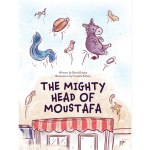
This fun new twist on “The House that Jack Built” uses the same style of building sentences on to a repeated story that the classic uses, as well as the silliness of it all, but is made unique with the Middle Eastern setting and cultural aspects.

90A73EFF-DE4E-4D30-9AF6-3353B0E0B979

The 8.5 x 11 size gives ample room to see the fun engaging illustrations that bring the comical rhymes to life in both small to medium sized groups.  I won a digital version, and will probably end up purchasing a paperback copy for my bookshelf, as the pictures and text will be easier to pour over in physical form.

1F6DDDD0-6F9D-4AFC-B8CF-8F5418D7DAD7

The book is 22 pages of text and perfect for toddlers to listen to, on up to 2nd or 3rd graders to read on their own and still be entertained.  There is nothing religious about the book, the boy is named Moustafa obviously, and there is a girl whose veil is the climax of the story, but nothing in the text is religion specific.

D7820AEC-BBAE-40AC-A521-79BDD19AD815

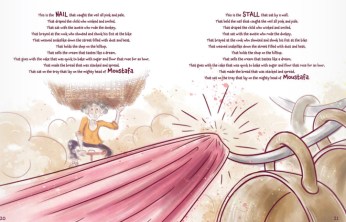
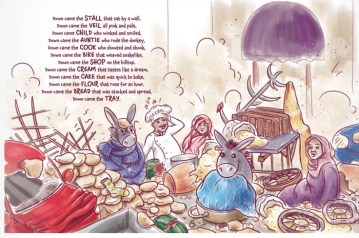
It all starts out with a tray on the mighty head of Moustafa.   Upon that tray is bread stacked and spread that goes with cake that was quick to bake, and before you know it, there is an aunty who rode a donkey next to a child with a veil, and then a nail, oh that tricky nail that caught the veil. . .

9568D24E-1062-4EA4-AA69-64DD4D6DCB7E

Moustafa and his tray and everything along the way are all brought to a tumbling halt, all because of a nail. The crash and falling down undoes the entire build up, and the smiling face of Moustafa makes you want to read it all over again.

266C3E0C-6233-41B9-ABE2-20C6E4307EA5

Alhumdulillah!

E2A54CA5-A964-4405-8181-F73EA84649BF

Amira’s Family by Elliot Riley illustrated by Srimalie Bassani

Standard
Amira’s Family by Elliot Riley illustrated by Srimalie Bassani

amira family

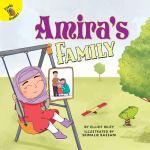
This 24 page, AR 1.5 book, is part of a series for emergent readers about different families.  The other books in the series focus on diverse family models, some that include a single parent, or lots of siblings, one in the series has foster kids, another adoption, one has two moms, so I’m not entirely sure why a refugee family is included in the group.  The family had to leave a dangerous home, but mom and dad and Amira, are not a “diverse” family structure, by the same definition used for the other books.  So, on its own it is nice to have a book for independent kindergarten and 1st grade readers, but as part of the collection, I find it a bit of a stretch.

5BD929BC-5490-4B6B-A729-CD85B227EE60

The book is divided into three chapters, or sections I guess, perhaps so that early readers can gain experience with a Table of Contents at the beginning.  There is also a Picture Glossary at the end along with a page encouraging Family Fun and a bit about the author.

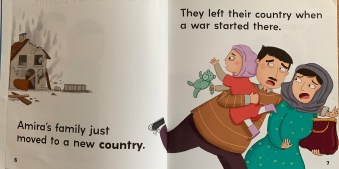
The book starts out introducing Amira, and her parents.  It then explains that they just moved to a new country, America, when a war started in their country.  It notes that Amira was sad to leave her home, and scared to move to a new place.

84893217-FB88-4ABC-8879-DA361636E17E

When Amira starts at school, the classmates welcome her and help her with the language.  It shows her teaching her language too, but it doesn’t look like more than random squiggles.  It then shows she likes recess and swings and slides, allowing the reader to see similarities with the character.

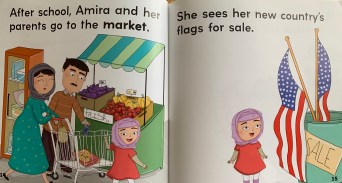
C2E8EF21-AC7B-4594-AA53-68B9764AB84DWhen the family goes shopping, Amira sees an American flag, buys it, and hangs it outside their home.  Amira loves her family and they love her, and it seems like they love their new home too.
C8E3398F-8A1B-4D40-8A79-4E1C52262E89

The illustrations are simple yet expressive, and show Amira and her mom in hijab.  It does not mention religion, or what country they left.

The story is basic, yet introduces young readers to the concept of refuges in a soft way.  It shows how the classmates are kind and the parents supportive of Amira.  I like that it also shows various emotions in the text and illustrations.

It might be making a bit of a political statement with the flag and national identity undertones, but I think it is a good thing to show that refugees can love a new country and be part of society, especially given the current climate toward immigrants.

I think the strength of this book is that it shows a Muslim character, and while meant for all new readers, Muslim children particularly will enjoy seeing themselves in a book they can read.  I’d check the library before buying the 8×8 paperback book, as it isn’t particularly memorable, but for the age group it serves a diverse and an inclusive purpose.

01FAE723-DA90-42EC-AC0D-B274B22515D9


Like the Moon Loves the Sky by Hena Khan illustrated by Saffa Khan

Standard
Like the Moon Loves the Sky by Hena Khan illustrated by Saffa Khan

moon

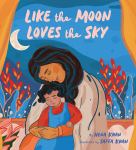
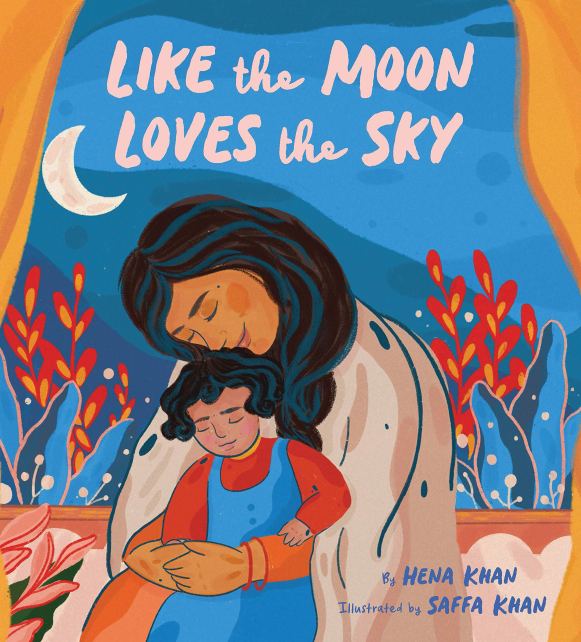
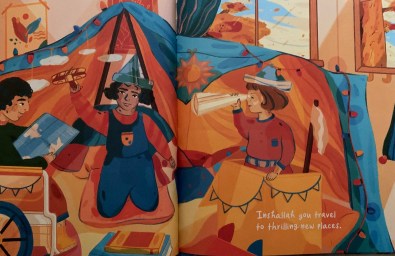
This 40 page book of prose begins each stanza with “InshaAllah” and reads as a beautiful prayer from parent to child.  Each two page spread is filled with warm vibrant colors and illustrations that radiate love while complementing the slow pace the book is meant to be read with.D900B288-5527-4519-8EDF-EE830D3A464D

The book is clearly from an Islamic perspective, yet I think any religious family would find beauty in the book.  The author has a note on the title page that defines inshaAllah as meaning God willing in Arabic and explains how it is a common wish/prayer for people of other cultures and faiths as well.  She also explains that that each line is inspired by the Quran, but universal for people everywhere.

94EE8AC2-8754-46F4-AF50-9CDB7BDFF145

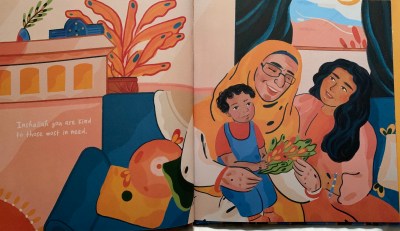
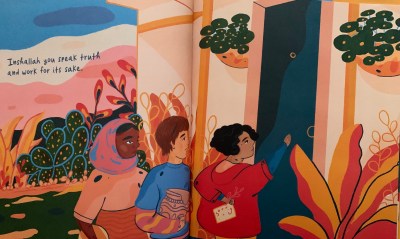
Some of my favorites are:”InshaAllah you seek knowledge, reflect, and read, InshaAllah you speak truth and work for its sake. InshaAllah you have faith that won’t waiver or bend. InshaAllah you are kind to those most in need.”

287D37BD-90E8-4464-B075-524E842A4B43

The illustrations show a family that at times wears hijab and at others does not.  It shows multiple generations, and diverse characters in terms of skin color and mobility.  The illustrations at first weren’t my favorite, but they definitely grow on you.

70D903DA-9763-44CA-B765-2FE15AE34C10

Over all the story reads like a lullaby, and is soft and sweet at bedtime particularly.  The 10 x 10 size would make it work well in groups as well, and I could see it used to lull kids to sleep at nap time with great success for the youngest baby to early elementary.

F6B4AB6F-E13A-4C05-836B-24CD28BAC21C


Zainab is Different by Irfana Khan illustrated by Josh Wise

Standard

zainab is different book

This 24 page picture book for kindergarten children and up, is sweet in its handling of being labled “different,” without getting overly negative or caught up in the manifestation of discrimination.  Unfortunately, with so much emphasis on different religions: the places of worship, the holidays celebrated, the manner of dress, etc., faith becomes inadvertantly highlighted as the root cause for the division and discrimination.  Perhaps I am reading too much in to it, and the book just needs a few more examples to make the author’s point that we are all different and unique, but as it is, I didn’t love it, my kids all thought it was cute though, especially my daughter named Zainab.

IMG_0555

Zainab walks to school every morning with her mom.  She says hi to the neighbor and can’t wait to get to school to her best friend Melissa and her amazing teacher Mrs. Sperber.

IMG_0556

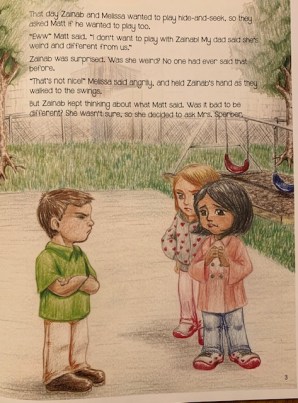
One day Melissa and Zainab want to play hide-and-seek and ask Matt if he wants to play too.  He responds, “Eww, I don’t want to play with Zainab! My dad said she’s weird and different from us.”

IMG_0557

Having never been called that, Zainab is bothered by the words and tells her teacher.  The teacher points out that they have different colored hair, but can see that Zainab is still hurt and tells her not to worry, she has an idea.

IMG_0558

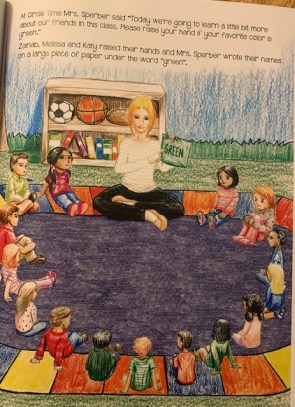
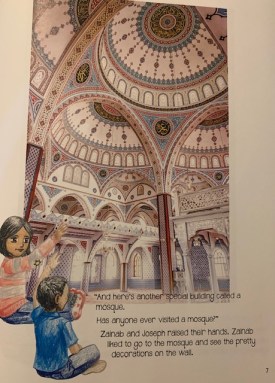
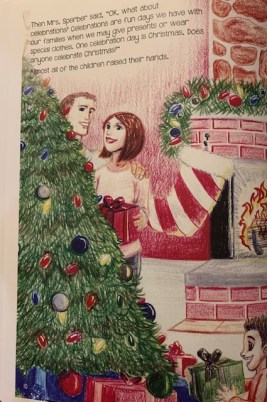
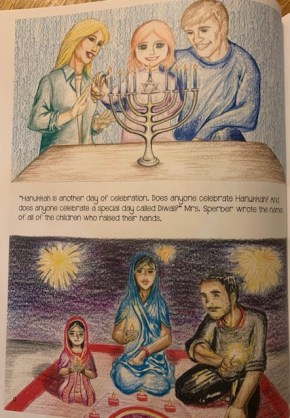
At circle time the teacher starts of by highlighting differences with the kids identifying their favorite color, and her writting their names on the ones they like best.  She then asks about places of worship they visit: churches, mosques, synagogues, temples, and again writes their names on the ones they have been to or frequent.

IMG_0559 Next she moves on to holidays celebrated, and then special clothing, only hijab is mentioned though.  The teacher then discusses feelings and how things about us might be different but our feelings are the same.  We like it when we are all nice to each other, and are sad when someone is mean.
IMG_0560

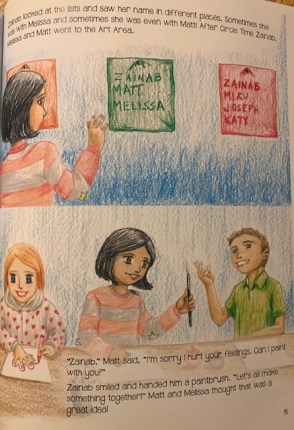
Zainab sees her name with different people’s names on the pictures now hanging up and Matt comes and apologizes for being mean earlier. The teacher also mentions that maybe some haven’t visited any of the buildings discussed.

IMG_0561

The pictures appear to be done in colored pencil and are colorful and detailed with the pictures of the places of worship bein actual images.  The 8.5 by 11 pages are large and would work well at story time or bedtime.

IMG_0562

The fact that Matt’s words are assumed to be about religion seems presumptious to me.  Maybe they are, maybe they aren’t, I feel like there needed to be more there.  A few pages about things other than faith, in my opinion, would make the message of us all being different in some things and the same in other things a bit more powerful.   The pacing too is a bit off. It is a big jump from what is your favorite color to do you go to a church?  The resolution is really quick too, as it is tied into feelings, a little bit more of showing the reader, rather than just telling them, would amplify the process and the message.


My Grandfather’s Masbaha by Susan Daniel Fayad illustrated by Avery Liell-Kok

Standard
My Grandfather’s Masbaha by Susan Daniel Fayad illustrated by Avery Liell-Kok

masbaha.jpgThis 20 page story is endearing and sweet for children aged 4 and up, with a great lesson.   At first I thought it was an Islamic fiction book, but after thinking about it, I’m not so sure.  Lots of faiths use prayer beads, although maybe only Muslims have 33, and the setting, Lebanon, is a pretty diverse place.  Regardless, the character’s names, and the lessons taught are universal and children will benefit from being reminded about how blessed they truly are, in a gentle loving way.
IMG_0113

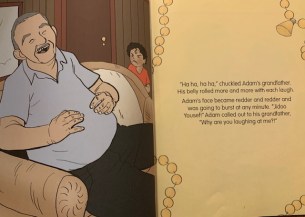
When little Adam’s friends go home and he has nothing to do, he enters his grandparents house stomping and complaining.  In response, Adam’s Jidoo, grandfather, starts to laugh.  This only makes Adam more angry.

IMG_0114

Jidoo Yousef then shows Adam his misbaha and explains that some people use it like an abacus to count, to mark prayers, some use it as decor, and that he uses it to remember God’s blessings.

IMG_0115

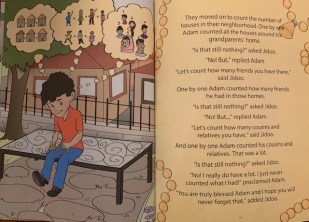
He and Adam, then go around and count all the blessings of toys, and people, and friends, and family, and food, and before Adam knows it, he is feeling blessed and thankful.

IMG_0116

The basic illustrations show the bond between Jidoo and Adam, but are nothing overly fabulous on the large 8.5 x 11 pages.  There is a lot of text on some of the pages, but it flows well and goes quickly.

IMG_0118

The book teaches a great lesson and if you get a chance to read it to your children, you definitely should.

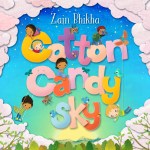
Cotton Candy Sky by Zain Bhikha illustrated by Amir Al-Zubi

Standard
Cotton Candy Sky by Zain Bhikha illustrated by Amir Al-Zubi

cotton candy sky.jpg

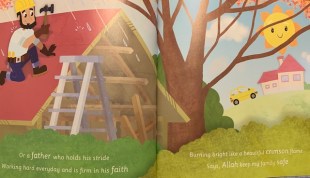
So glad to see another Zain Bhika song hit the mark and bring the beloved lyrics to life in book form. Ages 2 and up will enjoy the 28 page book even if they haven’t heard the song, and parents will enjoy watching the kids sing-read the pages independently if they have.

IMG_8895

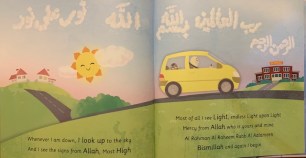
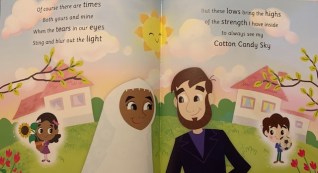
The illustrations are sweet and diverse with the characters and their families changing with each verse.  But all celebrating in their appreciation for the light of Allah’s blessings and the patience of waiting for the rain to pass.

IMG_8896

I particularly enjoy the Arabic in the clouds on the pages explaining what the character does whenever he/she feels down and looks up to the sky to see Allah’s signs.

IMG_8897

The hardback book is sturdy with a playful large font on the pages, and is meant for Muslim kids with the concept coming from Surah An-Noor (24:35).

IMG_8898

Once again, thank you Crescent Moon Store (https://crescentmoonstore.com/products/cotton-candy-sky?_pos=1&_sid=c94d58757&_ss=r) for fast friendly service and great prices!


The ABC of Allah Loves Me by Learning Roots

Standard
The ABC of Allah Loves Me by Learning Roots

abs-of-allah-loves-me.jpg

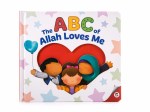
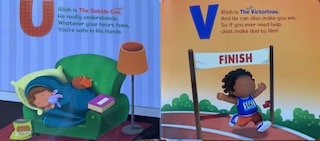
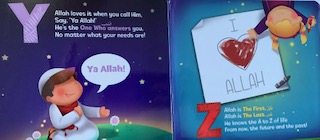
You really wouldn’t think there is much to review in an alphabet board book, but this particular one tries to do more than just pluck a random Islamic word or concept for each of the 26 English letters.  It attempts to give each of the letters one of Allah (swt)’s beautiful names explained in English, but written in Arabic too.

IMG_8773

Each 5 x 10 page features a four line description in a rhyming format to flesh out the highlighted word or phrase.

IMG_8774

Some letter to corresponding Asma al Husna are spot on, but some are a little more of a stretch and some don’t even seem to try.  Overall though it is well-done and delightful.

IMG_8778

The people illustrated don’t have visible eyes, but many have smiles, noses, or closed eyes.  They are bright and warm and engaging.  The binding and thickness of the pages is sturdy.

IMG_8777

Perhaps my favorite part of the book is that the while the rhyming is forced, as is nearly always the case in these type of books, the diction stays on level.  Little kids will understand the words used and emerging readers will be able to sound out and read many on their own as well.

IMG_8776

A great book for your toddler to preschool collection and a reasonably priced book from Crescent Moon Store http://www.crescentmoonstore.com.

Bibi’s Blessing by Lela Usama Goldsmith illustrated by Samantha Morazzani

Standard
Bibi’s Blessing by Lela Usama Goldsmith illustrated by Samantha Morazzani


IMG_8209

A wonderful lesson packaged in a sweet story about a girl learning to thank God for blessings, especially ones that don’t seem like blessings at all.  The 36 page book is meant for children age 4 and up and with its large 8.5 x 11 glossy full color pages it works well at bedtime and in small groups at story time.

IMG_8211

On the island of Lamu, Mwana lives with Bibi, her grandma who’s livelihood depends on making Mofa bread every day.  It is Mwana’s job to sell the sorghum ground bread in the streets for people to enjoy at tea time.

IMG_8210

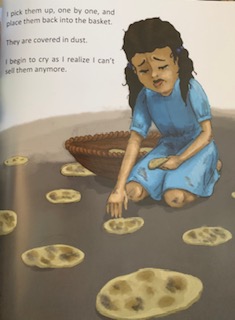
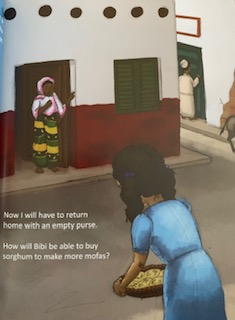
One morning a braying donkey frightens Mwana and she trips, spilling all the mofas on the ground.  When she tells her grandma what happened and how they have not made any money for the day, her grandma responds, “Thank God for this blessing.”

IMG_8212

Not believing Bibi, but being too excited to visit a friend, she doesn’t argue.  But then the power goes out and she can’t visit her friend and she gets grumpy. Grandma tells her to “Thank God for this blessing” and explains that sometimes not getting what you want is also a blessing.

IMG_8213

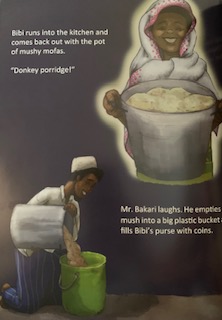
With nothing else to do, Mwana goes off to soak the rice pot, but instead accidently soaks the dusty mofas, to which her grandma again says it is a blessing.  She starts to feel she can do nothing right, and can’t believe there is any blessings in a pot of mushy mufas.

IMG_8217

But, with the power out many shops close and the owner of the donkeys has nothing to feed his animals.  He knocks on his neighbors door and Bibi and Mwana have just the thing.  He pays them for the food and alhumdulillah all is well, so many blessings from God.

IMG_8216

I love that the setting is a place many of us have never heard of and that there is information about Lamu at the end of the book along with a glossary.  The author is Muslim, the characters dress Islamically in the illustrations, and have Muslim names, but there is nothing Islamic specific in the text.

IMG_8214

Some of the sentences are worded awkwardly, for example, “We live in a small island by the Indian Ocean called Lamu.”  You typically say you live “on” an island not “in” it, and islands are in the ocean, not by them.  And some sentences read almost as run ons because of multiple conjunctions and their lack of punctuation.  I don’t love the illustrations.  The faces on many of the pages are really distracting and inconsistent, but the overall story is well done that I’m willing to over look my own critical opinions, and encourage y’all to give the book a try.