Category Archives: Poetry

Doctor Bear and Helpful Bunny: The Travelling Dentist by Emma L. Halim & Her Mum Mary Tucker illustrated by Alissa Mutiara

Standard
Doctor Bear and Helpful Bunny: The Travelling Dentist by Emma L. Halim & Her Mum Mary Tucker illustrated by Alissa Mutiara

Sometimes you just need a sweet little story about a traveling (sorry one l I’m not British) dentist going under the sea to help a hammer head shark with a toothache.  This rhyming story for toddlers is perfect for the demographic as duas are said to get through the pain and fear and the reliance on Allah swt that all will be well.  The Muslim animals and the fun illustrations make the story appealing whether your child is afraid of the dentist or not, and the focus on the duas in the backmatter, makes the book a good tool for repetitive use.  It is worth noting that their are 32 pages in the book, but the story is only 20 pages.  There is a glossary, multiple dedications, scanable codes for activities, ads for other books, duas, sources for duas and author bios in the back.

The book starts with Doctor Bear and Helpful Bunny introducing themselves as traveling dentists for all animals, even those under the sea.  When they get a call from Sonny, they set an appointment time, gather their gear on a boat and then head underwater to the shark village.

Sammy is glad they are there, as he is in pain. They clean his teeth, but need to remove the wiggly one, and that scares him.  He says a dua and before he knows it the huge tooth is out, alhumdulillah.

The book then has a two page spread about duas that help when you are “feeling funny inside” in Arabic, English transliteration, and their meanings in English.  A fun book with a great mix of story, silliness, education, and heart.

Mama Wears a Hijab by Fifi Abu

Standard
Mama Wears a Hijab by Fifi Abu

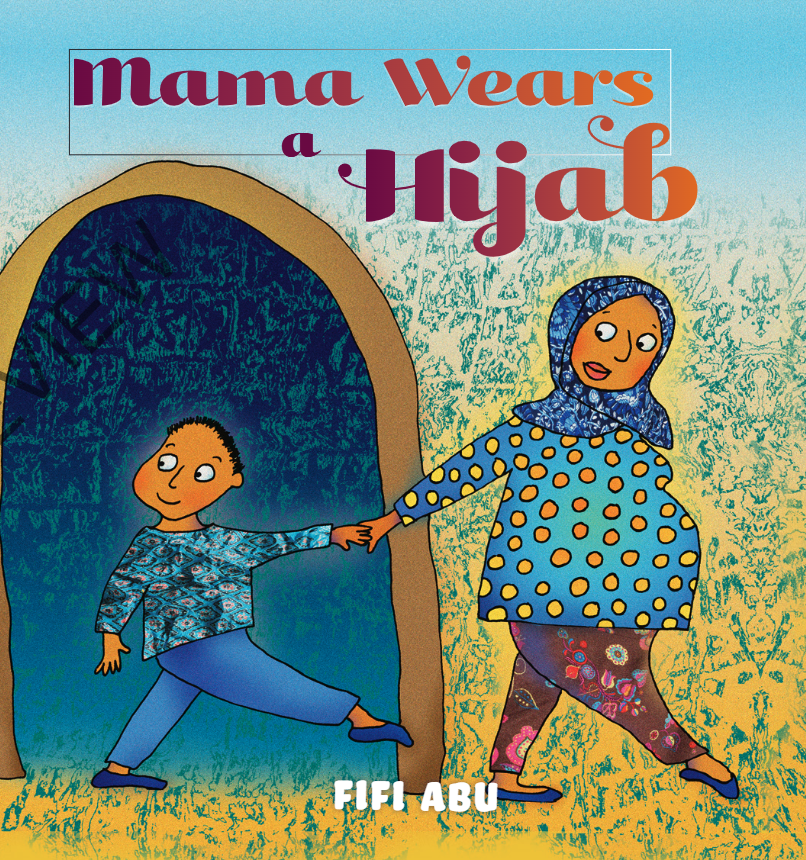
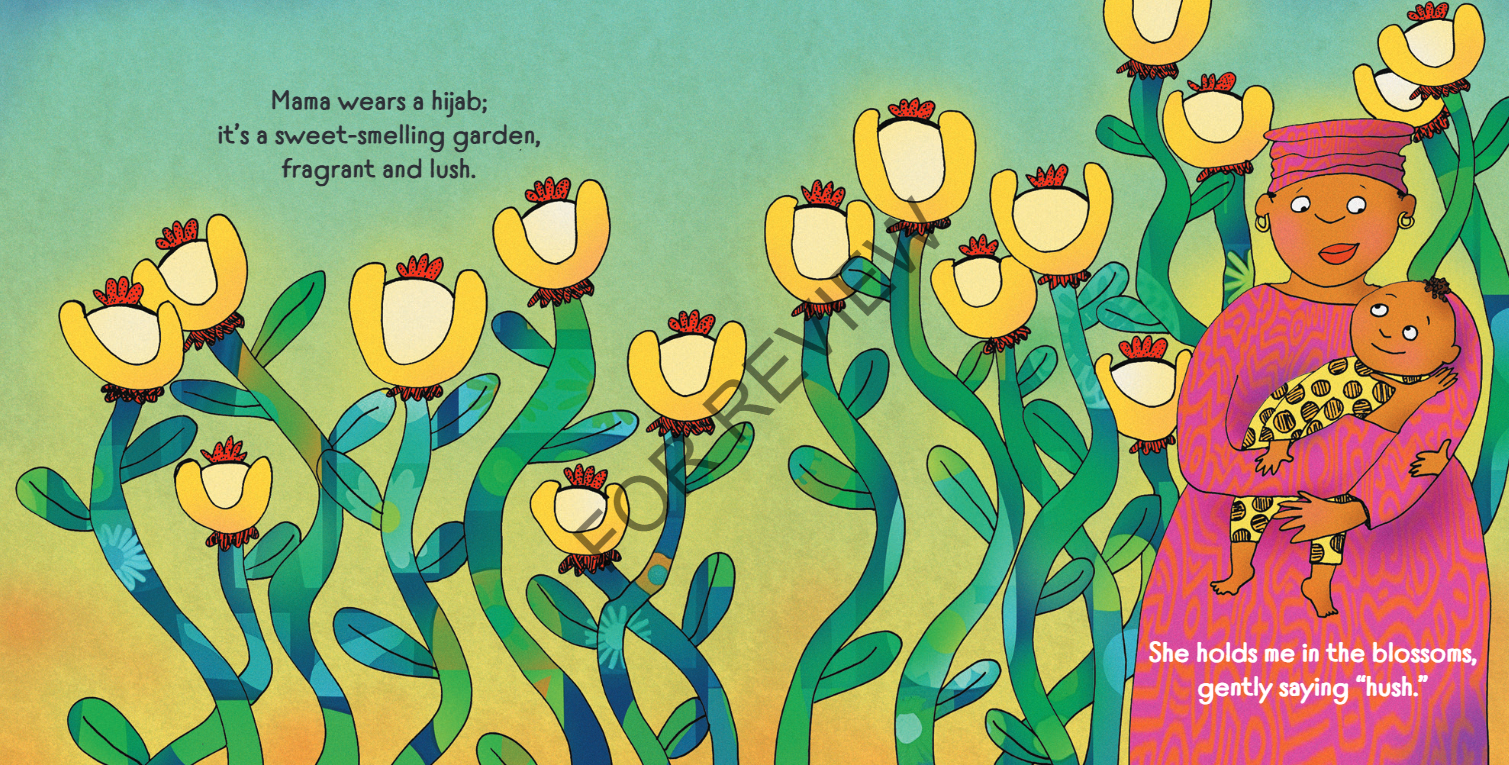
I don’t understand this 24 page 10 x 10 board book. I don’t get it literary wise, or Islamic rep value wise, and if someone can explain it to me, I will be happy to listen.  I’m figuring it is a “me” problem because the author has multiple masters, one in children’s literature and has even been on the Caldecott committee, so I don’t know why I can’t make heads or tales of the metaphors.  At times it seems they are describing the hijab, but maybe the parent child relationship, on one spread the pregnancy, possibly motherhood in general.  A few pages are beautiful, and I like the illustrations, but the continuity is lacking and makes me a little uncomfortable.  Islamically, I understand that women who cover their head often do wear makeup and perfume, but they are not part of hijab, so to have that be articulated is both erroneous and odd.

The illustrations show hijab, niqab, a duputta style, and everything in between.  The characters shown are families in a variety of skin tones, clothing styles, body shapes, and cultural settings.

The book is not a story, it functions in two page spreads of rhyme that take an abstract concept and ground it so to speak, but what the connection is, is by and large lost on me.  I know I have included more inside pages than normal, but I feel that I can’t really review it, so perhaps the least I can do is provide enough peeks for people to come to their own conclusions.

The Boy and his Sand Castle: A Journey of Redemption by Zakaria Amara

Standard
The Boy and his Sand Castle: A Journey of Redemption by Zakaria Amara

img_7416-1

This 213 page memoir is sad, so very sad. I don’t have the ability to review it, it is personal, and raw, and not to be forgotten. But “what” it is, is not so easily defined. It is poetry, prose, humor, reality, dreams, heartache, loss, vulnerability, redemption, introspection, faith, advice, hope.  From the introduction written by his sister, to the photographs of his childhood scrapbook, if nothing else, the pages are filled with humanity and a situation that is so unique, illuminated with threads that all readers will see at times themselves in. The book is not excuses, pointing fingers, rage filled or defensive, it transcends that to a place of true reflection and rediscovery through poetry.

SYNOPSIS:

The poetic introspection of the author touches on his marginalization, radicalization, and 17 year imprisonment. It has pieces inspired by events occurring in his life as well as pieces for his daughter, dreams, analytical pieces, and humorous coping anecdotes.  After reading the book, I don’t feel I know the facts about the case, the methods of the radicalization, the other 17 members, the judicial process experienced, or the daily struggles, but I feel some of the lessons, the humanity and surrendering are shared.  The book isn’t linear, it is snapshots of a variety of emotions, that leave the reader feeling similarly vulnerable and humble, subhanAllah.

The book is divided into 10 parts: Desolation, Despair, Hope, Near and Dear, Meaning, Selfhood, Joy, Modernity, Surrender, and Home. There are small images on the pages, some AI, some art, some drawings by fellow prisoners.  There are also some photographs.

This book was nominated for the 2024 Muslim Bookstagram Awards and I am grateful that it was.  I’m better for reading it and I feel I will revisit it in the future, perhaps not reading it from front to back, but thumbing through it, pondering the words, and being reminded out how temporary this world is.

Prayers of My Youth by F.S. Yousaf

Standard
Prayers of My Youth by F.S. Yousaf

I enjoy poetry, but don’t feel qualified to review it.  I saw the first few sample pages of this collection though and felt compelled to give it a read, and while I can’t confidently remark on the literary components, intellectual depth, or even symbolic power; I can say that I enjoyed the pieces.  I saw myself in many of the verses, felt a kinship to the author’s autobiographical musings, and often paused and reread lines, seeing glimpses of my own reflection staring back at me.  At other places, and on numerous other pages, though I truly had no idea what was being said, what the author was trying to convey, and why the details at hand were being discussed.  The former teacher in me, wanted to break down the poems, find the meaning, and write a thesis statement to organize the individual reflections, and overall story arc being conveyed, but truly, I am not qualified, and at it’s core, I do believe poetry should be felt.  I love that Islam is so present, that the symbolic and the real interweave throughout the 112 sparsely filled pages.  The exploration of family, faith, and journey of life feels real and vulnerable.  The book is an adult read, I think older teens though might see glimpses of themselves as well, and find a solace in the poetry on the page that they can so intimately relate to. Aside from enjoying the read, and looking forward to receiving my preorder to thumb through, I don’t know that I have much insight to offer, sorry.

The book is divided into 4 sections: Ablution, Iqama, Salaah, and Salaam.  At each division there is a simple sketched drawing and a bit of a grounding paragraph of text.  From there the individual title poems range from a few stanzas to a page or more, standing alone but also connecting the ideas and themes that move the book forward.

The book releases next month and is available wherever books are sold.

A Letter to the Beloved: Dear Prophet Muhammad (saw) by Jenny Molendyk Divleli illustrated by Rumeysa Abis

Standard
A Letter to the Beloved: Dear Prophet Muhammad (saw) by Jenny Molendyk Divleli illustrated by Rumeysa Abis

img_5332-1

I was a little skeptical about a 32 page rhyming letter to our beloved Rasullah, illustrated in book format, but it is cute and it won me over.  The rhythm keeps the rhyme from feeling too forced and allows for some forgiveness when it misses the mark, it also makes the book appeal to a wider audience. Even my preschooler could sit through it pretty well.  The book being the letter without any stilted framing, has a lovely authentic voice of a young boy, also named Muhammad, asking the Prophet (saw) questions and chatting in a very stream of conscience sort of way. It blends facts that the young boy knows with his stresses and asking the Prophet for advice.  The font is meant to look like a child wrote it, but it is a little cumbersome for children to read, and even adults (me) during read alouds.  I do wish the book was sourced, nothing really seemed wrong, but having it sourced or approved by a scholar is just a reassurance to the reader, and in my view a responsibility of the author.  The only line I didn’t like was near the end, when the boy hopes “that you will remember me, from this letter I am writing you.”  I feel like it will confuse kids, is the letter being sent? How would he know you when you’ve never met? What will be done with the letter once written? The illustrations are hit or miss, some are absolutely lovely, others a bit off, for example a music book on top of a picture of Masjid an Nabawi and the Kaaba, some also easier for small groups to see than others.  For kids there really aren’t a lot of books about Prophet Muhammad saw that are not textbook like in their portrayal, so I like the approach this takes, I just wish a few things were tweaked.

The book dives right in, with Muhamad introducing himself to our Prophet, he writes that he was named after him, and all about his family.  He then starts to tell what he knows about Prophet Muhammad, and questions he would like to ask.  Its a one sided discussion about siblings, smiles, appearances, kindness, and generosity.

The little boy then wants to know about Buraq, splitting the moon, talking to angels, standing out numbered at Badr.  It then turns to food and the little boy wondering about if RasulAllah would like mustard and relish, and burgers.  

img_5336-1

He imagines the Prophet visiting and leading his family in prayer and the scent that would then linger.  The boy hopes to meet him in Jannah, and promises to do his best to follow Allah’s decree. He signs off and sends salawat upon the Prophet. There is then a place for readers to write their own letters to the Prophet.  

I’ll See You in Ijebu by Bunmi Emananjo illustrated by Dian Ejaita

Standard
I’ll See You in Ijebu by Bunmi Emananjo illustrated by Dian Ejaita

img_5253-2-1

As a window into Nigerian life, this 32 page book is beautiful, celebratory, and an incredible resource to learn from and emerge yourself in, as the beautiful pages, and delightful language sweeps you away to Ijebu and Olu’s grandparent’s house for Eid al Adha.  As a Muslim, this book’s framing might require some conversation with little ones that may or may not be right for your family.  The protagonist in the book, Olu, is Catholic, her siblings and parents are as well, her mother’s family however, is Muslim.  The multi-faith family celebrate each others’ holidays, for example Olu goes to the mosque to pray after taking communion at church, and the cousins haven’t seen each other since they came to Lagos to celebrate Christmas.  Eid al Adha is celebrated with a big meal, prayers, and being together, but nothing specific about belief or doctrine is included in the text. The tender heart of the story is the subtle bond between Olu and her grandfather, Baba, even though language differences prevent them from talking. The writing style is as beautiful as the full page illustrations, with part of each page dedicated to more traditional story telling, and another complimentary part expressed in a more lyrical fashion that reads often like a song.  The backmatter is robust with information about Nigeria (including a map), Food, Fun, Faith and Family, Oriki, Fashion, an Author’s Note, a recipe for Puff Puff, an Illustrator’s Note, and a list of people who helped create the book. The book is OWN voice written and illustrated, but I do not think either are Muslim, and while the publisher lists the book as being for ages 4-10, it is a bit text heavy, so take that into consideration. 

The book starts with Mummy calling Olu and her brothers for breakfast.  Daddy is in America at their old home visiting his brother, and today they are going to Ijebu to visit Baba and Iya Akin for Eid.  This year Olu is eight and will finally get to help make the Sallah feast. The traffic is bad in the hot weather, with smells of vendors cooking filling the air.  The family listens to Afrobeats and 90s pop music until they are finally there.  When they arrive Baba is waiting and sings Olu’s oriki as they embrace.  Food is a big part of visits to Ijebu, as they pick ripe cashews, sugar cane, guavas, and mangoes on Baba’s farm.

When it is finally Eid the family walks to the nearby mosque for prayers in matching outfits.  Then it is time to cook the two rams for the Eid feast.  Olu is going to braid the ram intestines.  It is a lot to cook and a lot to eat. When the week is over, and it is time to leave, once again it is Olu and Baba’s hug that make the love tangible and the book emotional as they say their wordless goodbye.

Sheba: The Good Muslim Cat by Carima Elfarrah illustrated by Aaron Yusuf

Standard
Sheba: The Good Muslim Cat by Carima Elfarrah illustrated by Aaron Yusuf

img_4999-1

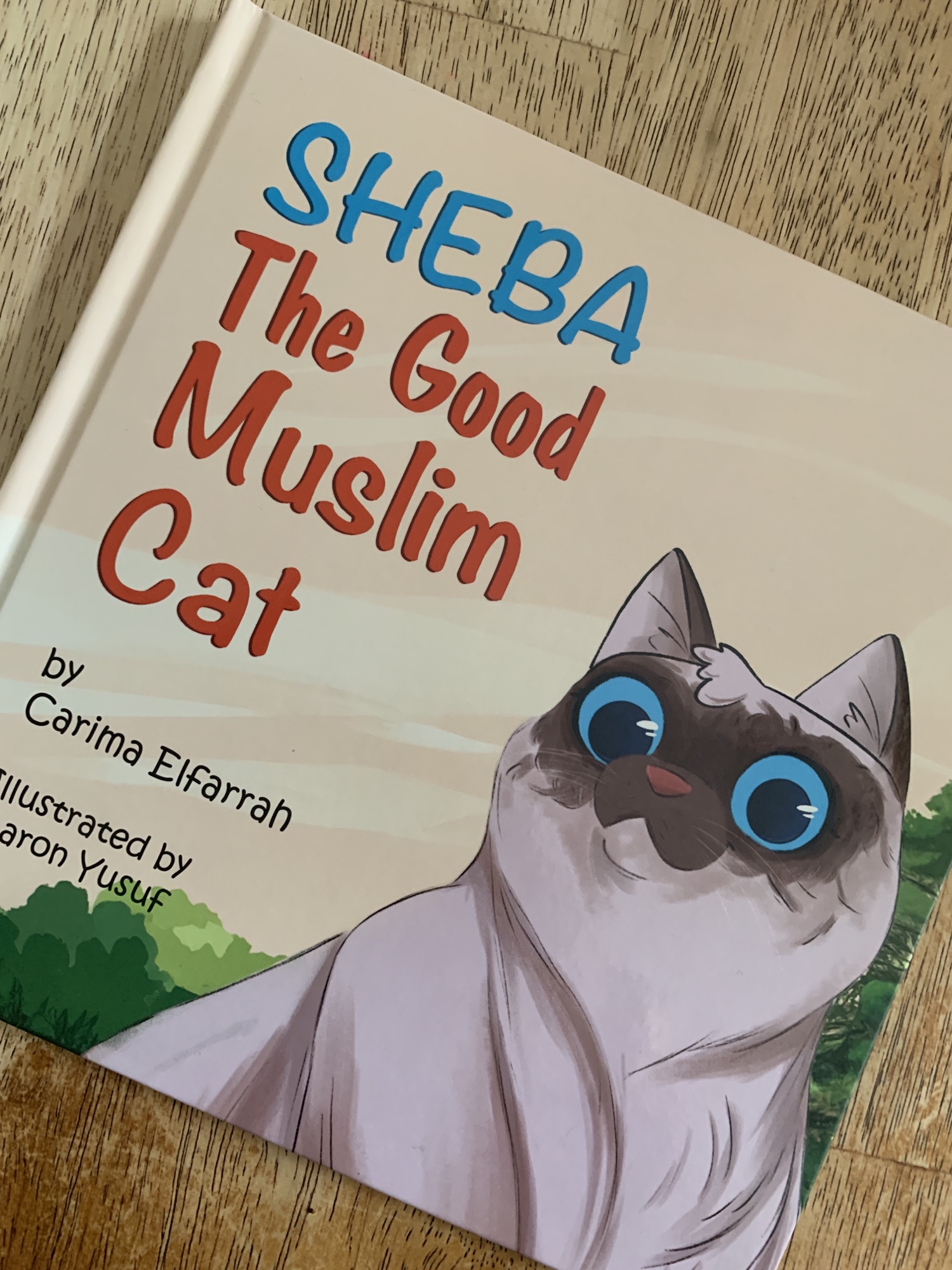
I was really looking forward to this book about Muslims and cats.  Every masjid seems to have cats all over the world, and while feline friends often sneak into Islamic fiction books about other things, I liked the idea of giving a cat the spotlight.  Alas, the rhyming text, the examples given, the inspiration shared in the backmatter, the angel imagery, and the ambitious glossary made this small 8×8 inch 32 page picture book rather off putting and ultimately forgettable unfortunately. The cat remains at the family home, and basically just hangs out with the family when they read Quran, pray, get up for fajr, and the cat is patient when waiting for food or water.  Sure it makes it a nice cat, but with a title implying this cat is a “Good Muslim,” I really expected more.  I appreciate the hadith at the end, but it is not sourced, and the cat with a halo and wings signals Christian imagery, that doesn’t align with the tone of the book.  Additionally, the idea of the book comes from a story of a Syrian scholar who had a conversation with a cat. I’m not saying it did or did not happen, but it seems a little bit of a stretch for my cynical brain.  The book reads for toddler and preschool Muslims, but the glossary reads copy and pasted from Wikipedia for non Muslim adults.  The small size makes the book impossible for group story times, and it can be hard to read at times because the text often runs over the pictures making it hard to see.  Ultimately though, while my toddler enjoyed it well enough the first time, he has not asked for the book again despite it sitting on my side table for weeks, which is probably more insightful than my review.

The book starts with a young boy introducing his family cat, Sheba, who has sapphire eyes. The family is Muslim and the boy is confident his cat is too because she hangs around his dad when he reads Quran, she comes running when salah time comes, she plays with the imam (the dad) after the last salaam, and she waits patiently for food and water when her bowls are empty.  She cries at fajr to wake the boy up and he hopes that on the day of judgement she will attest to the good the family did for her.

The backmatter includes the story of Shiekh Shukari, a scholar in Damascus that spoke to a cat, then a two page spread glossary, and author and illustrator bios. The illustrations aren’t particularly spectacular, the boy at the beginning seems much older on some of the pages compared to others, although his clothes stay the same.  I didn’t like the angel imagery, perhaps I’m erroneous, but none-the-less it felt off to me.

Allah Made Me Beautiful by Layla Izruna illustrated by Laila Radhani

Standard
Allah Made Me Beautiful by Layla Izruna illustrated by Laila Radhani

img_4555-1

This 6×6 board book is 18 pages of affirming and celebrating that no matter what we look like, “the Best of Shapers, shaped us all.” The little size, the rhyming lines, the repetition of the phrase “Allah made me beautiful” on the right page of each spread, is what you would expect from a board book meant for newborns and up.  The rhyme and cadence levels out after the first page, and makes for a sweet easy read.  The mirror on the last page with a hadith in English and Arabic is particularly nice.  The illustrations and text are intentionally diverse and inclusive and with the Islamic centering the book is good for starting discussions as well.

The book is no literary masterpiece, but sometimes it doesn’t need to be, to be a staple read on repeat to our little believers.  This book dives right in on the first page, there are no copyright or dedications that have to be flipped through.  It is numerous pages of examples of how Allah swt made us all different: straight hair, curly hair, twins, larger body size, skin color, mobility, freckles, glasses etc. The end spread, before the mirror, is the conclusion that our “looks have been perfected by Him, tying it all together.

The illustrations are engaging, and simple, but detailed enough to foster dialogue if desired and while the small size would make using it at story time impossible, I think little hands and little hearts will benefit from knowing that we are different, but just as Allah swt intended us to look.

The book is available from the publisher Prolance directly, or here on Amazon 

img_4560-1


Call Me Al by Wali Shah and Eric Walters

Standard
Call Me Al by Wali Shah and Eric Walters

albook

I feel like I should have really liked this 264 page book: OWN voice, Muslim, MG, Pakistani, author is poet laureate for the City of Mississauga, Ontario, co authored by a prolific YA writer, but it unfortunately reads inconsistent and unpolished.  The characters at the beginning and their relationships with one another don’t read consistent with who they are in the middle.  Sure the character arcs from the middle to the end are nice, but it feels really disjointed from the first quarter of the book.  There are parts that feel so rushed, and other parts that are heavy handed with the preaching and the moral lessoning that I found myself skimming whole pages.  He says his family isn’t that “religious,” but Islam is centered with quotes from “the Prophet” (no salawat given, only a few times Prophet Muhammad is mentioned to identify which Prophet is being quoted) and “Imam Ali” (who the protagonist is named after), yet Al telling a girl he likes her is no problem at all.  He fasts because he has to, but tells his younger brother it is ok to sneak food, and the grandfather gives a whole speech on how the purpose of fasting is to feel empathy for the poor (face palm, in case you don’t know, it is a commandment of Allah swt).  I really struggled with how “Whites” are seen as opposites to “Muslims,” there is some push back with quotes from Malcom X on his hajj experience, but I didn’t feel like the character really ever accepted that Islam is a religion for all people, and White is a skin color.  Honestly the book reads like an early 2000 memoir.  I know it is fiction, but the cultural be-a-doctor-nothing-else-matters-stereotypes, and Islamophobic talking points that feel performative for a Western gaze, combine with a very unlikable arrogant protagonist, and result in a book that was difficult to connect with and get through.

SYNOPSIS:
Al, short for Ali does everything perfect, he has perfect grades, always listens to his parents, and respects the rules.  The book opens with him sneaking off campus with friends for lunch at the mall where he is caught by his grandfather, who seems incredibly strict, but later is the soft spot in a firm family.  His parents have moved to Canada from Pakistan, his mom used to be a teacher, but now takes care of their apartment building, his father was a physician and now drives a taxi.  It is non negotiable that Al will be a physician when he grows up.  The middle child of all brothers, his older brother Sam, short for Osama, has set the bar very high with his valedictorian status in high school, scholarships to start college, and student of the year award in middle school.  Al is in 8th grade and is expected to follow in his footsteps.  When Al’s crush on Melissa results in him writing a poem about her, he realizes he likes the written word to express himself.  His father thinks poetry is a waste of time. With a teacher that encourages creative writing, Islamophobia and hate crimes hitting close to home, and Al coming of age, the story focuses on Al’s 8th grade year as he discovers his own identity, with some help from his friends and the month of Ramadan.

WHY I LIKE IT:

I like that his friends really pushed back on him to own some of his internalized Islamophobia.  Zach is probably the most fleshed out character, and his humor, his teacher crush, his ability to apologize and make things right, is really the heart of the book.  It contrasts so greatly to how I feel about Al.  By the end he was ok, but at the beginning, his arrogance is obnoxious. I get that he is bright and a hard worker, but, yikes, he needs some humbleness.  The supporting characters are rather flat.  Al’s crush Melissa is shallow and only desired for her appearance, Dad is strict and demanding, not in an abusive way, but in a cold undeveloped way, mom is idyllic and supportive, and Ms. McIntosh is the driving motivator for Al. The other characters do little to flesh out the main players which is unfortunate.  I think some depth would have shown Al more rounded. His so called friends don’t know he is Muslim or what he eats, but they are friends, not just classmates, seems off and lacking.  The grandfather gives all the teachable moments, he starts off stern, and then is not, and the transition is jarring.  He speaks in quotes and lessons, and if it were quirky, it might help the flow of the book, but he really is the Islamic conscience of the book so to speak, but we know so little about him and his relationship with Al.

I didn’t like how fasting and Ramadan were presented. Al is embarrassed by fasting and being different.  I like that it says the family goes to the mosque, not sure why masjid wasn’t used, but there are no Muslim friends and no praying, so it has no real impact, which furthers the feeling that it is performative.  Al doesn’t seem to consider faith or culture until others question him about it, which is a missed opportunity to give Muslim kids a mirror to see themselves in the characters.  There are chapters of the book that really are wonderfully written, they just are sadly too far and few between.

FLAGS:

Crushes, Islamophobia, physical and verbal assault, racism, classism, bullying, lying, sneaking out, discussion of partition violence including great grandfather being killed. The book though, aside from the crush thread at the start and end, is quite clean, and the crush is pretty innocent.

TOOLS FOR LEADING THE DISCUSSION:
I wouldn’t seek out this book for a classroom shelf, but if it was in the library I would leave it.  I don’t think most kids would pick it up and make it past the first 25 pages though, Al is really unlikeable at the start.

Allah Made Me Different by Maryam Abbas

Standard
Allah Made Me Different by Maryam Abbas

img_3535-1

There is nothing revolutionary about this 24 page picture book, but it answers a basic question that children always ask from an Islamic perspective in an engaging and adorable way.  Toddlers and preschoolers will enjoy the rhyming lines, thick pages, and playful illustrations as they learn why they might look different then others. The book concludes with a dua for gratitude and circles back to the reassurance that Allah swt made us each perfect every few pages.  After multiple readings the pages do crease open, and thus I wish it was a board book.  The small size of 8.5 x 8.5 also makes it a little difficult to read to groups, but ideal one-on-one with little Muslims, alhumdulillah.

img_3536-1

The book starts with a child asking mama about the color of eyes and height.  Mama responds that, “Allah made you how you were meant to be.” The remainder of the book is reassurance that He made us with eyes right for us, hair perfect for us, etc..

img_3537-1

That we are different colors, speaking different languages, as Allah made us all unique, but with hearts to be kind.  Celebrating our differences and our similarities both in the text and illustrations.

You can purchase the book here on Amazon or at Crescent Moon Store.

img_3538-1