Category Archives: Non Fiction

Maryam’s Magic: The Story of Mathematician Maryam Mirzakhani by Megan Reid illustrated by Aaliya Jaleel

Standard
Maryam’s Magic: The Story of Mathematician Maryam Mirzakhani by Megan Reid illustrated by Aaliya Jaleel

img_8776

This 40 page nonfiction biography is beautifully illustrated and informative.  I had never heard of Maryam Mirzakhani the Iranian born, first female winner of the Fields Medal.  Her life from loving stories and not liking math, to becoming a student and later a professor in the United States is remarkable and inspiring.  Second through fourth grade readers that both love and struggle with math will be drawn in to her unique way of looking at the world, and the math she found to serve as her magic wand in explaining it.  I don’t know if she identified as Muslim, while in Iran she was forced to cover, but when she left, she no longer did.  The illustrator is Muslim and religion aside, I am thrilled that a book like this exists, and that such a brilliant woman and her accomplishments can be presented to young readers.
img_8778

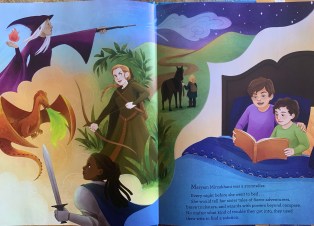
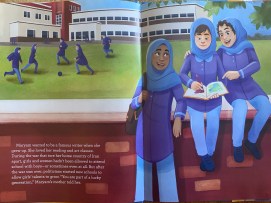
Maryam loves stories.  She reads them to her sister, her best friend Roya and her browse bookstores and dream themselves into plots of their favorite stories.  On the weekends she spreads long rolls of paper on the floor to draw and color her imaginary worlds.  She wanted to be an author when she grew up and knew how lucky her generation was to attend school after the war that tore her country apart.

img_8779

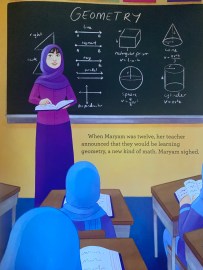
Math made her head spin, she would rather be doodling, but when she was 12 her teacher introduced her class to geometry.  It was different, the numbers held stories and the shapes were pictures. She made stories about the problems and wondered about them as if they were characters.
img_8781

In high school, Maryam and Roya entered the International Mathematical Olympiad.  The first year they received participation medals, but the next year, Maryam won the grand prize with a perfect score. She finished her schooling in Iran devoting her life to the stories that numbers told and left Iran to start graduate school at Harvard in the United States.

img_8782

When she had a hard time solving problems she would spread large rolls of paper on the floor and solve them.  Her daughter would tell people she was a painter.  She wanted to stretch the mind and how people went about solving equations.  She became a professor and a lecturer and one of her discoveries became known as “the magic wand theorem.”

In 2017 she passed away from breast cancer and the world lost a remarkable storyteller, mathematician and human.  The book concludes with an author’s note, important dates, and books to reference to learn more about Maryam Mirzakhani.
img_8780

It’s Ramadan and Eid al-Fitr! by Richard Sebra

Standard
It’s Ramadan and Eid al-Fitr! by Richard Sebra

img_9007

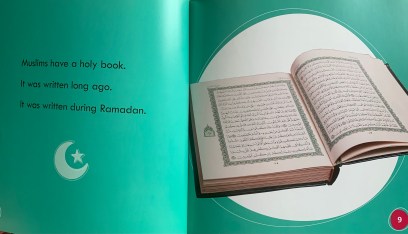
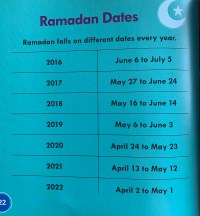
Sigh, another erroneous children’s nonfiction book from a holiday book series targeting classrooms.  This 24 page book is meant for pre-school to first grade and in addition to being vague and repetitive, states that Muslims have a holy book that was written in Ramadan.  It never states the Quran by name, and clearly it wasn’t written, it was revealed in Ramadan.  It later also states that Eid al-Fitr is the last day of Ramadan, failing to acknowledge that it falls on the first of Shawwal, when Ramadan is over.  The table of Ramadan dates at the end spanning from 2016-2022 is also problematic if you are trying to explain that we often don’t know until the night before when Ramadan and Eid will be because we need to sight the moon.  These errors may appear minor, but when they seem to fill every recently published children’s nonfiction book, it really makes the correction of such assumed facts that much harder to overcome.  If our non-fiction books are so consistently flawed, our sense of reality is being shaped erroneously, and imagine what else we have consumed as fact that isn’t accurate over the years.  Please speak out when you come across these errors, in Islamic books and all non-fiction works.

img_9008

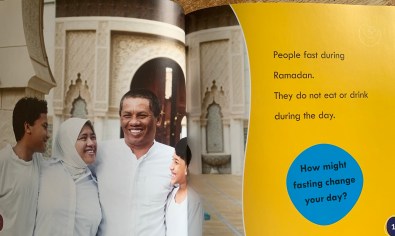
The book is filled with simple short sentence and often repeats the same basic information on multiple pages.  The two page spreads contain the text on one side and a realistic photograph on the other with critical thinking prompts to consider.

img_9009

It starts off by establishing that Muslims have a calendar based on the moon, that Ramadan is the ninth month and it is a holy month.  The next page again reasserts that Ramadan is not one day, but a whole month before introducing the idea that families get together to pray.  The erroneous page about the Islamic holy book follows and then the concept of fasting: not eating or drinking during the day is presented.  The critical thinking point asks readers to consider how fasting might change your day.

img_9010

There is then a page about prayer which includes that we kneel on rugs, pray everyday, but pray more in Ramadan.  I’m not sure why this page didn’t follow the page that first mentioned prayer, especially since the next page goes back to talking about food which probably should have followed the page on fasting.

img_9011

The page about Eid being on the last day of Ramadan is then followed by more sentences over a few pages about Eid being a festival, there being food, and gifts. There is a table of Ramadan dates at the end, as well as an index and books to further read.  There isn’t a proper glossary because there really isn’t any vocabulary presented  in the vague descriptions, but there is a picture glossary with words such as celebrate, dates, gifts, and prayers.

img_9012

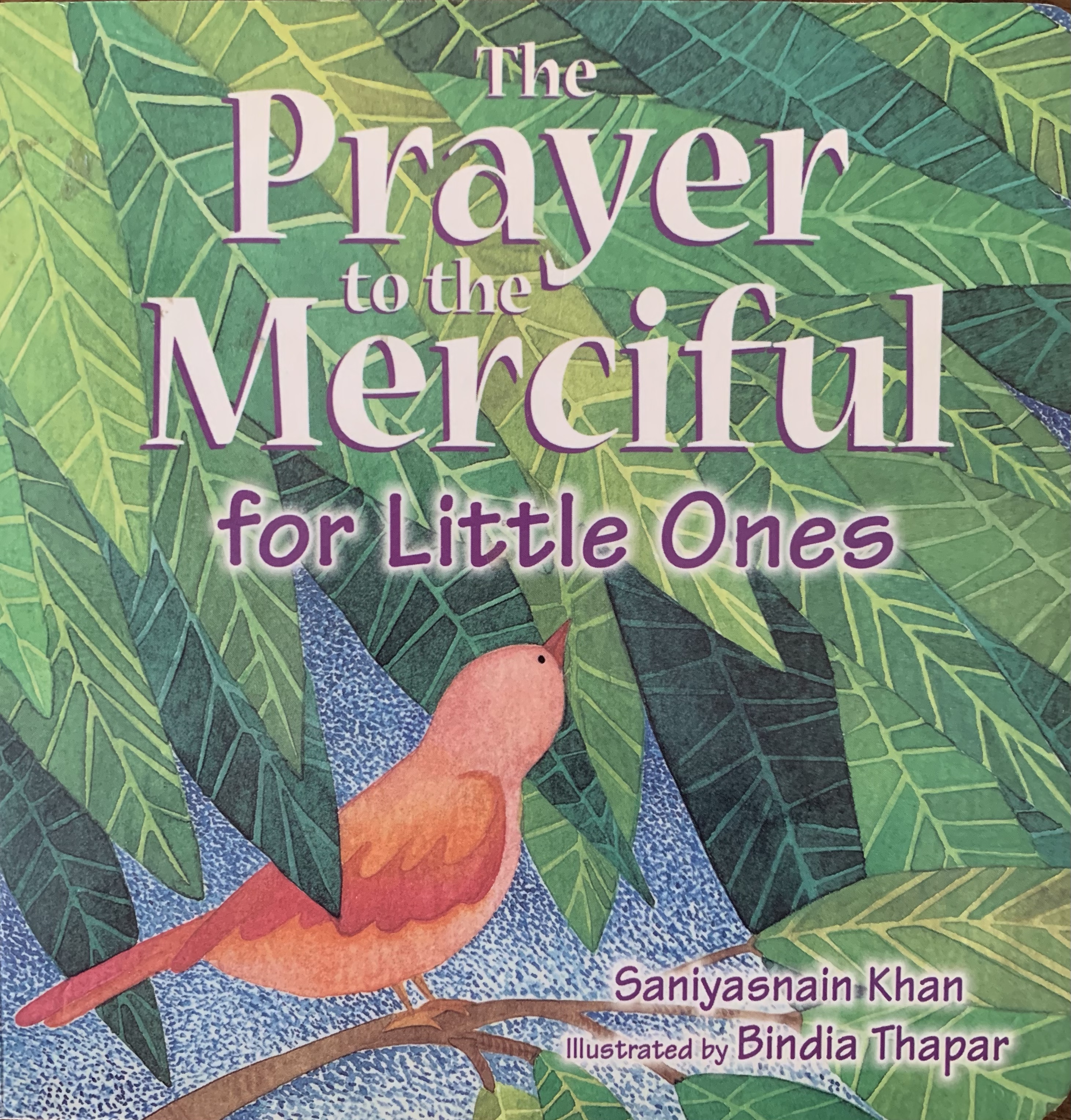
The Prayer to the Merciful for Little Ones by Saniyasnain Khan illustrated by Bindia Thapar

Standard
The Prayer to the Merciful for Little Ones by Saniyasnain Khan illustrated by Bindia Thapar

img_8938

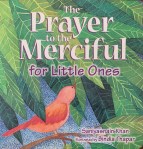
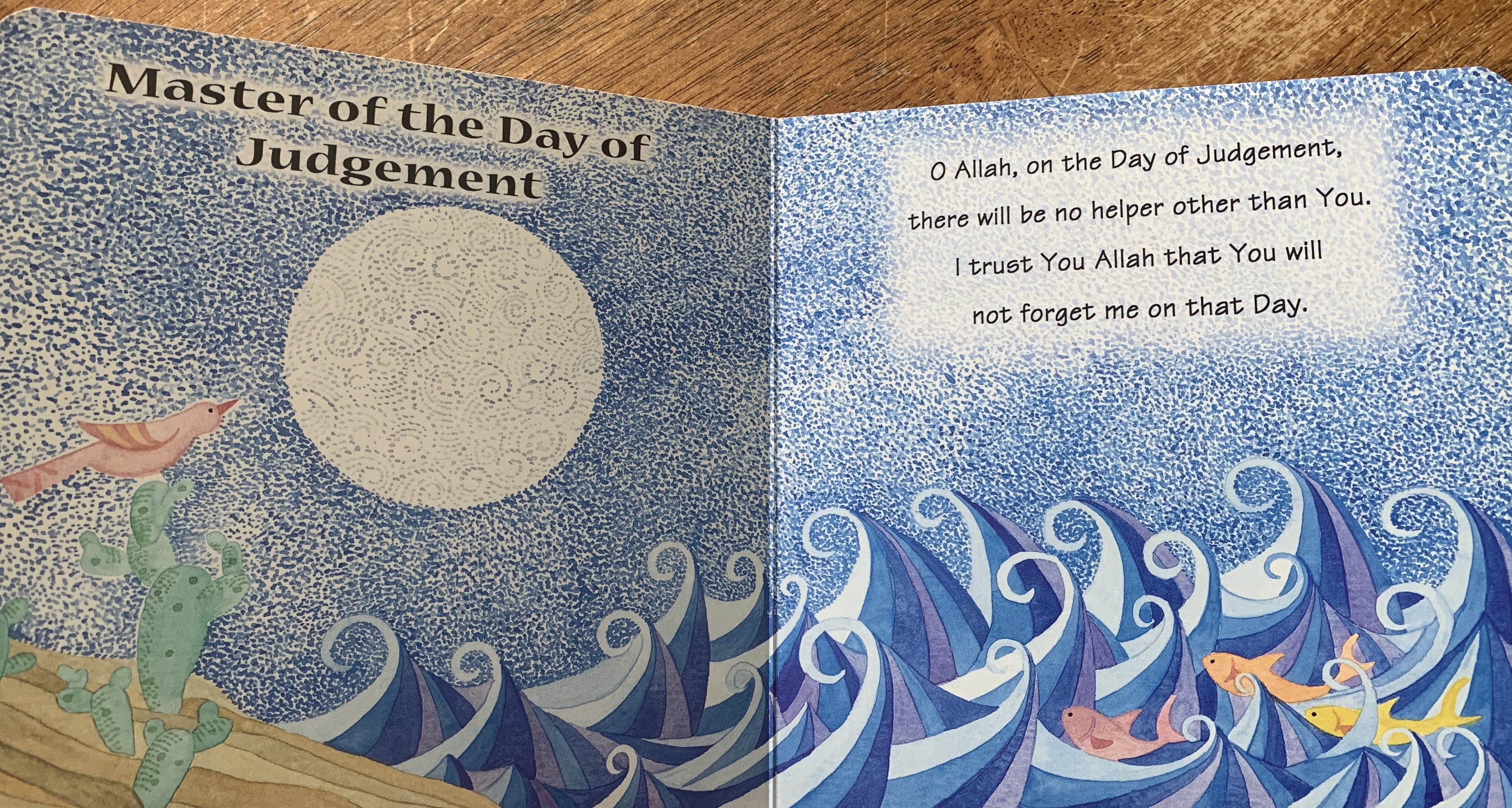
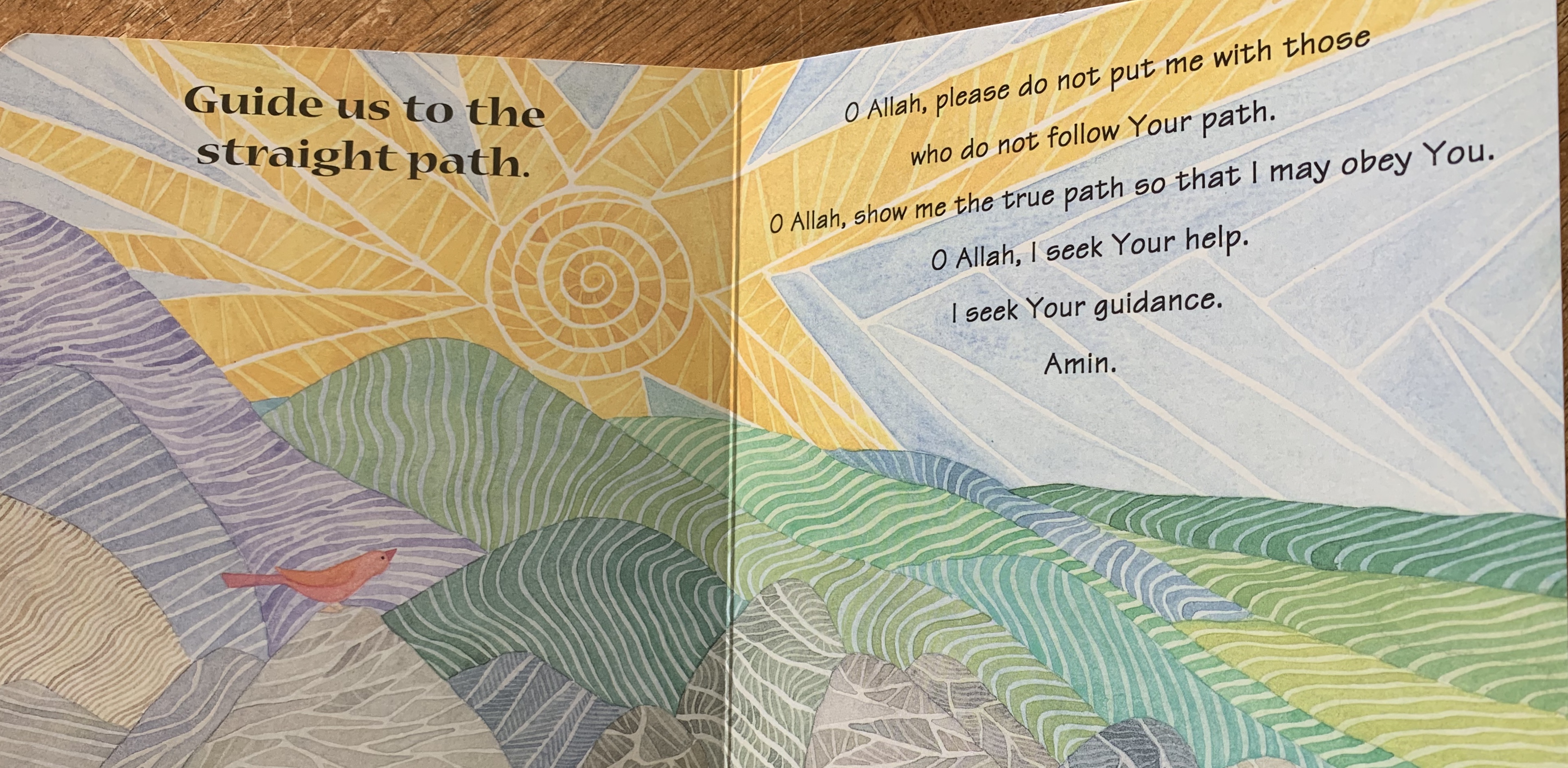
This 14 page board book is a prayer based on Surah Fatiha and explores the first few ayats with reflective and thoughtful duas.  It has soft muted illustrations of birds and nature on small 5 by 5 pages.  The idea of the book is sweet and soft that I can imagine reading it with a child in your lap after salat, or perhaps whispering into them at bedtime, but it really is a prayer for the parents to read.  Children might understand from the text that everything is from Allah swt and He is always with us and helps us, but because it doesn’t repeat those notions, I don’t think the message will stick. The vocabulary is not reflective of toddlers understanding, and really the comfort comes from them listening to a loved one’s voice not the text or pictures.  I have five kids, this book was purchased when I was pregnant with the first one, I don’t think it has ever willingly been picked up by any of them or sat through in the idyllic picturesque manner that a person with no children would imagine spawning from such a heartfelt book.  I hope I’m in the minority and other families have loved and appreciated this book as it was undoubtedly intended.

07F4AB67-2FEB-44B0-A5FF-994F9A884FDE

The book starts with a complete english translation of Surah al Fatiha.  The next two page spread is entitled “Praise be to Allah” which is explored in the text of praising Allah for the blessing given and knowledge of Allah being close. The theme isn’t entirely on point, but follows the rhythm of duas: praising Allah swt and glorifying him mixed in with making your requests.

6377C9F1-53DD-4C0A-84D4-66AD00FB9725

“Lord of the Universe” is the next heading, followed by “The Compassionate, the Merciful,” “Master of the Day of Judgement,” “You alone we worship and to You alone we turn for help.”  The final section is “Guide us to the straight path.”

40595865-EF04-42DC-9A71-B4F09DECE81E

The book came out in 2003, and I was ecstatic to see it available, however, there are now just better and more varied options available, that this one will once again be lost on my shelves.

80351529-FA74-444A-A8CA-7F23A6E3EB4C

My First Book About the Qur’an: Teachings for Toddlers and Young Children y Sara Khan illustrated by Ali Lodge

Standard
My First Book About the Qur’an: Teachings for Toddlers and Young Children y Sara Khan illustrated by Ali Lodge

img_9014

I had planned to review the Ramadan book in Sara Khan’s My First Book about series, but needless-to-say all of the board books in the collection look remarkably similar and the one on my shelf, that I thought was the Ramadan one is this one, the one about the Qur’an.  Rather than find another Ramadan book, I figured to just go with it, Ramadan is the month of the Qur’an after all, and the book is both informative and engaging for little Muslims.  The soft detailed pictures and sturdy binding introduce toddlers and up to the belief in Allah, the pillars, care for all creation and being good to one another.

img_9015

The book starts out stating the the Qur’an tells us in the beginning there was only Allah, and that He created everything.  His creations are as big as the heavens and the Earth and as small as the creatures we cannot even see.  He created the trees and mountains and the angels and jinn, as well as the people, He made us all special.

img_9017

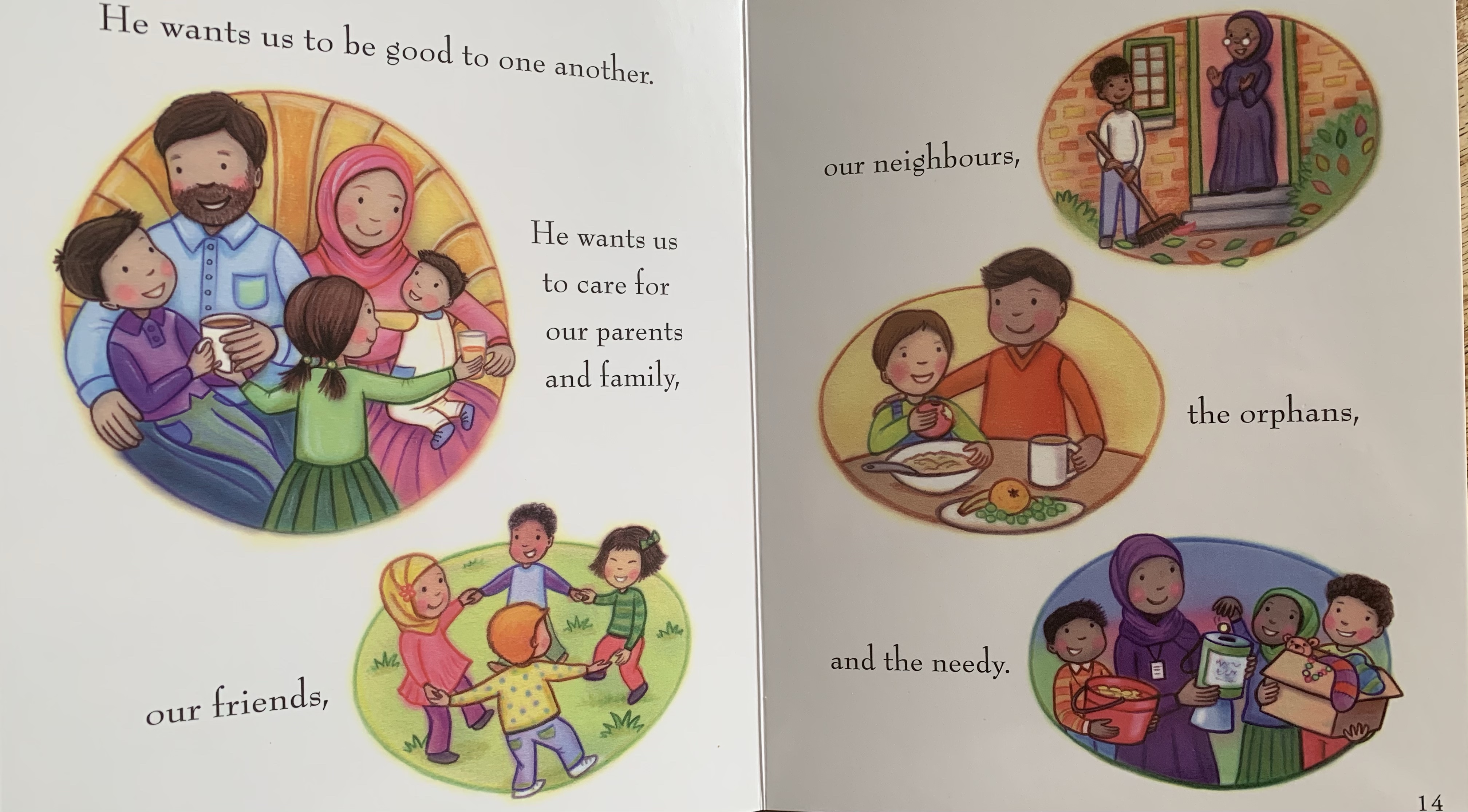
Allah wants us to follow His rules and sent books and Prophets to show us how to act.  He wants us to be good to one another, to be thankful, to look after our world, and everything in it.  Allah wants us to worship Him alone and pray five times a day, fast in Ramadan, give money to the poor, and go for Hajj.

img_9016

He also wants us to have families and to get married and raise our children to be good Muslims, so that when we die we will go to Paradise.  The book ends with facts about the Qur’an and questions and answers that can help further the conversation, increase understanding, and encourage love for the holy book.

Ramadan by Mari Schuh

Standard
Ramadan by Mari Schuh

ramadan edelweis

This 16 page holiday book is one in a series of six.  It keeps the text simple, the images bright and inviting, and turns the pages in to a search and find activity to increase time spent with the material.  The information is accurate and basic, there is nothing wrong (phew) with this recent addition to the very crowded nonfiction holiday book field.  In fact I appreciate that dates are explained and that the food looks tempting even if non Muslim children aren’t familiar with the dishes.  It shows a child in sajood and explains that he is praying. The realistic pictures show smiling faces and Muslim kids will feel represented. Non Muslim readers will become familiar with Ramadan as a time of fasting, the Quran, and prayer.

The pictures to look for are given at the beginning and again at the end with the “answers.” The limited pages have very minimal text.  The first one mentions a lantern being hung for Ramadan. It then states that Ramadan is a Muslim holy month where people fast, don’t eat or drink.

It shows a picture of the Quran and says it is used to pray, before showing someone praying on a prayer rug. When the sun has set it is time to eat. Dates are a sweet fruit to snack on after dark. It then shows a child and adult making dua and again reiterates that the holy month is for praying and helping others.

Ramadan and Eid Al-Fitr: Traditions and Celebrations by Melissa Ferguson

Standard
Ramadan and Eid Al-Fitr: Traditions and Celebrations by Melissa Ferguson

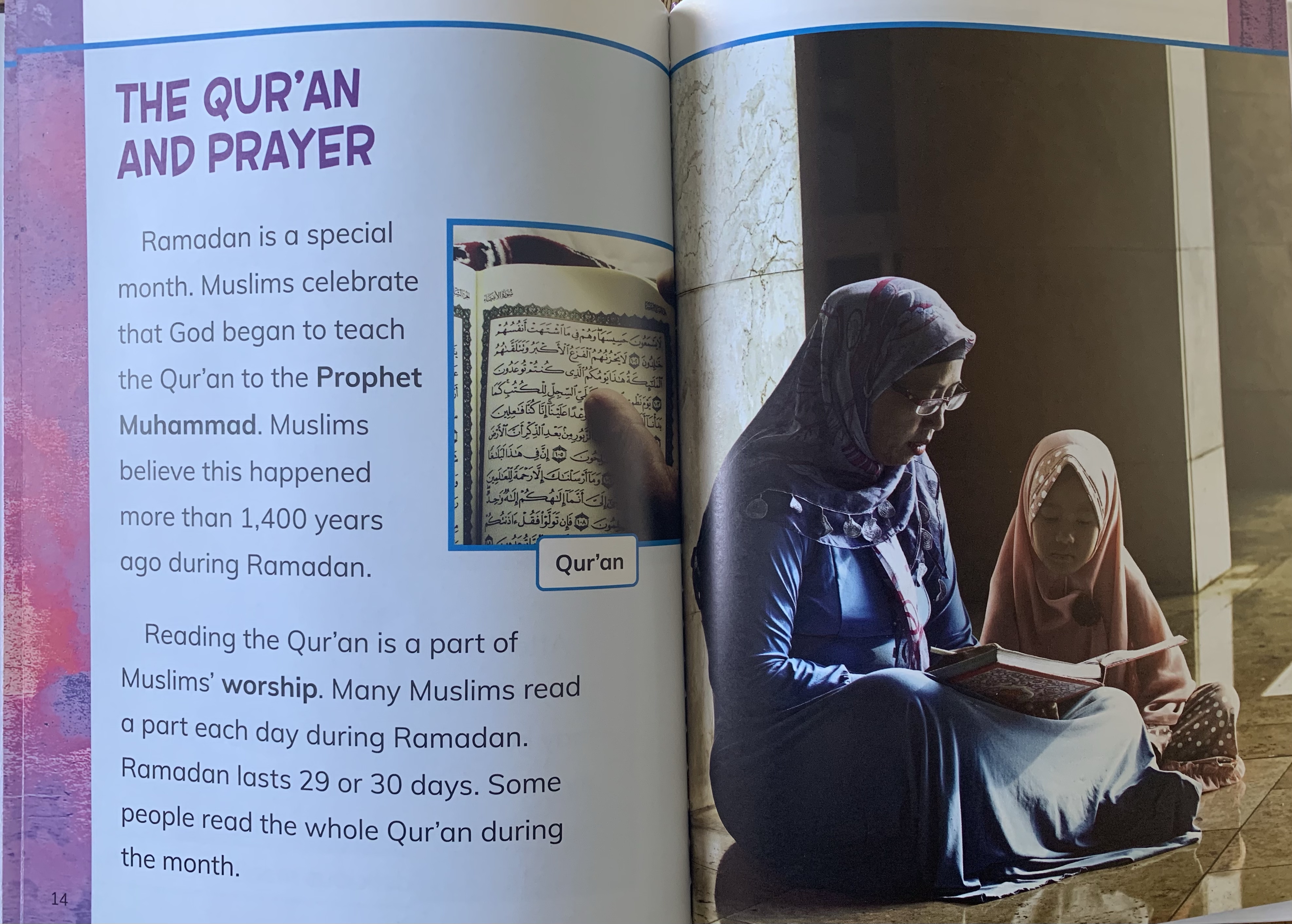
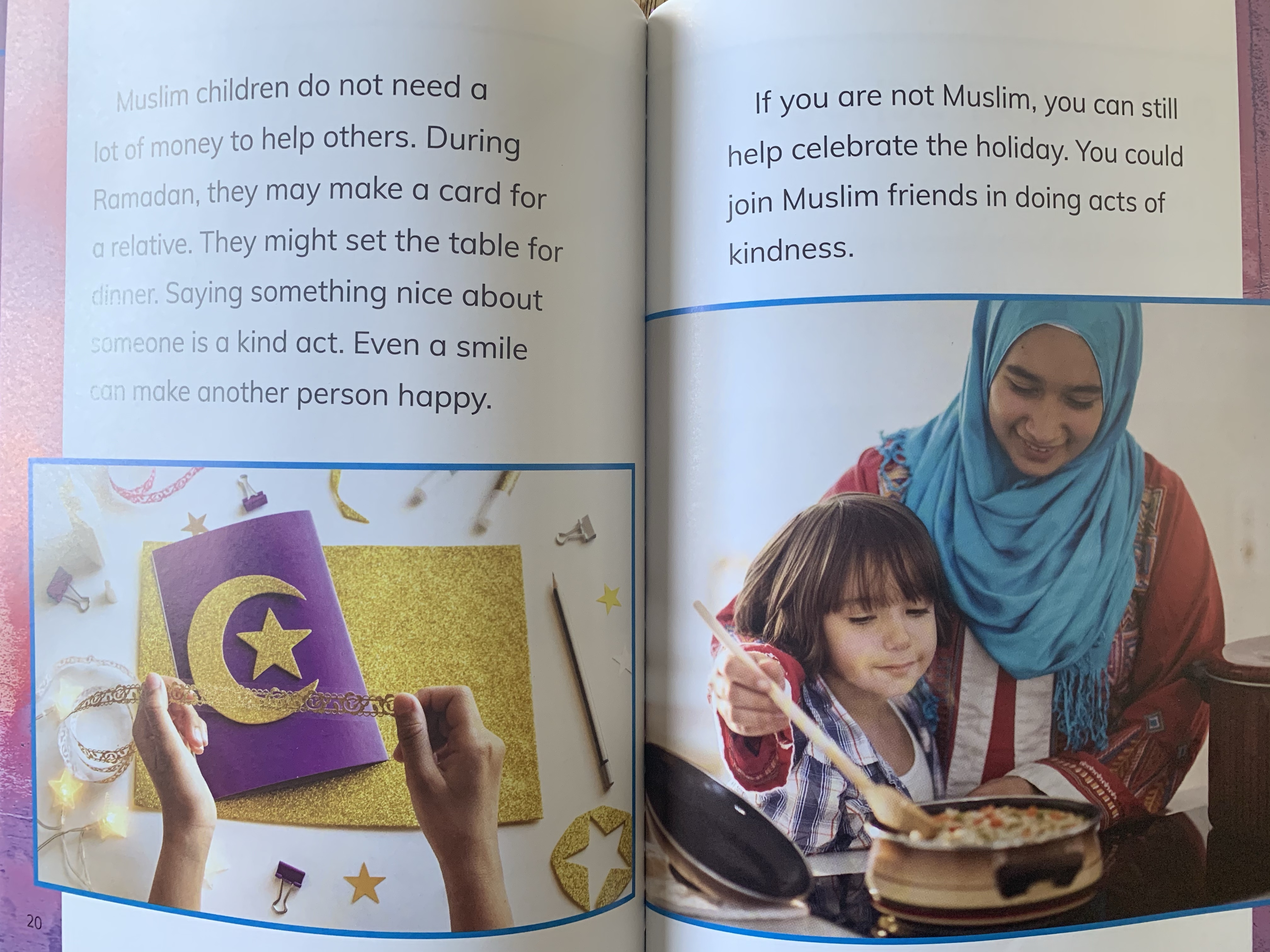
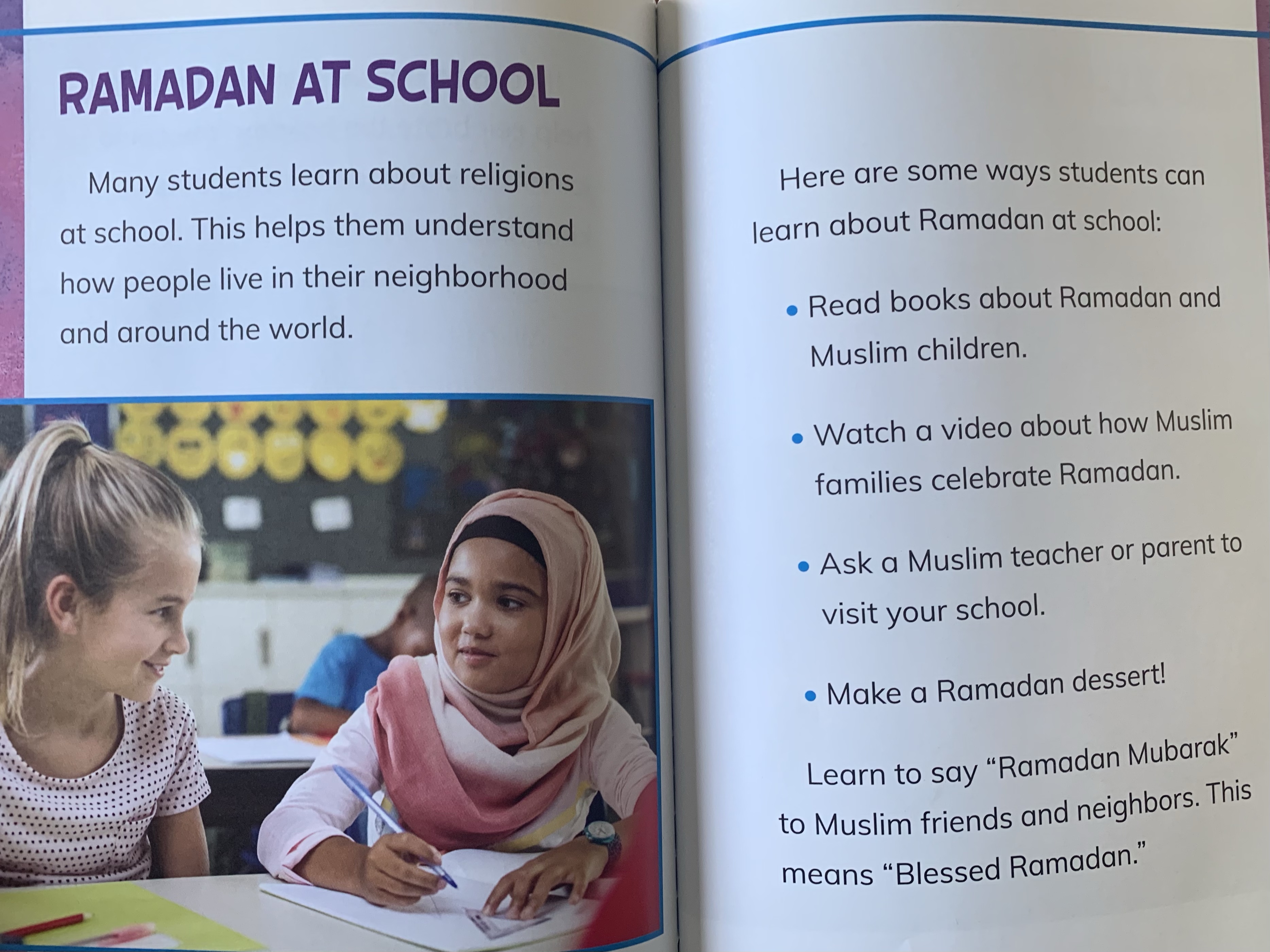
This 2021 nonfiction middle grade book about Ramadan and Eid al-Fitr breaks sections down by key concepts and the use of stock image photographs. The information is fairly accurate, no major flags, just a few awkward stresses: that kids look for the moon, that meat is so important at iftar, but most of the information is conveyed well. There is a glossary, more books to check out, internet sites to visit, an index, and pronunciation guide. The Capstone published, 32 page book, shows diversity in the pictures- some women with hijab and some without, different skin tones as well, and while it might not be the most tempting book to pick up, the text is inviting for non Muslims to understand Ramadan and Eid, how to join their Muslim friends in being kind and forgiving, and answers a lot of questions in a straightforward manner. Muslim children will also enjoy seeing their beliefs explained in a positive manner to readers in a book that stays religion focused and doesn’t get distracted by culture.

The book sections are: What is Ramadan?, When is Ramadan?, What does Fasting Mean?, Suhoor, Iftar, The Qur’an and Prayer, Acts of Kindness, Ramadan at School, and Eid Al-Fitr. It starts by introducing a fictional character named Ayesha reading the Quran with her family. It is the start of Ramadan, a month of praying, fasting, spending time with loved ones, and trying to be better people.

It then explains the lunar calendar before discussing that fasting is a choice to not eat or drink from dawn until sunset. It also notes that children and the sick and elderly are not required to fast.

It talks about eating healthy foods early in the morning before praying the first prayer of the day. It details iftar being dates and water, followed by the sunset prayer and then a large meal after that.

It is very clear in explaining that Muslims believe it was during Ramadan that God began to teach Prophet Muhammad the Quran more than 1,400 years ago. It identifies our five prayers and that people can pray at home or in mosques and that children learn to pray with their parents as they grow up.

The book then becomes a little more unique as it gives time to the aspect of kindness in Ramadan. It gives examples of what Muslims do, from raising money and hosting large dinners, to buying and donating a toy. It even dedicates a whole page to children doing kind acts with little to no money: setting the table, making a card, smiling. It encourages non Muslims to join a Muslim friend in doing an act of kindness too.

The next section, is similarly unique in talking about Ramadan at school and how often at school we learn about different religions in our neighborhood. It gives bulleted suggestions on how to learn about Ramadan in school and how to say Ramadan greetings. The book concludes with Eid Al-Fitr and coming back to Ayesha and her family celebrating.

Eid al-Fitr: Festivals Around the World by Grace Jones

Standard
Eid al-Fitr: Festivals Around the World by Grace Jones

img_8875-1

NO! NO! NO! NO! NO! Seriously, astagfiraAllah! This 24 page middle grades non fiction book about Islam and Eid published in 2018 with smart-board connections and QR scan media enhancements on its surface would seem to be a great classroom all-in-one to learn about the basics of celebrations, Islam, Ramadan, and Eid.  BUT, NO! The information is all sorts of off, and there is an illustration depicting Prophet Muhammad (saw).  How is this sort of ignorance even possible? This isn’t even a Karen Katz My First Ramadan depiction where you can possibly argue and stretch that it isn’t a depiction of the Prophet, but just of the people.  Every picture in the book is a photograph, except on the page talking about the first revelation, it is an illustration and there are no other people on the page, just a picture of the Quran.  I encourage you all to see if your public library shelves the book and ask them to pull it. ****UPDATE: My library pulled it, and the publisher has halted sales of it. Alhumdulillah! We must remember we can use our voices to make a differences, that people are receptive and willing, not always, but we won’t know unless we try.  ****

img_8873-1

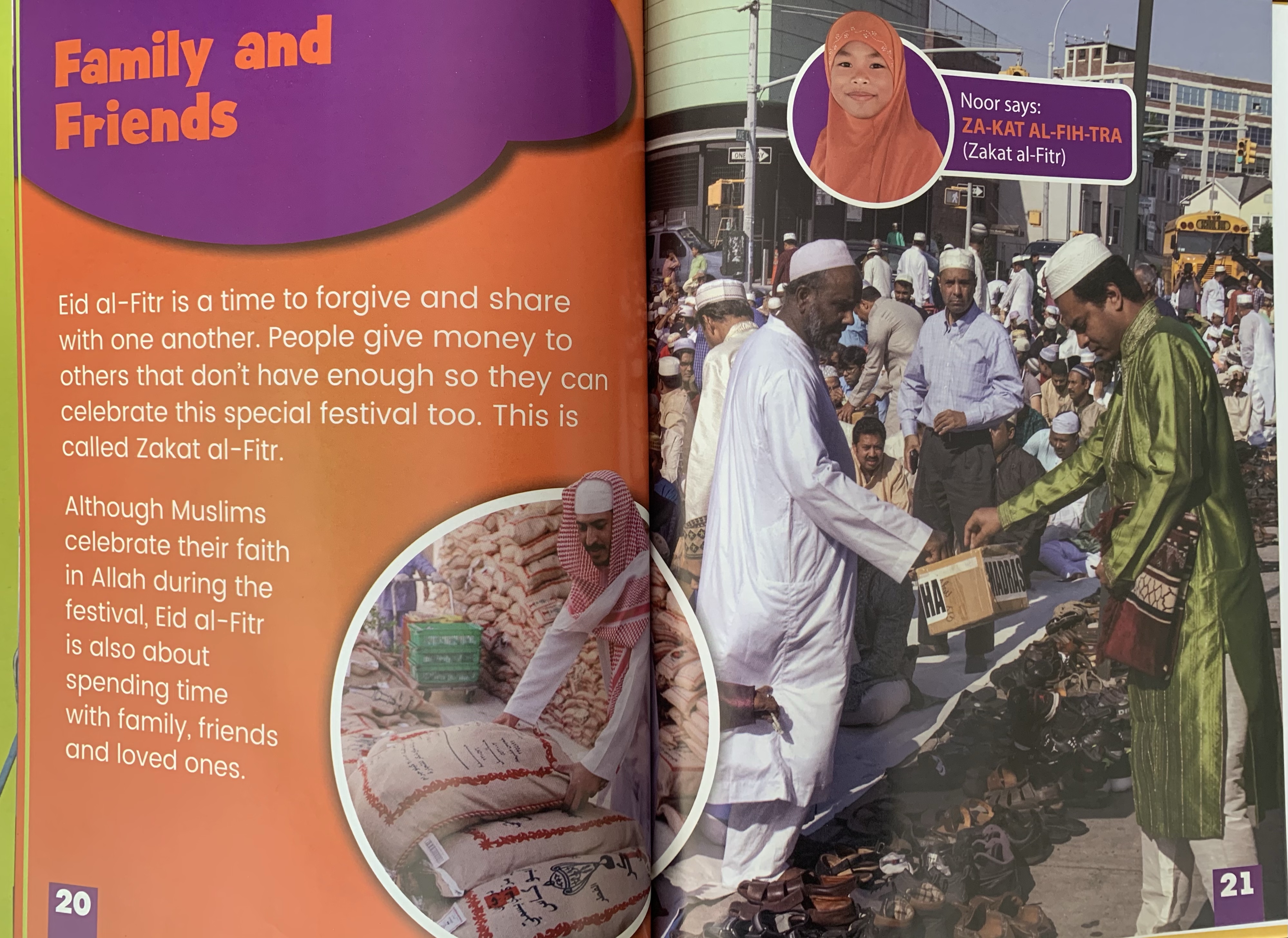
The book covers nine topics on two page spreads ranging from the generic what is a festival, to what is Islam to prayer and worship and festival food.  The book has a little girl Noor that pops up on pages to tell you how to say a word and has a glossary with her definitions at the end.  Even the definitions at the end about the foods are wrong, they seem to have switched ma’amoul and sheer khurma.  To it’s credit the book has a photographs of a lot of diverse Muslims celebrating Ramadan and Eid, unfortunately so much is wrong, from little things saying that “Sheer Khurma is traditionally eaten for breakfast during Eid,” to “Muhammad spread Allah’s words to other people by writing them down in a holy book…”.  

img_8869-1

It has in quotes that a voice from the sky called to Muahmmad, “You have been chosen to hear Allah’s words.”  This quote and its source are nor footnoted or referenced, clearly they are not from surah Al Alaq.  I’m not sure where they are getting this from.  There are no salutaions after Rasulallah’s name nor is Prophet before it.

img_8872-1

Other informative sentences are vague and suggest misinformation.  It says that we believe in Allah and pray to him in a mosque, which yes is fine, but we also pray to him in other places five times a day and the way it is worded, I don’t think that would be understood.  I feel like the role of the imam is also overly elevated in the book.  The takeaway I assume would be that only an Imam can lead a prayer and we must always pray in a mosque.  

img_8870-1

Ultimately the biggest problem I have in the book is the depiction of our beloved Prophet.  I can forgive that they assume eating a random dish for Eid is religious and not just cultural, but I can’t forgive such basic ignorance in a book that presumably is trying to teach about a faith to reduce ignorance and misunderstandings.


Crayola Ramadan and Eid Al-Fitr Colors by Mari Schuh

Standard
Crayola Ramadan and Eid Al-Fitr Colors by Mari Schuh

img_8546

This 32 page non fiction children’s book uses colors to introduce the very basics of Ramadan and Eid from a non Muslim point of view to a non Muslim audience.  The book is done decently and shows diverse Muslims and bright colors interwoven with facts about the month, but by-and-large it is forgetable and just discusses the broader sense of celebration.  There is very little that is religious outside of the photographs showing Muslims that are used to illustrate the book.  Even the concept of colors in a book by Crayola is a little lacking.  Yes, dates are brown, but just to say that “colorful designs cover prayer rugs,” and that “people shop for red and green vegetables, and many orange and brown fruits are used for meals too,” seems really vague and half hearted.  

img_8547

The book starts out with explaining what Ramadan is and defines what a crescent moon is in a blurb under a picture of one. It then explains what happens in Ramadan and dedicates two pages to lanterns that are purple, red, blue and green and used to hang in streets and homes.

img_8551

It then moves in to the celebrating of Eid Al-Fitr.  It shows children playing and having fun and receiving gifts and toys to celebrate. It talks about the food and mentions colors of the food without naming or describing them, it then does the same for desserts.

img_8548

When explaining the clothes that people wear on Eid, it says that sometimes they are colorful. It then repeats that gifts and money are given, but adds in that they are also given to those in need.

img_8550

The book concludes with a page that you can copy and color, a glossary, suggestions to learn more, and an index.

img_8549

A much better, color driven albeit not Ramadan and Eid specific choice would be Golden Domes and Silver Lanterns: A Muslim Book of Colors  by Hena Khan on in my opinion. Both are widely available in public libraries, maybe check them both out and let me know what you and your children think.

Baby’s First Ramadan by Clare Lloyd design and illustrations by Eleanor Bates

Standard
Baby’s First Ramadan by Clare Lloyd design and illustrations by Eleanor Bates

baby ramadan

I was excited to see publishing company DK add this Ramadan book to their board book selection, but overall it didn’t wow me, or even really impress me.  It has realistic pictures of diverse Muslims celebrating Ramadan, simple text, and bright images, but it read awkward as it switched between first and third person, realistic and stock looking images, and not terribly enticing with slightly faded mehndi and unexplained foods.  There are better board books out there for babies and toddlers than this 12 page mainstream published one.  If you can find it at the library, sure check it out, but I’d save my money on purchasing it.

baby ramadan 1

The book starts out saying Muslims follow Islam and Ramadan is a special month in Islam.  It features a a man holding a little girl and both are people of color.  The opposite page is a cartoonish crescent moon saying it is the start of Ramadan.

baby ramadan 3

The next page has a plate of realistic deviled eggs on a bright background stating that many Muslims fast, don’t eat from sunrise to sunset.  It also states that the meal before dawn is called suhoor or sehri.  I’m not sure why Urdu is included with the traditional Arabic and no other languages are mentioned.
The next page then shows a little girl praying and switches to present tense first person and says “Let’s pray…” followed by a little boy reading Quran and stating that reading Quran helps us learn about Islam.  It then switches back to declarative 3rd person saying that people break their fasts before sunset prayers and shows a bowl of dates.

baby ramadan 4

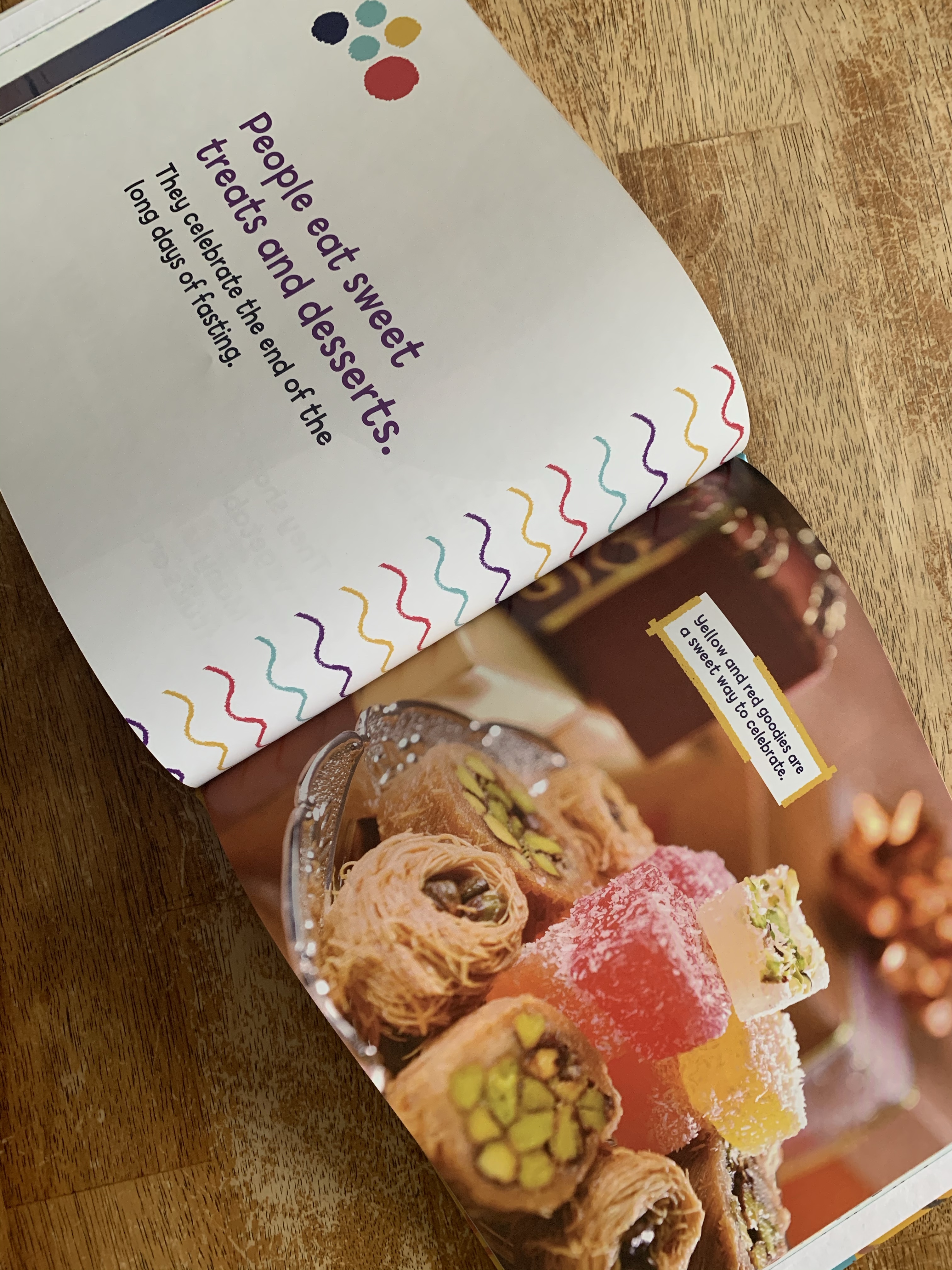
A family is then shown breaking their fast with a meal known as iftar and the reader is urged to pick their favorite sweet to eat from a plate of different shaped baklava.  There is no description about the baklava and I don’t know how enticing they would be if you have never tasted it before.

The book concludes with the same cartoonish night sky and silhouetted masjids saying the crescent has been seen, Ramadan is over and tomorrow is Eid.  The last page is a girls hand saying , “Let’s celebrate Eid by making henna patterns on our hands.”

baby ramadan 2

I think the idea is good, but I feel like it doesn’t answer many questions about Ramadan and Muslims and probably makes the religion and celebrations seem foreign and odd, presumably the opposite effect.  I admittedly haven’t read the other holiday books in the series and am not a baby expert, so perhaps I’m really critical and missing the developmental reasoning behind the presentation.  But I don’t know that this book is fun or really informative for any age, it just seems random.

Accused: My Story of Injustice (I, Witness Series Book 1) by Adama Bah

Standard
Accused: My Story of Injustice (I, Witness Series Book 1) by Adama Bah

adama

This is the first book in a new middle grades nonfiction series and is Adama Bah telling her own story about being detained as a 16 year old and falsely accused of being a suicide bomber.  A story that sounds like a movie plot is painfully real and terrifying and hearing it in her own words is powerful and impactful.  The writing is very basic in its linear format and straightforward presentation of the experience through her eyes.  It is not sensationalized or overly explanatory about how this situation came to be, how she got out of it, or what the family had to go to to find lawyers and pay for them, for example.  It is how she felt, what she understood at the time, and how the experience shaped her.  While the writing style is sufficient for middle grades, her story is intense.  A big part of her experience is being strip searched, exposed, and seeking asylum to avoid female circumcision.  The 128 page book is a great way to show the realities of our world.  It took place in the 2000, the recent past, to a New York teenager that enjoyed different colored sneakers, chatting with her friends, and spending time with her family, no different than the readers picking up her story to read.

SYNOPSIS:

Adama was born in Conakry, Guinea in 1988 and moved to America as a child.  She attended public school until high school when she was then sent to an Islamic boarding School in Buffalo, New York.  Her family was not particularly religious, but Adama become more visibly Muslim returning home after the attacks on September 11, wearing niqab and wondering why she was being treated with such hostility at the airport.  As she resumes her education in public school, she slowly makes the choice to take off her niqab, while maintaining her hijab and modest clothing.  In 2005 she and her father are taken in to custody early in the morning from their home and detained.  During the questioning at 16 years old, Adama learns that she is not a legal US citizen.  Her father is separated from her, to be deported, and she is moved to Pennsylvania as the youngest person swept up in a terrorist roundup.  She is being accused of being a potential suicide bomber and is detained for six weeks before a plea deal is brokered.  She will wear an ankle monitor for three years and have a nightly curfew.  During this time she is responsible to care for her family as her father has been returned to Guinea, her mother speaks very little english and she has four younger siblings.  Even after the bracelet is removed she finds herself still on no-fly lists and finally after one more time being denied and detained at the airport, she sues the Attorney General, FBI Director, and the Director of the Terrorist Screening Center. When they learn of this they offer to remove her from the no-fly list if she withdraws her case. She is granted asylum and while she had to drop out of school, she dreams of going back.  She has since married, her dad has been able to return to America, and she continues to study Islam and believe that things could have been worse.

WHY I LIKE IT:

I love that it is her story, from her eyes and perspective, but I worry that some of the details are misplaced.  She details enjoying talking bad about the government with a friend after she is released knowing that they are listening in, but maintains that she is constantly in fear of being returned to jail and that she considers America her home.  I’m not saying all of those things can’t be true and co exist, but some additional context would help the choppiness in this example and others.  I appreciated that the genital mutilation was clearly attributed to culture and not religion, I think when others tell stories about cultural and religious practices they often conflate the two.  I wish there was more information about where this mysterious list came from, what happened to the Bengali girl that was taken, how the Islamic community reacted.  The story is powerful and moving, and readers will be drawn in as they see themselves in her.  There are also questions at the end that help connect readers to her situation, and the reality that this is the unjust world we live in and can easily be consumed by as she nearly was.

FLAGS:

Detailing a strip search, detailing taking off her clothes, having orifices checked, and using the bathroom in the open.  There is talk of female circumcision although it doesn’t define it explicitly.

TOOLS FOR LEADING THE DISCUSSION:

I think in a high school Social Studies class or current events discussion this book would be a great topic to explore and voice to highlight.  The book is short and can be read very quickly.  It is an important story to know, to learn from, to sympathize with, and be acutely aware of for people of all ages.