Category Archives: middle grades

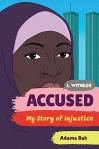
Accused: My Story of Injustice (I, Witness Series Book 1) by Adama Bah

Standard
Accused: My Story of Injustice (I, Witness Series Book 1) by Adama Bah

adama

This is the first book in a new middle grades nonfiction series and is Adama Bah telling her own story about being detained as a 16 year old and falsely accused of being a suicide bomber.  A story that sounds like a movie plot is painfully real and terrifying and hearing it in her own words is powerful and impactful.  The writing is very basic in its linear format and straightforward presentation of the experience through her eyes.  It is not sensationalized or overly explanatory about how this situation came to be, how she got out of it, or what the family had to go to to find lawyers and pay for them, for example.  It is how she felt, what she understood at the time, and how the experience shaped her.  While the writing style is sufficient for middle grades, her story is intense.  A big part of her experience is being strip searched, exposed, and seeking asylum to avoid female circumcision.  The 128 page book is a great way to show the realities of our world.  It took place in the 2000, the recent past, to a New York teenager that enjoyed different colored sneakers, chatting with her friends, and spending time with her family, no different than the readers picking up her story to read.

SYNOPSIS:

Adama was born in Conakry, Guinea in 1988 and moved to America as a child.  She attended public school until high school when she was then sent to an Islamic boarding School in Buffalo, New York.  Her family was not particularly religious, but Adama become more visibly Muslim returning home after the attacks on September 11, wearing niqab and wondering why she was being treated with such hostility at the airport.  As she resumes her education in public school, she slowly makes the choice to take off her niqab, while maintaining her hijab and modest clothing.  In 2005 she and her father are taken in to custody early in the morning from their home and detained.  During the questioning at 16 years old, Adama learns that she is not a legal US citizen.  Her father is separated from her, to be deported, and she is moved to Pennsylvania as the youngest person swept up in a terrorist roundup.  She is being accused of being a potential suicide bomber and is detained for six weeks before a plea deal is brokered.  She will wear an ankle monitor for three years and have a nightly curfew.  During this time she is responsible to care for her family as her father has been returned to Guinea, her mother speaks very little english and she has four younger siblings.  Even after the bracelet is removed she finds herself still on no-fly lists and finally after one more time being denied and detained at the airport, she sues the Attorney General, FBI Director, and the Director of the Terrorist Screening Center. When they learn of this they offer to remove her from the no-fly list if she withdraws her case. She is granted asylum and while she had to drop out of school, she dreams of going back.  She has since married, her dad has been able to return to America, and she continues to study Islam and believe that things could have been worse.

WHY I LIKE IT:

I love that it is her story, from her eyes and perspective, but I worry that some of the details are misplaced.  She details enjoying talking bad about the government with a friend after she is released knowing that they are listening in, but maintains that she is constantly in fear of being returned to jail and that she considers America her home.  I’m not saying all of those things can’t be true and co exist, but some additional context would help the choppiness in this example and others.  I appreciated that the genital mutilation was clearly attributed to culture and not religion, I think when others tell stories about cultural and religious practices they often conflate the two.  I wish there was more information about where this mysterious list came from, what happened to the Bengali girl that was taken, how the Islamic community reacted.  The story is powerful and moving, and readers will be drawn in as they see themselves in her.  There are also questions at the end that help connect readers to her situation, and the reality that this is the unjust world we live in and can easily be consumed by as she nearly was.

FLAGS:

Detailing a strip search, detailing taking off her clothes, having orifices checked, and using the bathroom in the open.  There is talk of female circumcision although it doesn’t define it explicitly.

TOOLS FOR LEADING THE DISCUSSION:

I think in a high school Social Studies class or current events discussion this book would be a great topic to explore and voice to highlight.  The book is short and can be read very quickly.  It is an important story to know, to learn from, to sympathize with, and be acutely aware of for people of all ages.

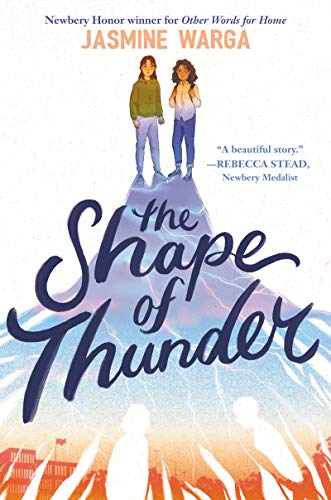
The Shape of Thunder by Jasmine Warga

Standard
The Shape of Thunder by Jasmine Warga

shape of thunder

Usually when a book leaves me with a lot of questions, it is because the author’s writing was incomplete or flawed, this book however, left me with a lot of questions and I’m certain the author did this deliberately. Hence, I don’t know to be irritated or impressed that I care enough about the characters to want to know more. Considering I’m still emotionally attached to the two alternating voices in the book, I’m going to claim the latter, and just be grateful that I was privy to follow the two girls for 288 pages and let the impression the book left me with overpower the curiosity I have to know everything about their past and their futures. This middle grades read is absolutely wonderful and emotionally gripping. I think all kids will have a hard time forgetting the story and characters, and more importantly I think over time they will recall and re evaluate their own thoughts regarding the personal weight of school shootings, gun ownership, sibling loss, responsibility, and maybe even the possibility of time travel. I know this book will stay with me for a long time. This amazing, half-Middle-Eastern half-American author in her OWN voice book somehow manages to discuss a school shooting without being political or preachy and the result is memorable, heartbreaking, and powerful.

SYNOPSIS:

Told in alternating 12 year old voices: Quinn and Cora are neighbor girls that used to be best friends until Quinn’s brother stole his father’s guns and shot and killed students at his school before committing suicide. One of the classmates he killed was Cora’s older sister Mabel. It has been nearly a year since the incident, and since the girls last spoke, but on Cora’s 12 birthday, Quinn leaves a box on her door.

Cora is whip smart and grieving. She lives with her dad, a professor and immigrant from Lebanon who speaks little about his culture or religion to his kids, even though the kids want to know about their heritage and do identify as Arab American Muslims. She also lives with her grandma, her mom’s mom, despite the fact that her mom has left them. It never tells where she went or what happened, which I desperately wanted to know, but Cora doesn’t miss her, because Cora doesn’t remember her, and the family dynamic seemed to be working until Mabel is gunned down. The loss of Mabel is palpable as Cora recalls that she will one day be older than her older sister, and refuses to pack up or touch anything on her side of the room. Cora is in counseling and seems to have a supportive network of friends in her Junior Quiz bowl team, but she misses Quinn even though she can’t forgive her.

Quinn’s chapters begin with a small letter to her brother Parker: what she wants to say, what she feels, questions, memories, anger, disappointment, despair. They are short, but haunting and heartbreaking. Quinn’s home life is fraught with guilt and blame. Her mother has quit work and her father is always working. Her parents fight, a lot. Her mom blames her dad for owning the guns, her dad wants to move to give them all a fresh start, it isn’t pretty. Quinn often has a hard time getting her words out at the speed she wants, she calls it freezing. As a kid, Cora would help, but without Cora and with no one in the house willing or ready to listen to Quinn, Quinn is often left alone. At school Quinn is largely ignored as no one wants to be around the sister of the mass shooter, so she doesn’t try out for soccer, she has no friends, and no one to talk to get the help she so desperately needs.

Quinn has an idea about how to fix everything, and that is what is in the box. She is convinced that if she can go back in time, she can make everything right. The only problem is, she doesn’t understand all the science and needs Cora’s help. Together the two girls work to figure out a way to find a wormhole and fix the damage that occurred. Along the way the girls realize how much they need each other to heal, and the role forgiving yourself has in the process as well.

WHY I LIKE IT:

I am shocked at how deftly the book talks about a school shooting without talking about a school shooting. It is how the families feel in the day to day acts that follow a year later and how the girls are trying to carry on with the limited tools that exist for individuals dealing with the aftermath of such an act of terror. It doesn’t go in to the 2nd Amendment rights or detail the lack of legislation to curb such acts, it really stays on the two girls. The hope of finding a wormhole is really farfetched and perhaps unrealistic, but they are so desperate to believe, to find a way to make things right, that you hope for their sake that they are successful.

It is amazing to see from the sister of a shooter the isolation and pain she endures. I don’t know that I’ve really ever considered the larger families of the shooter when your heart is so devastated for the families of the victims. Occasionally you hear about the parents, but what about the siblings, cousins, distant relatives?

I desperately wanted to know where Cora and Mabel’s mom went. I was tempted to contact the author since it really was gnawing at me. I also wanted some answers as to why Parker did what he did, what hate he was spewing online, what were the signs, did he single out Mabel for being Muslim, while also appreciating that there is no satisfactory answers for any violence of this magnitude in fiction or real life.

Cora knows nothing of Islam and kind of wants to, I felt like this could have been explored a tiny bit more. Not in that she has to be religious, but I feel like after such a life altering event such as death, religion and what happens when one dies usually comes up and a person decides they are satisfied with an answer or not. The story isn’t in the immediate aftermath of dealing with the shock, but rather is a little after the event to presumably not have to deal with the raw emotion, and can focus on the pain and strength that comes with finding a new normal. I’d like to imagine at some point perhaps Cora and her dad talked about what happens after death, but the text doesn’t suggest that it was an issue of concern. She does wonder if Mabel was killed for being Muslim and asks Quinn about it. Quinn never defends or justifies what her brother does, nor does she pretend to know, she is grieving too. She is irritated that people try and define her religiosity to make themselves feel better and she does say the family occasionally fasts, makes duas, and they always celebrate Eid.

She talks a bit more about wanting to know more Arabic, saying that if you are 50% Arab you should at least know 50 words, and she only knows five. She wants to hear about her father’s life growing up, and know that side of her. It mentions that he wanted her to feel like she belonged in America, but I’d love to know more. Maybe what happened to his family, what brought him to America, why they opted not to give them more cultural names, etc..

I also enjoyed the slight science thread. It seems the author used to teach science and I love that the scientific method and various random facts find their way into the story.

POSSIBLE FLAGS:

The book talks about death, killing, suicide, and gun violence, but doesn’t relive the chain of events or detail what happened exactly. Quinn and another friend have crushes on boys in their class. There is a Fall Festival that the kids dress up for, but it isn’t called Halloween, and there is no mention of it. The book opens with Quinn’s birthday.

TOOLS FOR LEADING THE DISCUSSION:

I would definitely read this as a middle school book club selection. It is engaging and gripping and a great book to have as an introduction to hard conversations with children. The author has a note at the beginning about her own children doing active shooter drills and having to face this real fear, and I think kids talking about it through fiction is a powerful tool to get them thinking and talking.

Becoming Muhammad Ali by James Patterson and Kwame Alexander illustrated by Dawud Anyabwile

Standard

img_8575

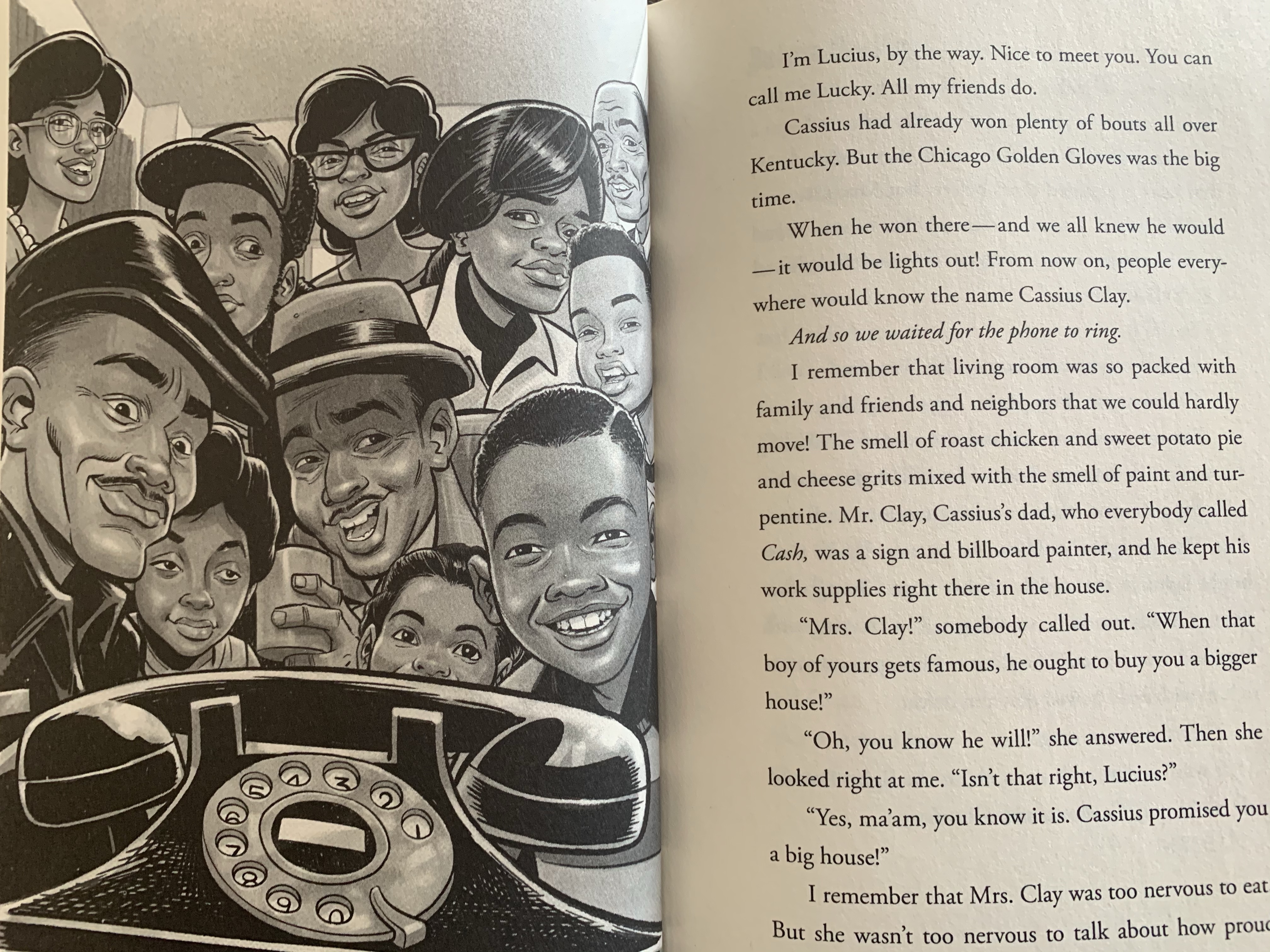
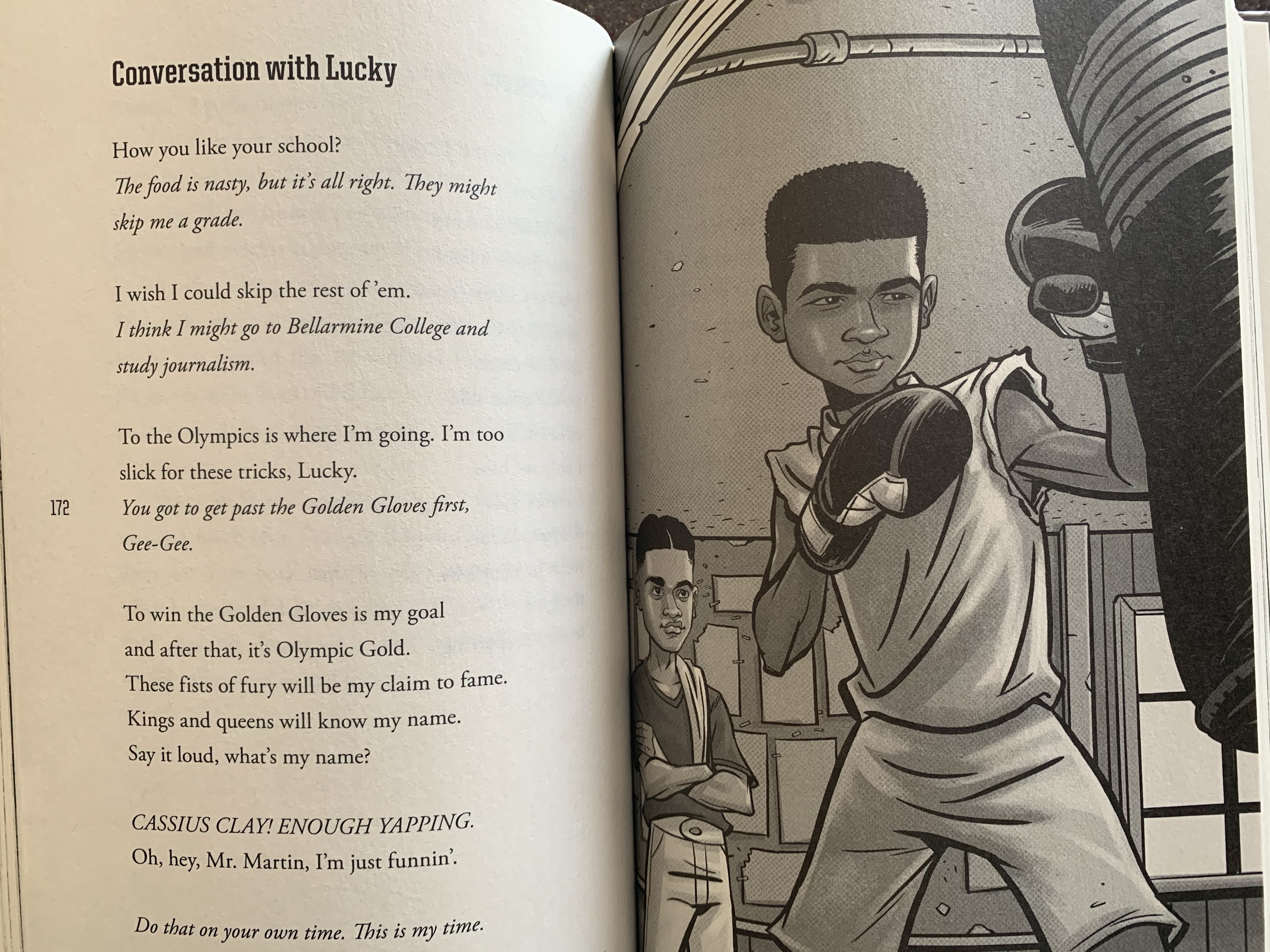
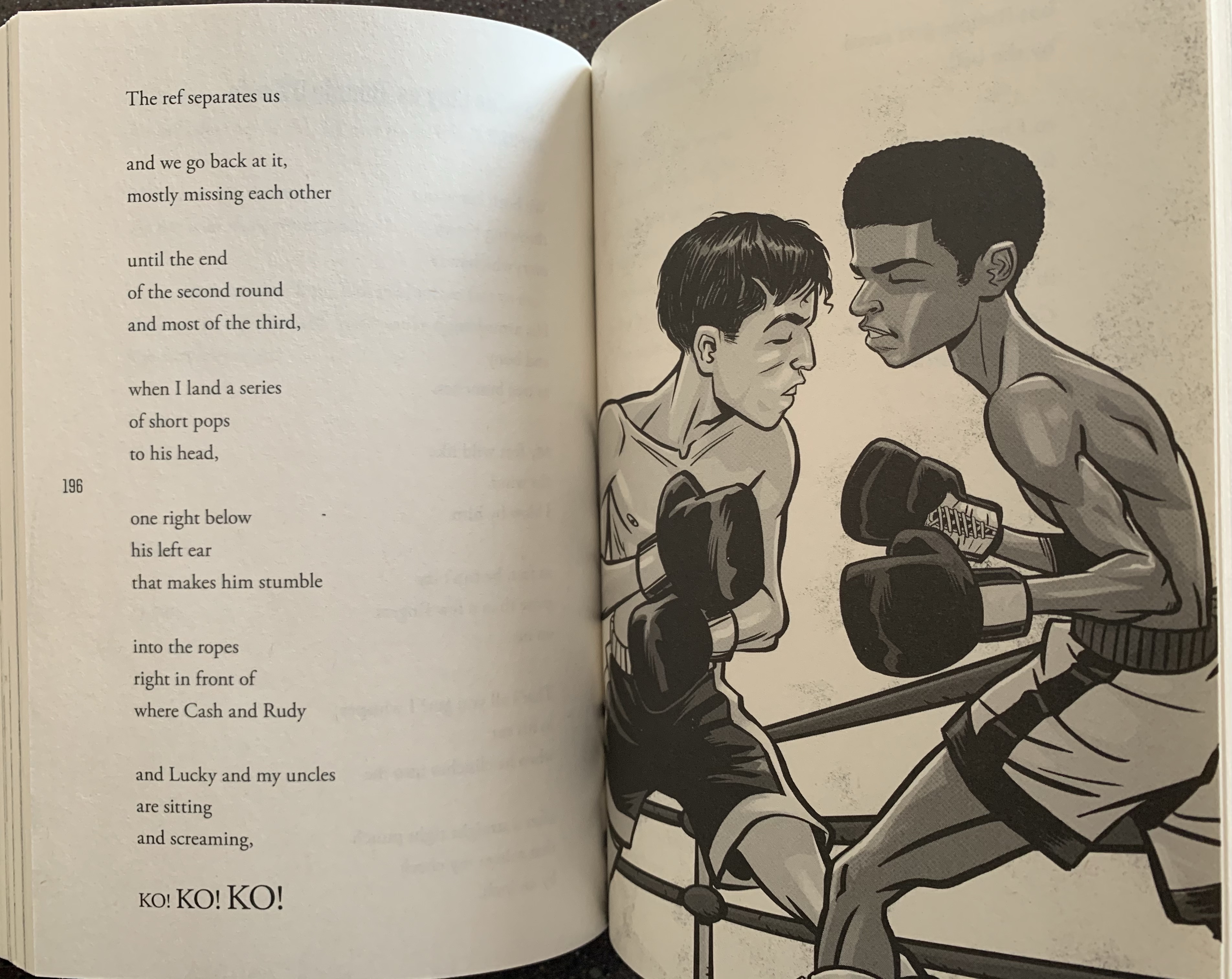
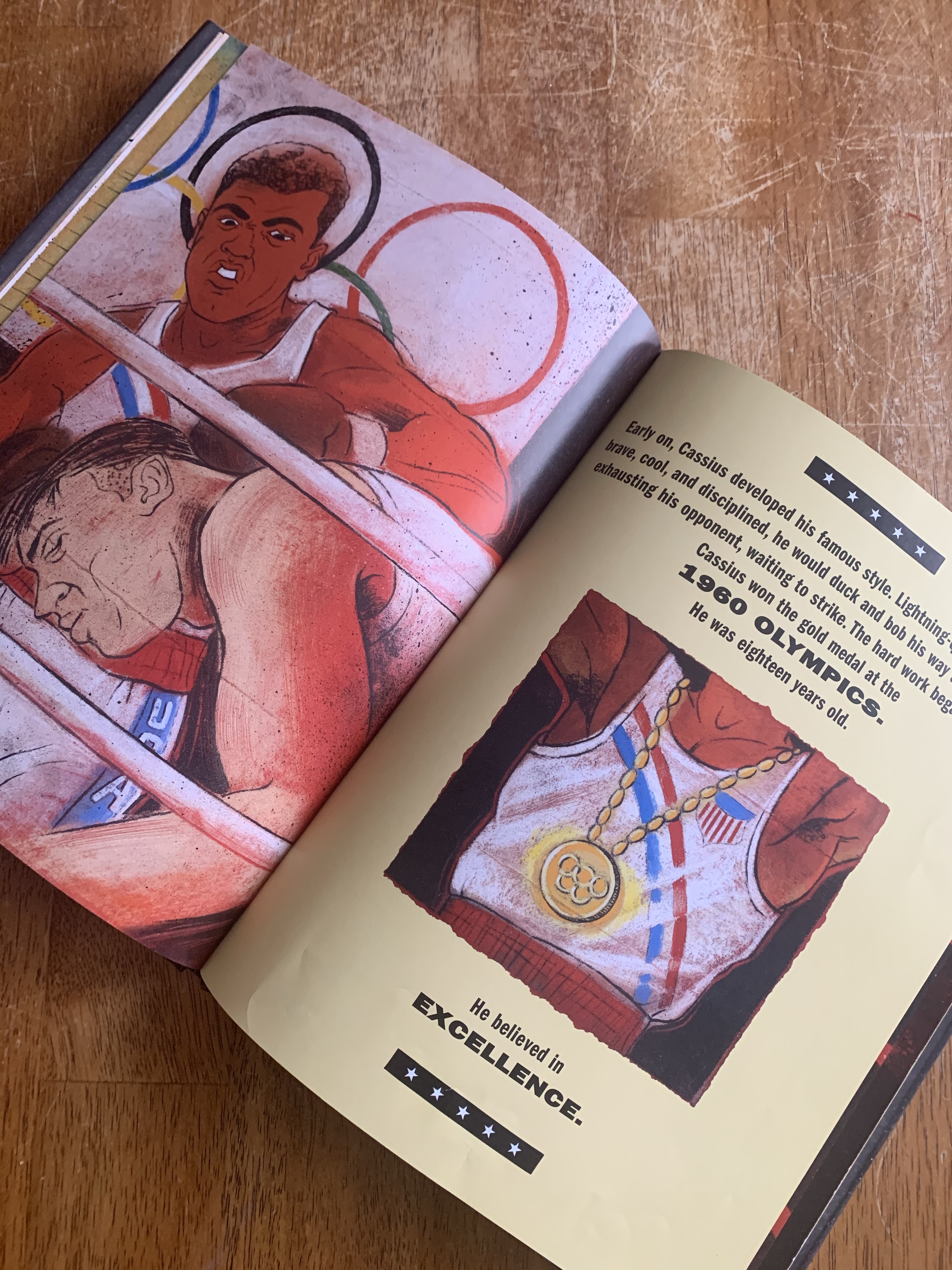
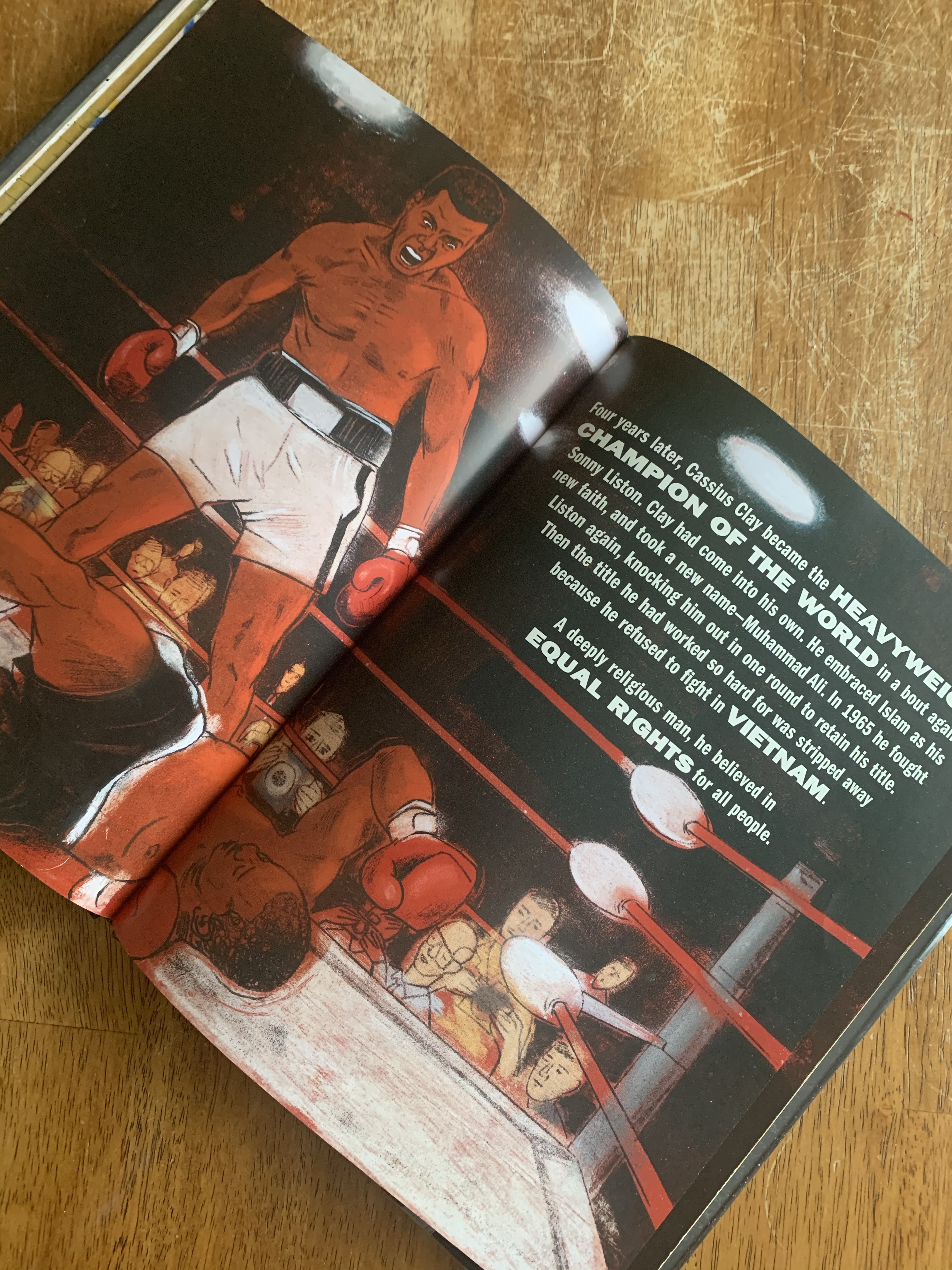
This 310 page, AR 5.4 biography reads like a dream being remembered and flowing with newly awakened images presented in a lyrical way. The changes in point of view and writing style keep the book bouncing like a boxing match, and flesh out the early life of Muhammad Ali for middle grade readers.  Only at the very end does it mention that he changed his name when he converted to The Nation of Islam, it doesn’t detail much about it, and it doesn’t mention his eventual conversion to Islam, even though it does mention him being diagnosed with Parkinson’s and his death.  I understand that the book focuses on his preteen and teen years, but it seems like The Awakening of Malcolm X also intentionally cut that footnote out of the book, and having read that book a few weeks ago, it seems a deliberate exclusion in both cases and that bothers me.  It could be coincidence, as both 2020 published middle grade coming of age books have familial support in the writing and research, admittedly it just might be my timing of reading them makes it seem that something larger is at play.  Ultimately, this book gives insight into who Cassius Clay was, and what his life and friend circle looked like as a boy in Kentucky. The verse and flow of the text make the book an easy and enjoyable read.

SYNOPSIS:

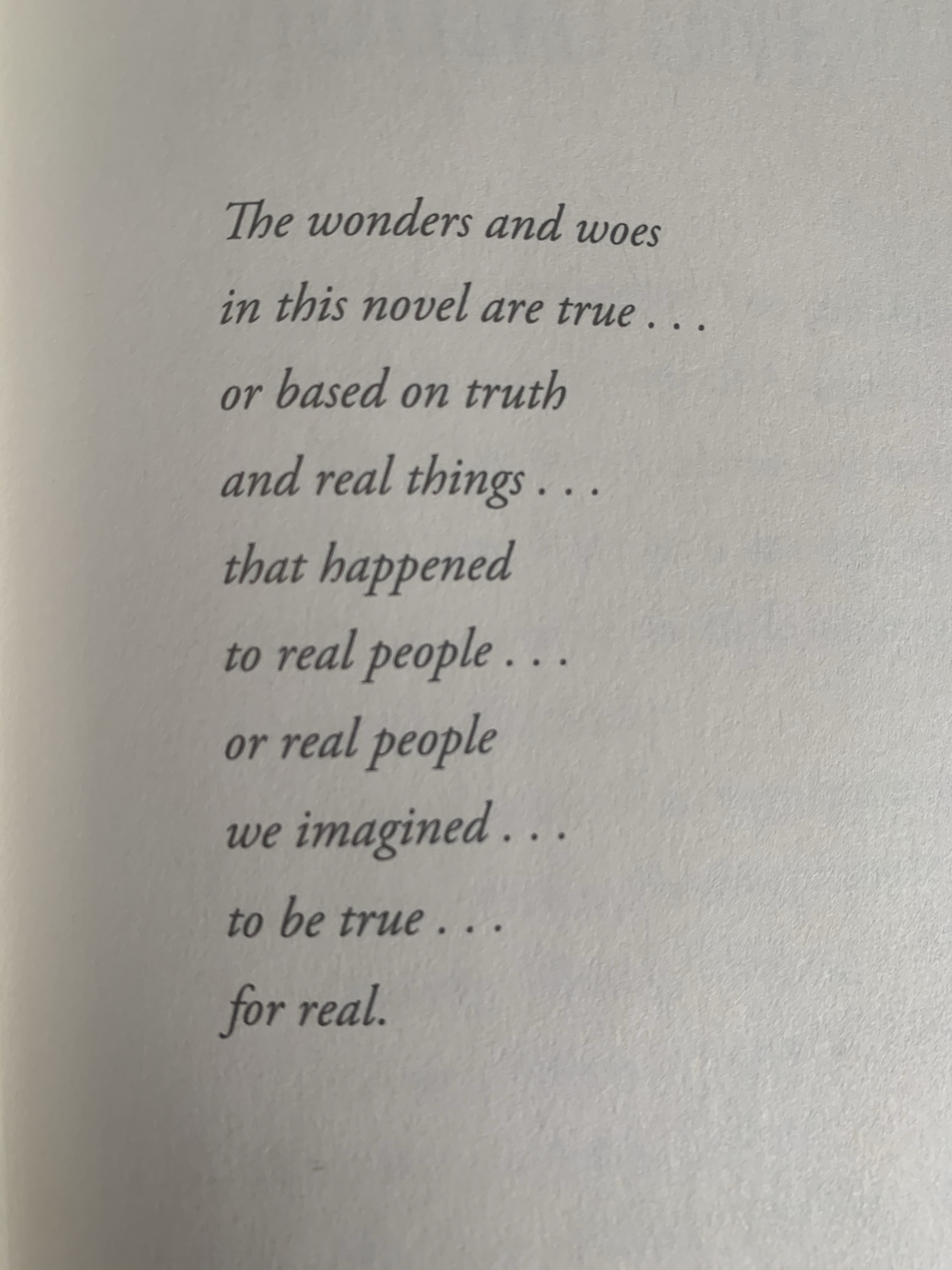
Lucky is Muhammad Ali’s friend growing up and is the narrating voice that sets up each chapter and overall framing of the book.  The bookish friend is a writer and eventually a journalist that moves the story forward.  The verses that follow each intro are the imagined voice of Muhammad Ali.  There is a bibliography at the back, but the story starts with this warning, or disclaimer, or wink of sorts:

img_8621

The book opens with Lucky and the Clay family waiting for the phone to ring in 1958 to find out if Cassius has won in Chicago.  He is there fighting for the National Golden Gloves.  He eventually loses the tournament, but he doesn’t stay down.  The book then rewinds and starts back before Cassius ever enters the ring.  The reader gets to know about Granddaddy Herman and the bond that the two share.  He is Cassius’s church and source of pride.  We also learn about how Cassius sees the world and the racism that exists in it. His humbleness and frustration with seeing how hard his mom has to work for so little reward.  We see how his friends shape him, but more importantly how he shapes them, and we see how although he struggles in school how he is articulate and respectful and beloved by so many.  His younger brother is a constant in the story, as is the narrator Lucky.  The book gets inside the character Cassius and if you didn’t know it was a biography, you would think it was a fictional coming of age book.  The ups and downs, the setbacks, the frustrations, the dreams, it all flows and makes you feel for this determined kid, who despite all his bravado, is really a down to earth human being.

img_8577

WHY I LIKE IT:

I don’t think I learned anything ground breakingly new reading this book, but I felt like I got to know the material in a more fleshed-out way.  It isn’t a list of facts or hight lights, it is the nuanced day-to-day that lift him off the page and out of the headlines.  I like the change of voice and style of writing, it made sense to me, and allowed the book to resonate differently than a traditional biography would.   I think it will also appeal to a wider audience because of the verse and easy flow.  I similarly enjoyed the illustrations that pepper the book.  I appreciate that the story is told from a friend looking in on someone that he knows well, but I almost would have preferred his brother being the voice and bringing the reader even closer to the boxer. Ultimately I want to know more about his parents and his brother and how they felt about his success.  The book didn’t answer a lot of question, but hopefully it will spark the curiosity of readers to go and learn more.

img_8578

FLAGS:

He slightly mentions crushes and dating, that his dad is out galavanting Friday nights until Saturday.  There is mention of a side character having part of his face damaged in an explosion, there is reference to the N word.

img_8576

TOOLS FOR LEADING THE DISCUSSION:

I would consider the book as a book club selection if it served a larger purpose or the group had a preexisting interest.  I think if I were to meet with a group of kids more than just once a month for an hour or so for a book club discussion, this book would have a lot of potential for introducing the athlete, writing styles, historical implications and so on.  I just don’t know that we could get to all that in such a limited time. If they had already learned about his boxing accomplishment,  his protesting of the war, his conversion for example, this book would be a great discussion extender to supplement basic knowledge of him.

Sasquatch in the Paint by Kareem Abdul-Jabbar and Raymond Obstfeld

Standard

sasquatch

My tween boys read the first two books in the Streetball Crew Series and recommended I read book one because there is a Muslim character and I’m a fan of the basketball all-star author who draws on his own life and experiences growing up in the story.  It is 265 pages, an AR 4.5, and while the story is decent, and I enjoyed the majority of it, I didn’t love it.  I was not thrilled at the choppiness of the story telling and ultimately the way Islam was presented.  Obviously there are plenty of Muslims that will occasionally eat pork and who get violent as they get more religious, but I don’t think it is the norm and definitely isn’t a message most middle grade Muslim readers would identify with, nor want non Muslims assuming about Muslims as a whole.  The book randomly has a sudden Muslim chapter toward the end and attributes some threats on the main character as being from Muslims becoming more devout.  The main character is not Muslim, this is a side character and her family, and you don’t find out til the book is nearly over that she is Muslim. I worry how younger readers will be affected by the negativity toward Islam, as it really isn’t explored or even part of the story.  There is enough going on in 8th grade Theo’s life with out the insertion of religion.  I was glad I read it so that I could discuss it with my boys, but I would encourage the book for more middle school aged kids, if at all.  The book involves basketball as a subplot, but has larger life lessons and developments away from the game.  Do be aware one of the young characters smokes cigarettes, there is female objectification talk among the male characters, racism is discussed, there is some physical assault, and beer, R-rated movies, tattoos, branding, and dating are mentioned in this coming of age book.

SYNOPSIS:

Theo is 13, in 8th grade, and over the summer has grown six inches.  He identifies as a science nerd and a geek and is on the Academic Olympic team at his school.  He now, however, finds himself on the school basketball team, and has no idea what he is doing.  Towering over everyone, he is assumed to be good, but his lanky body and new found size brings him ridicule and teasing. His life long best friend, a fellow geek, can’t figure out why he won’t just quit the basketball team, but Theo is oddly enough,  enjoying the concept of team, and suddenly being recognized in the halls.  When he joins a pickup game to improve his skills however, he gets in a fight with another kid, get’s threatened by some guys on motorcycles, and teased by a weird girl named Rain.

Outside of school it is just Theo and his police officer dad. Theo’s mom has recently passed away and the two are creating a new normal, that is until Theo finds out his father is giving online dating a try.   After the first abysmal basketball game, Theo is forced to go visit his cousin in LA who is a tiny bit older than him, but much rougher.  He constantly teases Theo and puts him down.  He claims to be a great musician, but no one has ever heard his music, and suddenly on this visit, he seems a bit more insightful, which has Theo confused. 

With Theo being pulled in multiple directions, he risks being kicked off the basketball team, moved down to alternate on the Brain Game Team, killed on Friday by the motorcycle gang and to top it all off, a CD of his cousins music has been stolen from Theo’s backpack and band has gone viral with one of the songs.

WHY I LIKE IT:

I like that it is a coming of age book for boys.  I feel like there are a lot of girl books out there, but this one really does get into a young males head.  It isn’t always pretty, and while women/girls are at times objectified in his thoughts and while chatting with his friends, I think he realizes it and doesn’t treat or talk to women in a negative way.  I like that race is discussed as he is one of 14 black kids in his school of 600.  There are times when he or his family are treated different for their skin color, but his mom never allowed him to accept it to be a reason for not being the best ‘you’ and she would make them put money in a jar any time they blamed race for something bad happening, a tradition they continue even though she has passed.  I like the pop cultural references, a lot of books overdo it, this book makes it pretty smooth and relatable.

*Spoiler Warning* So Rain, turns out to be Matar, Arabic for Rain, she has convinced her aunt and uncle to let her change schools while her parents are in Iraq (her mom is Iraqi, her father a Quaker from Pennsylvania) and call her by her American name and let her wear American clothes (no hijab).  The motorcycle villains, are her cousins, who were trying to find her and were threatening  Theo to try and find out where she was.  Their frustration with her behavior and dress is what prompted them to hit Rain which made her run.  Rain and Theo discuss why after September 11, she was tired of being accused of being a terrorist and so she wanted a fresh start.  Her uncle and aunt are noted as being nice, but clearly the devout Muslim cousins are what will be remembered.  She also discusses sometimes eating pork, that hijab is modesty in the Quran, not a requirement to cover your hair, and that she is Muslim, but doesn’t know if she will be when she is older.

The book didn’t find its flow for me until nearly half way through, maybe about page 100 or so.  It seemed to struggle to get all the characters introduced, flesh them out, and then decide what the book should be about.  Once it got through all that it flowed better, but still left me confused as to why there was a spontaneous breakfast party, why a lawyer would so quickly get involved in the music case, why Theo was withdrawing from his friends, why Rain wouldn’t just talk to Theo, how Rain had friends she could stay with after just starting at the school, how Rain could switch schools without her parents there. Really the Rain character in general seemed really forced.

FLAGS:

I listed most of the potential concerns in the opening paragraph so that anyone, like me that would think, ‘oh fabulous a middle grade sports book by a Muslim author’ would be aware that there are a few potentially concerning elements.

TOOLS FOR LEADING THE DISCUSSION:

I wouldn’t do this as a book club selection, it is a little all over the place, my 11 year old disagrees and thinks it would be a great book club read, so I’ll leave it to you to decide.

Video interviews with Kareem Abdul-Jabbar about the book:

https://video.disney.com/watch/sasquatch-in-the-paint-with-kareem-abdul-jabbar-4e8f920a40dec5fcc9be6a5d


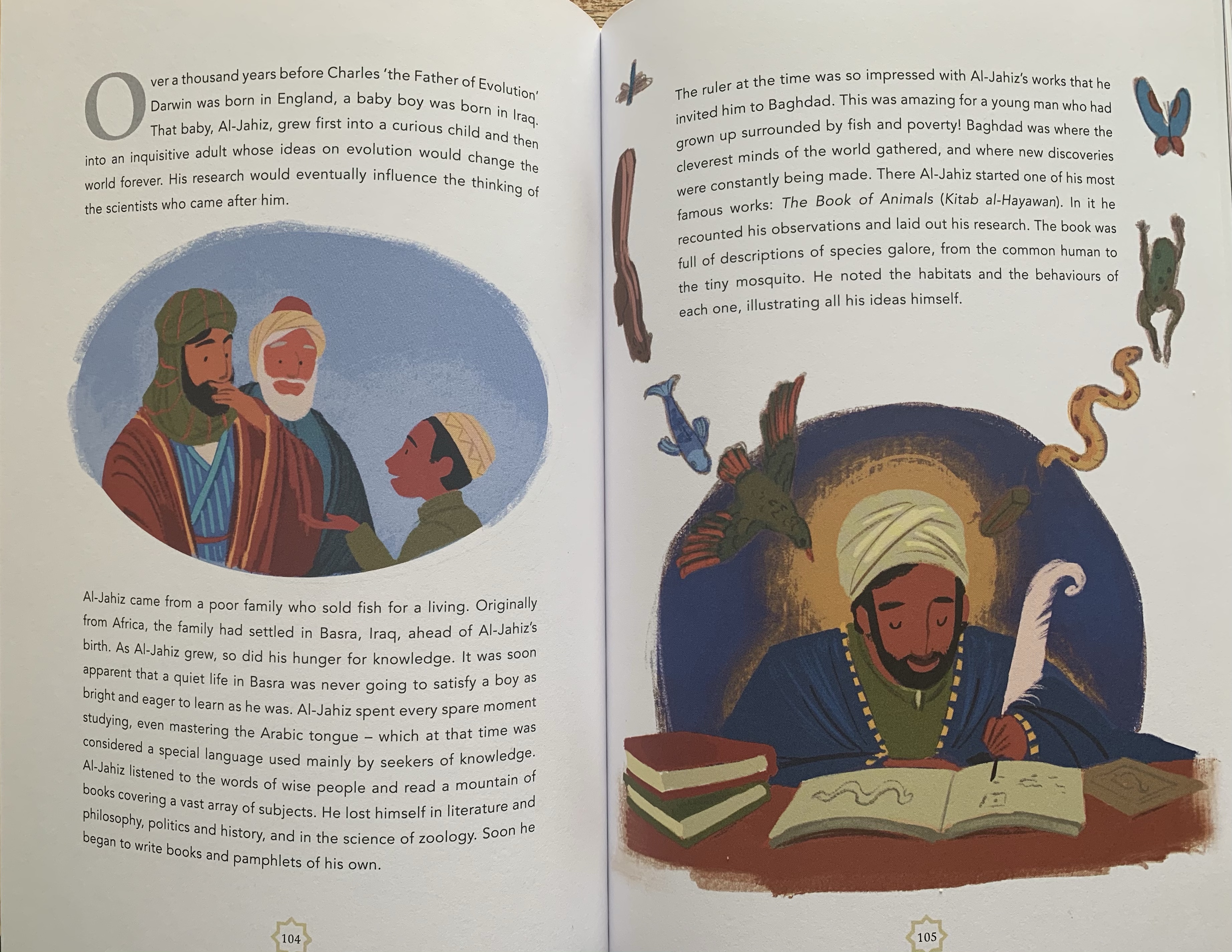
Amazing Muslims Who Changed the World: Extraordinary Stories of Incredible People by Burhana Islam illustrated by Reya Ahmed, Deema Alawa, Nabi H. Ali, Saffa Khan, Aaliya Jaleel and Aghnia Mardiyah

Standard
Amazing Muslims Who Changed the World: Extraordinary Stories of Incredible People by Burhana Islam illustrated by Reya Ahmed, Deema Alawa, Nabi H. Ali, Saffa Khan, Aaliya Jaleel and Aghnia Mardiyah

img_8359

The 30 stories presented over 197 pages are inspiring, and this compilation so desperately overdue. The book is not chronological it is completely random, and at first I was confused, but as I made my way through the book, I actually grew to love not knowing who I would be reading about next.  Yes, there is a table of contents, but the point being that you don’t have to be born into royalty, or be a warrior, or have lived a long time ago to be amazing, you just have to follow your passion.  I learned so much about people I thought I knew about, and was tickled to learn about people I have never heard of: bakers, athletes, actors, educated slaves, architects, spies, singers, scientists and politicians.

img_8360

At the end of each six page illustrated blurb is an “Interesting Fact” and at the end of the entire book are some activities in the “Amazing Extras” section.  Readers can crack a code like Noor Inayat Khan who helped the Allies decode and send secret messages from France to Britain or write a poem like Rumi, a song like Yusuf Islam (Cat Stevens), draw a superhero like G. Willow Wilson, make a camera following the science of Hasan Ibn Al-Haytham, or color a picture of Muhammad Al-Idrisi.

img_8361

My favorite biographies were those that I knew little or nothing about before hand.  If I had to pick two favorite among all of those sections, I’d pick Khawlah bint Al-Azwar and Ayuba Suleiman Diallo.

img_8362

In 600 CE Arabia, Khawah, the masked knight, learned how to fight along side her brother and eventually served with Khalid ibn Waleed in battle.  It is said that she killed the Byzantine leader that captured her and then asked for her hand in marriage.

img_8365

Ayuba Suleiman Diallo in the 1700s in modern day Senegal was a highly educated man who was captured and forced in to slavery in Maryland, USA, interacted with James Oglethorpe, found himself being sent to England and with the help of a Thomas Bluett was able to be freed and eventually return home a free man. SubhanAllah!

img_8363

This book has it all: famous Muslim men, famous Muslim women, Black Muslims, Arab Muslims, European Muslims, American Muslims, Asian Muslims, African Muslims, Muslims who lived a long time ago, Muslims who are still alive all jumbled up and beautifully presented by a Muslim author and a handful of Muslim illustrators. This book is wonderful for 3rd graders to adults and would be a benefit on any book shelf.  It is worth noting there are no sources given, and doesn’t explain how the people were chosen to be included in the book.

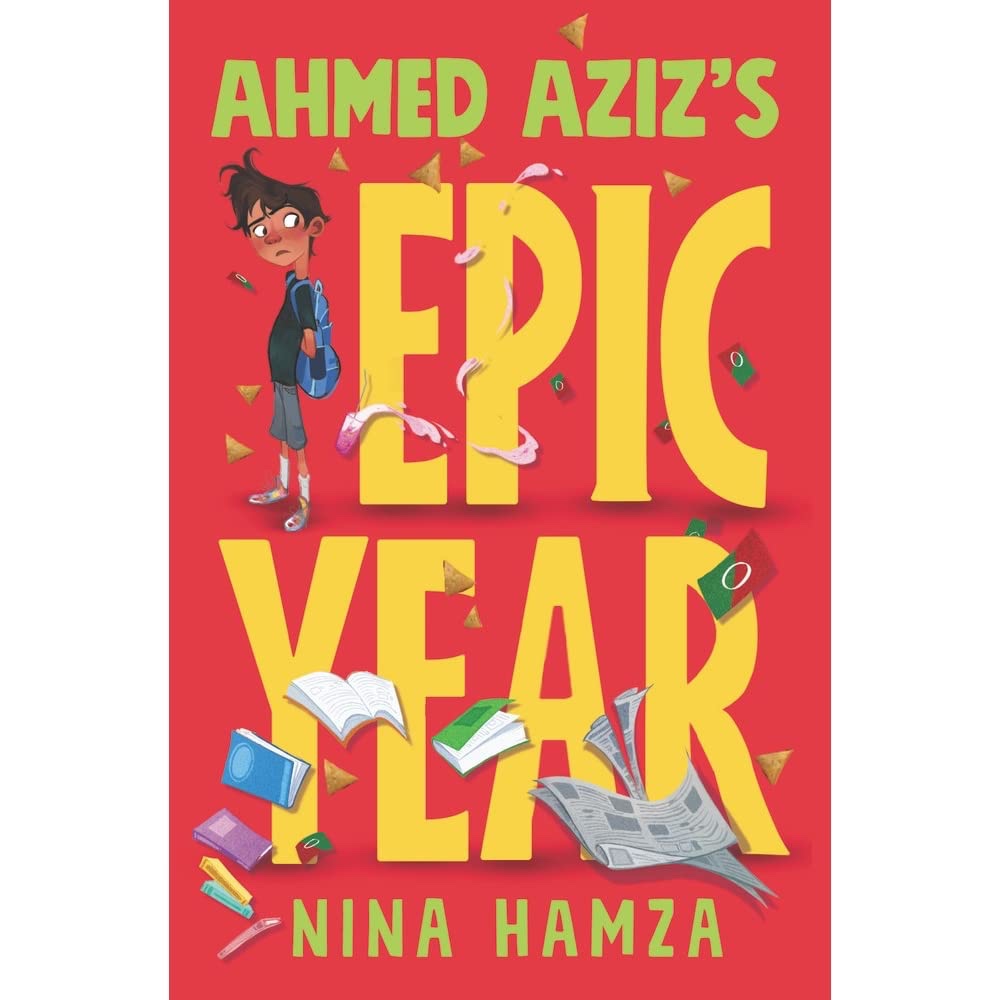
Ahmed Aziz’s Epic Year by Nina Hamza

Standard
Ahmed Aziz’s Epic Year by Nina Hamza

img_7992

There is such a shortage of male Muslim protagonist middle grades books that I have been waiting quite impatiently to get my hands on this one, and alhumdulillah, it didn’t disappoint.  I’m not sure if it qualifies as OWN voice, being it has a female author, but the authenticity in the little religious and cultural details would suggest that it should.  The 320 page book is meant for ages 8-12, but the weight of Aziz’s father’s illness, the plot pivoting around three classic books (Holes, Bridge to Terabithia, and From the Mixed-Up Files of Mrs. Basil E. Frankweiler), and the clever reflections of Ahmed along with his quick wit and thoughtful choices, might make the book’s sweet spot be 5th to 7th grade readers (as well as us moms who are suckers for elementary literary references, teachers who are heroes, and kids realizing their potential).  The book has a bully, but is clean and wonderful, and I thoroughly enjoyed it.

SYNOPSIS:

Twelve-year-old Ahmed is leaving the only home he has known in Hawaii to move to Minnesota.  His dad has Cirrhosis, a result from a rare genotype of hepatitis C, and Minnesota is one of the top options for treatment.  The family is nervous to move in general, but more so to move to Minnesota.  It is where Ahmed’s dad Bilal grew up, and where his dad’s younger brother passed away at age 12. Ahmed’s younger sister, Sara, is perhaps the only one excited for the new adventure.

The family arrives and is greeted by Bilal’s old friends, and when school starts he realizes one of his dad’s best friends, is his English teacher, and somewhat of a legend at the school in getting kids to try and beat her at an end of the year quiz show like competition.  The school is also where Bilal and his brother Muhammed went to school and a picture of Muhammed hangs right above Ahmed’s locker.  The biggest stress at school is Jack. Jack who lives a few houses over, Jack who rides the same bus, Jack who is in Ahmed’s English group, and Jack who has a lot of followers at school.  Jack is a bully.  One who makes Ahmed’s life miserable at every turn, not just socially, but even the police.

Ahmed is a laid back kid that doesn’t like to read, but loves words, who wants to blend in yet is the only brown kid in a sea of white, who enjoys attending  Jummah salat, but ultimately hates going because of the shoe chaos afterwards.  Ahmed has no intention to read the books assigned in class, but some how the three classic books assigned do get read, and  Holes, Bridge to Terabithia, and From the Mixed-Up Files of Mrs. Basil E. Frankweiler tie together and weave in and out of Ahmed’s epic year.

I don’t want to spoil much, but Ahmed’s dad is in the hospital a lot, there is a lot of plotting to survive being bullied, as well as getting revenge on the bully in Ahmed’s own way without involving parents.  Ahmed slowly grows to love Minnesota, his small circle of friends, and his school while learning about his uncle and the kind of person he wants to be as he grows up.

WHY I LIKE IT:

Ahmed is Muslim and while his mom prays five times a day and his dad is an occasional prayer it doesn’t specify how often Ahmed prays or how he feels about religion, other than going for Jummah.  At first Ahmed thinks he is being bullied by Jack because he is brown, his mom is an immigrant from India, his father the son of immigrants from India, but learns that Jack picks on anyone new.  I like that for as much as Ahmed hates stereotypes and assumptions, he acknowledges that he makes them too.  I like that Ahmed doesn’t like to read, but is smart, and eventually comes around to reading.  He is tech smart and very mature in how he views the world and himself in it, cares for his sister and parents, handles things on his own, and builds others up.  Ahmed is a good kid, not in that he doesn’t make errors or is a teacher’s pet, but in that he has a really good heart and a good head, and I think would make anyone better for knowing him.  I love that the book is smart too.  If you have read the three books mentioned you will love the discussions and questions about the books, if you haven’t read them, you will be tempted to after you finish this book.  I wish there was a tad more religion, there is a sprinkling of culture, primarily the mom’s tragic cooking, but a bit more religion in a book that has illness and death would seem natural to me.  The storytelling is superb, I was so curious where the father’s parents were, but alas it did answer that, I would have liked it sooner, but I was glad it made it in none-the-less.  I would have liked a bit more from the parents about why they wanted Ahmed at his dad’s old school, or how they were comfortable constantly leaving the two kids home alone at night, but Ahmed like I said is pretty mature.  I particularly love the brother sister relationship.  Ahmed is a good older brother and it reminded me in some ways of my older brother, which made my heart warm, good siblings are a blessing.

There are multiple climaxes, but while I expected the dad’s health to be a big one and Jack getting what was due to be a close second along with the outcome of the literary contest, I was not prepared for the level of Jack’s torture to climb to, and was pleasantly surprised by the unresolved thread of Jack and Ahmed’s future relationship.  Things in life don’t magically resolve and I love when middle grade novels keep that in mind.

FLAGS:

None

TOOLS FOR LEADING THE DISCUSSION:

I would absolutely do this in a heartbeat for a middle school book club selection.  Even if the book is more middle grades, I think the students will enjoy it and be surprised by the emotional investment the dad character extracts.  I think they will also benefit from the literary references, relatable characters, and the overall great storytelling.

Float Like A Butterfly by Ntozake Shange illustrated by Edel Rodriguez

Standard

img_8250

This 40 page biography beautifully presents major events of the famous boxer’s life without going in to much explanation. While it is an AR 4.7, it is still a picture book, and might work better for younger kids with some conversation and context, than for middle grade readers looking for anything in-depth about the beloved hero. While following his life, the reader sees him as a child growing up before he becomes famous, and sees that even after he retires, he is so much more than just a boxer, he is a compassionate leader, icon, and humanitarian.

img_8251

Born in Louisville, Kentucky in the Pre-Civil Rights South as Cassius Clay, he struggled to understand why there was only a white superman, and questioned if heaven was divided up by color and income like Smoketown.

img_8252

Cassius loved the power of words and would help his father make rhymes as a sign painter. When his bike gets stolen he is motivated to learn to fight so that nothing else is ever taken from him and his. He may not be the colored superman, but he is determined to be lightening fast and have fists that fly.

img_8253

In 1960 at age 18 he won Olympic Gold. In 1964 he converted/reverted to Islam and changed his name to Muhammad Ali days after becoming the Heavyweight Champion of the World. His titles were stripped from him, however, when he refused to fight in Vietnam.

img_8254

Years later in 1971, the Supreme Court reversed his convictions for not fighting and in 1974 he reclaimed his title by beating George Foreman in “The Rumble in the Jungle.” In 1981 after winning, keeping and losing the title, Muhammad Ali retired from boxing for good.

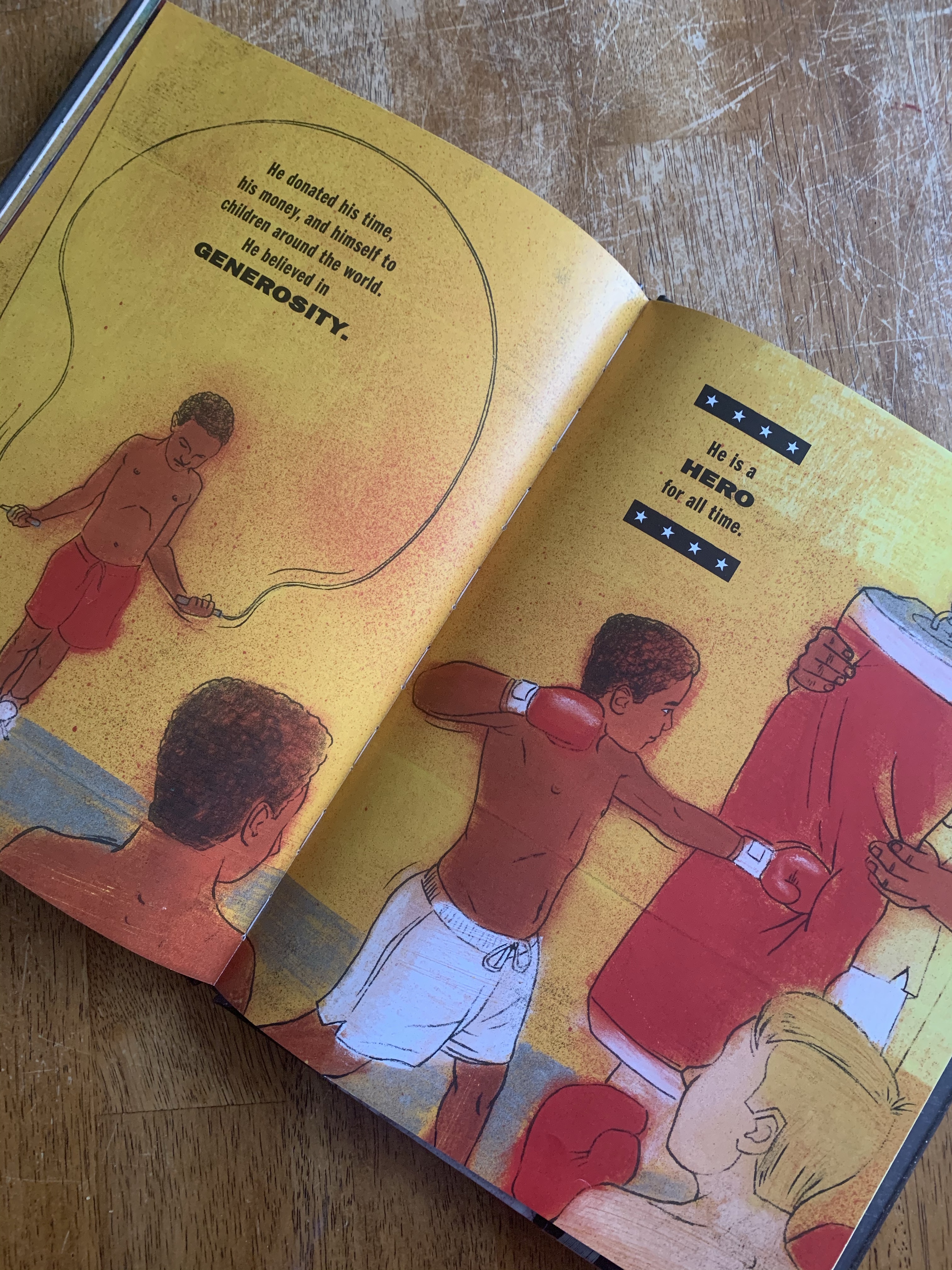
img_8255

Muhammad Ali suffered from Parkinson’s disease but still donated his time, his money and himself. He believed in perseverance, and equality, and fought for what he believed in. He passed away in 2016 at the age of 74.

img_8256

This is an updated edition from the 2002 originally published book, it now includes his death. I wish it was more than a fleshed out timeline and showed him as a person, or what it was like to lose everything when standing up for something you believe in, or explained what some of his catch phrases meant, or really just as a more high energy celebration of his life.

img_8257

Amina’s Song by Hena Khan

Standard
Amina’s Song by Hena Khan

img_7581

This middle grades companion book to Amina’s Voice, reads in much of the same way as a lot of Hena Khan books in that I feel she is presenting Pakistani Muslims in America to non Pakistani non Muslims in the west.  In the first quarter or so of this 288 page book that takes place in Lahore,  I felt a different tone than really spoke to me. Granted I am (half) Pakistani and Muslim, but when Amina says good-bye to her family, I was in tears.  It was relatable and powerful and so real to me that I got emotional, the rest of the book, sadly, not so much.  It’s not to say that it isn’t well written, I just feel like the majority of the book are borderline issues for many Muslims looking to see themselves in literature: music, school dances, boy/girl friendships, and when presented that a religious family is permitting and celebrating of these issues, it seems to be trying to make us fit in, rather than support us for holding to a different perspective.  There is a lot of good in the book about finding your voice, sibling and family relationships, friends, and challenging stereotypes, that I think the book would be great for some 3rd graders and up.  However, if your family is against the aforementioned potential flags you may find the book that talks about reading Quran and praying makes the characters harder to separate from your own kids, you may want to hold back in recommending it to them.  Don’t get me wrong the book is clean and well done, I just know from personal experience that sometimes when characters do things that you family doesn’t agree with it is easier to say that those things are for them, not us, but when the family doing them looks a lot like your family, you have to be ready to explain the differences.  

SYNOPSIS:

Amina is in Lahore exploring the city with her brother and cousins.  She is visiting her uncle who had come to visit in Amina’s Voice and as the trip comes to an end, she doesn’t feel like she is the same person that came to Pakistan a month ago.  She is closer to her older brother Mustafa, she feels connected to her extended family, and she is growing more comfortable with pieces of her self she didn’t know existed before.  Excited to go back to America and tell her friends about her summer, she finds they really aren’t interested, and she is unsure how to keep her promise to her uncle to show the world the beauty of Pakistan.  

Once school starts, Amina is assigned a wax museum project in Social Studies that requires her to research and present a person that has changed the world.  She picks Malala, but when she explains to her class at a midway check how Malala was shot for going to school, rather than feel inspired, her classmates feel sorrow that Pakistan is so backward and oppressive, the complete opposite of what Amina felt surrounded by such vibrancy and strength while in Pakistan.  Determined to set things right, she reaches out to her cousins and uncle in Pakistan, except her uncle is back in the hospital and worry consumes Amina and her family, who are torn with being so far away from their loved ones. 

At the same time Amina is feeling like her best friends Emily and Soojin are drifting apart.  Emily is in chess club, Soojin is running for class president, and Amina just wants to write music, produce songs and sing.  There is a new kid Nico, who is half Egyptian, and has music computer software that when he offers to help Amina produce music she says yes, and he starts spending a lot of time at Amina’s house.   

Friends new and old along with immediate and extended family, love and support Amina and cheer her on as she finds her voice to share the beauty of Pakistan, fight for her friendships, and be content with all her pieces that make her unique.

WHY I LIKE IT:

I love that Amina realizes her culture is more important than following rules and her grade.  She breaks from the assignment to spread light on more strong, brave Pakistani women than just the one, and is ok with her grade suffering as a result.  I love that she realizes the headlines don’t reveal reality and that you have to see more than one side to the story.  I love that she is religious and that the imam is cool and that her whole family is service oriented and compassionate.  I love that her friends are diverse and their families are close friends as well.  The sense of community established is carried over from the first book, and I think it gives the book a level of comfort that is pure and honest.

I have issues with Amina’s family being ok with her going to the school dance.  She goes with her female friends, but to me it seems like a conversation is missing or she shouldn’t be going.  It is mentioned that Mustafa went alone to a high school dance, but never explains why.  Similarly, Amina is nervous about having Nico over and her family at times is bothered by it, but again it never specifies why.  I feel like if there was a conversation about why her family would be weird about it or why she is nervous to tell her mom that the friend coming over is a boy then when Amina reminds her mom that her best friend in kindergarten was a boy and everyone was fine with it, or that when her mom asks if there is anything more than friendship going on, the reader would know why it is such a big deal.  It seems to skip the explanation part and jumps from the nervous to have a boy who is a friend, to defending the friend being a boy, and skip the why part.

I didn’t get why Nico identifies as Muslim and Christian but never says salam, and I especially didn’t get why Amina’s mom was more relaxed when she thought he might be Muslim.

I also wish that after the whole emphasis on music, that the lyrics would have at least been shared. I was looking forward to it and was let down by it not being shared.

FLAGS:
Nothing blatant.

TOOLS FOR LEADING THE DISCUSSION: 

I don’t think that this would work level wise or content wise for a middle school Islamic school book club.  

Unsettled by Reem Faruqi

Standard
Unsettled by Reem Faruqi

img_7503

This book is a great OWN voice, middle grade coming of age book that rings with truth and hope in its poetic lines that sweep you up and keep you cheering.  Over 352 pages the author’s semi-autobiographic story of coming to Peachtree City, Georgia from Karachi, Pakistan beautifully unfolds.  I absolutely loved this book and the way it is told, in verse.  The details, often small, ring with such sincerity that even those that have never moved to a new country, or been to a new school will feel for young Nurah Haqq and be inspired by her success, touched by her hardships, and disappointed in her mistakes.

img_7544

SYNOPSIS:

Nurah’s best day is spent on the beach with her best friend Asna, playing in the warm waves and riding camels.  However it ends up also being her worst day, when she returns home to her father’s news that they are moving to America.  Strong, confident Nurah who spends time with her grandparents, swimming with her older brother Owais, and excelling at math in school is reluctantly leaving it all behind to start anew.

When they arrive in Georgia the family of four settles in a hotel until they find a house.  Everything is different and new, and the transition with no friends and family difficult for the entire family.  The way words are pronounced, the way the air feels and the birds chirp all make Nurah long for home.  When they find a swimming pool at the rec center, things start to slowly change.  Owais was a medal winner in Karachi, and will be one here too, people start admiring him, and Nurah tries to bask in his light.

School starts and math is a relief, but people are white, so white, and a boy reaches out to shake her hand.  She feels betrayed that she has been told the schools in America are better, and lunchtime, with no one to sit by is a huge stress.  She questions her clothing, her appearance, and the weather.

Her and Owais try out for the swim team and make it, and Nurah makes her first friend, Stahr. Stahr lives a few houses down from their new house and when Nurah’s mom has a miscarriage, it is Stahr’s mom who comes to show support and give comfort.  The support is reciprocated when Stahr and her mom need help escaping from her abusive father.

As Nurah works to win swimming races and be more like her brother, she works to find her voice and use it to defend others and herself.  A terrorist attack committed by someone claiming to be Muslim sets the family up to be targets.  In a moment of jealousy, Nurah doesn’t intervene to help her brother and the consequences are huge.

img_7502

WHY I LIKE IT:

I love the details and how they are articulated.  I related to so much of Nurah’s feeling and impressions, that I reached out to the author and found her to be just as endearing as her character.  The feeling of being different when swimming because of your decision to be modest, the role of food to comfort you and make you feel at home, the older brother that you so desperately want to resemble and be like: All of it hit close to home for me.  I love how religion and culture are so much a part of the story and about the character’s identity, not to be made preachy, just to understand her and her experiences.  She goes to the masjid, she prays, she starts to wear hijab. I love how she finds her voice and defends those that can’t, but that her path is not easy.  She makes mistakes and she has to challenge herself to do what is right.  The backdrop is always trying to “settle” in a new place, but the story has it’s own plot points that are interesting and simply made more impactful by Nurah’s unique perspective.

There are lots of little climaxes and victories for Nurah that show her to be well-rounded and relatable.  You cheer for her early on and enjoy the journey.  The only slight hiccup I felt was the name confusion of her Nana and Nani (Nana), it is explained, but it was a little rocky for me, it might be based on a real thing in her family, but once that is resolved, the book flows beautifully and smoothly.

img_7545

FLAGS:

Nothing a 3rd/4th grader would find alarming, but none-the-less:

Crushes: Nurah has a crush on a boy at school when he shakes her hand and picks her for a lab partner, but she moves on from him while still maintaining a crush on her brother’s friend Junaid.  Nothing happens, she just thinks they are cute.

Miscarriage: Her mother has a miscarriage and it details a blighted ovum and the mental strain on the mom and family in the aftermath.

Abuse: Stahr’s father is abusive

Hate: There are bullies, discrimination, physical violence.

TOOLS FOR LEADING THE DISCUSSION:

The book is a little below level for my middle school book club, but I think it it was on a bookshelf and a middle schooler picked it up, they wouldn’t set it down until they were done reading it.

The Theft of Sunlight by Intisar Khanani

Standard
The Theft of Sunlight by Intisar Khanani

img_7254

Breathe, deep breaths, exhale, phew.  This book is good, like really good, but it ends on a cliff hanger and I was not prepared for it because I read a digital copy and didn’t think 528 pages had gone by.  Needless to say I was not emotionally prepared for there not to be a resolution.  Then the afterward said it was a duology, and I may have freaked out and contacted the wonderfully patient author and had her talk me down, because such words could imply that Thorn was book one.  Also, when I’m frantic I don’t read clearly, but now all is well, she assured me there will be a conclusion, inshaAllah, to Rae’s story.  Picking up chronologically where Thorn left off, this book is a companion in the Dauntelss Path series, but follows a different protagonist and while I highly suggest reading Thorn first, it is not necessary to understand this original tale.  So, phew, I am breathing again, and happy to venture back to Menaiya to share my review of a lovely story, written by an amazing Muslim who once again weaves such an engulfing tale that doesn’t drag or have holes in the narrative, is filled with strong female characters, and text that reads so effortlessly it just sweeps you away.  Truly it is fun for middle school and up (13+), and clearly I’m not passionate about books and fictional characters and don’t need to get a reality check.  

SYNOPSIS:

The book opens in a small village where Rae is in the market with her littlest sister Bean and their friends, Ani and Seri, when the unspeakable happens: Seri goes missing.  This isn’t a tale of a child who has wandered off, it is about a child taken by the snatchers and the materialization that the rumors and horrors they have been hearing of children being taken, becoming very real.  Niya, Rae’s middle sister is a secret mage who tries to track Seri, but can’t break through the mark that keeps her hidden.  As the townsfolk exhaust all resources and resolve she is just another child lost, Rae gets an opportunity to find answers.  Her pregnant cousin has invited her to spend the summer at the royal court and attend the wedding of Prince Kestrin and Princess Alyrra.  Convinced that the palace must have more information about the snatchers, Rae reluctantly agrees to go and investigate what is being done to stop the country’s loss of children.  Rae is nervous to leave her horse ranch, afraid of the teasing she will receive because of her twisted clubbed foot, but above all desperate to help her friend’s family.  

Everything about Tarinon baffles Rae: the extreme poverty on the outer skirts of the palace, the vacant stares of the children, the ignorance of the courtiers, the politicking and secrets.  She doesn’t get much time to ease into this new role though, because she is thrust head first in to it when asked to be one of Princess Alyrra’s attendants. She once again reluctantly agrees, with the hope of getting answers to help recover Seri and other lost children.  After tests to gage if the princess can trust Rae, the two join together to secretly unravel what is going on.  This work in and of itself is incredibly dangerous as those that ask questions often go missing.  Her work is compounded when the princess sends her to get information from the head of a thief ring, Red Hawk, and his informants.  The closer Rae gets to answers, the more perilous situations she gets in and out of, often having to count on her bravery, determination, and wit to stay alive.  She finds an unlikely ally in Red Hawk’s right hand man Bren, help and friendship in an employee in the tax office, Kirrana, and the need for favors from a Fae mage and his Cormorant.  As the investigation progresses, it leads to battles with neighboring thief rings, Rae held hostage at one point, getting her finger chopped off at another, the Circle of Mages seeming guilty, and royalty within the palace duplicitously involved.  All this while a week long royal wedding is underway and the princess’s brother is attempting to kill the princess.  No wonder 500 plus pages still ends with a cliffhanger, eh?

WHY I LIKE IT:

I love the world building and detail and speed of the story, but I’ve really delayed writing this review as I try and pinpoint and articulate what it is about the characters that I truly am invested in.  And the answer is, I really don’t know, it probably it isn’t just one thing.  They are believable, and flawed, yet so very strong.  Rae in particular has her own self doubt and questioning, but she is a force and she makes mistakes, yet is still gracious and humble, she really is well rounded. There might be some romantic twinges between Rae and Bren, but she isn’t going to compromise one bit of who she is for him or anyone for that matter, which doesn’t mean though that she isn’t still growing and learning.  The book absorbs you right away, there aren’t dull parts that you skim over, or character’s that you mess up and have to go back and clarify.  Unequivocally, the writing is superb.    

The snatchers are inspired by the slave trade and child trafficking that unfortunately is not fiction and is all too real.  I think the edginess and intensity is heightened when that realization occurs for the reader to see that it isn’t just a fictitious conflict within a fantasy plot.

There is nothing Islamic in the book, the characters have their own religion that pops up as Speakers are involved in healing the recovered children and Alyrra goes to pray at one point, but it doesn’t detail what that looks like.  The author is Muslim.

FLAGS:

The book is remarkably clean, especially for the genre.  It does mention that some of the girls snatched end up in brothels, and the guards sent to investigate take advantage.

TOOLS FOR LEADING THE DISCUSSION:

I think I would absolutely do this for a middle school book club book.  To open the students eyes to quality writing, taking a real problem and nesting it in fiction to be sorted out, and just to see their response to the journey that Rae under takes would make for a great lunchtime discussion.  The book has not been released yet, so there aren’t a lot of reader’s guides or author interviews about it, but I suspect there will be soon.