Category Archives: Elementary Fiction

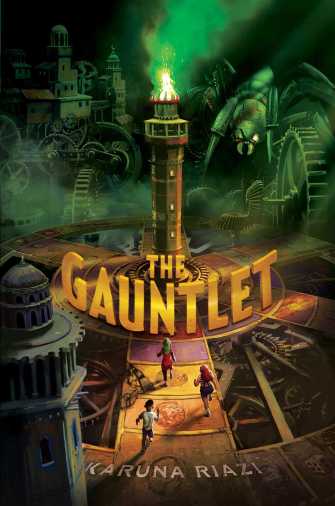
The Gauntlet by Karuna Riazi

Standard
The Gauntlet by Karuna Riazi

the gauntlet

Take Jumanji, turn it into a chapter book, flavor it with steam punk, set it in a Middle Eastern inspired marketplace, and have the protagonist be a Bengali-American, hijab wearing Muslim on a quest to save her little brother with her two BFFs from New York. Bam, you now have a 298 page AR 5.4 reading level booked called The Gauntlet.  

Published by Salaam Reads (Amina’s Voice) this book is written for all kids, the main character’s religion and culture just add depth and a connection to the game they have fallen in to.  I found this book on Scholastic, and when I got it, I handed it to my daughter to screen for me.  I asked her once she finished if it had any Muslims in it and how were they presented, to which she gaped at me and said, “umm mom the whole thing is about a Muslim girl and it is awesome!” So naturally I moved it higher up in the “to be read pile” and while I agree with her assessment, the book is more plot than character driven, and there isn’t a lot of theology in it, just a race against time to get out of the game alive.

SYNOPSIS:

It is Farah Mirza’s 12th birthday and while she should be downstairs visiting with her guests from her new school, she is holed up in her bedroom with her little brother Ahmad and her best friends from the old neighborhood, Essie and Alex, playing board games, the Mirza family’s favorite pastime .  When Aunt Zohra tries to coax them from the room she mentions a gift for the birthday girl is in her room, and the kids sneak off to get it.  Only it isn’t the book she brought to give Farah that they find, it is a bewitched game called the Gauntlet of Blood and Sand that lures kids in, and keeps them if they cannot out play the Architect.  When Ahmed falls in, the trio has no choice but to follow him in to try and rescue him and escape, before time runs out.

Once inside the game, they are in a city called Paheli. It resembles an old Middle Eastern city with large souks, market places, even a small masjid, surrounded by sand and levels absolutely breathtaking in both their beauty and in their threat to the children.  The inhabitants are those that played the game and lost. The challenges the kids must face range from a life size game of mancala to a taste test of Bengali/Indian sweets.  As they rush from challenge to challenge they meet a kind tea shop owner, giant lizards, spies and police of the architect and see fairly detailed descriptions of different parts of Paheli. The gamemaker/designer known only as the Architect senses that the kids will win, so he starts to cheat, and then feels bad and arranges to meet the players.  When the children meet him, and hear his story, they feel some sympathy for him, but not for the Jinn that holds the ultimate power over the game.  Obviously they do escape, but I won’t spoil the fun the process is, nor the sweet surprise of the reunion.  

WHY I LIKE IT:

I like that at the core, the story is driven by love for a sibling and requires the teamwork and cooperation of friends.  The rest is just frills from this central and clear message that is woven throughout the book.  While it is idealistic, there are hints that it isn’t overly so.  Yes Ahmad with his ADHD is a lot to handle at times, and the friends do have their squabbles, but ultimately both friends and family are worth risking it all.  I love that Farah is Bengali, many of the foods are Indian, and they are set in the Middle East, but yet somehow it seems interchangeable, this made me laugh, and while in other instances might have annoyed me, I liked how connected it made everyone seem, more alike than different.  Essie and Alex know some of the foods and cultural lexicon from growing up in New York.  They don’t find things different, they had lots of kids in school that wore hijab. Readers unfamiliar with some of the words and names found in the subcontinent and Islamic history might be put off a bit by the regular use of these words and the lacking glossary, but if you identify with any of it, you will celebrate seeing yourself in this book, just as Farah relished in seeing something of familiarity in Paheli.  

The book is fast paced and the detail given to the setting and cultural aspects are fun, but I really don’t feel like I connected much with the characters as a result.  There is very little character development and I actually had to look back in the book for some of the names to write this review.  There also isn’t much religion in terms of belief or practice.  The buildings and the food and the tone all hint at Islam, but I would have loved to hear an athan, or even her pausing to pray.  Not even that is there.  She wears hijab and that is about it in terms of religion.  

Ultimately I love that it is a mainstream book, with a strong storyline that is action packed and fun for older elementary and early middle schoolers that is clean and familiarizes and thus normalizes a culture not often seen in young adult fiction.  

FLAGS:

None, it is clean, at times possibly a bit scary with human bones, but not anything overly haunting.

TOOLS FOR LEADING THE DISCUSSION:

This would be an amazing book for a book club, and I would play the games that they play in the gauntlet at the meeting.  There isn’t a ton to discuss in terms of introspection and growth, but there is enough, and it is fun.  Plus, there aren’t a lot of books like this for Muslim kids to see themselves in, that I think it would be a blast for them to read, and enjoyable for the adults to watch them get swept away.

Interview with the Author: http://ew.com/books/2017/03/27/karuna-riazi-gauntlet-jumanji/


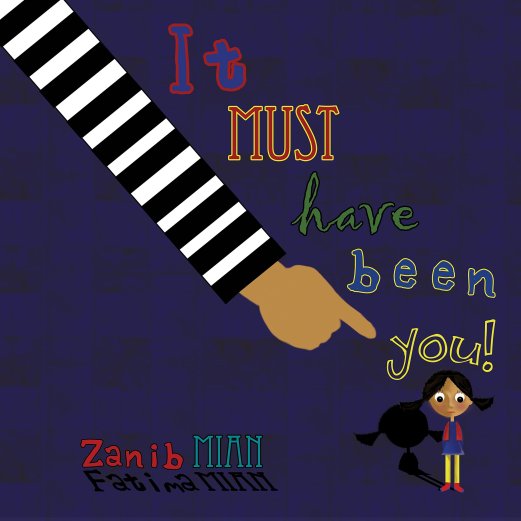
It Must Have Been You! by Zanib Mian illustrated by Fatima Mian

Standard
It Must Have Been You! by Zanib Mian illustrated by Fatima Mian

it must have been you.jpg

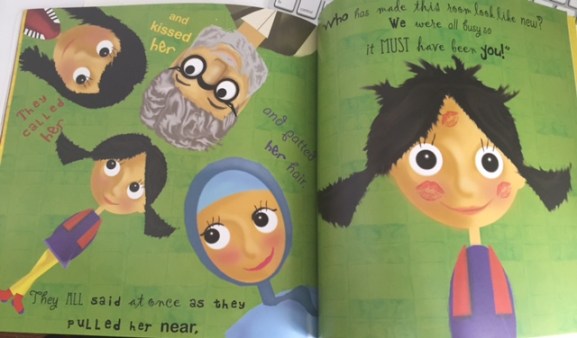
This rhyming 32 page book follows around a small girl, “about the same age as you,” who seems to make a mess every where she goes.  She never lies or even responds to the accusations of her unintentional messes, as she gets caught each time by someone in her family who points their finger and identifies the clues that led them to their answer. Luckily, she uses this pattern to her advantage as she cleans up and makes her family a card resulting in hugs, kisses, and love.

FullSizeRender (34)

Written for younger kids (4-6), the book is bright and colorful and very well done.  Even two and three year olds will enjoy the sing-song rhythm and chunky engaging illustrations.  The pages are thick and the binding solid, especially for a soft back book.  The 10 x 10 square size works well for story time and bedtime alike.  However, because the text is incorporated into the illustrations, if you are reading to a group, you will want to read it a few times before you present.  Looking at it straight on, the word order is much more clear and if you are reading it with emerging readers, I would recommend pointing to the words as you read, so as to help guide your listeners.  The fonts get a little crazy, which is part of the fun, but again may require some assistance to help the younger readers decipher the words.  Older independent readers (up to age 7 perhaps) might like the slight challenge of figuring out what word comes next, so that the story makes sense.

FullSizeRender (33)

The mom wears hijab and that is the only islamic reference or overt implication.  A fun book that thus far with multiple readings has yet to get monotonous and boring, yay!

FullSizeRender (32)

Wishtree by Katherine Applegate

Standard
Wishtree by Katherine Applegate

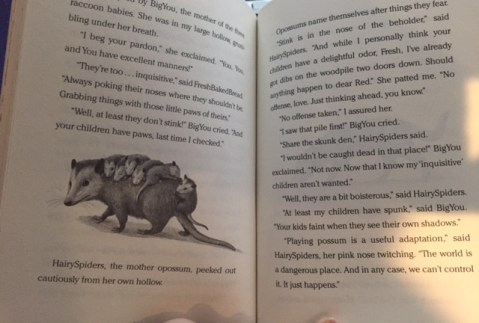
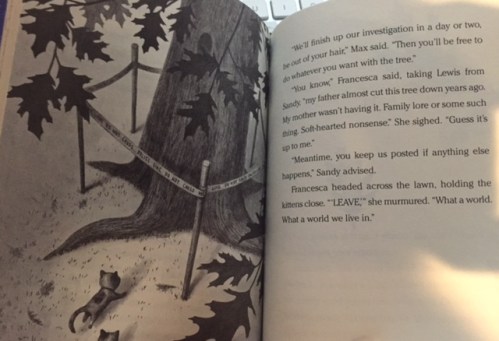
wishtreeI saw this book on Scholastic when I searched for “Muslim” on the website, a regular endeavor of mine, and was surprised to see it pop it since the synopsis on the back doesn’t mention Muslims or Islam.  So I researched it a bit, and sure enough the discrimination of a Muslim family in this tree’s neighborhood is the catalyst of this giant Oak Tree, sharing her story and enlightening the characters and readers with her wisdom.  At 215 pages, this slow and thoughtful book is a short read on an AR 4.2 level.  The pages are well spaced and the black and white drawings keep the reader engaged. And while I bought the beautiful hardback book, I didn’t read it, I listened to the two and a half hour audiobook version, and it was fabulous as well.

FullSizeRender (40)

SYNOPSIS:

Aside from maybe Shel Silverstein’s The Giving Tree, I can’t recall too many books being narrated by a tree, but like The Giving Tree, the lessons and wisdom come through loud and clear and stay with you long after the story has ended. Red, is an old Oak Tree that has been around for over 200 years.  She has many stories that she shares with her inhabitants: the possums, the raccoons, the skunks, the birds, her best friend a Raven named Bongo, but never humans, for they must not hear her speak, that is kind of a rule.  But when 10-year-old Samar’s family moves in and people don’t respond well to the new Muslim neighbors, the tree considers getting involved.  Samar spends a lot of time near the tree, and the animals enjoy her presence, while most people tie wishes to the wishing tree on May 1st (Wishing Day), trees are good listeners and Samar tells Red that she wishes for a friend.  This coupled with the act of vandalism someone commits against Red by carving “LEAVE” into her trunk, pushes the tree to ponder what makes people friends and how can she help Samar.  When the owner of the home who’s land Red resides on decides to have her cut down, Red throws caution to the wind and speaks.  Hoping to bring two kids together that need one another, and by extension their families and the whole neighborhood, Red has her work cut out for her.  Luckily she isn’t alone, her animal friends are up for the challenge and the lucky reader gets to laugh with the funny animals, ponder roots, and inclusion, and friendship, and diversity through the loving gentle manner of a tree.  It may be written for fourth graders, but I think everyone can draw upon the lessons, the depth, and the compassion needed to help Samar, to save Red, and to learn to be better to one another.  

FullSizeRender (43)

WHY I LIKE IT:

It flows like prose, the deliberate manner in which the story is told, grabs hold of you and halts time.  I love the relevance of inclusion and differences, there isn’t a magic wand, that makes everyone like everyone at the end, but there is hope.  And sometimes that is more powerful.  I listened to the book with my daughter, a 6th grader, and it was nice to chat about it with her after.  What makes people friends? How do people become friends? We move a lot, so she was really insightful about how sometimes friends are just friends because of proximity or because their parents are friends, she really had to think about what has kept certain people in her life, and I loved that this book gave us a starting point to have such a meaningful dialogue.  There isn’t much about Islam in the book other than that the Samar’s family is Muslim and that her mom wears hijab.  

FullSizeRender (42)

FLAGS:

None. It’s clean.

FullSizeRender (41)

TOOLS FOR LEADING THE DISCUSSION:

I would absolutely do this for a 3rd to 5th grade Book Club.  It has so many lessons presented in a non preachy way that the students would add themselves so naturally and effortlessly into the narrative and grow from it.  The book has won numerous awards, and the author is well known, so it also will encourage children to read other books of hers.

Author’s website: http://wishtreebook.com/

Teacher’s Guide: https://images.macmillan.com/folio-assets/teachers-guides/9781250043221TG.pdf


Museum Mysteries by Steve Brezenoff illustrated by Lisa K. Weber

Standard
Museum Mysteries by Steve Brezenoff illustrated by Lisa K. Weber

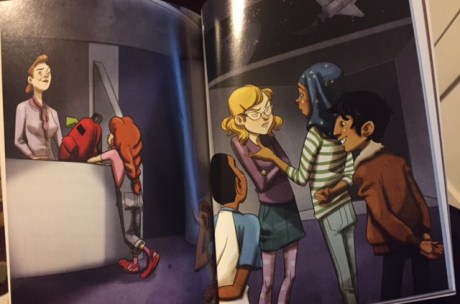
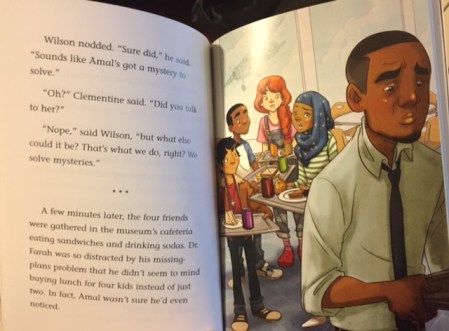
I’m going to review two of the eight books in the Museum Mysteries Series that have Amal on the cover:  The Case of the Missing Museum Archives and The Case of the Stolen Space Suit.  The series focuses on four characters of diverse backgrounds who have a parent that works in one of four Capital City museums.  Amal Farah is Somali American and her dad works at the Museum of Air and Space, Raining Sam is Native American and loves the American History Museum his mom works at, Clementine Wim’s mom works at the Art Museum, and Wilson Kipper’s favorite is the Museum of Natural History.  The kids solve mysteries and introduce the readers to real facts and tidbits of real information.  The AR level is 4.0 and 4.1 respectively, but I feel like they really are on a 2nd-4th grade level.  When a child is done with Ron Roy (A-Z Mysteries & Capital Mysteries) and Magic Treehouse, they are ready for these.  Much like those series, readers are similarly introduced to new vocabulary, but not overwhelmed with back story, detail, explanation, or much character development.

FullSizeRender (29)

SYNOPSIS:

In The Case of the Missing Archives, (the second in the Museum Mysteries Series), eleven-year-old Amal and her friends have to figure out who stole the plans for the German “Bat Wing” Plane, and fast.  If they don’t Amal’s father, Dr. Ahmed Farah, a museum archivist, is going to lose his job.  Luckily in 117 pages the kids suspect and rule out a “friend,” identify a mystery subject, and finally solve the case by piecing together the security guards clues and being perceptive.  Along the way you learn a bit about the characters, but nothing substantial.  You don’t feel a connection to the characters, and are only slightly annoyed when Clementine kind of takes over. 

IMG_7532

The second book where the Museum of Air and Space, and thus Amal are leading the plot is The Case of the Stolen Space Suit (#6 in the series).  I didn’t like this book as much as the earlier one because while yes, I learned about Sally Ride and how women in space are often over looked, I felt like the culprit was let off the hook with little reprimand for stealing Sally Ride’s space suit.  Once again the four kids come together to solve a mystery this time it involves two of the museums: Air and Space and American History Museum.  There is a bit more blatant lying in this book, which is normal in this genre as the kids have to snoop around and not get caught, but they seem a little less apologetic this time around.  The red herrings aren’t as believable, and the real culprit is only spotted by chance, no real sleuthing.  

FullSizeRender (31)

WHY I LIKE IT:

Obviously I like that a Muslim girl is included in this very diverse foursome.  She wears hijab, has a muslim name, tucks her phone in her hijab to go hands free, and is of Somali heritage.  Her father is educated and not over bearing or stereotypical, and her background is just detail.  Her group of friends seem to appreciate each other’s cultures and talents as well as their passions and hobbies.  The kids vary in age from 10 to 13 with two girls and two boys.  The only lack of diversity is perhaps that they seem to all be middle class and fully able bodied.  Faith, family structure, culture, all run the gambut.  

There is no religious reference at all.  The book mentions her scarf only as a hands free life saver, and we learn her favorite hijab is blue with little stars on it.

I like that all the books are full color about 120 pages.  There is factual information at the begining and at the end.  There is also a summary on each kid at the begining.  The story concludes with a glossary,  writing prompts, discussion questions, and information about the author and illustrator.

I love the covers.


FullSizeRender (30)

FLAGS:

There is lying, but the rest is clean.

TOOLS FOR LEADING THE DISCUSSION:

I probably wouldn’t use this book as a book club selection because there isn’t really much to discuss.  I would definitely have this series in the classroom or recommend it to other early chapter book readers.  Like Brezenoff’s other series the book is satisfying in its simplicity and a good book to build interest in a variety of things while feeling accomplished at reading a book.


The Silly Chicken by Idries Shah illustrated by Jeff Jackson

Standard

silly-chicken.jpg

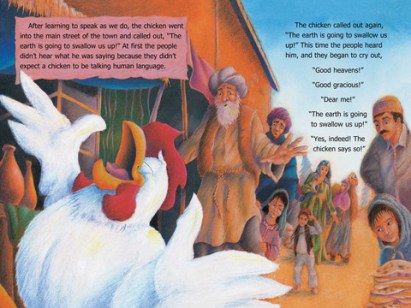
This story reads wonderfully aloud as it is silly, repetitive, and the message is more clear than in some of Idries Shah’s other Sufi inspired teaching books.  Written on an AR 4.0 level with 32 pages.  Some pages are heavily text laden while others just sprinkle a few words across a beautifully illustrated page.  Like his other books, the illustrations are truly spot on.  The lively faces on the characters, and colorful scenes bring the story to life and keep the audience engaged and giggling.

chicken

A man decides to learn how to speak “chicken,” when that doesn’t work, he teaches the chicken to speak our kind of language.  Fluent and conversational, the chicken then tells the villagers that, “The earth is going to swallow us up!”.  Everyone runs in all directions, up the mountain, down the mountain, across the meadow, around the world, but they can never get away from the earth.  When they return, they are upset with the chicken and ask how he knows that the earth is going to swallow them up, to which he replies that he doesn’t.  After they recap all the trouble he has put them through he poignantly laughs at them and asks, ” You think a chicken knows something just because he can talk?” Realizing how foolish they have been the chicken begins telling more outlandish things, just to make the people laugh, and isn’t taken seriously again.

silly chicken1

The message is clear, the characters funny, and the illustrations engaging. I finally found an Idries Shah book that I like! Yay, I guess for me they are hit or miss, and this one was definitely a hit!

chick

The Color of Home by Mary Hoffman illustrated by Karin Littlewood

Standard
The Color of Home by Mary Hoffman illustrated by Karin Littlewood

color of home

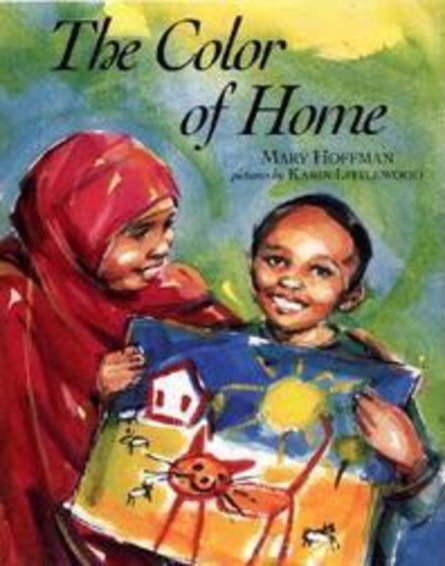
This powerful book about Hassan’s first day at school is a bit graphic, and incredibly important.  While it is a picture book, it is definitely not meant for small children.  The rich water color illustrations and the impactful text match the AR level 3.6 and would really appeal to thoughtful 2nd through 4th grade students.

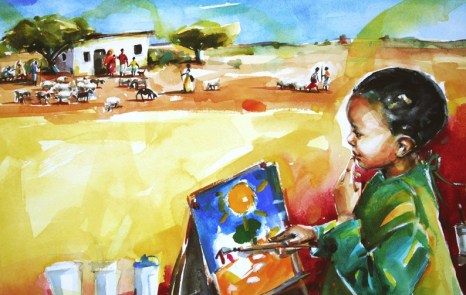
A refugee from Somalia, Hassan finds it “tiring remembering even a few English words.”  He misses the color of Somalia, his cat, the warmth of the sun, and the freedom of learning out doors.  He doesn’t miss the violence though.

colour3(1)

When it is time to paint, Hassan paints his home and his family, all 9 of them, and his pets, in bright happy hews, much to the delight of his teacher.  But then, Hassan, engulfs his house with the red paint of flames, smudges out his Uncle Ahmed when the black bullets that take him down, and Hassan communicates his sadness to his teacher.

Hassan doesn’t take his picture home, he knows it will upset his mom and little sister, Naima.  The next day, a translator comes to help Hassan.  Fela is Somali and wears a black hijab, like Hassan’s mom, but western clothes, a new concept to the young boy.

color

Through Fela, Hassan opens up to his teacher and explains what it was like when the soldiers came and he had to hide under the bed.  How they had to leave without any of their stuff, including his beloved pet cat Musa.  All they could take was his father’s prayer rug and the Quran, as they set off on foot in the night.  He tells about leaving his grandparents and cousins behind and being scared on the plane.

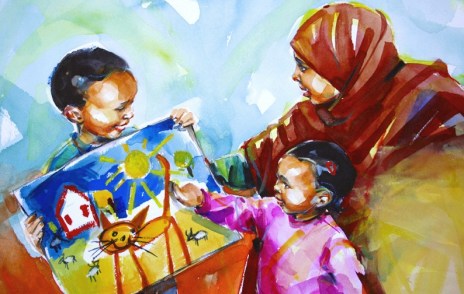
Being able to share his fears, seems to help as he paints a new picture to share with his mom.  This one filled with his animals, and not with fire and bullets.  There is hope for Hassan as he looks forward to adding color to his new life and reminds himself to learn the english word for “home.”

colour2(1)

The book  is great for seeing the experience through Hassan’s eyes, and taking the reader through some of his adult like fears, and childish stresses.  Older kids should appreciate that what he has lived through is horrific, but his understanding as a child is slightly limited.  It should increase empathy, compassion, and kindness.

While the illustrations are rich and detailed they are very realistic.  This adds to the somberness of the book, and keeps this work of fiction a very real reminder of the world and what trials so many go through.

The characters are visibly Muslim, but there is no mention of religious doctrine, and readers may not know what a prayer rug is or a Quran.  They will be able to use context clues to figure out hijab, but there is not a glossary in the back.

The Magic Horse by Idries Shah illustrated by Julie Freeman

Standard
The Magic Horse by Idries Shah illustrated by Julie Freeman

the magic horse

I didn’t get it.  I read it to my kids they did’t get it. I know it is written on an AR 5.8, but even with that, we didn’t get it.  I had to google it to see what the deeper meaning of the story was and all I found is that it is a teaching tale of two princes and how one found his heart’s desire in a fish and the other in a horse.  Which, I did get, but didn’t really get more than that.  The details in the story seem to wander and meander around to no point and not in an entertaining way. I never felt a connection to the characters, so their side stories didn’t appeal to me.  It is possible that I would have viewed it more favorably as a short story rather than as a really long picture book, but its hard to say.  I guess I feel like if forced, I could write an essay explaining all the small lessons, and moral guidance, but as a children’s book, I don’t want to dig so deep or spend hours at bed time trying to convince my children that the story made sense.  Ideally the book should have been shorter and more streamlined, or longer and fleshed out.

horse1

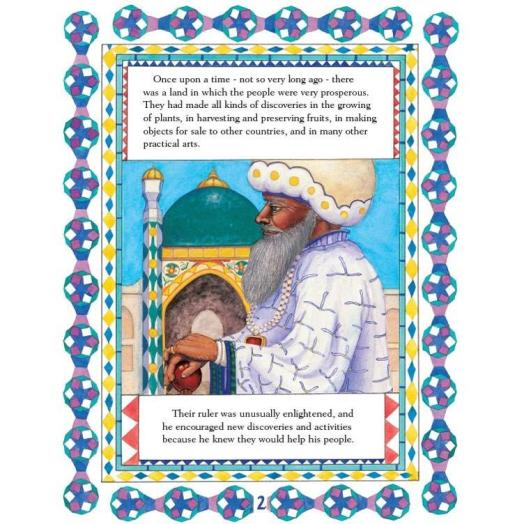
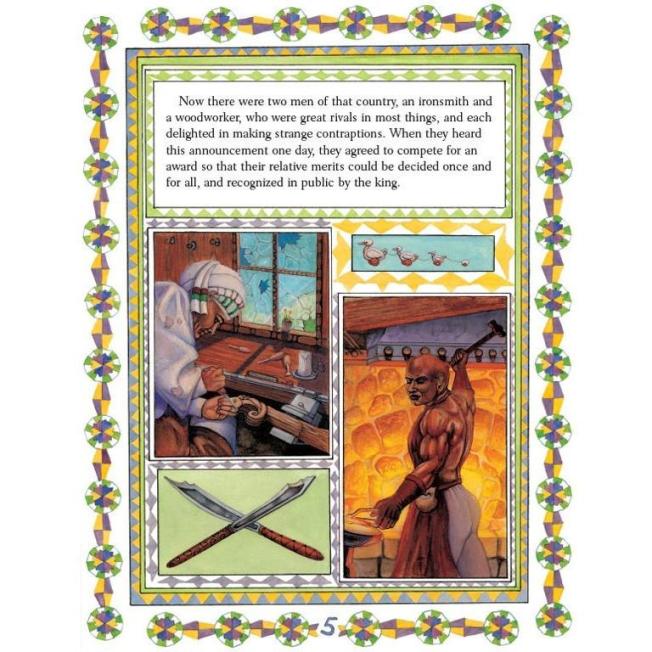
It starts out with an enlightened king encouraging his subjects to make new discoveries to promote quality of life, wealth and knowledge. He has two sons, one is an expert in strange devises and one is a dreamer.  The king puts out a call to have something new made, and an ironsmith makes a fish out of metal than can fly and swim and carry things.  A woodworker makes a magic horse that interprets the desire of the rider and carries the rider toward it.  The king suddenly becomes cruel and finding this a waste of time has the woodworker tied up.

horse

The dreaming Prince Tambal rides the horse on many adventures, which kind of disjoints the story and makes it like a fairy tale about Tambal falling in love and trying to persuade a king to let him marry his daughter, and in turn having to trick the intended suitor instead. Along the way there are poisonous fruits, turning into a beast, and eventually returning home to prove that, “Those who want fish can achieve much through fish, and those who do not know their heart’s desire may first have to hear the story of the wooden horse.” Huh? Exactly.

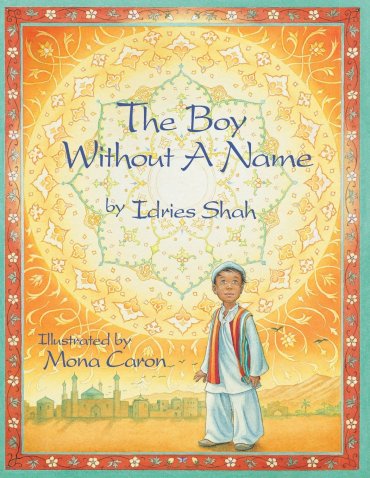
The Boy Without A Name by Idries Shah illustrated by Mona Caron

Standard
The Boy Without A Name by Idries Shah illustrated by Mona Caron

the-boy-without-a-name_orig.jpg

It is hard to know what a child would get out of this 32 page 3.2 AR level, but even if they just get lost in the pictures, and swept away by the idea of a boy searching for his name and a dream, I suppose there is value.  Some, ok most of Idries Shah’s, Sufi teaching stories are beyond my comprehension, but they are lyrical and often silly just the same. He has written over 30 and the libraries have quite a few, and people online seem to love so many of them, so perhaps I’m just not clever enough or philosophical enough to grasp them.  Which is neither here nor there, but maybe don’t buy one until you read one and see what you get out of them.  I keep checking them out and hoping I too will fall in love with one, I’ll keep you posted.

no name1

Before they can name their son an old man comes and tells the parents to not name him and to wait.  The boy grows up searching for a name, hoping someone has one he can have.  At one point he is made aware that he has nothing, even to trade for a name.  He responds that he has an old dream he no longer wants.  He and his friend Anwar then go to the wise man and he receives his name and a new dream.

The synopsis claims that patience and determination is learned, but I couldn’t get over the fact that the parents just didn’t name their child, and I never felt like I learned why he was such an important boy.

boywithoutname2

The pictures are wonderful with the scenic village’s tall minarets and colorful hijab clad women in the market place.  I particularly like the magic spilling out of the boxes in the old man’s house when the boys are finding names and dreams.  There is nothing overtly Islamic in the text, I’m not aware of how strong the Sufi origin is, not being Sufi, or having studied it.  But the illustrations definitely place the book in an Islamic cultural environment and the names reinforce this.


I Will Not Clean My Room by Saharish Arshad illustrated by Elsa Estrada

Standard
I Will Not Clean My Room by Saharish Arshad illustrated by Elsa Estrada

FullSizeRender (22)

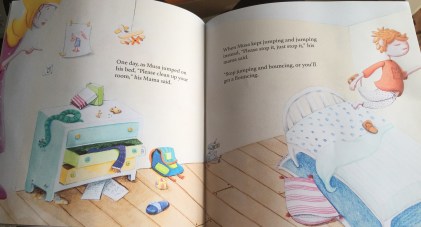
What a great premise for a children’s book, a little boy, Musa,  does not want to clean his room, and imagines all the better things he will get to do in Jannah (heaven) instead. Luckily for his room, his sister comes to help him tidy it up, as well as his mom and dad.  FullSizeRender (25)

The rhyme scheme and the kids’ imaginations at how wonderful Jannah will be, go hand in hand and make the book silly and fun.  The cartoonish illustrations also help sneak in messages of listening to your parents, cleaning your room, being kind to your siblings, helping each other, and ultimately doing things even if they are hard or boring to please Allah swt.  

FullSizeRender (24)

The book is a 28 page, 8×8, paperback.  The price is a little steep, $12, for its structure, in my opinion and is meant for Muslim readers.  The only real issue I had is when the mom threatens to flounce Musa. “Stop jumping and bouncing, or you’ll get a flouncing,”  seems excessive to me, and not consistent with how loving the family is throughout the rest of the book. It was probably included to maintain the rhyme scheme, but I took it to be a threat of violence, which I’m not ok with.

FullSizeRender (26)

The pictures show the mom in hijab, the word Jannah instead of heaven is used, the characters’ names are Islamic and Allah is mentioned throughout.  Musa’s thoughts on the last page are particularly sweet (see picture below).  I plan to read this to a group of kids at story time and will just omit the flouncing line, as it does well in appealing to ages 4 and up.  Three year olds may not understand it, but because of the rhyming, I think they will be equally entertained.

FullSizeRender (23)

Yo Soy Muslim: A Father’s Letter to His Daughter by Mark Gonzales illustrated by Mehrdokht Amini

Standard
Yo Soy Muslim: A Father’s Letter to His Daughter by Mark Gonzales illustrated by Mehrdokht Amini

yo soy muslim

I feel like I preordered this book years ago, I have been so anxious to see what all the hype was about. When it arrived I tore open the box and read it on the short walk from the mailbox to the house, read it again standing in the kitchen, left it for a few days, and reread it now to write the review. SubhanAllah, it didn’t disappoint.

yousoy4

It reads, as intended, as a powerful letter to a child.  There aren’t long winded morals or overly fancy words. It is direct in its many ways of telling you, that you matter, where you come from matters, that your foundation matters. That you are strong, and beautiful, always, even when the world may not think so. That you are Muslim, that you are from Allah, that you speak in Arabic and Spanish and dreams.  The verses become poetry that dance on the page with the illustrations telling the story as powerfully as the words.  The words in turn float and lilt around images as old as time and as innocent as dancing in the wind.

soy

The 32 pages fly by that you can’t help but read it again, slowly, savoring all the harnessed power and hope of a multi culture world, a multi cultural faith, that is truly beautiful.  Recognizing the humanity that we all share, yet feeling pride in your own unique skin is a balancing act that doesn’t need to be apologized for, and should be celebrated.

yo soy2

I love that this book exists.  That it is available on Amazon.  That it is bold and colorful and hardbound, and so well done.  There is diversity in Islam.  There is diversity of belief in Indigenous populations, that there is so much inspiration in the world around us and in our past.  Are all messages that come through even for the youngest readers.

yosoy3

yo soy1