Category Archives: Eid Al Fitr

Abdullah’s Bear Needs a Name by Yasmin Hanif illustrated by Sophie Benmouyal

Standard
Abdullah’s Bear Needs a Name by Yasmin Hanif illustrated by Sophie Benmouyal

I love the idea behind this 28 page book, and the illustrations are pretty great too, but I felt like the story needed a little more depth to convey meaningful emotion, appreciation, and connection.  It starts with an Eid gift, but there is nothing tying it to the holiday after the first spread.  And while it shows both Islam and Desi culture in action, I wanted to hear the stories of his family, and the connection to his culture that helps him name his bear.  I also feel like the premise was a little rocky, did everyone get family heirlooms for gifts? Did they get other gifts? Why was he gifted this special stuffed toy and not his older or younger siblings? Would a kid really be that excited to get a hand me down stuffed bear? Once you read the author’s intent, and the inspiration for the story, an adult could connect the dots and help a reader recognize the internalized othering being overcome, and discuss it, but I don’t know if all kids would not pick a cultural name for a toy, or see that Abdullah didn’t consider reflective names either.

The book starts with the reader dropped into an Eid day celebration.  Abdullah is handed a gift by his parents and when he unwraps it he finds himself the new owner of an old well-loved teddy bear.  His father was the previous owner, but refuses to tell Abdullah the bear’s name, urging him to discover it on his own.

Abdullah loves the bear, and takes it with him to the store, to school, to cricket, to madrasa Everywhere he goes he tries out names: old names at the museum, classmates names, but nothing seems to fit.  When his Abba tells him a story about his grandfather, he finally finds the perfect name for his bear.

I really like the details in the illustrations, they bring the story to life and feel authentic: the store names, the Eid spread, the activities.  I feel like this book is so close to being a standout, but I don’t know that kids who don’t find themselves exactly in Abdullah’s mindset, would be able to relate and connect to what transpires.  Unfortunately, it is unclear if he grows and learns from the experience, or if it was contained to this one incident. 


The Best Eid Ever by Sufiya Ahmed illustrated by Hazem Asif

Standard
The Best Eid Ever by Sufiya Ahmed illustrated by Hazem Asif

This book blends some facts about Ramadan and Eid with cultural practices, showing a day in the life of a family celebrating, and a sprinkling of a story line to keep elementary aged kids invested. The back of the book labels it as an introduction to Ramadan and Eid and I think that is a pretty solid summary.  Aisha is eight, and apparently too young to fast from sunrise to sunset.  I wonder if she is old enough to fast from dawn to sunset as Islamically prescribed? Yes, I’m petty, but it is wrong to say sunrise to sunset, and I’m not backing down. This year her aunt, Chachi Amal has made a scavenger hunt for her and her brother to find their Eid presents, but first there is henna to apply, decorations to hang up, Eid prayers to attend, desserts to be shared with neighbors, and lunch to be had, before the three question scavenger hunt can commence, and presents can be located.  The backmatter has information about Ramadan, Muslims, Eid, and a glossary.  The book would work well for a generic class or library story time. I don’t imagine Muslim kids will find it particularly memorable and ask for it more than once.  It is a Desi family, with the Chachi being Libyan and sharing desserts. hinting at the diversity of Muslims, and I can see kids wanting parents to hide their gifts and make a scavenger hunt, which is sweet and a nice idea to build on.

The book starts with Aisha looking outside to see if the moon can be spotted and Eid determined.  Samir and Dad come in and say that the mosque has declared Eid tomorrow.  Eid is Aisha’s favorite festival, she loves Ramadan, eating iftar with her fasting family, and she loves dates. This year her Chachi has hidden their gifts and made a scavenger hunt for the kids to follow.

Aisha can’t wait, but her Mom says they have other traditions first, and Aisha has henna painted on her hands.  They have to dry for at least two hours, so she watches a show while Dad and Samir decorate.  Then it is time for bed, and the scavenger hunt will have to wait.

Early in the morning is no time for a scavenger hunt, Mom is in the kitchen and they have to get to Eid prayers. After salat, and wishing everyone Eid Mubarak, Aisha is ready for the clues, but her and Samir are sent to deliver sweets to the neighbors.  When they return home, they can’t get to presents because it is lunch time. Finally, the scavenger hunt begins, the clues are solved, the presents found, and the day “the Best Eid Ever.”

I purchased this book from Crescent Moon Store, code ISL will save you 10%.

Can You Find My Eid Presents? By A.M. Dassu illustrated by Junissa Bianda

Standard
Can You Find My Eid Presents? By A.M. Dassu illustrated by Junissa Bianda

This brightly illustrated Eid book has cute illustrations, but is very basic.  There is very little about Eid, in fact I have no idea if it is supposed to be Eid al Fitr or Eid al Adha. The girl is outside when it gets dark and no mention of iftar is made, but there is no crescent moon for Eid al Adha as there is one prominently seen in the illustration, so any insight into the matter would be great.  The book is just a little girl running around looking for the missing Eid presents.  It doesn’t talk about traditions or faith, Hana is literally just moving from location to location to look under the bed, in the wardrobe, the broom cupboard, the bathroom, the garbage, outside, in the shed. So yes, yet another Eid book with no Islam, no heart, no explaining why finding presents makes this the “best Eid ever!” Sigh. Truly it could be, Can you find my birthday presents or Christmas presents, and nothing in the story would have to change.
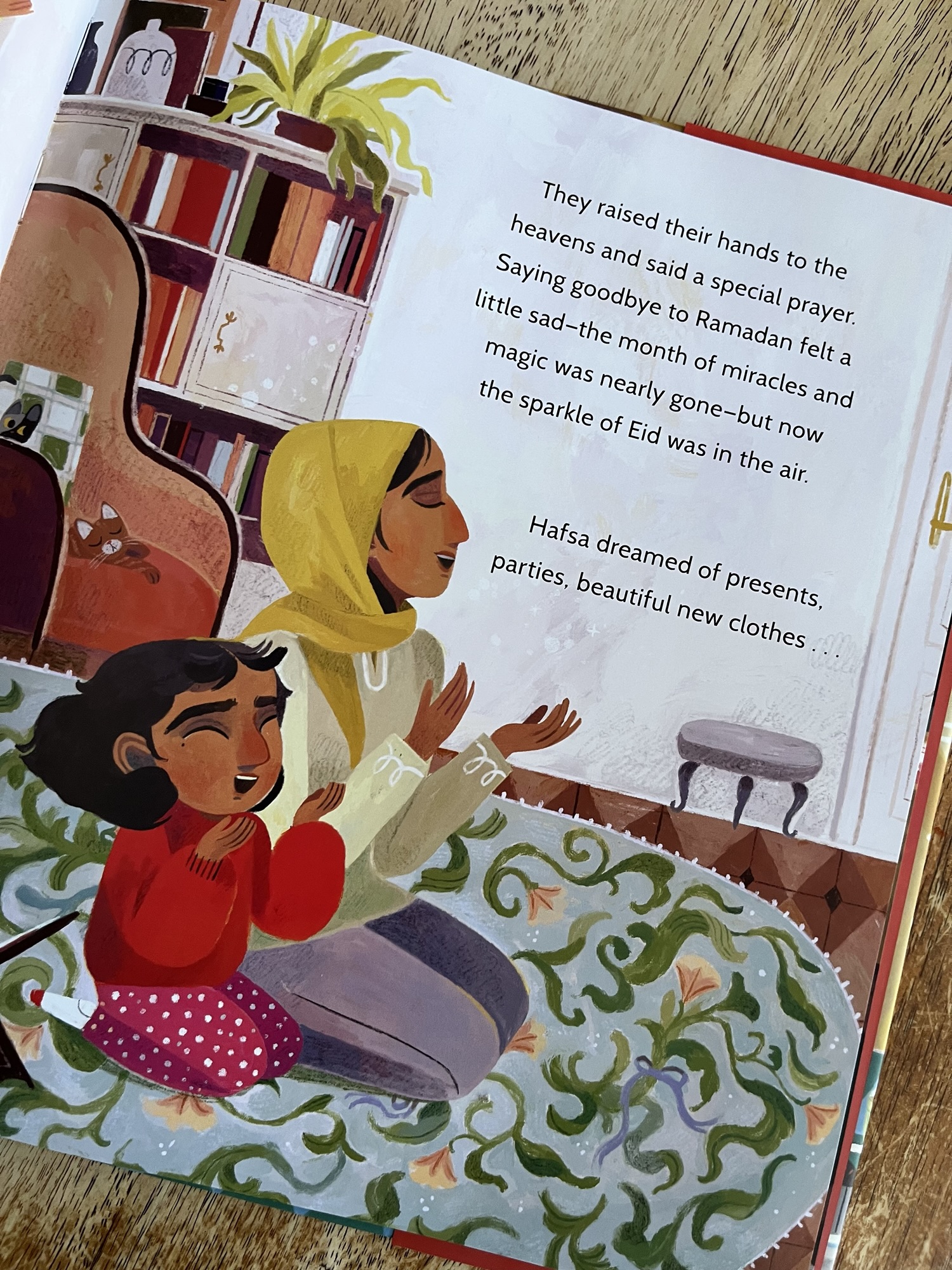
The book starts the evening before Eid, and Mummy and Hana are laying the table, and admiring the Eid decorations.  Mummy has a lot still to do and asks Hana to help by getting the Eid presents to Nani’s house for the party.  Only problem is that Hana can’t find them.

She looks everywhere, inside and out, and when Daddy comes home he is too busy to help.  He shoos her off to Nani’s next door, where the mystery is solved and the next morning when the presents are opened everyone is happy.

I wish there was some emotion, maybe whatever was in the little blue box for her Nani had her excited, and when it goes missing she is anxious.  Even to mention that they go open presents after Eid prayers seems like a natural inclusion, but alas, there is no emotion, no Islam, and no real point of the book.

Ibraheem’s Perfect Eid by Farhana Islam illustrated by Nabila Adani

Standard
Ibraheem’s Perfect Eid by Farhana Islam illustrated by Nabila Adani

Gorgeous illustrations, joyful Islam, and a sweet story about a little boy realizing there is more to Eid than presents. The protagonists voice is really on point and a great way to counter so many of the books, and real life antics of kids equating Eid to being about gifts. This 23 page picture book for 3-6 year olds, works for both Eid al Fitr or Eid al Adha, and follows little Ibraheem as he searches for his gifts throughout his sunnah and love filled Eid day at home and at the mosque.  I love that it shows him getting drawn into the khutba, doing takbir, ruku and sajood, eating dates before going, and taking a different path on the way home.  It doesn’t have any backmatter, but if reading it to a child, I would hope the little details in the text and illustrations would be discussed. It took me a few readings to be ok with how Ibraheem discusses his gift order with Allah swt, but I think for little kids and with the consistent tone of the book, it makes it relatable.  I also don’t know why his mom and rest of the family do not go for Eid prayers. Other females are shown at the mosque in the background, and people of various ages and mobility, but alas it is just Ibraheem and his Baba at salah, and a house full of love and family the rest of the day.

The book starts with an illustration of Ibraheem hanging up his “Eid Sunnahs” chart next to his “Dear Allah” swt list of gifts that he wants. The text then starts with it being Eid day and Ibraheem looking in all the usual places for his presents, but comes up empty. He wonders if his parents forgot, if Allah forgot, but he knows that would never happen. Luckily Baba and he are off to the mosque for prayers, maybe, he thinks, the presents are there.

As the father and son walk to the mosque they greet others, and then settle in for the “Eid day stories.” I don’t love that the khutbah is referred to as such, but that is probably just me. When the iqamah is called, it is time to pray and Ibraheem copies his Baba before they make their way into “the sea of smiling faces.”

Back at home it is time to enjoy food, games, fun, and cuddles with a bustling house.  Presents still haven’t been found, but the day has been perfect, and presents can always be opened tomorrow.

I love that this is a traditionally published book, that centers Islam on Eid and radiates with joy.  The large size makes it easy to share in all settings, and the illustrations beg to be explored and appreciated.

First Festivals: Ramadan: A Lift the Flap Book illustrated by Junissa Bianda

Standard
First Festivals: Ramadan: A Lift the Flap Book illustrated by Junissa Bianda

I was pleasantly surprised by the cuteness of this little (7.5 x 7.5) 12 page lift the flap Ramadan board book I got at the library. Written by committee (Ladybird Books) and part of a series, I didn’t really expect much, but the illustrations are adorable, and the salat flap made me smile. The text is simple and informative, fitting for the target demographic covering that Ramadan is a special time for Muslims to grow closer to Allah, do more good deeds, fast, fast, pray, and celebrate after prayers at the mosque with a feast.  It is positioned to teach non Muslims about Islam, so the “Muslims do, or say, or believe” framing, can inherently feel a bit othering, but being the tone of the book is to educate, I think it can easily be reworded for Muslim homes to benefit and enjoy.

The book starts with a two page spread of a family in a living room and text that identifies that “a new moon has appeared” and Ramadan is here.  The flap lifts the curtain to reveal a crescent.  It states that Ramadan is a special time for Muslims and that we grow closer to God, articulating that we call God, Allah (swt).

The remaining spreads feature diverse characters, various colors, mobility, hijab wearing and not, and cover fasting, suhoor, iftar, eating dates, praying tarawih and then celebrating Eid at the end of the month.  Flaps lift to show inside a mosque, praying and making dua, opening gifts, visiting neighbors, and eating.  The book concludes with Ramadan over and Muslims remembering what the special month taught them. Overall it does a good job of balancing, fasting, praying, and being together, not over emphasizing food, or commercializing the holy month at the expense of showing faith practices.

Maymoona’s Moon: A Special Eid Story by Razeena Omar Gutta illustrated by Zayneb Haleem

Standard
Maymoona’s Moon: A Special Eid Story by Razeena Omar Gutta illustrated by Zayneb Haleem

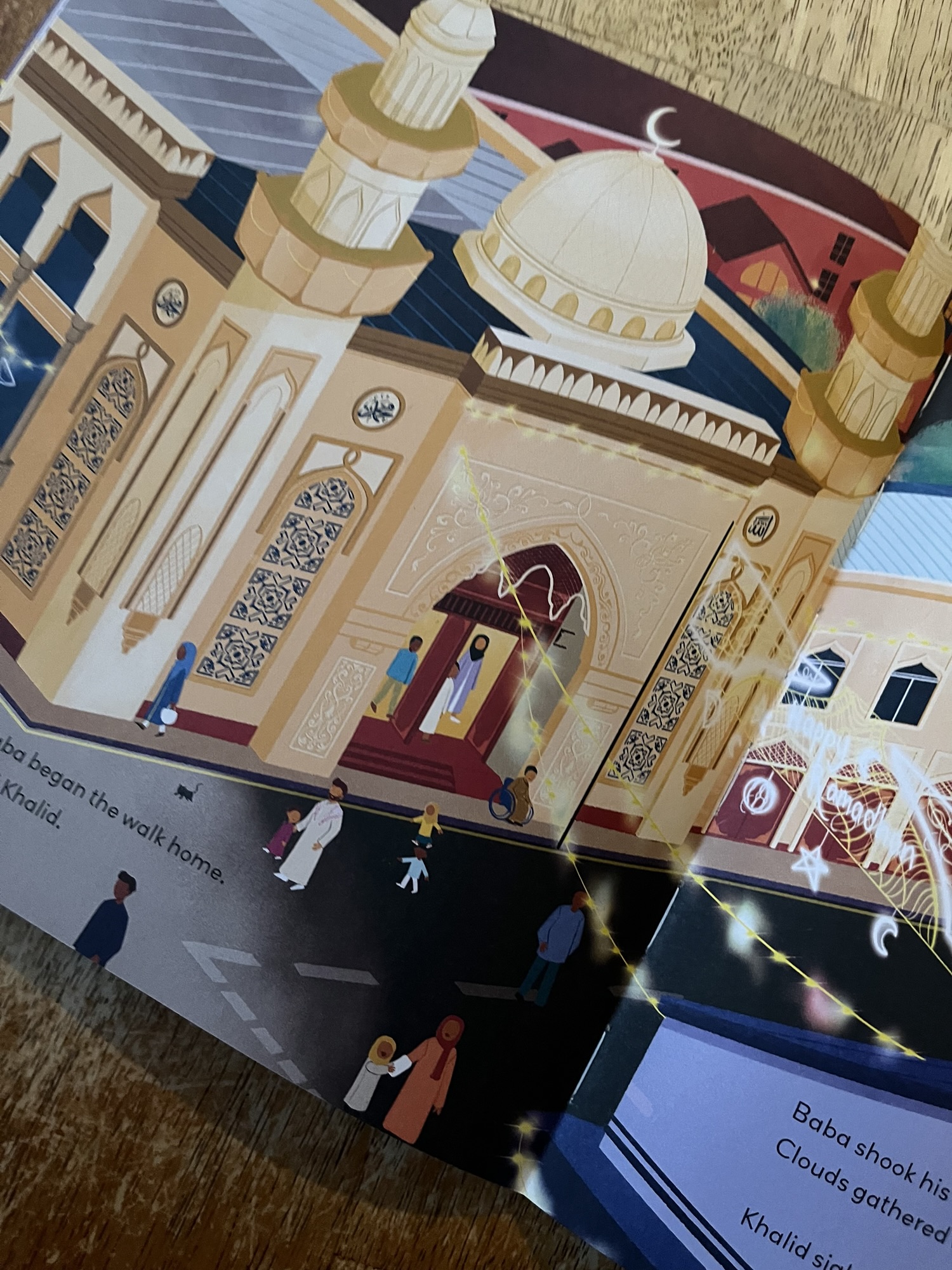
I love the illustrations of this book and have been trying to get it since it released in Australia to no avail, it finally is being released here in America and the 32 page hardback book is so cute to look through.  The story is, well, sigh.  It isn’t bad or wrong, but for a religious centered book, it has no Islam, no Eid feels, no faithful reliance.  Rather than using religion to bring the sighting of the moon to little Muslims and non Muslims, and blending it with the protagonists desire to be an astronaut as the framing of the story, it just focuses on the celestial intrigue.  “Cosmic compasses,” “galactic goggles,” and a cheering squad are needed for “Operation Galaxy Gaze,” there are no “Bismillahs” or “Alhumdulillahs” when looking for the moon, and ultimately seeing it.  Again, it isn’t wrong, it just seems a little unfortunate.  This book will be read in Islamic and public schools, libraries, and everywhere else children, preschool to early elementary, gather with hopes of hearing a Ramadan or Eid story.  I’m just fairly confident, none will leave knowing what Eid is, or why it is important to Muslims.  They will get that Maymoona loves the stars, there is an “inshaAllah” when she dreams of being an astronaut some day, but even the backmatter entitled, “Why is Seeing the Moon so Important for Eid?” focuses on just that, the seeing of the moon, not the month of Ramadan ending and Eid joy prevailing.  I know I’m harsh when it comes to Islamic rep, this one just skirted the line of telling us about searching for the moon, leaving Ramadan behind, and the excitement of Eid, when it so easily could have shown us, and left a lasting impression long after the book closed.

The book starts with the sights and sounds of Eid approaching. There is only one thing left to do and that is something Maymoona takes very seriously, looking for the moon.  It is the most exciting part of Eid for her, as she dreams of being a future astronaut.  She assembles her team to plot and plan, her gear to give her the best chance of success, and she squashes her nerves and makes her ascent to the best vantage point.  And then she waits, patiently to see if the wind will move the clouds, if her dreams of landing on the moon will come to fruition, if tomorrow will be Eid.

The large 8.5 x 11 pages with a matte finish make this book easy to share in small groups or at bedtime, and really let the pictures charm the audience on each and every spread.

Eid for Nylah by Nizrana Farook illustrated by Zelma Firdauzia

Standard
Eid for Nylah by Nizrana Farook illustrated by Zelma Firdauzia

I have read this book dozens of times and I honestly don’t know how I feel about it. If you remove the title and second to last page and just READ the words, the book could be about any holiday that you might clean and decorate for, that would involve giving gifts, putting on henna, wearing new clothes, praying, and sharing food at. The illustrations imply that it is a Muslim holiday with about half the women in the pictures wearing hijab, and a few decor items that say Eid Mubarak in English and Arabic, but readers that are unaware or unfamiliar might not grasp that it is faith based at all, and the Author’s Note mentions, but doesn’t detail much about the religious significance either. During one reading, I felt it also could almost seem like a mystery, that the title just happens to ruin. The cat Nylah goes to different houses on the street seeing and hearing the tidying and banner hanging and gift wrapping occurring, but doesn’t know why no one has time for her, until the big reveal that it is Eid. I think for little non reading kids that actually might be my approach, to share the book without the title and back blurb and see if they can figure out why everyone is too busy to play with Nylah.  I don’t know that it is tokenism, or that Islam is left out to make the book palatable for the Western gaze, I could be wrong though, I really just think this is the author’s style.  Having read her chapter books that always center animals, feature community, and include Muslim names, I think this is just an extension of her lyrical writing in her debut picture book. The book would work for either Eid, but the backmatter is the author’s reflection on Ramadan and Eid al Fitr.  I know I’m the minority that struggles with Islamic holiday books that leave out the Islam, so for those of you that do not find it disappointing, the book is sweet.  Nylah is a cat that is welcome and known to the entire neighborhood, to come and go as she pleases, the age engaging illustrations complimented by the cadence and rhythm of the structure, lines, and diction are easy to read aloud to groups of all sizes, and hold the attention of 3 year old children and up.

The book starts with a family “wiping and scrubbing, tidying and sorting, everything in sight.”  When no one has time to play with Nylah, she heads outside under the crescent moon, and goes next door to Bilal’s house, where he and his family are decorating.  When she tries to play with the ribbon, she is once again told they are too busy to play, so she slips into Reem’s house where they are doing henna.  This continues from one house to another until the next morning when her family all dressed wakes her up to go to the park with them for prayers and Nylah realizes it is Eid.  Now the children are not too busy and everyone plays with Nylah.

Yeah, I know, taking a cat to Eid prayers sounds wild to me too, kids love imagining though what chaos might ensue.  There is enough hinted at that Muslim families can find the clues and make the book more religious or holiday centered, but I wish it showed the cat seeing praying or reading Quran, hearing the athan or thikr, or something that would ground the book in Islam, but alas, it does not.

The book concludes with an Author’s Note and scanable QR Code for a free audio reading.

Cookies and Crescents: An Eid Story by Nada Shawish Dutka illustrated by Zelma Firdauzia

Standard
Cookies and Crescents: An Eid Story by Nada Shawish Dutka illustrated by Zelma Firdauzia


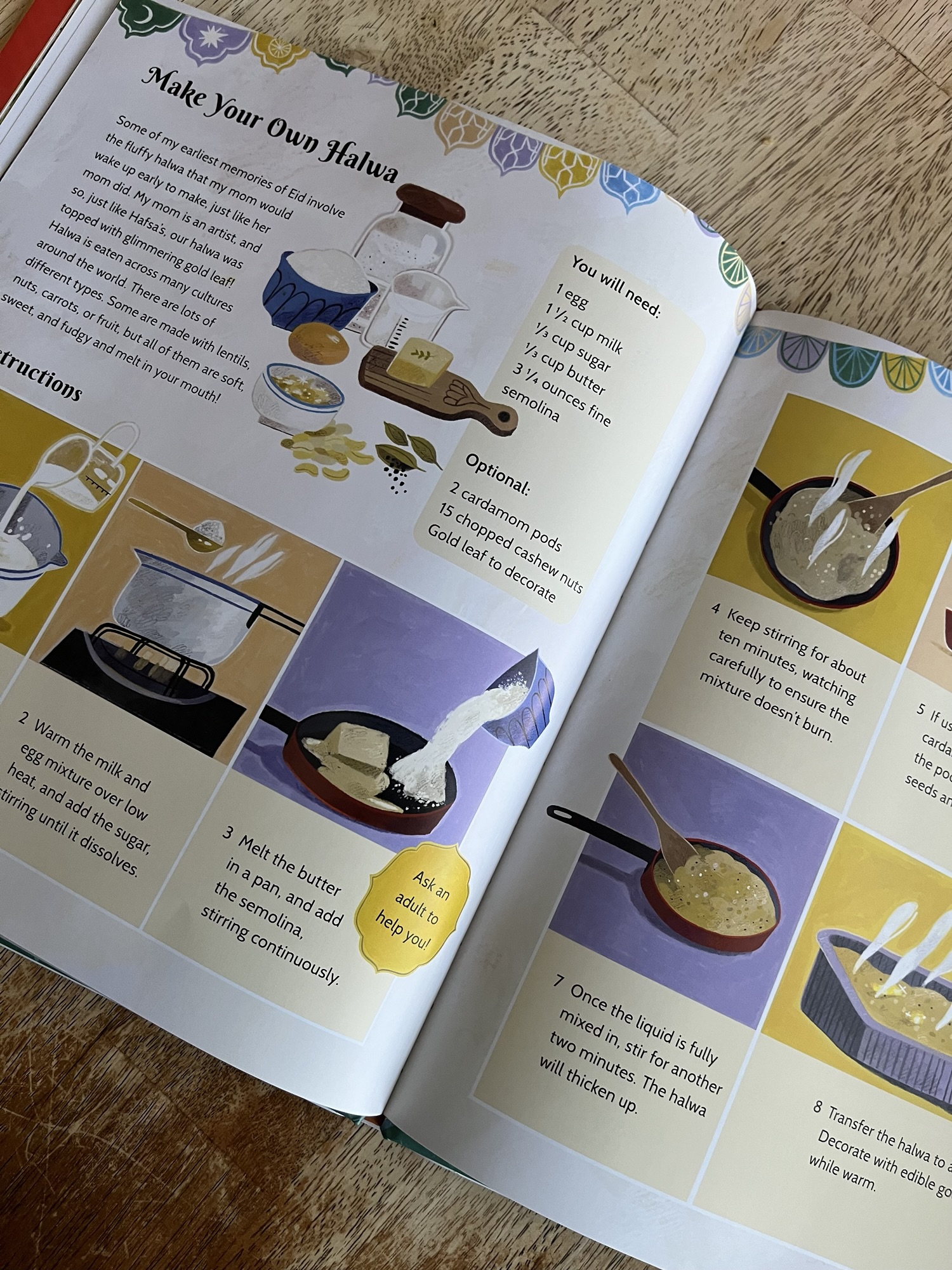
We can always use more Eid al Fitr stories, but to stand out in an increasingly crowded field, really requires something special, impeccable story telling, and repeatability.  Unfortunately for me, this book just comes up short.  Food centered books are already so over done, toss in small font that nearly bleeds into the binding where you would hold the book for story times, top it off with a vague story lacking the OWN voice charm that a religious holiday centered book, by a Muslim, that is noted to be slightly autobiographical should have, and the recipe is just going to feel lacking.  There isn’t anything “wrong” with the book, it just doesn’t really seem like it will be memorable or asked for again. Focusing on a mom and daughter moving the night before Eid, the book has elements of adjustment, new traditions, change, nerves, salat, iftaar, looking for the moon and making a new friend- layers that should resonate with readers, but somehow for me, stayed on the surface of this 32 page book for preschool to early elementary aged children.

The book starts with the protagonist talking about the city where she was born, the community, the family atmosphere, and her mama’s famous Eid cookies.  But this year will be different, it is almost Eid and Reem and her mama are moving away from the city to a house with a yard. Reem is not excited, in fact, she spends much of the drive feeling carsick.  Once they arrive it is time to unpack, break their fast, pray and look for the moon.  The excitement of making making cookies with her Mama sustains her, until she notices the walnuts are missing. Change is inevitable, and Mama is determined to show Reem that they can make do with what they have.  When neighbors come over to welcome them to the neighborhood, a new friend might be just what Reem needs to settle in.

The book seems to be deliberately vague, and I don’t know that it will bother children, but it bothered the journalist in me.  Why are they moving, what city are they leaving, is Sarah Muslim or just knows to say Eid Mubarak, but doesn’t say walaikumasalam.  I also feel like the publisher didn’t properly invest in the book.  The text is tiny, when ample space is available on nearly every spread.  Blocks of text on the lower inner binding make one’s hand cover the words when reading to a group, and certain paragraphs seem to be erroneous or at the very least awkward.  Take for example this paragraph when they are unpacking, that I stumbled over every time I read it. “Tonight, it’ll be just me and Mama who look from between tall boxes.” Maybe it is in reference to looking for the moon, but the next page does have her and Mama planning to look for the moon.  Similarly, when the walnuts can’t be found, Reem wants to go back, but Mama says the store is too far. The mother in me was fuming that she didn’t see it was more than about the nuts, go give the girl a hug. Earlier Reem remarks that “Finally, Mama kept her promise,” in regards to the cookies, but is it finally they are making cookies or does Mama not normally keep her promises. I know I’m being picky, but it starts to add up, the reader doesn’t feel that Mama and Reem are in this together. That they listen to each other. So it is hard to get emotionally invested. And when I review I try and unearth why a book doesn’t work for me, and all these little hiccups for me, become obstacles that keep the book from being great.  Sadly all it needs is some good editing and my critiques really could have been resolved, sigh.
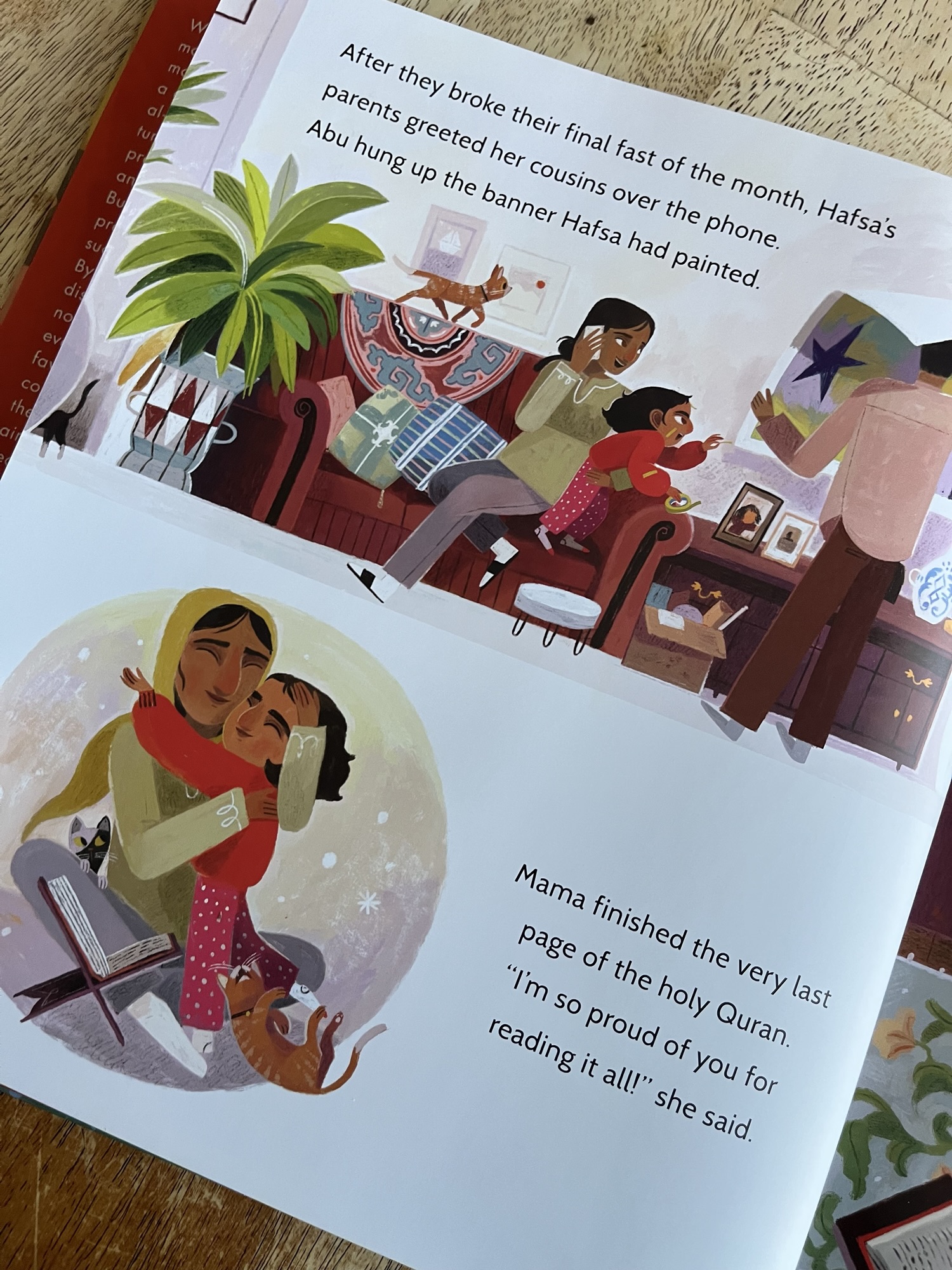
Even though the book is set at Eid, and shows the mom and daughter praying, they say salaam, they look for the moon, there is no real Eid as a religious holiday stressed, the focus is the cookies and the new friend.  Culture also seems to be noticeably absent, the cookies are Arab, the phrase “Al Harakah Barakah” is Arabic, but it isn’t sourced, the reader is never told where that sentiment comes from and it isn’t explored as much as the inner flap would suggest. The book concludes with an author’s note and a recipe for ma’amoul.
 

The Eidi Bag by Shazia Afzal illustrated by Shiva Delsooz

Standard
The Eidi Bag by Shazia Afzal illustrated by Shiva Delsooz

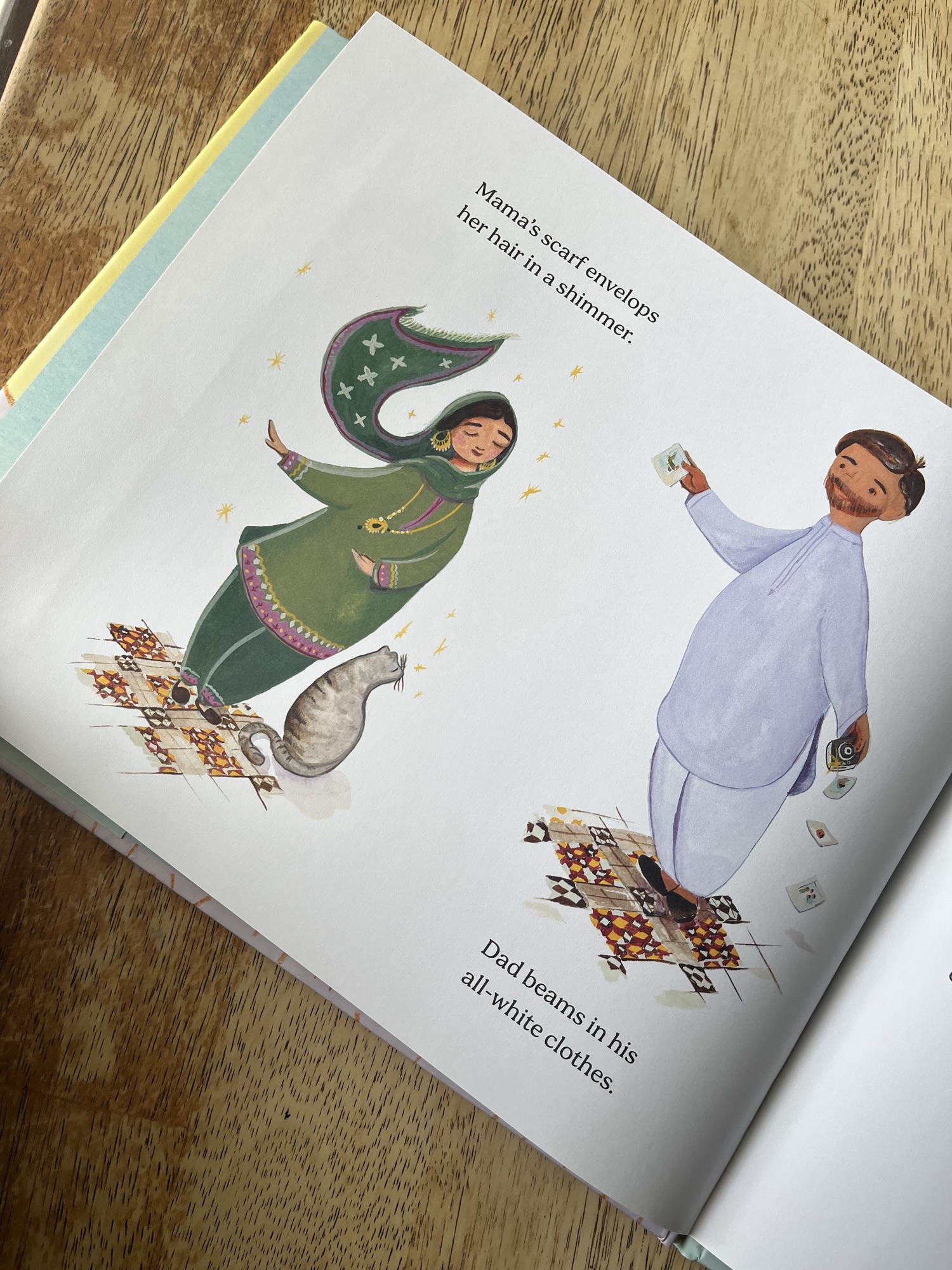
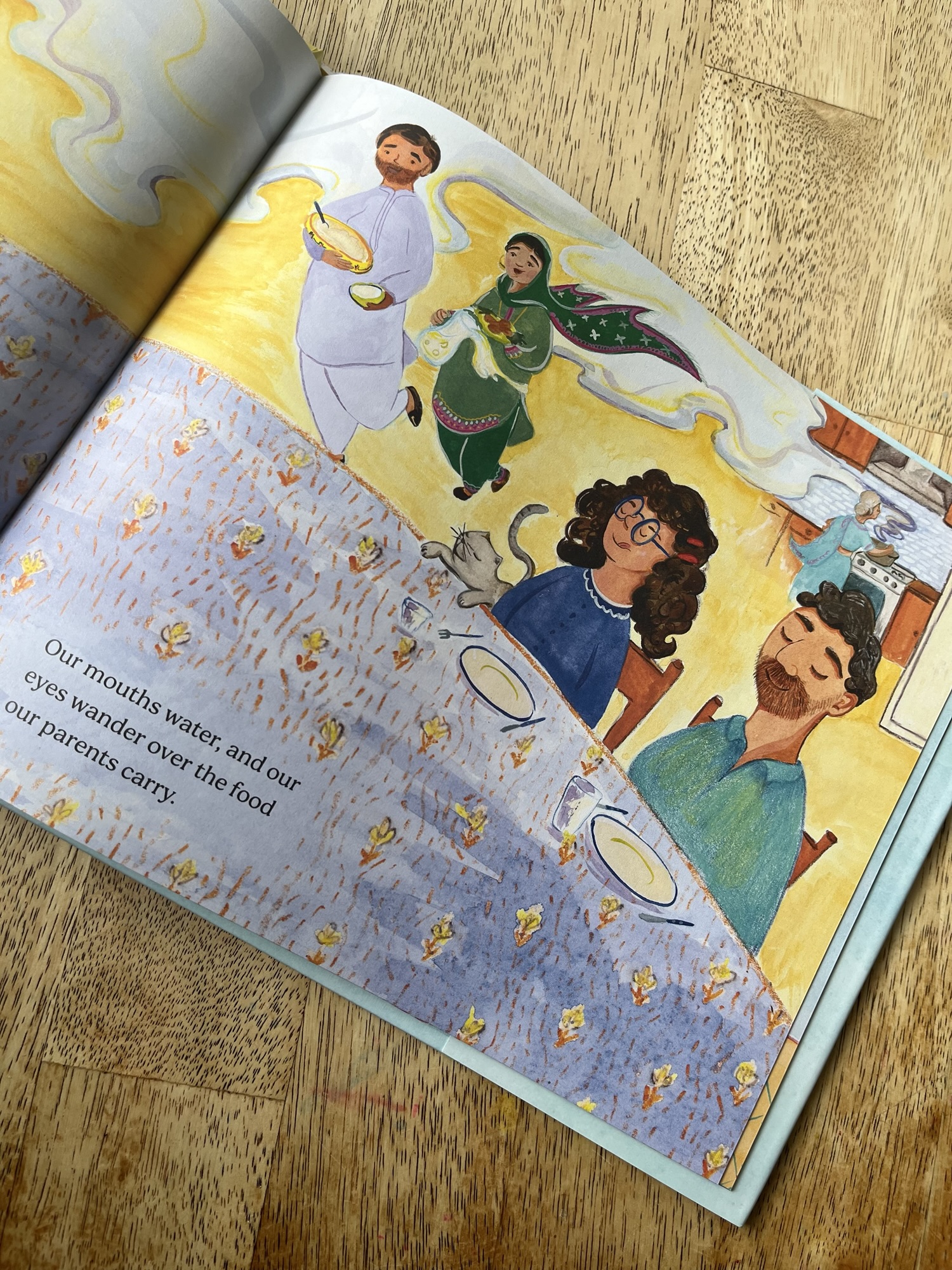
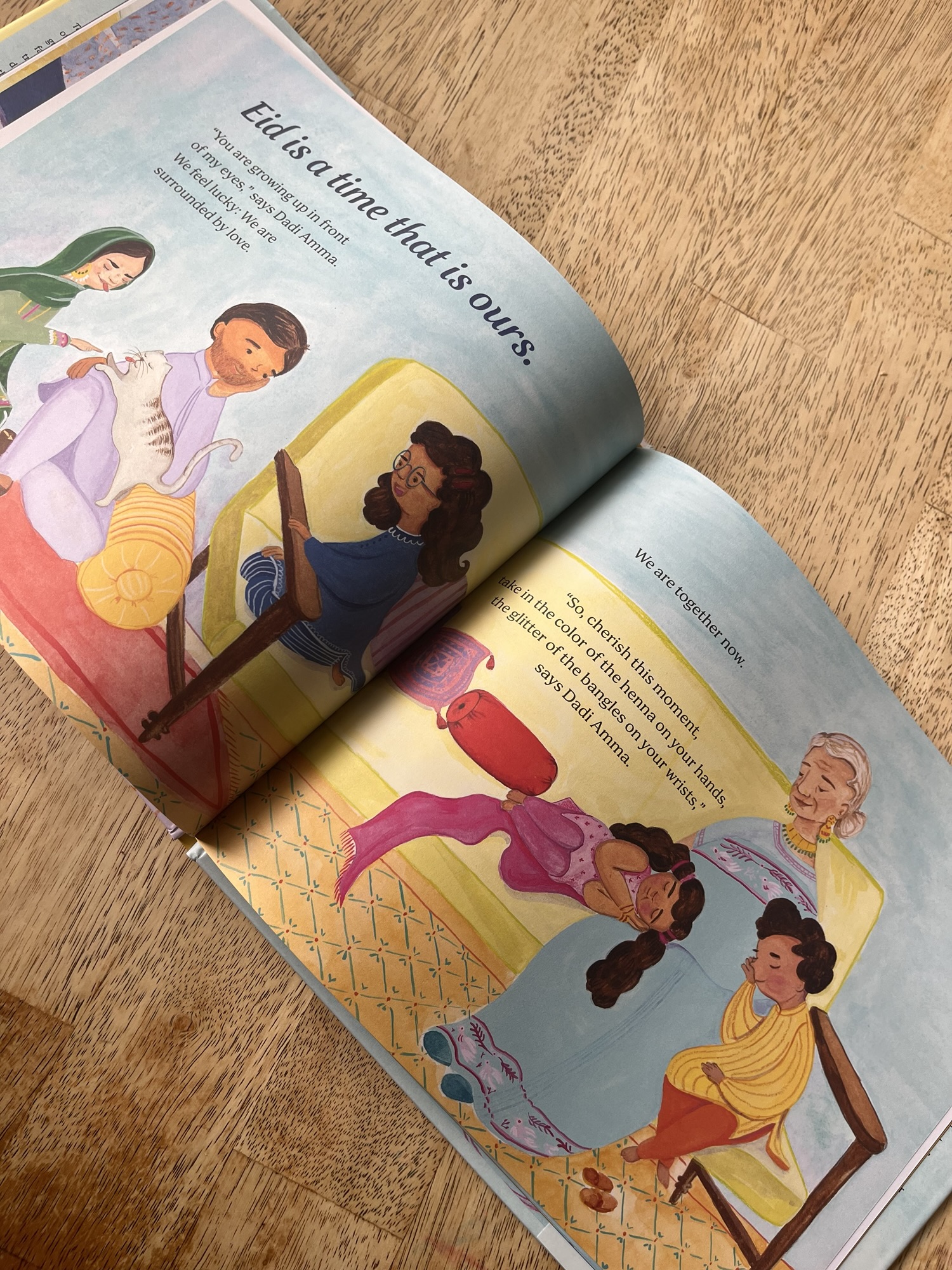
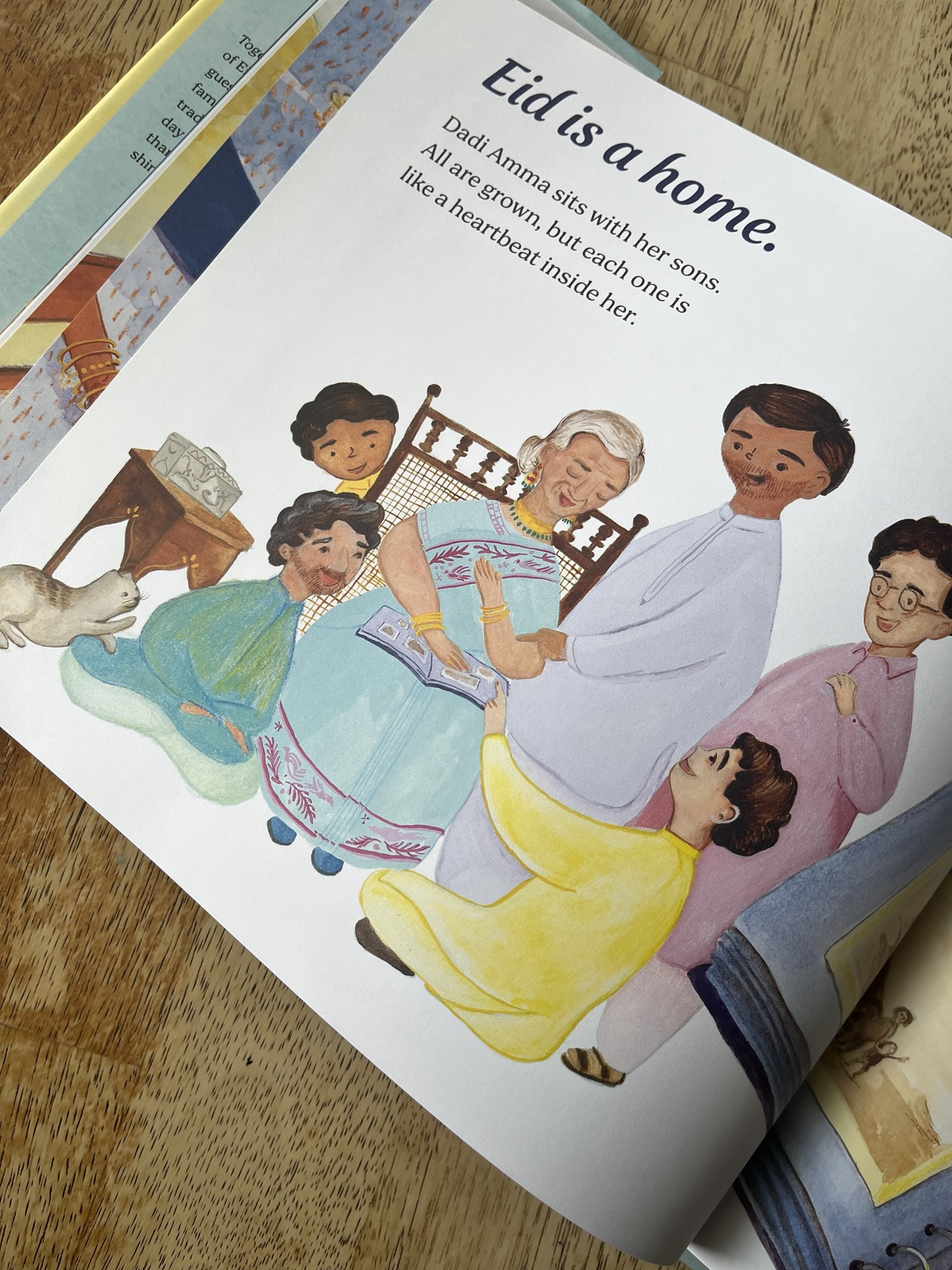
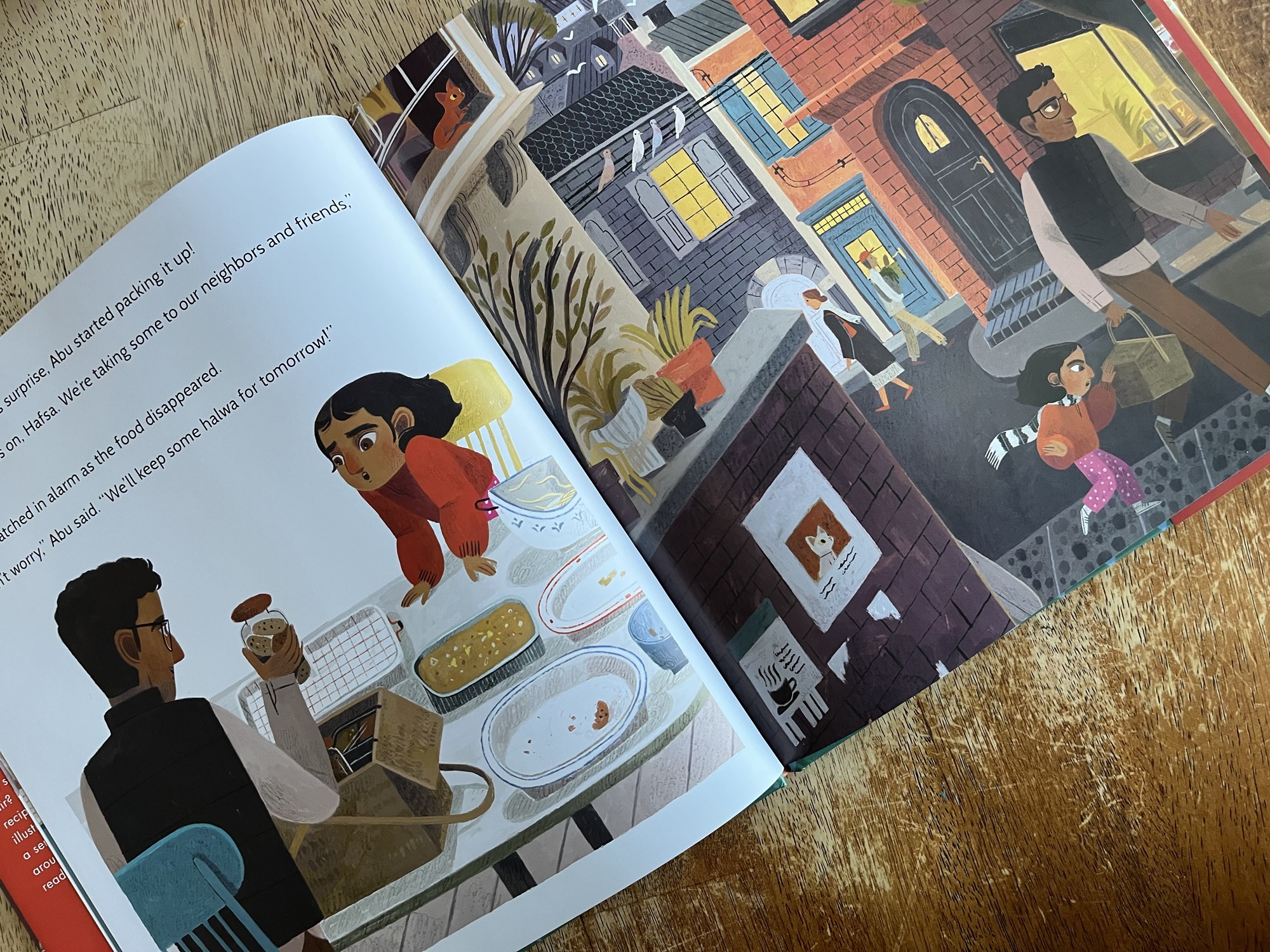
This adorable 32 page picture book, is not just a story about celebrating Eid al fitr, it weaves in themes of culture, faith, anticipation, disappointment, change, and appreciation.  It is Sarah’s first Eid in a new country and she has made herself a new Eidi bag just for the occasion, to collect the money she will receive from friends and family to celebrate the holiday, and then use to buy treats to share.  Except other than her parents and grandfather, no one gives her Eidi.  She longs for Pakistan and the traditions that she is used to, when slowly she sees that new and different traditions can also be fun and filled with love and joy.  The slow realization and protagonist point of view are skillfully done in keeping the story engaging, the arc smooth, and the lessons nuanced.  The beautiful illustrations, tug at your heart and bring the story to life making me confident that it will be a highly sought after addition to any book shelf for story time, bedtime or independent readers, Muslim and non Muslim alike.

The book starts with Sarah running into the kitchen on Eid morning to show her Mama her Eidi bag and ask for her Eidi. Her Mama lovingly gives in and reminds her that it isn’t polite to ask for Eidi.  Sarah repeats the requests when Baba and Dada ji enter, and Mama rolls her eyes.  The family is then off to the masjid to pray, listen to the khutba and give donations.  At each turn of greeting friends, Sarah shows off her bag, and yet no one offers her Eidi, much to her confusion.  On the way home Sarah is missing Pakistan and recalling how full her bag would be if she were there.

Once home, Mama is busy in the kitchen getting ready for guests to come by. Sarah notices that they will be coming at a certain time, not in and out all day long like before.  When the guests, Muslim and non Muslim, start to arrive they each bring a gift, baklava, flowers, candies, a little plant, and even a set of 40 markers just for Sarah, that she can store in her Eidi bag.

I love that even though it could very easily come across as whiney, or with money being discussed, greedy, it doesn’t.  The book is very tender, and you feel the emotions of Sarah in a new place adjusting to what her expectations are to the reality, and adapting. Being kind of dismissed at Eid also was very reflective as children everywhere get a bit jostle with all the hugging and greetings flying around above their heads. I also love that the neighbors come, including a friend named Jessica, modeling for non Muslims what they too can expect if invited to an Eid party. Someone brings baklava, not a traditional Pakistani dish, also showing the diversity within Islam, subtly adding an additional beautiful layer to the story.

The book concludes with an Author’s note and a glossary.  A great book that will work for both Eid al Fitr and Eid al Adha.

Join Us for Ramadan by Sana A. Faqir illustrated by Amna Asif

Standard
Join Us for Ramadan by Sana A. Faqir illustrated by Amna Asif

This 18 page chunky board book is about 7.5 x 7.5 inches and a little over an inch thick.  Each spread features interactive touch, feel, lift, slide, and rotate features that keep little toddler hands engaged, while the text shares Ramadan basics. Interestingly enough though, the back says it is not for 0-3 year olds, presumably because parts could tear and be choking hazards, but making it unusable for the demographic(?).

It starts with a slider that reveals the Ramadan moon and encourages readers to find the moon in the sky. The next spread has you lifting a cover to see what Mummy has made for suhoor.  The prayer mat is then pulled out, The Qur’an opened, Sadaqah collected, dates and chocolate rotated, masjid doors opened, and once again the moon slides into view to know it is time for Eid.  

The illustrations are cute, the manipulatives are clever and not repetitive, but the flaps on any of the lift the flap reveals are incredibly thin, and the outer strip that holds the entire book is similarly skimpy and I don’t know how long it will hold up with regular use considering the thickness of the actual pages.