Category Archives: 6th grade and up

Other Words for Home by Jasmine Warga

Standard
Other Words for Home by Jasmine Warga

other words for home.jpg

Three hundred and forty pages written in verse that beautifully consume you and leave you emotionally changed and vulnerable and humbled all at once.  The book claims it is for middle grades, but I think middle school will appreciate it more, and I sincerely hope everyone of all ages will take a couple of hours to fall under the spell that is woven to tell a story of a refugee leaving home and starting anew in America.

SYNOPSIS:

Jude is a 12 year old girl living on the beach in Syria, watching American movies with her friends and hanging out at her dad’s store.  With an older brother and a little sister on the way, life as told from her own perspective is pretty good.  Until it is not.  Until the crimes they only hear about happening in Aleppo and Damascus start to hit closer to home.  Until her brother starts sneaking out to meetings with other youth hoping to change the politics of their country.  Until a raid almost catches Jude and her brother and her parent’s decide it is time for Jude and her mother to journey to America, for a little while, to visit her mom’s brother and deliver the baby.

America is not like it is in the 90’s movies that Jude loves: Pretty Woman, Legally Blond, Miss Congeniality.  Her American aunt and her Uncle that seems to have forgotten his Syrian upbringing, are gracious and welcoming and their daughter, Sarah, who is less than a year older than Jude waxes and wanes in her approach to her cousin.  Adjusting to school, life without baba and her brother, and all the other adaptations that moving to a new country entail are brought to life through Jude’s eyes and understanding of the world around her.  As she comes of age and decides to wear hijab, as Islamaphobia shakes her sense of justice, and her little sister is born, the reader sees her grow and change and mature and find themselves hoping that she will soar.

WHY I LIKE IT:

I love that the style of the story telling somehow gives life to so much.  With verse some things are highlighted in detail and other things skimmed over and yet at the end, not only do you feel like you understand Jude, but a lot of the side characters as well, which caught me off guard.  Truly the writing is strong and deliberate.  A lot of the politics and war crimes occurring in Syria are not detailed, and I have to assume that is because the point of view is a 12 year old girl that is blissfully in her own world.  I imagine this is also why the target audience is listed as 8-12 year olds, because it simplifies a truly horrific situation.  Also because despite moments of raw vulnerability, the book stays pretty optimistic and hopeful.  

I like that the characters are Muslim, and that the mom scolds her brother for not going to the mosque.  The book does talk about Jude’s period starting and thus Jude starting to wear hijab, which is one of the reasons I feel like early middle school might be a bit more appropriate age group.  There isn’t too much talk about faith and Islamic beliefs, but a few tidbits are sprinkled in, prayer, not eating pork, modesty.  The book is not gender exclusive, but I think girls will gravitate much more to Jude’s perspective, experiences and voice.

The only thing I found a bit off is that the book takes place in modern time, present day, yet none of them have cell phones or social media.  Jude Skypes her dad, yet writes letters to her friend back in Syria and is distraught when they don’t have a forwarding address to send them to after her friend also leaves home.  It seems that social media, email, a cell phone number, something would be available for them to all keep in touch.

FLAGS:

There is mention of Jude and her friends having to sneak in to see Pretty Woman because Julia Roberts is a prostitute, and mention of blood between one’s legs and periods starting.  The book otherwise is pretty clean.  It hints at her kind of crushing on a boy that is in the play with her, but nothing more than friendship is explored.  Violence mentioned is minimal and language is clean even when dealing with hate crimes in America.

TOOLS FOR LEADING THE DISCUSSION:

There is a good chance that next year the students joining the middle school book club will be all girls, so if that is the case and the school counselor feels all the girls can handle the puberty aspects mentioned I would totally do this book.  The book reads very quick and might be a good way to get new kid to give a book club a try as well.

Author’s website: http://jasminewarga.com/about

Q & A with the Author: https://www.publishersweekly.com/pw/by-topic/childrens/childrens-authors/article/80127-q-a-with-jasmine-warga.html

Interview with the Author: https://www.hbook.com/2019/04/authors-illustrators/publishers-previews/spring-2019-publishers-preview-five-questions-for-jasmine-warga/



Shadow Magic by Joshua Khan illustrated by Ben Hibon

Standard
Shadow Magic by Joshua Khan illustrated by Ben Hibon

shadow magic.jpg

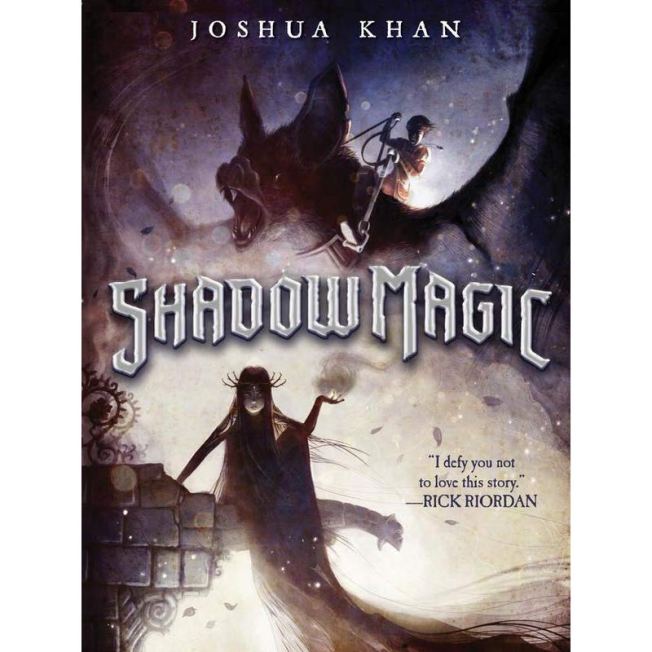
This book is fun and enchanting, whether you read all 321 pages and fall in to the occasional illustrations and pour over the map, or listen to the audio and get swept away.  It is an AR 4.1, and the first in the three part series.  Told by the point of view of two characters, the book’s short chapters and high action speed are expertly crafted to keep suspense and interest high, while maintaining solid world building events and making the character’s history come alive.  There isn’t anything Islamic in the books, save some critical and cleverly named characters and ideas, but the author in interviews has said he is Muslim, and that is enough for me to share a book I thoroughly enjoyed on this blog!

SYNOPSIS:

Thorn is a fugitive kid, on the run from something left intentional vague and possibly the son of an outlaw.  Raised on the edge of Herne forest (earth), he is good with animals, feels comfortable in nature, has a soft heart for doing what is right, and isn’t afraid of hard work.  He finds himself being sold as a slave to the executioner of Gehenna, Tyburn, and is off to Castle Gloom where he will meet and befriend the new ruler of House Shadow (death/darkness), Lily.

Lillith Shadow’s parents and brother have been murdered and she is now the ruler of Gehenna.  She is also still a child and events around her require her to grow up fast.  To end hostilities with House Solar she is to wed Prince Gabriel, a pompous idiot, who she despises in principle and in person.  

When an attempt is made on Lily’s life, Thorn and an unexpected ally, K’leef a Prince from the Sultanate of Fire, must work together to figure out who is trying to kill Lily, possibly who killed her parents, where Thorn’s father is, who is raising an army of zombies, and now how to get out of this wedding without causing continued war.

The history of the six founding houses that make up this world, and their elemental magical rules and limitations as magic dies out with each passing generation, come together and a tale is told that contrasts easy everyday language in a mystical proper world of royalty and dukes, colored by the dark of death and necromancy and shadows, while somehow remaining light, and funny, and completely relatable as the kids come of age and learn who they are and what they are capable of doing and accomplishing.

WHY I LIKE IT:

I love that the book is clean and that it has both Thorn and Lily’s perspectives to move the story along and give insight into the characters.  I love the world building and how the history of each of the houses is so well thought out and clear.  

“The whole idea of House Shadow is based on the Middle-East. Lily’s dad’s name is Arabic for the devil. Her mother’s the great villainess of the Old Testament and Lily is Lilith, a Hebrew demoness. The view people have of House Shadow mimics the fear the West has of East, and specifically Islam. For that reason all of House Solar is named after archangels. . . Some houses were easier to establish than others. House Djinn was fire as djinns are (out of Arabic lore) beings of smokeless fire. Herne’s an ancient English forest deity, so again a pretty easy fix” (http://www.cybils.com/2017/03/interview-with-joshua-khan.html).

A big plot point is that Lily is magical, and it is against ancient laws, meaning all six houses agree, that women cannot practice magic.  The irony is great, in that even kids can pick up on the fact that the six brothers and founders of the magical houses acknowledge that the source of their magic comes from their mother, a woman, and the hypocrisy of it all is frustrating.  I love that three very different characters have to work together, and pick their battles, it really is a testament to the strength of friendships even with people so very different than yourself.

FLAGS:

Pretty clean, not recalling anything cringeworthy as we listened to it in the car (kids ages 3, 8, 9, 12).  The book is dark in that it takes place in Gehenna and there is talk of the undead and bringing the dead back to life and they really celebrate Halloween in their own dark way.  There is murder and death and assassinations, but it isn’t overly morbid or gory or violent.

TOOLS FOR LEADING THE DISCUSSION:

I think I’ve already 90% decided to start next years middle school book club off with this book.  It is fun and engaging and the discussions would connect this fantasy story to so much in the kid’s lives and greater world that I get giddy just thinking about how fun a discussion it will be.  Sadly the school year is wrapping up and I’ll have to wait until fall.  Here are some of my favorite interviews online with the author:

http://www.cybils.com/2017/03/interview-with-joshua-khan.html

https://www.greenhouseliterary.com/authors/joshua-khan/

Author’s Website: http://www.joshuakhan.com/


Ayesha Dean: The Seville Secret by Melati Lum

Standard
Ayesha Dean: The Seville Secret by Melati Lum

seville.jpg

This is the second middle grade mystery story for globe trotting sleuth, Ayesha Dean, and much like her first adventure in Istanbul, this Spanish setting is infused with rich history, delicious food, relatable characters and quick paced action.  

SYNOPSIS:

Once again Ayesha and her two friends Jess and Sara are tagging along on a business trip with Uncle Dave, Ayesha’s uncle who has raised her since her parent’s passing.  As they wait in line to board the final flight of their lengthy journey from Australia, a young man drops his contents and Ayesha and him chat, later they are seated next to each other on the plane where he discloses his travels from England to Seville are to help locate his missing grandfather.  Ayesha volunteers herself and her friends to help him and they hit the ground in Spain determined to solve the case.

The boy, Kareem, is staying with the friends his beloved grandfather was staying with when he went missing, so that is where the detectives start their work.  In searching his room, Ayesha uncovers a 400 year old diary written in Arabic, and a pamphlet from the Archeology Museum with a necklace circled, the Collar de Pajaros.  Just enough to get them started and set their adventure in motion.

The group of teens rely on Kareem to translate the Arabic in the diary and Ayesha’s wit to decide what to follow up on and how to incorporate their sightseeing with the task at hand.  As they journey through the city of Seville, learning the history and tasting the food, nefarious characters start to notice the group and things get intense.  From Cathedrals, to cafes, to Museums, and even to an ancient city uncovered in Cordobo, Madina Al-Zahra, the chase is on, not only to find Kareem’s grandpa, but to also avoid being caught themselves and maybe even solving a centuries old mystery about treasure and a necklace along the way.

WHY I LIKE IT:

I love that Ayesha in any situation stays true to her self.  She wears hijab, she prays, she is aware of the good looking guy, but doesn’t cross her own line, she is a good friend, an inquisitive person, and confident.  All amazing attributes for a fictitious hero and real ones too.  

Much like Nancy Drew and other middle grade novel series, the books don’t need to be read in order, and while they reference other adventures, they stand alone sufficiently too.  Also, like the aforementioned books there is definitely a formulaic pattern to how the author writes her books.  And while reading it I didn’t notice it intensely, as I write the review I do.  Ayesha travels abroad, she has her sidekicks that are not developed at all and truly have no barring on the story plot wise or as comic relief, they are simply foils to bounce conversation off of, there is a cute boy who could be pursued, but isn’t, someone passes out while she and her friends are sight seeing, and the spouses provide added clues, Ayesha gets locked in a small dark space, there is a twist and a surprise, a trap, and they all live to repeat the adventure in another city another day.  I don’t think I have a problem with it, but maybe because I am not the target audience age, I might get bored with it about book four or so.  As it stands right now, I’m anxiously waiting for book three.

While reading I was a little irked that Sara and Jess weren’t any more developed in Spain than they were in Turkey.  One of them could have been the one to administer CPR or to stumble on the diary in the room, something to give them some plot significance, but alas, the books do not bare their names.  I wish Kareem would have at least said “Salam” on occasion.  I like that the author shows he doesn’t know much about Islam and shows that his grandfather admits its been so long since he has prayed, but the boy is a Morisco and his parents immigrants from Algeria, he translates Arabic, he should say Salam when he meets Ayesha in her hijab wrapped head. 

The author does a much better job in this book staying with the characters and showing the city through their eyes rather than pulling them out of their scenes to convey something.  Only once at the end of a chapter did I feel there was some forced foreshadowing that was not needed, as the book is quick and chapters may end, but the pages still turn until the end is reached.  I had more trouble putting the book down than picking it up, and that is saying something as I read it online and I definitely favor physical books.

I wish there was an afterword or author’s note explaining what was real and what was fiction.  I googled Madinat al-Zahra and found it fascinating, but couldn’t find anything in English about the Collar de Pajaros.  Also a map or two would be great.

FLAGS:

None.  This book is clean and even the fights are not gory or over the top. Yay!

TOOLS FOR LEADING THE DISCUSSION:

I would absolutely do this as an elementary book club selection, and can’t wait to get a copy to my children’s school library and their classrooms.  The book is an easy read and the history and culture is seamlessly interwoven in to the story that kids will enjoy the action and find they learned something about a culture along the way.   I think boys and girls will enjoy it, even if it appeals more to the girls.   The cover, the binding, the font is all spot on for the age group and I eagerly await Ayesha’s next adventure.


Proud: Living My American Dream (Young Readers Edition) by Ibtihaj Muhammad

Standard
Proud: Living My American Dream (Young Readers Edition) by Ibtihaj Muhammad

proud.jpg

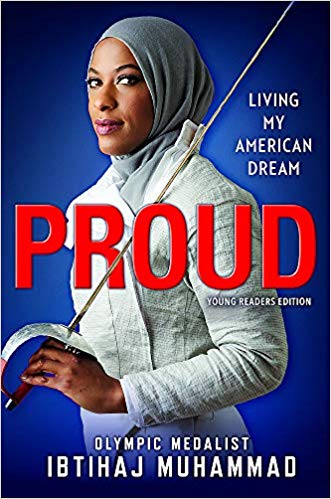
I had high expectations for a memoir about such an inspiring figure, so I treaded timidly into the book waiting to be disappointed, but after finishing the book in two days (high praise considering I have four kids), I realized I was holding my breath for nothing, the book and Ibtihaj are amazing! Now three days after I started, my daughter too has read it and I have ordered a handful of copies to offer as my next Middle School Book Club selection.  Inspirational, real, Islamic, hopeful, empowering, check, check, check, check, and well written too.  A great story and a great role model, alhumdulillah.  The Young Reader’s Edition is an AR 6.7 and 304 pages including Acknowledgements, Glossary of Fencing Terms, Ibtihaj’s Advice, and Q and A with Ibithaj.

SYNOPSIS:

Ibtihaj begins her life story establishing her background of who her parents are, how they met, how they came to Islam and how they are raising their children.  She also details how she is different and realizes it from a young age, whether it is substitutes not being able, or willing, to pronounce her first name, or not being able to sleep over at her friends’ houses.  She also sets the stage for the environment of Newark that she was born into and how it differs racially and economically from Maplewood where she spent most of her childhood.  The story then is pretty linear walking through some of the challenges of being highly driven and motivated and determined to succeed and get in college.  How she is first introduced to fencing and why she gives it a second chance after initially not liking it.   Along the way the reader gets to know how Islam influences her point of view as Allah is very central to her decisions and expectations of herself.  The quick pace is not depressing, while others at times do treat her differently she definitely doesn’t paint herself or seem to see herself as a victim or as privileged, she is just herself and this is her story.  It isn’t all rosy and it isn’t harsh, she is putting one foot in front of the other and there is amazing support from her family, and some of her coaches and some of her teammates, but not everyone and that is a very important part of her story too, which I think provides even more for young readers to relate and learn from.  Anyone not familiar with fencing and how the sport and its rankings work will learn so much reading this book, but thankfully not be overwhelmed with it all either.  The book ends shortly after the Olympics and her historic bronze medal win.  The title may reflect her being proud of what she accomplished and continues to pursue and her pride in being a Black American Muslim Woman, but I think anyone who reads the book will just be proud that someone like her exists, and that maybe some small part of ourselves can be great too.

WHY I LIKE IT:

I love that the book leaves in some of the naysayers and difficult coaches and teammates.  I really think it is easy to assume that people are great and things should all work out when you are competing on an international level, but alas no, completely not the case, yet differences aside, they still had to win an individual sport as a team. 

 I also love that she is truly what she claims, the way she practices Islam is who she is and she loves her family and her faith.  There are no contradictions she excels and perseveres and finds herself while acknowledging all parts of herself and it is so inspiring.  She portrays Islam as a way of life, she prays and fasts and has days when her iman is low and days her faith is rewarding.  She focuses on what she can control and has to learn to accept what Allah swt has decreed for her.  She has Muslim friends, and non Muslim friends and through it all she is finding her place and is surrounded by love and support from her family.  It really is a feel good story and we should all pray that it continues to be.  She doesn’t portray Islam as limiting, nor as her family an exception to what a Muslim home is, and this level of dawah can really change perceptions.  The book is not preachy or arrogant, it is simply her story and Islam is a part of it.

I like that she went to a prestigious university and it didn’t make all her dreams come true, she still had to work hard and find herself and humble herself to work at a dollar store to scrape by, it shows tenacity and a glimpse of the real world that privileged middle schoolers might not have had to consider before.

FLAGS:

The book is clean.  It talks about how uncomfortable she was at her first fencing lesson with her coach having to reposition her stances and thus touch her, and it discusses how she felt listening to music was ok in Islam even though her parents disagreed.  A few sentences at most, collectively, but kids will have thoughts on it.

TOOLS FOR LEADING THE DISCUSSION:

My 12 year old daughter read the book in a few hours and discussed it with me for even longer.  It was as if some tidbit from the book would blossom inside her and she would consider it, and want to discuss it, from why she would not talk to the kids she was substituting about fencing, to why her coach made her switch to saber, I don’t think there is a shortage of things to discuss, or more importantly listen to from the young readers.

There is a ton about her online as she became the first American Muslim to medal and the first to compete in hijab.  I highly recommend this book for book club, and will  hopefully add how our meeting went in a few weeks.


Mansa Musa: The Lion of Mali by Kephra Burns illustrated by Leo & Dianne Dillon

Standard
Mansa Musa: The Lion of Mali by Kephra Burns illustrated by Leo & Dianne Dillon

mansa8

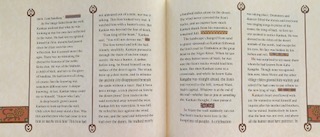
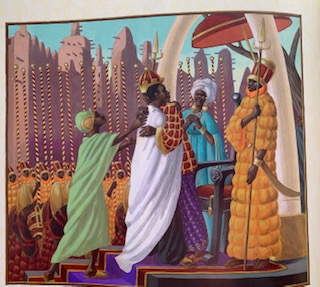
This beautiful work of historical fiction/folklore is both moving and visually breathtaking.  The 56 page book presents as a picture book, but with an AR 6.4 and the amount of text, it reads like a chapter book.  Thus, I’m going to review it as a chapter book, but keep in mind that it is hard bound, 11 x 9, horizontal and while there are frequent small story breaks, there are no chapter breaks.  

IMG_3078

SYNOPSIS:

There is little historical fact about Mansa Musa as a child, thus this story while rooted in fact about the time, about Mansa Musa as an adult, and about what is known regarding Mali and the Malinke and Tuareg tribes, is a work of imagined fiction.  The story begins with premonitions and dreams from Kankan Musa of the Kaba Kangaba tribe.  Kankan and his two brothers live with their mother, and do not know who their father was, a source of stress and teasing for the young boys.  Having just turned 14, Kankan is treated as an adult, but because he has yet proved himself as a hunter, he may sit with the adults, but not yet join their conversations.  Mali in the years after the great King Sundiata had passed away has begun to fade, but their wealth and hospitality still prospers in the desert. 

One day a desert nomad from the Tuareg tribe dressed in flowing blue robes appears and is welcomed by the village elders.  That night he regales stories about jinns, and the sea, and time spent in the desert, and fears he has for their King, when slave raiders tear through the night and kidnap Kankan.  When Kankan awakens days later, enslaved, the same mysterious man, Tariq al-Aya, again appears and buys him from the raiders.  Tariq vows to accompany Musa on his journey to learn who he is and the two spend seven years together learning about the desert, about the larger world, about themselves, in trial and test and challenges.

When Musa journeys back to his home, and Tariq disappears as mysteriously as he appeared, Musa must make himself known to the new Mansa of Mali and see if his wisdom and knowledge can ensure the success of Mali in the future.

IMG_3079

WHY I LIKE IT:

I’m not from Africa and my heart was cheering Musa on as if, my own families success was rooted in his growth and understanding of the world.  As a Muslim, I was proud to know of the success Mali found in Mansa Musa and the historical significance of his rule throughout time.   I wish there was more Islam in the book, his Hajj is well documented and thus tidbits of Mecca and his understanding of it is sprinkled through the story.  There is no talk about prayer or what Islam is, just that he is Muslim and that most of the villagers “had converted to Islam, but at the same time, they had not given up their traditional religious practices or their belief in the ancestors.”  It mentions at the end that he built mosques wherever he went, but prior to this it never mentions him spending any time in a mosque or worshiping in any way. 

I love that the story is told like all great stories, it makes you want to settle in and drink up the details and imagery and got lost in the pictures.  The author weaves in cultural phrases and descriptions, that hopefully readers can unravel from the context as there is not a glossary.  There is a map at the beginning, and author’s note at the end that reveals what is fact and what is fiction in the story.

IMG_3080

FLAGS:

None

IMG_3081

TOOLS FOR LEADING THE DISCUSSION:

This book should be in every school library and used in classrooms to learn about West Africa, cultures, 14th Century, Islamic history, culture, you name it.  I think this book would work wonderfully in home school environments, where the child could dictate how much to supplement, how much to cover, and the wisdom shared could really be understood.  This isn’t a book that most kids would pick up and read, they would need prodding and guidance, but be better for it.  

IMG_3082

The Young Muslim’s Mindful Book of Wellbeing by Zanib Mian

Standard
The Young Muslim’s Mindful Book of Wellbeing by Zanib Mian

wellbeing.jpg

This tiny book (5.5 inches square) is non fiction and I’m reviewing it, because I think it has a lot of value and will appeal to the parents that check out this site for book suggestions for their middle grade children.  The flower on the cover and the topic, might naturally turn away boys, but the depicted character that presents the information is a boy and while it is a token gesture, it is a nice one, to try and make the book and it’s contents appeal to all children.  Irregardless of if you have teens, or tweens, or toddlers, girls or boys, I think parents should read the book and use the concepts and framing presented when talking with their children.  At least that is what I hope to do.  One doesn’t need to wait until their child comes home crying from friend drama, or losing out on something they desperately wanted, to implement the lessons and reassuring bits of mindfulness, it should be the established foundation of how to handle emotions in a healthy way, inshaAllah.

SYNOPSIS:

The book is broken into 14 chapters based on topics covered, and the directions encourage the reader to read them all in order the first time through, then going back to certain sections as needed.  The headings include: How to be happy, A Way Out of Every Problem, How to Feel OK If You Wanted Something, but Didn’t Get It, Friends, Feeling Sad, and Talking to Allah.  The information is presented in a positive reassuring manner that helps the reader to feel like others have felt this way too, and to try some of the suggestions.  It doesn’t belittle or talk down to the feelings one might be having which is great, as the concept of Allah (swt) is incorporated onto every page.  Strengthening ones relationship with Allah as a way to cope with stresses and know that He is always there, is the central theme throughout.

The book offers advice on dealing with negative people, negative thoughts, and finding your own positivity and strength with the help of Allah no matter what.  The book isn’t dry though, it engages the reader and uses examples children can relate to and comparisons that are tangible.  At one point the book talks about shields that reflect back whatever you are giving off.  So when you are shining from the inside, you feel better, and so do others around you.  When talking about seeing the bigger picture, the book urges the reader to consider seeing an entire room through a key hole and likening it to how we see our own lives seeing only what is happening right now.

The book also takes into account that somethings may take work to feel better, and that it isn’t an easy fix to feel good, but inshaAllah worth the effort.  The end summarizes in two points what the previous 36 pages articulate and explore, concluding how to make you shine and be your best self.

WHY I LIKE IT:

I love that we are talking to and with children, not just toddlers, about their feelings.  We aren’t telling them to just cheer up or be happy or get over it.  We are giving them tools that they can carry throughout their lives, inshaAllah.  The pages are text heavy, granted the book is small, but the book is thick and the amount of words on the pages could intimidate some, but like I said earlier, even if the child won’t read it, parents will benefit from it and implementing it in the home.  Also just having the book sitting around will urge kids to pick it up and thumb through it, I would almost guarantee it.

My critiques are the presentation.  I am no expert on the content and what I read seemed logical, and I liked it.  Vague I know, hence I don’t review non fiction often, because what do I know?  As for the physical annoyances of the book, it is too small.  It doesn’t need to be huge, but for the topics covered, it is trivialized by the size, in my opinion. 

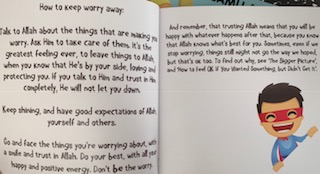
I don’t mind the font, I mind that it changes size so often and for no other reason it seems than to fit everything on the page.  Nearly every chapter is a different size font, but sometimes its even within the same chapter.  A few times for example the page on the left appears to be a size 14 font and the text in the same chapter on the right is like an 11, making it seem inconsistent and jarring..  If the idea needed to be bolded, or shouted or whispered, I support playing with font size, but this is not the case, it is so that the picture and text can all fit without having to turn the page, and its not the best solution I feel, its too distracting. 

IMG_2672.jpg

The other inconsistency that I found a bit odd, are the illustrations.  The little boy on the cover with his yellow flower and yellow shirt take you through maybe 80% of the book, but on occasion other characters pop up, which is fine, when they are drawn in the same manner, like the frog.  But the random appearance of the full color super hero, reminiscent of My Dad’s Beard book, and the full color Migo and Ali looking bears, there’s also a one time appearance of a girl in full color, seems bizarre.  I don’t see the cameos as adding a shoutout to the content and author, but more like the books from the 90s that used free clipart to illustrate the pages that otherwise would be text only. 

FLAGS:

None

TOOLS FOR LEADING THE DISCUSSION:

I think this would be a great book for a school counselor to use as a guideline for group discussions.  I think it could be done from the library, but a counselor and students would really benefit from the book and the manner in which the material speaks and empowers youth to shine.

Anything But Okay by Sarah Darer Littman

Standard
Anything But Okay by Sarah Darer Littman

anything but ok.jpg

This 345 page contemporary book is brand new from Scholastic and isn’t yet in the AR database, it is billed as appropriate for ages 12 and up and is probably pretty accurate.  The cover, in my opinion, is rather a disservice for the audience.  The book would appeal to girls and boys, and isn’t really about school drama, which is the vibe I got from the cover.  The story is actually pretty deep and thought provoking, on a wide range of issues facing many young adults today.

SYNOPSIS:

Told from Stella Walker’s perspective, the book opens with her and her friends, Ken and Farida, reviewing old movies.  Farida, an Iraqi immigrant, is constantly pointing out the stereotypes, tropes, and bias they engage in regularly and see depicted around them.  She is constantly nagging her friends to recognize their privilege and check it.  Stella tries to get it, but it’s not that easy. Nor are the obstacles that the book explores. 

Stella’s parents are vets, and her brother, Rob, has just returned from his second tour in Afghanistan and is suffering from PTSD.  Additionally, Rob’s best friend commits suicide and yet, Stella’s family doesn’t involve her in the conversations and concerns, and as a result she doesn’t talk to her best friend Farida.  This tension is amplified when Farida wants to run for class president, but her parents advise her against it, as Islamaphobia is on the rise with the mayor, up for re-election, spouting hate speech, and his son, already in the race to lead the school. 

Stella, as a result, is convinced to run with the help and support of her friends.  All should be going well, but in a desperate attempt to get Rob out of the house, a trip to the mall to watch a movie results in Rob sticking up for a Sikh kid being bullied, and breaking the instigators nose.  The police are called in, and the real drama of the book takes center stage, as social media, a bigoted mayor, and a family’s member friendship with a Muslim paint Rob as a radicalized terrorist.  The Walker’s house is vandalized and Farida’s family’s restaurant is suffering and the mayoral election and class office election will all require some tough decisions and insights into honesty, framing, perseverance and friendship.

WHY I LIKE IT:

I don’t think I was expecting the book to explore so many topics and to do it, in a rather real and raw way.  The arc of concepts covered provides a lot of juice and relevance and the quick pace, makes it a quick read.  Some pages are letters written by Rob, a number of pages are the various police reports taken after the mall assault and the various points of view are great.  It explores how media editing and framing can change a narrative to one side or another. 

I love Farida, bless her, she is annoying and one-dimensional, but yet so relatable.  She is the token minority that ties it all together and is the billboard representation of “other.”  I can so relate to her, being the minority and the one that constantly had to be the gadfly on the masses.  

The school election is a little cheesy and overly elevated in importance, but it is the catalyst, so while I wasn’t really invested in who won, I liked the concepts it brought to the forefront of the characters lives.  The family struggles and retaking the truth and owning it, was the real strength of the book, and introducing kids to the horrors of war, returning from war, mental illness, the blind eye of politicians, the struggles of the VA, the power of the media, friendship, and concepts of patriotism, privilege, pride, suicide, and moving forward.

My biggest complaint is the awkward and forced romance.  It isn’t even romance really.  After the mall incident, Stella confides in a classmate, Adam,  who comes over to see if she is okay and they hold hands and kiss.  It is so out of left field and so awkward I would imagine for most readers, not just me the conservative muslim mama looking for books for my kids and their school book club.  In all they kiss five times I think, and mentions them holding hands twice.  It isn’t lamented or dwelled on, it just kind of boom, jumps in to the story and then yes, they kind of snuggle after the election results, which is a little more fitting (but still irritating).  Rob meets a girl, and again later on when she comes to celebrate the plea deal its nice that she is there, but they talk like once and he completely falls for her, kind of intense and random.  The discussions about letting someone in to your life and all is good, and more natural and they don’t kiss, but they do have “feelings” for each other.  

There isn’t much about Islam other than that Farida is Muslim and that her mom wears hijab.  Even the Islamaphobia is mentioned more for political and prejudicial purposes than as a segway in to understanding Islam.

FLAGS:

Kissing (see above), suicide, war, violence.  Beer is mentioned at the end when a college veteran gets one out of the fridge.  

TOOLS FOR LEADING THE DISCUSSION:

I really want to do this as a Middle School Book Club choice, yes I’m hosting those again.  I need to talk to the school counselor about the kissing stuff.  I think they can handle it, but I don’t know the kids well enough just yet, to verify this.   Being it isn’t the Muslim characters, I can’t imagine it is any different from what they see on TV or in Disney Movies, but still, I can’t confidently say it will happen.  Twelve and up is the non Muslim age point, I’ll have to think it over and update this once I investigate. 

Author’s website: https://sarahdarerlittman.com/books_2/young-adult/anything-but-okay-coming.html

Reading Guide: https://sarahdarerlittman.com/books_2/young-adult/abo-teaching-reading-guide.pdf


Escape from Syria by Samya Kullab, Jackie Roche, and Mike Freiheit

Standard
Escape from Syria by Samya Kullab, Jackie Roche, and Mike Freiheit

9781770859821.jpg

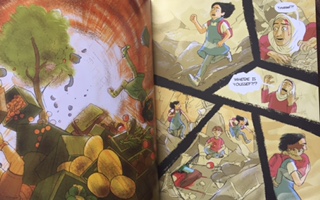
I have read a fair amount of fictionalized accounts of the war in Syria, the journey of refugees, and their resettling in various countries, but this was the first graphic novel on the subject that I have seen, and I was excited to wait my turn behind my kids to read it.  My 7th and 4th graders read it in about 20 minutes and said they really liked it, knowing that it was a quick read, I wanted to take it in slowly and examine each picture to grasp the full message that the author, a Lebanese journalist, was conveying.  Definitely meant, for ages 5th grade and up because of the content, I appreciated the book more than I loved it.  It seemed rather choppy and the fictionalized parts come across just as a front to convey facts.  The book definitely is a great introduction to the conflict, and the format will appeal to a broad range of individuals.  

SYNOPSIS:

Told from the voice of Amina, a bright young girl who rushes home to show off her latest A grade paper to her family, is met instead by a bomb striking the beautiful peaceful neighborhood.  The images on the first page are destroyed as her younger brother Youssef must be located in the rubble and debris.  Now in Canada, Amina tells the story of their journey from Aleppo.  The bouncing around of time, provides some context to how life became under the rule of Bashar al-Assad, how checkpoints and emergency rule changed everything about Amina’s life.  As war creeps in it isn’t just inconveniences and fear, but also death, as further shown through Amina’s uncle who has joined the rebel army.  The family decides they need to flee to Lebanon and truly believe it will be just for a little while. 

IMG_2082

They rent an apartment for a year, but when they cannot afford rent they relocate to a refugee camp, where they stay for two years.  Amina’s father is determined that Amina stays in school but as work remains scarce and Youssef’s health continues to deteriorate.  Amina is forced to take a break from school to try and find work.  Eventually her father arranges to go by raft to Europe to try and start a new life and bring his family there once he is settled.  The terms of the loan to pay the smugglers is steep and when the raft doesn’t make it too far before tossing its passengers, Amina’s father Walid is forced to return to Lebanon unsuccessful. 

It isn’t until Amina’s family considers, like many other families in the camp, to get her married to keep her safe.  That Amina upon picking up some aid at a UN reception center, spills everything to a worker there, and a week later the UNHCR contacts the family to help move them to Canada.  The readers at this point I would assume are relieved the family will be safe, and are surprised when the family isn’t sure if they want to leave.  Syria is there home, and before the mom will agree to anything, she wants to go back to Syria to see her newborn niece.  Once in Syria, she sees that her home is no more as she remembered it, and agrees to be resettled anywhere.  Through the same flashbacks and flash-forwards in time, we also see that life in Canada is not easy.  The family is welcomed and helped and grateful, but it isn’t yet home, and the ghosts of Syria are still present.

WHY I LIKE IT:

I kind of like how choppy it is upon further reflection.  At first it annoyed me, but as I thought about it more and more, I have decided I like that it isn’t easy and smooth and fleshed out, the tone of the unknown comes through by not over narrating the emotions and circumstances.  I also like that everything that happens to Amina and her family is anchored in reality and the footnotes, references, and facts are all in the Endnotes.  Having said that, I wish their was a little more character development, it reads like a bunch of facts strung together and connected by this fictional family.  There isn’t anything wrong with it, but a little more warmth for the characters would have added a beautiful level and would not have been hard to come by at all.  There are so many stories from this conflict out there, and the reason they resonate with so many isn’t from all the facts and numbers, but often from the individuals that make the numbers real and haunting.  I felt like this book fell short on the human element unfortunately.  The only character I really felt had some heart, was the dad, he was awesome, and his love for his family and determination for his daughter’s education was definitely felt.

The book does drop some acronyms and political alliances to add context but not overwhelm the reader.  It definitely hints that there are a lot of groups vying for power, and control: Assad, Russia, ISIS, US, rebels.

IMG_2084

I love that the flashbacks to pre-war Syria are so relatable.  Kids need to really understand that we are all so much more alike than different.  Not just in our hopes and dreams, but even in our daily lives.  The characters in the book are the same as us, their lives look great,  maybe even better.  They have friends, and families and jobs, and cell phones, they also unfortunately, have war.

There were a few surprises for me, for example that buses between Lebanon and ISIS held Syria took/take people back and forth.  Similarly,  I was surprised to see that the punishment of smuggling cigarettes was being beheaded, but maybe more surprised that the book included it.

IMG_2083

It is reassuring for readers to know that the family survives, but the harrowing journey of seeing body bags, cutting costs to survive, risking it all to trust smugglers with fake life jackets, paint pictures of a journey that will stay with the reader.  The book doesn’t talk down to anyone, if something seems too simplistic, it almost encourages the reader to go research more about it.  

There isn’t any mention of Islam or religion, the females wear hijab, that is the only indication along with their names that they are a Muslim family.

FLAGS:

The violence, is pretty haunting and while the images and text aren’t graphic, the splatter of blood and guns and death are very present.  There is also mention of cigarettes.  While not explicit and possibly over the heads of some readers, the book does show that the loan sharks would be willing to take Amina, “Something nice and sweet…like you,” to help pay off the family’s debts.  A former classmate of Amina also invites the family to her wedding.  At 13 Amina’s family is also considering getting her married as a way to help keep her safe.  

IMG_2085

TOOLS FOR LEADING THE DISCUSSION:

This book would be better in Social Studies class more than in a Language Arts one. It would be a great supplement to share even, when discussing current events.  Its a quick read, a factual account and a powerful one at that.  

Book Trailer: https://www.youtube.com/watch?v=AsZZwxM7YyQ

Publisher’s Synopsis: https://www.fireflybooks.com/index.php/catalogue/product/11566-escape-from-syria

The Day of the Pelican by Katherine Paterson

Standard
The Day of the Pelican by Katherine Paterson

pelican.jpg

There is a lot to be grateful for in this 145 page AR 5.2 book before you even begin reading it.  The fact that Katherine Paterson, of Bridge to Teribithia fame, would write a middle school book about the horrors that took place in Kosovo in the late 90s and conclude with the events of 9/11 is both bold, and daring.  There isn’t a lot of mainstream YA literature about the events that happened in the Western Balkans and this book is much needed in shedding light on a history that cannot and should not be forgotten.  While the book doesn’t compel the reader to pick it up, I think as a novel study in school, or as suggested reading, kids 4-8th grade will benefit from the story and retain the humanity presented in the characters.

SYNOPSIS:

The story follows 13-year-old Meli Lleshi, an ethnic Albanian, and how her world changes as Serbian atrocities escalate. The story opens showing how while there is tension in the air, a lot of the Lleshi family’s life is relatable to today’s western readers.  The children go to school, they have a big family and help out at home.  The dad owns a grocery store under the house and the neighborhood is made up of Albanians and Serbs, Muslims and Christians.  Quickly, however, bad news of the Serbs kidnapping people and destroying homes becomes reality as Meli’s 14-year-old brother Mehmet, goes missing.  The police refuse to help and with no other recourse the family is left to wait and see if he returns.   Luckily he does, but as fears continue to grow the family leaves home to go live at the familial farm in the country.  This stop is temporary and the first of many as the family moves from one refugee camp to another.  Fighting to stay together and look forward, as that their homes, livelihood, and material goods have all been destroyed, the Lleshi’s end up in America, only to be faced with the discrimination following 9/11.

WHY I LIKE IT:

I had the priviledge of helping with a lot of Bosnian and later Albanian refugee families that came through Salt Lake City, Utah in 1998-2001.  Not in any official capacity but as outreach to help get them settled, enrolled in school, a friendly face to call on for help, and eventually a friend.  Later, I even interviewed many of them in a series I did for my journalism classes at the University of Utah.  This story rings incredibly true to what I recall hearing them speak about.  What they saw, what they had to sacrifice, what they hoped to achieve in America.  So I was almost giddy to learn about this book knowing that it wouldn’t be a “fun” read, but an important one bringing a fictionalized account of a historical horror to children that probably have never even heard about it.  I only wish so desperately that the book had a map in it.  There is a great historical note, but a map would have made it so much more impactful. 

I like that the family is Muslim, they do not practice, but they identify as Muslim and are thus tortured both in Kosovo and harassed in America.  They are served a ham at one point in America, and they eat it, noting that culturally they don’t eat it, but don’t really see the big deal in doing it.  I remember the first time my family went to meet a Bosnian family and there were no men in the house, all had been killed at the children’s elementary school at dismissal for being Muslim, and they served us beer.  The ham incident reminded me of that, that these are so often the religious rules we tell others and children about what it means to be Muslim, but in the grand scheme how important are they compared to belief in the oneness of God?  I don’t want to turn this literary blog into my theological thoughts, but its hard over the years to forget that these people died for being Muslim, but yet really didn’t know a lot about Islam.  In my safe sheltered world, I know a lot of people that know a lot about Islam, but would we be willing to die for being Muslim?  The Lleshi family don’t pray or go to the mosque, but they do sprinkle their talk with Arabic words like inshaAllah (God willing), and their names are Islamic in nature: Mehmet, Adil, Isuf, etc., they are forced to relocate because of both their nationality and their religion, where the line is between one identity and the other isn’t clear in the book, nor is it in real life.  

FLAGS:

There is a bit of articulated violence, but the book is clean for 4th grade and up.  

TOOLS FOR LEADING THE DISCUSSION:

I would absolutely do this for a Book Club selection, and if I was a upper elementary or middle school teacher for a novel study.  The book balances character narrative and historical context to the point that the book is not boring, sensationalized or easily dismissed.  I think kids will need the school environment and structure to compel them to pick up the book and finish it, but will not fight the actual reading of it.

A guide for book discussion: https://media.btsb.com/TitleLessonPlans/454.pdfTeacher’s Lesson Plan: http://mrscarafiello.weebly.com/day-of-the-pelican.html


It Ain’t So Awful, Falafel by Firoozeh Dumas

Standard
It Ain’t So Awful, Falafel by Firoozeh Dumas

it aint so awful

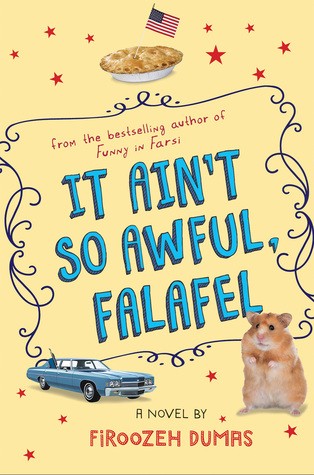
Islamaphobia is rampant in today’s America, but it isn’t the first time that a minority group has had to face extreme persecution.  Often us Muslims need to look around and be reminded: Blacks are still targeted, Japanese once were interned, Italians, Irish, Hispanics, really every minority group has, and continues to struggle to be accepted as part of American culture, unfortunately.  Today’s middle school students didn’t live through 9//11 and often they think they are the first to be ostracized for their faith or their parent’s countries of origin.  So I picked up this book to see how well the book would serve as a way to discuss prejudice and persecution with Muslim kids, in a way that they could relate to, but be removed enough from that hopefully they could offer their own insights and experiences.   This book takes place in the 1970s and the climax is the Iran hostage situation as the book is told from an 11-year-old Iranian girl’s perspective. 

Similarly, most Persian penned books that I’ve read fight against Islam and the way it was forced upon them by their government, so I also wanted to see how the author would paint the faith in her semi auto-biographical-middle-school tale.  Alhumdulillah, I was happily surprised how Islam was handled in this 378 page, AR 4.7, book, and I think, like the inscription reads, “To all the kids who don’t belong, for whatever reason.  This one’s for you.”

SYNOPSIS:

Zomorod has lived in America before.  She was born in Iran, moved to California, moved back to Iran, back to California, and now from Compton, California she is moving to the much wealthier Newport Beach and hoping to start middle school fitting in more with her new Brady Bunch inspired name, Cindy.  Establishing early that she is the translator for her mother, who doesn’t speak English and doesn’t want to learn, and that she is somewhat embarrassed by her parent’s thick accents, lack of American snacks, Iranian food, and conversation topics, the book will appeal to most middle schooler’s who can relate.  Her parents, however, are pretty chill about letting her go out with friends, and doing whatever she wants, so really its more about the age and being angsty and awkward, then it is about her parents and their lifestyle and culture.  The basic point of the book is a growing-up tale of making friends, finding real ones that care about you, finding the balance between family and the outside world, cultures that conflict, the past and the future, and ultimately finding acceptance and pride in who, and what you are.

The political climate in Iran and in America amplify what it is like when people hate your country, but can’t find it on the map, and manifest in the story with bullying at school, Zomorod’s father losing his job and not finding a new one, and some hateful acts occurring at the Yousefzadeh’s home. 

WHY I LIKE IT:

The book could be heavy and dark, but it’s not.  The voice of Zomorod really stays in the persona of an 11-year-old girl and is poignant, clever and light-hearted, I even laughed out loud a few times.   The 1970’s backdrop isn’t too alienating for today’s readers, as there aren’t a lot of cultural references that would turn them off.  The historical significance, is very likely one they will not have heard of before and the book, through Zomorod’s eyes, will shed light on Iran in the late 70s and early 80s without boring the target audience.  They might even learn something and remember it.  

The stereotypes about Iran are addressed, the concept of a single person having to represent every one of that minority group is felt first had through the main character, and many misconceptions about Iran are clarified.  Yet, the book doesn’t get preachy, it maintains its lightness, and while I read it in a few days, it was just as easy to put down as it was to pick up.  The characters felt real and developed for the most part, so even though it was a tale about life, it was compelling enough to stick around, and you are invested enough to care how the characters are doing. There are a lot of really great supporting characters in the book as well: neighbors, friends, teachers, friend’s families, and a few not so nice characters that surprisingly aren’t painted with a singular condemning evil stroke.  The author is very careful to reserve judgement of all her characters and the sub groups they represent.

Which brings me to how Islam is handled in this book.  Her family doesn’t practice, but her reference for Islam is shia, as evident by her mentioning 12 imams.  I took pictures of most of the pages where Islam is mentioned, less than 10 in all, but where it is mentioned it is handled very politically correct and powerfully.   She talks about how they don’t celebrate Christmas or most holidays as they aren’t Christian or really American, but when the pool key is lost she does pray to a Christian Saint after a suggestion that such an act will help it be found.  It isn’t really presented as a religious act, more of one done in desperation. Here are the most applicable and relevant passages regarding Islam.

  • Dr. Klein shakes his head in sympathy.  “Do your wife and Cindy have to wear those cover-ups if you go back?”  “Yes, and I cannot believe this.  When we lived in Iran, my wife, my sisters, all the women I knew wore western clothes.  No tennis clothes like you see here, but regular clothes.  Only religious women chose to wear hijab, it meant something.  Imagine if everybody in America had to wear a cross around their neck or a Star of David-what would those symbols mean? Nothing. If you have to wear it, it means nothing.  If you choose to wear it, it means something” (168).
  • “The Ayatollah is Muslim, right? So is, like Allah, his God?”  “Allah is the Arabic word for God,” I say.  “It’s the same God. (154).”
  • We don’t have Saints in Islam, just a Prophet with twelve imams, and they don’t preach to animals or help find lost items,  My family, like most Iranians, is Muslim, but we never do anything religious.  I’ve never even been in a mosque, which is like a church (40).
  • “Being Muslim means different things to different people,” I say.  “My family doesn’t do anything officially religious.  My dad says religion is kindness and that’s what everyone should practice” ((184-5).
  • “…even though we belong to three different religions. We are alike in so many more ways than we are different.” 

FLAGS:

The book is fine for middle school readers, there is mention of Cindy’s dad trying alcohol at one point in the past and not liking it.  Cindy’s friends tease her once or maybe twice about liking a boy and Halloween is celebrated.  There is a lot of lying in the book, but it is made clear why, even if she doesn’t always feel bad about it: she is embarrassed by her mom’s food and lies that she shared it, she withholds information a lot, she pranks the neighbor lady who left a dead rodent on their porch, etc.  Hopefully the demographic won’t be inspired by Zomorod’s antics and just find them as her way of dealing with life.

TOOLS FOR LEADING THE DISCUSSION:

This would be a fun book club book to discuss being new to a country, minorities, how to handle conflicting cultures, and how to be and have good friends.

Educators guide: http://firoozehdumas.com/wp-content/uploads/2016/03/ItAintSoAwfulFalafelguide.pdf

https://www.floridamediaed.org/uploads/6/1/4/2/61420659/ms_-_it_ain%E2%80%99t_so_awful_falafel.pdf

https://www.bookmovement.com/bookDetailView/49051/It-Ain’t-So-Awful,-Falafel-By-Firoozeh-Dumas

Author’s page: http://firoozehdumas.com/books/it-aint-so-awful-falafel/