Tag Archives: Refugee

From Far Away by Robert Munsch and Saossan Askar illustrated by Rebecca Green

Standard
From Far Away by Robert Munsch and Saossan Askar illustrated by Rebecca Green

from far away

Robert Munsch is a staple in most classrooms and libraries, but somehow, much to my embarrassment, I just learned about this book.  Originally published in 1995 with a different illustrator, I read the newer version that was rereleased in 2017.  I’m not sure how they differ, but they stem from an autobiographical experience of the co-author Saossan Askar, and her leaving of the war in Lebanon.  She wrote to the author and their letters back and forth are how the book came to fruition. 

IMG_4986

The 24 page picture book is an AR 3.5 and my guess it is because of the content a bit more than the reading level.  While it never gets graphic or sensationalized, she does leave a war zone of bombs and shootings, and the words may trigger fear in younger children.

IMG_4987

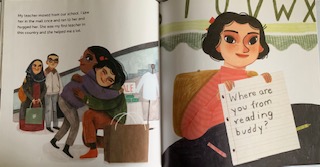
As the book progresses, the focus is much more on Saoussan settling in to her new life and the hiccups along the way.  From not knowing what anyone is saying, to sneaking out of class to go to the bathroom, and being frightened by a paper skeleton.  The book gives concrete examples that while silly, really show how someone unfamiliar with a new culture could be very confused and even scared.  

IMG_4989

The book has a happy ending with Saoussan adjusting and making friends and even becoming the best reader and speller in her class.  She also gets in trouble often for talking too much.  

IMG_4990

The book, like many in the genre of discussing war and refugees on a child’s level has its strengths and weaknesses.  The heart of the story I would say is wonderful, the illustrations lively and engaging, some of the transitions and details, however, are a bit abrupt and unsatisfying.  Once you know that it is based on reality and came about through letters, it makes more sense, but even that is a concept older readers will appreciate more than younger ones will.
IMG_4991

I checked the book out from the public library and I think does a great job of inspiring empathy.  It is vague as to what conflict is being left which makes it timeless in that I, unfortunately don’t see refugees disappearing soon.  The mom wears hijab, but there is no mention of religion in the book.

Here are the letters from his website: https://robertmunsch.com/book/from-far-away

From Far Away started with this letter:

To Robert Munsch
I am a little girl. My name is Saoussan. I am seven years old. I am in grade two now. I came to Canada one and half year ago. I didn’t know how to speak English at all. I was just sitting and listening. A lot of funny things happened to me.

Children were trying to talk to me, but I was not able to answer them. I began to talk a little by little.

I finished grade one and now I am in grade two. The teacher now is complaining to my dad that I am talking a lot in the class and I read and write a lot of stories.

One day I found a book called Thomas’s Snowsuit. I read it and I laughed with my family.

I went to the library and I brought some of your books. I enjoyed reading them. I even read them to my dad that he laughed so hard he could not stop laughing.

Please come to our school we want to hear a story from you and we want to see you.
I wrote back and asked her what “funny things” had happened. Saoussan wrote back telling me about her first Halloween in Canada:
To: Robert Munsch
Thank you for your letter. My teacher read it to the class and he said: I am not going to tell the class the funny thing that happened to her when she was in kindergarten and I am not going to embarrass you.

I don’t remember all of the funny things. But I remember one thing.

When I wanted to go to the washroom I didn’t know how to say I want to go to the washroom. That’s why I used to crawl to the door and when the teacher turns her head and looks at the other side I crawl under my friend’s desk and when someone opens the door I crawl out and go to the washroom.

When I come back from the washroom I wait beside the door and when someone opens the door I crawl in and go to my desk.

Once I crawled to the washroom. When I opened the washroom door I saw a skeleton. Then I screamed: Aaaaahhhhhhhhh!

Everybody came out. My teacher, Mrs. Garwan came, opened the washroom door and she tried to tell me that it is Halloween time and the skeleton is paper.

I didn’t understand her and I didn’t know what Halloween is.

She jumped up and down and danced around to explain to me that Halloween is just fun, but I thought the skeleton made her crazy and I screamed louder.

Then she hugged me to make me feel better and I jumped on her lap and the pee went down my knees. She put me down because she got wet.

Now I am in grade 2/3 and I am the best reader and speller in the class. This year when it was Halloween I weared a mask and a costume and we did a party at school. Then I went with my sister trick or treating to the neighbours.

Please, please, please, please, please, please, please, please come to our school.

I liked her letters so much that I decided to turn them into a book.

So Saoussan and I wrote a lot of letters back and forth and we made the letter into a book. Saoussan and I are both the authors and we split the royalties.

Other Words for Home by Jasmine Warga

Standard
Other Words for Home by Jasmine Warga

other words for home.jpg

Three hundred and forty pages written in verse that beautifully consume you and leave you emotionally changed and vulnerable and humbled all at once.  The book claims it is for middle grades, but I think middle school will appreciate it more, and I sincerely hope everyone of all ages will take a couple of hours to fall under the spell that is woven to tell a story of a refugee leaving home and starting anew in America.

SYNOPSIS:

Jude is a 12 year old girl living on the beach in Syria, watching American movies with her friends and hanging out at her dad’s store.  With an older brother and a little sister on the way, life as told from her own perspective is pretty good.  Until it is not.  Until the crimes they only hear about happening in Aleppo and Damascus start to hit closer to home.  Until her brother starts sneaking out to meetings with other youth hoping to change the politics of their country.  Until a raid almost catches Jude and her brother and her parent’s decide it is time for Jude and her mother to journey to America, for a little while, to visit her mom’s brother and deliver the baby.

America is not like it is in the 90’s movies that Jude loves: Pretty Woman, Legally Blond, Miss Congeniality.  Her American aunt and her Uncle that seems to have forgotten his Syrian upbringing, are gracious and welcoming and their daughter, Sarah, who is less than a year older than Jude waxes and wanes in her approach to her cousin.  Adjusting to school, life without baba and her brother, and all the other adaptations that moving to a new country entail are brought to life through Jude’s eyes and understanding of the world around her.  As she comes of age and decides to wear hijab, as Islamaphobia shakes her sense of justice, and her little sister is born, the reader sees her grow and change and mature and find themselves hoping that she will soar.

WHY I LIKE IT:

I love that the style of the story telling somehow gives life to so much.  With verse some things are highlighted in detail and other things skimmed over and yet at the end, not only do you feel like you understand Jude, but a lot of the side characters as well, which caught me off guard.  Truly the writing is strong and deliberate.  A lot of the politics and war crimes occurring in Syria are not detailed, and I have to assume that is because the point of view is a 12 year old girl that is blissfully in her own world.  I imagine this is also why the target audience is listed as 8-12 year olds, because it simplifies a truly horrific situation.  Also because despite moments of raw vulnerability, the book stays pretty optimistic and hopeful.  

I like that the characters are Muslim, and that the mom scolds her brother for not going to the mosque.  The book does talk about Jude’s period starting and thus Jude starting to wear hijab, which is one of the reasons I feel like early middle school might be a bit more appropriate age group.  There isn’t too much talk about faith and Islamic beliefs, but a few tidbits are sprinkled in, prayer, not eating pork, modesty.  The book is not gender exclusive, but I think girls will gravitate much more to Jude’s perspective, experiences and voice.

The only thing I found a bit off is that the book takes place in modern time, present day, yet none of them have cell phones or social media.  Jude Skypes her dad, yet writes letters to her friend back in Syria and is distraught when they don’t have a forwarding address to send them to after her friend also leaves home.  It seems that social media, email, a cell phone number, something would be available for them to all keep in touch.

FLAGS:

There is mention of Jude and her friends having to sneak in to see Pretty Woman because Julia Roberts is a prostitute, and mention of blood between one’s legs and periods starting.  The book otherwise is pretty clean.  It hints at her kind of crushing on a boy that is in the play with her, but nothing more than friendship is explored.  Violence mentioned is minimal and language is clean even when dealing with hate crimes in America.

TOOLS FOR LEADING THE DISCUSSION:

There is a good chance that next year the students joining the middle school book club will be all girls, so if that is the case and the school counselor feels all the girls can handle the puberty aspects mentioned I would totally do this book.  The book reads very quick and might be a good way to get new kid to give a book club a try as well.

Author’s website: http://jasminewarga.com/about

Q & A with the Author: https://www.publishersweekly.com/pw/by-topic/childrens/childrens-authors/article/80127-q-a-with-jasmine-warga.html

Interview with the Author: https://www.hbook.com/2019/04/authors-illustrators/publishers-previews/spring-2019-publishers-preview-five-questions-for-jasmine-warga/


The Boy at the Back of the Class by Onjali Q. Rauf illustrated by Pipa Curnick

Standard
The Boy at the Back of the Class by Onjali Q. Rauf illustrated by Pipa Curnick

boy at the back.jpg

A perfect introduction to the refugee crisis for upper elementary aged kids.  The story is told from the perspective of an unnamed 9 and 3/4 year old narrator about her friends and how the filling of an empty chair in the back of the room changed their lives.  Ages 7 through 12 will enjoy the plotting and planning of the friends, the awesome climax and the gentle opening of their eyes to the atrocities and bigotry around them.  At 297 pages, with a few pictures and some engaging notes and tidbits at the end, the book is both big, yet completely non intimidating at the same time.  
SYNOPSIS:

Right near the end we learn that the narrator’s name is Alexa, and not too much before that, I learned that she is a girl.  I kind of like that vagueness of it, especially as we also learn that she is half Indonesian and half Austrian.  You realize that it doesn’t matter, that it doesn’t change anything, and that we all bring our own assumptions to the story and learn a bit about our selves as the narrator’s identity is revealed.  But really, thats a tiny bit of the book, the book is really about a group of diverse friends battling bullies, bully teachers, and trying to help the new kid in their class Ahmet.

Ahmet is a refugee from Syria, but the information isn’t easy to establish, he doesn’t talk to anyone, he disappears at lunch and recess, so Alexa, Josie, Tom, and Michael, first have to figure out who he is, and how they can be his friends.  Along the way we learn the Tom is from America, the book takes place in England.  Josie is the best football player and her parents are nervous to have her interacting with Ahmet, Michael is incredibly wealthy and his parents are Nigerian and French, and Alexa lives with her mom a librarian who works really long hours, her dad passed away and money is incredibly tight.
Once friendships are established, Alexa learns that Ahmet’s mom and dad are missing and that his sister and cat died while fleeing Syria.  When she learns that the government is planning to close the borders to immigrants and refugees, the group of kids come up with plans to keep the gates open until Ahmet’s parents can be found and they can come to the United Kingdom.  The kids come up with a variety of plans, but “The Greatest Idea in the World,” is the one they decide to go with.  It involves a lot of danger, but the general gist is to get a message to the Queen of England, who will keep the gates open, find Ahmet’s parents and reunite the family.  

Naturally, there are a lot of moving parts to the plan, and a lot of naivety on the part of the 9 year olds, but they do get the Queen’s attention, and they do have a wonderful support system of parents and teachers and while their are bullies around every corner, they do come together to make the world a bit better for Ahmet and for us all.

WHY I LIKE IT:

I love that it is realistic, with the plotting, and understanding of war, alike.  The war and Ahmet’s journey is very very simplified, but the tone, introduces kids to the intensity without overwhelming them.  Just like the plot to get the Queen’s attention is not celebrated, but appreciated.  What the kids did was wrong and dangerous and they lied, and the kids don’t ever know after if they are in trouble or being praised.  I like that the integrity of both situations is upheld and the book doesn’t get too far fetched.  Similarly, the book is fun and adventurous, and in many ways Ahmet is just a catalyst for the kids to come together to solve a problem and save the day. 

There aren’t a lot of details about his life in Syria, because he doesn’t speak English, there isn’t anything about Islam, except he draws his mom with a scarf on her head.  But there is a lot of learning to accept each other, and stick up for whats right and to not give up on people.  I love the diversity of the friends and how they don’t expect each other to change, they accept each other and move along.  

There is a slight typo on page 3, “…could be half as useful as a Tintin’s dog, Snowy,” that had me afraid that this book was going to be unrefined, but alhumdulillah I was wrong.  The book reads easily and wonderfully, and my children loved it as much as I did.  The author is a first time writer, and I hope she has a bunch more stories in her, because I look forward to reading them.  

FLAGS:

The book is clean and reads believably from a 9 year old’s perspective.

TOOLS FOR LEADING THE DISCUSSION:

I would do this in an elementary book club in a heartbeat. I’ve suggested it to many and I hope to read it aloud to my 4th and 5th grade lunch bunch crew. It is well written, timely, and memorable.

Teacher’s Notes: https://www.hachetteschools.co.uk/wp-content/uploads/2018/07/The-Boy-at-the-Back-of-the-Class-Teachers-Notes.pdf

A bit about the author: http://beingthestory.org.uk/speakers/onjali-q-rauf


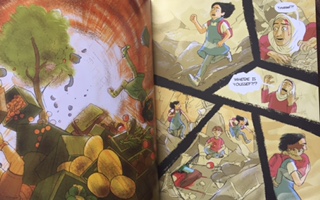
Escape from Syria by Samya Kullab, Jackie Roche, and Mike Freiheit

Standard
Escape from Syria by Samya Kullab, Jackie Roche, and Mike Freiheit

9781770859821.jpg

I have read a fair amount of fictionalized accounts of the war in Syria, the journey of refugees, and their resettling in various countries, but this was the first graphic novel on the subject that I have seen, and I was excited to wait my turn behind my kids to read it.  My 7th and 4th graders read it in about 20 minutes and said they really liked it, knowing that it was a quick read, I wanted to take it in slowly and examine each picture to grasp the full message that the author, a Lebanese journalist, was conveying.  Definitely meant, for ages 5th grade and up because of the content, I appreciated the book more than I loved it.  It seemed rather choppy and the fictionalized parts come across just as a front to convey facts.  The book definitely is a great introduction to the conflict, and the format will appeal to a broad range of individuals.  

SYNOPSIS:

Told from the voice of Amina, a bright young girl who rushes home to show off her latest A grade paper to her family, is met instead by a bomb striking the beautiful peaceful neighborhood.  The images on the first page are destroyed as her younger brother Youssef must be located in the rubble and debris.  Now in Canada, Amina tells the story of their journey from Aleppo.  The bouncing around of time, provides some context to how life became under the rule of Bashar al-Assad, how checkpoints and emergency rule changed everything about Amina’s life.  As war creeps in it isn’t just inconveniences and fear, but also death, as further shown through Amina’s uncle who has joined the rebel army.  The family decides they need to flee to Lebanon and truly believe it will be just for a little while. 

IMG_2082

They rent an apartment for a year, but when they cannot afford rent they relocate to a refugee camp, where they stay for two years.  Amina’s father is determined that Amina stays in school but as work remains scarce and Youssef’s health continues to deteriorate.  Amina is forced to take a break from school to try and find work.  Eventually her father arranges to go by raft to Europe to try and start a new life and bring his family there once he is settled.  The terms of the loan to pay the smugglers is steep and when the raft doesn’t make it too far before tossing its passengers, Amina’s father Walid is forced to return to Lebanon unsuccessful. 

It isn’t until Amina’s family considers, like many other families in the camp, to get her married to keep her safe.  That Amina upon picking up some aid at a UN reception center, spills everything to a worker there, and a week later the UNHCR contacts the family to help move them to Canada.  The readers at this point I would assume are relieved the family will be safe, and are surprised when the family isn’t sure if they want to leave.  Syria is there home, and before the mom will agree to anything, she wants to go back to Syria to see her newborn niece.  Once in Syria, she sees that her home is no more as she remembered it, and agrees to be resettled anywhere.  Through the same flashbacks and flash-forwards in time, we also see that life in Canada is not easy.  The family is welcomed and helped and grateful, but it isn’t yet home, and the ghosts of Syria are still present.

WHY I LIKE IT:

I kind of like how choppy it is upon further reflection.  At first it annoyed me, but as I thought about it more and more, I have decided I like that it isn’t easy and smooth and fleshed out, the tone of the unknown comes through by not over narrating the emotions and circumstances.  I also like that everything that happens to Amina and her family is anchored in reality and the footnotes, references, and facts are all in the Endnotes.  Having said that, I wish their was a little more character development, it reads like a bunch of facts strung together and connected by this fictional family.  There isn’t anything wrong with it, but a little more warmth for the characters would have added a beautiful level and would not have been hard to come by at all.  There are so many stories from this conflict out there, and the reason they resonate with so many isn’t from all the facts and numbers, but often from the individuals that make the numbers real and haunting.  I felt like this book fell short on the human element unfortunately.  The only character I really felt had some heart, was the dad, he was awesome, and his love for his family and determination for his daughter’s education was definitely felt.

The book does drop some acronyms and political alliances to add context but not overwhelm the reader.  It definitely hints that there are a lot of groups vying for power, and control: Assad, Russia, ISIS, US, rebels.

IMG_2084

I love that the flashbacks to pre-war Syria are so relatable.  Kids need to really understand that we are all so much more alike than different.  Not just in our hopes and dreams, but even in our daily lives.  The characters in the book are the same as us, their lives look great,  maybe even better.  They have friends, and families and jobs, and cell phones, they also unfortunately, have war.

There were a few surprises for me, for example that buses between Lebanon and ISIS held Syria took/take people back and forth.  Similarly,  I was surprised to see that the punishment of smuggling cigarettes was being beheaded, but maybe more surprised that the book included it.

IMG_2083

It is reassuring for readers to know that the family survives, but the harrowing journey of seeing body bags, cutting costs to survive, risking it all to trust smugglers with fake life jackets, paint pictures of a journey that will stay with the reader.  The book doesn’t talk down to anyone, if something seems too simplistic, it almost encourages the reader to go research more about it.  

There isn’t any mention of Islam or religion, the females wear hijab, that is the only indication along with their names that they are a Muslim family.

FLAGS:

The violence, is pretty haunting and while the images and text aren’t graphic, the splatter of blood and guns and death are very present.  There is also mention of cigarettes.  While not explicit and possibly over the heads of some readers, the book does show that the loan sharks would be willing to take Amina, “Something nice and sweet…like you,” to help pay off the family’s debts.  A former classmate of Amina also invites the family to her wedding.  At 13 Amina’s family is also considering getting her married as a way to help keep her safe.  

IMG_2085

TOOLS FOR LEADING THE DISCUSSION:

This book would be better in Social Studies class more than in a Language Arts one. It would be a great supplement to share even, when discussing current events.  Its a quick read, a factual account and a powerful one at that.  

Book Trailer: https://www.youtube.com/watch?v=AsZZwxM7YyQ

Publisher’s Synopsis: https://www.fireflybooks.com/index.php/catalogue/product/11566-escape-from-syria

Mustafa by Marie-Louise Gay

Standard
Mustafa by Marie-Louise Gay

mustafa book.jpg

This 40 page book caught my attention because I have a son named Mustafa, and the illustrations looked endearing and fun.  The author/illustrator was inspired to write the story when she visited Croatia and saw the resilience of the children.  She also remarks on her website, that children in new places can all relate to the nuanced uneasiness and gradual fitting in process that takes place universally (http://marielouisegay.com/blog/).

IMG_1816

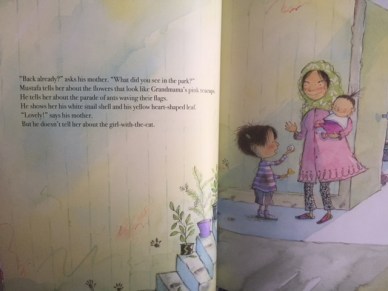
The text is prose-like as young Mustafa ventures from his apartment each day to the park nearby.  He notices things he has never seen before and compares them to the destruction he recalls of his homeland.  He also finds things that remind him of home and things that look familiar. From little ladybugs and a heart-shaped leaf, to the changing leaf colors and kids dressed up in costumes, there is so much to take in and understand.

IMG_1818

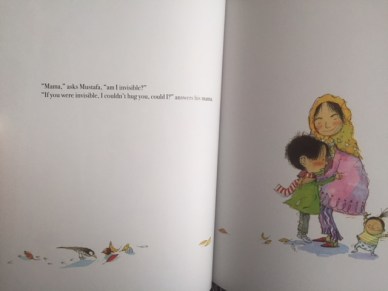
As the days go on, he begins to wonder if he is invisible.  Finally, a little girl with a cat makes a small beckoning gesture to him that doesn’t need language to be understood, and just like that, the world gets a little more welcoming.  This gentle story shows what being new can feel like, and reminds us that sometimes all it takes is a simple act of kindness to change so much.

IMG_1820

The book mentions that Mustafa came on a long journey, but does not specify where he has come from.  He draws his house being bombed in the dirt with a stick and mentions loud noises and fire.  The mother wears hijab, and obviously his name would identify them as Muslims, but other than that there is no reference or mention of religion.

IMG_1817

Overall, the book would be great for ages 4-8.  The passages are a little long, but with the illustrations and relatable concepts, I think children will reflect on what the author is trying to convey, and be able to process what Mustafa has been through, and how hard even the littlest things can be in a new place.

Refugee by Alan Gratz

Standard
Refugee by Alan Gratz

refugee.jpg

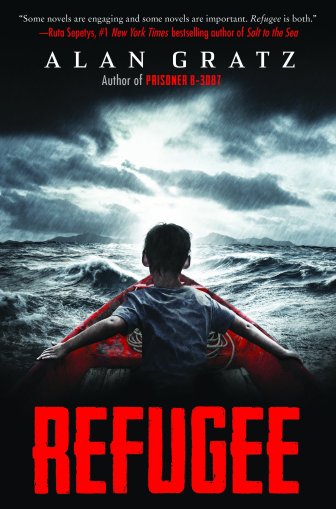
I debated whether I should read this book, or listen to it as an audio book with my children, ages 2,7,8,11.  The AR level is 5.3 and Common Sense Media suggests 10 and up because of the intensity, but knowing my kids are aware of some of the heartbreak the book discusses from other fictional works and the news, I decided to share this emotionally powerful book with them.  Tears were shed, discussion occurred, and the stories I pray will haunt and bother my children for years to come, inshaAllah resulting in compassion and action.  

The book is 338 pages with maps, references, ways to help, and acknowledgements at the end.  The audio book is just over seven and a half hours.

SYNOPSIS:

Three kids stories are told in pieces as they occur in different time periods, in different parts of the world, and for different reasons, but the heart of the stories are not the differences, but the similarities that all three share.  The real life parallels of each horrific event, and how small the world suddenly seems, is amplified by the ties that connect these fictional stories to one another.

Josef is a Jewish boy living in 1930 Nazi Germany.  When his father is released from a concentration camp; he, his mom, and younger sister Ruthie board the MS St. Louis headed for Cuba to try to find a new life.  However, Cuba refuses to let them in, and Josef’s father cannot escape the ghosts from his time in a concentration camp.  Returned to war in Europe, the family is once again on the run from Nazis and not all survive.

Isabel is a Cuban girl in 1994. Unrest is growing in Havana and when Fidel Castro says people can leave, her family: Grandfather, dad, and pregnant mom, join their neighbors in their makeshift boat to try to reach El Norte.  The shark filled waters, tankers, getting blown off course, and a temperamental boat engine, all pose as obstacles for the family trying to get on dry land to avoid being sent back to Cuba by the US Coast Guard.  

Mahmoud is a Syrian boy in 2015 who’s life has been altered by the civil war, but when their home is destroyed by explosians, they must leave right then.  His parents, younger brother Waleed, and baby sister Hana,  begin walking, their journey will travel through many countries as they seek the promised land of Germany.  Along the way they will be held at gun point, be forced into detention centers, walk for days and put their lives at the mercy of the Mediterreanean Sea in a flimsy rubber dinghy. 

WHY I LIKE IT:

I love that this book takes huge pivitol historic events in our life time and gives them a face.  Numbers are often numbing as they are difficult to grasp, and political motivations are often so hard to understand in their complexities, that this book does a marvelous job of making it about the person, about the humanity at stake.  I challange any one, especially those opposed to letting refugees in, to not cheer these three on, to not get irrated by those that willingly can help and chose not to, and those being relieved when people finally do see them and do help.  Its amazing how far a little kindness can go, and seeing it in tangible terms is powerful.  Yes, taking into your home a refugee is a huge kind step, but so was the giving of water and asprin to Isabel and her family, or giving of clean clothes and a ride to Mahmoud and his family, or removing the protrait of Hitler from the Social Hall during Josef’s Bar Mitzvah, all little kindnesses that hopefully we can rememember.

I love that the author got Mahmoud’s religion right.  They stop and pray, they make duas, their cell phone apps for salat times all ring at once, they are Muslim and their religion is mentioned as they practice it, not as a storyline.

Overall, I was impressed at the book.  Many reviews online found issue with the structure of the stories being broken up and seperated, but listening to it, atleast, made them feel incredibly connected.  I absolutely enjoyed seeing the parallels of each story and the humanity of each chacter shine through.

FLAGS:

The book has a lot death, and violence, and it is intense, but, it is not glorified and it isn’t too graphic.  It is done tastefully to make a point and keep it real, but not to overwhelm the audience or sensationalize the events, although I don’t know that any fiction, could be worse than the reality endured during these time periods.

TOOLS FOR LEADING THE DISCUSSION:

A map, would be awesome, a big one.  I like that the author gives some tips to help, but I think more on hand would be beneficial as the urge to help others is pretty intense after listening to/reading the book.  Especially ways to get involved in Syria, as the struggle is still ongoing.  

There are lots of tools online as the book is published through Scholastic. 

https://www.scholastic.com/teachers/lesson-plans/17-18/refugee-discussion-guide/

Book Unit Ideas: http://bookunitsteacher.com/wp/?p=5858

Author’s page: https://www.alangratz.com/writing/refugee/refugee-discussion-guide/


The Color of Home by Mary Hoffman illustrated by Karin Littlewood

Standard
The Color of Home by Mary Hoffman illustrated by Karin Littlewood

color of home

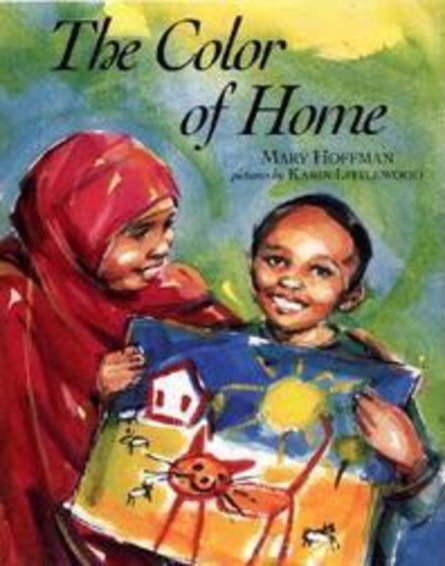
This powerful book about Hassan’s first day at school is a bit graphic, and incredibly important.  While it is a picture book, it is definitely not meant for small children.  The rich water color illustrations and the impactful text match the AR level 3.6 and would really appeal to thoughtful 2nd through 4th grade students.

A refugee from Somalia, Hassan finds it “tiring remembering even a few English words.”  He misses the color of Somalia, his cat, the warmth of the sun, and the freedom of learning out doors.  He doesn’t miss the violence though.

colour3(1)

When it is time to paint, Hassan paints his home and his family, all 9 of them, and his pets, in bright happy hews, much to the delight of his teacher.  But then, Hassan, engulfs his house with the red paint of flames, smudges out his Uncle Ahmed when the black bullets that take him down, and Hassan communicates his sadness to his teacher.

Hassan doesn’t take his picture home, he knows it will upset his mom and little sister, Naima.  The next day, a translator comes to help Hassan.  Fela is Somali and wears a black hijab, like Hassan’s mom, but western clothes, a new concept to the young boy.

color

Through Fela, Hassan opens up to his teacher and explains what it was like when the soldiers came and he had to hide under the bed.  How they had to leave without any of their stuff, including his beloved pet cat Musa.  All they could take was his father’s prayer rug and the Quran, as they set off on foot in the night.  He tells about leaving his grandparents and cousins behind and being scared on the plane.

Being able to share his fears, seems to help as he paints a new picture to share with his mom.  This one filled with his animals, and not with fire and bullets.  There is hope for Hassan as he looks forward to adding color to his new life and reminds himself to learn the english word for “home.”

colour2(1)

The book  is great for seeing the experience through Hassan’s eyes, and taking the reader through some of his adult like fears, and childish stresses.  Older kids should appreciate that what he has lived through is horrific, but his understanding as a child is slightly limited.  It should increase empathy, compassion, and kindness.

While the illustrations are rich and detailed they are very realistic.  This adds to the somberness of the book, and keeps this work of fiction a very real reminder of the world and what trials so many go through.

The characters are visibly Muslim, but there is no mention of religious doctrine, and readers may not know what a prayer rug is or a Quran.  They will be able to use context clues to figure out hijab, but there is not a glossary in the back.

Stepping Stones: A Refugee Family’s Journey by Margriet Ruus Artwork by Nizar Ali Badr

Standard
Stepping Stones: A Refugee Family’s Journey by Margriet Ruus Artwork by Nizar Ali Badr

stepping stones

I usually have a running lists of books to check and see if the library has in their catalogue, and another list for when I have a few extra dollars and/or a reason/excuse to purchase books for my own.  I’ve seen this book recommend by countless critics, educators, refugee resettlement volunteers etc., and was thrilled that I could get it from the local public library.  However, it isn’t enough to have this book and mull over the artwork and prose for three weeks, it deserves a permanent place on the shelf.  Or better yet, open hands to pass the book around to within your home, to reflect on the humanity that binds us all, and the plight of so many in the world.

FullSizeRender (12)

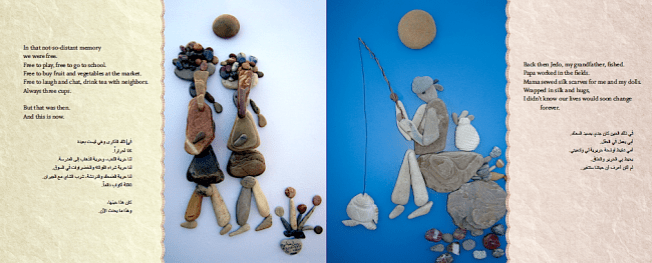
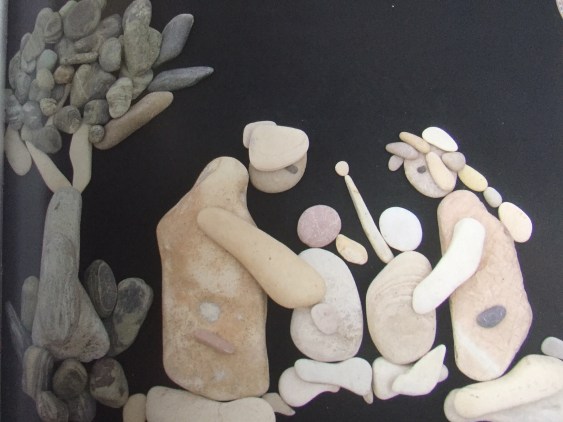
The story is fairly simple, Rama and her family have a good life in Syria and the war changes that, forcing her and her family to flee on foot to Europe with what they can carry.  The emotions on the other hand, are not that simple.  The book is illustrated in stone, but the reader would have to have a heart of stone to not be moved.  Written on an AR 3.2 with 28 pages, the book is written in both English and Arabic.  The book is not sensational, but it does discuss the shortage of food, and going hungry, how they are not free, not really, how bombs fall and kill people going to the market,  and it does show that people were lost in crossing the sea.  The family has to walk, there is no going to the airport or cars to take them across borders so easily, this is contrasted to the beginning of the book where Rama was free to play and go to school, things the reader can relate too.

stones

Ultimately the book is full of hope.  The fictionalized account of a horrific reality still on going, pales only to the story of how the book came to be.  The Foreword is wonderful and gives the book so much more warmth and heart.  How the author saw the artisans work, sought him out, and built the story around his pieces, gives even the youngest reader a sense of reality for an unfathomable situation.  After the story is more information about the author and the illustrator, as well as a list of resources to volunteer, donate and help.  Portions of the book sales go to help resettlement organizations across North America.

stones2

The publishers page gives info and has a youtube book trailer as well: https://steppingstonesthebook.com/

FullSizeRender (11)

The book would be great at story time or in a classroom setting followed by an activity with making pictures with stones previously collected.  At bedtime the book is great to read aloud and let the words sweep your listener toward empathy and compassion.  Check your library first, and if it isn’t there, I don’t think you’ll regret your purchase.