Tag Archives: no islam

Eid for Nylah by Nizrana Farook illustrated by Zelma Firdauzia

Standard
Eid for Nylah by Nizrana Farook illustrated by Zelma Firdauzia

I have read this book dozens of times and I honestly don’t know how I feel about it. If you remove the title and second to last page and just READ the words, the book could be about any holiday that you might clean and decorate for, that would involve giving gifts, putting on henna, wearing new clothes, praying, and sharing food at. The illustrations imply that it is a Muslim holiday with about half the women in the pictures wearing hijab, and a few decor items that say Eid Mubarak in English and Arabic, but readers that are unaware or unfamiliar might not grasp that it is faith based at all, and the Author’s Note mentions, but doesn’t detail much about the religious significance either. During one reading, I felt it also could almost seem like a mystery, that the title just happens to ruin. The cat Nylah goes to different houses on the street seeing and hearing the tidying and banner hanging and gift wrapping occurring, but doesn’t know why no one has time for her, until the big reveal that it is Eid. I think for little non reading kids that actually might be my approach, to share the book without the title and back blurb and see if they can figure out why everyone is too busy to play with Nylah.  I don’t know that it is tokenism, or that Islam is left out to make the book palatable for the Western gaze, I could be wrong though, I really just think this is the author’s style.  Having read her chapter books that always center animals, feature community, and include Muslim names, I think this is just an extension of her lyrical writing in her debut picture book. The book would work for either Eid, but the backmatter is the author’s reflection on Ramadan and Eid al Fitr.  I know I’m the minority that struggles with Islamic holiday books that leave out the Islam, so for those of you that do not find it disappointing, the book is sweet.  Nylah is a cat that is welcome and known to the entire neighborhood, to come and go as she pleases, the age engaging illustrations complimented by the cadence and rhythm of the structure, lines, and diction are easy to read aloud to groups of all sizes, and hold the attention of 3 year old children and up.

The book starts with a family “wiping and scrubbing, tidying and sorting, everything in sight.”  When no one has time to play with Nylah, she heads outside under the crescent moon, and goes next door to Bilal’s house, where he and his family are decorating.  When she tries to play with the ribbon, she is once again told they are too busy to play, so she slips into Reem’s house where they are doing henna.  This continues from one house to another until the next morning when her family all dressed wakes her up to go to the park with them for prayers and Nylah realizes it is Eid.  Now the children are not too busy and everyone plays with Nylah.

Yeah, I know, taking a cat to Eid prayers sounds wild to me too, kids love imagining though what chaos might ensue.  There is enough hinted at that Muslim families can find the clues and make the book more religious or holiday centered, but I wish it showed the cat seeing praying or reading Quran, hearing the athan or thikr, or something that would ground the book in Islam, but alas, it does not.

The book concludes with an Author’s Note and scanable QR Code for a free audio reading.

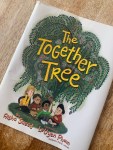
The Together Tree by Aisha Saeed illustrated by LeUyen Pham

Standard
The Together Tree by Aisha Saeed illustrated by LeUyen Pham

img_7924

Being the new kid, not having friends, and being teased are not new themes in literature (or life), so if you are going to write a book about them, take a lesson from Muslim author Aisha Saeed and make sure the story is heartfelt, emotional, and well-told.  There is no Islam in the book, no foreign culture, or teasing because of skin color, it is a boy named Rumi who has moved from San Francisco to the other side of America and his shoes, with their drawings and colorings, that cause the kids to stare and start bullying.  Rumi seeks solace under a willow tree and fellow classmate Han has to be brave to put a stop to the mistreatment by finding his voice and not simply staying silent.  The text and illustrations provide a lot of opportunities for children to see themselves in the story, in the various characters, and ruminate over the actions and feelings from different points of view.  The book is lyrical, it is not heavy handed or preachy, and the Author’s Note at the end is equally touching and hopeful.

img_7925

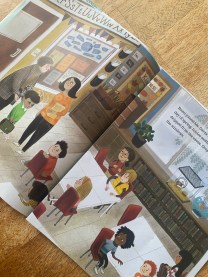
Rumi is quiet, and on his first day in Ms. Garza’s class the kids stare at him as he stares out the window.  At recess he wanders off to sit beneath the willow tree when Asher, Ella and Han leave the swings to see what he is up to.  Asher and Ella start to make fun of Rumi, Han is uncomfortable, but stays quiet.

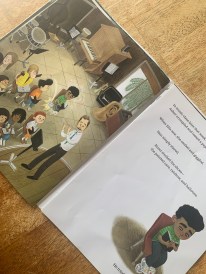
Rumi recalls coloring his shoes with his friends, and how different it was to where he is now, he picks up a twig to twirl as the hurt grows. In music class when the giggling starts, he tries not to cry.  At recess he retreats to his refuge under the tree.

When the bullying escalates, and tears fall, Han speaks up and breaks the cycle. Others follow and see the world Rumi has created with his twig and are drawn to it and to Rumi.  Forgiveness is asked for, and granted and the tree becomes a place of friendship and togetherness.

img_7928

The Author’s Note shares the real life observations of the author about her son in kindergarten and how while heartbreaking, there was also hope in the concern shown by other kids that simply weren’t sure what to do.  I love that even though Rumi is being teased for his shoes and being different, he doesn’t stop wearing his shoes or try and clean the drawings off.

img_7926

I think this book is a must read in classrooms and homes were kids can slowly peel back the pieces and see where they can relate, how they can plan to act, and what parts they identify with.  The book is deliberate and slow, and while a child could read it on their own and enjoy the story and illustrations at hand, the real power it has, is being a catalyst for discussion and empathy and speaking up.

Pre order/order here on Amazon

img_7927


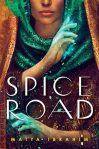
Spice Road by Maiya Ibrahim

Standard
Spice Road by Maiya Ibrahim

spice

I have no idea if the author identifies as Muslim. I saw the 2023 YA book described as a Middle Eastern fantasy, characters with Arabic names,  djinn representation and possibly a hijab wearing protagonist on the cover, so I requested an advanced reader’s copy, squealed with delight when I got approved, and happily fell into the 464 page world of The Sahir and Kingdom of Alqibah.  Their is no Islam in the book, it is not a hijab, but I’m sharing it here, not just to let readers know it isn’t Islamic rep, but to let them know that for the genre it is pretty clean, and the story is an engaging easy read.  At times Imani is whiney and annoying, but she has a developed arc, and the book has a few slow patches, but nothing that lasted long enough to tempt me to give up on it.  I think 14 year olds and up can handle the three brief kisses, the sexual assault that is thwarted, the lusting glances, the killing, the potential addiction, and the commentary on colonizers and oppressors.  It is the first book in a series, so this review is only for this book and not an evaluation of the rest of the books that perhaps are not even written yet.

SYNOPSIS:

In Qalia, the Shields protect their community from monsters with the Spice entrusted to them, misra, that magically empowers affinities in them.  The top Shield, Imani, has an affinity for iron, and with the support of her powerful clan she exists in a world of privilege and opportunity.  When her powerful brother, Atheer, is assumed dead after stealing misra and suffering from magical obsession, the family’s reputation is not as pristine as it once was.  Imani’s younger sister, Amira, is also keeping secrets as she is caught stealing, skipping school, and refusing to follow family orders and country laws.  When the two girls find themselves following Atheer’s horse into the forbidden waste, they learn that their brother might not be dead and that there is more to their world than they ever were allowed to know.  With desperation to learn more about her brother’s location clouding her judgement, the Djinni Slayer, Imani, bonds with Qayn, a djinni who claims to not only know Atheer, but to have been his close friend.  Imani scrambles to know what to do, and seeks out answers and permission from Council, that results in her and three other’s heading off on a rescue mission to the Kingdom of Alqibah.  Everyone’s orders, however, are not the same, and first they must survive the desert, the monsters, and each other if they are to find Atheer.

WHY I LIKE IT:

I love  that the world building is not at the expense of character development.  The single linear story line does mean that at times side characters are seemingly forgotten, but the focus of the world through Imani’s eyes allows the gaps to be overlooked as her concerns and priorities take center stage.  I love the emphasis on family, it is sibling love that is motivating the protagonist and closeness to an aunt that allows for privilege and opportunity. The romantic threads and tangents never overshadow the familial importance- it isn’t a forced obligation it is very warm and it is nice to see and feel the truth in the characters approach to family.  I love the Arabic names, foods, and while my electronic version did not have a map, the author has one on her Instagram page that suggests the physical book will have a map.

I love that the book discusses colonizers and oppressors.  It may be fiction and fantasy, but there are some very real themes included in fleshed out way that would allow for a lot of deeper discussion and connections to be made. The book is well polished, I don’t know that it reads like a debut, which is always a good thing I suppose.  At times Imani is really unlikeable, but fortunately it doesn’t last too long, same goes for Amira and her bouts of childishness juxtaposed with her glimpses of maturity. Taha, is noted to be very different depending on the company he keeps, so while frustrating- it seems to be intentional. The only real hiccup I felt in the book was understanding how at times the language differences were such an obstacle and how at other times Imani could read the graffiti and be understood.

FLAGS:

Magic, romance, lust, kisses, flirting, attempted sexual assault, lying, killing, addiction, alcohol, drinking, murder, abuse, physical abuse, bullying, oppression, colonizing.

TOOLS FOR LEADING THE DISCUSSION:

I don’t know that I would pick this as a book club read, but I would definitely shelve it in a class, school, or home library.  I think it is a fun read for teens and up and I look forward to the rest of the series.  The book releases in January 2023 and as always presales are the biggest way to show support to authors and titles.  You can find the book here.