Tag Archives: Muslim Family

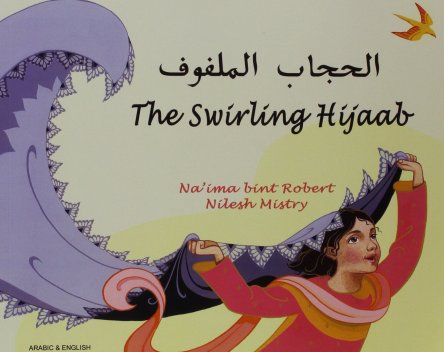
The Swirling Hijaab by Na’ima bint Robert illustrated by Nilesh Mistry

Standard

81fjfxOGmNL

Written in 2002 I’m not sure why this book isn’t in libraries or easy to find, it is wonderful.  We all got so excited when Mommy’s Khimar came out, and for good reason, it is great, but I feel like this book is very similar and somehow not appreciated.  The book is written in verse, with just one line on each page, there are 20 languages that this book appears dual language in, and the author is incredibly well known (Ramadan Moon, From Somalia With Love, Boy Vs. Girl, Going to Mecca, She Wore Red Trainers).

The large pictures show a small girl using her mom’s hijaab to play pretend with as a fort, a boat’s sails, a cloth for her tea party, a comfort when mom isn’t there, and most of all as a covering as a part of one’s faith.  The book shows the little girl as a desi bride, an African warrior queen, a beduin, and a relatable little girl having fun.

The book works well for little ones, with its simple text and large pictures, and is perfect for story time and bedtime alike.  The pictures aren’t bold and vibrant, but are colorful in their muted state and engaging as the swirling hijaab transforms into so much more than a piece of cloth.

It doesn’t mention Islam or Muslims, but just that the hijaab is worn as a sign of faith.  It depicts the girl praying, but doesn’t offer and text regarding it.


Zaydo Potato: A Muslim Superhero by Randa Taftaf and Maz Galini illustrated by Lovyaa Garg

Standard
Zaydo Potato: A Muslim Superhero by Randa Taftaf and Maz Galini illustrated by Lovyaa Garg

img_0531.jpg

This is the second review of a Zaydo Potato book on the blog, and much like the first book this one caters to toddler and early elementary aged children who will enjoy the large colorful pages, the silliness of finding a potato on each page, and who can benefit from the repetition of events to understand a concept.  In this 32 page book the concept being conveyed is taking care of each other, as established by the hadith at the beginning of the book.

zayd

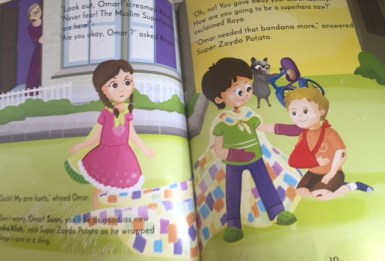
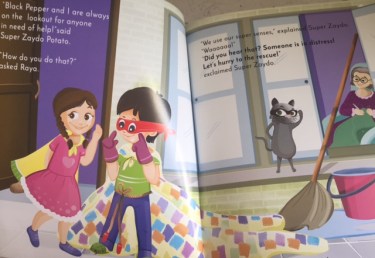
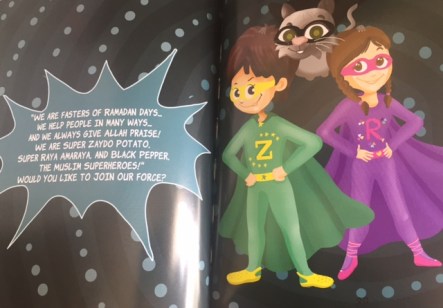
Zaydo and Raya dress up as superheroes, but find their power in saving the day involves using their capes, and masks, and belts, and gloves, to help those around them who can benefit more. They use a bandana to sling a hurt arm, a towel cape to cover a spill, and silly gloves to make a baby stop crying.   They call themselves Muslim Superheroes and after showing the reader that it is good to help one another, praise Allah, and do what is right, they ask if you want to join their force.
zayd2

I read the book to my own children and then to a group of about 25 kids under the age of 6 and it went over pretty well.  The amount of text on a page is sufficient to convey the repetitive scenarios.  Honestly, I don’t really understand why the book takes place in Ramadan.  Other than the first page saying that they are the fasters of Ramadan days, and the last page repeating it, there is nothing Ramadan specific about the story.  In fact the Grandma is drinking tea on the first page, so yes maybe she is excused, but it is a bit confusing to have the Ramadan element in there when it is not a facet of the story at all. 
zayd1

The word ‘super’ is used a lot, and if reading it aloud can get your tongue a bit tied.  I also don’t understand why Raya has a last name or second part to her name, Raya Amaraya, maybe to go with the rhyming of Zaydo Potato? Either way by adding super, before their names, and the rhyming second name, I felt like a lot of the book was just saying names. The only other critique of an other wise solid book about teaching kids how to truly be super in a practical way, is that the Grandma is in a lot of the pictures in the background sewing so that when she surprises them with real costumes, the kids can enjoy going back and see she was working on them the whole time.  Except I thought, my kids thought, and the story time kids all thought she was knitting, and the costumes don’t look knitted, so it is a bit jarring.  On closer inspection there is just one needle, not two, but it is really large, almost crochet hook size, so a sewing machine illustration would have been a much better choice.

zayd3

The activities and lessons at the end and the founding premise of the book really make the book an important one to share with your little ones.  The binding and glossy pictures of smiling children having fun will entertain and educate them at the same time.  My critiques are small, but I feel like a few test readings by the authors, and the minor quirks could have been eliminated all together.  
zayd4


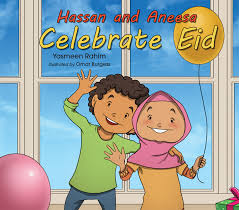
Hassan and Aneesa Celebrate Eid by Yasmeen Rahim illustrated by Omar Burgess

Standard
Hassan and Aneesa Celebrate Eid by Yasmeen Rahim illustrated by Omar Burgess

hassan.jpeg

So, cute, mashaAllah, I remember last year when I read about these two siblings celebrating Ramadan how pleasantly surprised I was by their relatable sweet story, and once again, I am thrilled that such a little book packs so much information in a fictionalized story to smile at.  Really its size is my only criticism, the book is tiny in size at 7 inches by 8.  The length of 24 pages is fine, its just hard to read it to a group, and really is only ideal for bedtime (not that I won’t read it to a group of kids, its just hard).  Even the price is fabulous, alhumdulillah, and also available in the public library.  Overall, the book is pretty sweet.

handa

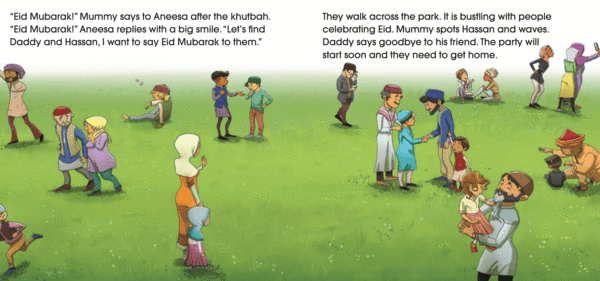
Hassan and Aneesa are getting ready for Eid after a month of fasting.  Their parents are having a party so there is a lot to do to get ready, cleaning, cooking, sampling food, and wrapping gifts. The morning of eid is chaos with everyone running around (so relatable)!  They finally are out the door and heading to the park to pray outside, following Prophet Muhammad’s example.  They listen to the imam give a speech about sharing food and then its off to hug everyone and wish one another an Eid Mubarak.

handa1

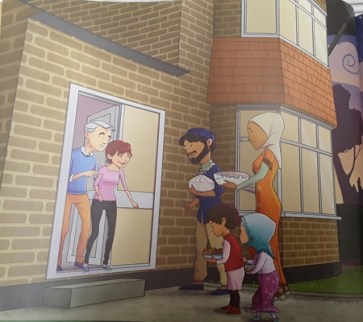
When everyone heads to the siblings home, you see kids having fun, dad cooking, and presents being exchanged.  After everyone leaves, they take food to the neighbors, as the imam reminded and the fictional family concludes a wonderful eid that they don’t want to end.

anda2

There is a glossary at the back and the pictures are colorful, bright, and expressive.  While there isn’t a plot or any character development, the situations the kids find themselves are relatable.  The joking that Aneesa will help her mom by sampling the food, and the picture at the end of the kids playing in a messy room with the parents passed out from exhaustion on the couch is pretty fun. 

handa4

There are a few books out there that timeline an eid day, but this one does it well. Kids two and up will enjoy the excitement and feel ready to celebrate eid themselves.  It shows the holiday as fun and desirable and something to look forward to.  Because the kids are in a handful of books, it also does create some identity confidence, as kids see themselves in the various situations that Aneesa and Hassan explore.

Eid by Maria Migo

Standard
Eid by Maria Migo

eid cover

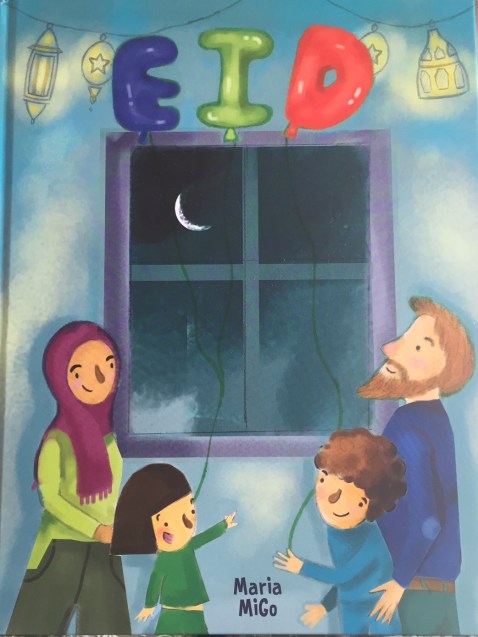
This linear story works great for toddlers that might not remember what a typical eid day is like, or those that do well to know what to expect.  There isn’t a ton of detail, but each page has a sentence or two that move the story from spotting the moon, to putting on new clothes, going for prayers, opening presents, and falling asleep at the end of the day dreaming of next year.

eid4

The gentle pictures convey that Eid is a time of family and love, but don’t necessarily convey that chaos and excitement of the day.  The kids are smiling, as are their parents, and the interaction is playful and safe.  I feel like this book is really ideal for kids with anxiety or that need some reassurance when their daily schedule is altered.  For kindergarten kids and older for the most part, I think they might find the book a glorified timeline list.  After one reading, I’m sure they will not ask for another nor remember much from the 32 page book.

IMG_0478

As seems to be the unwritten rule for books like this, the story is framed through a brother sister duo, however the simplicity of the text doesn’t name them, nor give them any role other then to show what an Eid day is like.  

FullSizeRender (100)

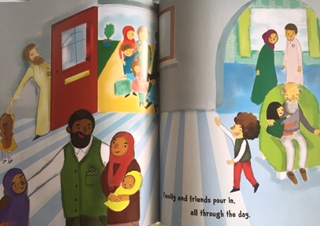
I like that they do go to the mosque and that it remarks that it is a little squished.  I also like that it mentions Eid is in summer, and implies that it isn’t always, something that could be discussed with older readers.  It doesn’t clarify if it is Eid al Fitr or Eid al Adha, so it would work for both.  The hard back binding and size are beautiful and ideal for story time and bedtime.  

FullSizeRender (99)

It isn’t my favorite book, but there is nothing wrong with it.  The Muslim Children’s Books publisher seems to have changed the cover, I’m not sure if anything else has changed.  The book would be a great addition to a book shelf, or in an Eid basket, but I don’t know that it has the wow-power to be a great stand alone gift or book to generate excitement for the blessed holiday.  


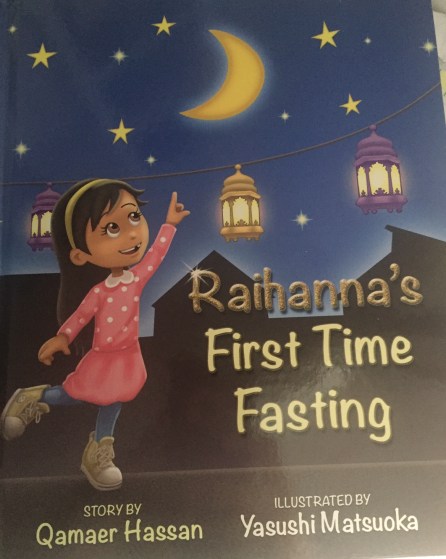
Raihanna’s First Time Fasting by Qamaer Hassan illustrated by Yasushi Matsuoka

Standard
Raihanna’s First Time Fasting by Qamaer Hassan illustrated by Yasushi Matsuoka

FullSizeRender (94)

By this time in Ramadan I’ve read a lot of very similar books that all seem to have slightly different takes on presenting the basics with various degrees of turning them into a fictionalized story.  Each have their own flavor and approach and this story in many ways is for mature little kids and works to bring a slightly deeper understanding to Ramadan and helping the less fortunate.  At 36 pages long, most of the pages are heavy on text, but not overly preachy or dense.  Dialogue and emotion fill the paragraphs, and the book works to establish Raihanna as an actual character, not just a foil to move from one Ramadan fact to another. This is also apparent, as a new Riahanna book has just come out, Raihanna’a Jennah, in making her the lead in a series.
FullSizeRender (95)

Raihanna is excited to be fasting this year, after establishing that the crescent must be sighted and that suhoor is the meal to start the fast, Raihanna puts on her hijab to pray.  She asks for forgiveness for being deceitful to get another cookie and asks Allah to make her and her friend able to go ice skating.  At bedtime it also mentions that she says her three kuls before going to sleep.  

FullSizeRender (98)

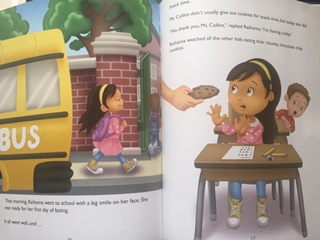
All her excitement starts to falter at school, however, when the teacher hands out chocolate chip cookies for snack and Raihanna has to explain she is fasting.  By the time she gets home from school she is not sure she even knows why she is fasting as her stomach rumbles and her mood is pretty sour.  Mom jumps in to action and takes her to a soup kitchen where the two of them, along with others, serve food to the homeless. 

FullSizeRender (97)

At iftaar time Raihanna understands how blessed she is to be surrounded by family and food, and makes a more heartfelt dua.  The book ends with letting the reader know that Raihanna spends the next 29 days loving Ramadan and being appreciative.

I love that it really picks one specific aspect of Ramadan and focuses on it in a tangible way, the poor and hungry.  Yes, she prays and recites Quran and all, but establishes that she probably does that every day out side of Ramadan as well.  I like that the author also shows that it is ok that Ramadan is hard.  There is a bit more insight and understanding in this book than just the typical list of facts.  I think ages kindergarten through 2nd grade, kids that are starting to fast will get the most of it, and relate the most to Raihanna.  It could work for non Muslims, with a bit of context of belief or just read a different Ramadan book first, but the target audience is Muslim kids.

FullSizeRender (96)

The beautiful cartoonish pictures are bright and engaging.  I have no idea why it bothered me that the characters wore the same clothes everyday, or at least the two days that the story covers, but it kind of did. I like that the dad sets the table and helps in the food prep and parenting.  The list of family members and all the dishes seems unnecessary, but with the glossary at the back it does offer a bit of culture to be conveyed.  There is also a little reader response at the end.   

Zak and His Little Lies by J. Samia Mair illustrated by Omar Burgess

Standard
Zak and His Little Lies by J. Samia Mair illustrated by Omar Burgess

zak and lies

In the first Zak book, Zak had good intentions that just never went his way and we, as the readers, really felt bad for him.  In this new book, it takes a few pages to feel sympathy for Zak as his little lies get him in trouble, but sure enough when he finally changes his ways, it is cause for relief, celebration, and a great lesson to teach kids something that they do without much thought.

ZakLies2

The book claims to be for 3 to 7 year olds, but I think it works best for 3rd graders who seem to be testing honesty out.  Yes, it is great to introduce it to younger kids, and you really should, but like the first Zak book, the pages are a bit text heavy and the concept really should be understood without too much hand holding.  For me, the power of the book is the way that Zak’s little lies snowball in to a habit, and the climax really is something that you want the child to feel from within, not as just an adult once again telling them to be honest and not lie and to listen.

zak lies 1

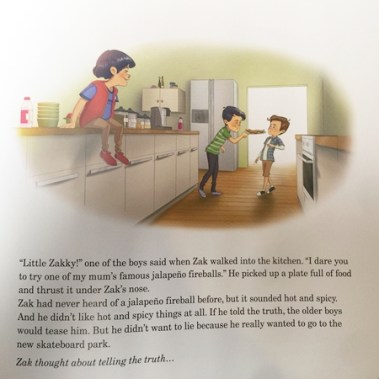
Zak starts the book with one more chore to do until he can go to the skate park with his Baba to play.  But, he gets caught in a lie about his bearded dragon, Dwayne, and the stage is set for him to get through the day honestly.  The next test doesn’t involve lying to his parents, but rather some kids from school that tease him, he doesn’t tell the truth and consequences ensue.  Next up he lies to his sister, again a great addition in showing that honesty is not just important when dealing with parents or adults, but that it needs to be the standard in all our dealings.  At the end, it is his sister getting in trouble for something that he has done that forces his to come clean about his whole day and to learn that truly, “Nothing in the earth and in the heavens is hidden from Allah” (Surah Al-Imran 3:5).

The hardback book is 29 pages with the last two pages being Discussion Questions and more information about the Quran Ayats and Hadiths mentioned.  The illustrations are not too busy, but the characters facial expressions are spot on, and often where the emotional cues for the text are found.

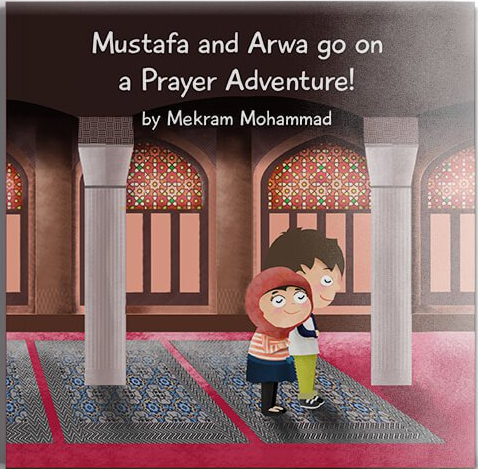
Mustafa and Arwa go on a Prayer Adventure by Mekram Mohammad

Standard
Mustafa and Arwa go on a Prayer Adventure by Mekram Mohammad

mustafa-and-arwa.jpg

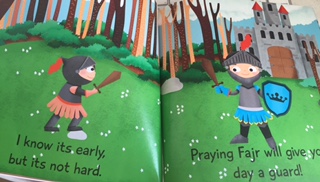
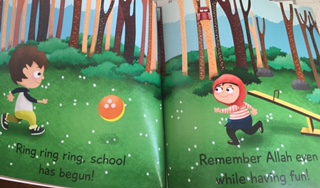
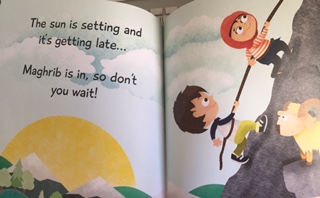
This short rhyming book introduces toddlers and little ones to the five daily prayers as it presents the brother sister duo on a typical day.  Ok, so maybe not a typical day, unless dressing up as knights and battling each other, winning medals, and climbing mountains is typical.  But, it presents the salats in time sequence that little ones can understand, more than as hours on a clock or as the various position of the sun.  Fajr is early, and it guards your day, then you go to school, but the book reminds you to remember Allah, then you take a break for duhr and if you do, inshaAllah Allah will help you pass, then you come home and have a snack and then pray Asr, etcetera.  By combining daily activities like spending time with family and reading Quran with the five prayers makes the routine seem doable and inshaAllah making it regular will truly allow us all to battle, win, and reach new heights, ameen.

FullSizeRender (57)

The book is a great tool to learn the names of the prayers, and their order, while strengthening a child’s Muslim identity.  There is no glossary or further detail about Salah or how it is performed, but I think assumes that that the reader would be able to provide additional information to the listener.  The book is more to get children excited to pray, and get closer to Allah (swt).

FullSizeRender (56)

The illustratrions are adorable and the font and text appealing  to little children.  The book is one in an adventure series by Muslim Pillars, and I look forward to reading Mustafa and Arwa’s other adventures.

FullSizeRender (55)

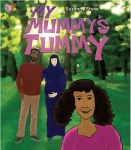
My Mummy’s Tummy by Suzanne Stone illustrated by Suzanne Stone and Omar Faruq

Standard
My Mummy’s Tummy by Suzanne Stone illustrated by Suzanne Stone and Omar Faruq

mummy-tummy.jpg

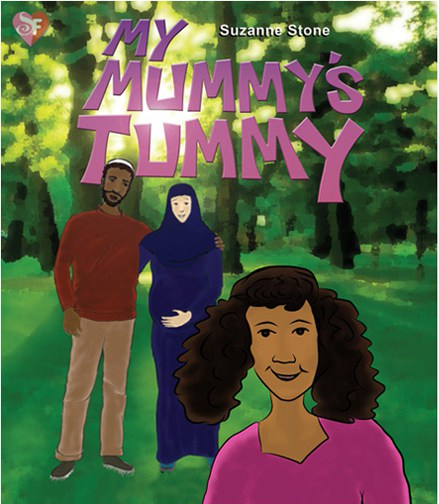
The copy I have is called My Mummy’s Tummy, but the binding says My Mummy’s Fat Tummy, I would assume that they are the same book except for this one word, and I’m hoping they opted to remove it at the last minute.  Actually, while on the title, it only  works well for the first four pages and yes, it sets up the story of a new sibling, by page five, the baby is born and mom’s tummy is the least of big sister, Maryam’s worries.

mummy tummy

The 24 page rhyming book, is a good introduction to what kids ages 3-6 can expect with a new sibling.  From Mummy’s large tummy, to having to stay with an Aunt when Mummy’s tummy starts hurting, Maryam is excited to have a new baby sister, except it ends up being a baby brother.  And while she is promised someone to play with, initially all he does is cry and sleep.  With gentle prodding by her parents and islamic reminders of patience and kindness, by the end of the book the baby is nearly one and his favorite person is his big sister Maryam, alhumdulillah.

mummy tummy

I love the diversity of the parents, and the acknowledging that changes are hard without being condescending or dismissive.  The book stays positive and hopeful and reminds us to keep Allah close to us when dealing with challenges and dreaming of the future.


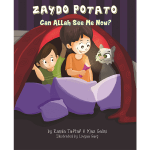
Zaydo Potato: Can Allah See Me Now? by Randa Taftaf and Maz Galini illustrated by Lovyaa Garg

Standard
Zaydo Potato: Can Allah See Me Now? by Randa Taftaf and Maz Galini illustrated by Lovyaa Garg

zaydo

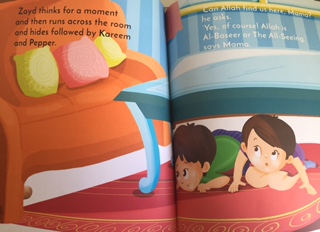
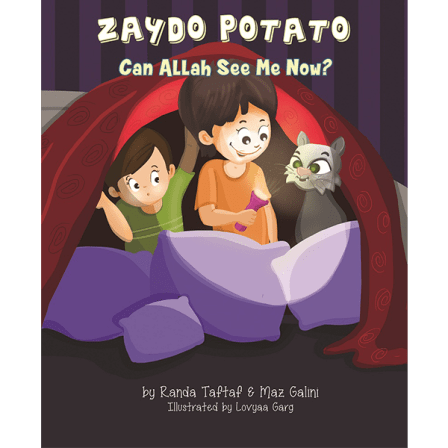
The book starts off simple enough with a little boy, Zayd playing hide-and-seek with his friend (or maybe cousin), Kareem, and his cat Pepper, when the challenge of hiding where they can’t be found, spawns a lesson in how Allah (swt) is always watching and watching over us.  As the kids hide in different places, the mom uses the names of Allah (swt) to emphasize the point.  The story presents the names of Al-Baseer, the All-seeing, Al Aleem, the All-knowing, Al-Khabeer, the All-aware, Al-Raqeeb, the Watchful, and Al-Shaheed, the Witness.

FullSizeRender (53)

The book is 32 pages, with the story taking up 24 of those pages. An ayat from the Quran, surah Hadid verse 4, starts the story and there is a glossary of the names of Allah at the end.  There is also some suggested activities for the book.  Hidden on each page is Pepper the cat and a potato.  There are other activities of finding shapes, counting blocks, finding different animals, etcetera,  that encourage children to go back to the book to engage in the pictures, and inshaAllah the message presented.

FullSizeRender (52)

There are two books thus far in the series and one E-book, the order doesn’t matter, as each is a standalone book.  The husband and wife authoring team also have a publishing company, Rummana Publishing Inc, and based on their website seem to have plans for more in the future.  This book came out about six months ago, and with its Glossy cover and large colorful pages, children will enjoy the story and activites.  The pictures are warm and engaging, and overall they are very well done.  The sentences are short, and the amont of words on the page is appropriate for the target audience.  There seems to be some arrant spacing on new text lines, but I doubt anyone would notice, and a few sentences are awkward either in their wording or lacking commas, but again, it is minor.

FullSizeRender (54)

A good story premise, easily conveyed to younger Muslims, makes the book an asset for Muslim children establishing a foundation and building a relationship with Allah swt.


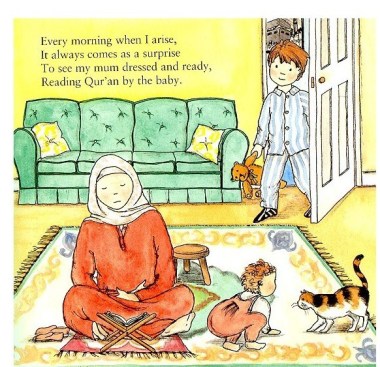
My Mum is a Wonder by Michele Messaoudi illustrated by Rukiah Peckham

Standard
My Mum is a Wonder by Michele Messaoudi illustrated by Rukiah Peckham

my mum.jpg

This book published in 1999 was one of the first books I remember reading regularly to my Sunday school class, and reading it now as a mum myself makes it warm me all the more.  In 34 warmly colored illustrations, this 8×8 book shares the story of how a little boy sees his mom.  How impressed he is by her and how truly he loves her for all that she does, all that she is, and all that she shares with him.

inside-mum.jpg

As the story progresses from what she does within the home and family, to what she does for others, the little boy also imagines himself all grown up and his mum as a nan.  He imagines that she will need him and he is ready and willing for when that time comes, to take care of her.

mum-inside-3.jpg

The book and illustrations target ages 3-6.  Written in rhyming couplets, four lines per page, the story moves at a steady pace and the pictures are detailed and familiar enough to engage most kids at bed time or in small settings.
mum inside 2

There are little Islamic specific tidbits sprinkled throughout that give parents or readers a chance to use it as a more specific teachable moment.  Saying “salam, reading Quran, thanking Allah for the food they have, praying salat, giving charity, visiting the elderly, celebrating eid, obeying her, and caring for her in her old age to achieve jannah, inshaAllah.