Tag Archives: Muslim Character

Zak and His Good Intentions by J. Samia Mair illustrated by Omar Burgess

Standard

Zak and his good intentions

Zak  and his sister Hana compete to do good deeds, but nothing goes as Zak intends.  Each time he sets off to help someone or do something kind, he is thwarted by something unexpected.  As frustration mounts with each failure, his mom steps in to reassure him that, “Prophet Muhammad (saw) said that whoever intends to do a good deed, but does not do it, still gets a good deed for his or her intention.” With his spirits restored Zak appreciates Allah’s mercy and accepts that even when we try and plan, it is Allah’s plan that ultimately prevails.

The beauty of the book is in its simple message that is reiterated four times and brought to life with simple straightforward text and detailed, but not overwhelming illustrations.  The book is written on about a second grade level and would appeal to ages 4 to about 8.  It has 32 pages and contains discussion points at the end.  The book is fun and funny and conveys a message and moral in a relevant non preachy way.  Young kids can definitely relate to the character’s desire to do good, disappointment when he fails, and comfort in knowing that Allah swt knows all and is the most just.

Overall a good book with a strong message that can be read more than once and referenced often in both the home and school setting.


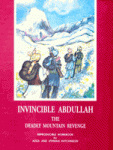
Invincible Abdullah: The Deadly Mountain Revenge by Haji Uthman Hutchinson

Standard
Invincible Abdullah: The Deadly Mountain Revenge by Haji Uthman Hutchinson

invincible-abdullah-the-deadly-mountain-revenge-workbook-aziza-and-uthman-hutchinson-2

I’m pretty sure I’ve seen and handled this book hundreds of times in my involvement in four Islamic Schools, as a teacher, a librarian, and host of book fairs.  So, it is a little embarrassing to admit that this is the first time I actually cracked open the cover and read the book.  Written in 1992 with a less than attention grabbing cover, I had minimal expectations, but with a newborn and down time, I thought I needed to give it a chance, and I’m glad I did.  The book is definitely geared to boys (there isn’t even a female character in it), and is pretty action packed and quick paced.  You know the boys will get out of the predicament at hand, he is “Invincible” after all, and there are three more books in the series, but you don’t feel bad reading it anyway, because it is sufficiently entertaining.  The book isn’t amazing, but it holds its own largely because it doesn’t talk down to the reader.  The characters are independent and thoughtful and yes they are teenagers battling drug carriers in the tribal areas of Pakistan, and yes they are wielding guns and hiking over glaciers, but mind you they never miss their salat or fail to thank Allah (swt) for their success which kind of makes the book that much more fun.  The book is 218 pages with a glossary at the back.  It is not an AR book, but I probably will make it into one at about a fourth grade fifth month level (4.5).  I also am considering doing it for book club, but might wait and read the rest of the series to see which one will have a wider appeal.

SUMMARY:

Abdullah travels to Pakistan from England to visit his cousin Hasan.  At the airport Abdullah’s bag gets switched with someone else’s and the boys find themselves getting accosted by the rightful owners who have a half a million dollars in their suitcase.  The boys talk to the police and learn that the money is part of a heroin operation going on in the tribal areas and that the inadvertent switch messed up the police’s sting to catch the criminals.  The boys run in to the drug runners again in the bazaar, and after an all out brawl decide when an opportunity to go into the tribal areas presents itself, that they should take it and do what they can, to put a stop to the criminal’s drug ring.

WHY I LIKE IT:

There is drugs, violence, and guns, but it is all done for the right reasons, in an action filled manner.  The “good” guys are all religious, and while the “bad” guys have religious sounding names, clearly are not, which lends it self to a decent discussion about what makes a good person and what makes one religious, clearly not just their name or culture.  It also lends itself to a realistic conversation about drugs, their effects on the users, and on drug culture as well.  The guns, well the guns are there to make threats, and to hurt people, at best it gives you a seg-way to discuss your views on guns with your children, but in the book, it is what it is, not a moral or religious issue as the drugs are made out to be.  The boys, the heroes of the book, are all very devout mashaAllah, and their actions, manners, and thoughts reflect this.  I like that this is consistent with their character.  They are respectful to their families, to each other and are ever mindful of themselves as Muslims in all facets of their adventures.

FLAGS:

Just the content of drugs, violence, and death. Mild compared to most TV shows or movies, but present, none-the-less, nothing a third grade and up can’t handle. (Spoiler, only one person dies and it isn’t directly at the hands of anyone, nature steps in to save the day).

TOOLS FOR LEADING THE DISCUSSION:

There is a workbook that apparently can be purchased to accompany and teach the book: http://www.islamicbookstore.com/b9648.html

The author gives pause as the characters have to decide what to do next and to weigh the pros and cons and possible repercussions of their decisions.  These moments would lend themselves well to a book club discussion to find out what the students would do, what they would be willing to risk, and at what cost.

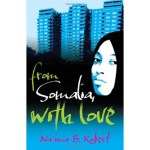
From Somalia With Love By Na’ima B. Robert

Standard
From Somalia With Love By Na’ima B. Robert

somalia

This book was a great glimpse into Somali Muslims in the UK, a world I admittedly know nothing about.  Whether accurate or not, I loved the incorporation of words, foods, culture, all of it.  And most of all I love that the main character Safia is a Muslima.  Yes, the point of the book is a coming of age story as she searches to find herself and define who she is, but in every sphere she is defining herself in, Islam is present.  Her home-life, her friendships, her poetry, all of it.  My only concern in recommending the book to my students. I think 7th and 8th graders, even in an Islamic School, can understand the temptation of going to the movies with someone of the opposite gender, of sneaking out, I think they can understand dealing with someone they love that is making bad decisions, in this case her brother experimenting with drugs and alcohol (the author doesn’t go into explicit detail).  But, truly one page (page 128) just goes too far for my students.  Had he tried to hold her hand, or kiss her even, I think the message would still come back to her conscience and her repentance, but the implied attempted rape pushes the issue over the line in my view, for my sheltered students.  High School students I think can handle it and I think lends itself well to a discussion on boundaries, respect, and sexual violence.  The AR level of the book is a 5.1 and it is a quick 159 page read.  There is a glossary of terms and phrases in the back and the font and book size make it very approachable and inviting to readers.

SUMMARY:

Safia Dirie is a 14 year-old-girl living in East London with her Mom, two brothers, and in close proximity to her large extended Somali family.  Safia is a good student, very close to her mother and very devout in her Islamic faith.  Like most teenagers she is defining who she is in a world that doesn’t seem to understand her.  Unlike most however, she has the added burden of being a religious and cultural minority.  In addition to handling friends, and temptation, she also learns that her father who has been missing in Somalia for the last 12 years has been found and is coming to live with them in London. The focus through the whole story is Safia and the reader is definitely drawn into her struggles of how to help her brother, who is rebelling, how to be a good daughter, and with her internal debates to drift closer to a less religious cousin who encourages her join in activities that Safia is hesitant to be a part of. Once her father arrives everything she has known is threatened and the issues and struggles intensify.  Despite efforts Safia can’t connect to her father and the changing dynamic of the family tests her in ways that while fiction and extreme, I think many can relate to and sympathize with.

WHY I LIKE IT:

The book does a good job of showing how people are not “good” or “bad” and how often mistakes, are just that, mistakes. It also provides hope that people can recover and improve.  The heart of this book is Safia’s and Safia’s heart is pure and has a strong connection to Allah (swt).  She sways and swerves, but never loses sight of who she is at her core, and i think for many young Muslim’s today that is an incredibly strong message.  That mistakes can be made, and Allah (swt) will forgive.  That intentions and repentance are real and valid, irregardless of where you are in life.  From friends Safia wrongs, to a brother who realizes what he is doing is wrong, to a cousin who is passed around without a permanent place to belong, to a mom trying to balance a returned husband, every character is fallible, yet not beyond hope.

FLAGS:

 The attempted sexual violence.  The implied drug abuse and lying of Ahmed, Safia’s brother.  The lying of Safia to her mom and parents about her whereabouts.

TOOLS FOR LEADING THE DISCUSSION:

The Author’s blog about the book: http://fromsomalia-withlove.blogspot.com/

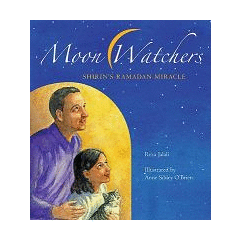
Moon Watchers Shirin’s Ramadan Miracle By Reza Jalali Illustrated by Anne Sibley O’Brien

Standard

moon watchers


This book is similar to Night of the Moon By Hena Khan as it focuses on a young girl experiencing the month of Ramadan and Eid, through the waxing and waning of the moon.  This is an AR book 3.5 and the text is driven by dialogue between nine-year-old Shirin and her Persian American family.

Too young to fast Shirin is feeling left out of the blessed month of Ramadan, her older brother Ali and her bicker until her Grandma encourages her to do “part-time fasts.”  Facts about Islam and Ramadan are slightly peppered in to the story, primarily through vocabulary, and the characters do discuss hijab and why Shirin’s mother doesn’t wear it.  It is important to note that the tale is told from a Shia perspective that is made clear as it explains how the family prays, touching the prayer stone, and kissing it three times.  The illustration here is more peculiar as it shows Shirin praying next to her dad and her brother, mom, and grandma in the row behind.

The pictures show a happy family that most readers or listeners would probably be able to identify with, along with the sibling bickering and excitement felt with the blessed month.  Persian culture is represented in the foods and sweets they prepare as a family and the henna Shirin gets on her hands.  The family prays together, spends time together and they discuss doing good deeds, not just fasting in Ramadan.

The book is beautifully done, but I think because of the brushing aside of hijab being a cultural practice, not a religious one and the presentation of prayer, I don’t know if I would give the book without discussion to a third grader in a Sunni school to read independently.  As for story time, I might simply omit those few sentences, but I’m not sure, it would depend on my audience.

If your children are aware of the differences between Sunni and Shia or you are Shia, this book is wonderful.  If your children would be greatly confused or get hung up on a few lines in a 32 page book, then it would be better to hold off.


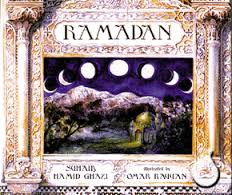
Ramadan By Suhaib Hamid Ghazi Illustrated by Omar Rayyan

Standard

ramadan

I remember when my parents first acquired this book (maybe they ordered it or it was a gift, I’m not sure), in 1996 there weren’t a lot of Islamic picture books to choose from and I took it to Sunday school to share with my students.  My preschool class loved the pictures, but the text was way over their heads and I had to summarize it to keep their focus.  Nearly twenty years later, there are a lot more options, yet the illustrations of this beautiful book are still mesmerizing to children, and the text is still too lengthy, factual, and complex to engage most children under 10 years old.

Hakeem, the main character in the book, explains not only Ramadan and fasting in detail, but also the basic tenets of Islam, words in Arabic with English descriptions, and makes numerous comparisons to other religions.  Everything is tastefully done, and probably was written to appeal to both Muslim and non Muslim children, allowing the reader to identify with Islam through whatever background they come from.  The result, unfortunately, results in a book with very little “story” and a whole lot of information.  It reads like a research paper on Islam, with a fictional boy thrown in to tell it in a simple way.  However, it isn’t a child’s voice speaking, and if the pictures weren’t so wonderfully done, no child would be at all tempted by the book.

That being said, if you have multiple aged children in your family, it works well to let the little ones look at the pictures while you “tell” them about Ramadan, and later letting the older ones build on their knowledge of Islam and Ramadan.  It doesn’t lend well to story time or larger groups in my experience, but could be a way to share information on Islam to curious adults, new converts, or young adults looking for the basics without being consumed by a text book.

Traveling Man, The Journey of Ibn Battuta, 1325-1354 By James Rumford

Standard

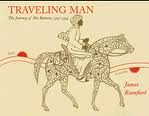
travelingThis is a fascinating book about 14th century explorer Ibn Battuta. Born in Morrocco, Ibn Battuta, travelled to China, Russia, through Africa, totaling some 75,000 miles in all and returning to document his travels and lessons. A devout Muslim he performed Hajj and saw the beauty of Islam in much of his travels. The book is beautifully done, as the words flow around the pages in both English and Arabic calligraphy. The story is simple enough to be read aloud in a Social Studies class or poured over independently time and again. It has an AR level of 4.0 and I think if it correlates with a lesson about Ibn Battuta, or is read in conjunction with lessons of Marco Polo and even Christopher Columbus, the book will be well received. I can’t forsee anyone younger than second grade truly understanding his journey, and how remarkable it was then, and still is today. This non-fiction book is clean and imaginative in summarizing his travels. Adults as well as children will spend time analiyzing the pictures and maps included in this 34 page book.

I am Malala By Malala Yousafzai and Christina Lamb

Standard

malala pic big

Naturally we all have heard Malala’s story and while some are inspired by it, some seem to have major hostility toward her and her approach.  Chosing to take her at face value and be inspired by her, I was generally looking forward to reading her story before I ever entertained thoughts of using it as a teaching tool in a school.  It is an AR reading level of 7.1 so once I obtained the book I rushed to read it before the end of the school year to see if perhaps our 7th and 8th grade students could read it and leave for the summer realizing the blessing that an education can be from someone who has had to risk it all, just for the chance to learn.  However upon completion I think that the dates, and history of Pakistan would ultimately drag the book on for the majority of Middle-Schoolers and her message and inspiration would be lost.  For adults looking for a book club book however, I would highly recommend it.  As a half Pakistani-American growing up spending my summers in Pakistan, I could relate and recall so much of what she wrote about.  I think most adults of any background would similarly be able to recall major news events, and be able to follow along.  I think anyone younger would find it incredibly difficult and possibly dull to get through.  I think that students would benefit from learning about her story and then only reading excerpts from the book.  There are some very moving sections that I think the average middle schooler would be impacted by, and the included pictures amongst the 327 pages would give them a glimpse into her world.   I on the other hand, couldn’t put it down, the book reads very quickly and bounces around all over the place, which actually didn’t bother me, I enjoyed her descriptions of her town and family and friends.  While Malala wrote it with an author, I think the tone is very much that of a young girl and thus the style works for me.  Political views aside the book made me smile, made me cry, and makes me feel better off having read it.

SYNOPSIS:

Malala is a Pashtun girl in the Swat Valley in Pakistan.  In a culture that keeps females behind doors and cloth, her father is the anomaly and encourages her to be educated, free, and vocal.  As 9/11 occurs, the Taliban sets in, the west wages war on Afghanistan, Osama bin Laden is killed, governments change in Pakistan, floods and earthquakes destroy the land, Malala and her family struggle to survive, improve their community, and advocate for the right of women to be educated.  All this climaxes in the Taliban boarding her school van and shooting her in the face at point-blank range.  She is then rushed to various hospitals before being taken to Birmingham, England. 

WHY I LIKE IT: 

It gives hope and shows that there are people making a differences and despite the risks, do want to change things in the world.  It is a great example that one person can make a difference.  Her family and her are active Muslims, that reflect on the Quran and try to understand where the Taliban is wrong in their interpretation.  Religion is a defining factor in every aspect from personal to culturally to government, and presents just how different each person seems to manipulate religion to their own benefit.   It might seem odd for some that she is writing this memoir of sorts when she has barely lived a long enough life to reflect back upon.  It also is perhaps overly optimistic as the story is ongoing, what she will do now is unanswered because it is not yet been given a chance to unfold.  I think the story is strong enough to cut through the criticism, and can be very powerful from both a child’s point of view, and from her parents.  Most readers if they can get through the intermingling of her story and that of her country will be affected by her plight.

FLAGS:

Violence, but done in a newscast style, not overly sensationalized, but details are given.


The Meat Eating Vegetarian by Caroline Maryam Ward

Standard

ImageA quick read even for the 2nd through 4th grade age group with 44 pages, lots of pictures, and generous spacing.  I  feel it could have been done as a picture book, but for the age group and the fact that it is hardback, the book does sit nice on a shelf and encourage a budding reader to open it up and not feel intimidated.  The book is written in British English, so my daughter had a few questions regarding terminology and spelling, which alhumdulillah, gave us a chance to talk about a different culture (albeit a different one than the book was targeting).

SYNOPSIS:

British born of Pakistani heritage, Tasneem starts a new school in the fall, she quickly becomes friends with Yvonne and Lisa.  After a play-date at Tasneem’s house however, Lisa and Yvonne feel Tasneem has been lying to them about wearing a scarf and eating vegetarian lunches every day in the cafeteria.  Their teacher helps facilitate a dialog and the girls learn about zabiha, rules of hijab, and the importance of communication in a friendship.

WHY I LIKE IT:  

The book is not preachy, Tasneem is Muslim, the other girls are very nice, it is a simple story that helps a Muslim reader see that one can be true to themselves in any environment and succeed.  In terms of identity building it is great to see mixed characters with open minds, but at the same time not present it as trouble free, which is something it often is not.  The only hesitation in recommending this book that I can foresee, is within the Muslim community there is division on Zabiha/Halal.  Tasneem does tell her friends that because she is still young, the hijab is not mandated for her, but the meat issue will either be amazingly relative to a student, or incredibly off putting, depending on their background.

FLAGS: none, completely clean, Alhumdulillah


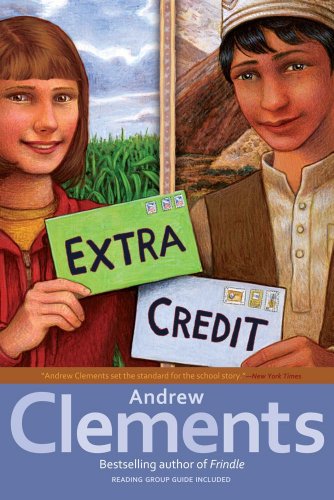
Extra Credit by Andrew Clements

Standard
Extra Credit by Andrew Clements

ImageHaving seen this book a million times, I never paid close enough attention to realize that the boy on the cover is an Afghani boy and that half of the story is told from an American girl’s perspective and half from young Sadeed.  My trusted librarian friend advised that the book is best taught through a discussion on what rules exist in Islam regarding gender roles, and why they exist.  And after reading it, I quite agree.  The story is very straight forward and predictable, and I really doubt most kids would find this to be Clements best work, however, I think if the students could be directed to critically evaluate WHY Sadeed’s community doesn’t want him communicating directly with American Abby, they might realize more about their parents own rules and reasoning, and be able to talk about them objectively.  The book is 183 pages and an Accelerated Reader Level 5.3.

SYNOPSIS:

Sixth grader Abby is in danger of being held back if she doesn’t keep up on her homework and do extra credit.  The extra credit assignment is to do a pen-pal project with a student in Afghanistan, unfortunately Sadeed, is the most qualified, but the village elders don’t think it appropriate for a girl and a boy to communicate.  As a result, Sadeed’s younger sister, Amira,  is selected to write back to Abby with Sadeed’s help.  Sadeed is annoyed by the process and begins writing to Abby independently, until events force him to reconsider.  The book is meant to show how people are universally the same, even when they seem so different.  Abby loves to rock climb and doesn’t like school, Sadeed loves school and has never thought to climb a mountain. Through their letters they realize they have more in common than originally thought.

WHY I LIKE IT:

The book discusses the Taliban and how fortunate Amira is to attend school.  It talks about Afghan culture in a fair light, and doesn’t paint all in Sadeed’s village with one stroke.  His parents, the village elders, the principal, all are seen as different individuals, with different thoughts and in a positive light.  If anything Abby’s world is seen as more bland and presented with a broad stroke of uncaring characters.  Sadeed and his family practice Islam and it shapes their moral conduct as well as their every day lives.  Islam is not what the book is about, but it does define the characters and their environment.  I like that it is age appropriate in dealing with complex topics of gender roles, and societal customs, I think our students can relate to both Abby and Sadeed (and even Amira), however I think that the characters would soon be forgotten.  While the book has a lot going for it, it seems to come up a little short.  If I do this as a book club discussion I would keep it 4th through 6th graders, I think the older students would be bored by it.  I think that the discussion would be more fruitful than the book alone.  InshaAllah, if one can get through the tediousness of, if Abby will get to go to seventh grade, and reach the top of the rock wall, there is a sweet story of building bridges and trying to see the world from other people’s perspectives; as well as opening the door to understanding why religiously and culturally our parents set up the boundaries that they do.

FLAGS:

The younger sister teases her older brother that he has a crush on her pen pal, and one could argue either way that he does, but, it is clean in terms of language, violence, and anything clearly objectionable.

TOOLS FOR LEADING THE DISCUSSION:

The discussion guide is found in the back of some editions, if not you can see it here:

http://books.simonandschuster.com/Extra-Credit/Andrew-Clements/9781416949312/reading_group_guide

Shooting Kabul By N.H. Senzai

Standard

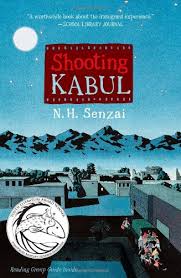
ImageShooting Kabul is another book that I just re-read to see if it would be a good fit for our 5th – 8th grade Book Club, and I think it will be a perfect fit, so much in fact that i just ordered enough copies to use for our next selection, inshaAllah.  It has an AR level of 5.4, perfect for our age group, and depending on the copy and extra glossary, book discussion and extra pages, about 262 pages of story. I haven’t decided if I will have everyone read it, or divide the group on gender lines, have the boys read Shooting Kabul, and the girls read When Wings Expand.  Senzai’s book is definitely not a “boy” book, but knowing the boys in the school, and how tender-hearted they all seem to be to their little sisters and the preschool students, I may divide the genders so they feel a bit more free in discussing.  Not sure yet, will keep you posted.

SYNOPSIS:

Told from the 11-year-old perspective of Fadi, the reader is taken on an adventure that is both heart-wrenching and plausible.  Fadi’s family makes the decision to leave Afghanistan as the Taliban’s power grows and threatens the family.  In their covert escape, Fadi’s six-year-old sister Mariam is left behind and the family must continue on to America, obviously all completely destroyed by their loss.  Once in California the family struggles with fitting in, making their way, and living through September 11th and the repercussions of the aftermath on Muslims.  Fadi turns to photography and finds a niche, as well as hope that perhaps he can win the grand prize in a photography contest that will take him to India, that much closer to where his sister might be found.

WHY I LIKE IT:

The book, while political does not make it a black and white issue, like some YA novels dealing with Afghanistan.  Similarly while September 11, is a huge incident in the book, it is presented from the perspective of how it makes Fadi feel, and the bullying that comes with it, again keeping the terror a bit at arms length and consumable by a younger audience.  Being that the book is loosely based on the Author’s husband, and his family’s escape I think it would be permissible to say that the account and portrayal of life in Kabul and immigrating to America is realistic.  As a result, the authenticity of Islam is also kept.  The characters are Muslim and it defines them, it gives the character’s depth, but is not forced upon the reader.  Fadi goes to Jummah, he ponders points about the khutbah (sermon), he and his father discuss how the Taliban uses Islam to their advantage, not in the way the Qur’an and Hadith present it.  The reader, either Muslim or non, I doubt would be overwhelmed by the religious presentation, it simply shows that aspect of the character.  Fadi is not questioning his faith, nor is it being forced on him, it is simply who he is, and something that defines him, something I think will be identifiable to my students and allow them to imagine what they would do if they were in Fadi’s place.

In a few parts the story gets a bit slow, but I think if the connection is made, the students will not be bogged down by his internal struggles to tell everyone that he blames himself for the loss of his sister.  And if they do, they are short lived pauses and the book flows fairly smooth and quick as a whole.

FLAGS:

The book is clean of language, boy girl issues, violence and content.

TOOLS FOR LEADING THE DISCUSSION:

The author’s website is helpful

Home

If your copy doesn’t have the readers guide it can be found here:

Click to access SHOOTING%20KABUL_reading%20guide.pdf

I liked these interviews with the author:

http://www.mitaliblog.com/2010/06/chat-with-n-h-senzai-author-of-shooting.html

http://carpekeyboard.blogspot.com/2010/10/talking-with-n-h-senzai-author-of.html


UPDATE:

Yes that is the author down in the comments section, commenting, amazing I know. And get this I emailed her AND she responded, amazing indeed, subhanAllah, so here is what I wrote her:

Hi, wow, I’m still a kid in the sense that I feel author’s aren’t real people, so to get a comment from you, blows me away 🙂 thank you.  I will absolutely let you know how it goes, if you get a few minutes, I’ve read a number of your interviews, but was wondering why you chose to use your initials rather than your first name? And also, since I’m sure there will be a cynic or two in the group, as a writer/ storyteller, did you ever consider not having Mariam found and returned? If so why did you go with the “happy ending.”  Love your book, need to read Saving Kabul Corner.
Thank you so much,
and her reply:
no need to feel like a little kid! but i know what you mean… i still feel like that when i meet authors i love and respect!  regarding the initials — it would make a foreign name longer and harder to remember — plus since its a boy book I wanted to have an ambiguous authorship.  since its a kids book it “had” to have a positive ending, thus mariam was found…. but when i talk to kids i tell them that thousands of children are not found in war/conflict.

hope you guys have fun reading it!

best,
Naheed

N.H. Senzai
www.nhsenzai.com