Tag Archives: Muslim Character

One Hundred Ice Creams by Sumayyah Hussein illustrated by Derry Maulana

Standard

one-hundred-ice-creams

This book on my first reading reminded me a lot of Amira’s Totally Chocolate World in that it takes a religious idea, in this case Jannah or heaven, and uses a child’s excitement for a favorite food to explore it.  Not a bad technique, and alhumdulillah the author was able to stay on the idea of heaven and add some additional information then just the silliness of having all the ice cream you could imagine.  The book is 36 pages and can probably be read by a first or second grader independently and appeal to story time ages of preschool 4 and up.  The book unfortunately takes a while to get going. I struggled with the first few pages, which I found really wordy, and puzzling.  The kids seem to be about 6 years old in the illustrations and in their mannerisms, but they start off the book complaining about homework and needing a break from it, which even my own children found confusing and remarked on it.  There also seems to be some unnecessary description too, in setting the stage: the day, the vehicle, the season, that it’s their favorite park, that they haven’t been there in a while, that they took a breath of fresh air, that they waited 10 minutes, etc..

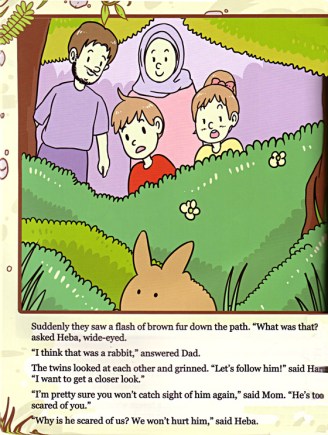
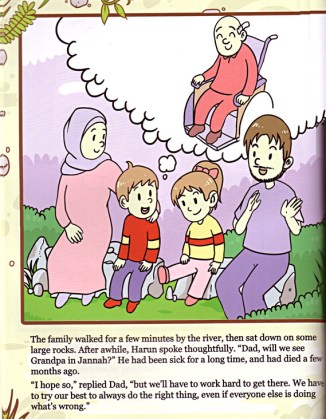
Thankfully I think once the reader’s get that the park is crowded, that the kids couldn’t enjoy the swings and slide and decide to explore the nearby woods, the story finds its rhythm and engages the reader quite well.  A few minor hiccups throughout the book are again, the abundance of details that don’t further the story and aren’t developed. The river is described when they cross the bridge, and then there is another one, or possibly the same one, as this one is now rushing, and it jars the story as there seems to be a lot of rivers in this park.   There is also a rabbit that pops up and excites the kids and then shows up at the end again, which is cute and brings the story to a happy close, but I don’t really love how the parents dismissed it.  Why not let the kids see that he is scared of them and figure out that he doesn’t know they won’t hurt him/her,  rather than have mom tell them they won’t see him again and dad quickly steering them in another direction. Granted this is my personal preference, but I like when kids figure stuff out in books and solve things themselves, rather than how perhaps it is in real life, with mom and dad constantly calling the shots.ice-creams1I really like how when discussing Jannah, they talk about the rivers of milk and honey, and I absolutely loved how they talk about Grandpa (hopefully) being in Jannah and being young and strong.  I couldn’t figure out why when in the woods and marveling at nature the characters didn’t use Islamic expressions like, mashaAllah, subhanAllah, and inshaAllah, and when I read it aloud I had to add them when we got to the pages about Grandpa.  It seemed awkward not too.  The book is clearly for Muslim children, there is a reference page in the back with the ayats from the Quran and hadeeth that tell us about Paradise, and the characters are discussing an Islamic concept, so I’m not sure why their language isn’t reflective of that.ice-creams-2

The illustrations are simple and colorful and complimentary to the story.  I don’t know why the color of the character’s skin is yellowish green.  It seems to match the ice cream and on some pages seemed more noticeable then others.  Dad’s face when he is swatting the fly is a little angry and the color of the skin makes him look mean.  Not sure why the flies are mentioned. And the illustration is not reflective of his personality in the rest of the book.
cream.JPG

Overall the book has a good message, I think I have just loved all the books at Ruqaya’s Bookshelf so much, that my expectations may have been a little too high.  I’ve never written a book and I have no idea what the publishing process for this book was, but I feel like a a few minor adjustments from an editor or proofer would have made this book absolutely phenomenal.  That is not to say it isn’t a good book,  children undoubtedly, will get a tangible understanding of Jannah after reading the story.  An additional plus is that it is on their level in both content and in perspective, meaning that there is lots to chat about after.  Concepts that the children can discuss based on what they understood from the story with little prodding from an adult.  Points from how the kids are treated at the playground, to adding what they would want they are in Jannah, and ultimately steps we can take to increase our chances of getting there, inshaAllah.

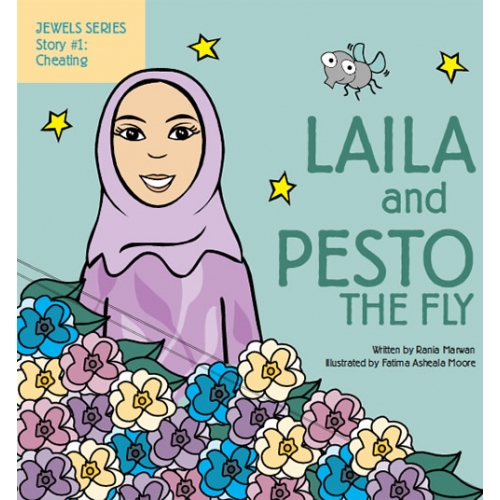
Laila and Pesto the Fly by Rania Marwan illustrated by Fatima Asheala Moore Jewel Series Story #1 Cheating

Standard

laila-and-pesto-the-fly

I ordered this book with the hopes that it would be the first book of a wonderful series teaching values in an Islamic context.   It says that it is book #1 in the Jewels Series and it focuses on cheating.  However, the book was published in 2009 and I can’t find any other books in the series.  Sadly, I can possibly see why.  The book is not great.  The illustrations make it so tempting even if all the girls are gorgeous and the illustrations simple, they would seemingly work well with a book aimed at 4 to 8 year olds, and just 24 pages long.

laila1

Unfortunately the text is lacking and doesn’t create a story worth reading more than once. The sentences are repetitive. And the same words are used over and over.  The first page alone says the word “play” four times in three sentences.  It is about 4th grade girls that play, watch cartoons and essentially hold lessons/ book clubs for each other once a week.  A lot going on for a book that on the second page says the word “flies” three times in three sentences.  Needless to say the repetition makes it hard for a story time selection, and the run on sentences hard for young readers.  The first page features a font that is probably about a size 20 and the next page it drops down to one that is about 11, the third page is about a 14 and the trend of the ever-changing font size continues throughout the book.

laila-text

Example of repetitiveness from Laila and Pesto the Fly

The story idea is a good one at its core.  A girl teaches her friends about flies.  Then the fly talks about Laila and how she is kind and honest. Then the next sections returns to Laila not being ready for a math test and she is tempted to cheat when Pesto, the fly, distracts her and writes a message for her in glitter.  I’m not sure how the glitter stays on the page, but, the message is received by Laila and emphasized by the author sharing a hadith, “He that deceives us is not one of us.” The last page of the book is a bulleted list emphasizing the harms of cheating, and how to overcome the temptation as the girls urge you to join their Cheat Deceit Foundation.

Overall, the book is awkward and doesn’t work for me.  There are a lot of better books out there.  That being said, if the author wrote another book, I may give her another chance, it isn’t hopeless. It just needs some tweaks. The fly is a silly likeable character, but the group of friends are a monolith and have no individual roles.  The message is clear and important, and we need books like this, but alhumdulillah the standards have gone up, way up, and the writing quality isn’t where it needs to be to attract Muslim children or their parents.


Broken Moon by Kim Antieau

Standard
Broken Moon by Kim Antieau

Broken Moon.jpg

I didn’t initially think the premise of the book was terribly original: a poor scarred girl in Pakistan working as a servant, cuts her hair to look like a boy and be free to move about and rescue her brother.  But the weaving in of the One Thousand and One Arabian Nights stories into the larger story, and the plot of kidnapping children to be camel jockeys in the Middle East, made the story good.  Really good, but not the book.  I really struggled with the format of the book.  It is written as letters by the main character Nadira to her young brother Umar.  The information seems too forced in this style, she is telling him how old he is, or retelling him things he said a few days ago.  Once they are together she has to clarify that now she is writing it to their mother, and then again alter it to be writing to those following her story.  It presents too many characters, that are awkwardly introduced because presumably he knows who they are, the reader does not, and bridging that gap makes the book halt the reader from diving head first into a really compelling story.  I feel like the book’s editors let the characters down, it would have been an easy fix to tell the story as Nadira told it to the Sheikha, and then when the story caught up with the present to continue it from there as written, without the guise of it being shared in letters or a diary format.  But, alas no one asked me.  Luckily the book is only 183 pages and written on a AR 4.2 level so it is a speedy read.  Do not let the fourth grade level, however, trick you into thinking it is content appropriate for a 10 year old. There is a lot of abuse, in every sub category of the word.

SYNOPSIS:

When Nadira was 12 years old she was attacked by a group of men seeking to avenge an alleged crime Nadira’s older brother committed against their daughter.  By this girl’s reputation allegedly being ruined by Nadira’s brother, the village decides that a female in his family should in exchange be ruined.  Nadira manages to fight and ends up with some external scarring, including a moon shaped scar on her face, a lot of internal scarring, but the book points out quite often that she got away from being sexually abused.  In her culture she is assumed to be ruined, and will never be married.  She begins to work as a servant to help the family financially as her older brothers have more or less disappeared and no longer are of any help to her family.  When her father dies, her mother and younger brother, Umar, rely on Uncle Rubel who is a horrible man who covertly sells Umar to the smugglers to become a camel jockey.  The family that Nadira works for seem kind, they stick to the norms and don’t include her in their fun and frivolity, but they don’t abuse or belittle her either.  They offer her, her mother, and Umar a place to live on the property, and assist her in finding someone to locate her brother.  Nadira, however, is strong and determined and takes matters into her own hands by cutting her hair to look like a boy, finding the smugglers, and convincing them to take her.  Once in the camp she wins over all the boys, by becoming Sherazad and telling a story to delay her being beat.  Her wit, tenacity, and perseverance is infectious and you find yourself cheering her on.  As she prepares for the races and to broaden her access to camps to find her brother at, she meets a western vet, a Sheikha who essentially owns her, and discovers that all the boys she lives with know she is a girl and love and respect her.  The climax involves her racing in the Sheikha’s Race where the winner is granted a wish by the Sheikha.  Can Nadira win? Can she find her brother? Can she save all the boys at the camp that she has taken in as her brothers? I won’t spoil it this time.  You’ll have to read it.

WHY I LIKE IT:

I like that the author did not cast judgement on a group of people.  Not all Pakistanis are bad, not all women are helpless, not all men are oppressive, not all employers are abusive, etc..  similarly, there is a western character, but she doesn’t swoop in and save the day, in fact I read her to be complacent in what she knew were obvious human rights violations.  I loved the relationship that Nadira had with her father.  The love of learning and love of his daughter is so sincere and beautiful that I think readers can see that the stereotype of daughters not being prized jewels in a family as being false.  I wish the mother would have been further developed.  She seems defiant, but not fleshed out, which is unfortunate. I also like the subplot of the gardener boy, Saliq.  A boy who completed some of his education in England, only to be made crippled by a horse, and sent back to be a servant.  He’s role and respect of Nadira furthers the notion that her scar does not define her, as he proposes marriage and pledges to support her in her efforts to continue rehabilitating kidnapped children and stopping the cycle.  I also like that the author doesn’t share her response, as if to emphasize that she is liberated and with or without a husband she is a complete person.

The characters are Muslim by culture, but there is no real mention of Islam or Islamic practices.  Before Nadira cuts her hair she wears a scarf, but that is neither her nor there.

FLAGS:

The premise of the book is an accusation of a sexual crime.  One of the stories she tells at the  camel camp to delay the beatings,  is the story of the lady who traps a merchant, a king, a carpenter, and a Kazi to free her lover.  She offers her body to the men and traps them in a cabinet naked after obtaining their signatures.  There is some kissing and some innuendos and references to sexual acts.  There are also references to the sexual abuse at the camps as well as descriptions of the physical ones that take place.  Not for the faint of heart or young and innocent. The boys at camp also discover that Nadira bleeds like their sisters, as a clue to them figuring out she is a girl, but compared to the sexual crimes, menstruation seems hardly like a flag, and I only mention it because the AR level is so low, not because there is any reason for shame or shyness in discussing an act all women endure.

TOOLS FOR LEADING THE DISCUSSION:

I think high school students could handle the book, and would allow a plethora of discussion options from child labor, civic responsibility, abuse, justice and the power of literature as a coping mechanism.  I wish the author would have included some information on camel racing and how they are regulated and jockeys are obtained, and maybe thrown in a recipe for masala chai as well.

There are no online websites or guides that I could find to accompany the book.

King For A Day by Rukhsana Khan illustrated by Christiane Krome

Standard

King-for-a-Day1.jpg

Its time for Basant, the Lahore, Pakistan kite flying festival, and Malik and his siblings are ready.  Ready to launch Falcon into the sky, ready to set other kites free, and ready to put the bully next door in his place.  While some kids have huge kites, and some have many, Malik has just Falcon, a speedy little kite that Malik prays can get the job done.

King for a day inside

Once again Rukhsana Khan does a remarkable job of taking a universal theme, adding some culture, and finding artists to empower minorities without making it an issue, all in a 32 page children’s book.  Written on an AR level of third grade ninth month, readers see characters handling a bully by beating him “on the court” so to speak, a character having confidence in his abilities, yet still asking Allah swt for help, and a boy in a wheel chair celebrating a fun spring time festival with his family.

king 1

The illustrations are rich with texture and angles, which contrasts the font and text presentation.  Little kids probably won’t be tempted to pick this book up, but as a read-a-loud first and second graders will enjoy the story and the kite flying action.  Third and fourth graders will enjoy reading the book independently, and find themselves cheering for Malik, appreciating his kindness, and wanting to pick up a kite and head out themselves.  The author includes a note at the back which provides more information about Basant and how it is celebrated.  Although it takes place in Pakistan and is a festival not celebrated in America, there isn’t a “foreign” feeling to the book, as kids can relate to bullies, wanting to be the best and the satisfaction of succeeding and feeling like a “king for a day.”

king2

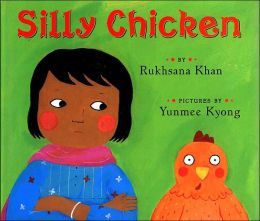
Silly Chicken by Rukhsana Khan illustrated by Yunmee Kyong

Standard

silly chicken

Silly Chicken is a story about sibling rivalry, except there isn’t a sibling, there is a chicken.  Rani feels that her mom, Ami, loves a chicken, Bibi, more than she loves her.  Rani is jealous of the attention Bibi receives and finds the chicken in general, silly.  One day when Rani and Ami leave their home by tonga to visit her father’s grave, a dog gets in and when they return, Bibi is no more.  Ami is devastated and Rani is sure she closed the gate.  It isn’t until Bibi’s egg hatches by surprise, that the story comes full circle and Rani responds to Ami’s chiding that she loves the baby chick more than her mother, that the reader and Rani realize how silly that would be.

I really liked this 32-page, brightly and playfully illustrated book.  It is written on a AR 2.3 level and is fun out loud or at bed time.  The story takes place in Pakistan and a lot of reviews online remark that it is a good book about Pakistan or for showing Pakistani culture, critiques that I both agree and disagree with.  Every kid, everywhere, through out time, can probably relate to being jealous of something or someone occupying their mother’s attention.  The concept of a pet and loving it and being sad and feeling guilty, are all universal themes.  That being said, both the author and illustrator do a remarkable job of breaking stereotypes without drawing attention to them.  Ami and Rani are relatable and are clearly Pakistani, subtly removing an us and them stance.   Rani’s dad has passed away, but Ami and Rani seem to be doing well.  Ami seems very self-sufficient in daily activities and brave when they think a burglar may be present.  The two chat with neighbors and travel independently breaking down the erroneous stereotype that women cannot go out or be recognized without a male.  The mother wears hijab and traditional Pakistani clothes while Rani being young obviously does not cover.  Their clothes are bright and colorful and their expressions relatable and inviting.  The way that Bibi’s death is handled is age appropriate and a child could possibly think she simply was run off rather than killed, either interpretation would allow the reader empathy for Ami and be a great topic to explore with a child.  Enjoy!


Ten Things I hate About Me by Randa Abdel-Fattah

Standard

Ten Things I Hate About Me

I’ve read and reviewed a few Randa Abdel-Fattah books and read and reviewed even more cheesy West-meets-East-and-my-parents-are-so-strict-so-I-will-rebel books, that with such a flimsy title referencing a movie which references Shakespeare, I didn’t expect much.  With such minimal standards, the book didn’t disappoint and the surprising warmth of many of the characters actually left a pleasant smile on my face.  I’ve had this book on my to-read list since it came out in 2006, and for some reason it is a bit hard to find now a days.  There seems to be a few covers out there, and I don’t know if they differ, but the one pictured above is the one I read, and it is 297 pages and written on an AR 4.8 level, but probably would appeal and be more content appropriate as a light read to 9th through 12 graders.

SYNOPSIS:

Jamilah Towfeek leads a double life.  At home she is a proud Lebanese Australian that goes to Madrassa, plays the darbuka drums in an Arab band, and identifies as Muslim.  She has recently dyed her hair blond and wears contacts to hide her Arab heritage and doesn’t allow her sister who wears hijab to pick her up from school where she is known as an all Australian girl, Jamie.  Her mother has passed away and her father is pretty strict about who she goes out with and her curfew.  They even have a contract posted on the fridge. Despite this, Jamilah and her dad seem to have an ok relationship and it is definitely something they both are fighting to improve.  Jamilah’s older brother is a bit of a rebel and goes out with girls to bars and the book definitely discusses the double standard.  He however, isn’t painted as “bad” or as presented as an outcast, he just does things differently, and must wage his own path to build a relationship with their father.  At school Jamilah has acquaintances more than friends, as she is constantly pushing people away.  The stage is set that she has to keep lying to her friends, but it is more in her head than in reality.  She doesn’t open up to her friends, nor they to her.  As a result the Jamie at school amongst her peers are presented as incredibly shallow, which is partially intentional I think, and partially, under developed.  She makes up excuses to not attend parties and it isn’t a big deal until the most popular guy at school starts to take an interest in her.  In frustration she starts opening up to someone who has started e-mailing her.  Her user name is Ten_Things_I_Hate_About_Me and the dialogues between her and Rage_Against_The_Machine reveal a lot about how she sees the world.  There is some tension with immigrants in Australian and Jamilah starts to realize that her silence is consent to the bigotry and bullying around her, and that there is no way to stay neutral.  There really aren’t any major plot twists, you can see a mile away who the mystery email boy is, and that he likes her, you can see that her friend Amy will come through, and that she will have to reconcile her two identities.  There are a few minor ones with her dad getting remarried and thankfully with her opting to not “hookup” with anyone in the end despite a climatic kiss in order to stay honest with her father.

WHY I LIKE IT:

I’m obviously older than the target audience and the characters, as is the author, but compared to a lot of the other books of similar content, I feel like this book stays the most grounded.  There are some pop cultural references, and obviously the kids are naive, but there are some universal truths and experiences brushed upon that I think a lot of high schoolers can relate to, not just immigrant Muslim ones.  The idea of having to be two different people at home and at school, family relationships, cultural identity, being true to yourself, dealing with the loss of a parent, taking a stand when you see something wrong, etc.. All that being said there is a huge gaping plot hole.  How her friends that have known her from elementary school when her mom brought Arab food suddenly don’t know she is Arab, or don’t pick up on her ethnic last name is beyond even a 5th grader to over look.  If you can tune out your internal sense of logic for the premise, the book is much more enjoyable, but it really is a stumbling point.

I wish that Jamilah was a bit religious.  She identifies as Muslim and clearly her sister is, but pretty much all of her actions and gripes come more from her culture than from her faith.  Many of her father’s friends drink, as they are either not religious, or Christian, which is fine, but part of me really wanted her to live up to the picture on the cover of the book and discover her religious stance alongside her owning up to her cultural one.  I love that at it’s core it is a book about a girl’s relationship with her dad and being true to her self, but somewhere her religion fizzled out of the narrative and I wish it hadn’t.  I Would have loved that she turned down the prospect of a boyfriend because it wasn’t Islamically permissible, in addition to her wanting to be honest with her father.  But, alas the author didn’t pursue that.  She did however, do a good job of not making it a judgement of culture or faith, just as attributes of her characters.

FLAGS:

There are racial slurs, drinking, dating, and kissing.

TOOLS FOR LEADING THE DISCUSSION:

Surprisingly I wouldn’t completely disregard this book for a Book Club selection.  It would be for older kids, ideally upper High School.  But I think especially in an Islamic School setting the discussion would be so much better than the book.  Many send their children to Islamic Schools to reduce the need for dual identities and I would love to see how the kids view the effectiveness of it.  I would also enjoy hearing students’ perspectives on going to formal dances with siblings or a group of girls, the double standards of boys in girls, and dealing with Uncle’s and Aunty’s constant opinions.

Author’s Website 


Colours of Islam by Dawud Wharnsby

Standard

Colours of Islam

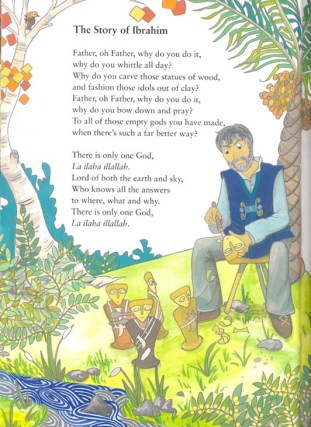
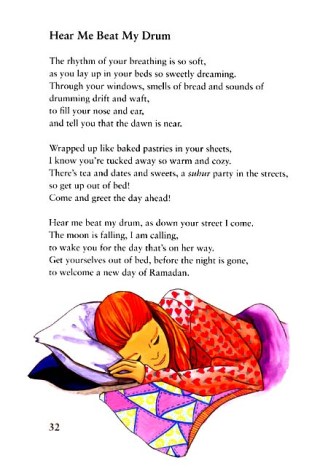
This beautiful book is a compilation of the lyrics from Dawud Wharnsby’s well known collection of songs found on the Colours of Islam CD released nearly 20 years ago.  The book states for ages 5+ and is a large and very colorful 35 pages.  The hardback binding, the inclusion of the CD, and the knowledge that royalties go to a trust fund supporting educational initiatives for children, make it a great gift item.  It looks lovely on the shelf and the children will eagerly thumb through it, once.  After that, I’m not entirely sure what to do with the book.  colours of islam2

The pictures are very busy for the most part, and very detailed.  The text on the page is pretty intimidating in its line length and volume.  The songs are lovely, I’ve knows them by heart since I was a child, but I don’t know that they lend themselves directly to poetry for children.  If a child knows the songs, or is following along with the CD then yes, older children will benefit from the book.  A five-year-old or possibly a 7-year-old will not.  I can see the poems/songs supplementing a language arts lesson in a classroom, and in a library the book looks wonderful displayed.  But, as hard as it is for me to not gushingly praise a Dawud Wharnsby product, I don’t know that the book would really ever be read cover to cover and/or more than once.

colours of islam1colours of islam


Ilyas & Duck and the Fantastic Festival of Eid-al-Fitr by Omar S. Khawaja illustrated by Leo Antolini

Standard
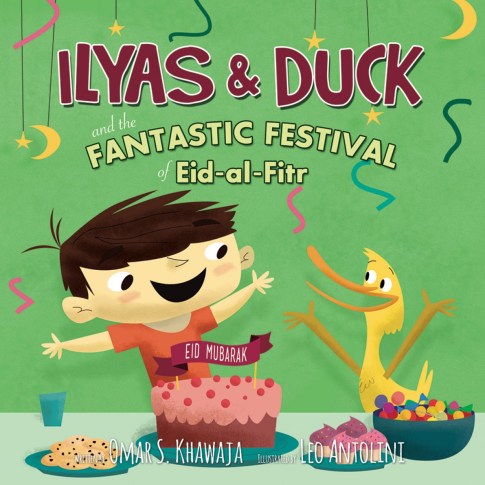
Ilyas & Duck and the Fantastic Festival of Eid-al-Fitr by Omar S. Khawaja illustrated by Leo Antolini

Ilyas & Duck and the Fantastic Festival of Eid-al-Fitr


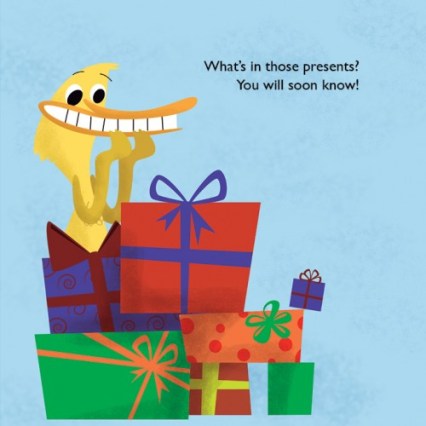
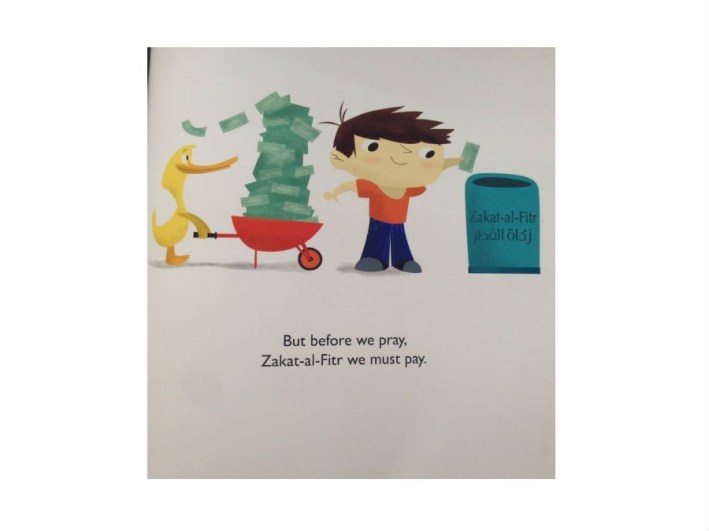
In the world of Islamic fiction, there are a lot of Eid books out there for children, but this one is definitely more fun than most, especially for the younger crowd.  The presentation of a big, bright, hardback book is aimed at 3 to 6 year olds, and reads well out loud, however, the book is very, very inviting, and older kids with happily pick it up and thumb through the 32 pages of rhyming lines as well.

The book starts with Ilyas watching the sky to see if Ramadan is over and if Eid is here.  Duck in all his silliness doesn’t know what Eid is and rushes out to get decorations to celebrate.  he returns with a Christmas tree and ornaments.  Ilyas non judgmentally explains that those are for our Chrisitian neighbors for their holiday.  Duck then runs out again and returns with a menorah and dreidel and once again Ilyas explains that those are for our Jewish friends celebrating Hanukkah.  Ilyas and Duck then fly away in their hot air balloon to the Masjid to learn about Eid.

Ilyas and Duck2Ilayas and duck

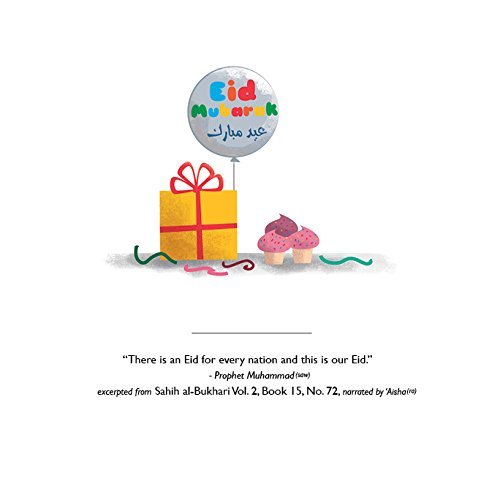
The book works for Muslim children to understand what others celebrate and works for non Muslims to see what we celebrate.  It is all done in a matter of fact way of celebration, not of doctrine.  It is built on the idea that, “There is an Eid for every nation ant his is our Eid.”ilyas and duck eid

Much like the first Ilyas and Duck book, this one is great to have around and read again and again!

Zak and His Good Intentions by J. Samia Mair illustrated by Omar Burgess

Standard

Zak and his good intentions

Zak  and his sister Hana compete to do good deeds, but nothing goes as Zak intends.  Each time he sets off to help someone or do something kind, he is thwarted by something unexpected.  As frustration mounts with each failure, his mom steps in to reassure him that, “Prophet Muhammad (saw) said that whoever intends to do a good deed, but does not do it, still gets a good deed for his or her intention.” With his spirits restored Zak appreciates Allah’s mercy and accepts that even when we try and plan, it is Allah’s plan that ultimately prevails.

The beauty of the book is in its simple message that is reiterated four times and brought to life with simple straightforward text and detailed, but not overwhelming illustrations.  The book is written on about a second grade level and would appeal to ages 4 to about 8.  It has 32 pages and contains discussion points at the end.  The book is fun and funny and conveys a message and moral in a relevant non preachy way.  Young kids can definitely relate to the character’s desire to do good, disappointment when he fails, and comfort in knowing that Allah swt knows all and is the most just.

Overall a good book with a strong message that can be read more than once and referenced often in both the home and school setting.


Invincible Abdullah: The Deadly Mountain Revenge by Haji Uthman Hutchinson

Standard
Invincible Abdullah: The Deadly Mountain Revenge by Haji Uthman Hutchinson

invincible-abdullah-the-deadly-mountain-revenge-workbook-aziza-and-uthman-hutchinson-2

I’m pretty sure I’ve seen and handled this book hundreds of times in my involvement in four Islamic Schools, as a teacher, a librarian, and host of book fairs.  So, it is a little embarrassing to admit that this is the first time I actually cracked open the cover and read the book.  Written in 1992 with a less than attention grabbing cover, I had minimal expectations, but with a newborn and down time, I thought I needed to give it a chance, and I’m glad I did.  The book is definitely geared to boys (there isn’t even a female character in it), and is pretty action packed and quick paced.  You know the boys will get out of the predicament at hand, he is “Invincible” after all, and there are three more books in the series, but you don’t feel bad reading it anyway, because it is sufficiently entertaining.  The book isn’t amazing, but it holds its own largely because it doesn’t talk down to the reader.  The characters are independent and thoughtful and yes they are teenagers battling drug carriers in the tribal areas of Pakistan, and yes they are wielding guns and hiking over glaciers, but mind you they never miss their salat or fail to thank Allah (swt) for their success which kind of makes the book that much more fun.  The book is 218 pages with a glossary at the back.  It is not an AR book, but I probably will make it into one at about a fourth grade fifth month level (4.5).  I also am considering doing it for book club, but might wait and read the rest of the series to see which one will have a wider appeal.

SUMMARY:

Abdullah travels to Pakistan from England to visit his cousin Hasan.  At the airport Abdullah’s bag gets switched with someone else’s and the boys find themselves getting accosted by the rightful owners who have a half a million dollars in their suitcase.  The boys talk to the police and learn that the money is part of a heroin operation going on in the tribal areas and that the inadvertent switch messed up the police’s sting to catch the criminals.  The boys run in to the drug runners again in the bazaar, and after an all out brawl decide when an opportunity to go into the tribal areas presents itself, that they should take it and do what they can, to put a stop to the criminal’s drug ring.

WHY I LIKE IT:

There is drugs, violence, and guns, but it is all done for the right reasons, in an action filled manner.  The “good” guys are all religious, and while the “bad” guys have religious sounding names, clearly are not, which lends it self to a decent discussion about what makes a good person and what makes one religious, clearly not just their name or culture.  It also lends itself to a realistic conversation about drugs, their effects on the users, and on drug culture as well.  The guns, well the guns are there to make threats, and to hurt people, at best it gives you a seg-way to discuss your views on guns with your children, but in the book, it is what it is, not a moral or religious issue as the drugs are made out to be.  The boys, the heroes of the book, are all very devout mashaAllah, and their actions, manners, and thoughts reflect this.  I like that this is consistent with their character.  They are respectful to their families, to each other and are ever mindful of themselves as Muslims in all facets of their adventures.

FLAGS:

Just the content of drugs, violence, and death. Mild compared to most TV shows or movies, but present, none-the-less, nothing a third grade and up can’t handle. (Spoiler, only one person dies and it isn’t directly at the hands of anyone, nature steps in to save the day).

TOOLS FOR LEADING THE DISCUSSION:

There is a workbook that apparently can be purchased to accompany and teach the book: http://www.islamicbookstore.com/b9648.html

The author gives pause as the characters have to decide what to do next and to weigh the pros and cons and possible repercussions of their decisions.  These moments would lend themselves well to a book club discussion to find out what the students would do, what they would be willing to risk, and at what cost.