BismillahirRahman ir Raheem
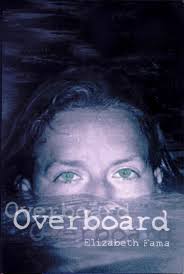
I decide to start off the Book Club with a book that is completely clean of any boy girl issues, preachy-ness, excessive violence, crude language, etc. My good friend and a former Islamic School Librarian in Rhode Island recommend Overboard, by Elizabeth Fama, for its quick moving plot, and easy reading style. The book is only 158 pages and I read it in about 2 hours. The book additionally appealed to me because it is an Accelerated Reader level 5.1, allowing me to open up the Book Club to grades 5-8th to see where the most interest is, and helping establish the Book Club participation protocol; To gain access to the lunchtime discussion students are required to earn a passing score on an AR Book Test. The book is out of print (according to the Author, more on that later), but through ebay and a local used book store I was able to acquire eight copies of the book.
SYNOPSIS:
Fourteen-year-old Emily boards an over-crowded ferry in Sumatra. When the boat sinks, she’s trapped by hundreds of panicked people. She finds Isman, a terrified young Muslim boy, floating in a life vest. Together, with Emily’s physical strength and Isman’s quiet faith, they swim for their lives.
WHY I LIKE IT:
The book is not in your face about Islam, as the main character is not Muslim. Emily is from Boston who has moved to Indonesia with her physician parents, and is miserable. She does not relate to the people, does not try to even, and wants nothing more than to go home. Knowing her uncle is on a nearby island she runs away from her parents and boards a ferry to search out her uncle and hopefully, a way home to Boston. The ferry sinks and she must not only find a way to survive, but is constantly forced to make choices that define and often surprise her as well as the reader. In the middle of the ocean with people fighting for life vests, and dying, it is her own personal convictions that shape her choices and provide a great starting point for the reader to question what their own behavior would be in such a circumstance. I like that there are other Westerners on board, and how while she initially gravitates toward them, she eventually chooses a different path. As she floats, she meets nine-year-old Isman and for the first time really begins to relate to an Indonesian, someone completely different from herself. Some of out students have been struggling with “stereotyping” and using negative terminology to describe different groups within the school, and I look forward to stressing that in the dark of night when your life is on the line, does it matter? Where are your loyalties? Do you feel Allah’s presence more? Do your choices come from survival instincts or from a highter belief? As they swim together Emily learns a bit about Islam, Ramadan, the names of Allah (swt) etc. and I think each and every point poses the question to the reader of what would you do? and why? At one point Isman is contemplating eating some candy that a fellow ferry passenger has offered him in the water and recalls a verse from the Quran allowing travelers to eat during Ramadan before tasting the morsel. In his own quiet ways, he shows tremendous strength, resolve, and trust in Allah, attributes that I hope the students can be guided to reflect upon. Initially I think they will identify with Emily, but I hope by the end they love the character of Isman and internalize some of his strength, inshaAllah.
TOOLS FOR LEADING THE DISCUSSION:
Here are two links I plan to use when engaging the students in the discussion:
http://www.elizabethfama.com/p/teacher-study-guide-for-overboard.html
Click to access 50_strategies_lesson_plan.pdf
THE AUTHOR:
So if you go to the first link, the author’s website, she has an email address listed, so naturally I wrote her a little note, and crazy, subhanAllah she responded, I felt, and still feel like a little kid, so happy. She also offered to answer some students questions after our discussion.
Some excerpts from our emails back and forth:
FROM ME: … I read through your website for teachers teaching the book, and was wondering if there is anything more you can add for me to share with the students, I think they will be thrilled to hear something from the author directly. Maybe something about how you came up with the character Isman, and what you hoped the readers would feel about him once the book ended. Perhaps also some insight as to why you chose to present a character with a strong Islamic faith in a world not very Islamic friendly at the moment…
FROM ELIZABETH FAMA: … Thank you so much for this note, and for featuring OVERBOARD as a book club selection! I’m impressed that you’ve found copies (it’s technically out of print), and also impressed that you found the teacher study guide, which I thought I removed from my website in October of 2012! I didn’t realize that googling something like “elizabeth fama teacher guide” would turn up that page, but I’m glad to know that persistent teachers and librarians can still find it. The study guide is quite helpful, I think, but since the book is out of print I grudgingly decided to move on, and I unlinked it from the main page.
Anyway, I’d love to answer your students’ questions. Maybe you can even compile some after your club meets, and I’ll answer as many as I can?
As for your starter questions, Isman came about of his own accord while I was writing. Emily shoved the life vest on him, and I didn’t think about him after that. Then, as I wrote on, Emily heard crying in the water and I was surprised to discover that it was the same little boy! Honestly, I didn’t expect to see him again. But he became absolutely essential to the plot, because I realized that Emily’s conflict was that she felt like a stranger in Banda Aceh and was not opening herself up to friendships, and that this boy was going to become important to her and change all of that.
I wrote the manuscript in 2000, and sold it to Cricket Books in August of 2001, so while I was writing it I didn’t really think about any prejudices westerners might have against Islam (this may have been naive of me, but I live in an academic, fairly tolerant, racially-mixed community). It was just natural for Isman to be Muslim because the book was set in Indonesia, and because I wanted a culture and geography that felt very different from everything Emily has known. Then September 11 happened, and I was so grateful I had written the book, because without making any sort of heavy-handed point, it shows a lovable boy who happens to have a strong Islamic faith–and in fact that faith helps both him and Emily to survive. (And yes, I assumed everyone would find him lovable by the end, as I did!)…
The book club will meet in a few weeks, inshaAllah I’ll post how it goes