Tag Archives: job

Aarzu All Around by Marzieh Abbas

Standard
Aarzu All Around by Marzieh Abbas

I was hesitant starting this 384 page middle grade novel in verse, because the stereotype of having to disguise yourself as a boy to make things happen, seems like a western performative troupe that reinforces stereotypes, and has been done a fair amount in literature.  Pushing down my disdain, I opened the book to numerous pages of cricket terminology and rules, which further served as a barrier.  I do not understand the info dumping, literally, at the start of the book, and to top it all off it is not needed.  The book is blurbed as being a cricket loving, girl dressing as a boy in a patriarchal society, but really those are the most forced aspects of the all over the place narrative.  Cricket is underdeveloped and her actually playing is very minimal and lacking. Aarzu disguising herself as a boy is a blip that she admits to a few pages after she gets the job, and thus the story that remains is an orphaned girl with a mean uncle trying to find a way to help pay for her younger sister’s medical bills. Which isn’t a bad story it is all just so very disjointed.  And the verse is not written well, there are no beats or flow, it just seems to be a few decent poems in a sea of jumbled ones.  About 40% when the Islam starts to shine, I felt a brief connection to the book and the characters, but the loose threads and telling over showing, found skimming the pages to find out if the sister survived, if Aarzu got in trouble, and how cricket fit into it all.  The weak climax and sloppy resolution, combined with the premise, marketing, and info dumping, makes me recognize that I am not the target audience as a cynical Pakistani American reader, but truly makes me wonder who is.  I don’t know that the words on the page or the story at hand are going to resonate with middle graders.  I appreciate that Islam and culture are separated, that the mean uncle is confined to him and him alone, not a label on Pakistani men, but it feels like the editor took a day off or didn’t want to help the author make the story cohesive, which is unfortunate.

SYNOPSIS:

Aarzu and her younger sister have come to live with her poor maternal aunt’s family in Karachi after her parents are killed in an earthquake.  She is treated like a servant by the family, not allowed to watch cricket let alone play, and her government public school is hardly a challenge.  When Sukoon’s kidney failure worsens and dialysis is needed, as they wait for a kidney transplant match, Aarzu decides to find a way to make money.  She starts frying onions and selling them at the local market, the labor intensive and odorous job helps, but not enough.  When a nearby bungalow preparing for a wedding, needs laborers, her friend Nazia encourages her to cut her hair to look like a boy and apply.  Lying to her aunt about where she is, she spends her time after school getting to know the kids that live at the bungalow, confessing that she is a girl, and playing cricket.  The money helps her sister and things are starting to look up, until the truth comes out, Sakoons health worsens, finances at home hit rock bottom, and friendships frazzle.  Luckily though SPOILER the wealthy family likes her and solves all her problems and bribes the right people for her to make the cricket team.

WHY I LIKED IT:

Some parts, mostly the Islam, really spoke to me. I love that distinctions were made between religion and culture, that she taught the wealthy girl how to pray, that Aarzu is Muslim and loves her faith and relies on her relationship to Allah swt in handling every aspect of her life. The rep feels real and sincere and while it made me force a friend to read the book, it also highlighted how weak the other aspects were.  We, the reader, see so little of what Aarzu’s world is, we are just told. There are no flashbacks to her life with her parents juxtaposing her current situation that would have connected us to her.  The poverty, the mean uncle, the cricket, the sick sibling, they all just seem like plot points, not pieces to this girl. She compartmentalizes them in a way that make it hard for the reader to see the overlap, or that she is keeping all of these parts close to her heart at all times.

The resolution was disappointing, it felt half hearted. Why have wealthy saviorism? Dreams coming true from bribery? It took the grit out, and made the messaging fall less on hard work and perseverance, and more on, don’t be poor.

I did appreciate the kidney disease representation, having seen a loved one endure failure and daily dialysis, I appreciated the mention of dietary changes, and swelling, and lethargy, it was well done.  I wish the emotional impact, though not just the sibling love, but the fear of demise, could have come through stronger.

FLAGS:
Lying, physical abuse, theft, fear, illness

TOOLS FOR LEADING THE DISCUSSION:
I don’t know of a kid I would recommend the book to, but I would shelve it, let nine and up read it, and happily discuss with whoever wants to chat about it.

Wake Up! It’s the Ramadan Drummer by Mariam Hakim and Dalia Awad

Standard
Wake Up! It’s the Ramadan Drummer by Mariam Hakim and Dalia Awad

wake up

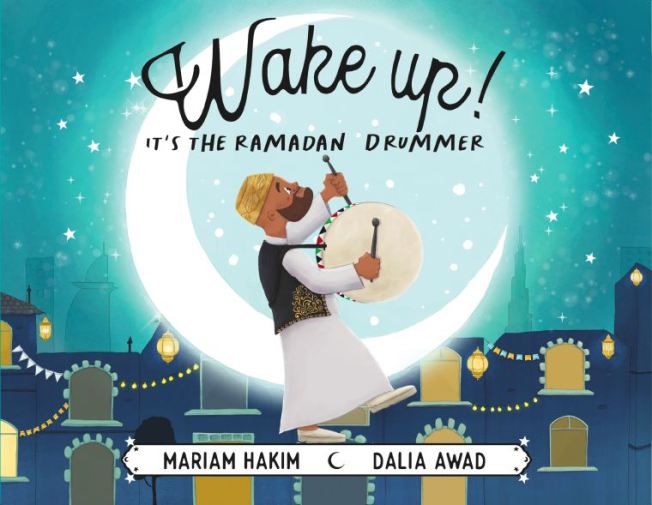
The beautiful shimmering cover of this new Ramadan book drew me in from the first few pages with the emotional impact of the father in the story losing his job.  Unfortunately the fun illustrations and overall story are not quite enough to make the book an enjoyable read over multiple readings.  By the time you read the book a second time, the missing punctuation, the assumptions and continuity holes, make the book unravel.  It has merit and highlights, I just really hope that an editor is brought in before a second printing takes place to clean up the sentences, patch the holes, and polish it to make it shine.  It has so much potential, but it is disappointing especially if you have been waiting, perhaps a bit impatiently, to share this with children to get them excited for Ramadan.  Even more so if you had hopes of reading it again and again throughout the month.

img_7075

The book summarizes Ramadan on the first page, presumably making the ideal reader a Muslim already familiar with Ramadan significance, and then jumps into revealing that the Baba has lost his job.  The optimistic mama isn’t deterred and sends the Baba and kids to the store so she can cook up something special.

img_7077

While at the store an elderly woman greets the kids and their father as, “Abu Tabla.” The son dismisses it until later that night when Baba has gone to the mosque and Mama surprises Adam and Anisa with the story of their Baba’s baba walking the streets before dawn to wake people up for suhoor.  She even digs out an old photograph, and with that, Adam is determined to get his father to revive the tradition.

img_7076

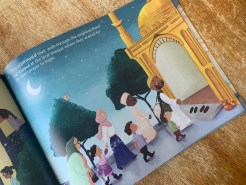
I love that Adam and his Baba work together to figure out lyrics and a beat.  I also like that it isn’t an instant success, but rather takes some grit, determination, and perseverance.  I also like that the whole family and eventually neighborhood come together, and that men and women go to the masjid for fajr.

There are some concerns I have though as well.  There are a lot of missing commas, the text uses mosque instead of masjid which reads inauthentic, and the whole old lady character, Hannah, is all sorts of underdeveloped.  She has to introduce herself, yet she knows where Abu Tabla lives, a drum magically appears in her hands, and her prodding is based on the premise that she knows what is going on inside people’s homes, what they are thinking, and what their intentions are.  I get that it is a kid’s story, but by the second or third reading it is hard to unsee how erroneous the logic is.  Especially when fasting like so many acts in Islam, are between a person and Allah swt, not for everyone else to judge.

img_7078

Presumably the story takes place in an Islamic majority setting and the neighbors are all Muslim, which offers a great discussion starter for readers in non Muslim majority places to find ways to maybe share Ramadan or to imagine living where everyone is fasting.

I feel like the last few pages about the drummer going viral is unnecessary, and the story could have, and probably should have, ended with the family and parade entering the masjid.  I particularly found it odd that a line reads, “News of the Ramadan drummer tradition starting up again reached as far as Pakistan, Egypt, Somalia, Turkey and even Indonesia,” why is Indonesia called out like that? Seems off putting somehow, not inclusive. The book concludes by circling back to the Baba getting paid to wake people up and finding jobs through the people also coming to fajr, which seems a bit raw for a children’s book.  A simpler, “even though Baba found another job, being the drummer was still the one he loved most,” would have tied everything up a little better for the demographic.  I’m hoping to include this story during one of my weekly Ramadan story times in my local community, and will probably skip the last few pages and just read the hadith at the end about waking up for suhoor.

Could Be Anything! by Eman Mouneimne El Ayoubi illustrated by Victoria Romanenkova

Standard
Could Be Anything! by Eman Mouneimne El Ayoubi illustrated by Victoria Romanenkova

mariam

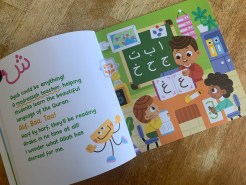
This is not normally a book I would review because it will read like paid endorsement, which it is not.  It is a 32 page personalizable book, that I’m highlighting because it exemplifies a concept of Islamic literature, that is often lacking.  We have numerous books teaching Islamic concepts to toddlers and preschoolers, but forget to teach the secular concepts through an Islamic lens.  We often have a bookshelf of Islamic books that include learning to say Alhumdulillah, and the names of Allah swt; and a bookshelf of non Islamic books that features stories about dinosaurs, monster trucks, and being silly.  This book reminded me of how important it is to have books that do both.  Not to necessarily preach, or even teach, just to merge the two shelves and present a singular framework of Islam, a way of life, not just a religion to our youngest believers.

Sure the name and customizable appearance is fun, but deeper than that, learning about different careers knowing that Allah swt created all of us to do so many worthwhile jobs is a great lesson to be sharing.  The larger concept of teaching Qadr to our children is only presented on the back cover of the book and can be implemented by using the parent guide at the end of the story.

img_4967

The book starts with asking what you want to be when you grow up and informing the child that Allah swt has a plan for us all.  Each page after then mentions the child’s name, introduces a career, and ties back to that Allah swt has written, or decreed something for us.

img_4968

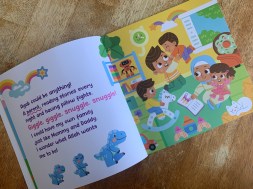
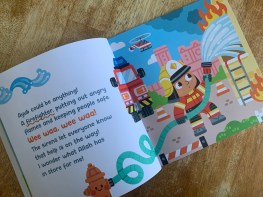
The highlighted careers vary from being a parent, to an astronaut.  A teacher to a chef, a mechanic to a dentist.  There is no priority, nor opinion on one career or job or hobby being more important or more valuable than another.

img_4970

The pages are bright and colorful and the paperback book thick and sturdy.  I did struggle with the word “could,” and often would self edit as I read and would change it to, “Ayub ‘can’ be anything.” I’m not sure why the diction is what it is, but it reads incorrect to me.

img_4969