Tag Archives: Interfaith

My Grandma and Me by Mina Javaherbin illustrated by Lindsey Yankey

Standard
My Grandma and Me by Mina Javaherbin illustrated by Lindsey Yankey

grandma and me

I absolutely love that this 32 page picture book for children five and up breaks so many stereotypes and highlights so many commonalities between all people, everywhere.  I strongly believe that books like this, can change people’s perspective, and as a children’s books can prevent negative biases from forming in the first place.

IMG_8078

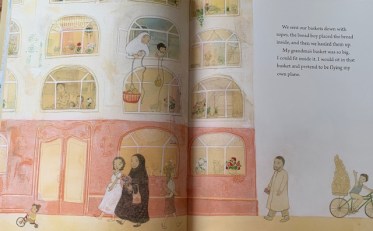
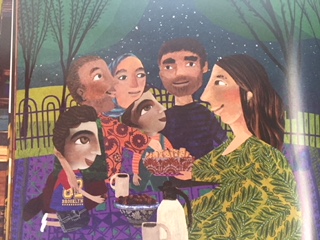
Set in Iran, a little girl absolutely loves and adores her grandma.  They pray together, they buy bread together and they share that bread with their best friends, their Christian neighbors next door.  While the little girl and her friend Annette play, the two grandmas chat, drink coffee and knit blankets to donate to the mosque and Annette’s Grandma’s church.

IMG_8079

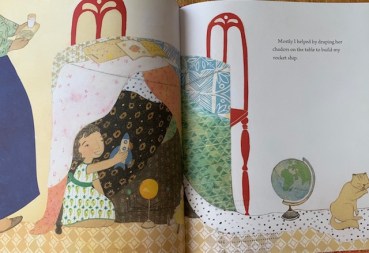
Grandma sews chadors to wear, and Mina helps.  But, mostly she uses the scarves to make rocket ship forts, and capes to fly to outer space in.  When she returns to base camp grandma has cookies for her and wants to hear about her adventures.

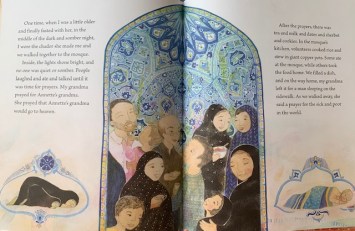
In Ramadan, the little girl wakes up early to eat with grandma even though she is too young too fast.  When she gets older, they go to the mosque together at night too, after they have broken their fast.

IMG_8082

One time she hears her grandma praying for Annette’s grandma to go to heaven.  The next day Annette tells Mina she heard her grandma praying at church for her grandma to go to heaven.  The little girl imagines the two grandmas knitting and laughing together in heaven, on Mars, on Earth, anywhere.

IMG_8081

The book ends with the little girl stating past tense how wonderful her grandma was and  that she still wants to be like her.

The book touches on family, interfaith, love, helping others, faith, religion, friendship, culture, and is just really really sweet.  I wish I loved the pictures, as much as I love the story, but I don’t.  I think I like most of them with their texture and details, unfortunately the faces in some just seem a little off to me.

I absolutely love that there is no over explaining, and no glossary, the author seamlessly brings words like namaz, and Ramadan and chador in to the story, normalizing them as the pretend play, and familial bonds are so universal.

IMG_8083


My Name is Fatima. Mine Too! by Fatima D. ElMekki illustrated by George Franco

Standard
My Name is Fatima. Mine Too! by Fatima D. ElMekki illustrated by George Franco

IMG_1926

This book is interfaith, and learning your own roots, and asking questions about your heritage and faith all rolled in to a cute little package for children.  But despite it’s length, 28 pages, and cute little girls on the cover, the book is for more first grade/second grade and older children, rather than toddlers. 

IMG_1927

The message that we are more alike than different is a great message, even for the littlest of readers, but this book goes a little deeper, and the didactic approach will bore them a bit.  Older kids for sure 2nd and up will benefit from the exchanges between Fatima and Fatima and learning both valuable religious lessons about their namesakes as well as respect and friendship for those with different beliefs.

IMG_1928

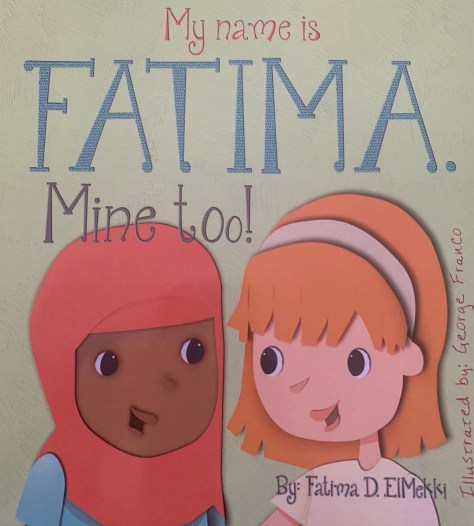
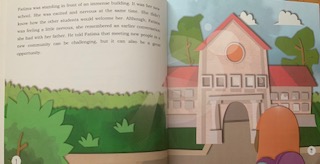
Fatima is from the Democratic Republic of Congo and on her first day of school in a America she tries to remember her father’s advice, that meeting new people can be a challenge, but also an opportunity.  

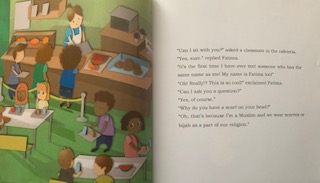
At lunch a little girl asks to sit with her, excited to meet someone with her same name.  Fatima asks her why she wears a scarf, and listens to her explain it is because she is Muslim and the hijab is part of her religion.  

IMG_1929

At recess, Muslim Fatima tells non Muslim Fatima that she is named after Prophet Muhammad (saw)’s daughter and asks her who she is named after and if asks she is Muslim, too.  The other Fatima says that she is Catholic and that she doesn’t know why her parents named her Fatima, but that she will find out and let her know.

IMG_1930

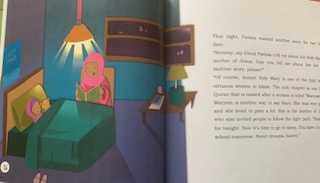
That night Catholic Fatima learns that her mom had gone to Fatima, a city in Portugal, a famous city for all the miracles that have happened there and the apparition of Mary, the Mother of Jesus.  Fatima’s mom had gone there to pray for a baby and promised if she got pregnant that she would name the baby Fatima.

IMG_1931

The next day Catholic Fatima tells Muslim Fatima and also asks her if she has heard of Mary, the mother of Jesus.  Muslim Fatima says she has heard of her, but doesn’t know much and that she will ask her parents and let her know.

Muslim Fatima learns that Mary is one of the four virtuous women in Islam and that there is a chapter in the Quran named after her.  When she tells Catholic Fatima the next day at school, the girls marvel at how much they have in common.  They are BFFs despite their differences and beautiful ones at that.

IMG_1932

I love that the book is framed in opposites to show similarities.  I also love that it shows women in our respective faiths with similar values, similar names, and Mary’s role in both our traditions.  So often, when we are building bridges we discuss how Yusuf is Joseph and Musa is Moses, Yahya is John and we go through the old Prophets, this was a nice change in perspective.

IMG_1935

The illustrations are nothing to get excited by, but they do show smiling warm characters and family members.  They serve as a distraction from the text heavy pages that do nothing to grasp the reader with their plan font and majority white backgrounds.

IMG_1933

This book would work for Muslim children, Catholic children, really all children.  It talks about faith, but as the characters view it, not in a one is better or more right than another.  There is a second book in the series about Fatima inviting Fatima to an Iftar party  that I look forward to checking out soon.  I hope it is a little more rich in dialogue and character building instead of just a foil to disseminate the information between the two faiths, but even if it isn’t I still think the book has value and you should check it out.

IMG_1934


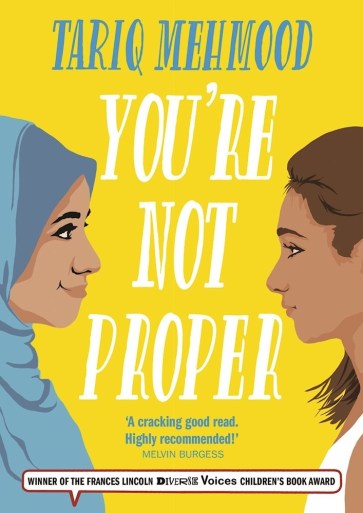
You’re Not Proper by Tariq Mehmood

Standard

your not proper

This highly praised British young adult novel is intense.  If I was trying to sell you the book I would say that it is relevant, gritty, raw, and real, but as a reviewer, it is definitely more rough, all over the place, and random.  There is so much going on in the book that it should be well over 400 pages to resolve it all, but almost as if the publisher required that the book be less than 200 to fit the demographic, it all gets tied up way too simplistically and leaves dozens of tangents unresolved, unexplored, and hanging.  The main characters are 14 years old, but I think it is a bit too harsh for that age group and should probably not be read by them.

SYONPSIS:

Karen’s mom doesn’t believe in God but takes her to church.  Karen’s dad is a Pakistani Muslim who loves bacon and beer.  The book opens with Karen’s gang marking her forehead with a cross against her will, and her soon after deciding that she doesn’t fit in with her friends and will now be Muslim.  Part of this transformation involves her wanting her name pronounced properly, as Kiran and her wearing a hijab.  Her parents are pretty ok with the decision, but the author foreshadows that this will be the undoing of her family.  

The book gets crazy, like all over the place crazy, but because of the little hints that all this craziness is leading up to something, I kept reading thinking that the author had it under control.  But no, I don’t think he does or did. 

The most craziness comes from Kiran’s rival Shamshad who leads another gang and pretends to be really religious, but is a bit of a rebel and bully herself.  The author is told from both Kiran and Shamshad’s perspectives, and while at times the reader sympathizes with Shamshad, as her influential father is abusive, many of her actions are so jarring and awkward, that no, she isn’t really like-able at all.  She wants a computer, her parents are that strict, yet she goes out with a guy, gets drunk, hangs all over him, goes to a Halloween party/dance without seeming to have to sneak about doing it.  She is regularly beating people up, threatening to kill and maim people with scissors, not a nice 14-year-old, nor a believable one either.  

As Kiran tries to learn about Islam and figure out what is tearing her family apart, and Shamshad is trying to find her place, the two storylines come closer together before the big climax of learning what tied the two girls’ families together in Pakistan and then here in the same English neighborhood.  The climax/ point of the story is actually a good one, but the resolution of it, is so simplistic that it cheats the reader of any potential investment they may have skimmed from the crazy build up.  It seems like the author had an idea and just worked backward for his big reveal, which is probably how most books are written, but in good books, you connect with the character and join them in their journey, here there is no character connection.

WHY I LIKE IT:

I like the idea of the book.  That there are good and bad Muslims and Christians, that things are diverse and complicated and that we all have our own baggage either at home, or in our heritage, or in our environment. But the book is not cohesive, the characters are really, really harsh.  And it doesn’t seem the author gets their voices right.  Plenty of males write beautiful complex female characters and vice versa, and plenty of adults get teens right, but I don’t think this author got either.  The girls are not believable and the minor characters are just as bizarre.

I think if you you live in a highly diverse area and you are acquainted with lots of minorities you can handle the way Islam is portrayed, but if you aren’t I think both Muslim and non Muslim readers alike will be shocked and offended by the portrayal of such crude characters.  This isn’t a book of accepting differences and finding a way to get along, it is more of a book showing how awful everyone is in varying degrees.  If it was an adult book perhaps you could argue it is realistic, but as a teen book, I think the lifestyle choices of all the characters will be eye-opening and not necessarily in a good way.  I do like that the book isn’t offering a moral statement or opinion on Islam, but the way Islam is presented isn’t inspiring either.

I’ll admit I’m a sucker for books that are meticulous, not boring, but deliberate.  Authors like John Irving who seem to map their stories with crime solving precision.  Where every sentence serves a purpose and every idea has a reason for being shared.  Most books leave something hanging, but this book, left everything hanging.

For two girls in gangs, the gang members by and large fade away before we even get to know them.  There is a rally being planned but resolved half heartedly.  Kiran has to fight with her parents to learn about herself in a really unrealistic way.  Kiran harasses her dad to learn about Islam, but then all of a sudden her paternal grandpa lives nearby and brings over a marriage proposal, why couldn’t she ask him about Islam, and why would a 14 year old be considering marriage?  The whole scene of Kiran getting a hijab is weird and pointless, why stress underwear and having another customer make a random comment for no reason.  What was the obsession with swimming for Shamshad and her mother, like there is a lot of space dedicated to this topic, and I don’t really get it.  Shamshad’s dad is also creepy, he seems to have a decent relationship with her, but is physically abusive to her mom, and he does a weird inappropriate thing with a pointer stick to Kiran at the masjid, that should be discussed more in my opinion.

Once the big reveal happens really there are more questions than answers.  Like I still don’t get why the families hate each other, if they had to make promises of secrecy in Pakistan, couldn’t they just ignore and be ambivalent to one another in England? Why so much hate and hostility? And what is up Jake? He seems like a good friend that makes some mistakes and Kiran is awful toward him, then all of a sudden she claims him as a brother.  And whats up with him going on and on about his brother in the military, I need closure! And last but not least why when Kiran’s mom is in the hospital after a failed suicide attempt, why does the Curry Club, that no one in the book ever liked, suddenly in the hospital room with them, when it should be a tender mother-daughter moment? Seriously, I was beyond annoyed.  There should have been a message, or a cathartic release, not annoying super side characters coming back for no reason.

FLAGS:

Lots of violence, alcohol, language. There are also romantic relationships and the celebration of Halloween.

TOOLS FOR LEADING THE DISCUSSION:

I don’t know that I would recommend this book to anyone.  I am willing to concede that some of it was lost in translation for me, but there is so much going on in the book that there is no way that it can excuse it all.  I would love to discuss some of my concerns with someone who has already read it though. So feel free to reach out, I’m all ears.

A Moon for Moe and Mo by Jane Breskin Zalben Illustrated by Mehrdokht Amini

Standard
A Moon for Moe and Mo by Jane Breskin Zalben Illustrated by Mehrdokht Amini

IMG_1514Based on the release date of this book (August), I preordered it in the Spring with the Peg+Cat book thinking they were both about Eid al-Adha.  Oops.  As someone who reads a lot, I really need to learn how to read.  This book is not about Eid al-Adha, it actually mentions Ramadan, but just as a context point, so rather than wait til next Ramadan to post the review, I though, lets do it now and celebrate how much we all have in common and build bridges of friendship across religious lines during this blessed month of Thul Hija.
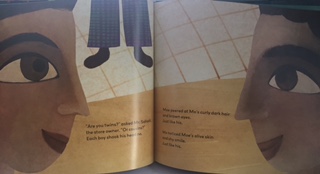
Set in Brooklyn, New York, Moses and Mohammed live on opposite ends of the same street.  One day they accompany their moms to a store in the middle of the street, and when the boys start touching things they shouldn’t their mothers’ reprimands reveal their shared nickname, Mo/Moe.  

IMG_1520

The boys then pause to look at each other and notice the same dark hair, brown eyes, olive skin, and shy smile.  Add in to the mix that one of them has a bouncy ball, and the boys become quick friends, while their mothers shop.

IMG_1519

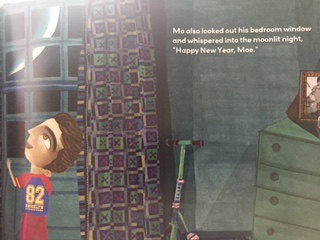
The boys hope to see each other again, but don’t.  Weeks pass, and the Feldman family is busy getting ready for Rosh Hashanah and the Hassan family is preparing for Ramadan.  Another chance meeting happens at the park, and the boys are thrilled.  The mom’s are seen chatting and then, the boys are missing, and the moms are panicked.  They are found playing in the dirt, but the relief from the moms, bonds the families who plan an evening picnic together.

The book concludes with the boys in their own homes looking at the same moon and wishing each other a blessed Ramadan and Happy New Year to themselves.

IMG_1516

The book reminds me a lot of Yaffa and Fatimah, Shalom, Salaam, in the way the two characters, one of Jewish faith, and one of Muslim, occupy the same environment and come to know and appreciate one another as friends.

IMG_1517

The illustrations are by the same artist that illustrated Hena Khan’s color and shape books, and they are vivid and fun.  I’ve read the book a few times, and flipped through it a few more times just to marvel at the pictures and the world of these two sweet families.

A great book, that I hope to use in an interfaith story time when the opportunity arises!

IMG_1518

Sidenote, the shop keeper is the nicest one ever, he gives the boys taffy, and warm falafel, and doesn’t scold them.  The book mentions a few foods and at the end of the book there is a factual paragraph about the holiday and a recipe to try.  There is also an Author Note and Illustrator Note at the end of the 48  page book.  The book would be perfect for 5-8 year olds, but younger kids and older kids will enjoy the book as well.


Hats of Faith by Medeia Cohan illustrated by Sarah Walsh

Standard
Hats of Faith by Medeia Cohan illustrated by Sarah Walsh

Hats_of_Faith_Sm_1024x1024

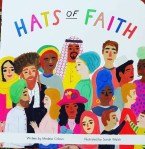
How fun to find similarities between groups that on the surface might seem so very different.  This 7×7, 14 page board book, keeps it simple and perfect for toddlers starting to notice people all the way through to early elementary children making connections around them.

Each page shows a portrait style illustration with a warm smiling face and the repetitive text of identifying what the name of the “hat” is followed by who wears it.

The opening page states that ” Many religious people share the custom of covering their heads to show their love for God.” And concludes by saying that “Learning about each other makes it easy to be more understanding.  Being understanding helps us spread love and peace.”

hats_of_faith_deensquare_04.jpg

Muslims are mentioned and depicted on the hijab page, the topi page, and on the head wrap page.  The book shows Muslims, Sikhs, Rastafarian, Jewish, and African Christians, it shows both men and women and offers phonetical pronunciations when necessary.


The Most Magnificent Mosque by Ann Jungman illustrated by Shelley Fowles

Standard
The Most Magnificent Mosque by Ann Jungman illustrated by Shelley Fowles

Most-Magnificent-Mosque

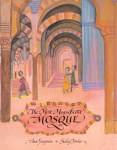
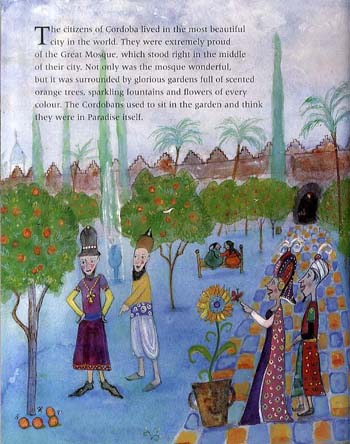
Three very naughty boys harass visitors to Cordoba’s Great Mosque in Spain.  Rashid, a Muslim, Samuel, a Jew, and Miguel, a Christian, run through the fountains, destroy the flowerbeds and throw oranges at people leaving their prayers.  Most days the boys can out run the gardeners, but one day they pelt the Caliph himself with a rotten orange.  The punishment from the Caliph is three months of hard labor working with the gardeners everyday on the mosque grounds.  On their breaks the boys explore the mosque and marvel at its beauty.  By the end of their sentence, the boys have such a love for the mosque and one another that they are forever bound.  As the boys grow and make their way in the world, they don’t keep in touch much.  However, when Cordoba is defeated in battle by the Christian king Fernando, it will be up to these three boys to convince the new king, that the Mosque shouldn’t be torn down.  And that the it is the pride of all people in Cordoba, Muslim, Jewish, and Christian alike.

magnificent mosque 1

The book is 32 pages and an AR 4.0.  It does a good job of showing the three faith communities coming together to save something they all value.  It also shows a kind, yet purposeful punishment from the Caliph to the three boys.  While younger kids in story time will enjoy the concept of people working together, the book really finds its strength with students learning or familiar with Spain, particularly prior to the Inquisition.  There isn’t a lot of detail regarding the structure of the mosque, or the doctrine of each faith, that knowledge would have to come from outside the book, in order for it to be appreciated. There are some plot holes in the story and the book itself doesn’t make it clear what parts of the story are historically accurate and which are fiction.

magnificent mosque

The illustrations are charming in their own way.  The watercolors do a good job bringing to life the mosque and gardens, and battle, but for me fall a little flat in depicting the three boys.  I don’t know if the text or illustrations are at fault for me not connecting to the story or finding an emotional resonance to what should be a very inspiring story. Perhaps it is a combination of the two.  I feel it is desperately in need of an author’s note detailing the factual origins of the tale,  Something to uplift and give hope to people of different faiths coming together in a peaceful way, that can be put into real world actions.

magnifectn

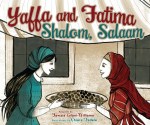
Yaffa and Fatima: Shalom, Salaam by Fawzia Gilani-Williams illustrated by Chiara Fedele

Standard
Yaffa and Fatima: Shalom, Salaam by Fawzia Gilani-Williams illustrated by Chiara Fedele

Yaffa and Fatima cover.jpg

Oh how full my heart is after reading this book, and wiping a tear from my eye.  When the daily news angers and frustrates, a story as sweet as two friends helping and worrying about each other gives hope to the future of the world. I know that is probably over reaching the impact of a children’s book, but sometimes it really is just one person helping another person, just finding similarities instead of differences, and above all having a big heart.

Yaffa and Fatima are neighbors and both grow dates.  The two women, one Jewish and one Muslim, share a lot of similarities they both fast, pray, celebrate, and help others. They often sell their dates next to each other in the market and then share their food and customs with each other.  During one growing season, rain is scarce, and each woman begins to worry about if the other has enough- not just to sell, but to eat as well.  Secretly they both help each other and prove the power of friendship and kindness is universal and powerful.

Dino-Wresting

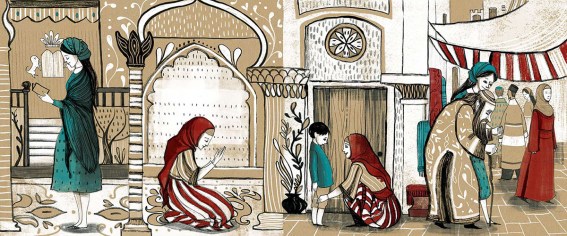
The illustrations are smartly done.  This isn’t the book for bright and colorful or overly cartoonish depictions.  The simplicity of the words introduce the reader to Islamic traditions and Jewish traditions, but the purpose is to show their similarities and the illustrations mimic that sentiment beautifully.  The contrast of red and blue show the differences with the larger muted tones being the same. The warmth in the characters faces mirror the warmth of their actions and the detail is balanced with intriguing the reader without distracting from the text.  The illustrator does a good job of also showing the women covering their hair in public, albeit differently, but not within their homes. And of also showing the different ways the women worship without the words having to do so.

Dino-Wresting

The author has a note at the beginning acknowledging the roots of the story as a tale about two brothers in both Jewish and Arab traditions.  And at 24 pages it works for children of all faiths and all ages, two years old and up.  The book was recommended by a woman, who I hope to meet next week, when she and her Jewish community join us at the mosque for our monthly story time.  With a theme of friendship, this book will be the focus of what bridges and connections we can all make in our personal lives to make the wold a little better.  I can’t wait to share it with our children of both faiths!