Tag Archives: Henna

The Best Eid Ever by Sufiya Ahmed illustrated by Hazem Asif

Standard
The Best Eid Ever by Sufiya Ahmed illustrated by Hazem Asif

This book blends some facts about Ramadan and Eid with cultural practices, showing a day in the life of a family celebrating, and a sprinkling of a story line to keep elementary aged kids invested. The back of the book labels it as an introduction to Ramadan and Eid and I think that is a pretty solid summary.  Aisha is eight, and apparently too young to fast from sunrise to sunset.  I wonder if she is old enough to fast from dawn to sunset as Islamically prescribed? Yes, I’m petty, but it is wrong to say sunrise to sunset, and I’m not backing down. This year her aunt, Chachi Amal has made a scavenger hunt for her and her brother to find their Eid presents, but first there is henna to apply, decorations to hang up, Eid prayers to attend, desserts to be shared with neighbors, and lunch to be had, before the three question scavenger hunt can commence, and presents can be located.  The backmatter has information about Ramadan, Muslims, Eid, and a glossary.  The book would work well for a generic class or library story time. I don’t imagine Muslim kids will find it particularly memorable and ask for it more than once.  It is a Desi family, with the Chachi being Libyan and sharing desserts. hinting at the diversity of Muslims, and I can see kids wanting parents to hide their gifts and make a scavenger hunt, which is sweet and a nice idea to build on.

The book starts with Aisha looking outside to see if the moon can be spotted and Eid determined.  Samir and Dad come in and say that the mosque has declared Eid tomorrow.  Eid is Aisha’s favorite festival, she loves Ramadan, eating iftar with her fasting family, and she loves dates. This year her Chachi has hidden their gifts and made a scavenger hunt for the kids to follow.

Aisha can’t wait, but her Mom says they have other traditions first, and Aisha has henna painted on her hands.  They have to dry for at least two hours, so she watches a show while Dad and Samir decorate.  Then it is time for bed, and the scavenger hunt will have to wait.

Early in the morning is no time for a scavenger hunt, Mom is in the kitchen and they have to get to Eid prayers. After salat, and wishing everyone Eid Mubarak, Aisha is ready for the clues, but her and Samir are sent to deliver sweets to the neighbors.  When they return home, they can’t get to presents because it is lunch time. Finally, the scavenger hunt begins, the clues are solved, the presents found, and the day “the Best Eid Ever.”

I purchased this book from Crescent Moon Store, code ISL will save you 10%.

Our Neighborhood: Excited for Eid by Marzieh Abbas illustrated by Anoosha Syed

Standard
Our Neighborhood: Excited for Eid by Marzieh Abbas illustrated by Anoosha Syed

img_8357-1

Like the first book in the Celebrating Islam from the Our Neighborhood series, Friday Fun, this 26 page 7 x 7 board book is delightfully done in capturing the joy, sentiments, and traditions of the day. The mix of specifics and generalized parts of an Eid day experience offer both a window and mirror for toddler to early preschool kids. My concerns is that while maybe families will sense that henna/mendhi is cultural fun, and balloons and ice cream are not a religious requirement of the holiday, the two page spread dedicated to gathering at graves is a lot of space given to a cultural practice, not an Islamic one. I’m not a scholar and the book with its minimal words does not indicate if these families are visiting all graves, if they visit on days other than Eid, if they are grieving recent deaths and acknowledging that holidays can be hard. It shows multiple families at multiple graves some with flowers, some bare, some placing flowers, under the words, “gather together” and “love forever.” It is uncomfortable to me because of the space it takes up and the implication that it is a major part, or perhaps that it is a requirement of the religious holiday, when it is not.

img_8360-1

Similarly, the absence of going to the masjid or even praying is also glaringly missing. The family goes past the “lit up mosque” to get to the “fun kiosk” later at night for fun and games, but again no Eid prayers, five daily prayers, or really any worship is shown to take place on Eid other than in the illustrations reading Quran and making dua at graves. Hijab is shown on numerous women and mentioned in the text. For a book about a religious holiday, positioned to celebrate Islam, I would have hoped for some clear religious acts to be shown and articulated as being joyous parts shared by a global faith.

I enjoyed the little baby’s desire for ice cream that stretches through the story. It will add a layer of joy to even the youngest audience members. The gathering to eat and share and have fun is beautifully illustrated under the simple rhyming text, but Eid is a religious holiday, and that point seemed unfortunately absent.

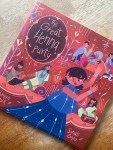
The Great Henna Party by Humera Malik illustrated by Sonali Zohra

Standard
The Great Henna Party by Humera Malik illustrated by Sonali Zohra

img_3465-1

This 32 page story shares a desi family at a henna party before a wedding.  There is nothing Islamic in this book by a Muslim author, it is simply cultural.  The story on its own is fine.  It is sweet and joy filled, as a girl tries to decide who’s name to have hidden in her henna design.  I do wonder though, if the book is meant to be a window into desi culture, why the Urdu word “mehndi” isn’t used instead of henna.  It mentions it in the backmatter, that mehndi is the Urdu word, but it seems a little inauthentic and western gaze presenting throughout the story, and honestly I really struggled to get past it.

img_3466-1

The book starts with Noor entering the henna party, the night before her cousins wedding, to sing with the ladies of the family and have their hands painted.  Her mother asks her if she knows about the name game, where the bride hides the grooms name on her hands, and if he finds it, he wins, and if he does not, the bride wins. Noor asks if she can hide someone’s name and her mom says yes, just tell the artist.

img_3467-1

She watches her dad setting up decorations and wonders if she should have his name hidden.  She then sees her Mama playing the dholki and singing and wonders if she should hide her mother’s name.  She continues through various family members before making her decision.  Along the way the reader learns about the music, the food, the clothes, and how the paste dries and leaves a color.

img_3468-1

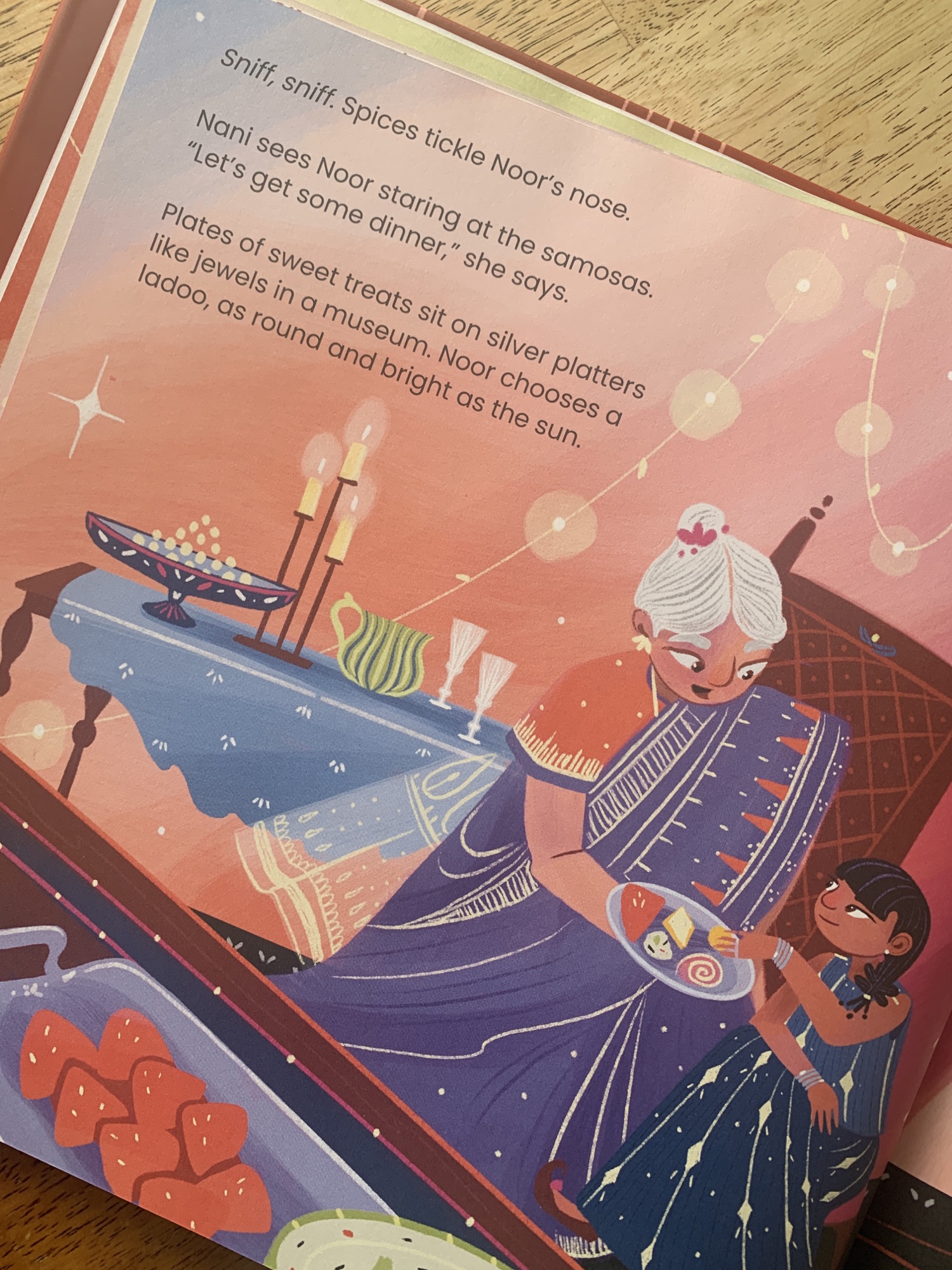
The page on food starts with spices, then talks of samosa and then they are eating ladoo, and while I’m glad there is not a glossary, I don’t know that the lacking context clues make any of those scrumptious foods known. I do like that her grandfather helped her pick out her lehenga, and her father is shown decorating to show full family involvement.

Ultimately, though I think the tricky thing about cultural weddings, is that every family has their own traditions, and while in a desi wedding some things might be widespread, when presenting them to readers outside your culture, it is hard to know how they will be perceived.  I almost feel like this book makes it seem that every family hides names in the mehndi as a staple of the festivities. And based on other reviews I’ve read, people seem to feel that this is insightful into the culture, or that hiding and finding names has more weight, a stress even, than just being fun.

img_3469-1

I could be over thinking it, but it feels like even the backmatter is trying to cast a wide net over every religion and culture that uses henna and ends up being oddly vague in this specific example.  Like I said the book is adequate, I like that the little protagonist Noor, loves so many people and solves her dilemma on her own, it has plot, and conflict and resolution, it just seems to lack the exciting tone and thus fails in immersing the reader into the henna party.

Arab Arab All Year Long! by Cathy Camper illustrated by Sawsan Chalabi

Standard
Arab Arab All Year Long! by Cathy Camper illustrated by Sawsan Chalabi

arab

This 40 page month-by-month celebration of Arab culture, both old an new, will be a source of pride and smiles for readers of all ages.  The author is an Arab American of Lebanese decent and the illustrator was born in Lebanon.  The book shows Muslim’s teaching others about Ramadan, looking up hijabi fashions, as well as making cookies at Easter and dressing in sleeveless shirts.  To be Arab is not a monolith and this book seems to convey that culture and tradition and love are all it takes to be included in the broad diverse identity of being Arab.

January starts with finding stars with Arabic names, and February recalls how a comic about Martin Luther King, Jr. helped inspire the Arab Spring.  The kids in turn make a comic to teach others about Ramadan.  March is a chuckle about Arab time, and April is making maamoul with Sitti for Easter. May is learning to write Arabic and June for gathering grape leaves to make warak enab.  July is picnics that remind mama of Morocco and making perfume with familiar smells and memories. 

August is playing the doumbek with Dad who is in an Arab band. September is researching hijab costumes to wear to comic con.  Dressing up like Umm Kulthum wins first prize.  October is pomegranate time, which means the kids jump in the tub to eat and enjoy the messy fruit. Chilly November air requires the Palestinian keffiyeh to keep memories warm, and December when friends are busy over winter break it is time for sleep-overs and henna parties.

I like that dressing up is not for Halloween and that while some examples are country specific, many are general.  The book specifically mentions a few Arab countries, but the electronic arc did not include all the supplemental information that the published hardback book will contain.  I can’t wait to check it out and gift to my Arab friends and their children. 

Nadia’s Hands by Karen English illustrated by Jonathon Weiner

Standard

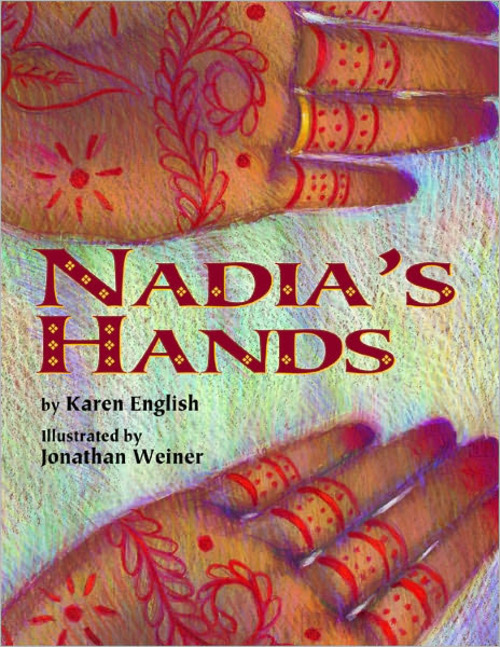
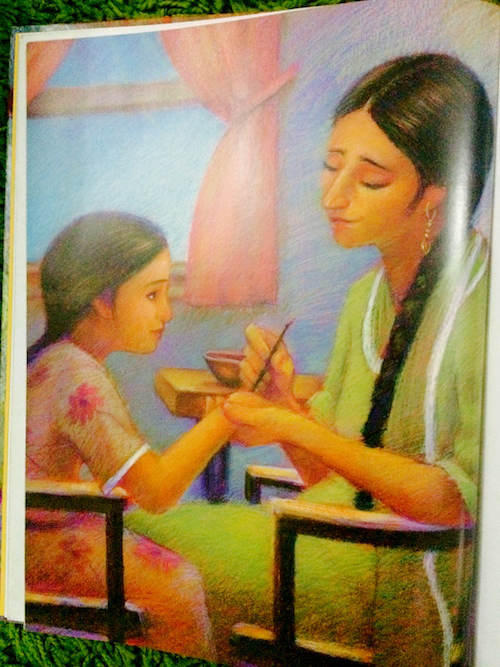
nadia's hands.jpegNadia’s aunt is getting married and she gets to be the flower girl in the Pakistani-American wedding.  She also will get mehndi put on her hands for the big event.  Her cousins warn her that she might mess up and even in the midst of her excitement she begins to worry what the kids at school will say when they see her hands on Monday.  As her aunt prepares the mehndi and the application process begins, various uncles peek in on her and her aunt gifts her a beautiful ring.  The mehndi has to sit on the skin for a while to set and as Nadia practices sabr, patience, I couldn’t help but think something seemed off in the story.  I’ve been at, in, and around a lot of Pakistani and Pakistani-American weddings, and this story didn’t seem to reflect the tone of such occasions.  The book doesn’t reflect the hustle and bustle and near chaos, it doesn’t sound like the tinkle of jewelry and laughter as the women sit around chatting and getting mehndi put on together, the pots on the stove are referenced but not described so that the reader can smell the sauces thickening and hear the pans crashing and taste the deep rich flavors.  It is lonely.  Nadia is lonely and filled with anxiety about Monday.  Durring the wedding she is walking down the aisle and suddenly freezes when she looks down and doesn’t recognize her hands.  Her cousins seem to show unsupportive “I-told-you-so” expressions as she searches for some comforting encouragement to continue on.  When she finishes her flower girl duties, her grandma asks if she understands why looking at her hands makes her feel like she is “looking at my past and future at the same time.” Nadia doesn’t understand and the author doesn’t explain.  At the end she is ready to embrace that her hands are in fact hers and that she will show her friends on Monday.  But the reader has no idea how it goes, or what exactly the significance of her painted hands are.  The book fails to give any insight or excitement for a culture bursting with tradition at a time of marriage.
 nadia's hands inside

There is a glossary at the beginning for the few Urdu words sprinkled in the book.  There is no further explanation however, of  mehndi, or weddings, of the brides clothes etc.  The illustrations are adequate, but because the text doesn’t offer much warmth or vibrance, they seem a little drab, and raise more questions about what some of the traditional items depicted are.  The book is a standard 32 page picture book and is written on an AR 3.8 level, which I think is a little high.  Granted my children are familiar with mehndi, but my first grader read it to me with little assistance.  There isn’t any mention of Islam and could probably be argued that the story reflects any wedding from the subcontinent background performed in the west.  The bride has a duputta on her head in the picture, but that is neither here nor there, and no one in the audience appears religiously covered.  I would assume they are Muslim because of the minor characters’ names: Omar, Saleha, Amina, Abdul Raheem.  Also, the word Sabr, an Arabic word, suggests that they are Muslim.  Plus they eat kabobs which the glossary defines as mincemeat, so probably not Hindu.  Overall the book is not, “bad” or “wrong,” I just wish there were more to it.