Tag Archives: grandfather

Music of the Mountains: A Story in Pakistan by Sabrina Shah illustrated by Manal Mirza

Standard
Music of the Mountains: A Story in Pakistan by Sabrina Shah illustrated by Manal Mirza

Set around an Eid concert in the North-West Frontier in Pakistan, a young girl must find her courage to play the rabab in front of an audience, even though she is still learning her first song. The beautiful illustrations of Manal Mirza and focusing on an under represented population, made me hopeful that this book would transcend the musical focus and weave in Islam and culture. Sadly, though, the book falls victim to cliche lines that mean nothing, and a story that doesn’t make a lot of sense once you move past the superficial attraction. The backmatter infographics about the rabab, where it can be heard, details about the Pathan/Pashtun people, What Eid is, the traditional clothing, and a Pashto Glossary, add to the vibe of the book, but still fail to offer any specific “hospitality, courage, and rich traditions,” that are only ever referenced in generalized terms and statements.

The book starts with Roohi’s favorite time of day, the sun is settling behind the snow capped mountains and her family is gathering around to listen to her grandfather, Neeka Baba, play the rabab. No they aren’t praying maghrib, or breaking their fast, so presumably it is not Ramadan.  When Neeka Baba plays, “songs full of rhythm echo through the cherry blossom hills.  Songs from long ago tell stories of folklore, heroes, and love. . . songs of Roohi’s ancestors.” A beautiful sentiment, but it is not a thesis statement or main idea of the book as we, the reader, never learn about her ancestors, or folklore, or about the culture.” We are just told they all had courage, and she needs to channel that strength.

She will need strength to play the rabab at her school concert, except remember “she hasn’t even learned a whole song yet.” She also worries she won’t be as good as her grandfather, but presumably he has been playing longer and she is just starting, so I never connected why she felt she should be as good as him.  No one in the story compares them, or says she should be as good as him, or even strive to be as good as him.  There is nothing that hints that this is even a part of the characters development other than the repetitive refrain that she must “play with the courage of those who came before her.” So the cathartic release of being told “to play like yourself” also seems forcefully contrived and not a natural arc of growth and understanding.

As Eid creeps closer, Roohi has lessons with her grandfather on the rabab, and then Neeka Baba coughs and is in the hospital. The reader has no idea how this man falls ill, or recovers, if it was sudden or a known affliction, but he is no longer the focus, the rabab is, and so the story continues.

At the school concert, Roohi is introduced as playing music from the North-West Frontier Province.  Hold up, yes I thought I skipped a page.  They live in the North-West Frontier, don’t they, this is a school concert? What an odd introduction, did they travel? At the end there is a “smile as wide as the lush valleys back home.”  When did they leave home? And why a silent prayer, why not a “bismillah.” Isn’t the point of OWN voice to have the little details and the voice that can’t be imitated by researched work?

I am going to spoil the ending, she freezes, Mama and Neeka Baba help her find her beat in the audience and she steals the show so to speak. The ending is sweet, but not anywhere near as heartfelt as it should have been if the audience would have been shown the strength and courage of the Pashtun culture, not just repeatedly told it, felt the warmth of their hospitality, the rich ancestral values that would be threads that manifest in the music that she is hoping to share with others. Sadly we are just expected to know that they all exist and cheer for Roohi to succeed.

Disappointing, considering how fantastic the illustrations are, sigh.

Amar’s Fajr Reward by Amire Hoxha illustrated by Hilmy An Nabhany

Standard
Amar’s Fajr Reward by Amire Hoxha illustrated by Hilmy An Nabhany

As Muslim authored stories are increasingly more available, certain cultural Muslim stories continue to be limited or none existent. Since 2021, when four of us reviewers created the Muslim Book Reviewers and Muslim Book Awards space, we have constantly been encouraging Amire to work on her dream of being an author, and write a joyful Muslim Kosavar book. Through Ruqaya’s Bookshelf, her dream has become a reality, Alhumdulillah, in the form of this 32 page, 8.5 by 11, full color books for early elementary readers. In all my years of reviewing I have not ready many Kosavar books, and of those few, none have been OWN voice, and all have focused on the war.  Enter Amar’s Fajr Reward, a simple story of a boy and his Gjyshi, going for fajr at the masjid, finding the door locked, and the obstacles, determination, and results that transpire, not just for Amar but his grandfather as well.

The book starts with Gyjishi splashing water on Amar to wake him up for Fajr, while reminding him that “Prayer is better than sleep.”  Grandpa’s quick steps and a sleepy little boy, keep Amar hustling after his Gyjishi only to arrive at the masjid and find the door locked.  

Gyshi cannot be deterred by his grandson wanting to go home and pray, or a locked door and decides to jump the fence, something he has done in the past.  Calamity strikes, when he falls and hurts his foot and it is up to Amar to help.  But he can neither scale the wall or find anyone to help.  When the muadhin finally runs up the street Fajr can be made, Gjyshi can be assisted, and changes can be made so that hopefully getting locked out doesn’t happen again.

I love that there are pronunciation tips on the cover page of Gjyshi, grandfather, and Axhi, uncle, but I do wish there was some backmatter showcasing Muslims in Kosovo.  Are Muslim communities spread out in large diverse areas, or do they tend to have neighborhoods that are tied together by faith? As a place not often seen or heard about, a little layering of details would have deepened the story.  Especially, if the reasons are cultural or societal explaining why people don’t wake up until the athan is called, but were annoyed that Amar was knocking on the doors at that time, or maybe why the didn’t just pray outside the masjid, calling the athan and waking up the regulars that attend. Also about why the key to the masjid is “special.” Are places of worship regulated or only allowed to be open at certain times?  I also wish it would have given a little build up about Amar and this particular day. At the start he wants to pray at home as it seems like that is his norm, and Gjyshi going to the masjid seems to be the grandfather’s norm, so was this something special, a right of passage, are kids not typically seen in masjids is he visiting his grandfather? 

The book is sweet and warm, with a lot of heart and I love that it takes place in a masjid and threads in that salah is better than sleep, and that praying in congregation is 27 times the reward.  I also love that the author fulfilled her dream inspired by her own grandfather, and inshaAllah she will continue to write and bring Kosovar stories to our bookshelves, ameen.

Kamal’s Key by Rifk Ebeid illustrated by Sophia Soliman

Standard
Kamal’s Key by Rifk Ebeid illustrated by Sophia Soliman

This 44 page hardback book gently, yet powerfully, focuses on the Palestinian resistance symbol of the key, by sharing a multi generational tale of new beginnings, heartache, hope, and resilience. The writing is moving, and flows with simple lines, beautiful illustrations, and maintaining a focus on a singular theme. So often well meaning books about oppression, war, politics, try and include numerous details that the picture book suffers in its appeal to younger audiences, the opposite is often true with books being so generalized that it isn’t clear exactly where refugees are from or what turmoil is being discussed. This book strikes a beautiful balance of calling the incoming occupiers a dark cloud and not giving them space or attention, while focusing on Palestinian experiences through a lens of hope, joy, and love.

The book starts with the key. It is a beginning to Kamal’s home. It is on his belt at his wedding, it is the beginning of his and Huda’s new life starting together, a symbol of their home when their son is born. It is the beginning of Jalal’s imaginative play of using it as a dhulfiqar. It is secured around Huda’s neck when they are forced to leave their home, and find refuge in tents. It is hung when the tents become walls.

One day Jalal takes it down, when the hurt in his father’s eyes is too much for him to witness. When Jalal becomes a father though to Salma, the key becomes her toy, her microphone, her connection. When Kamal gifts the key to his granddaughter it becomes her art, her poetry, her necklace, a symbol of her hope and a people’s right to return.

I’ve read this story a few times to myself, as well as with my children, and I only wish it was a little larger in size. It works well one-on-one or with a few, but it is a story that needs to be shared in large story time groups, and the 9 x 9 inch size makes it a bit difficult.

img_8454-1

The book concludes with an author’s note, an illustrator’s note and a glossary, not just of terms, but traditions, concepts, and information about the song. I purchased my copy from Crescent Moon Store.

Amir’s Blue Jacket by Sarah Musa illustrated by Rania Hasan

Standard
Amir’s Blue Jacket by Sarah Musa illustrated by Rania Hasan

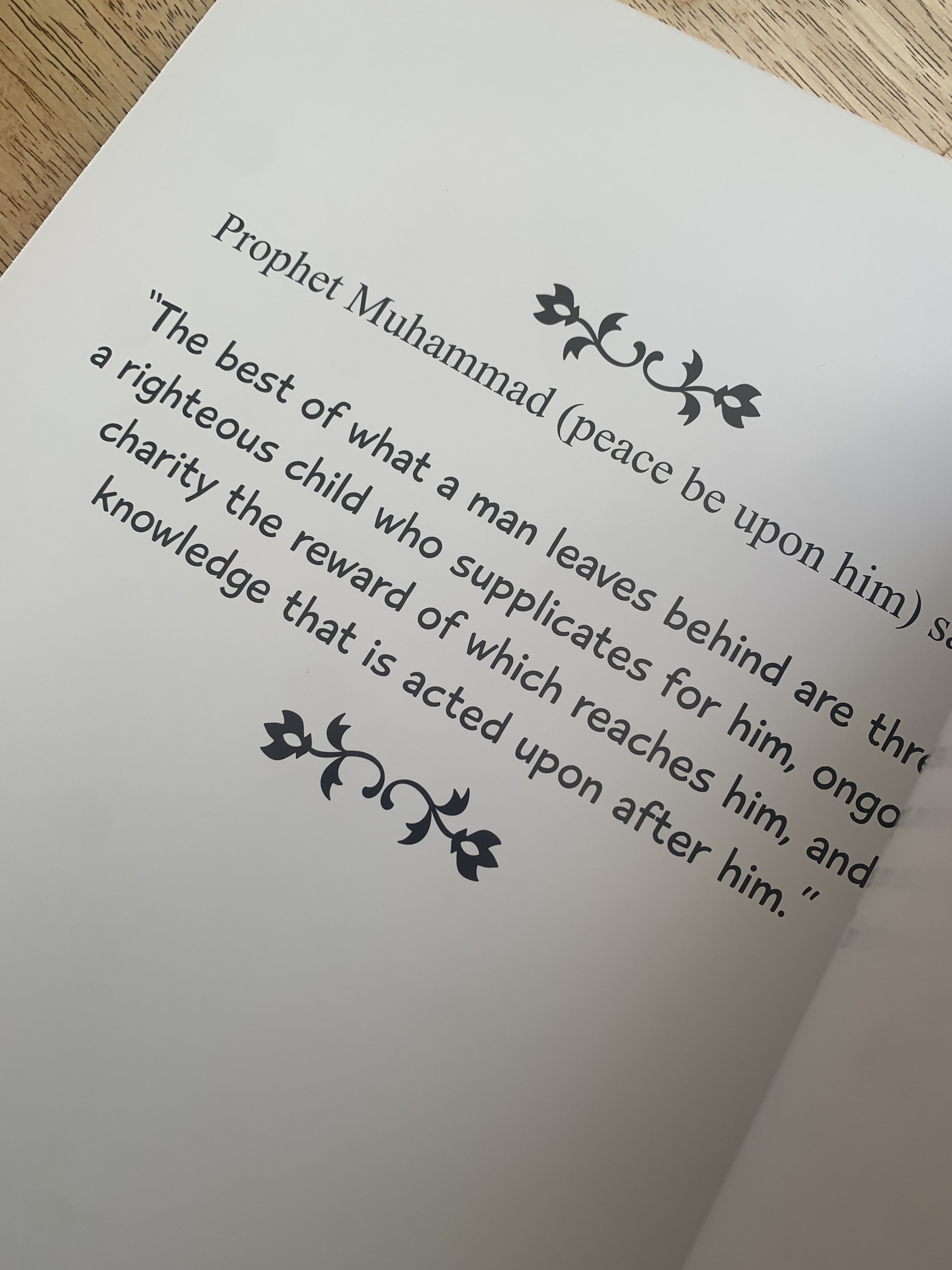
This heartfelt elementary picture book does a remarkable job of drawing the reader in to the emotions of the main character, his relationship with his grandfather, and imparting a moral message without being preachy. The illustrations are lovely on their own, but the way the muted tones convey the memories and illustrate the text really ties the book together. Whether it is for a larger story time or a one-on-one bedtime read, the book will offer discussion, comfort, guidance, and a little surprise at the end for Muslim and non Muslims alike. The slightly allegorical book does conclude with a widely known hadith (it is attributed to Prophet Muhammad saw, but is not further cited/sourced) and the family is clearly Muslim with their names mentions of Eid and God, and a hijab clad woman, but the book is universal and a lovely addition to any book shelf.

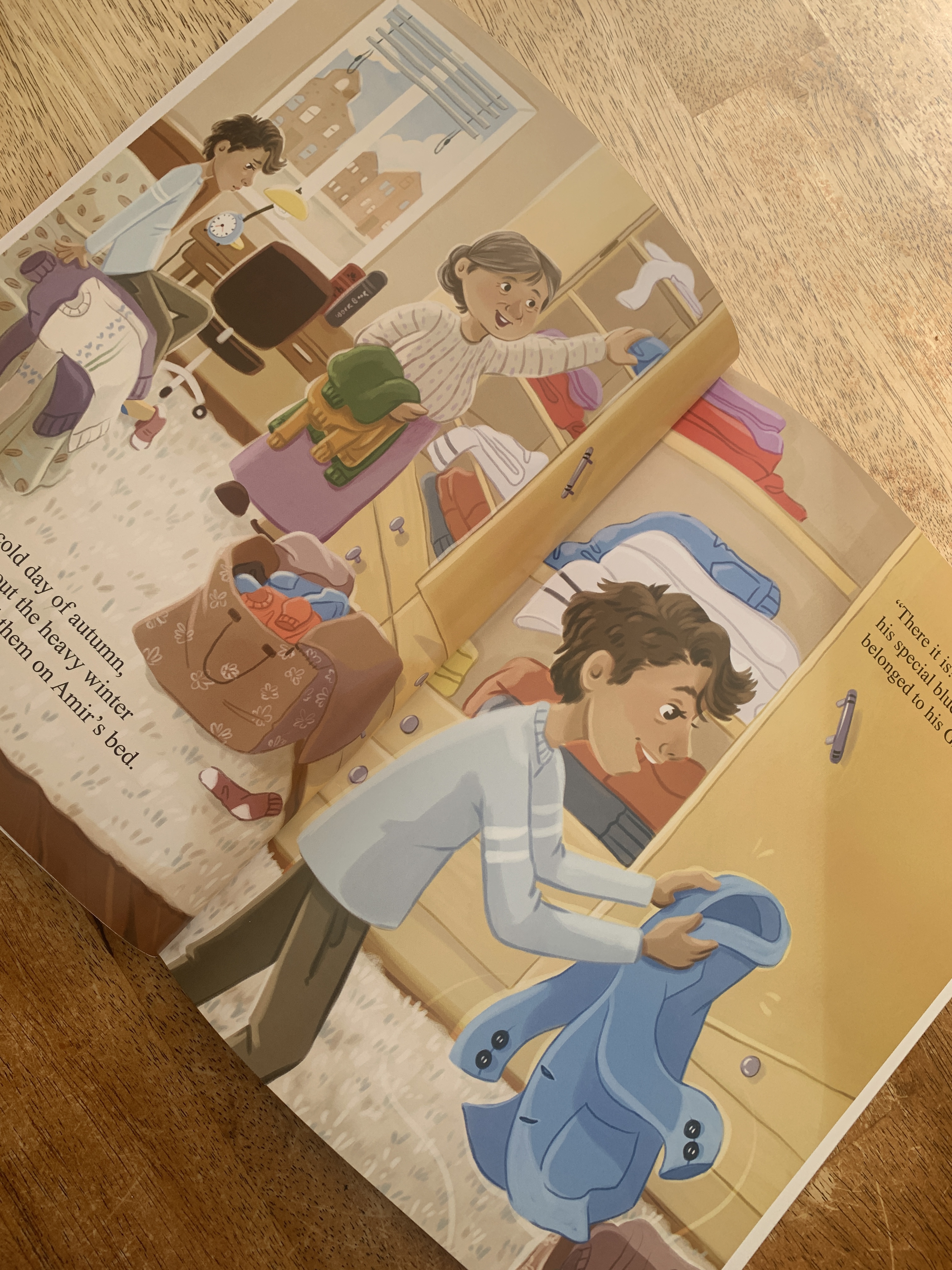
The book starts with Amir finding his Grandpa’s old blue jacket and recalling wrapping himself in it the day after his beloved Grandpa died. With it smelling like mothballs, he tosses it in the washing machine, but unfortunately when it comes out it has clearly shrunk. Amir is in denial, he says it fits fine and he has no desire for a new one. It is Grandpa’s jacket, and Amir is going to wear it, no matter how tight it is. Amir storms off to sit under the apple tree and recalls picking apples and making applesauce the year before for the whole neighborhood. Grandma shares that she used to keep grandpa’s cane but when someone needed it, she let it go.

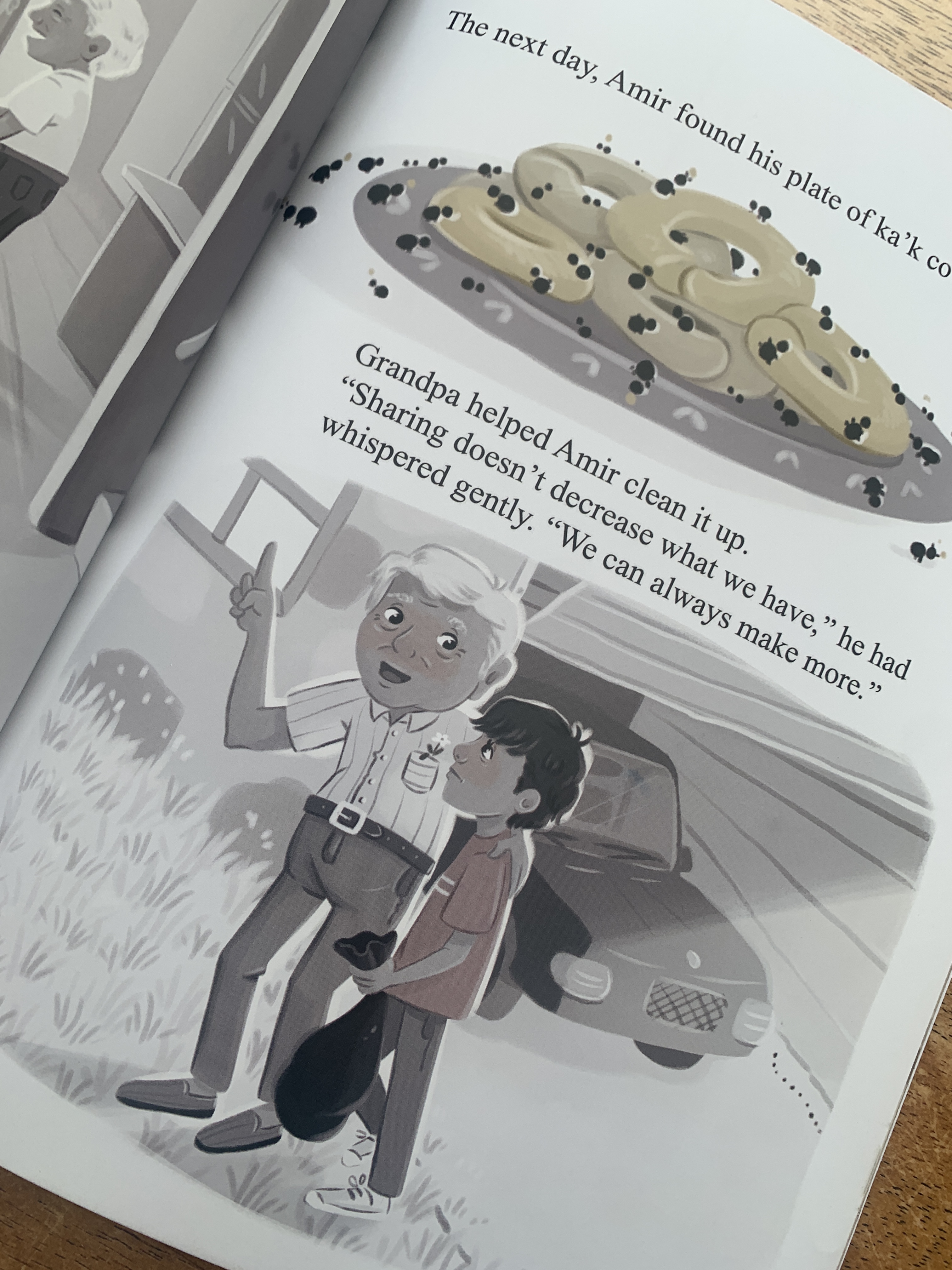
Grandma stirs another memory in Amir when she pulls the tray of ka’k out of the oven, of him trying to sneak a whole plate for himself only to have his hiding spot taken over by ants. When he is asked this time to share a plate, every step to the neighbors house reminds him even more of making the trip with his grandfather. Slowly he starts to realize that his memories are with him, not in his grandfather’s things, and Amir makes a decision that would make his grandfather proud, and (inshaAllah) give him more good deeds, even though he is gone.

The idea of sadaqah jariyah is understood through the story, and present in the hadith at the back, but it is never mentioned outright. Just as God is used, not the term Allah (swt). As Amir feels denial, frustration, and eventually peace, nothing is really told, it is shown, which really opens the book up to be a tremendous tool in sharing it with children and asking them to discuss what they understand, what they feel, and what they took away from Amir and his Grandpa’s blue jacket story.

The book is available through the publisher Ruqaya’s Bookshelf as well as HERE at Crescent Moon Bookstore where code ISL will save you 10%.

Hannah and the Ramadan Gift by Qasim Rashid illustrated by Aaliya Jaleel

Standard
Hannah and the Ramadan Gift by Qasim Rashid illustrated by Aaliya Jaleel

img_0275

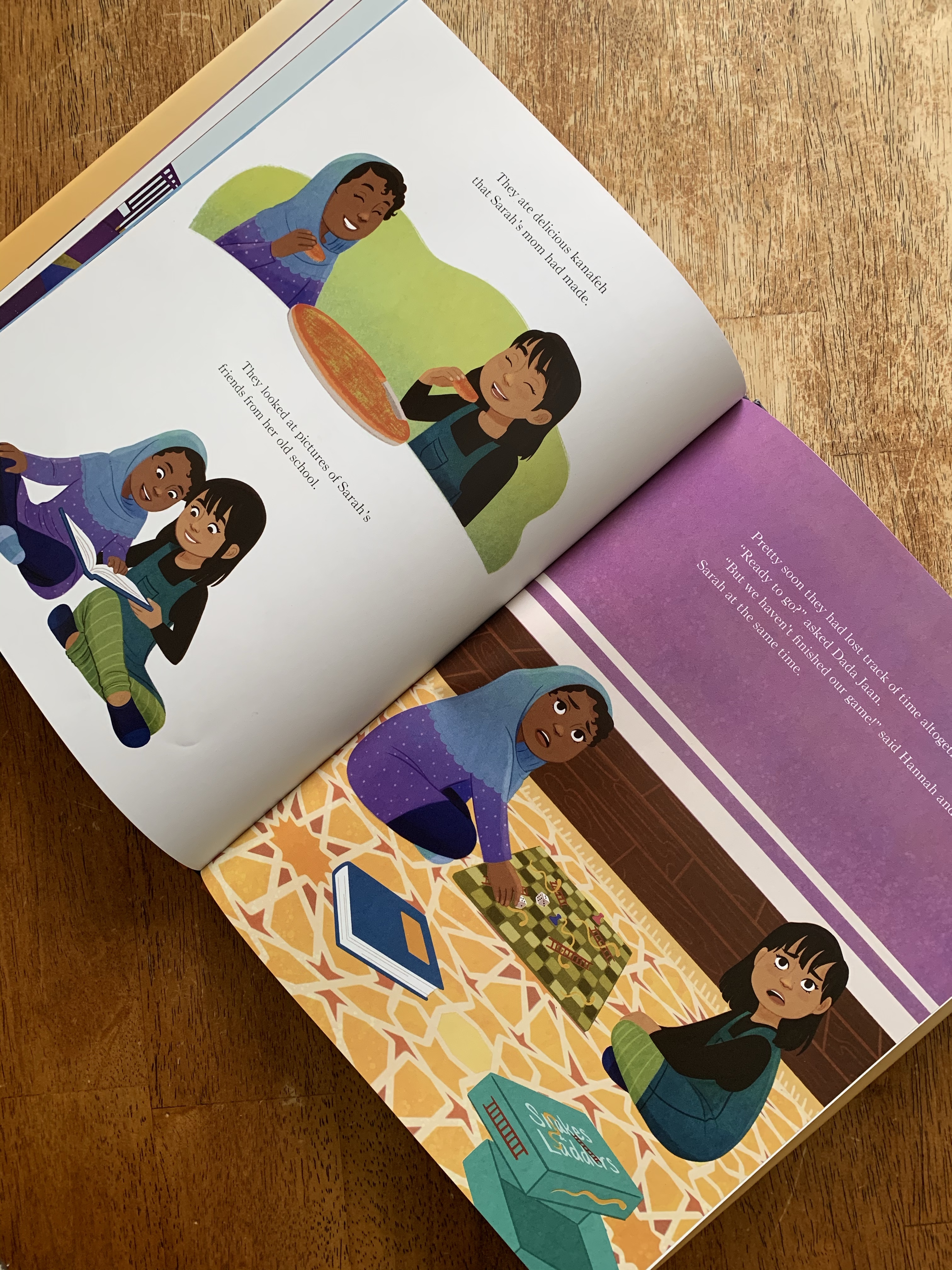
You may have seen this new 40 page Ramadan book that came out yesterday and thought, “another book about what Ramadan, is and a girl being told she is too young to fast, I’ll pass.”  And I’m here to tell you, please reconsider.  This book is wonderful and it is not the same-old-same-old.  I know the title and cover don’t hint at the heartfelt story within, but it really does an amazing job of showing, not just telling, about the feelings and purpose of Ramadan beyond the restraining of food and drink.  The text is a bit heavy, but the illustrations keep even four and five year olds engaged, and the story works for Muslim and non Muslim children alike.  The OWN voice book has a Desi slant with Urdu words, Pakistani clothing and featuring an immigrant family, but the cultural tinges are defined in the text and it flows smoothly.  This would be a great book to share with your children’s class to show how Ramadan is more than just going without food, or being just one day, or one act of kindness, it is an ongoing effort to show kindness to those near and far.  The book shows an authentic Muslim family and presents universal themes, making Ramadan and Islam more relatable and familiar to all readers, and inspiring Muslim children to find their own ways to save the world.

img_0276

The book starts with Hannah being woken up by her paternal grandfather, Dada Jaan, it is the first day of Ramadan, and she is excited.  She hopes that now that she is eight years old, she is old enough to fast.  Her heart sinks when she is told, “Fasting is for grown-ups, not for growing children,” but her spirits rebound when Dada Jaan tells her that she is going to celebrate Ramadan by saving the world.

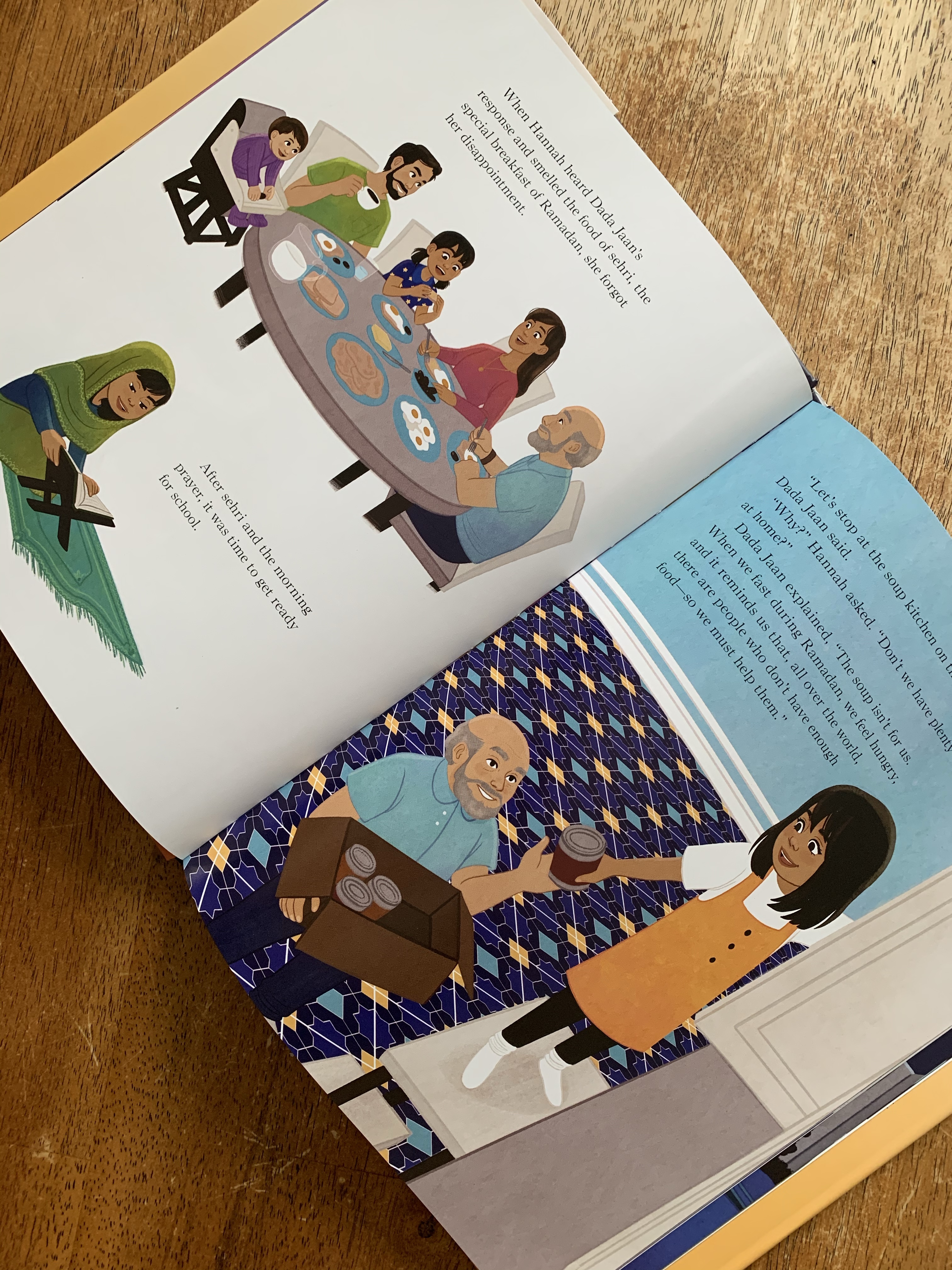
The first thing Hannah and Dada Jaan do is collect cans from the pantry to take to the soup kitchen.  Dada Jaan explains what a soup kitchen is, and why it is important to help those that don’t have enough food.  Hannah is worried they won’t be able to help everyone in the whole world, but Dada Jaan encourages her to start with her neighbors.

img_0277

Later in the day, Hannah’s friend loses a beloved family necklace, and when the bell rings she doesn’t want to be late for class, but she remembers that she is supposed to help, so she does.  Hannah finds the necklace, but her teacher is not happy when she comes to class late, and Hannah isn’t even given a chance to explain.

On the 11th day of Ramadan, Hannah and Dada Jaan decide to save the world again before they head off to the science fair.  They are packing up clothes to take to the shelter.  Hannah is worried that the people at the shelter won’t know that they are the ones that donated the clothes.  Dada Jaan says that it is enough to help people out of love and adds that the best superheroes work in secret.

img_0278

At the science fair Hannah sets up her model replica of Abbas ibn Firnas’s flying machine next to her friend Dani.  When Dani runs off to see a robot, his globe rolls off the table and Hannah saves it. Dani ends up winning and she is happy for him, but she is sad that no one knows she saved his project.

Twenty days in to Ramadan, Hannah has a play date with a girl she has never met before and Hannah does not want to go.  Sarah is new to the neighborhood and Hannah’s mom insists she goes.  Luckily Dada Jaan strikes up a deal that he will take her and they can leave when ever she wants.  Hannah and Sarah have so much fun together, Hannah doesn’t want to leave.

img_0282

When they get home, Dada Jaan shows Hannah old photographs of when he and Dadi Jaan had first come and didn’t even know the language.  They talk about how the kindness of others helped them, that and Dadi’s butter chicken.  The night before Eid, Dada Jaan asks Hannah if she helped make the world a better place, she doesn’t think she did, but he seems to think otherwise.

On Eid day they go to the mosque, then to the cemetery to pay respect to Dadi Jaan, and when they return home they find Hannah’s whole world there to celebrate with her.  Cousins, friends Maria and Dani from the church across the street and the synagog by the mosque, as well as the Sikh family that runs the soup kitchen.  Dada Jaan and Hannah enjoy gulab jamun, kheer, and jalebis as they discuss if Hannah really did help the world this Ramadan.

img_0280

It is hard in my heart to go wrong with a story that focuses on an amazing grandfather/granddaughter relationship that ends with them racing to get the last gulab jamun, so I might be a little bias.  But I was genuinely surprised and delighted by the direction the book took and the way it presented Ramadan in everyday situations that children can relate to and imitate. I was a little disappointed that the book wasn’t larger considering the phenomenal illustrations.  It is just 8.5 x 11.  I love that the characters pray and read Quran, and the mom covers and the neighbors are diverse.