Category Archives: Kg-2nd

Ibn Yunus: The Father of Astronomy by Ahmed Imam

Standard
Ibn Yunus: The Father of Astronomy by Ahmed Imam

ibn yunus.jpg

This book is part of a new Muslim Scientist Series featuring 24 glossy colorful 8×8 pages highlighting a great Muslim from the Golden Age of Islam.  Meant for Muslim children ages 4-7, the book sets out to teach and inspire little Muslims, and does a pretty decent job of presenting it in a memorable easy to understand way.  Adults might have to explain and help out a bit, but the book accounts for that too.

C6059DA8-08CC-41FE-9088-086C38EE07AC

The book starts off with some “Notes to Parents and Teachers” about supplemental activities and conversation starters to make the book relevant, and show how beneficial their contributions to science were and still are today.

A3210097-9DBA-49CC-B370-25187E4DCA3E

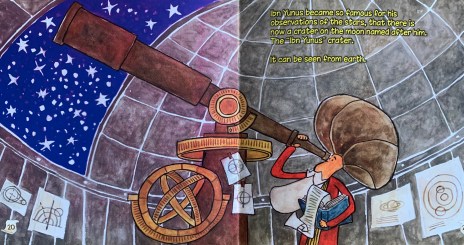
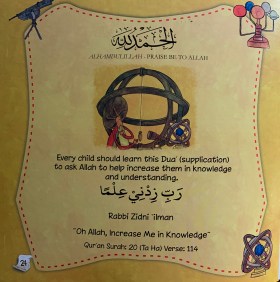
The book is a simplified biography of Ibn Yunus, and I would imagine the other books: Ibn Majid, Ibn Battuta, Ibn Al-Batar, follow the same pattern.  It tells about where he was born and when, and what he is famous for, before telling a bit about his family, an ayat from the Quran that inspired him is then given in English and Arabic and translated, before it shows how he worked toward his goal, and the accomplishments he made in his lifetime that still are used today.

938B76A9-E626-4B09-936E-446183F3141D

The fun illustrations make Ibn Yunus’s field of study easier to understand and will keep the littler listeners interested.  Adults will hopefully also learn something in the reading, and feel the same pride and inspiration of Muslim’s contributions to science.

13D95DDB-5EE2-4354-801D-85E561DABC86

It is critical to teach our children about the accomplishments and discoveries of Muslims, and this non fiction series is a great introduction to Muslim scientists, scholars, and adventurers, that they might not otherwise learn about.

Cotton Candy Sky by Zain Bhikha illustrated by Amir Al-Zubi

Standard
Cotton Candy Sky by Zain Bhikha illustrated by Amir Al-Zubi

cotton candy sky.jpg

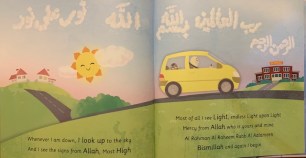
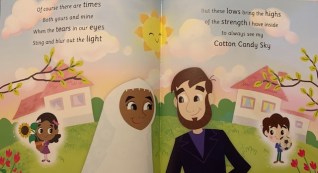
So glad to see another Zain Bhika song hit the mark and bring the beloved lyrics to life in book form. Ages 2 and up will enjoy the 28 page book even if they haven’t heard the song, and parents will enjoy watching the kids sing-read the pages independently if they have.

IMG_8895

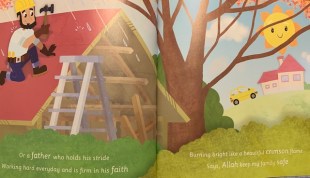
The illustrations are sweet and diverse with the characters and their families changing with each verse.  But all celebrating in their appreciation for the light of Allah’s blessings and the patience of waiting for the rain to pass.

IMG_8896

I particularly enjoy the Arabic in the clouds on the pages explaining what the character does whenever he/she feels down and looks up to the sky to see Allah’s signs.

IMG_8897

The hardback book is sturdy with a playful large font on the pages, and is meant for Muslim kids with the concept coming from Surah An-Noor (24:35).

IMG_8898

Once again, thank you Crescent Moon Store (https://crescentmoonstore.com/products/cotton-candy-sky?_pos=1&_sid=c94d58757&_ss=r) for fast friendly service and great prices!


The ABC of Allah Loves Me by Learning Roots

Standard
The ABC of Allah Loves Me by Learning Roots

abs-of-allah-loves-me.jpg

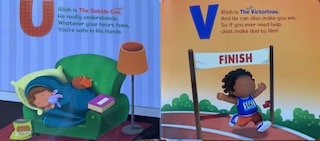
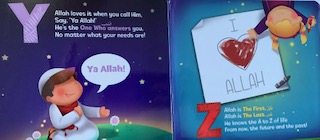
You really wouldn’t think there is much to review in an alphabet board book, but this particular one tries to do more than just pluck a random Islamic word or concept for each of the 26 English letters.  It attempts to give each of the letters one of Allah (swt)’s beautiful names explained in English, but written in Arabic too.

IMG_8773

Each 5 x 10 page features a four line description in a rhyming format to flesh out the highlighted word or phrase.

IMG_8774

Some letter to corresponding Asma al Husna are spot on, but some are a little more of a stretch and some don’t even seem to try.  Overall though it is well-done and delightful.

IMG_8778

The people illustrated don’t have visible eyes, but many have smiles, noses, or closed eyes.  They are bright and warm and engaging.  The binding and thickness of the pages is sturdy.

IMG_8777

Perhaps my favorite part of the book is that the while the rhyming is forced, as is nearly always the case in these type of books, the diction stays on level.  Little kids will understand the words used and emerging readers will be able to sound out and read many on their own as well.

IMG_8776

A great book for your toddler to preschool collection and a reasonably priced book from Crescent Moon Store http://www.crescentmoonstore.com.

Bibi’s Blessing by Lela Usama Goldsmith illustrated by Samantha Morazzani

Standard
Bibi’s Blessing by Lela Usama Goldsmith illustrated by Samantha Morazzani


IMG_8209

A wonderful lesson packaged in a sweet story about a girl learning to thank God for blessings, especially ones that don’t seem like blessings at all.  The 36 page book is meant for children age 4 and up and with its large 8.5 x 11 glossy full color pages it works well at bedtime and in small groups at story time.

IMG_8211

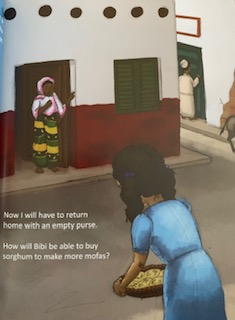
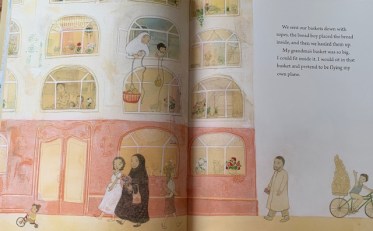
On the island of Lamu, Mwana lives with Bibi, her grandma who’s livelihood depends on making Mofa bread every day.  It is Mwana’s job to sell the sorghum ground bread in the streets for people to enjoy at tea time.

IMG_8210

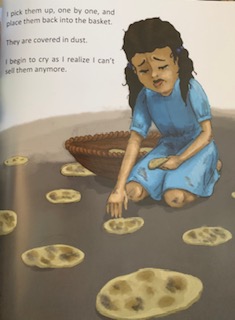
One morning a braying donkey frightens Mwana and she trips, spilling all the mofas on the ground.  When she tells her grandma what happened and how they have not made any money for the day, her grandma responds, “Thank God for this blessing.”

IMG_8212

Not believing Bibi, but being too excited to visit a friend, she doesn’t argue.  But then the power goes out and she can’t visit her friend and she gets grumpy. Grandma tells her to “Thank God for this blessing” and explains that sometimes not getting what you want is also a blessing.

IMG_8213

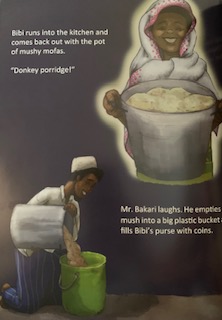
With nothing else to do, Mwana goes off to soak the rice pot, but instead accidently soaks the dusty mofas, to which her grandma again says it is a blessing.  She starts to feel she can do nothing right, and can’t believe there is any blessings in a pot of mushy mufas.

IMG_8217

But, with the power out many shops close and the owner of the donkeys has nothing to feed his animals.  He knocks on his neighbors door and Bibi and Mwana have just the thing.  He pays them for the food and alhumdulillah all is well, so many blessings from God.

IMG_8216

I love that the setting is a place many of us have never heard of and that there is information about Lamu at the end of the book along with a glossary.  The author is Muslim, the characters dress Islamically in the illustrations, and have Muslim names, but there is nothing Islamic specific in the text.

IMG_8214

Some of the sentences are worded awkwardly, for example, “We live in a small island by the Indian Ocean called Lamu.”  You typically say you live “on” an island not “in” it, and islands are in the ocean, not by them.  And some sentences read almost as run ons because of multiple conjunctions and their lack of punctuation.  I don’t love the illustrations.  The faces on many of the pages are really distracting and inconsistent, but the overall story is well done that I’m willing to over look my own critical opinions, and encourage y’all to give the book a try.


My Grandma and Me by Mina Javaherbin illustrated by Lindsey Yankey

Standard
My Grandma and Me by Mina Javaherbin illustrated by Lindsey Yankey

grandma and me

I absolutely love that this 32 page picture book for children five and up breaks so many stereotypes and highlights so many commonalities between all people, everywhere.  I strongly believe that books like this, can change people’s perspective, and as a children’s books can prevent negative biases from forming in the first place.

IMG_8078

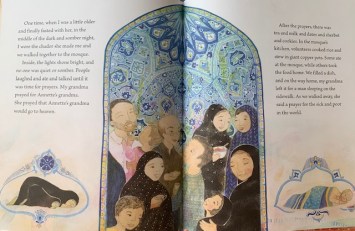
Set in Iran, a little girl absolutely loves and adores her grandma.  They pray together, they buy bread together and they share that bread with their best friends, their Christian neighbors next door.  While the little girl and her friend Annette play, the two grandmas chat, drink coffee and knit blankets to donate to the mosque and Annette’s Grandma’s church.

IMG_8079

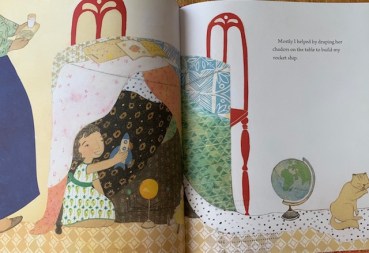
Grandma sews chadors to wear, and Mina helps.  But, mostly she uses the scarves to make rocket ship forts, and capes to fly to outer space in.  When she returns to base camp grandma has cookies for her and wants to hear about her adventures.

In Ramadan, the little girl wakes up early to eat with grandma even though she is too young too fast.  When she gets older, they go to the mosque together at night too, after they have broken their fast.

IMG_8082

One time she hears her grandma praying for Annette’s grandma to go to heaven.  The next day Annette tells Mina she heard her grandma praying at church for her grandma to go to heaven.  The little girl imagines the two grandmas knitting and laughing together in heaven, on Mars, on Earth, anywhere.

IMG_8081

The book ends with the little girl stating past tense how wonderful her grandma was and  that she still wants to be like her.

The book touches on family, interfaith, love, helping others, faith, religion, friendship, culture, and is just really really sweet.  I wish I loved the pictures, as much as I love the story, but I don’t.  I think I like most of them with their texture and details, unfortunately the faces in some just seem a little off to me.

I absolutely love that there is no over explaining, and no glossary, the author seamlessly brings words like namaz, and Ramadan and chador in to the story, normalizing them as the pretend play, and familial bonds are so universal.

IMG_8083


Tunjur! Tunjur! Tunjur! A Palestinian Folktale retold by Margaret Read MacDonald illustrated by Alik Arzoumanian

Standard
Tunjur! Tunjur! Tunjur! A Palestinian Folktale retold by Margaret Read MacDonald illustrated by Alik Arzoumanian

tunjur.jpg

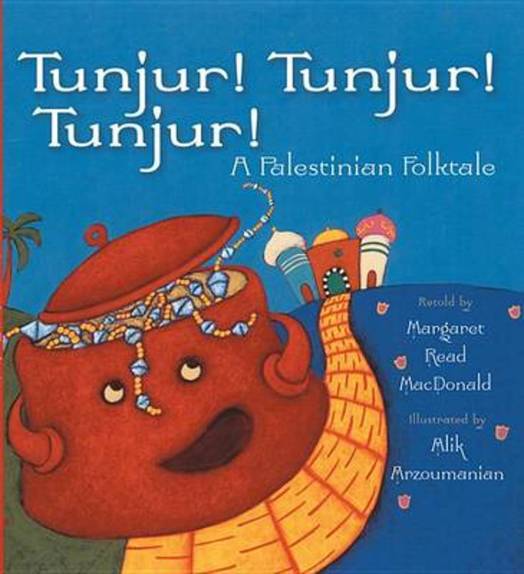
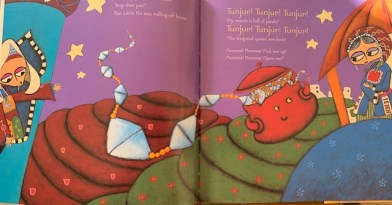
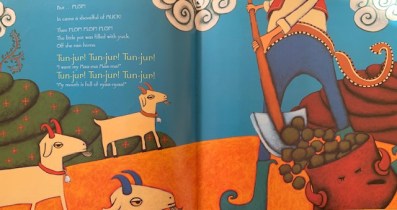
This delightful little folktale is beautifully presented in 32 pages on an AR 1.7 level.  Perfect for little ones to listen to and early readers to tackle on their own.  The pictures are fun and engaging and the story teaches a great lesson of right and wrong in a silly memorable fashion.

IMG_8036

A childless woman asks Allah to bless her with a child, even if it is just a cooking pot, and “Willa! She had a child! And it was a little pot!”

At first taken aback, the little pot professes her love for mama and thus the woman decides to take care of the little pot.  Every day the little pot bumps against the walls as she rolls and jumps around making the sound, Tunjur.

IMG_8037

One day the pot wants to go to the market by herself.  Mama refuses as she is too young and doesn’t know right from wrong, but alas she talks her mom in to it, and off she goes.

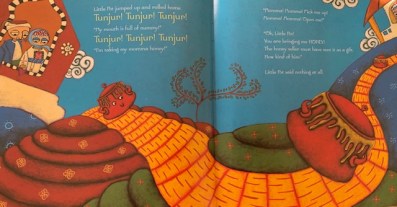
She meets a rich man who wants to fill her with honey for his wife.  The pot loves honey so she doesn’t protest, but she refuses to release her lid when the man gifts the pot to his wife.  Angrily he throws the pot out the window and the little pot finds her way home. Mama assumes the honey seller sent it as a gift and little pot says nothing at all.

IMG_8039

The next time little pot heads out she finds herself filled with the queen’s jewels and when she returns Mama is not happy that her little pot has taken things that do not belong to her.

IMG_8038

When little pot heads out again to apologize, the rich man takes her to the king and queen for a reward,  and they fill her with something to teach her a lesson.  When she comes home to Mama, she has definitely learned her lesson.

IMG_8040

The women in the story seem to wear hijab, most notably the wealthy man’s wife.   The Mama asks Allah swt for a child, but other than that there is nothing religious in nature in the book and seeing as I checked it out from the public library, I think it appeals to all kids.


Can Mustafa Control His Anger? By Hadeek Aziz and Katherine Bullock illustrated by Eman Salem

Standard
Can Mustafa Control His Anger? By Hadeek Aziz and Katherine Bullock illustrated by Eman Salem

mustafa.jpg

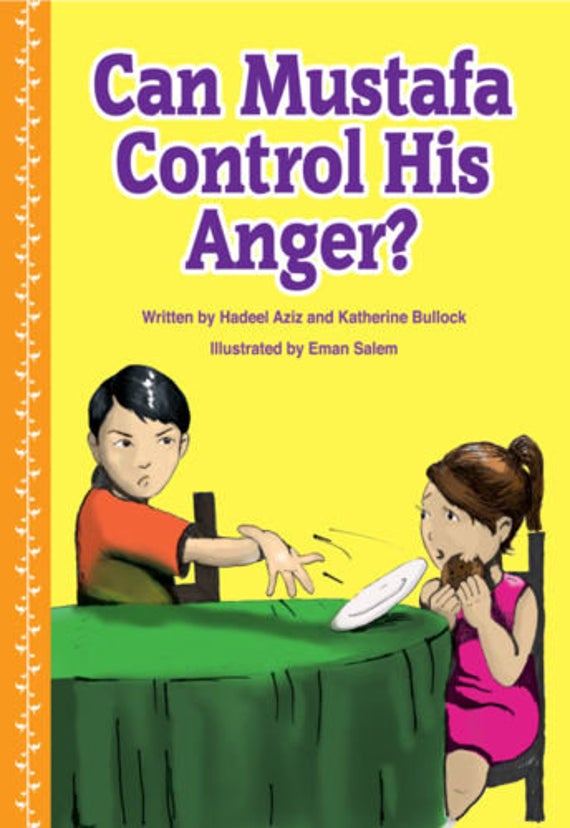
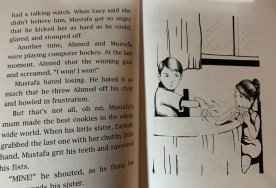
When I finished the 27 page Islamic fiction early chapter book, I thought, “It reads like a child wrote it.”  And sure enough as I flipped to the bio page I learned that indeed it is written by a secondary school senior.  I don’t want to be overly critical as a result of learning this, but as a published book that I paid for, I really wish some would have “corrected the book” and smoothed it out.  It has a lot of potential, and a good message, it just slightly misses the mark in details, some awkward tense changes, and crossing the line of what Mustafa does and says when he lashes out.  He doesn’t apologize and physically assaults people without consequences other than kids not liking him, and considering its for independent readers seven and up, that is a bit concerning.

SYNOPSIS:

Mustafa is a nice boy, except for when he isn’t.  Unfortunately he loses his temper a lot and as a result has no friends.  Whether it is losing a game, having someone not believe him, or even someone taking a treat he wanted, Mustafa resorts to physical violence and hateful words.  No parents or adults seem to ever correct him, so other kids just steer clear of him.

When a teammate won’t pass him the ball in soccer he punches poor Humza and when he goes to throw another punch he gets pushed off and bumps his head.  He storms off into the forest feeling alone, but not remorseful when a little red creature pops up and tells him he will be weak until he can control him.  Determined to show the creature he is strong he chases after it only to be scooped up by a giant named brother Haneef.

Brother Haneef and his giant friends live in a mud house in Makkah.  Shocked at how he got to the desert, he learns from his giant friend to ignore taunting, when another giant says you cannot learn Surah Al-Falaq in an hour.  Later when the giants race and Haneef loses, he says Audhu bilallahi min ash-shaitan ar-rajm and to sit down if standing and lay down if sitting as per the Prophet (saw) advice.  A giant girl gives Mustafa a strawberry tart and when he reaches to get a chocolate cupcake and someone else takes it, both he and Haneef scream, but Haneef goes and makes wudu reminding Mustafa of another hadith.  When Mustafa asks Haneef why he shouldn’t be mean to people that make fun of him or leave him out, Haneef tells him the hadith about how the strong man is the one who controls himself when he is angry.  As the giants go off to pray at the Kabaa, Mustafa finds himself at home in his bed with his sister waking him up and asking him where he has been.
41582EA9-516C-41FA-A337-C668F29C9F3A

WHY I LIKE IT:

I love the topic and that hadith are used and referenced in the book, as well as other resources. I also do like that it was written by a teen.  The pictures in the book are well done for the style and audience of the book, and the six short chapters are appropriate and inviting as well.

Oddly, the tense of the story changes at an awkward place on page 6 and I think it was intentional to go from telling about Mustafa to experiencing his “adventure” with him in the present tense, it just needs to be smoothed out.  Similarly, Mustafa is the protagonist, and we know his thoughts, but randomly at one point we know Haneef’s.  It isn’t technically wrong, but again, it is awkward as it is a short book, and everything else focuses on Mustafa asking Haneef to know things, not suddenly being in Haneef’s head.  I also felt like some resolution with shaytan, the red being, leaving or saying I’ll be back or something to continue his arc and role in the book is needed.  The details are hit or miss, vague descriptions about the giants lumps them all together, why they were at the Kabaa seems a bit random as well.

The biggest concern I have is a common one with these type of books, think Ahmed and Layla Deen books.  To make the point that he has a problem with his anger, the story goes way overboard.  Mustafa is genuinely hurting people, with kicking, punching, pushing, and throwing.  He lashes out and tells his little sister to shut up and calls her an idiot, and never once does he apologize even after his time with the giants.  Haneef makes the point that we all lose our temper, and need to simmer down, but Haneef also never apologizes for yelling or getting upset.  This is not ok, if you are teaching with the Prophetic method then that is a fairly large hole to have in the story.

There are no parents or adults which could make the point that kids won’t play with him stronger, but I feel like it really just means he gets away with a lot, and as a bully, that is not reassuring at all to the other characters in the book.  Some immediate consequences would be nice, or delayed guilt, something to make Mustafa not just seem like an awful person.  The moral is that he has learned his lesson, but I wasn’t convinced, nor where my 9, 10, and 12 year olds.

FLAGS:

Language and violence. Mustafa says, “shut up” and  “idiot,” he kicks a girl, throws a kid off a chair, throws a plate at his sister, punches a teammate,  and yells at everyone.

TOOLS FOR LEADING A DISCUSSION:

I wouldn’t recommend this book as a book club book, or even one to spend library or classroom library shelf space on.  It isn’t awful, there are just much better books out there and this one if not discussed might leave kids with the wrong impression.

3F32BB71-B114-48E9-978F-8B6031A2F88F


The Cosmos That Allah Has Designed by Zenubia Arsalan illustrated by Ada Konewki

Standard
The Cosmos That Allah Has Designed by Zenubia Arsalan illustrated by Ada Konewki

2E77412C-8D86-40DC-AC49-0409390CAD93

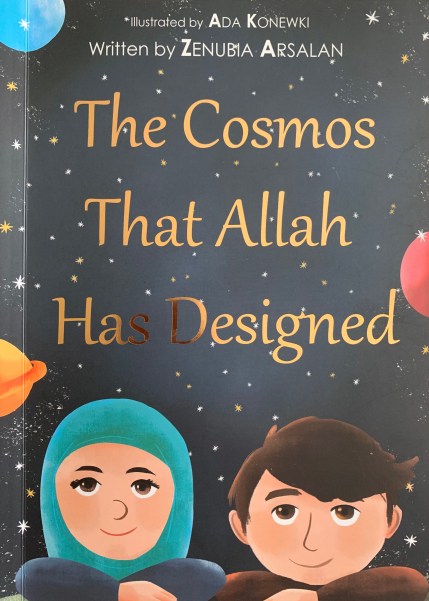
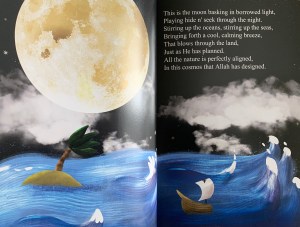
This 22 page beautifully illustrated picture book clarifies that it is not a science book, but rather an invitation to think deeply.  For ages 4 and up the rhyming pages will appeal to children’s sense of wonder and Allah’s perfection and precision.  Older kids will appreciate the journey through the cosmos and how limitless Allah swt is in all things.

1CE0C4F4-1AE9-4738-9D3E-BFAACA4A8186

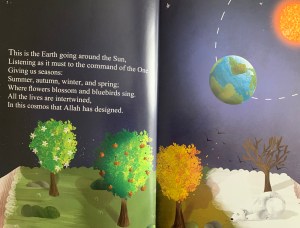
The book starts with Earth and how the spinning of our planet on its axis allows for the alternation of night and day, it then moves to how going around the sun at Allah’s command gives us our seasons.  But because it rhymes and is not a science book, the text is more imagery and tangible in nature, rather than a list of facts.

68DD1DA3-102B-417D-B24D-435B8DFC3FF0

It touches on the moon reflecting borrowed light and the power and strength of the sun before moving on to the planets and gravity.

53909F77-D035-4FB9-BB77-3429E64A948E

It then extends out to the Milky Way and has a page on black holes before coming back to Earth for us to recognize how we only are a small part of something so much bigger.

31117DCF-73A0-4ABE-BD01-80AC92AA3843

There are two pages at the end with talking points, an ayat from the Quran, and emphasis that science and Islam are not at odds as Allah is the creator and governor of all things.

EFCD5023-940B-4D63-88FA-338A7F76C2D3

The book is 6×9 and with the beautiful illustrations I truly wish the book was larger.  Not only to dive in to the glossy pages easier, but also so that the book could be used at story time to small groups.  The tone is contemplative and marveling as it challenges the readers to find mistakes or flaws in the perfection of outer space. I love that science-y Islamic kid books are now available that appeal to children’s sense of wonder and understanding.  Really the only other suggestion I would have liked to see, would have been a page defining the word “cosmos” as it is used on every page, and while I think kids will figure it out as the continue through the book, I think it is a bit of a block for the younger readers.

Sadiq and the Fun Run by Siman Nuurali illustrated by Anjan Sarkar

Standard
Sadiq and the Fun Run by Siman Nuurali illustrated by Anjan Sarkar

sadiq

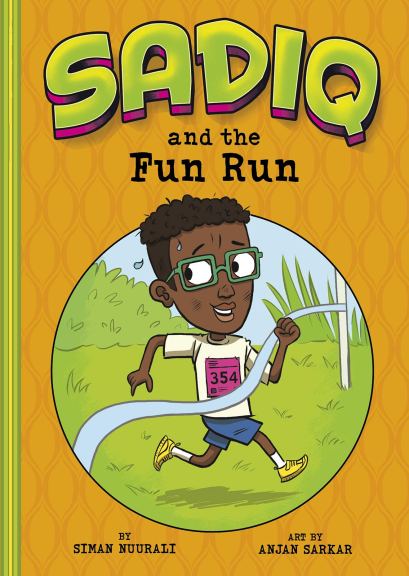
This new series featuring Sadiq, a Somali American living in Minnesota, is great for early chapter book readers looking for representation and diversity.  There are four books about Sadiq, his family, and his friends and classmates in third grade, and all are either an AR 3.6 or AR 3.5.  At 57 pages long, divided into five chapters and filled with bright and colorful illustrations students in grades 1st through fourth, depending on reading level and interest, will enjoy these simple plotted, yet relatable stories.

F905B46F-CCAE-4094-A2C1-C7A66CD4B66F

SYNOPSIS:

Sadiq’s friends are all getting ready to try out for football, but his parent’s say that he is too young for such a rough sport and has to wait until he is 12 like his older brother, Nuurali, did.  Sadiq’s parents and family encourage him to try another sport, and with a new running club starting in a few days coached by a member of the national team, that’s what he opts to do.  Begrudgingly he joins the team, but is hurt when his friends talk about how much fun football is and how much more tough and difficult it is compared to running.  While this is going on, he is getting support from his brother to keep running, and from his teammates, but it is hard and he doesn’t enjoy it.  Slowly, he starts to improve, however, and with the Fun Run the climax of the book he sails across the finish line in first place when he sees his friends have come to cheer him on!

307C04CE-AE9B-4121-9DA0-04BE7302D795

WHY I LIKE IT:

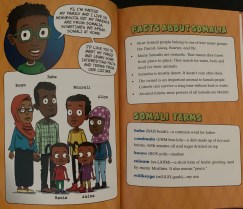
I love that the book/series proudly features a Somali-American-Muslim family.  There is information about Somali at the beginning as well as some Somali terms and a portrait with names for the members of Sadiq’s family.  The mom and older sister wear hijab, “Salaam” is one of the defined words and the characters use it when they meet.  I also love the diversity of skin tones in the illustrations and one of the girls on the track team wears a scarf as well.  There are Muslim named kids and non Muslim named kids in the story, and while Islam isn’t mentioned outright, it is definitely represented through the characters words, names, and appearances.

4F1421B3-B166-4B44-BB86-0DA161F5939F

The story is straightforward and perfect for the age group, the books in the series do not need to be read in any order, and you will get to see the different supporting casts featured more prominently in different books, thus getting to know Sadiq and his world.  I like that he doesn’t get his way, and doesn’t get to do what all his friends are doing, but he makes it work.  He is grumpy and upset, but he doesn’t get obnoxious or overly whiney.  I think this subtly gives readers some tools and insights to model in their own disappointments.  I also like that while he has to put in the work and fix his attitude, he doesn’t have to do it all alone.  His family and coach are supportive, and eventually his friends apologize and support him too.  For the simplicity of the book, you actually do get invested in his little trial and want to see the outcome.

3AC10F17-7A77-40AD-BC46-A57D4359D94F

FLAGS:

None, it is clean.

TOOLS FOR LEADING THE DISCUSSION:

This book is like a boy protagonist version of the Meet Yasmin books, they show a kid of culture in everyday experiences.  The target audience wouldn’t make it work for a school wide book club, but I think early elementary teachers would benefit from having the series in their classrooms and letting kids in small groups discuss if they want. These books would be great for first graders that are way above reading level and parents are struggling to find appropriate books.

The end of the book has some resources as well: a glossary, discussion questions to talk about and some to write down, as well as a home workout guide and information about the author and illustrator.

Little People, Big Dreams: Muhammad Ali by Isabel Sanchez Vegara illustrated by Brosmind

Standard
Little People, Big Dreams: Muhammad Ali by Isabel Sanchez Vegara illustrated by Brosmind

muhammad ali

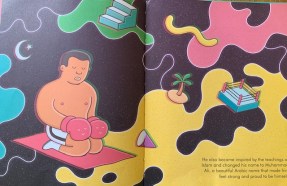
A few things surprised me in this latest addition to the non fiction biography series Little People, Big Dreams. First that a police officer told him to learn how to fight if he wanted to face the thief that stole his bike.  Second, that the 32 page book targeting 5 to 8 year old children has an AR level of 4.8 and finally that it does mention his conversion to Islam and shows him praying.

IMG_7247

The biography hits a lot of major milestones in the boxer’s life after showing he once was a little kid too.  He was born in Kentucky, had a younger brother and after his bicycle was stolen he started learning how to box.  He wasn’t the strongest fighter, but he was fast.

IMG_7243

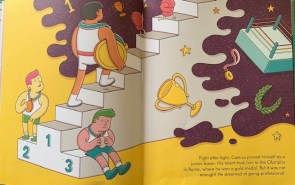
He won a gold medal at the Olympics in Rome, and then set his sights on being a professional boxer and becoming the world heavyweight champion.  Its nice that on this page the illustrations show that part of that pursuit involved physical training but the books and meditation show internal growth was valued and pursued as well.
IMG_7244

It shows how he used to taunt his opponents and that some thought it poetry, while other’s thrash talk. It also makes it clear that he used his voice to speak out for things important to him at a time when it was dangerous and accepted the consequences, whether it was African American rights or the war.

IMG_7246

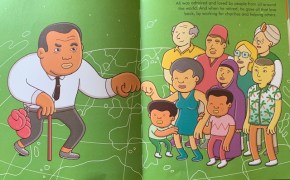
The page about him becoming Muslim explains that he was inspired by Islam, changed his name and “felt strong and proud to be himself.”  After his ban from boxing, he won the heavyweight belt three times before retiring and dedicating his life to community and giving back.

IMG_7248

The book ends with a timeline and some real pictures of Muhammad Ali, along with some other books you can turn to for more information.  The illustrations are comical yet detailed in their emotion and the information that is conveyed.  Kids will enjoy them and find they give life to the simple text on the pages.
IMG_7245

I got my copy from the library and my children aged 4-12 enjoyed the book as they have the other books in the series.

IMG_7249