Category Archives: Kg-2nd

Littering Stinks by Summayyah Hussein illustrated by Eman Salem

Standard
Littering Stinks by Summayyah Hussein illustrated by Eman Salem

img_6510

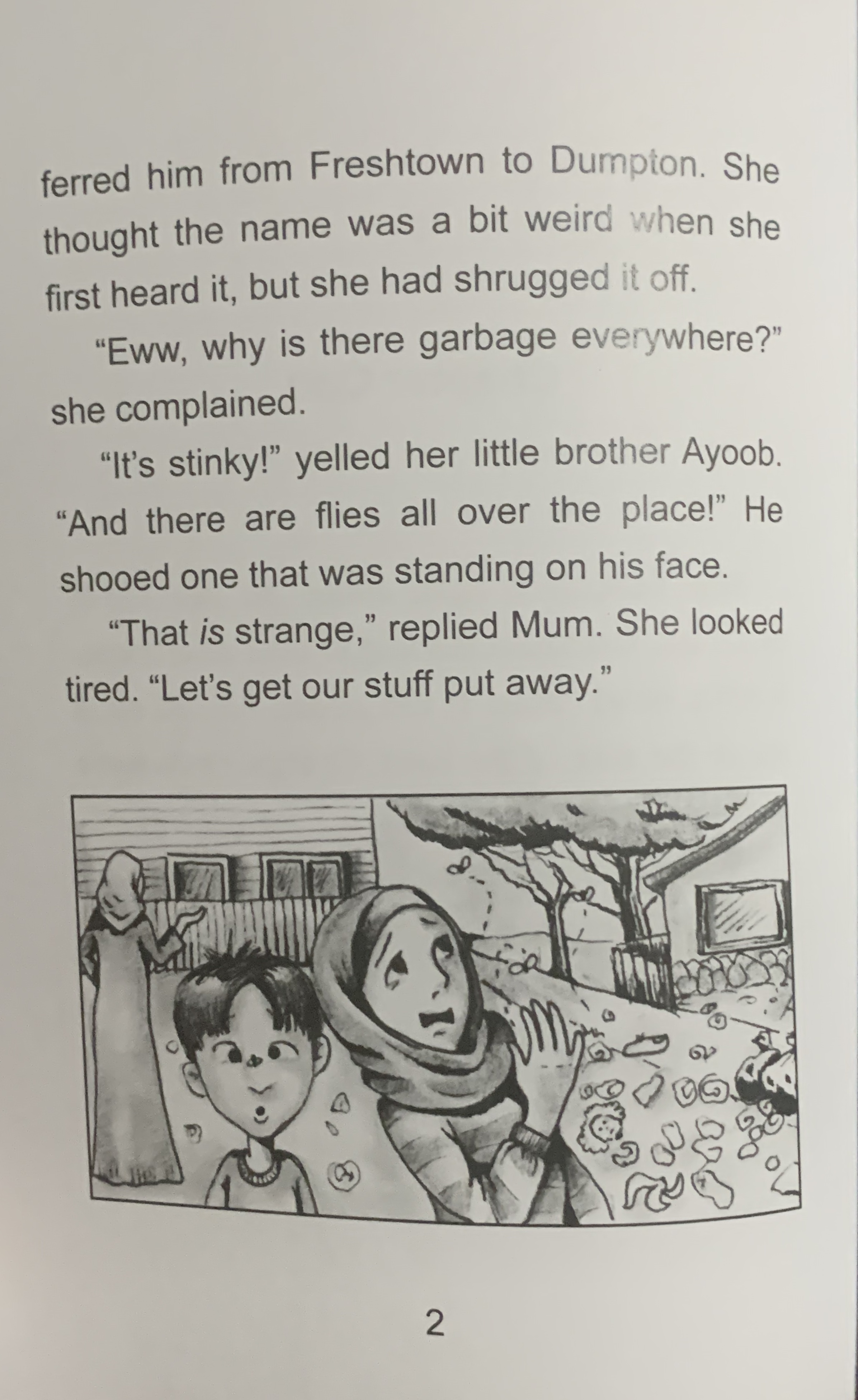
This 36 page early chapter book is a good introduction to the concept that one person can make a difference.  The seven chapters flow easily, and while the names of the cities, Freshtown and Dumpton are a little on the nose and the premise a bit of a stretch, fluent 1st and second grader readers will enjoy the story and delightful pencil illustrations of a kid changing things for the better and making a difference.  One blatant hole for me was the lack of outright Islamic preaching.  For a book that is not available in mainstream outlets here the US and only through Islamic book stores, I expected more than just a Muslim family with hijabi characters and Islamic names.  I wanted cleaning up the environment and doing good deeds to have hadith and ayats quoted and referenced throughout, but alas there are none.  So, I suppose the book isn’t “Islamic Fiction.” but, in my opinion it really could and should be.

img_6514

SYNOPSIS:

Aliyah and her family have just moved to a new city, Dumpton.  Transferred by her father’s work, the family is shocked by the trash, smell, garbage and flies everywhere.  The kind neighbor lady brings them a pie and welcomes them to the neighborhood, but is later seen throwing a candy wrapper out the window.  Aliyah is shocked that such a nice lady is also a litterbug.  Aliyah calls a family meeting to come up with a plan to clean up Dumpton.

Each day Aliyah tries something new: cleaning up the street she lives on by herself, letting people know about littering, putting up signs, and finally on day four forming a clean up crew.  But nothing works.  Aliyah gets discouraged, but her parents encourage her to do the right thing no matter what.

The night before the first day of school Aliyah has an idea, she grabs a bunch of solid color t-shirts and a permanent marker and makes herself some shirts to encourage people to take care of their trash.  Every day she wears a different one with a different saying and by the end of the week people are starting to ask her about them.

The following Monday, her brother joins her and wears a matching shirt to start the cycle again, but when she gets to school the two of them aren’t the only ones wearing yellow t-shirts that say “Littering Stinks.” Everyone is!

The principal calls her into the office to discuss the potential of children to change the pollution in their city and slowly but surely they get the city cleaned up.

img_6513

WHY I LIKE IT:

I love that it encourages everyone, no matter how small, to make a differences and do what they can to make things better.  I love that it doesn’t just happen and that she gets frustrated and has to power through and stay true to herself. The main character wears hijab, but there is no mention of religion or faith which would have added some depth to her as a character finding motivation from belief in a higher cause and a responsibility to the care of the Earth.  Even some concern with starting at a new school as a hijabi would have possibly added some relatable connection to her personal strength and why she is willing to trust herself with the littering task at hand.

The premise that no one born and raised in the town seems to have a problem with the littering and pollution or that people from the outside haven’t been completely disgusted by it, but rather joined in over time, is a bit far fetched.  Sure you could make the argument that in other countries this is how it is, but it seems like a bit of a leap given the setting of the book and the target audience.

img_6512

FLAGS:

Clean, haha pun intended?

img_6515

TOOLS FOR LEADING THE DISCUSSION:

This book is an early chapter book, not to be confused as being a book for early readers.  The sentences and diction and vocabulary are for fluid readers that are just moving into short chapters and need a few illustrations, spaced lines and a bit larger font.  There are questions at the end which would make the book a great small group reading to discuss, but definitely for early elementary.  Would be a great inclusion in a unit on leadership, project planning, or Earth Day.

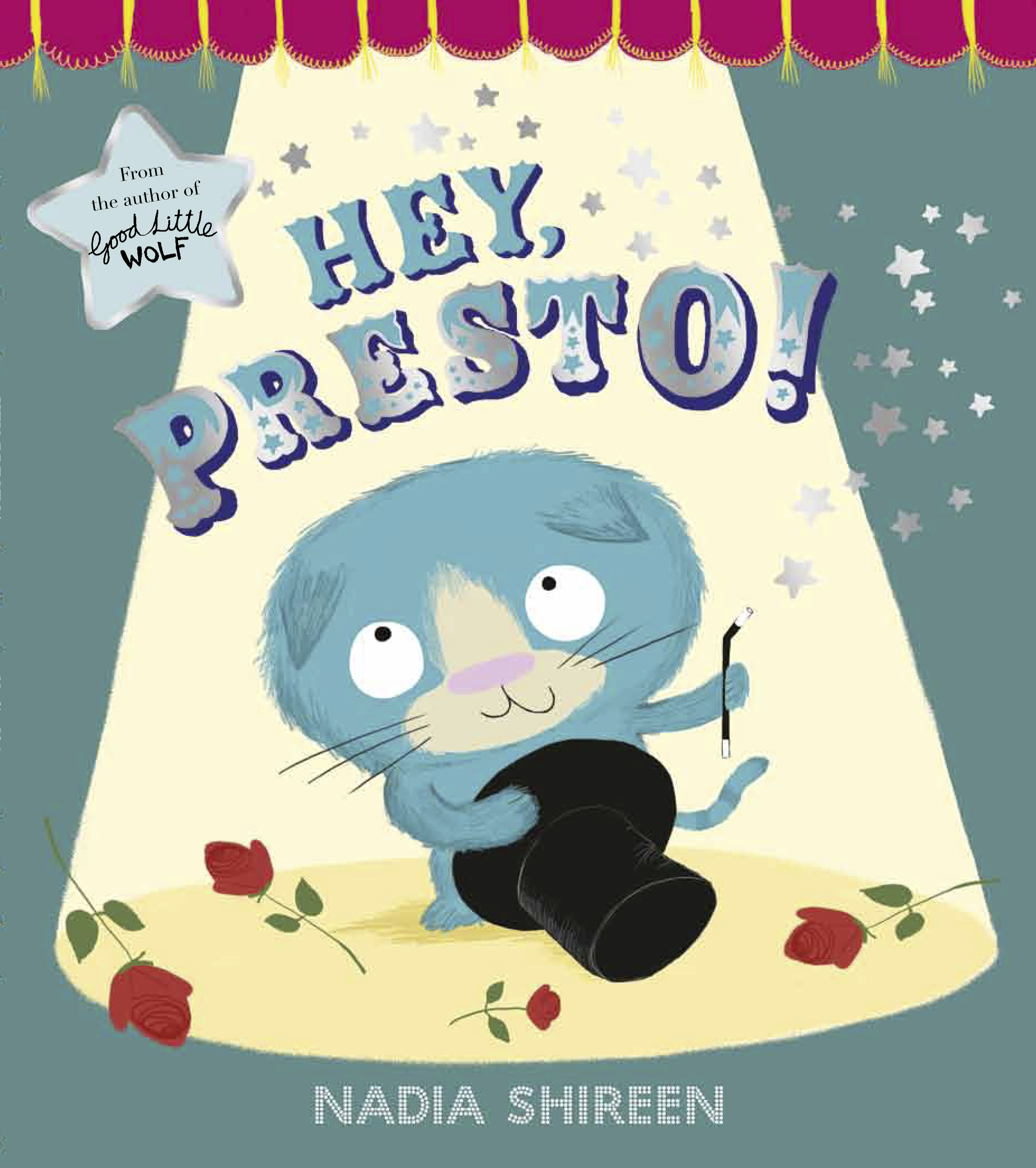
Hey, Presto! by Nadia Shireen

Standard
Hey, Presto! by Nadia Shireen

presto

This 32 page picture book about friends learning to appreciate each other is both silly and sweet.  An AR 2.6 the book is great for preschool through third grade and gives lots of teachable moments along the way if you want to make it more than just a fun book.  There is nothing religious, but I believe the author, who is also the illustrator, is Muslim.

3D98CA51-5683-4B47-AA1D-D2D59EC0534B

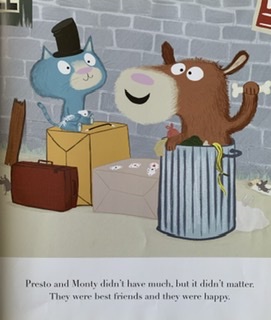
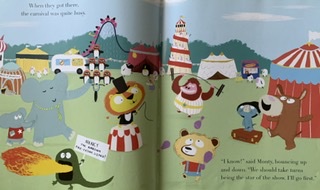
Presto and Monty are best friends.  Presto is a brilliant magician and Monty is good at singing, eating ice cream and making funny faces.  When the carnival comes to town the two decide to put on a show and become famous.

A14B6C11-5B00-402D-AC0B-6471AD953433

Monty suggests they take turns being the star of the show, and Monty decides to go first.  Monty isn’t a magician, so Presto stays behind the scenes to make sure the tricks work.  Somehow, this is how it ends up going night after night after night.  Presto never gets his turn.

BD1712A8-2E13-4AA5-9E7A-902456DD1820

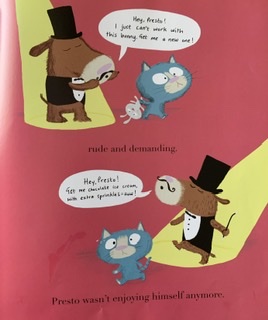
Monty gets bossier and bossier, demanding things of Presto and being rude.  Presto is no longer having fun.  When Monty signs a contract to go on TV with his magic show, Presto has had enough and leaves.

C0366580-AF19-4A17-A787-22C33A3CBF90

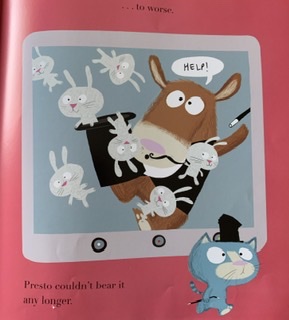
When showtime rolls around, Monty realizes Presto has left and has to try and learn magic real quick.  The show doesn’t get off to a good start when none of the magic tricks work.  As the show goes from bad to worse Monty realizes how bad of a friend he has been.

5DF12A03-2366-4EE7-A7F9-FA6BD355C730

Presto watching from home can no longer bare it and rushes to save the day.  Monty promises things will be different and the two of them cook up a new act and realize together their show is perfect.

1A295E46-CE70-46DF-AC17-976B023930AA

My Monster and Me by Nadiya Hussain and Ella Bailey

Standard
My Monster and Me by Nadiya Hussain and Ella Bailey

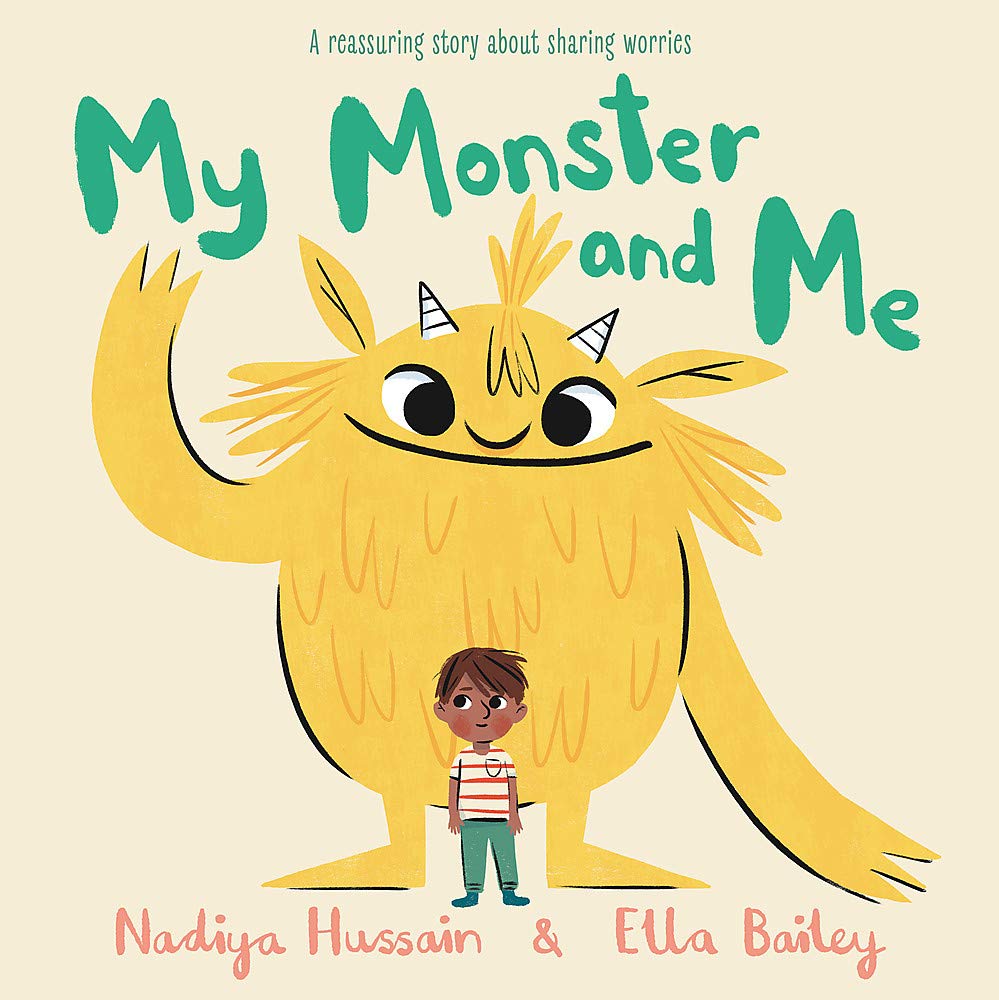
This adorable 32 page book about facing worries, anxiety, and fears is told in story format and meant for ages four and up. The personified monster isn’t scary, but he is big, and the little boy learns to talk about him to get him to shrink. The book is engaging, fun, and powerful. I had my teenager who has anxiety read it and she loved it, a few days later as she was forcing herself to get out of the car, she mentioned that she needed to make her monster small. Normalizing mental health, feeling like you aren’t alone, finding the words to explain to others how you feel, having empathy for those that are facing challenges, are all things the book conveys without being preachy or condescending. I think every child, parent, and caregiver, needs to be aware of what children are facing and find ways to be like the gran in the book and listen, so that children suffering aren’t doing so alone. The fact that the author is a Muslim celebrity chef in Britain and the protagonist is a boy with brown skin, makes the message that much more universal.

The book starts out with an unnamed boy introducing himself and his much bigger monster. He doesn’t know when the monster arrived, but it seems he has always been there, and the monster knows all about him.

The monster is big, and when he stands infront of the little boy, the little boy can only see his tummy. At night he snores too. When he asks his mom or dad or brother to take the monster away, the monster hides.

Over time the monster has gotten bossier. When the little boy is getting dressed or brushing his teeth or when he wants to play, the monster is always there, blocking him.

One day after school the monster was there and the little boy tried to lose it, but couldn’t. Gran asked what was wrong when he showed up crying, and the little boy told his grandma all about his monster.

Gran listened quietly and the more the little boy talks, the smaller the monster gets. Pretty soon the boy realizes he can make his monster go away. When he finds the monster later, the little monster is confused, so the boy puts him in his pocket.

The monster is always there, but the little boy can make him behave and he isn’t scary any more. At the end the boy is big, and the monster is little.

I love that the boy finds someone to talk to, and that he accepts that the monster may never leave. Even if you don’t have anxiety or worries, the book is a great metaphor that even little kids can understand to help them cope when stresses do occur. I love the large size of the book, the minimal text and the bright illustrations. Truly a great book that needs to be in classrooms and homes and anywhere kids are.

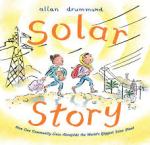
Solar Story: How One Community Lives Alongside the World’s Biggest Solar Plant by Allan Drummond

Standard
Solar Story: How One Community Lives Alongside the World’s Biggest Solar Plant by Allan Drummond

Set in Morrocco, the fictionalized framing of a children’s story about solar energy and sustainability at the the world’s largest solar plant in Ghassate will appeal to curious children in kindergarten and up. Told through the every day life of Jasmine, a little girl living near the plant, the concepts are not technical, but give a broad overview allowing readers to understand how impressive solar energy is, as well as the disparity that exists in the world. Over 40 pages with factual sidebars and an author’s note at the end, children who enjoy the story and are curious about the reality of it all will find an easy opportunity to learn more.

Jasmine and her friend Nadia live in Morocco between the High Atlas mountains and the huge Sahara desert. It is always sunny where they live.

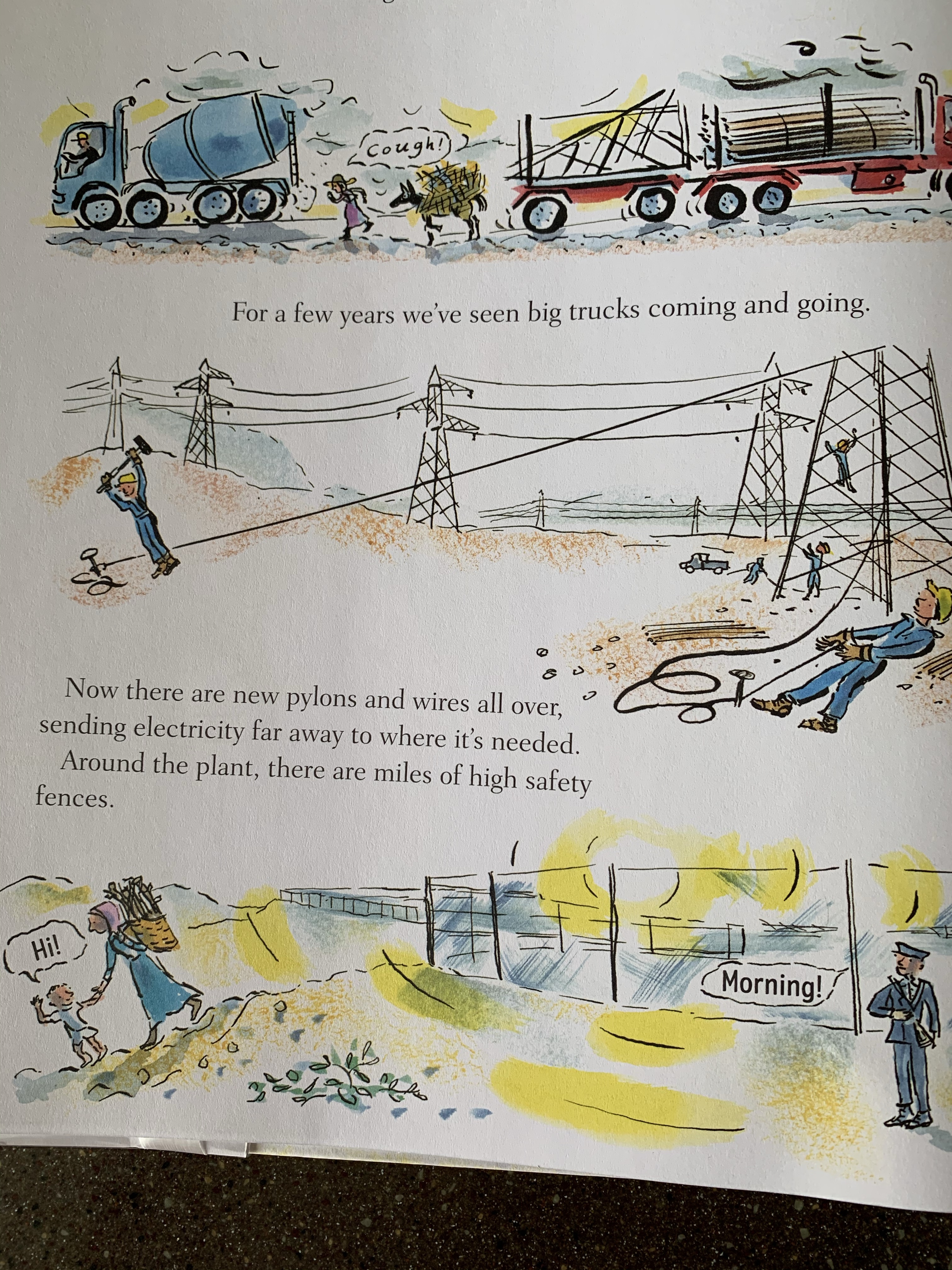
They talk a lot about making energy from sunshine as they watch trucks going and coming from the world’s largest solar plant. Their teacher likes to ask them about the big changes happening in their world.

As the villagers tend to their sheep and cows, they cook on open fires and bake bread in clay ovens all while keeping an eye on the workers making the largest solar tower in the world. Jasmine’s dad rides a mule to work and many classmates parents work at the state of the art plant. The contrast is obvious.

The next day at school Miss Abdellam the teacher asks the students about sustainability. And the book doesn’t define the concept right away. First the class goes on a field trip to the solar plant.

At the plant the size of 3,500 soccer fields they see the 660,000 mirrors that follow the sun like sunflowers and bounce the rays to the 800 ft tower. The tower gets to a thousand degrees on top and heats water whose steam powers turbines and is turned into electricity.

The kids go home to work on their sustainability homework. With no internet or computers even, they have to think for themselves. The remaining pages define and provide examples of how solar power is changing life for the villagers and improving life for people not just in Morrocco or Northern Africa but potentially the entire world.

I love that the concept of sustainability isn’t just a definition it shows how it is in every day things, and those every day things lead to big things that are both tangible and ideological. The author/illustrator acknowledges his own surprise and bias when he learned that the largest solar power plant was in Nothern Africa. I love that some of the females wear hijab, and some do not, and that the teacher and some of the parents at the solar plant are female. There is nothing religious even mentioned in the book, but the visibly Muslim characters are empowering and honest for a story about science and Morocco.

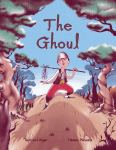
The Ghoul by Taghreed Najjar illustrated by Hassan Manasra

Standard
The Ghoul by Taghreed Najjar illustrated by Hassan Manasra

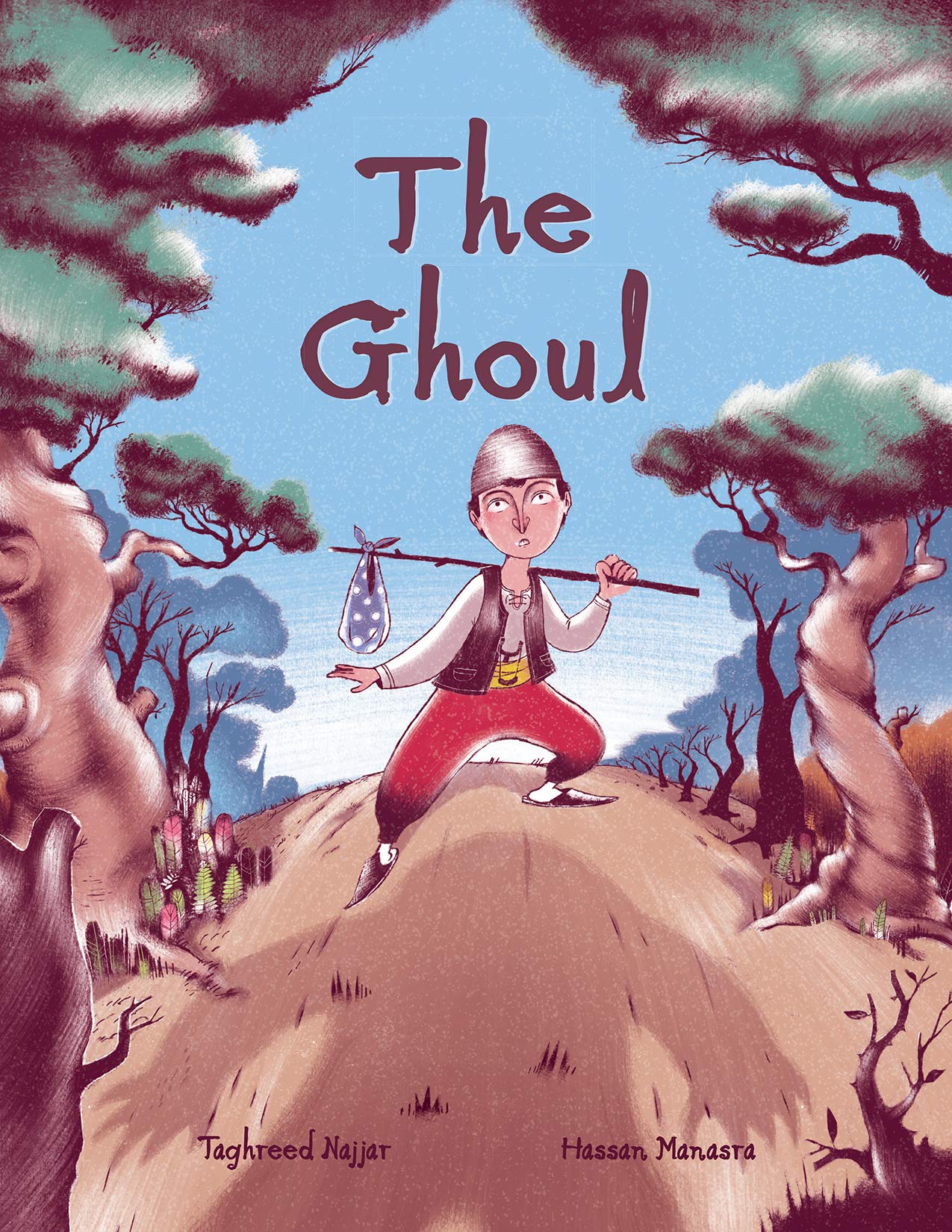
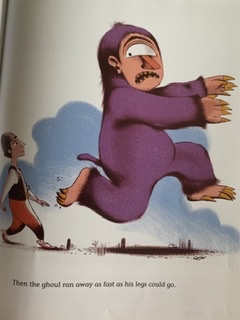
the ghoulThis 36 page book for ages five through eight is a cute story about being brave, facing your fears, challenging your perceptions, celebrating differences and giving friendship a chance.  Recently translated and published in English, this Arabic inspired folktale is timeless and important for readers of all ages to learn from.
8B5F2DF2-9E4D-41B0-B9CE-3220C01849D3

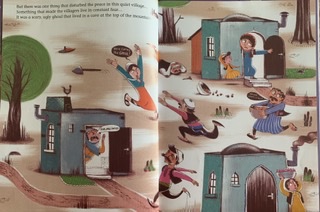
Hasan the Brave is a young boy that lives in a mountain village.  The children are told not to laugh out loud, the adults tiptoe to their fields, and the fear of being eaten by the ghoul that lives in a cave on top of the mountain consumes them all.

397BB0D0-FE53-491D-997C-F0A69FA851BE

But Hasan isn’t buying it and starts asking questions. Why is everyone afraid of the ghoul, he asks his aunt one day in the olive grove? She tells him because he is covered in hair, has one eye, long claws, sharp teeth and his favorite food is little boys and girls.  Unconvinced Hasan asks his dad if anyone in the village has been hurt by the ghoul.  His dad can’t think of anyone.  He asks his mom if the Ghoul ever ate anyone in the village? She can’t think of anyone, but has heard plenty of rumors and wants him to not disturb the ghoul none-the-less.

BA9EE74E-0AEA-4418-8265-146E1DFF7682

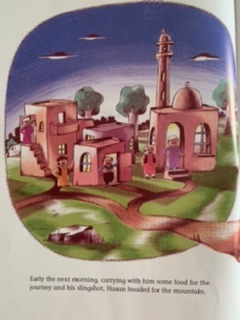
Hasan is tired of being scared and decides he will climb the mountain.  Everyone in the village tries to warn him against it, but he is Hasan the Brave after all and is determined to go.  When he gets to the top of the mountain and relishes at the beautiful view he proclaims that he is fearless and that he won’t be afraid of the ghoul.  Then he sees the ghoul, and after the ghoul sizes him up, the ghoul runs away.

76499216-F79A-45D1-8BD5-E7559269F315

Hasan goes to investigate why such a monster is scared of him and learns that the ghoul is scared of people because they have two eyes instead of one, they do not have thick hair like him, they have strange hair, small teeth, and they eat ghouls.  Ghouls, Hasan finds out are vegetarians.

A3D05D5F-10FB-42D3-866F-5863CEEDE484

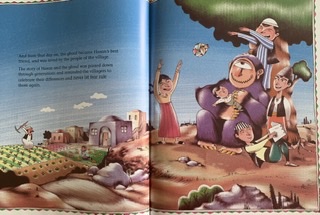
The two laugh at their assumptions, and run off to play together.  From that day on the two are best friends and the people in the village pass on stories to remind future generations to celebrate differences and not let fear rule them again.

There are a few women in hijab, the villagers say inshaAllah, but there is nothing religious in the book.  The illustrations are detailed and colorful in a muted manner.  Overall a fun book with a great lesson.


Yeti and the Bird by Nadia Shireen

Standard
Yeti and the Bird by Nadia Shireen

yeti

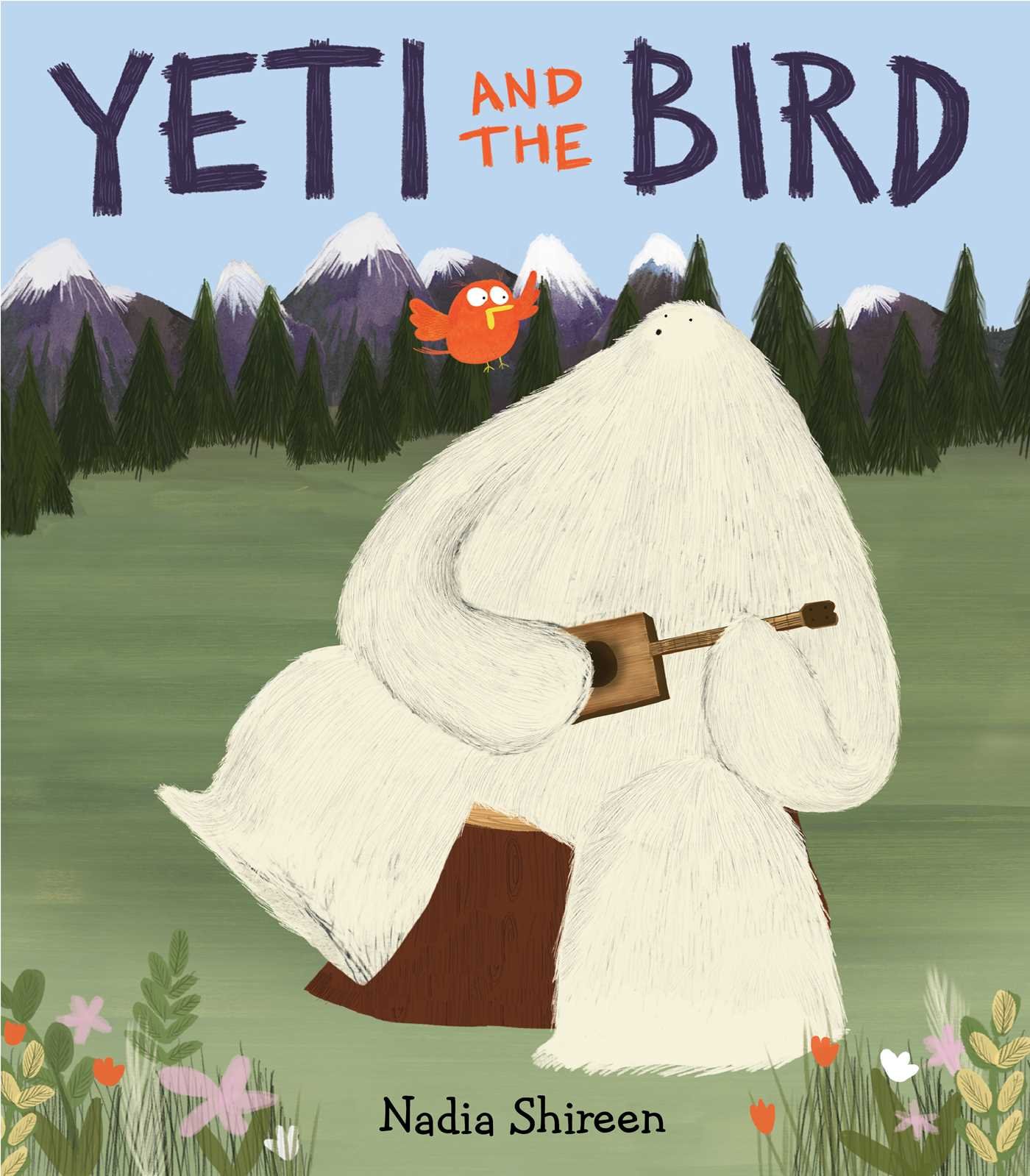
What a sweet story about assumptions, loneliness, friendship and kindness.  An AR 2.0, this 32 page simple picture book tells the story of an accidental meeting, making friends, and the opening of hearts of the forest critters as a result.  Written and illustrated by a Muslim author, the adorable illustrations make the story come to life and provide smiles for kg-2nd graders along the way.

84128316-9DAA-4B13-9391-E41C19804A57

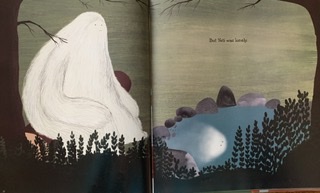
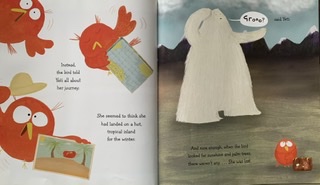
Yeti is the biggest, hairiest, scariest beast anyone has ever seen.  So no one comes near him, making him very lonely.  But one day a lost bird thunks him on the head.  The Yeti growls, but the bird doesn’t get scared. At all. Instead the little bird tells Yeti about her journey and how she was headed to a hot tropical island for the winter.

9794A3B4-1DEF-4183-B784-67190ED94037

Yeti doesn’t know what to do with the sad little bird, so he picks her up and takes her home.  The next day the two play and laugh.  The forest animals look on in surprise and curiosity.

51FA79D6-1ABE-4C09-8E2B-31023FC4E69A

As it gets colder, Yeti knows his new friend will need to leave so he studies the map and helps give her directions for the long journey ahead.  Once she leaves, Yeti is even lonelier than before.

41A015EF-3798-41D6-BEF9-395197E9401B

But, alas, new friends are ready to play and the little bird stops by to play when she can.

587A7DA5-DE9A-4270-B8B4-202C6943F846

Cute and fun and great for littles, to be brave and give a new friend a chance.

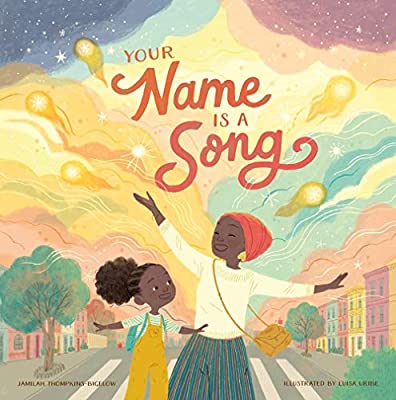
Your Name is a Song by Jamilah Thompkins-Bigelow illustrated by Luisa Uribe

Standard
Your Name is a Song by Jamilah Thompkins-Bigelow illustrated by Luisa Uribe

song

An amazingly empowering simple story that breathes pride and beauty in to names and our identities.  The 40 pages are a celebration of the rhythm of our names and the dreams and hopes that they contain for us.  Perfect for kindergarten to second graders, readers of all ages will find something valuable in this book.  Those with “common” names might reevaluate what their names mean or why they were so named, children with “unique” names will find the music and confidence to ask others to learn their name correctly, older kids might reconsider shortened nick names, and we all inshaAllah will make more of an effort to get people’s names pronounced right.

3A20341F-991D-4929-9A52-D9794E284880

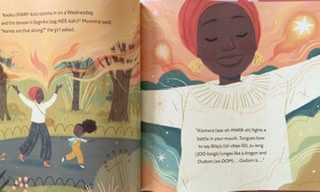
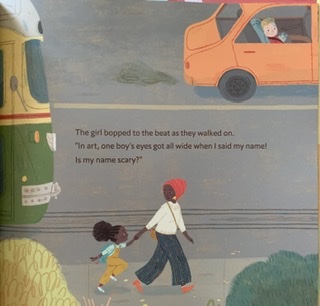
A little girl has had an awful first day of school.  As she stomps toward her mom at dismissal.  No one could say her name.  Not even the teacher, it got stuck in her throat.  Her mom gently reminds her stomping is only for dancing, and tells her that her name is a song.

034DED6F-D931-4FB1-ADC0-15006AC8EAC2

The little girl is skeptical, but as they say people’s names on their way home, and find the magic and rhythm and beat in each one, they address the horrible things that have happened to the girl that day regarding her name.  At lunch girls pretended to choke on her name, and later one boy said her name was scary, some even tell her, her name sounds made up.

86E8B8E7-5336-4D72-BAC3-174F2B5B9AA2

Her mother explains that some names come from deep in the heart, not the throat and cannot be choked on, that names are fire and strong, and that names are made from the sky when our real names were stolen and so new ones have to be dreamed.

8D42050F-B9BA-4813-8BD6-CB543566748A

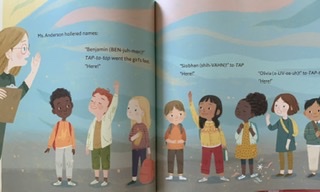
All the way home they go through names, diverse names, beautiful names.  The next day she doesn’t want to go to school, but she has a song to teach.  When her teacher starts calling  out names, the little girl starts tapping the rhythm, when Ms. Anderson starts to struggle on the little girl’s name, she starts to sing it.  She explains that her name is a song, and that she will teach it to them.  The other children then ask her to sing their names. And with a smile on her face, it is music to Kora-Jalimuso’s ears.

58B39FE0-63CA-4196-9452-4C64B517BAAA

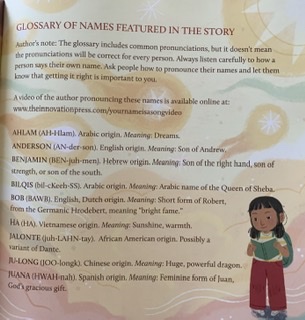
I love that there are three pages of the names mentioned in the story and their origins and meanings listed.  I also like that the little girl’s name is not revealed until the end.  The pronunciation of the names is in the text, all of them, even Bob.   And when I read the name Trayvon, I felt an added weight of saying people’s names, breathing them into our lives and not forgetting them.

74247213-AEE1-464E-A8C4-DE0ECB824335

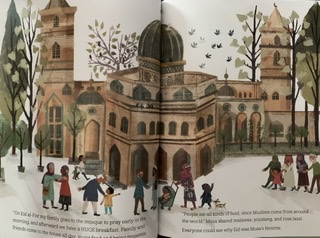
The family could be Muslim based on the mom’s head wrap.  The author is Muslim and there are Arabic and Islamic names included in the story.

Our Favorite Day of the Year by A.E. Ali illustrated by Rahele Jomepour Bell

Standard
Our Favorite Day of the Year by A.E. Ali illustrated by Rahele Jomepour Bell

favorite day

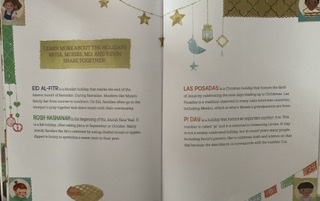
A great book about inclusion for back to school, except well with Corona, we aren’t doing things how we always have.  None-the-less this book about the first day of kindergarten for Musa and the friendships and celebrations of diversity (Eid al-Fitr, Rosh Hashanah, Las Posadas, Pi Day) that will take place over the school year, connect the kids and their cultures in a beautiful and heartwarming way.  The book is 40 pages with engaging illustrations and text perfect for 5-7 year olds.

EDFC15B2-0A7C-4B7F-ACAD-E019DBDEDEC4

It is the first day of school and Ms. Gupta tells the class it is her favorite day of the year.  She also tells the children that the people around them will become their best friends.  Musa doubts this as he looks around at the strangers at his table.

EFE30123-CA0D-41E9-BAFB-2ADFA7CE811F

He also wonders how the first day of school can be any ones favorite day, clearly Eid al-Fitr is the best holiday.  Luckily, every show-and-tell will be about someone’s favorite day, so that the class can join together in celebrating it.  Moises can’t believe that Christmas isn’t the most fun until he learns that not everyone celebrates it.

011E4F77-4479-412E-AF9E-D37B9B870308

When it is Musa’s turn to teach about Eid, his mom and he bring in food and decorations and teach the kids to say Eid Mubarak.  They learn what Eid is like and can see why it is his favorite.

6B5884B2-A9ED-42D1-A624-B8100CE0D160

Up next is Mo’s turn.  He tells everyone about Jewish New Year and how to say Shanah Tovah.  On Rosh Hashanah they light candles and share food with friends and family.

DAC82C2A-06CC-485B-B589-F34682F0914E

Moises explains how Las Posadas is how his family celebrates Christmas.  It lasts nine days and there are songs and pinatas and presents.

2CECB33E-AFBD-4118-B893-8B9D2B81385C

In the spring it was Kevin’s turn and he shared his love of Pi Day as his family celebrates science.  On March 14 (3.14) they make different pies and learn about scientists and their discoveries.

A657B13B-02A0-4E75-95D0-25513C8788F6

On the last day of school, the children are sad, but their teacher hopes they will remember each other always throughout the year as she hands out calendars for them to keep.

83CC82E2-4045-4F02-8202-D6E6124A0E5F

The book concludes with information about each of the four holidays mentioned. It is possible that on the Rosh Hashanah page the family is two gay men with two children, but it could be just two men as well, and doesn’t say anything in the text that suggests who and how the family is comprised.

731DE17E-FCD5-4B41-9209-3EEB21052101

Be Sure to Pray, Zain! By Humera Malik illustrated by Gonmuki

Standard
Be Sure to Pray, Zain! By Humera Malik illustrated by Gonmuki

1636FC1C-82AA-48FD-9904-10616FD9CB55

A very relatable 31 page early elementary chapter book about not only establishing salat, but doing it for the right reasons.  The book is not preachy or reprimanding, and even with a moral purpose, Zain manages to connect with readers and be funny and likable along the way.  Told from the view of the young narrator, realization is achieved, confessions made, understanding gained, and inshaAllah regular prayer established.  A great book to share with your own children when salat integrity is in question, and a great reminder of the power of salat that kids will enjoy reading even when it is not, alhumdulillah.

3FE2BB19-9372-4292-A0AE-B091D66B8F1D

SYNOPSIS:

Zain starts off by introducing himself as a kid who lives with his parents and is having an  awful week.  He rewinds and begins with recapping Monday.  Right away he acknowledges that Monday actually started out ok as he was having an awesome dream, but that sometimes when he is mad he only sees and remembers the bad things.  Because of his awesome dream he didn’t want wake up and pray Fajr, but his parents reminded him that when you pray you can ask anything you want from God and that praying protects us from bad decisions.  He drags himself up to pray and asks God to help him on his spelling test.  Later that day he took his test, said Bismillah, and aced it.  So he concludes that maybe Monday wasn’t so bad, and Tuesday wasn’t either.

On Tuesday, Zain sticks up for his neighbor Joey who is being picked on by some older bullies.  Later that night Joey’s parents come over to thank him and take him out for ice cream in appreciation.  Wednesday, starts out great at school, and after school he gets to bake blueberry muffins with his mom.  When the muffins are done he was suppose to pray Asr and then take the muffins to his friend Ali’s house.  His mom reminds him to take the safe way and not cross the busy street.  But, Zain forgot to pray Asr and sees no cars coming and chooses to take the short cut across the road.  When he gets to Ali’s house his backpack is open and the muffins are missing.

The rest of the week continues with highs and lows.  Many of the lows coming when he doesn’t pray.  At one point a friend comes to tell him to come to the park to play soccer, and he knows his mom is going to ask him to wait a so they can pray together, so he pretends not to hear and rushes out the door.  Another day he chooses to not miss the end of a show he is watching to pray and heads off to tutoring without praying at all.

When the book rejoins Zain in the present he is feeling bad about kicking a friend playing soccer, cheating on a math test, and not getting to taste his muffins.  He unloads everything that has happened over the week, and his parents calmly and patiently ask him if he has been praying.  When Zain realizes he has been neglectful his mom likens prayer to bricks in a wall that help keep bad things out.  His parents tell him that when we miss our prayers, we end up with holes in our wall and bad ideas can sneak in.  Resolved to stay strong, Zain wakes up the next morning to pray Fajr and have a good day, inshaAllah.

31F4B3A3-12AE-493B-80DA-E93FC0F75AEB

WHY I LIKE IT:

I love that it stays with a young kids perspective and doesn’t get weighed down with hadith and ayats and lectures.  The parents let him learn from his mistakes and he comes to his own realization, not through their reprimanding or catching him in his deceitfulness.  The book is a great way to remind kids that it is their responsibility to pray and that Allah swt knows everything, so that connection has to be made between the person and their creator, it isn’t something you do only when someone is watching or telling you to do it.  I do wish that when he did resolve to pray that there would have been a bit of an outpouring to Allah.  I love that he had tears in his eyes when he told his parents everything, but I think it would have been really powerful to see Zain ask Allah to forgive him and to help him keep his wall strong.

The book reads smoothly, and the illustrations are well done and inviting.  Early chapter book readers will enjoy the font and format and knowing where the story is going with the days of the week chapters.  On one occasion I wish the word “wudu” would have been used instead of ablution, and I’m not sure what Zain has against carrots, but nothing too major will keep kids from enjoying the story and understanding it.

4AE0291F-2915-4F34-BA1C-D625DC0B97D6

FLAGS:

none.

EA28C866-45A0-47D6-B446-AF196504321E

TOOLS FOR LEADING THE DISCUSSION:

This book is for children learning to pray and realizing how important salat is.  So while it won’t work for a book club, I really hope teachers in Islamic Schools and Sunday Schools will read the book aloud or assign it to their students.  It is a great teaching tool, a great reminder, and a fun story too.