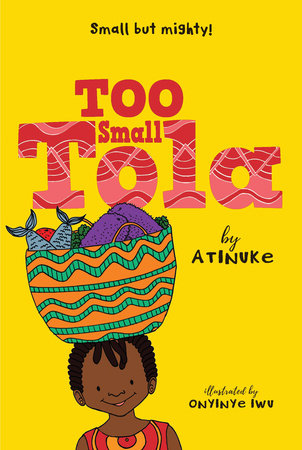
Too Small Tola by Atinuke illustrated by Onyinye Iwu

Standard
Too Small Tola by Atinuke illustrated by Onyinye Iwu

9781536211276

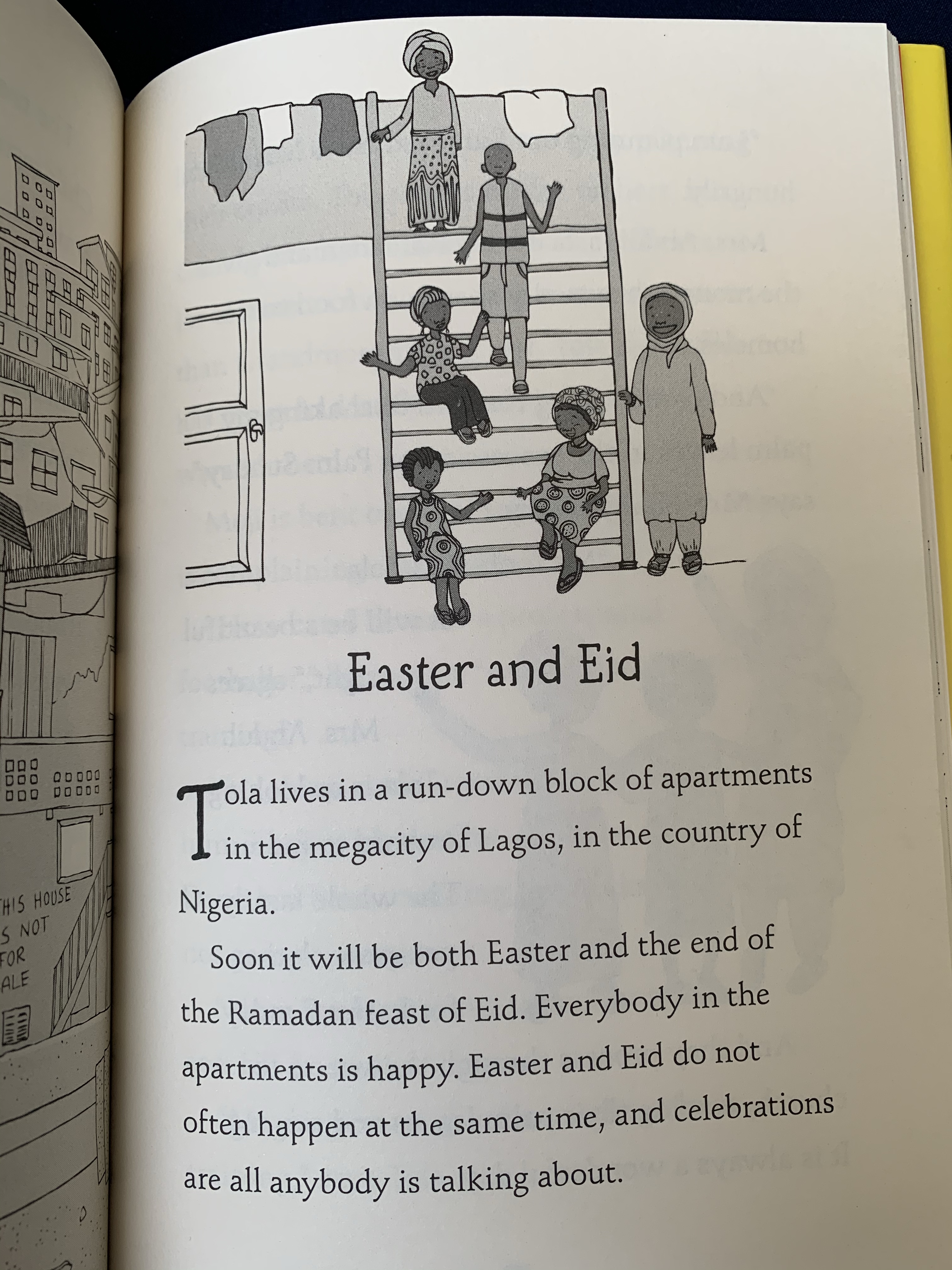
This AR 3.6, 89 page early chapter book features three stories set in Lagos, Nigeria.  The main character and her family are Christian, but many of the neighbors are Muslim, and the third story is set in Ramadan with Easter and Eid falling at the same time.  The sense of community throughout the book, the OWN voice detail and charm make this book silly, warm, and delightful for first through third grade readers.

img_9777

SYNOPSIS:

In the first story Tola heads to the market with her Grandmommy.  Not the fancy mall, but the muddy market further away.  Her older brother Dapo is too busy playing soccer to help, her older sister Moji is busy with homework, that leaves little Tola to carry the items on her head with her tough as nails little grandmother.  Everyone says she is too small, but Grandmommy knows she can do it.  As they purchase the items, and neighbors call to have them pick up items for them too, the duo have to take lots of breaks on their way home, but Too Small Tola does it and proves to herself and others that she might be small, but she is strong.

The second story once again focuses on life in Lagos and the one bedroom apartment the family shares.  One morning both the power and the water are out and the jerry bottles need to be filled at the pump.  When some bullies trip Tola and the water spills, an elderly neighbor lady patiently waits for the right time to get her revenge on Tola’s behalf, and when the bully challenges the woman, the entire line stands together.  Tola may be small, but she stood for something and made a difference.

The final story involves the neighbor, Mr. Abdul, the tailor who lives downstairs, coming to measure Tola and her family for their new Easter clothes.  He let Tola measure everyone last year and praises her as the best measurer in Lagos, and Tola is eager to take the measurements this year.  When the tailor breaks his leg, he is worried he will not be able to ride his bicycle to his clients and will not be able to prepare the Eid feast and pay rent.  Tola knows they have been fasting all Ramadan and between her, Grandmommy, and Dapo they come up with a plan to help.  Dapo will peddle the bike and take Tola to measure everyone for their orders.  Tola may be small, but she can save the day for the Abdul family.

WHY I LIKE IT:

I love little Tola and her sassy grandma.  The book would lend itself so wonderfully to be read aloud as it bursts with personality and dialogue.  I love the sense of community in such a day-to-day life that would seem to stark and hard to most western readers.  Tola’s draws on those around her to find her strength, from her Grandmommy, to her neighbors, they may tease her that she is too little, but they also build her back up and stand with her.  I love the diversity in Tola’s world.  She seems so excited that Eid and Easter will be aligned and that after her services they will be joining the Abdul’s feast, such a great lesson of tolerance and respect without being preachy about tolerance and respect.  Young readers will enjoy Tola and the insight into Nigeria.

FLAGS:

Grandmommy lies when a neighbor calls her in the market to ask her to pick up his TV, she pretends the battery dies as she and Tola laugh at how ridiculous them carrying a TV would be in addition to everything else they are carrying.  There is bullying when Tola is tripped and then when Mrs. Shaky-Shaky trips the bully.

img_9781

TOOLS FOR LEADING THE DISCUSSION:

This wouldn’t work for a book club, but would be ideal in small groups, or to be read aloud.  There would be a lot to discuss as children would relate to Tola and find themselves cheering her on.

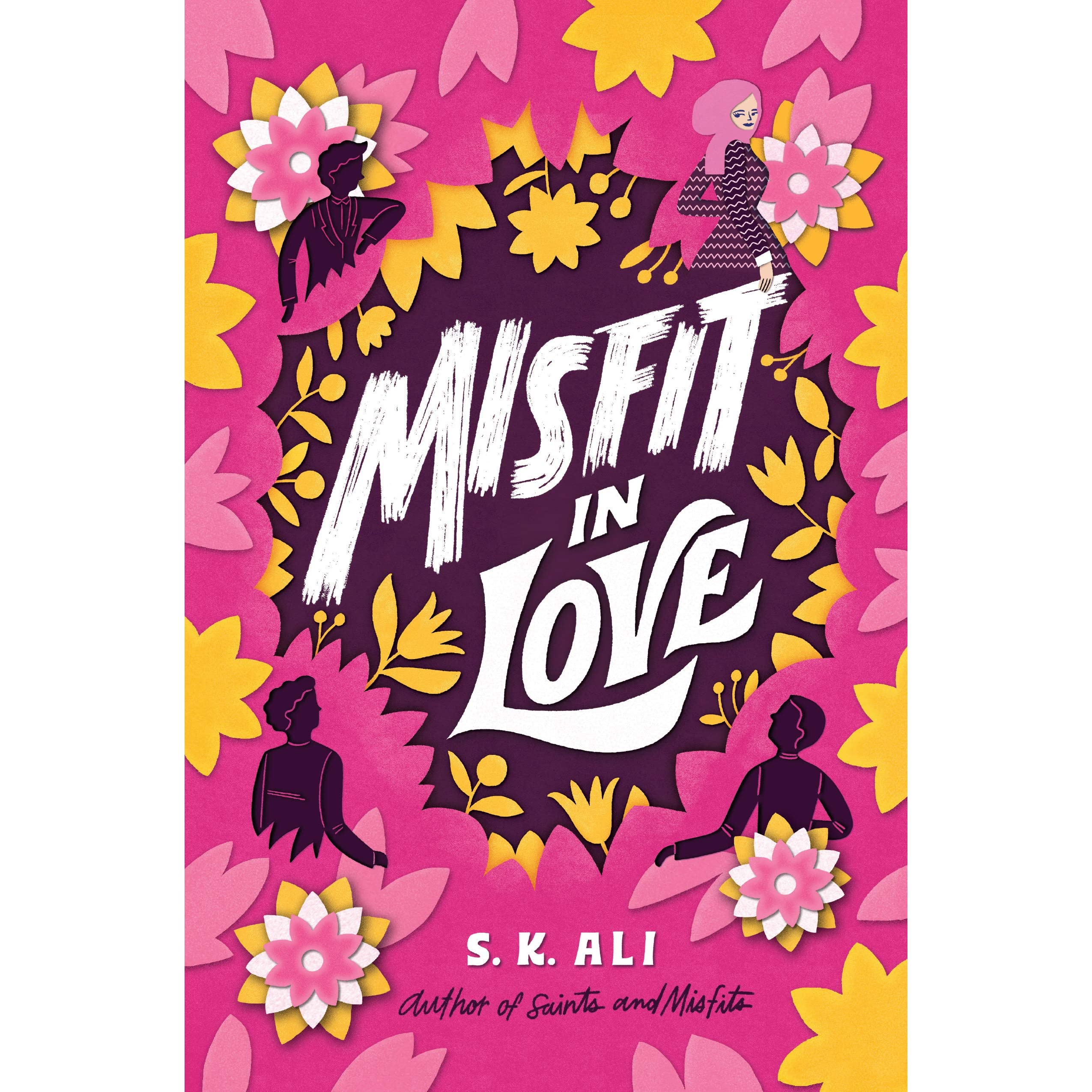
Misfits in Love by S.K. Ali

Standard
Misfits in Love by S.K. Ali

misfit

I reread my review of Saints and Misfits before diving in to this sequel that can also work as a stand alone, and imagine my absolute delight when all the things I wanted more of: Muhammed and Sarah, the mom, Jeremy, etc., were explored in this wonderful high school and up, 320 page, romantic comedy story.  The romance stays halal and the comedy light, but seamlessly interwoven into a weekend wedding are very serious notions of racism and prejudice within the Muslim community.  The writing is flawless as I tried to tell the summary to my daughter I realized just how many characters there are in the book, yet while reading, I never once was confused about who someone was or how they fit in to the family, it really is quite remarkable how real and personal the characters all become.  In many ways the story is uniquely an American-Muslim (arguably) one with characters that are half this culture, a quarter that, wearing cultural clothes to coordinate with friends, mutli lingual, multi ethnic, and yet all coming together as friends and family.  We, nor are the characters perfect, but that our weakness is explored in fiction so that we all might benefit in reality, is truly remarkable.  I honestly couldn’t put it down, and my teen and tween children may or may not have had to figure out their own meals, as I hid in the corner to devour this book in a single day. I regret nothing.

SYNOPSIS:

Janna Yusuf has just graduated high school and has been spending the last few weeks at her father’s sprawling house on a lake to help with wedding preparations for her beloved older brother.  What started out with plans to be a small nikkah between Muhammad and Sara, has quickly snowballed into a “wedding” with a few hundred guests and an ever evolving color scheme.  With extended family and friends pouring in over the three days, Janna is anxious to see Nuah and finally tell him that she is ready to return his feelings, reunite with her mom after being apart for weeks, and see who her best friend Tats is bringing as her plus one.  But, Nuah is acting weird, her mom seems to be considering remarrying, and her father is revealing himself to be racist.  There is a lot going on, and in between wedding preparations, possible crushes, family drama, prejudice overtones, and a curious ice cream man, Janna is having an unforgettable weekend.

Janna and Muhammad are close, they are the children of an Indian American non practicing father and an Egyptian American religious mother.  Their parents have been divorced for a while, and their dad and his Greek wife Linda have two little boys and are hosting everyone and the wedding.  The heart of the story is Janna as she thinks she is ready to pursue something halal with Nuah, but is slightly intrigued by Sara’s cousin Haytham and very perplexed by her mother’s potential future new husband’s nephew Layth. Being it is a wedding, and many people are staying at her father’s house and many more at the hotel in town with their own families.  Jana is trying to figure stuff out about Nuah while hanging out with Nuah’s older pregnant sister.  She is constantly thrown together with Layth as she meets his Uncle Bilal, her mom’s college friend that has proposed to her, and who’s own daughters are friends of Sarahs.  Yeah, there is a lot of overlap, a lot.  It’s like real life. As attractions wax and wane in such a short time, it is the relationship Janna has with her own family and the contentment she must find within herself that ultimately matter most.

WHY I LIKE IT:

I love how authentic the story and its characters are.  I come from a small family, but a very close friend has a huge family, and this just reminded me of going to her family events and finding how interconnected and small the world really is.  I absolutely love Janna, she is Muslim by choice through-and-through and is genuine in her understanding and actions that, while the book is meant for Muslims and nonMuslims, she really sets the standard of how fictitious characters can positively affect their readers.  The only slightly forced thread for me was Janna suddenly loving animals and being ready to head to Peru.  I get that she was crushing, but it seemed a little too over the top for an otherwise very plausible plot.

The best part of the book, in my opinion is that it isn’t all fluff and fun, there are some very real issues that get spotlighted.  Like in Saints and Misfits where Janna is sexually assaulted by a seemingly devout, religious, well liked male, this story addresses racism and prejudice within the Islamic community.  Janna’s dad always felt treated as less than by Janna’s mom’s family for not being Arab.  He flat out warns Janna about her feelings for Nuah because he is Black.  Sarah’s Aunt is offended that the mendhi is more Desi than Arab.  The issues aren’t just pointed out, they require active acknowledgement and action.  The author’s note at the end, even discusses the significance and weight of such views at the end.

FLAGS:

There are mentions of the sexual assault that happened to Janna in the first book.  There is mention of periods, a possible affair, racism, and a character who drove while drunk and killed his son as a result.

TOOLS FOR LEADING THE DISCUSSION:

I don’t know that this book would be a great fit for a school book club, but I think a group of high school or college aged girls would thoroughly enjoy reading this and discussing it, and I would totally invite myself to their gathering to do so.

It’s Ramadan and Eid al-Fitr! by Richard Sebra

Standard
It’s Ramadan and Eid al-Fitr! by Richard Sebra

img_9007

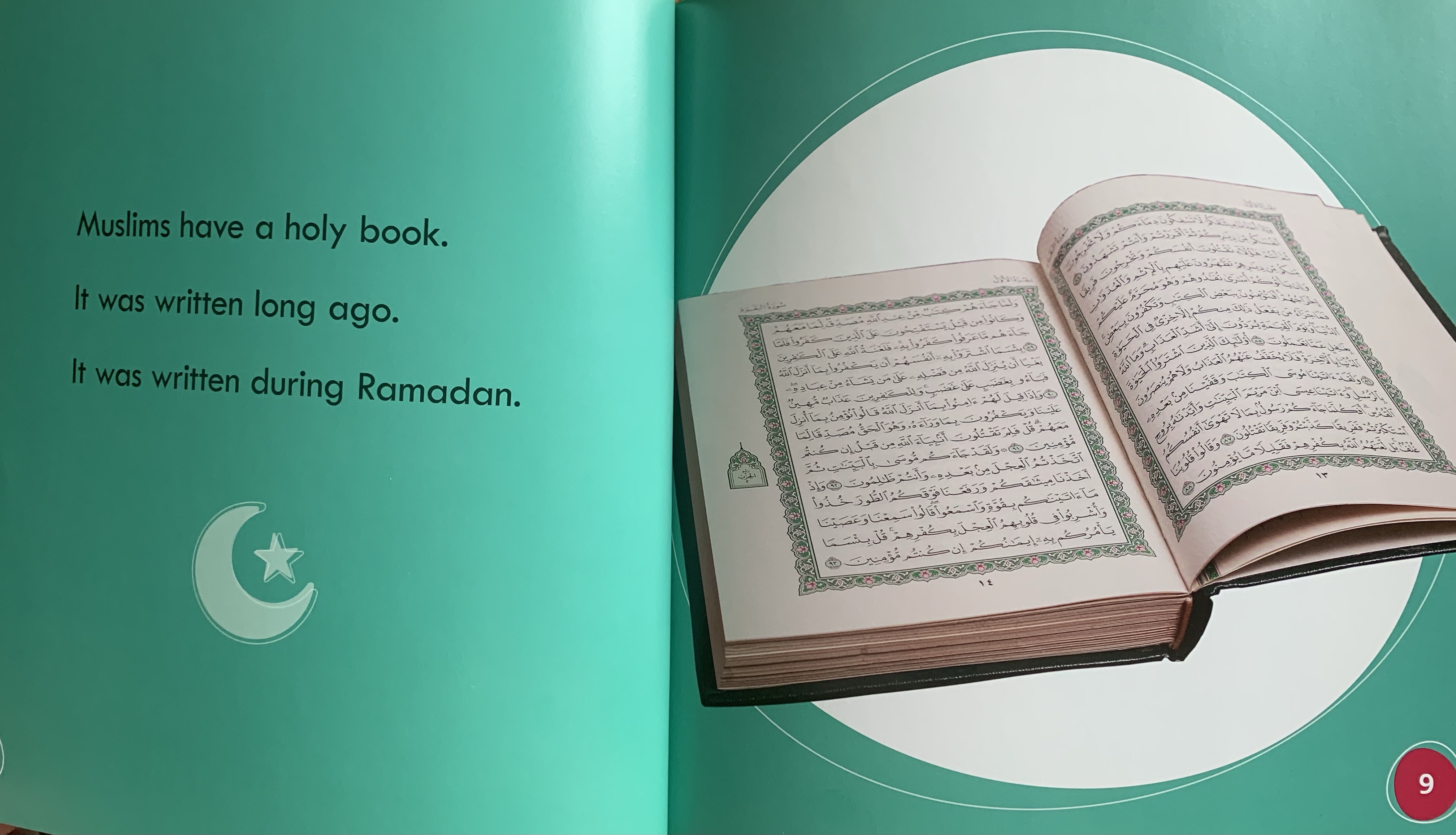
Sigh, another erroneous children’s nonfiction book from a holiday book series targeting classrooms.  This 24 page book is meant for pre-school to first grade and in addition to being vague and repetitive, states that Muslims have a holy book that was written in Ramadan.  It never states the Quran by name, and clearly it wasn’t written, it was revealed in Ramadan.  It later also states that Eid al-Fitr is the last day of Ramadan, failing to acknowledge that it falls on the first of Shawwal, when Ramadan is over.  The table of Ramadan dates at the end spanning from 2016-2022 is also problematic if you are trying to explain that we often don’t know until the night before when Ramadan and Eid will be because we need to sight the moon.  These errors may appear minor, but when they seem to fill every recently published children’s nonfiction book, it really makes the correction of such assumed facts that much harder to overcome.  If our non-fiction books are so consistently flawed, our sense of reality is being shaped erroneously, and imagine what else we have consumed as fact that isn’t accurate over the years.  Please speak out when you come across these errors, in Islamic books and all non-fiction works.

img_9008

The book is filled with simple short sentence and often repeats the same basic information on multiple pages.  The two page spreads contain the text on one side and a realistic photograph on the other with critical thinking prompts to consider.

img_9009

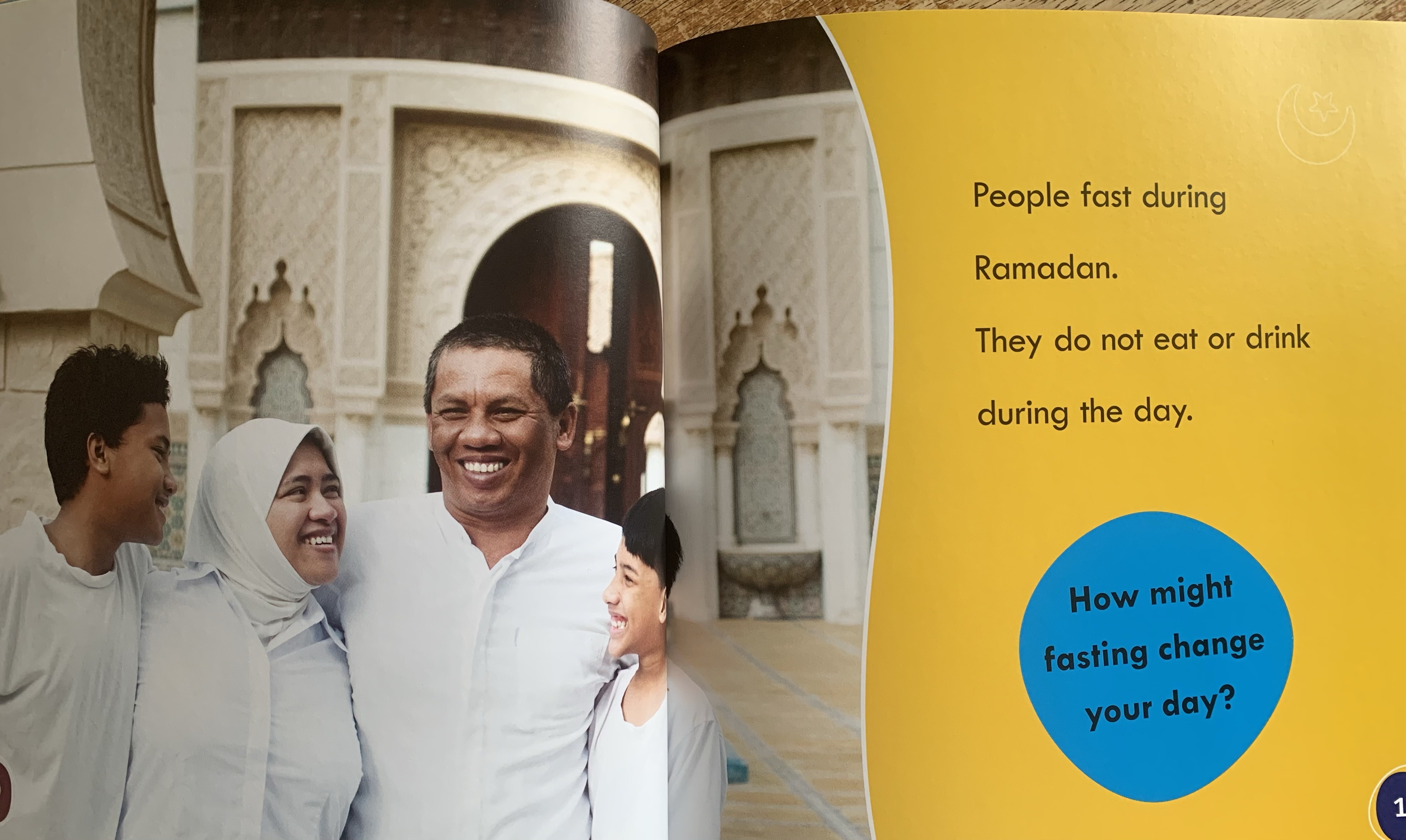
It starts off by establishing that Muslims have a calendar based on the moon, that Ramadan is the ninth month and it is a holy month.  The next page again reasserts that Ramadan is not one day, but a whole month before introducing the idea that families get together to pray.  The erroneous page about the Islamic holy book follows and then the concept of fasting: not eating or drinking during the day is presented.  The critical thinking point asks readers to consider how fasting might change your day.

img_9010

There is then a page about prayer which includes that we kneel on rugs, pray everyday, but pray more in Ramadan.  I’m not sure why this page didn’t follow the page that first mentioned prayer, especially since the next page goes back to talking about food which probably should have followed the page on fasting.

img_9011

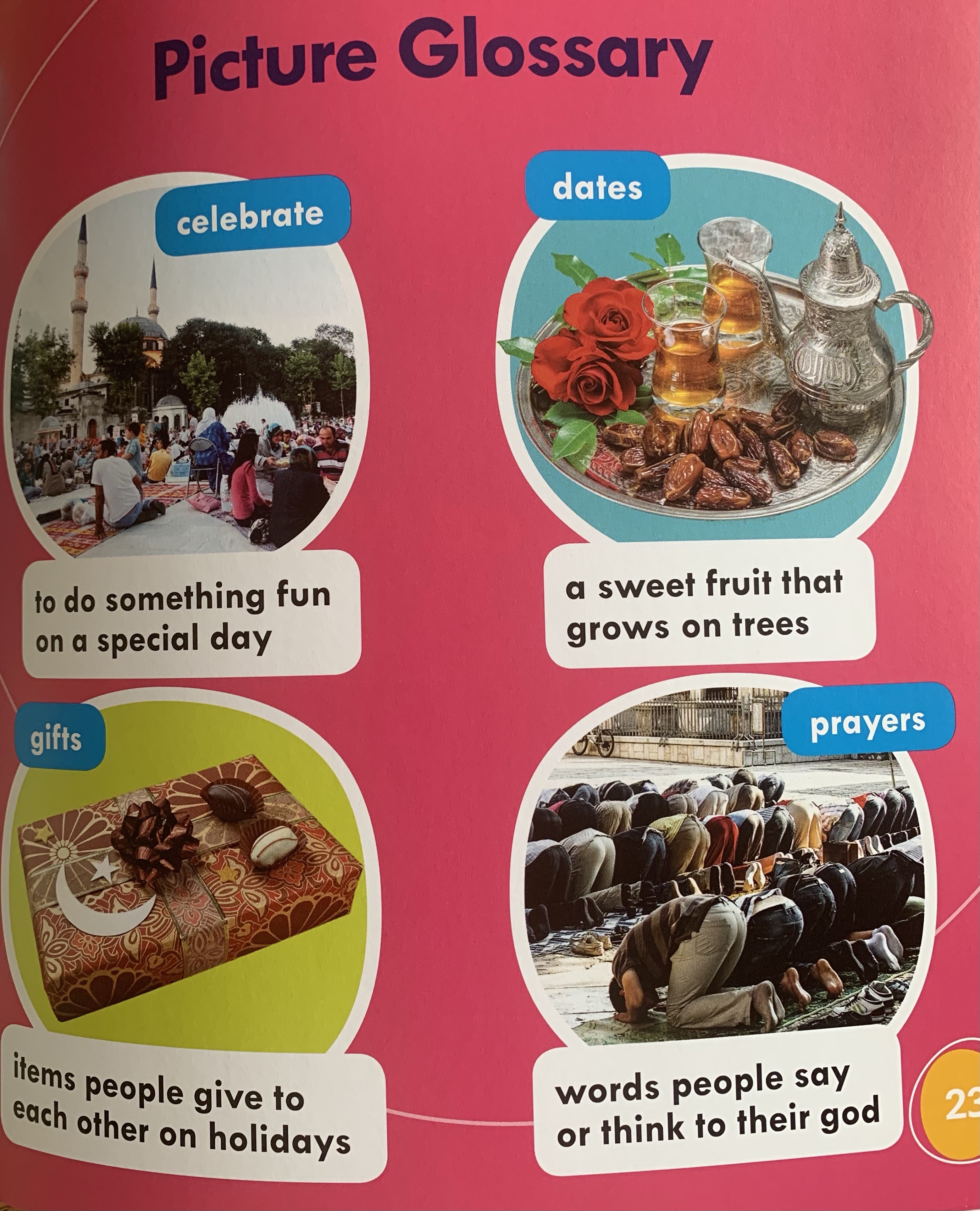
The page about Eid being on the last day of Ramadan is then followed by more sentences over a few pages about Eid being a festival, there being food, and gifts. There is a table of Ramadan dates at the end, as well as an index and books to further read.  There isn’t a proper glossary because there really isn’t any vocabulary presented  in the vague descriptions, but there is a picture glossary with words such as celebrate, dates, gifts, and prayers.

img_9012

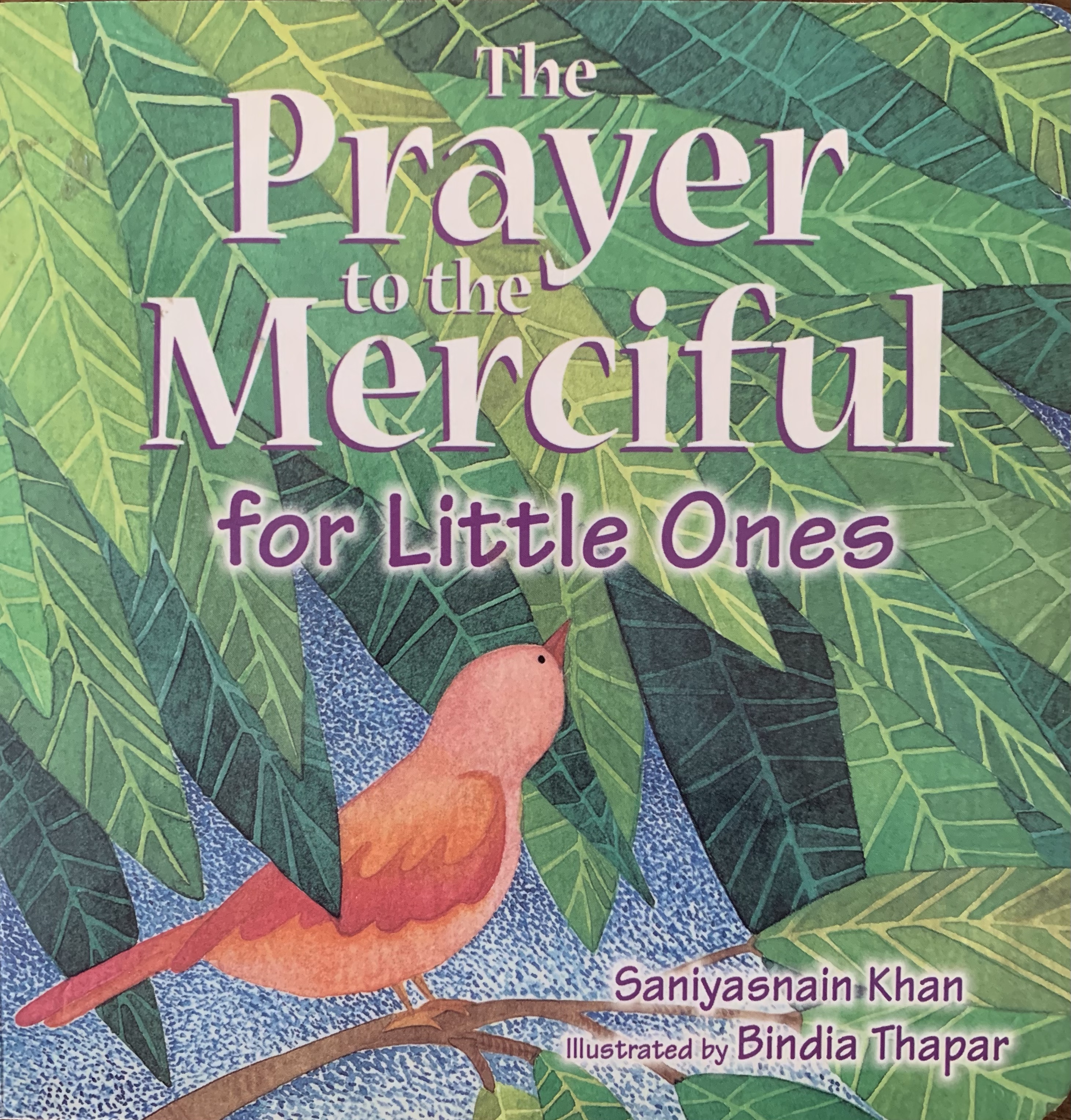
The Prayer to the Merciful for Little Ones by Saniyasnain Khan illustrated by Bindia Thapar

Standard
The Prayer to the Merciful for Little Ones by Saniyasnain Khan illustrated by Bindia Thapar

img_8938

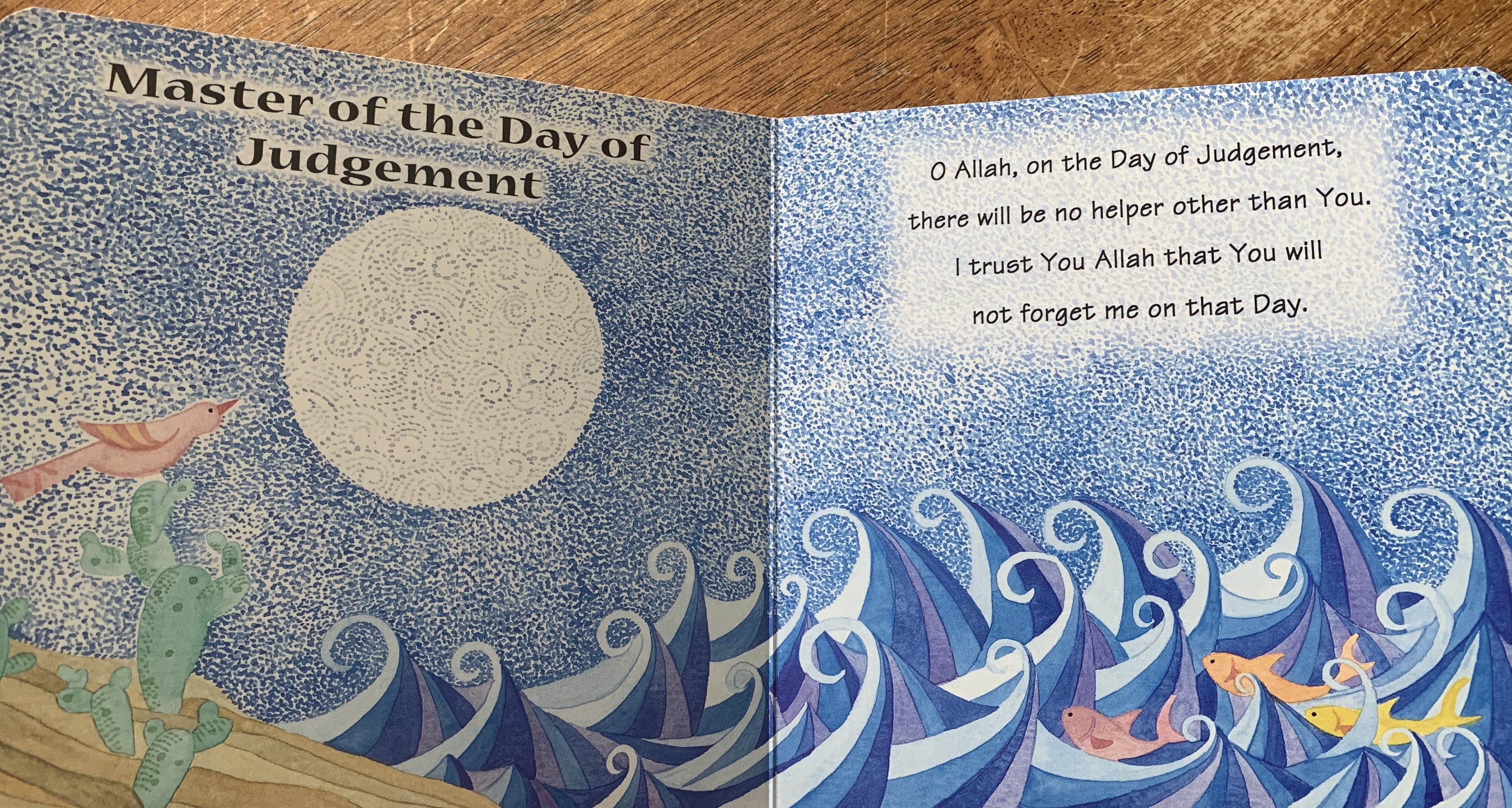
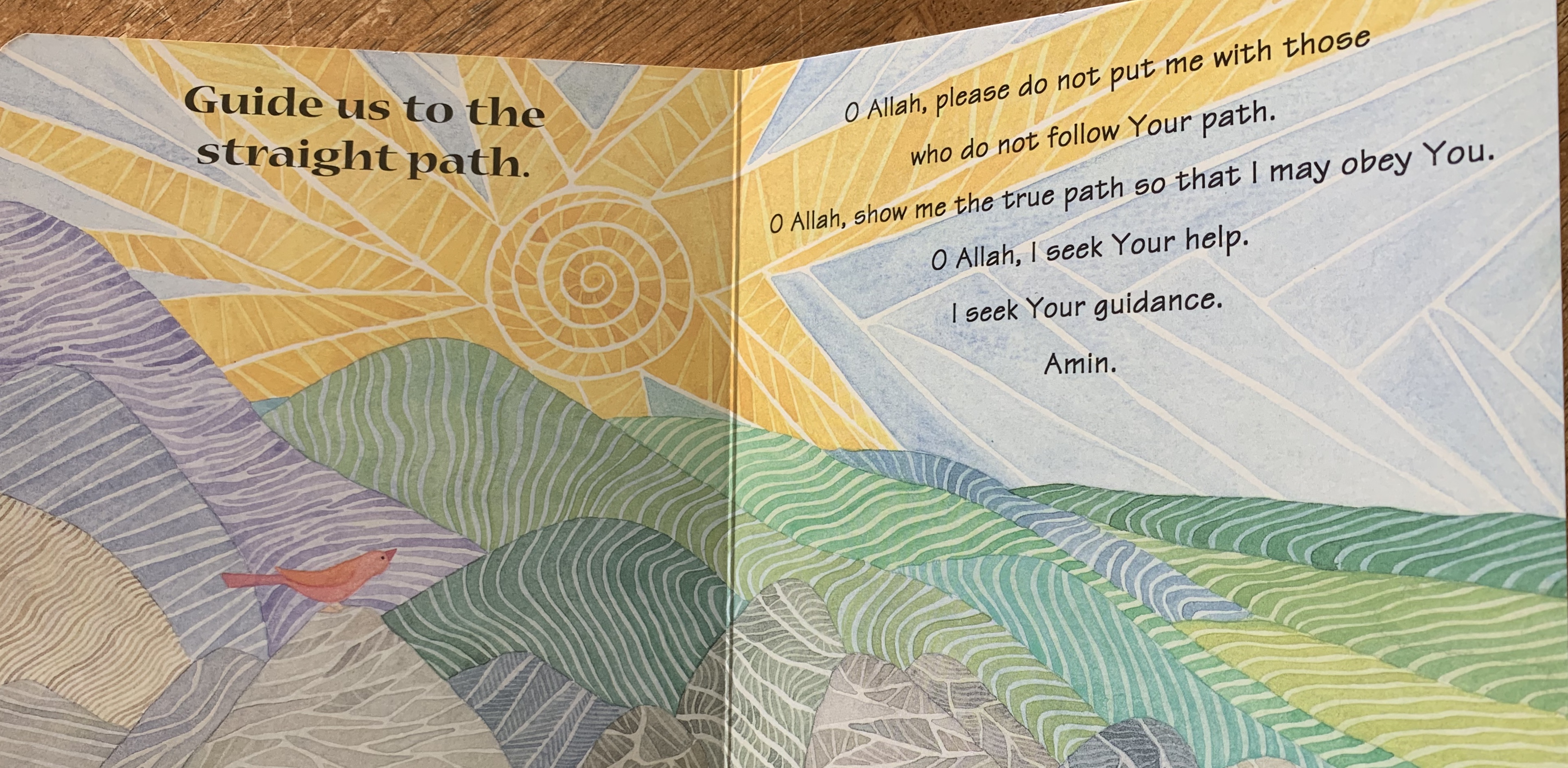
This 14 page board book is a prayer based on Surah Fatiha and explores the first few ayats with reflective and thoughtful duas.  It has soft muted illustrations of birds and nature on small 5 by 5 pages.  The idea of the book is sweet and soft that I can imagine reading it with a child in your lap after salat, or perhaps whispering into them at bedtime, but it really is a prayer for the parents to read.  Children might understand from the text that everything is from Allah swt and He is always with us and helps us, but because it doesn’t repeat those notions, I don’t think the message will stick. The vocabulary is not reflective of toddlers understanding, and really the comfort comes from them listening to a loved one’s voice not the text or pictures.  I have five kids, this book was purchased when I was pregnant with the first one, I don’t think it has ever willingly been picked up by any of them or sat through in the idyllic picturesque manner that a person with no children would imagine spawning from such a heartfelt book.  I hope I’m in the minority and other families have loved and appreciated this book as it was undoubtedly intended.

07F4AB67-2FEB-44B0-A5FF-994F9A884FDE

The book starts with a complete english translation of Surah al Fatiha.  The next two page spread is entitled “Praise be to Allah” which is explored in the text of praising Allah for the blessing given and knowledge of Allah being close. The theme isn’t entirely on point, but follows the rhythm of duas: praising Allah swt and glorifying him mixed in with making your requests.

6377C9F1-53DD-4C0A-84D4-66AD00FB9725

“Lord of the Universe” is the next heading, followed by “The Compassionate, the Merciful,” “Master of the Day of Judgement,” “You alone we worship and to You alone we turn for help.”  The final section is “Guide us to the straight path.”

40595865-EF04-42DC-9A71-B4F09DECE81E

The book came out in 2003, and I was ecstatic to see it available, however, there are now just better and more varied options available, that this one will once again be lost on my shelves.

80351529-FA74-444A-A8CA-7F23A6E3EB4C

My First Book About the Qur’an: Teachings for Toddlers and Young Children y Sara Khan illustrated by Ali Lodge

Standard
My First Book About the Qur’an: Teachings for Toddlers and Young Children y Sara Khan illustrated by Ali Lodge

img_9014

I had planned to review the Ramadan book in Sara Khan’s My First Book about series, but needless-to-say all of the board books in the collection look remarkably similar and the one on my shelf, that I thought was the Ramadan one is this one, the one about the Qur’an.  Rather than find another Ramadan book, I figured to just go with it, Ramadan is the month of the Qur’an after all, and the book is both informative and engaging for little Muslims.  The soft detailed pictures and sturdy binding introduce toddlers and up to the belief in Allah, the pillars, care for all creation and being good to one another.

img_9015

The book starts out stating the the Qur’an tells us in the beginning there was only Allah, and that He created everything.  His creations are as big as the heavens and the Earth and as small as the creatures we cannot even see.  He created the trees and mountains and the angels and jinn, as well as the people, He made us all special.

img_9017

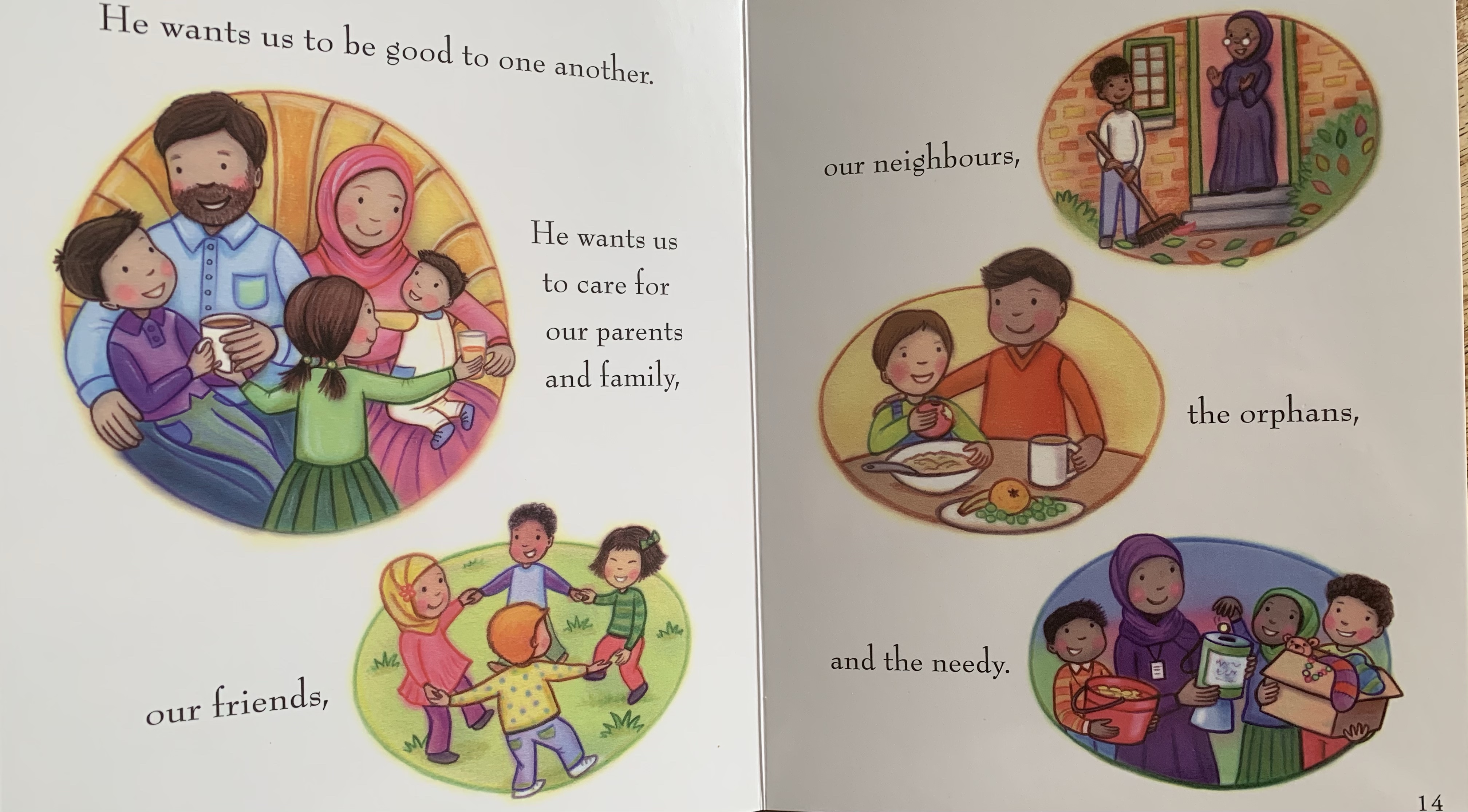
Allah wants us to follow His rules and sent books and Prophets to show us how to act.  He wants us to be good to one another, to be thankful, to look after our world, and everything in it.  Allah wants us to worship Him alone and pray five times a day, fast in Ramadan, give money to the poor, and go for Hajj.

img_9016

He also wants us to have families and to get married and raise our children to be good Muslims, so that when we die we will go to Paradise.  The book ends with facts about the Qur’an and questions and answers that can help further the conversation, increase understanding, and encourage love for the holy book.

Ramadan by Mari Schuh

Standard
Ramadan by Mari Schuh

ramadan edelweis

This 16 page holiday book is one in a series of six.  It keeps the text simple, the images bright and inviting, and turns the pages in to a search and find activity to increase time spent with the material.  The information is accurate and basic, there is nothing wrong (phew) with this recent addition to the very crowded nonfiction holiday book field.  In fact I appreciate that dates are explained and that the food looks tempting even if non Muslim children aren’t familiar with the dishes.  It shows a child in sajood and explains that he is praying. The realistic pictures show smiling faces and Muslim kids will feel represented. Non Muslim readers will become familiar with Ramadan as a time of fasting, the Quran, and prayer.

The pictures to look for are given at the beginning and again at the end with the “answers.” The limited pages have very minimal text.  The first one mentions a lantern being hung for Ramadan. It then states that Ramadan is a Muslim holy month where people fast, don’t eat or drink.

It shows a picture of the Quran and says it is used to pray, before showing someone praying on a prayer rug. When the sun has set it is time to eat. Dates are a sweet fruit to snack on after dark. It then shows a child and adult making dua and again reiterates that the holy month is for praying and helping others.

‘Tis The Night Before Eid by Yasmin Rashidi illustrated by Mariam Aldacher

Standard
‘Tis The Night Before Eid by Yasmin Rashidi illustrated by Mariam Aldacher

img_8995

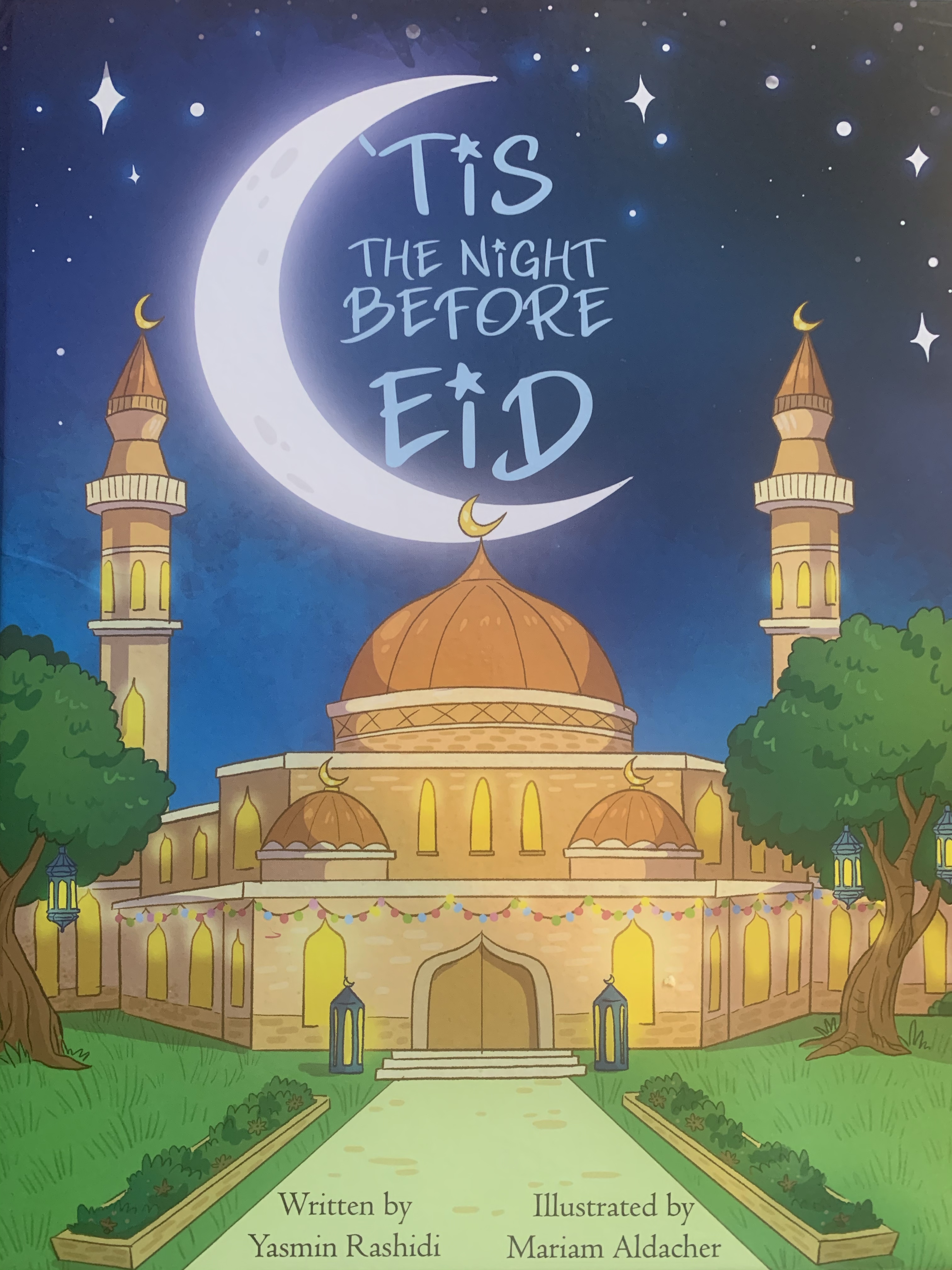
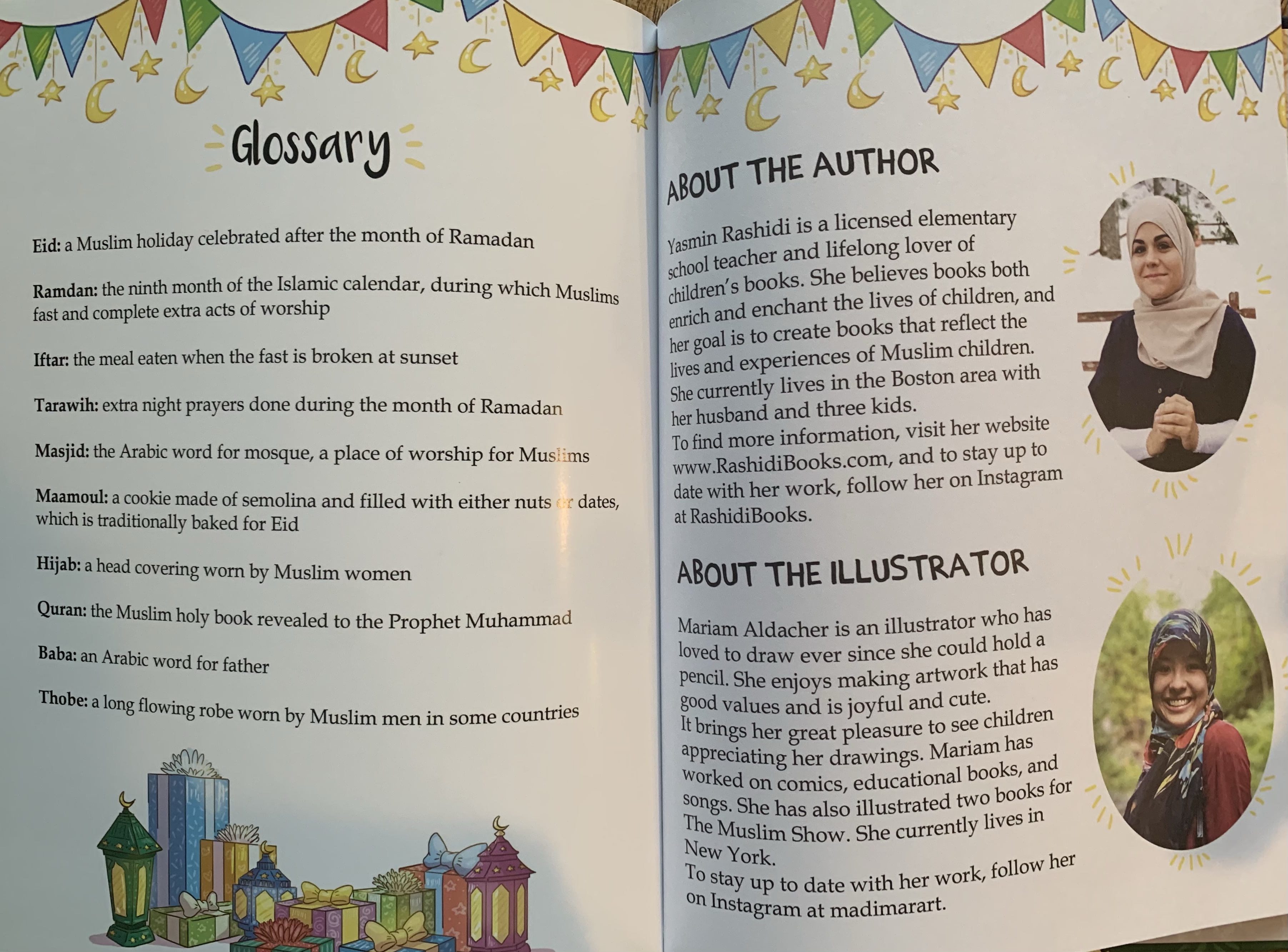
On the surface this 32 page inspired re-imagining of the classic Christmas poem might not seem that impressive, but it is really quite effective in highlighting general key points of Ramadan, the mix of sadness that Ramadan has gone too quickly with the excitement of Eid, and showing the diversity of Muslim families and communities.  The large 8 x 10 hard bound pages showcase fun and relatable illustrations that would help inform those unfamiliar with the holiday, while also mirroring and encouraging Ramadan and Eid excitement.  It is already a favorite at our house and with simple rhyming lines, the book can lend itself easily to more in-depth discussions (there is a glossary at the back) or be kept as a sweet flowing story that you don’t mind reading repeatedly at the prodding of toddlers and preschoolers alike.

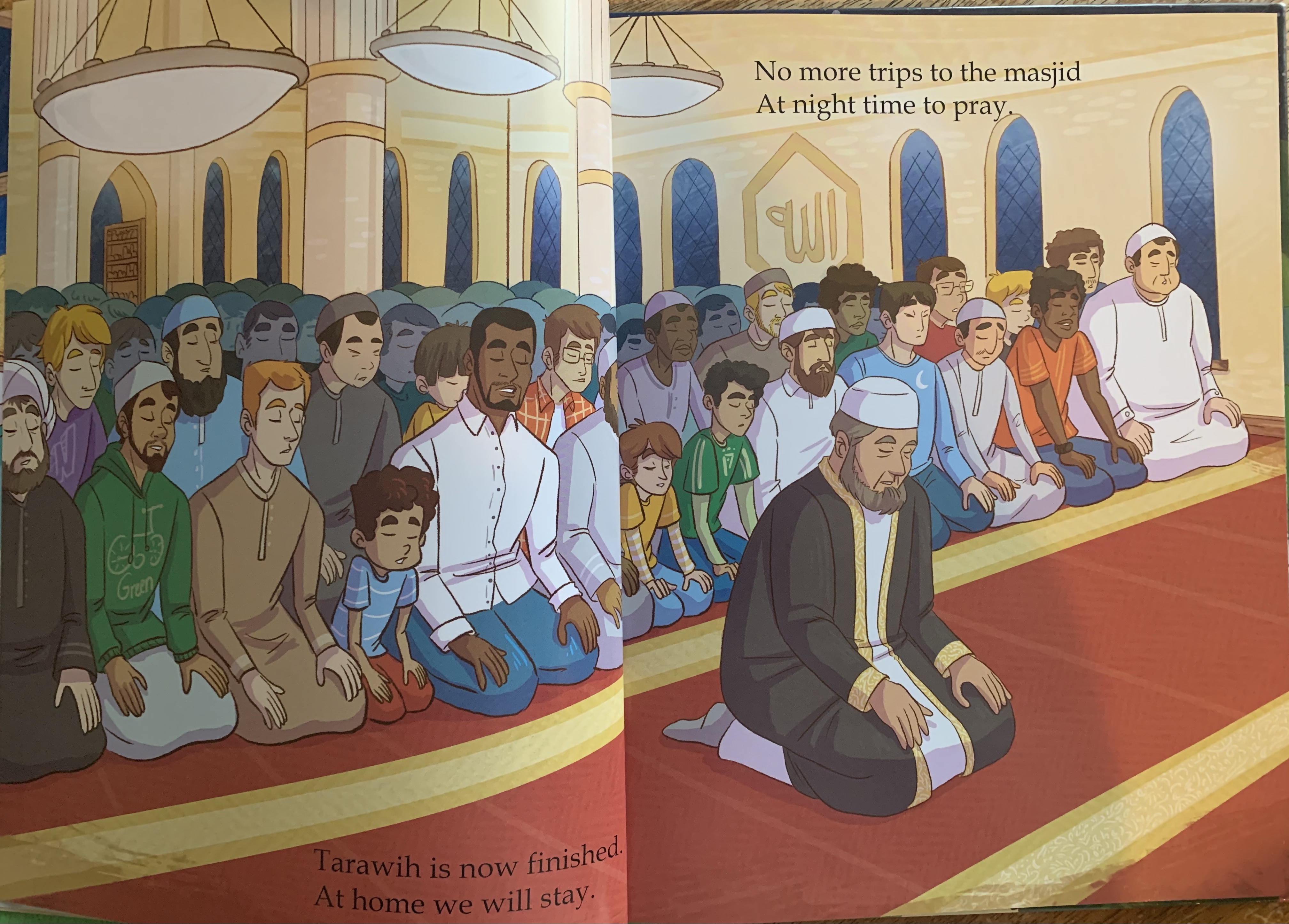
img_8997The story starts with it being the night before Eid.   Ramadan has flown by, iftar eaten, dishes are put away, trips to the masjid for Taraweh have concluded and now it is time to prepare for Eid.  The house is cleaned, clothes ironed, sweets prepared and dreams of gifts filling the kids minds.

img_8998

The narrative bounces back to Ramadan to explain that fasting is not eating til sundown for 30 days, that Quran was revealed during the blessed month and that we hold on to the lessons of Ramadan all year long.

I pre-ordered mine from the author’s website https://rashidibooks.com/home , but it is also available at Crescent Moon Store https://crescentmoonstore.com/products/twas-the-night-before-eid.  There are also printables on the author’s website.

img_9002

Ramadan and Eid Al-Fitr: Traditions and Celebrations by Melissa Ferguson

Standard
Ramadan and Eid Al-Fitr: Traditions and Celebrations by Melissa Ferguson

This 2021 nonfiction middle grade book about Ramadan and Eid al-Fitr breaks sections down by key concepts and the use of stock image photographs. The information is fairly accurate, no major flags, just a few awkward stresses: that kids look for the moon, that meat is so important at iftar, but most of the information is conveyed well. There is a glossary, more books to check out, internet sites to visit, an index, and pronunciation guide. The Capstone published, 32 page book, shows diversity in the pictures- some women with hijab and some without, different skin tones as well, and while it might not be the most tempting book to pick up, the text is inviting for non Muslims to understand Ramadan and Eid, how to join their Muslim friends in being kind and forgiving, and answers a lot of questions in a straightforward manner. Muslim children will also enjoy seeing their beliefs explained in a positive manner to readers in a book that stays religion focused and doesn’t get distracted by culture.

The book sections are: What is Ramadan?, When is Ramadan?, What does Fasting Mean?, Suhoor, Iftar, The Qur’an and Prayer, Acts of Kindness, Ramadan at School, and Eid Al-Fitr. It starts by introducing a fictional character named Ayesha reading the Quran with her family. It is the start of Ramadan, a month of praying, fasting, spending time with loved ones, and trying to be better people.

It then explains the lunar calendar before discussing that fasting is a choice to not eat or drink from dawn until sunset. It also notes that children and the sick and elderly are not required to fast.

It talks about eating healthy foods early in the morning before praying the first prayer of the day. It details iftar being dates and water, followed by the sunset prayer and then a large meal after that.

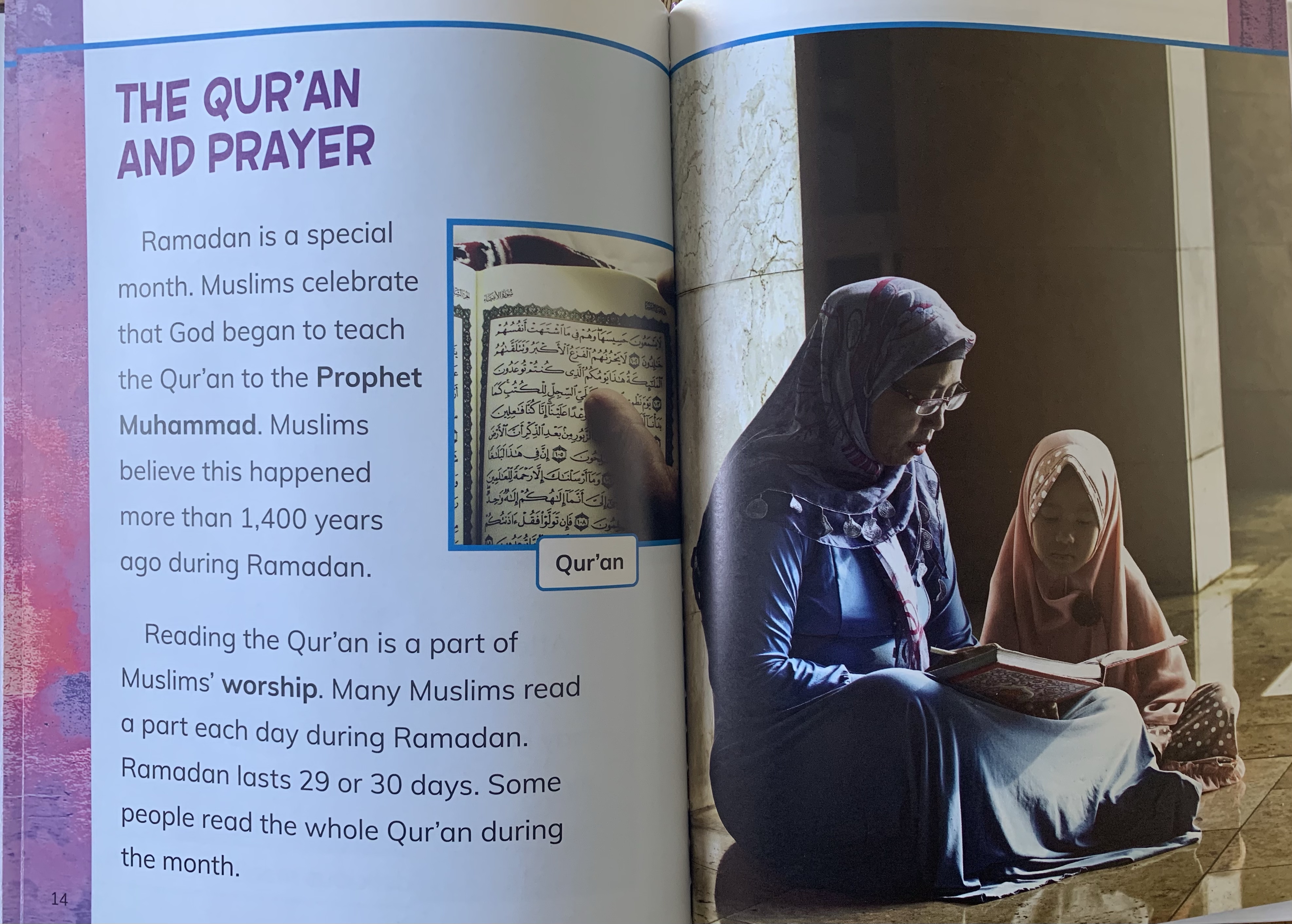
It is very clear in explaining that Muslims believe it was during Ramadan that God began to teach Prophet Muhammad the Quran more than 1,400 years ago. It identifies our five prayers and that people can pray at home or in mosques and that children learn to pray with their parents as they grow up.

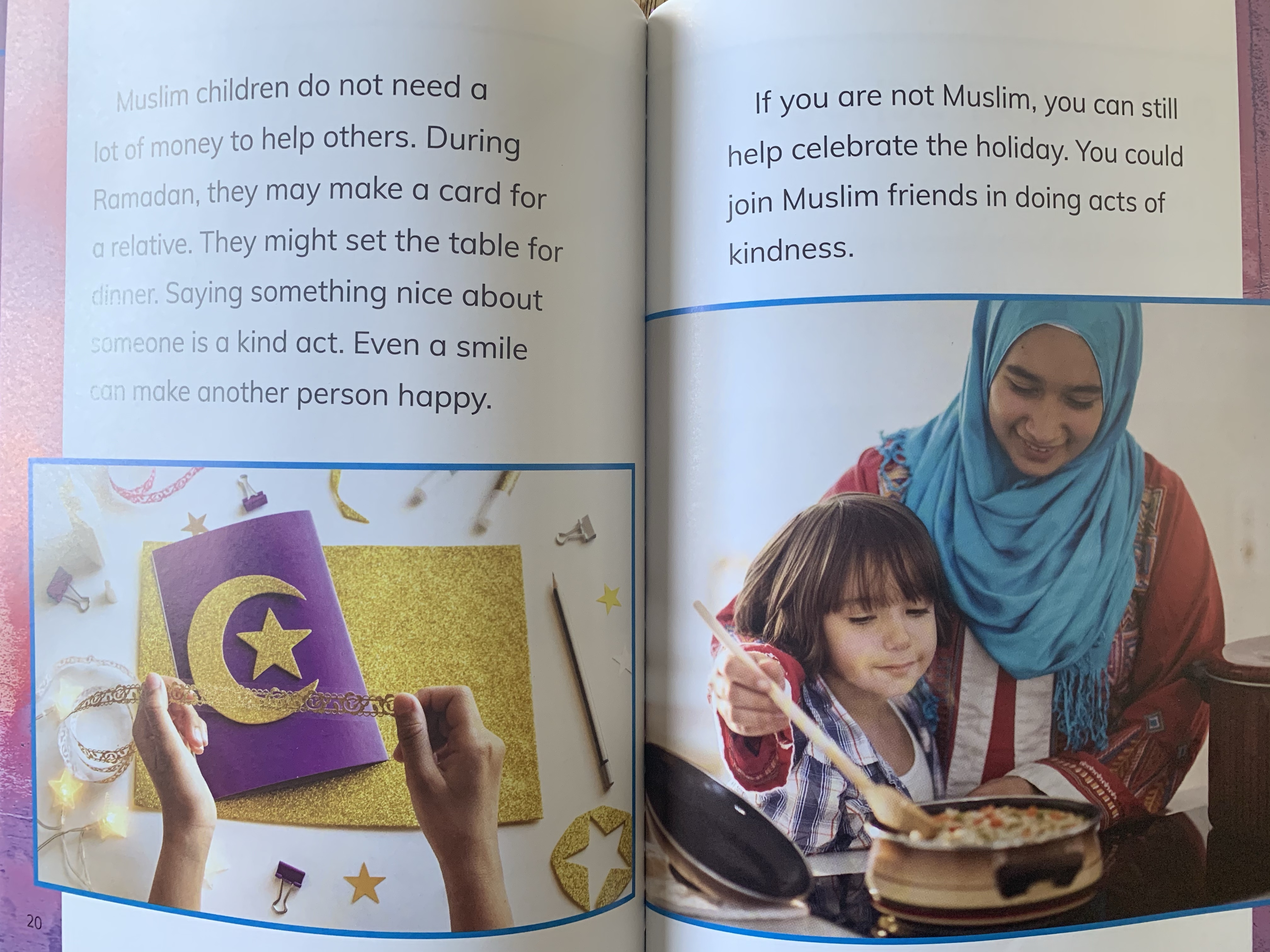
The book then becomes a little more unique as it gives time to the aspect of kindness in Ramadan. It gives examples of what Muslims do, from raising money and hosting large dinners, to buying and donating a toy. It even dedicates a whole page to children doing kind acts with little to no money: setting the table, making a card, smiling. It encourages non Muslims to join a Muslim friend in doing an act of kindness too.

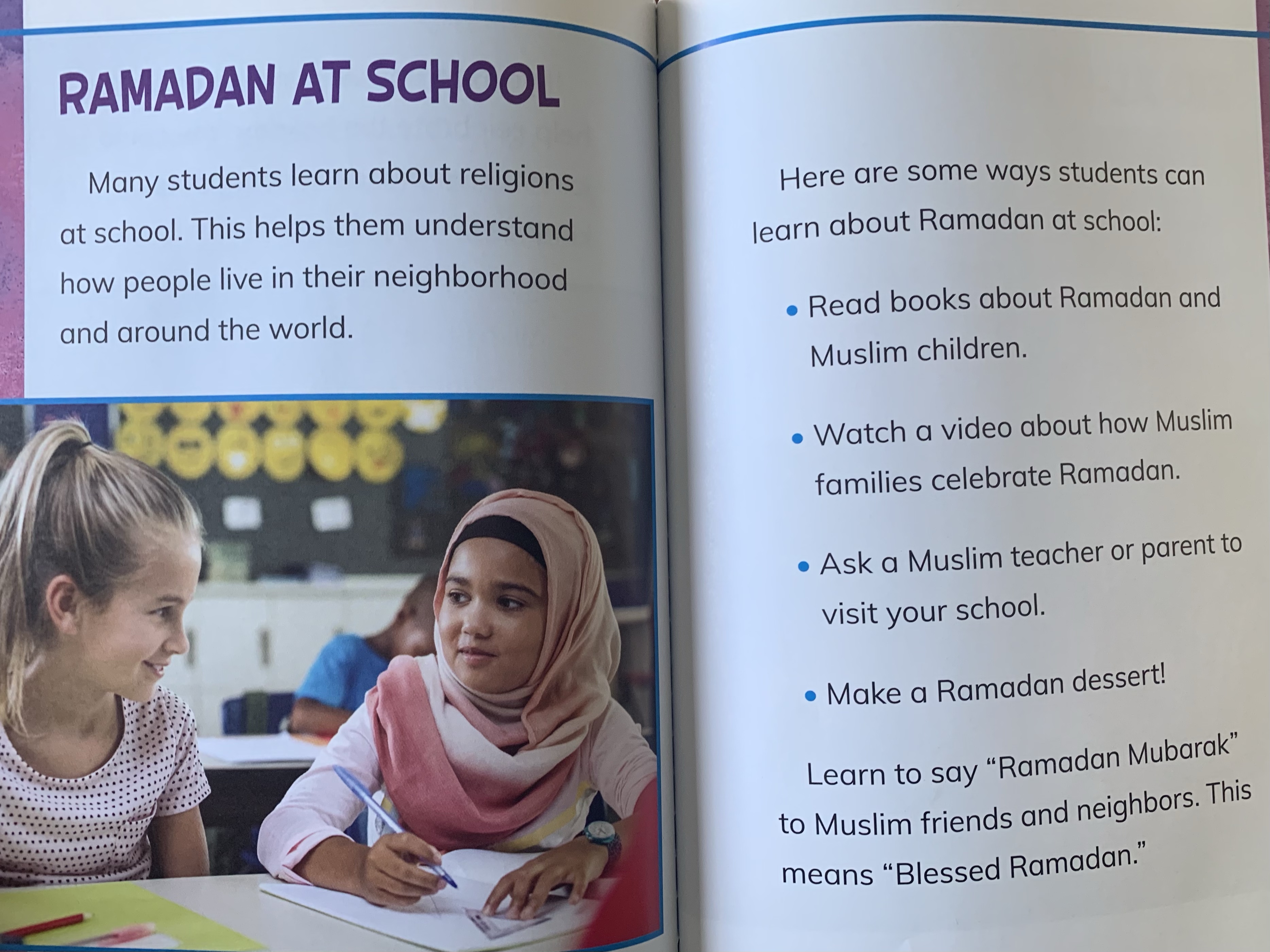
The next section, is similarly unique in talking about Ramadan at school and how often at school we learn about different religions in our neighborhood. It gives bulleted suggestions on how to learn about Ramadan in school and how to say Ramadan greetings. The book concludes with Eid Al-Fitr and coming back to Ayesha and her family celebrating.

Zara’s New Eid Dress by Nafisah Abdul-Rahim

Standard
Zara’s New Eid Dress by Nafisah Abdul-Rahim

img_8802

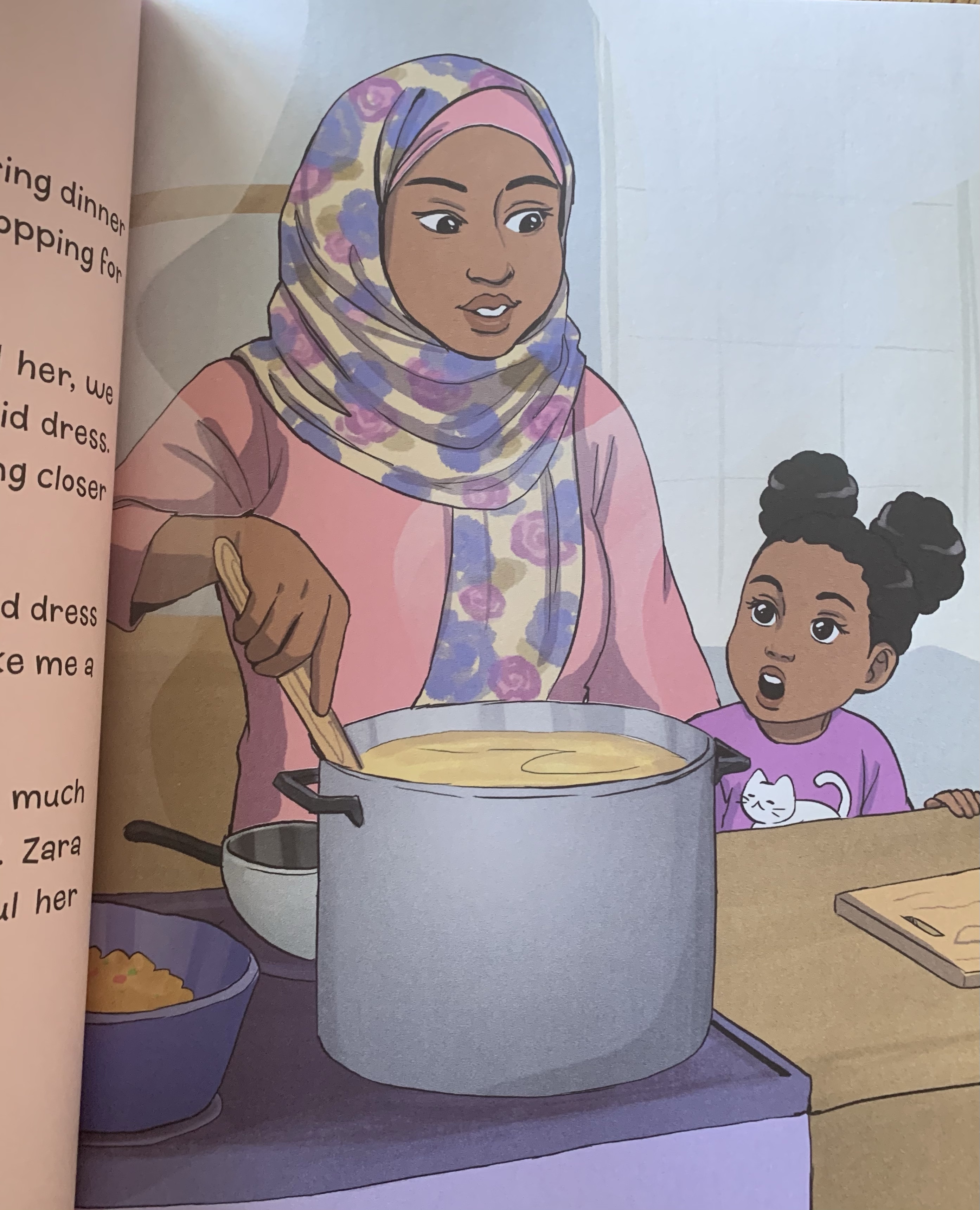
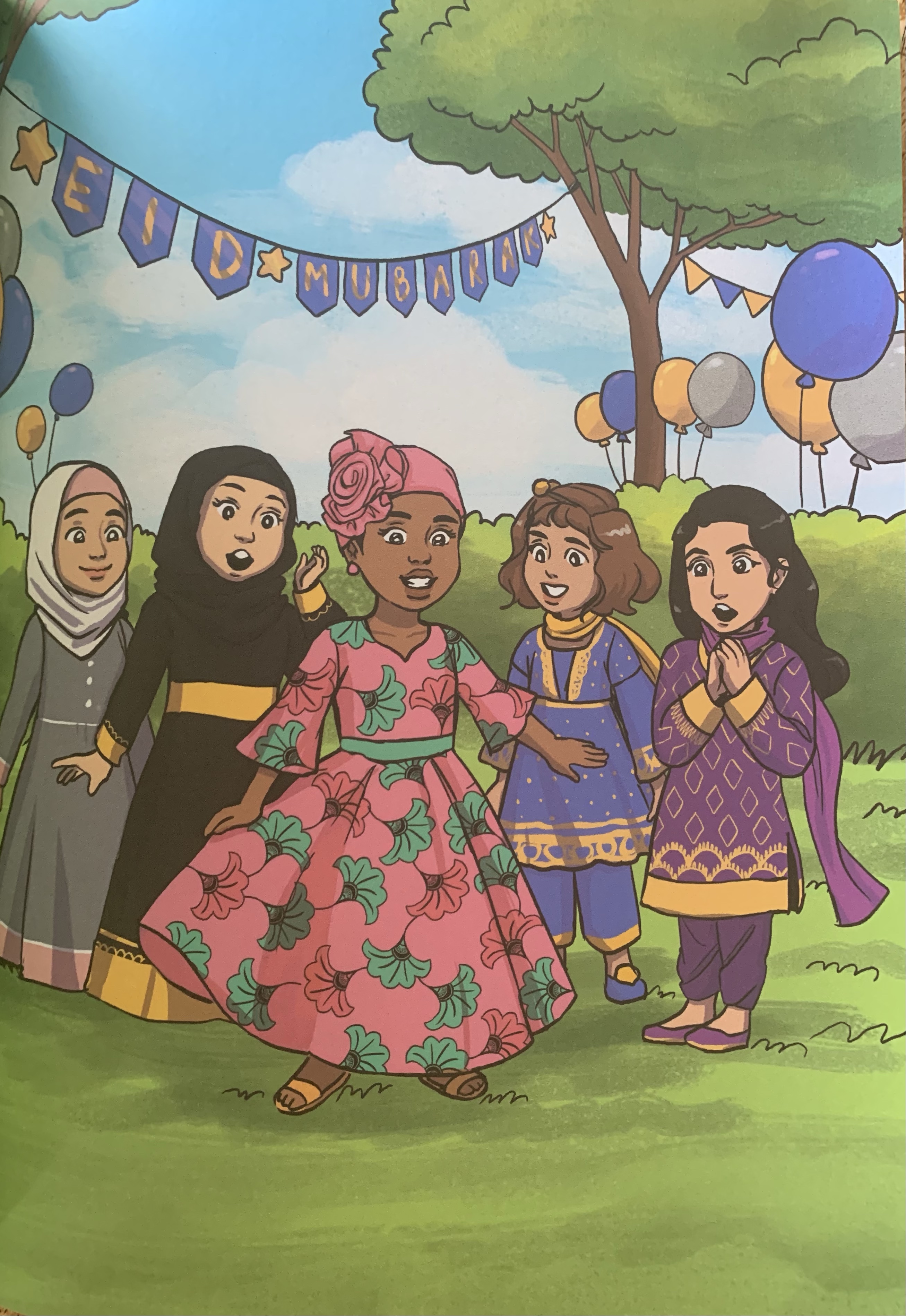
The search is on for an eid dress that reflects Zara’s African American Muslim culture.  This much needed representation highlights more of looking for a dress and the process of having one made, than providing information about Eid or the African American Muslim experience over its 30 pages.  Iftar is mentioned on one page in parentheses, so if you omit that word it could reflect either Eid preparation.  The book is cute if you are looking for a slice of life and coming together of a child, mother, and grandmother over the creation of a dress that has what Zara is wanting: pink, fluffy and containing flowers.  It falls short if you are looking for a book to learn about Eid, Ramadan, what a cultural African American Muslim dress would look like, or a peek into an under represented culture.  The illustrations are sufficient.  I felt the girl looked younger in some of the depictions, and I was surprised that the girl’s rain boots and clothes were worn over multiple days in her search for a dress, picking out fabric and inside her house when the dress is completed.  Similarly, on Eid day while her dress is stunning and fabulous, her friends are wearing the same eid clothes they wore at the start of the book from years past.

img_8804

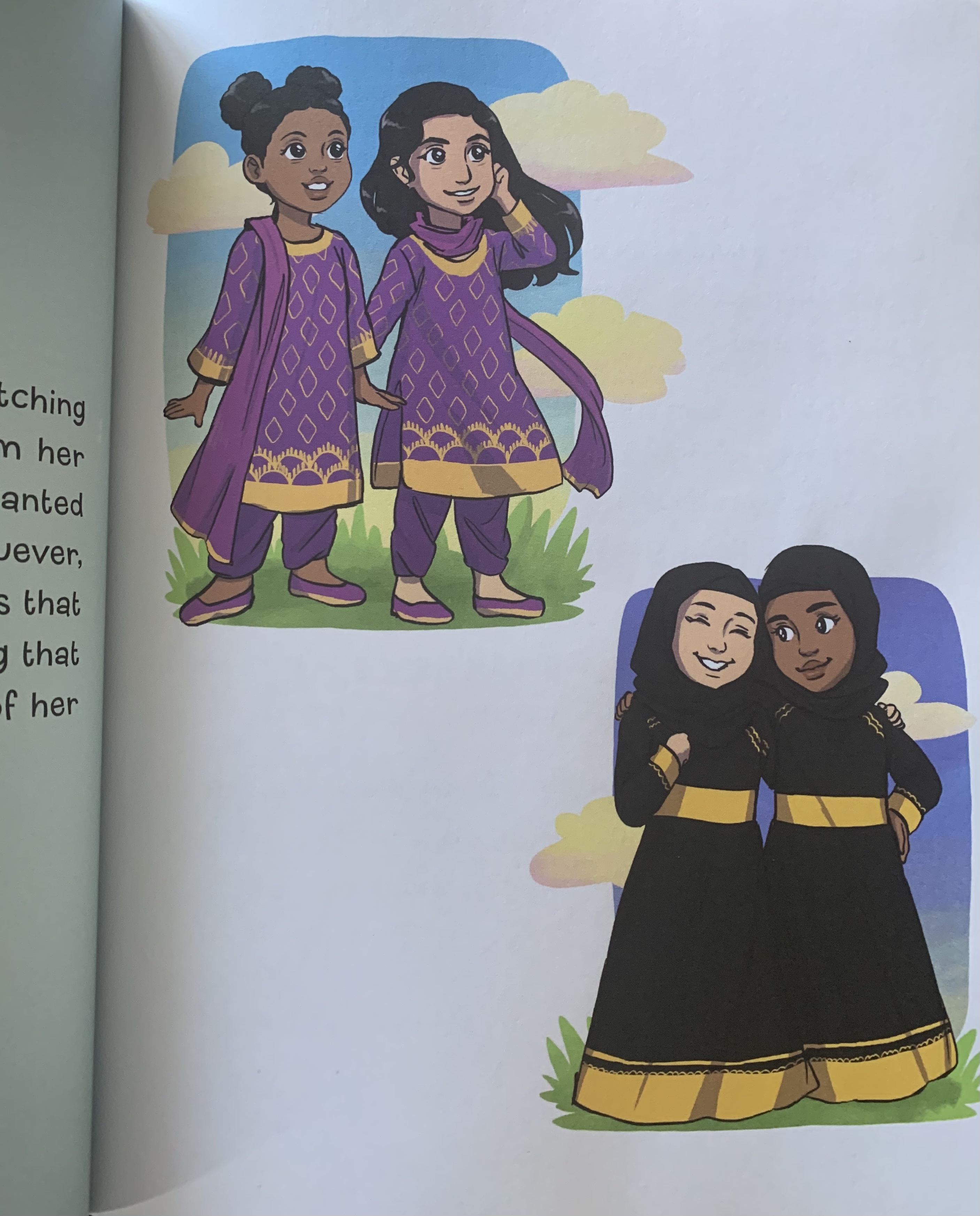
Zara has worn a salwar kameez from Pakistan with her friend Sana, an abaya like her friend Noura one year too, but this Eid, she wants a dress that shows “her own style, her heritage, a reflection of her culture as an African American Muslim.  As her mom is preparing iftar she asks when they can start shopping for her Eid dress.  She knows it won’t be easy to find and convinces her mother to start looking this weekend.

img_8805

She pulls on her rainboots as they head out the door to find “something bright, pink, fluffy, and has flowers on it.” They go to several stores and kind find anything just right.  Her mom suggests asking Nana to make it.  Zara’s mom recalls the fabulous dresses her mom used to make her to wear on Eid.

img_8806

Nana and Zara head out to the fabric store the next morning. First they find the pattern, then they find the fabric.  After a few days of hard work for Nana, the dress is complete.

img_8808

On Eid day, Zara meets up with her friends in her dress that is uniquely her own.

img_8812

We’re off to Pray by Sana Munshey illustrated by Eman Salem

Standard
We’re off to Pray by Sana Munshey illustrated by Eman Salem

img_8684

This 8×8 hardback rhyming book for ages 4 and up is filled with detailed pictures that will remind children of all ages how important salat is despite how tempting it often is to neglect it.  I think six and seven year olds will benefit the most from this 30 page book that also has an activity poster included, as they start to take on the responsibility of praying on time and making good choices.  The gentle parents, the relatable scenario and the adorable little sister, bring this story to life, and will hopefully be a benefit for young muslims and their families.

img_8685

A small family of a mom, a dad, a brother and a sister are out working in the garden when the athan is heard.  The five prayers are mentioned as they set off to pray just like the Prophet (saw) did.

img_8686

They all head in to make wudu as wudu and salah go hand in hand.  They start with bismillah before going through the simplified steps to wash their sins away.  They are about to start, when the doorbell rings.

img_8687

Friends have come to play.  Mom and dad tell the boy to pray.  The boy says there will be time after they play.  Once takbeer is called, the boys slip out on their bikes.  The boy wants to have fun, but something is nagging at him and he wonders what the Prophet (saw) would have done.

img_8688

Whispers urge him to enjoy the beautiful day, but he realizes what he must do, and when his friends ask what is wrong he suggests they go pray.  Aqeemus salah!

img_8689

They head back to the boy’s house, make wudu and pray together. The steps are named and explained and after concluding he sees his proud parents watching.

img_8690

There is a glossary at the end and the poster has the steps of wudu and salat as well as an activity to put the steps in order.

img_8691