Tag Archives: samosa

Awe-Samosas! by Marzieh Abbas illustrated by Bhagya Madanasighe

Standard
Awe-Samosas! by Marzieh Abbas illustrated by Bhagya Madanasighe

img_4196-1

I was really enjoying this book about a determined young girl and her dad making samosas for friends, missing Dadijan, adapting and problem solving, an encouraging Urdu speaking parrot, a reference to Ramadan, and incredible illustrations… and then I froze.  On page 32 of the 40 page book it says the word “pepperoni” clearly affirming that the Muslim girl who’s dupatta wearing Dadijan wakes up at fajr to call her, has made pepperoni pizza samosas for her friends.  Perhaps I’m over reacting, it is one word, but I truly cannot get past it.  The first time I recall asserting myself as Muslim was in preschool making pizzas and me telling my teacher at three and half years old that I cannot eat pepperoni.  Sure as a middle aged adult, I know you can get beef or turkey or faux pepperoni, but the standard is pork, and this book does not clarify that it is not pork.  The word is intentional, the story would be exactly the same if it were just a cheesy pizza samosa, yet it articulates it as a peperoni pizza samosa. And I truly cannot fathom why.  Classrooms and libraries will shelve this book, teachers and librarians will read this book, little Muslim kids that look like Noor, are going to shrink when they get to that line: either they will question if we can have pepperoni (why else was it in Noor’s home), or have to now convince adults and classmates that the book is wrong in addition to explaining that Muslims do not eat pork, a big task for the intended audience of preschool to third grade.  If you omit that one word, the book is wonderful, layered, joyful, and a lot of fun.

Noor’s friends are coming over, two girls and a boy, for the first time and Noor wants to make samosas to eat with them.  It is too early to call Dadijaan in Pakistan, and Noor thinks she remembers how to make them.  Abbu offers to order pizza, but Noor is determined, even when she discovers they don’t have the necessary ingredients.  She puts on Dadijaan’s kitchen dupatta, and with her parrot, Mithoo, encouraging her every time she gets stuck with “Sab theek hai. Sab theek Hoga! Everything’s great, everything’s going to be okay!” Noor heads to plan B, Awe-Samosas, samosas with unique fillings.

img_4197-1

Noor gets Abbu onboard and helping and when her friends arrive, the turmeric colored pastries are ready for eating.  Some are apple-cinnamon filled, and remind Kaitlin of her grandma’s Fourth of July apple-pie, some are stuffed with honey and pistachio like baklava according to Layla, and Jonathan finds the cheesy peperoni samosa genius.  When Dadijaan sees the pictures Abbu has sent at fajr, she calls and praises Noor with the friends hoping to have another samosa party when she is visiting next.

The book concludes with Dadijaan’s Special Samosa Recipe, and a Glossary.  The book is widely available, including here on Amazon.

img_4200-1

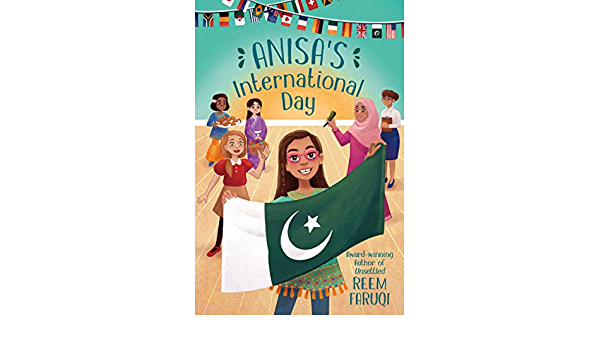
Anisa’s International Day by Reem Faruqi

Standard
Anisa’s International Day by Reem Faruqi

international

Full of determination, creativity, culture, misunderstandings, and learning from your mistakes, this story will resonate with readers 6-10 who want to solve problems on their own, stand out and be special, and who must own up to their mistakes when they happen.  In just under a hundred pages of story, the characters are developed and made memorable, the voice realistic, and the story engaging and enjoyable.  I love that there is no cultural or religious identity crisis, no parental fixing of problems, and no preachy moral overtones.  There are many lessons learned, explored, and threaded through the book, but the incredible writing never lets the threads overpower the story.  The emotional attachment to Anisa has you cringing when she messes up, cheering for her to solve a problem, and sighing in relief when amends are made.  The backmatter is quite robust with recipes, a glossary, numerous activities, and notes from the author.  I know the book says it is meant for grades 3rd through 7th, but I think early chapter book readers will enjoy it the most.  There is not a lot of Islam in the book, but enough that Muslim readers will appreciate the representation and OWN voice authenticity.

SYNOPSIS:

Anisa is an artist, a baker, and pushes herself to be ingenious in all she does.  With her aunt’s wedding coming up, her and her sister and their A-Z Bakery are tasked with making cookies for a party, and her Nani in Pakistan has even sent clothes for her to wear.  Included in the package is a beautiful kurta that Anisa decides to wear to school.  Inspired by her pride in her culture the teacher, Miss Torres, decides the class will have an international day.  Anisa can’t wait to bring samosas, but Prerna from India commits to bringing them first and ingenious Anisa can’t copy her.  To make matters worse, Anisa’s best friend Katie doesn’t seem to like the mehndi Anisa got put on at the dholki.  Misunderstandings, assumptions, and hurt feelings get amplified when Anisa takes action, and when everything gets put out in the open, she will have to find a way to make things right.

WHY I LIKE IT:

I love that the drama is not over sensationalized, it is on par for 3rd grade and the solutions are as well. The teacher and Anisa’s parents are supportive and present, but they don’t solve the problems or force reflection, the children in the story do.  I love the subtle backstory of Anisa and Prerna seeming to be in competition, but finding support in one another as the story moves through.  I also love that no one puts pressure on Anisa to be the most creative or the best at anything, it genuinely feels like her personality and a standard she expects for herself.  I was glad that there was no cultural (or religious) self doubting.  The problems with a friend is communication, approval, and misunderstanding.  The mehndi is the catalyst, but it is not meant or perceived to be a symbol of a whole culture and identity.  It is just mehndi. Of course I also love that the apologizing is not just saying sorry, but rather making things right.

There is mention of the aunt wearing hijab and taking it off because Anisa’s dad is not home, that is tucked in and appreciated.  There are black and white illustrations sprinkled throughout that show women in hijab (#muslimsintheillustrations) as well.  The pictures are not finalized in the arc I received, so I will update the included images in this review at a later time.

FLAGS:

There is mention of music, not sure if it is just drums, or other instruments as well. Makeup is also worn by the adult women and mentioned a few times.  Anisa is mean, but she does apologize.

TOOLS FOR LEADING THE DISCUSSION:

I think fans of the Yasmin series (Saadia Faruqi) will move on to this book, and also enjoy the upcoming Marya Khan series also by Saadia Faruqi. The book fills a gap for this reading demographic, and will add relatability, representation, and warmth to whatever shelf it is placed on.

Fatima’s Great Outdoors

Standard
Fatima’s Great Outdoors

fatima's great outdoors

As a partially brown person who enjoys camping and does it frequently, I have been anxiously waiting to get my hands on this beautiful 40 page, kindergarten to fourth grade picture book. So, trust me, I’ve read it multiple times to myself, to my children, and even to a Muslim storytime group to try and figure out why I like it, but, unfortunately, really don’t love it. Ultimately, I think it is because there is just too much going on.

Everything about this book is wonderful: the idea to encourage brown people to go camping, to highlight that time in the wilderness is for everyone and doesn’t have to look a certain way, that bullying and micro aggressions are oppressive, that immigrants have diverse and full lives in their home countries and work hard when they come to America, that culture and language and food and music is diverse, yet universal, that learning new skills and trying hard things makes you a super hero, that dad’s can cook and mom’s can be great fire starters and critter catchers, truly it is all so powerful and affirming, it is just a lot for one book.

It could easily be a three book series with just the information and layered themes presented, and I really wish it was spread out. If you are a 4th grade desi kid who has been camping or desperately wants to go camping this book is a great glimpse to mirror your place in the hobby without compromising your unique spin on it, but I think for anyone not in that demographic, many of the little celebrations, messages, themes, and cultural nuggets will simply be lost.

I wanted to hear the campfire stories and jokes, and laugh at the lyrics being belted out, not just told about them. I wanted to feel Fatima’s accomplishment at helping set up the tent and maybe see her struggle and rebound, not just be told she suggested reading the directions. The book has a ton of industry praise and personally came with a lot of expectation for me, so perhaps I’m overly critical, but kids in my storytime were struggling to stay focused when they couldn’t relate to the cultural touchstones being tossed out, they didn’t get the “not being good at math stereotype,” they needed the non text pictures to be explained to grasp their impact on the story, and they wanted to know why of all the Islamic things a Muslim family could do while camping, halal bacon was the only Islamic reference and came with precious little contextual defining.

The story starts with a Fatima and aapa waiting to be picked up after a terrible week of school to go camping for the first time. The Khazi family has immigrated from India and their father has told them that camping is an American pastime. During the week Fatima has been teased for her pronunciation and lunch, had her hair pulled and done poorly on a math test. But when her parent’s pull up with a packed car and the girls jump in to enjoy samosa and Bollywood songs, the weekend holds promise.

When they get to the campsite, Fatima and her dad tackle the setting up of the tent. Dad cannot seem to figure it out, and after the week she has had, Fatima is scared to help, but after a while she suggests looking at the directions and it seems that does the trick. The family enjoys shami kabab and rotis from home for dinner, before the girls climb in the tent.

A spider on the outside of the tent is magnified inside, and has the girls terrified it is a monster. Mom, the ever brave lizard and scorpion disposer in India reassures them that it is nothing and sends them off to brush their teeth before settling in for the night.

The next morning mom shows the girl the small spider keeping the mosquitos out and they all share a laugh while dad is cooking anda and roti on a gas grill. He calls the girls to come out in urdu to attempt a campfire to cook the halal beef bacon on like other American’s do. Dad and Fatima can’t get it to light, so mom, who is from a smaller town in India has to show them how it is done. Along the way Fatima looks at the other campers and is annoyed that they aren’t having trouble and that her family always is so different. The other families it is worth noting are white.

The Khazi family then starts to pack up and then they go for a hike, play in water and when the time to leave comes Fatima is sad. She doesn’t want to go back to the life they live where they are different and teased and her parents have to work two jobs each. But aapa suggests she share her fun at show and tell, and the family reassures her that they will be back.

The book ends with Fatima telling her class she is a superhero because she can build fires and tents and isn’t afraid of spider monsters. There is no glossary to define the urdu words used and spoken, but there is a reference at the end about the author’s @brownpeoplecamping initiative.

I think the book is rather remarkable and ground breaking because of its subject matter. The illustrations are wonderful, and the book a great reminder that camping and being outdoors is for all. I just wish it focused on a theme or two and highlighted them for this Indian American Muslim Family with relate-ability for other types of minority groups. The book set its own standard in what it wanted to achieve and convey, and sadly I think it missed the mark.