Tag Archives: mother daughter

Aya and the Star Chaser by Radiya Hafiza illustrated by Kaley McKean

Standard
Aya and the Star Chaser by Radiya Hafiza illustrated by Kaley McKean

Most people probably don’t read as much Islamic rep fiction as I do. Add in I’m an adult reading MG, who consistently shares thoughts on books that fit a slim criteria, and the result is I’m nitpicky and hard to please.  But, because I read a lot of a very small niche genre, the stark contrast to books with Islamic representation done well, compared to those done poorly or somewhere in the middle is hard to ignore. This 213 page book has an all Muslim cast, but has very little Islam, and what is there is terribly presented. It has one Assalamualaikum, one mention of salat, a reference to shoes worn on eid, and the mother sings Quran.  Yes the characters wear hijab, but it is only ever called a headscarf, so while the pieces are there they don’t add up to much, which I predict leaves Muslim readers disappointed and non Muslim readers chalking it up to more pointless details that serve as filler, and provide no real fleshing out of the characters on the page. I forced myself to read it, the desire at page 12 when stars and meteors are used interchangeably to dnf was strong, and to the book’s credit, I was mildly rewarded with the last 65 pages or so being slightly better written. The plot holes, repetition, inconsistencies, the reliance of the mother simply refusing to answer the daughters questions, and overall surface level of the book makes it regrettable, but can I see young readers that love quirky characters, balls, royalty, and happily ever afters enjoying the read? Yes. And being there is nothing blatant in the book that would warrant you not letting them dive in, you can take my criticisms with a grain of salt, or stardust.

SYNOPSIS:
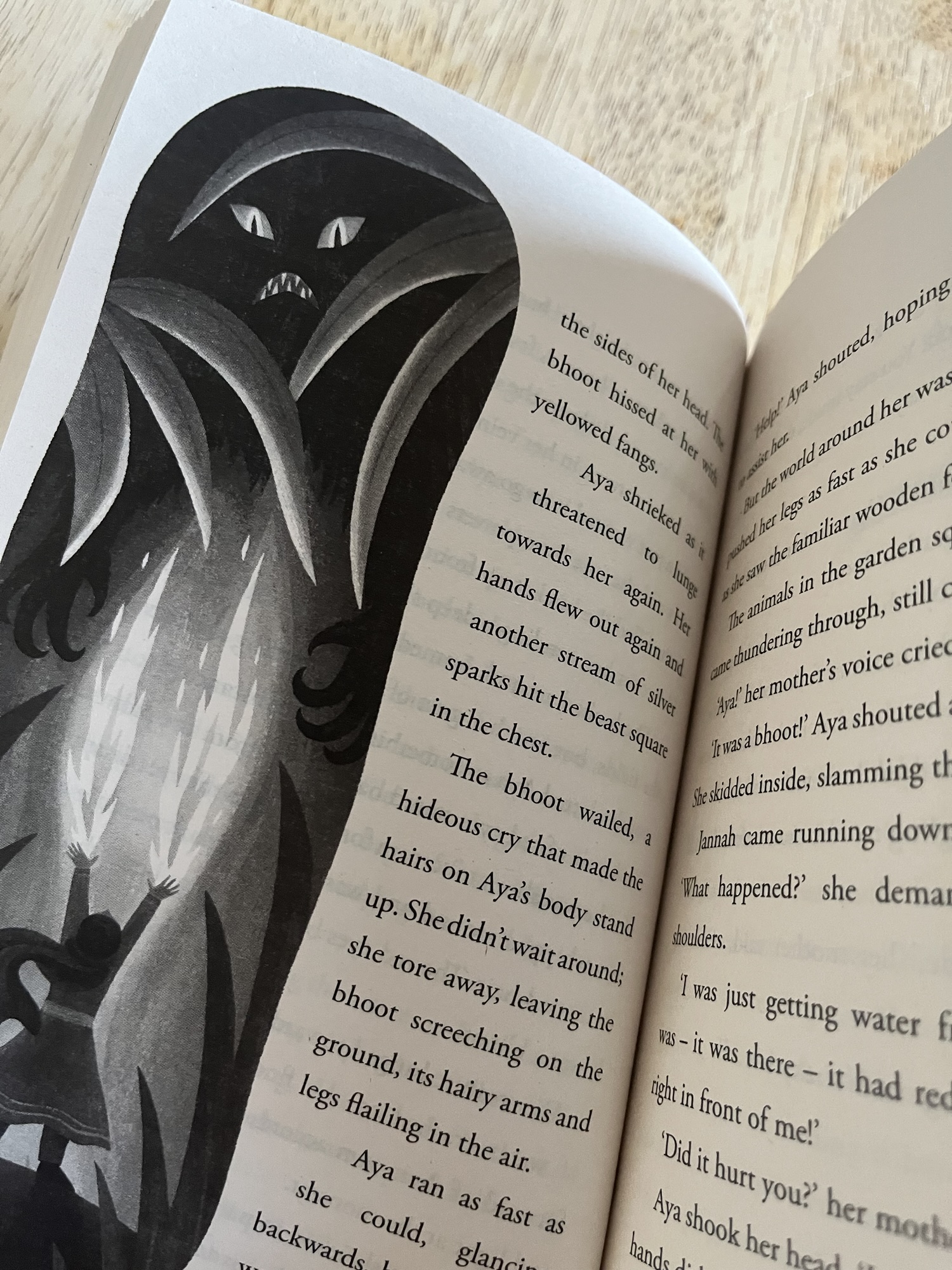
Aya and her mother, who is “stern with a big heart” live in kingdom of Alferra.  Her father has been gone for seven years, she doesn’t even know his name, as Aya and her mother, Jannah, have a strained relationship. Aya loves the ocean and the night sky and dislikes school, the only friend she has is Naznen, and on the night of the Perseids meteor shower the two girls meet in the middle of the night to watch the sky.  One star (is it not a meteor?) hits Aya and give her powers: she can shoot fire and cry flowers. Desperate for answers Aya and Jannah head to the Somerfest Ball at the palace to meet a seer.  When they do they learn of a prophecy and the remainder of the book is Aya and her mother running away to avoid the prophecy, before Aya reluctantly has no choice, but to face the villain, and thus see the prediction through.  I don’t want to spoil spoil it, but there is an Evil queen and demons of sorts with red eyes referred to as bhoots, and a battle that takes place in true fairytale format before the happily ever after occurs.
WHY I LIKE IT:

I do like that Aya is strong and determined, her strength however, is undermined by her sickness, sleepiness, and lack of determination to find the answers her mother refuses to give though, which is unfortunate.  The biggest problem with the book is the writing quality just isn’t great.  Even the religious representation aside.  Why have a whole conversation about wearing matching clothes to the ball between Aya and Naznen for Jannah to gift Aya a gown of a different color and no mention of wanting to match with her friend revisited. Why have Naznen sneak through the window just to have Aya go through the door using the spare key under the mat? Why mention a strange lady at school dismissal, that is never explained? Why is everyone scared to be out because people are missing, just to have Naznen alone, show up with Aya’s homework? I could go on and on, the book brings things up and then dismisses them using them to be page filler it seems. So many details do not provide insight in to the story or the characters or the setting, they are just random fleeting observations.

I didn’t like that the prince is described as having a “lover,” there are better less abrupt identifiers that could have been used, or perhaps in British vernacular it isn’t as pointed as it is in the US.  I also didn’t love that they bowed down to the Evil Queen Abnus. This highlights a place where an Islamic lens would have fleshed out that the characters are Muslim, not wanting to bow, as we bow to Allah swt alone, but perhaps being struck and forced.  Other easy inclusions of Islam would be seeing the meteor shower and saying SubhanAllah, being so sick from the star hitting you and asking Allah swt to heal you, asking Allah swt for strength in a dozen scenarios the book presents.  Duas before leaving the house with people going missing, it really seemed blaringly absent given the nature of the book to not have little sprinkles woven in, yet it halts the story early on to have those labels noted. It definitely could have used some polishing to make it part of the story or characters or taken out all together.

TOOLS FOR LEADING THE DISCUSSION:

I wouldn’t rush out to buy this book for your school, library, or home book shelf, but if you have it, there is no need to remove it.  There is not enough Islam nor literary value.  There is not even enough character development or details to show the change in the mother-daughter relationship to foster conversation.  One page they claim they have no secrets when the mother and her secrets is the bulk of the backstory, to the next page where the mother simply discloses all the letters and answers that Aya needs to move forward.

FLAGS:
Lying, sneaking out, scary evil villains, disowning, abandonment, disobeying parents, death, killing, prophecy, fortune tellers/seers, magical powers, abuse, imprisonment,

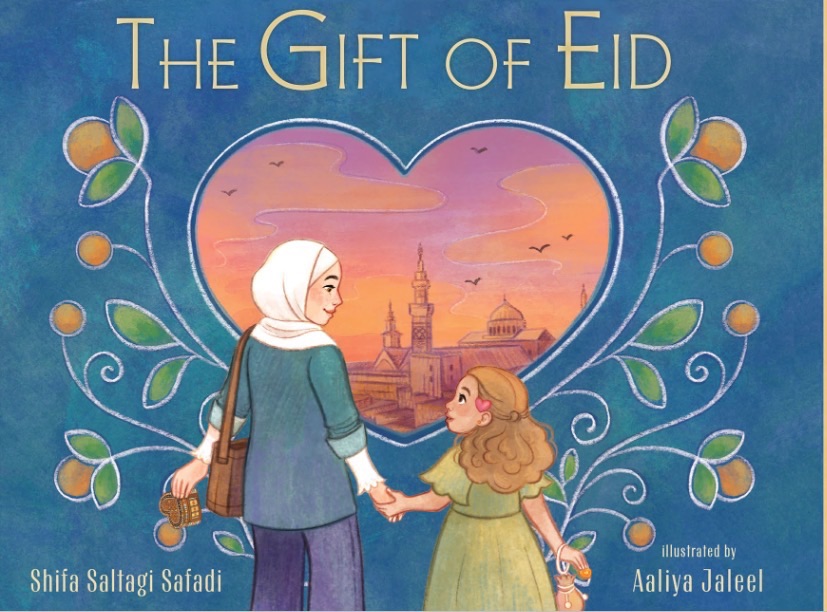
The Gift of Eid by Shifa Saltagi Safadi illustrayed by Aaliya Jaleel

Standard
The Gift of Eid by Shifa Saltagi Safadi illustrayed by Aaliya Jaleel

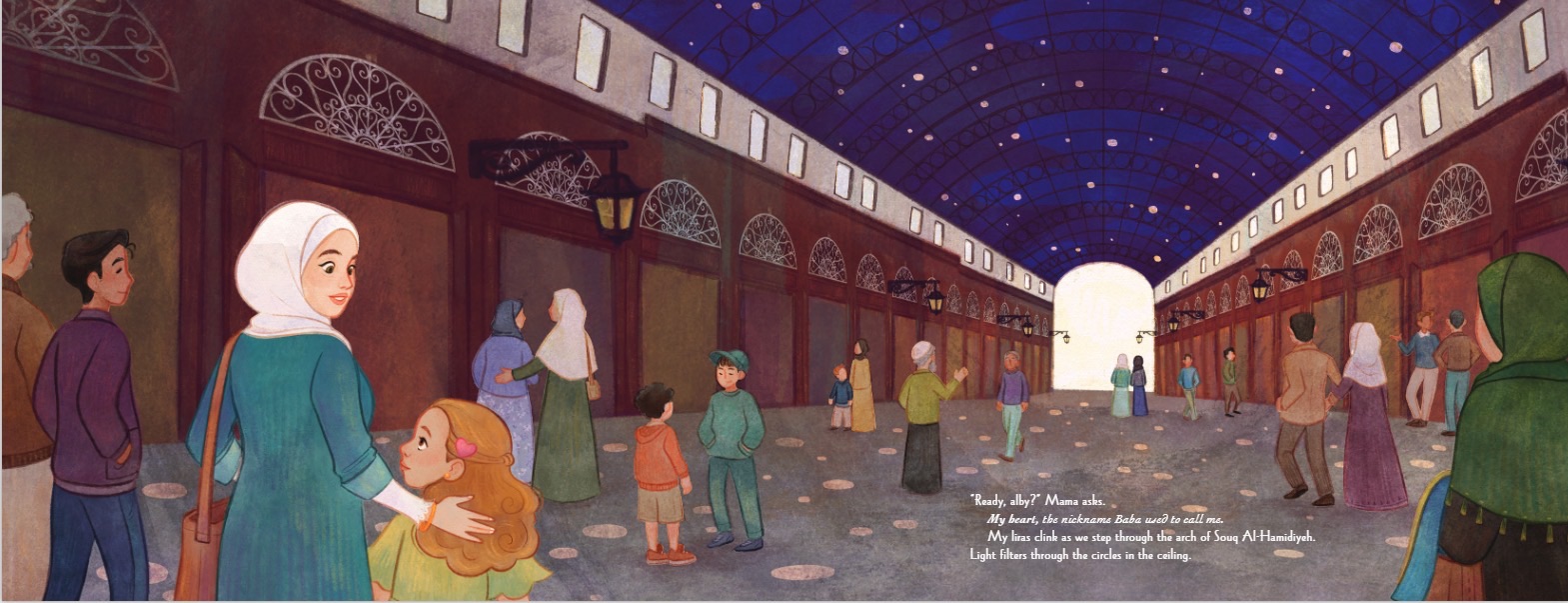
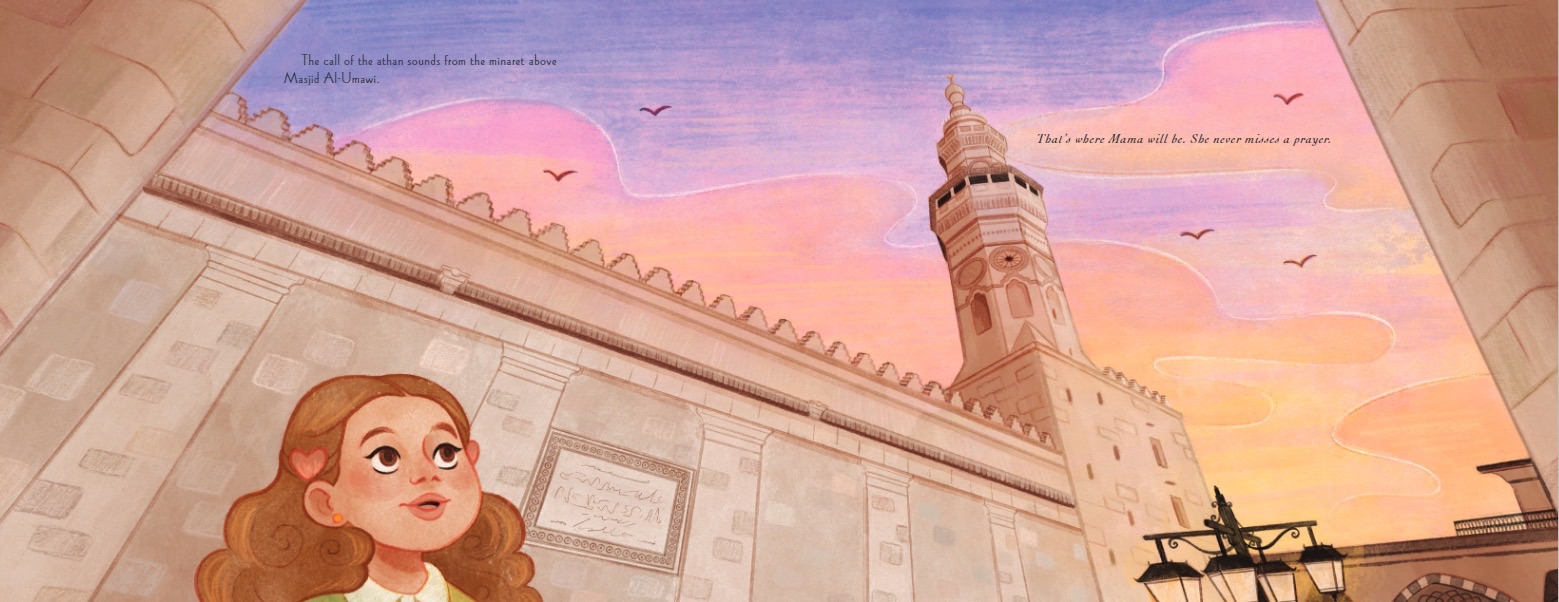
With heartfelt words and large two-page spread illustrations, this beautiful book shares a mother and daughter finding the perfect Eid gift for one another while bringing the reader into the Souq Al-Hamidiyeh, before sending them off to Masjid Al-Umawi for a warm hug.  A retelling of the classic, A Gift of the Magi, the story poignantly presents threads of love, gifts, loss, and Eid to fill the reader with joy, peace, and gratitude.  I’m admittedly very bias, as a close friend of the author, but this beautiful book doesn’t need lip service or marketing, it will appeal to all readers in all settings, and be cherished and asked for, over and over again, all throughout the year. Alhumdulillah.

The book starts with Yasmine and her mama entering the souq through the archway, and Yasmine remembering her father and her imagining the circles in the ceiling to be twinkling stars.  He is no longer with them, the magic is gone and money is tight now, but with liras jingling in her pocket, Yasmine is determined to find an Eid gift for her mother that will make her smile.

Yasmine looks around the shops as her mother counts out liras to buy za’atar, and tries to find something cheaper than sfeeha at the bakery.  She finally knows what to get her mother, but it is more lira than she has.  With determination and selflessness she makes a decision to get her mama the perfect gift.

The process separates the two, and when they reunite at the masjid for maghrib salat, it isn’t the gifts themselves, but rather what they mean, that make the laughter, tears, and love overflow.

I love the emotional depth the book conveys so deftly, never explaining or pulling the reader out of the story, thus allowing the connection to linger long after the book is closed, a rare treat in a picture book.

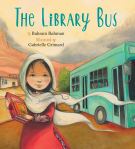
The Library Bus by Bahram Rahman illustrated by Gabrielle Grimard

Standard
The Library  Bus by Bahram Rahman illustrated by Gabrielle Grimard

library bus

It seems this polarizing 32 page picture book has instagram reviewers torn, perhaps along racial/cultural lines, as to whether the book is wonderful or simply victim to perpetuating the same old tropes and stereotypes.  Maybe being half brown, I shouldn’t be surprised to find myself in the middle.  I think if you are tired of feeling like the only strong Muslim female from the subcontinent acknowledged by the West is Malala Yousafzai, and seeing her single narrative and experience being repackaged in a new book every other week, then yes, this book is going to grate on a similar nerve and OWN voice or not, you will write it off as Afghanistan being close enough to Pakistan and the story of a girl and education being unoriginal.  I think the flip side is that if you find a female lead taking education in the form of a library bus to the places where formal education is not available and you love the empowerment that women educating women can have in changing a society, then you are going to probably love a female driving a bus, a female teaching, a girl planning to go to school, a grandfather making sure in a previous generation when women couldn’t be educated, that he taught his daughter, and being thankful that it is a person from the society and not a “white savior” coming to help the people in Afghanistan.  Both as far as I can tell have merit.  I think that you see in the book what your paradigm and perspective is before you even start.  I have read it and re read it and then read it again over the span of many weeks. I was alerted to it by @muslimkidsbooknook who sensed that we might disagree before she even posted her review (haha it’s like she knows me!), so my review is going to try really hard to focus on the text, and what it says, not on the 30 books before it that had a similar message or on my views on publishers only accepting manuscripts with reassuring easily palatable narratives, there is enough of that already about this book out there.  I’m going to try and offer my perspective on what the book contains and while it has problems for me, I definitely liked it more than I disliked it. Oh and one more thing: the illustrations, swoon, are gorgeous, like really, really beautiful. Bismillah…

img_0157

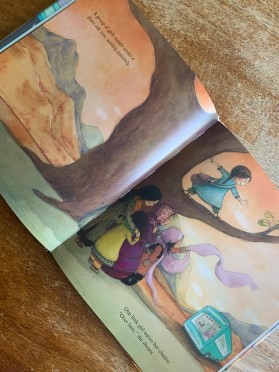
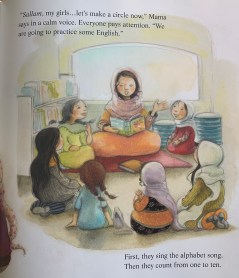
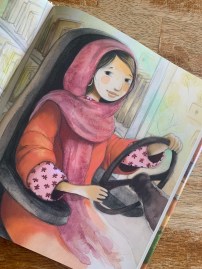
Pari and her mother are getting ready to set off in their library on wheels.  It is Pari’s first day as her mother’s helper and she is a little nervous. It is dark when Pari’s mom drives the bus to their first stop- a small village tucked in a valley between two gray mountains.  There are a group of girls waiting for the bus and call it over to return books and pick new ones.  This reminds me of my time in New England and hearing about the Book Mobiles and Mobile Book Fairs that would visit the small seaside towns that didn’t have proper libraries.  Even my mom used to tell me stories about waiting for the Book Mobile to stop on her street in Davis County, Utah to get books once a month.  The concept is universal and that it takes place in Afghanistan and is driven by a woman who is educated and independent, is intentional with the hopes of being inspiring.

img_0158

The girls then gather for a lesson, it is hard to know how impromptu it is or if it is a regular organized class.  It is also not made clear if they always practice English or it is something unique to the day, but they sing the alphabet song and count to ten.  After class a girl tries to chat with Pari and see how much she knows.  Pari lies and says she can print, but in reality can’t even read or write in Farsi yet. This shows a gap in the story as earlier Pari said she could barely count all the books in the library, and in the pictures there are a lot of books, but she is trying to keep up as the girls count to ten.  As the mom and daughter team pack up to head to their next location they discuss how Pari’s mama learned.

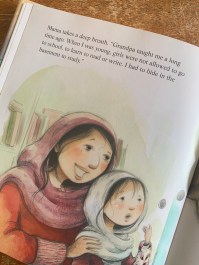
Pari’s grandpa taught her mom a long time ago, at a time when girls were not allowed to go to school and she had to hide in the basement to learn.  Pari wonders if her mom was afraid of the basement.  It is always dark down there.  It is really one paragraph on one page that mentions that girls could not learn.  It is presented in the past tense, and as the story progresses we learn that next year when Pari is older she will be going to school.

img_0159

There is a two page spread about the mom seemingly going off on her mantra that learning makes you free.  And I’m ok with it.  It says when you go to school study hard, period, then the next line says, “Never stop learning. Then you will be free.” Yes! I agree, how many of us pursued a skill or a hobby during this pandemic to feel free from the confines of staying at home.  Learning in any capacity is liberating.  It may not keep you safe in a war, but the freedom of the mind to find peace and pursue passions is critical to mental health and survival.  Am I reading too much in to these basic lines? Absolutely, well probably anyway.

img_0160

When the bus gets to a refugee camp with tents everywhere, Pari and her mom start handing out pencils and notebooks before settling in to what seems an organized English lesson of ABC.  I am torn on my thoughts about them stressing English over their own language.  A sense of pride in who they are by learning Farsi or Dari or Pashtu would show readers that Afghan culture is rich and worth learning and valuing.  I worry that by stressing the English, it presents the culture and language erroneously as the opposite.  At the same time, as a child and teen, I went to Pakistan over a dozen times and would beg my (middle class) cousins to teach me Urdu.  I’d make them take me to Urdu Bazaar for dictionaries and text books, and preschool grammar books so that I could learn my father’s language.  And it never happened.  I’d beg in letters before I got there, and they would agree, but when I arrived they all wanted to work on their English.  They wanted to practice it in conversation, they wanted me to read over their assignments, they would introduce me to their coaching center teachers, their principals, the tutors, and I’d find myself teaching them colloquialisms and explaining idioms, and I’d watch my “textbooks” gather dust.  This was before social media, and YouTube and Netflix and I was their link from their studies to the larger world that rewarded knowledge of the English language.  Is it correct or even logical? No.  But it was my experience that they desperately wanted to learn English over Urdu or the required provincial language Sindhi.  Would readers of this book know that? No.  Do critics of them learning English wish that it wasn’t the case more than wishing that the book simply didn’t highlight it? I don’t know.

img_0161

As they leave the camp, Pari reads the letters of the refugee organizations off the tents.  I find it off that earlier she called it ACDs instead of ABCs and yet now she knows the alphabet.  Again I’ve read the critiques questioning why the refugee camps are named and have over thought it.  In some ways I think it is a reminder that the country has been at war and that individual organizations are helping care for those displaced by countries that tore the country apart.  The text says that, “there are no schools for the girls in the village or the camps.” If anything I took this to show that while we stereotype Afghan society as not making education of females important, that international relief groups don’t either.  The great saviors aren’t teaching the girls in the camps, a mom and her daughter come once a week.  There is a subtle yet powerful critique of foreign policy there, if you want to really be honest, I think this should be made more clear.  At the end of the day the strong Afghan people are putting their country back together after a never ending illegal conflict has ravaged them further.

img_0162

The author says in his note at the end that this book is based on real people he met in refugee camps when he returned to his homeland and that this book is a tribute to the strong Afghan people, particularly the women.  Imagine where any war torn nation would be without the bravery and determination of mothers and teachers, and women who will risk it all for their children and ultimately an entire generation, when politics and power have found other things to value.

The book on its own I think is fine, allbeit written plainly for western readers.  Do I wish stories about life in this part of the world didn’t feature war and refugees and education, absolutely.  We can argue my experience compared to your experience, to the author’s purpose and intent, to the publisher’s vision. That is the beauty of books, we don’t have to agree and we can discuss and we can all be better for it.  There is nothing Islamic in the book other than some of the characters wearing a scarf or chador or hijab.

img_0163