Tag Archives: hijab

Nusaiba and the 5th Grade Bullies by Asmaa Hussein illustrated by Zul Lee

Standard

Nusaiba.png

As someone who deals a lot with reading and comprehension, I really misread the description of this book and assumed erroneously that it was a chapter book targeting 5th graders.  Oops, alhumdulillah, my confusion and slight disappointment didn’t last long as I got swept up in Nusaiba’s spunky imagination and endearing personality.  The message of the book is powerful.  Not only does Nusaiba have to deal with bullies, but she has to wrangle with accepting herself, even if that means being different.

nuaiba2

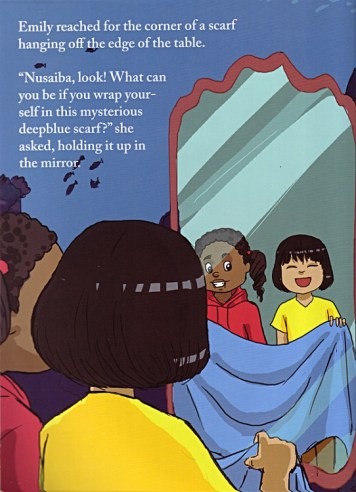
Nusaiba is almost to school when she overhears some 5th grade boys making fun of her mom and what she is wearing.  Nusaiba’s mom is wearing a hijab, and the story is set up to imply that that is what they find “weird.”  This morning encounter bothers Nusaiba all day, and while she doesn’t talk to her teacher about it when asked, she does spill the beans to her best friend Emily.  The next day Nusaiba distances herself from her mom and asks to walk to the school gate alone.  The bullies don’t say anything, but Nusaiba feels guilty about leaving her mom like that. Later that day when Mom picks Nusaiba and Emily up from soccer they swing by a local hijab shop for some clothes shopping.  I don’t know why, but I found the premise for taking the girls clothes shopping a little forced.  It seemed too words of a setup, and I couldn’t help but wonder why Emily would be dragged along.  As mom tries on skirts for work, the girls in their boredom get swept up in using the scarves as costumes and transforming themselves from queens, to underwater divers, to fisherwomen, to mountain climbers, to fantastic cleaners ready to clean up all the scarves on the display.  Her mom lets her pick one to buy, and she decides to wear it to school the next day.  It is noteworthy that Emily doesn’t try on any of the scarves.  She is an amazingly supportive friend, and even in make-believe is right there with Nusaiba, but she doesn’t put one on, and I kind of want to know the author’s reasoning or purpose as to why.  So the next day at school, Nusaiba asks her mom to again walk with her, and when the 5th grade boys call her mom an “odd-ball.” Nusaiba finds her courage to confront them.  Nusaiba and the reader discover the boys are making fun of Nusaiba’s mom, but it isn’t for her hijab.  Nusaiba and her mom set the boys straight and giggle in the process, as Nusaiba realizes she can be anything she dreams.
nusaiba1

The book is 44 pages and probably about a second grade mid year reading level.  The pictures are big and bold and beautiful making it a great option for story time to ages 4 and up.  The pictures do an amazing job complementing the story and going back through to look at them after the “twist” at the end was even more delightful.  The illustrator draws you into Nusaiba’s world and you really do cheer her on when she stands up for herself. The book easily lends itself to discussion, and there is also a question guide at the end, incase you get stumped. It reads more like a school assignment, but it could obviously be re-worded to engage a child at bedtime or in a read-a-loud environment.  The font is a nice size, however, I found it distracting. On some pages it is white on others black, on some it has a shadow and on others it does not.  I’m certain most people would not notice, but for some reason it was jarring to me.  Alhumdulillah, alhumdulillah, if that is the only negative in a book, I think everyone who reads it will be glad to have a copy of their own to read again and again and again and again and….
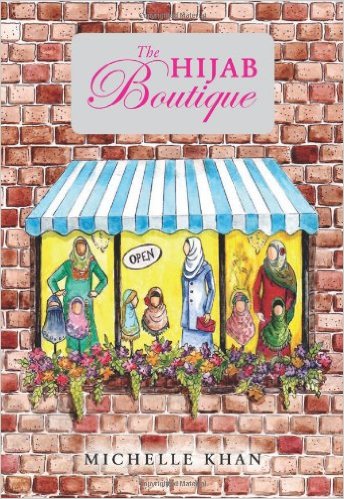
 

The Hijab Boutique by Michelle Khan

Standard

The Hijab Boutique

I was really hoping this book would help out the sparsely populated early chapter book section.  And it should, at just 52 pages with beautiful full page pencil style drawings, it just somehow seemed confused instead.  The content is much more young adult in story line, but because of the short length, the characters seem flat and underdeveloped.  My fourth grader read it in less than a half an hour. Yet, I don’t think a 1st or 2nd grader would get much out of the book.  I don’t know what kind of editing process the Islamic Foundation puts its books through, but back when I was a teacher, I would have told the student they have a wonderful, wonderful rough draft with so much potential, they just need to flesh it out and add more detail so the reader connects with the characters. The back of the  book suggests the book for ages 10 and up and content wise that is fine, but it also has a list price of $7.95 and for something that can be read in less than a half an hour, it seems a little steep. If it didn’t have so much potential, perhaps I wouldn’t be so bothered, I just feel like if she stretched it out to being 200 pages, it could be so powerful.

Farah is a fifth grader at an all girls art school.  She has a best friend, who’s mom is a soap opera star, but some popular girls still make  her nervous.  When her Social Studies teacher assigns the girls to bring in something representing her mother, she can’t find anything to share about her mother that she doesn’t think is boring.  Farah’s father passed away two years prior and with money tight, Farah’s mom is opening up a Hijab Boutique.  No real details are given about her family life with her father or the impact his death had on her, which is unfortunate.  The story discusses why the mom started wearing hijab and why it is important, but makes it seem like Farah knows so little about her mother.  Again a hole that if explored would make the book that much more interesting. Not to mention that it could prod young girls to talk to their own mothers about such things.  To no one’s surprise Farah brings in some hijabs to represent her mother and Alhumdulillah the book ends on a positive note with little fanfare, catharsis or drama.

Farah and her mom are practicing Muslims who are an active part of their western community.  It would seem Farah is the only Muslim in her school and it doesn’t seem to be an issue.  They are all upper class and a bit snobbish, but there are no flags.  If your library has the book, reading it is by no means a waste of time.  I don’t know that you’d read it more than once if you purchased it, but 4th through 6th graders might enjoy the short read, and be inspired by fashionably fabulous hijabs while furthering their understanding about why Muslimah’s are required to cover.


How to Get Hijab Ready: A Guide for Muslim Girls Ages 8 to 11 by Aisha Elwan & Megan Wyatt illustrated by Sarah Hafeez

Standard

How-to-get-Hijab-Ready

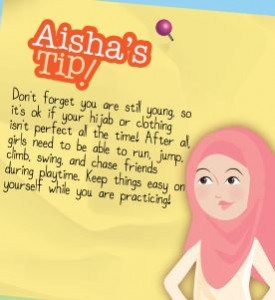
Yes I know it isn’t fiction, but How to Get Hijab Ready is such a fabulous and much needed book that any positive attention I can direct toward it, I feel is effort well spent, Alhumdulillah.  The book is obviously meant for 8 to 11 year old girls contemplating hijab.  The beauty of this how-to book is that it answers everything from how to accessorize one’s hijab to dealing with bullies in a beautiful manner.  Not only are the pictures bright and colorful, but the presentation is clear, precise and inspiring.  The authors do not talk down to the readers, nor do they make it seem like a burden as they discuss hadith, ayats from the Qur’an, challenges and fashion sense.  The book is divided into sections: The Basics, Getting Started, Having Conversations,  Worries and Concerns, and finally Your Reward for Good Deeds. Each section addresses different topics and “Aisha’s Tips” are scattered throughout to give 12-and-a-half-year-old Aisha’s tips on the subject at hand.

Aishas-Tip-275x300

Truly this book is a gift to moms and daughters alike.  I plan to let my daughter look through it for a few days and then sit down with her to discuss.  It functions as both a how-to manual as well as a reference guide and I can see it being looked at A LOT.  Additionally I can see my daughter discussing it with both Muslim and non-Muslim peers.  I think the book offers confidence, direction, and pride as young girls will find inspiration from young Aisha while having many of their concerns about hijab answered in a fun, hip way.

My only criticism is that it wasn’t around when I was a young girl.  For some hijab is an unknown, for some it is a stress, and for some it is a natural expression of faith, and subhanAllah this book in just 51 colorful pages manages to convey information, smiles, and excitement irregardless of your background.

project-708-body-Screen_Shot_2015-02-21_at_11.49_.38_AM_

Sameerah’s Hijab and the First Day of School by Janette Grant Illustrated by Fatimah Ashaela Moore

Standard

sameerah's hijab

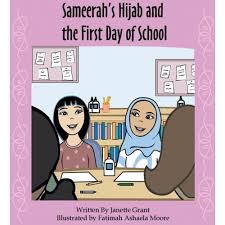
This book is perfect for 1st through 3rd grade girls, as it focuses on Sameerah’s first day of school in America and meeting new friends.  Sameerah and her family have just moved from Yemen and Sameerah is nervous about fitting in, however her love of wearing hijab and Islam radiate through her as her new classmates ask her questions.  Before long the students have found they have more in common than differences and Sameerah can’t wait to go back to school the next day, alhumdulillah.

This book works well for students to see how confidence, patience, and kindness can go a long way in understanding those around you.  Sameerah is articulate and confident and a great example in knowing your deen well enough to present it to others.  It is also a way to introduce Muslim children to how others may worship as Sameerah also learns about her classmates.


Deep in the Sahara By Kelly Cunnane Illustrated by Hoda Hadadi

Standard

deep-in-the-sahara

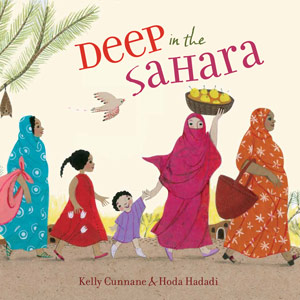
SubhanAllah, how absolutely wonderful to walk into your public library and find such a treasure of a book.  So simple and beautiful in appearance, in its poetic text, and in its message.  Set in Mauritania, West Africa and sprinkled with Hassaniya (an Arabic dialect), young Lalla wants to wear a malafa, a beautiful, colorful cloth that some Muslim women in Mauritania wear to cover their clothing and heads when they go out in public.  She wants to wear it to be beautiful like her mother, mysterious like her older sister, a fine lady like her cousin, and a long-ago queen like her grandmother but it isn’t until she understands what the malafa means and why the women wear it does she receive a beautiful blue one from her mother.

The illustrations and descriptions take you to a far a way land, with eager anticipation at what you will see, hear and experience.  Culture is shared, tidbits about Islam’s traditions are shared and a wonderfully simple, yet thought provoking story is conveyed.  With an AR reading level of 3.7 this book would be wonderful for story time listeners as well as independent readers.  Also because it is probably not a culture most are familiar with I think students up to 5th grade would enjoy the book and close the last of the 40 pages with a smile on their face and a light happy heart.  Alhumdulillah

Moon Watchers Shirin’s Ramadan Miracle By Reza Jalali Illustrated by Anne Sibley O’Brien

Standard

moon watchers


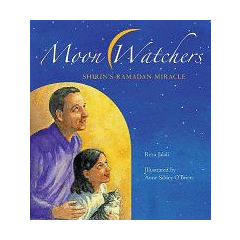
This book is similar to Night of the Moon By Hena Khan as it focuses on a young girl experiencing the month of Ramadan and Eid, through the waxing and waning of the moon.  This is an AR book 3.5 and the text is driven by dialogue between nine-year-old Shirin and her Persian American family.

Too young to fast Shirin is feeling left out of the blessed month of Ramadan, her older brother Ali and her bicker until her Grandma encourages her to do “part-time fasts.”  Facts about Islam and Ramadan are slightly peppered in to the story, primarily through vocabulary, and the characters do discuss hijab and why Shirin’s mother doesn’t wear it.  It is important to note that the tale is told from a Shia perspective that is made clear as it explains how the family prays, touching the prayer stone, and kissing it three times.  The illustration here is more peculiar as it shows Shirin praying next to her dad and her brother, mom, and grandma in the row behind.

The pictures show a happy family that most readers or listeners would probably be able to identify with, along with the sibling bickering and excitement felt with the blessed month.  Persian culture is represented in the foods and sweets they prepare as a family and the henna Shirin gets on her hands.  The family prays together, spends time together and they discuss doing good deeds, not just fasting in Ramadan.

The book is beautifully done, but I think because of the brushing aside of hijab being a cultural practice, not a religious one and the presentation of prayer, I don’t know if I would give the book without discussion to a third grader in a Sunni school to read independently.  As for story time, I might simply omit those few sentences, but I’m not sure, it would depend on my audience.

If your children are aware of the differences between Sunni and Shia or you are Shia, this book is wonderful.  If your children would be greatly confused or get hung up on a few lines in a 32 page book, then it would be better to hold off.


The Garden of My Imaan By Farhana Zia

Standard

Image

I really, really wanted to love this book, I saw it in last month’s Scholastic catalog and without even reading it I ordered a copy for me and two classroom six packs (total of 13 books).  I was so excited, a 3.6 AR reading level, 226 pages, a sweet hijabi girl on the cover, a Muslim author, good reviews online, I was waiting to be swept away.  Nuts, perhaps it was over anticipation or perhaps the book just fell short.  Either way we will not be using this in our current book club, nor will I kick off a 3rd grade book club with this book, sorry parents.   As I type this my printer is spewing out the return label to send the classroom copies back. 

SYNOPSIS:

Aliya is a fifth grader dealing with typical pre-teen issues of friends, family, and school.  The book starts with her at religious Sunday school surrounded by diverse friends.  Some friends are contemplating wearing hijab full-time, some preoccupied with their new boyfriends, some excited about fasting in Ramadan and others dismissing it completely.  On the way to Sunday school, Aliya’s mom is taunted by stereotypes from an angry motorist that has Aliya rattled and confused.  Immediately the author establishes that Aliya is unsure how to fit in because she is unsure where she stands on many of these issues.  Her home life involves multiple generations of Pakistani immigrants, and US born characters in one home, her great grandmother, grandmother, parents and her brother.  Later a great Aunt comes to visit as well.  At school Aliya has a best friend, Winnie, who is by far the best character in the book, a bully she has to deal with, a girl that Aliya is intimidated by, a boy she has a crush on, and a new student, Marwa. Marwa is Muslim from Moroccan heritage, wears hijab, and while religiously is the same as Aliya, culturally is worlds apart.  Marwa also is confident, strong, and devout; characteristics that Aliya slowly comes to admire and draw strength from as she defines who she is and wants to be in some aspects of her life.

Although there seems to be a lot of characters, there is no problem keeping them straight, the writing is very simplistic and at times weak, but clarity is never a concern. The first 15 pages of the book bring up stereotyping, discrimination, bra sizes, boyfriends, hijab, menses, and fasting.  All told from a very naive, innocent character’s voice which makes for an awkward start in my opinion.  As the book progresses she begins writing letters to Allah (swt), which, while I don’t imagine is wrong, seems odd, but that is probably my own background projecting.  My concerns with the book are that for as open as Aliya is with all the mulit-generations living in her home, there is no moral compass.  No one guiding her to be a better Muslim, to help her develop her internal conscious of what is right or wrong.  They all read her letters and no one discusses her infatuation with a boy? Seems a bit odd to me.  She tries to fast, against her families protest then breaks her fast with pepperoni pizza (she took it off) isn’t that a learning moment? I’m not saying the book should have become preachy, but the lack of basic parent-child interactions make it seem that everything she does is basic common sense, and I cannot with a good conscience encourage my little 3rd and 4th graders to read the book.  They will think I’m supporting Aliya’s actions and frame of mind.  Had the author opened the door to discussion or even had Aliya’s conscious question her actions, as a teacher/librarian the students and I could discuss the issue, but there is no pause, the story just states it and moves on.  Same goes for the fact that her father doesn’t fast regularly because he has important business decisions to make.  A concept so contrary to what we teach our kids, we teach them to fast when they have a big decision to make. Once again had the author taken just a few sentences to explain that the dad travels for work and that travelers are not required to fast, readers would get a more accurate view of what Islam teaches, not that fasting in Ramadan is optional.  

The one character that is presented as religious is described as being OCD, belligerent, rude, uneducated and a nuisance.  The character eats only halal, religiously raised and slaughtered meat, and the family essentially refuses to accommodate her, lies about what they feed her, and bully her.  Seemed to me the same treatment they are whining about receiving from society as a whole, they were projecting onto their great aunt within their home.   Finally the tipping point was when this same great aunt started praying/asking Bibi Sayeda for help, a saintly person who helps people find lost things…what? Islam is pretty clear we pray to Allah swt and only Allah.

WHY I LIKE IT:

I like that the book shows diversity within the religion, it isn’t preachy, and it shows the balance that non-Muslim kids often have to balance.  I think if my daughter picked this book up at the public library and we read it together we might be able to talk our way through it.  I think students in public school who have to face more of Aliya’s struggles or students that have non-Muslim family members will see themselves at some point in the book and find comfort in it.  But again, because of the reading level, I can’t justify handing it to a Islamic school student to read without numerous warnings and disclaimers.

I like that the characters do discuss their different view points on hijab, and that Aliya forms her own opinion on it.  And while it takes awhile to make the point and does involve Aliya yelling and insulting the bullies, she does find a way to handle them by being kind, which for this age level is a nice, albeit optimistic, message. 

FLAGS: 

Questionable basic Islamic facts, minor characters with boyfriends discussing kissing.


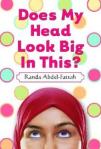
Does My Head Look Big in This? By Randa Abdel-Fattah

Standard
Does My Head Look Big in This? By Randa Abdel-Fattah

Image

I think I have purchased this book at least twice before and have never gotten around to reading before loaning it off to someone, that is until we were snowed in a few days ago.  Similarly bizarre, whenever I’ve asked someone who has read it what they thought of it, I’d nearly always get a a smirk, a shrug a nod of the head, and a vague response.  So when the book came in the mail and the snow hit the roads, I decided to put an end to all this none sense.  Needless to say I’m very tempted to make a video of me shrugging, smirking, and shaking my head instead of writing a synopsis, ya, it’s got a lot going on.

According to Accelerated Reader it is a 4.9, so fourth grade ninth month reading level, however, I wouldn’t encourage anyone that young to read it, you would need to be at least a junior or senior in high school for content.  It has 360 pages that fly by and is one of those books that if you put it down you could pick it up a month later and not miss anything, or you could read it in one sitting and not find it to be a daunting task.  I akin it to empty calories, a half hour sitcom, or books like Janet Evanovich’s Plum novels or Sophie Kinsella’s Shopoholic books; entertaining, light, and with a happy ending.

SYNOPSIS:

Australian born Amal Mohamaed Narullag Abdel-Hakim is considering wearing hijab and as she makes the decision, she is forced to handle obstacles in every relationship her sixteen-year-old life contains.  The only child of her Palestinian born parents, her mother is a dentist, her father a doctor, Amal seems to have it all: a few close Muslim friends from her days in an Islamic School, a few close friends at her current prep school, an amazing relationship with her parents, brains, looks, opportunity.  There is really no climax as she navigates all this other than the fact that she is a teenager and doesn’t often know what she wants.  Additionally she is Muslim and as various terrorist plots occur she is challenged with coping at school, deciding if she can achieve her goals and cover her head, if she can have male friends and go to parties, and if she can win over her critical elderly neighbor.  This book honestly has it all: Islam vs. culture, boy girl issues, gender roles, immigrant and assimilation, extremism vs liberal, weight and self esteem issues, Ramadan, cousins and family members who make things difficult, female circumcision, terrorism, drug and alcohol use, smoking, racism and bigotry,  and even at times a poignant moment or two.

But, to cram all that in to a YA book is really just too much that it gets lost and ultimately doesn’t leave a memorable place in the reader’s head or heart.

Never really getting into Amal’s head about why she wants to cover, the book stays superficial with her infatuation with Adam and her poor choices regarding her relationship with him.  A constant struggle she has is wondering if she can ever get a job and be taken serious as a professional while wearing a hijab, which seems really silly since her mom is a successful dentist who covers, but that never even is addressed.  Amal fights with her Principal, fights with classmates and at times even her parents regarding her decision to cover, and while yes you cheer for her, it seems to almost contradict how flighty she is in other capacities of her life.  The other main story line is with Amal’s Muslim friend Leila who’s parents are “cultural” and not very religious and thus oppressive in letting Leila practice Islam.  A worthwhile story line, however it almost makes Amal’s family in contrast seem “too perfect” which after a while just seems unrealistic.  The character fasts and prays and does many of the prescribed aspects of faith, but Amal seems in many regards to lack spirituality or enthusiasm or even a deeper connection for Islam.  She is a character who is Muslim, but not necessarily defined internally by her love of Allah, she just wears it on her head.

WHY I LIKE IT:

Many reviews of the book remark that it is a book that “needed to be written and needs to be read,” and I think yes, if you are an avid reader that is looking for a quick entertaining read about a Muslim, by a Muslim, go for it.  I don’t foresee me using this as a book club selection, but i think in a few years there are some students that I would recommend picking it up and reading it.  To some non-Muslims I think it would show that Muslim’s have the same everyday problems that everyone has, and in fact we are not all extremists.

FLAGS:

There is a little cursing in the book, girl/boy issues of dating, kissing,  mentioning of porn and prostitution, there is alcohol, drug use by a minor character, smoking, and lying to parents as a norm.

TOOLS FOR LEADING THE DISCUSSION:

Click to access RA-DMHLBITNotes.pdf

A little about the author and why she wrote the book:

http://www.randaabdelfattah.com/index.asp