Tag Archives: daughter

Kamal’s Key by Rifk Ebeid illustrated by Sophia Soliman

Standard
Kamal’s Key by Rifk Ebeid illustrated by Sophia Soliman

This 44 page hardback book gently, yet powerfully, focuses on the Palestinian resistance symbol of the key, by sharing a multi generational tale of new beginnings, heartache, hope, and resilience. The writing is moving, and flows with simple lines, beautiful illustrations, and maintaining a focus on a singular theme. So often well meaning books about oppression, war, politics, try and include numerous details that the picture book suffers in its appeal to younger audiences, the opposite is often true with books being so generalized that it isn’t clear exactly where refugees are from or what turmoil is being discussed. This book strikes a beautiful balance of calling the incoming occupiers a dark cloud and not giving them space or attention, while focusing on Palestinian experiences through a lens of hope, joy, and love.

The book starts with the key. It is a beginning to Kamal’s home. It is on his belt at his wedding, it is the beginning of his and Huda’s new life starting together, a symbol of their home when their son is born. It is the beginning of Jalal’s imaginative play of using it as a dhulfiqar. It is secured around Huda’s neck when they are forced to leave their home, and find refuge in tents. It is hung when the tents become walls.

One day Jalal takes it down, when the hurt in his father’s eyes is too much for him to witness. When Jalal becomes a father though to Salma, the key becomes her toy, her microphone, her connection. When Kamal gifts the key to his granddaughter it becomes her art, her poetry, her necklace, a symbol of her hope and a people’s right to return.

I’ve read this story a few times to myself, as well as with my children, and I only wish it was a little larger in size. It works well one-on-one or with a few, but it is a story that needs to be shared in large story time groups, and the 9 x 9 inch size makes it a bit difficult.

img_8454-1

The book concludes with an author’s note, an illustrator’s note and a glossary, not just of terms, but traditions, concepts, and information about the song. I purchased my copy from Crescent Moon Store.

Hidden Fires by Sairish Hussain

Standard
Hidden Fires by Sairish Hussain

I will not be getting over this book any time soon. It broke my heart, and all my other critical organs, in the most delightfully well-done way possible, and undoubtedly I am better for it. I don’t read a lot of adult fiction these days, and with some diabetic retinopathy concerns, I couldn’t read the 384 page adult book about generational trauma, partition, the Grenfell Tower fire, family dynamics, bullying, self-harm, and resilience, but was pulled in to the audio book version instead. The Desi-British voices of Yusuf, Rubi, and Hassan were refreshing to my American ears.  The multi-perspective book told in parts richly develops the characters, their relationships, and their current, past, and future struggles.  The author is Muslim, as are the characters, and while they all practice in their own way, it is undoubtedly who they are, and their Islamic identity is not questioned, feared, blamed, or apologized for.

SYNOPSIS:
The book weaves three distinct voices. Yusuf, is an 80 year old an immigrant who lived through partition, raised his family in the UK, has lost his wife a year prior, and is struggling with haunting memories of the past, failing health, regular loss of friends, and loneliness.  Hassan, Yusuf’s youngest son is a workaholic who is married to a non Muslim, non Desi who is suffering from fibromyalgia and who’s mother unexpectedly passes away in Spain.  Rubi, is Hassan’s 16 year old girl who is overweight, bullied, lonely and about to take her GCSE exams when she is dumped on her grandfather Yusuf’s door while her parents head to Spain.  The book opens in Ramadan the night of the Grenfell Tower fire and the horrific event affects them all, stirs memories, and shapes futures.  From there the layers of each character slowly unravel as they cope with the swiftly changing present as they desperately work to break free from the past.  As dementia plagues Yusuf, Rubi finds purpose in being needed, and Hassan is forced to re-prioritize his life before it is too late.

WHY I LIKE IT:
The book takes a slow approach to building up the characters and their back stories. It is almost feels like world building as a book would if it were a fantasy, it doesn’t info dump, but at some point the hooks are so deeply embedded that you really cannot leave the characters and their world and you have to finish the book, just to ensure they are ok.  Because I listened to the book, I feel like there might have been some Islamic content that was not completely ok, but again I was having vision issues and couldn’t note where to go back and check.  I think it is fine, and because it is an adult read, I think the audience can discern accuracy, but please know, I’m not 100% green lighting the Islamic rep.  It is undoubtedly well done and fasting and praying are a part of the characters, but their relationship to their faith and their understanding of it, is presented as theirs, it doesn’t get preachy or make broad statements about Muslims everywhere or Islamic doctrine.  

FLAGS:
There is body shaming, self-harm, trauma, death, torture, killing, lying, abuse, fear, guilt, dementia, bullying, assault, physical violence, drug use (mentioned), attempted suicide (mentioned), music, theft, make-up, close male and female relationships, Muslim marrying a non-Muslim, hallucinations.

TOOLS FOR LEADING THE DISCUSSION:
I think mature high school seniors or possibly even juniors could benefit from this book with discussions.  I think Rubi’s voice tied to her father and grandfather, will really open up youngsters perspectives, and provide a great vehicle to hear their thoughts, fears, worries, concerns about body image, self harm, aging grandparents, accessibility to parents, etc..

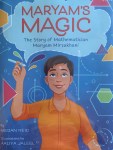
Maryam’s Magic: The Story of Mathematician Maryam Mirzakhani by Megan Reid illustrated by Aaliya Jaleel

Standard
Maryam’s Magic: The Story of Mathematician Maryam Mirzakhani by Megan Reid illustrated by Aaliya Jaleel

img_8776

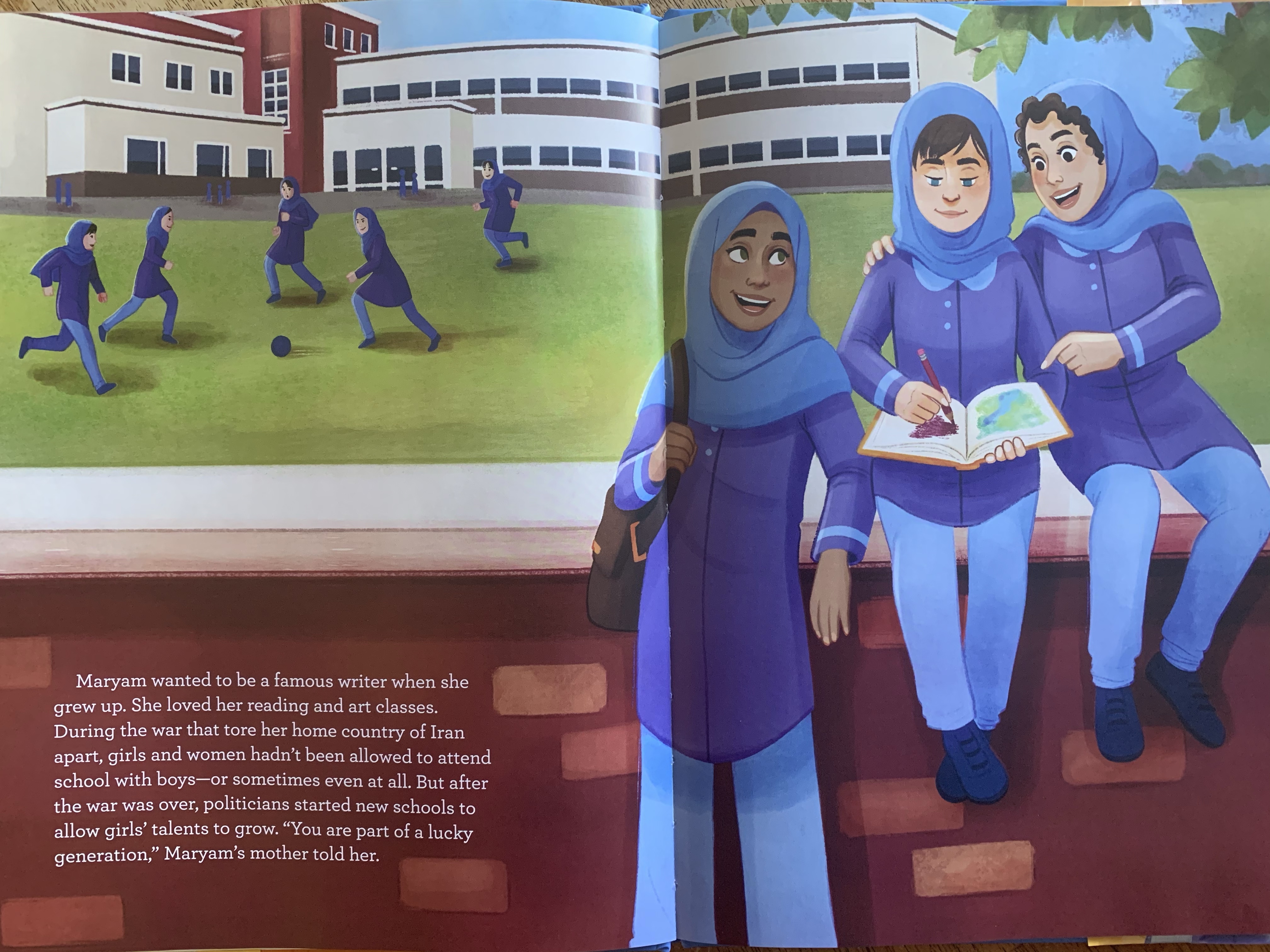
This 40 page nonfiction biography is beautifully illustrated and informative.  I had never heard of Maryam Mirzakhani the Iranian born, first female winner of the Fields Medal.  Her life from loving stories and not liking math, to becoming a student and later a professor in the United States is remarkable and inspiring.  Second through fourth grade readers that both love and struggle with math will be drawn in to her unique way of looking at the world, and the math she found to serve as her magic wand in explaining it.  I don’t know if she identified as Muslim, while in Iran she was forced to cover, but when she left, she no longer did.  The illustrator is Muslim and religion aside, I am thrilled that a book like this exists, and that such a brilliant woman and her accomplishments can be presented to young readers.

img_8778

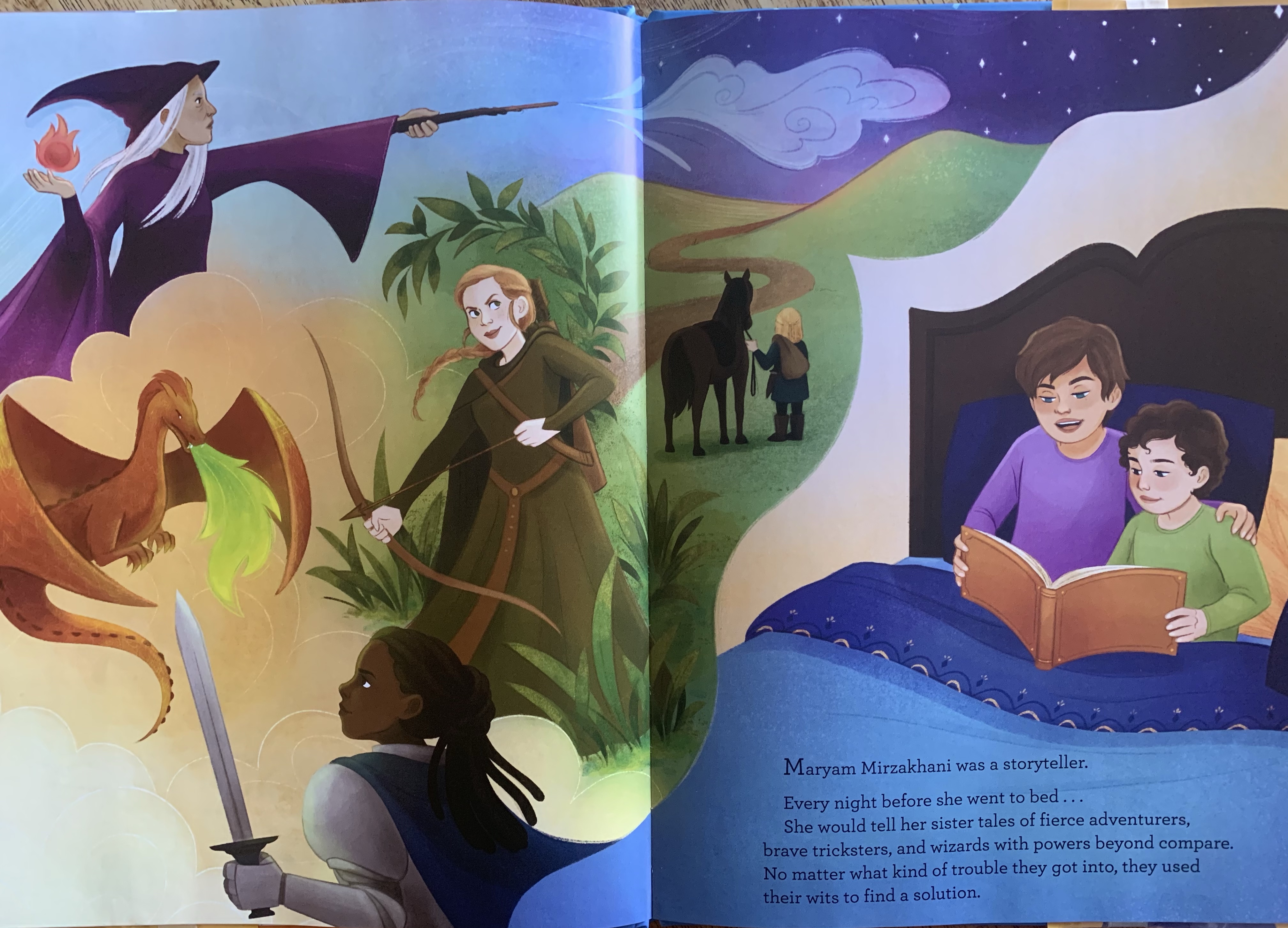
Maryam loves stories.  She reads them to her sister, her best friend Roya and her browse bookstores and dream themselves into plots of their favorite stories.  On the weekends she spreads long rolls of paper on the floor to draw and color her imaginary worlds.  She wanted to be an author when she grew up and knew how lucky her generation was to attend school after the war that tore her country apart.

img_8779

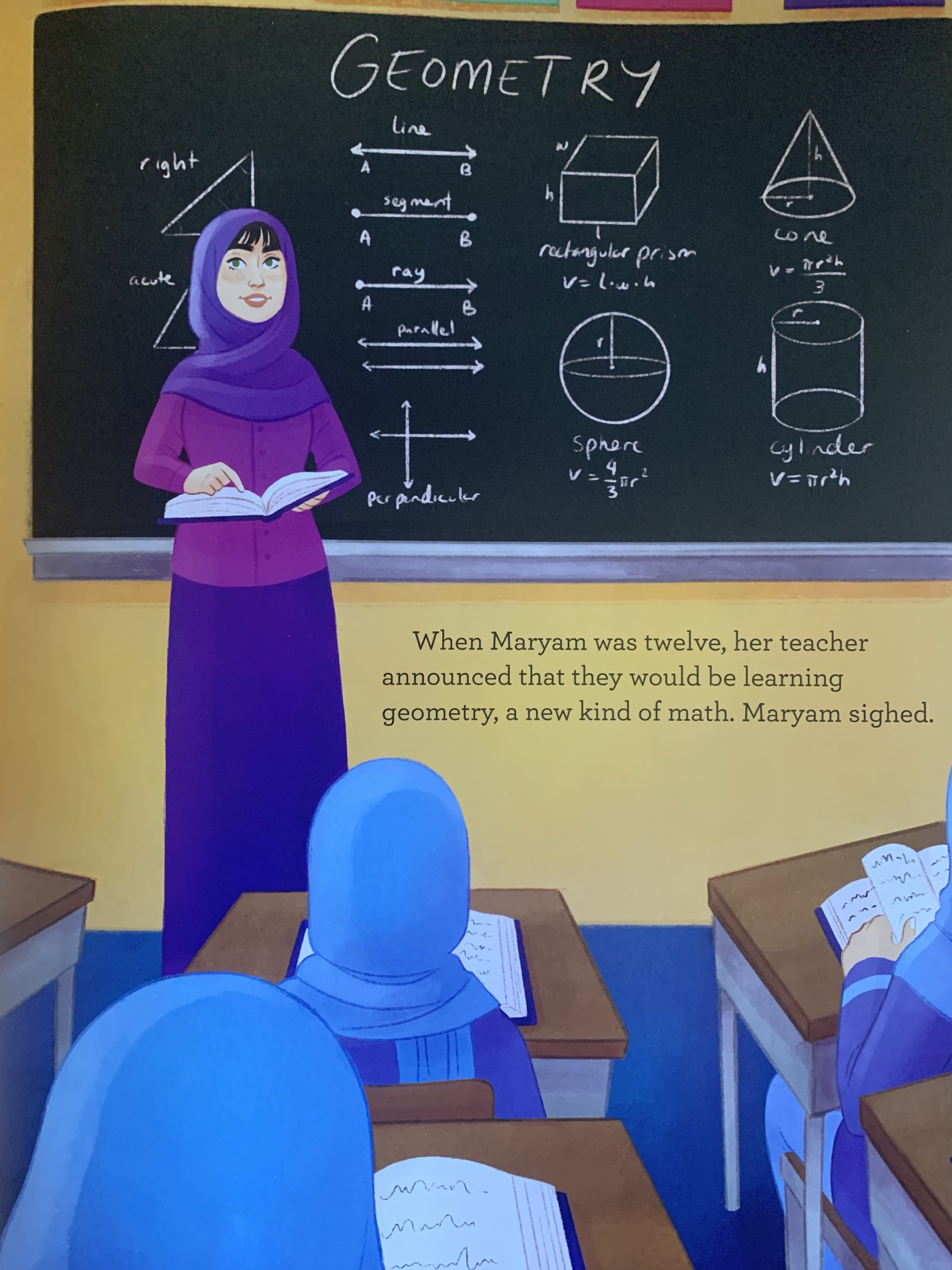
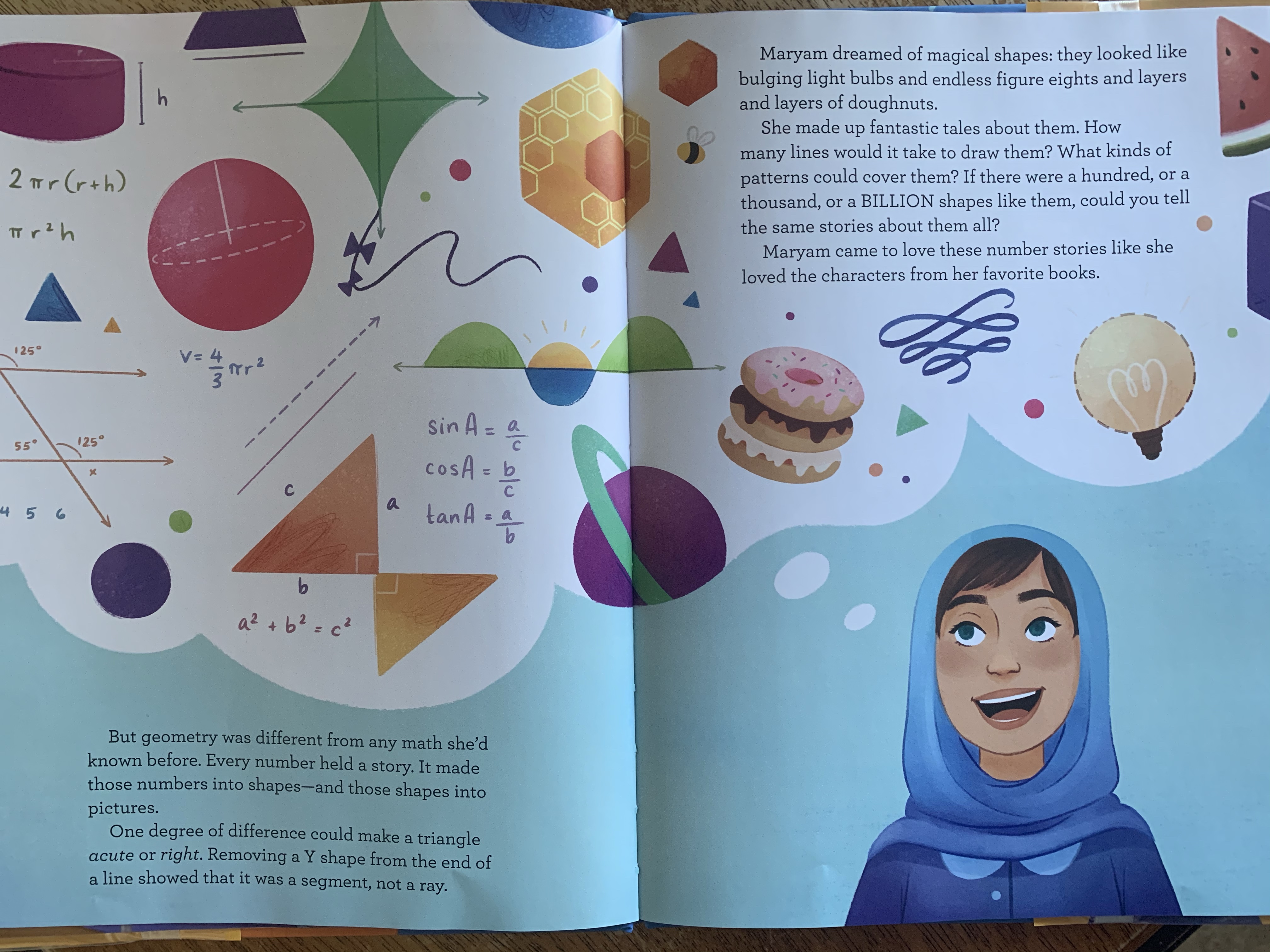
Math made her head spin, she would rather be doodling, but when she was 12 her teacher introduced her class to geometry.  It was different, the numbers held stories and the shapes were pictures. She made stories about the problems and wondered about them as if they were characters.

img_8781

In high school, Maryam and Roya entered the International Mathematical Olympiad.  The first year they received participation medals, but the next year, Maryam won the grand prize with a perfect score. She finished her schooling in Iran devoting her life to the stories that numbers told and left Iran to start graduate school at Harvard in the United States.

img_8782

When she had a hard time solving problems she would spread large rolls of paper on the floor and solve them.  Her daughter would tell people she was a painter.  She wanted to stretch the mind and how people went about solving equations.  She became a professor and a lecturer and one of her discoveries became known as “the magic wand theorem.”

In 2017 she passed away from breast cancer and the world lost a remarkable storyteller, mathematician and human.  The book concludes with an author’s note, important dates, and books to reference to learn more about Maryam Mirzakhani.

img_8780

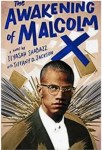
The Awakening of Malcolm X: A Novel by Ilyasah Shabazz and Tiffany D. Jackson

Standard
The Awakening of Malcolm X: A Novel by Ilyasah Shabazz and Tiffany D. Jackson

img_8312This historical fiction piece about Malcolm X follows him through incarceration with flashbacks to his childhood and teenage years.  Written by his daughter it is hard to know where this 336 page book is factual and where it takes artistic freedom with filling in the blanks. A few creative liberties are mentioned in the author’s note at the end, but some sources in the back would help clarify, as she was a toddler when her father was killed. The time frame of Malcolm X’s life and a large portion of the book covers his introduction and conversion to The Nation of Islam, but it never mentions even in the timeline at the end that he left it, or that they were responsible for his assassination.  The book is beautiful and heartbreaking at the same time, it is also so very humbling and empowering. I just don’t know that younger middle school readers (the stated intended audience is 12-18), will really grasp the content, his condition, and his searching, while trying to keep all the characters, time frame references, and slang straight.  With the mention of his girlfriend who he is/was sleeping with, as well as the drugs, the alcohol, and the abuses occurring in prison, older teens might be able to handle the book better, and be tempted after to dig deeper to learn about him going for Hajj, becoming Sunni, changing some of his views, and ultimately being gunned down in front of his family.

SYNOPSIS:

Malcolm Little is living between Roxbury and Harlem and going by the nickname Detroit Red.  When the story opens, Malcolm and his friend Shorty are about to tried for stealing a watch, a crime that he acknowledges he committed, but undoubtedly doesn’t deserve 8-10  years in prison for at age 20.  Nearly every chapter starts with a flashback to an earlier time and then concludes with the atrocities of prison life at hand.  As the narrative flips back and forth Malcolm’s story and awakening emerges.

Born in Omaha the Little family’s home is burned down by the Ku Klux Klan, they move a few times as the growing family grows closer together and establish themselves as followers of Marcus Garvey in advocating for Blacks.  Malcolm’s preacher father is killed when Malcolm is six years old and his mother institutionalized when he is 13, for refusing to feed her children pork amongst other things, and thus leaving the family grasping as they know she isn’t crazy, yet cannot get her released.  Malcolm is incredibly bright and attends a nearly all white prep school, but even after being class president, a teacher discourages him from pursuing his dreams of being a lawyer, and Malcolm drops out of school and ends up being a hustler.  His white girlfriend, a married woman in Boston and her friends convince him to rob some wealthy white neighborhoods and when he later takes a stolen watch to be fixed he is arrested and found guilty of grand larceny, breaking and entering, possession and more.  He is sentenced to Charlestown State Prison and day-to-day life is rough.

The guards at the overcrowded prison are aggressive, the food un consumable, and being put in the hole as punishment is beyond inhuman.  Malcolm is filled with anger and rage and is still trying to hustle people.  He learns his family has become followers of The Nation of Islam and he doesn’t want to hear it, he doesn’t want to hear about his prison mates preaching the Bible and he doesn’t want to hear about God.  He feels betrayed by God and feels guilty for not being a man his father would be proud of, the refrain: up, up, you mighty race! echoes throughout.

Throughout it all his family’s love is felt in visits, letters, and warm memories of life before his incarceration.  His flashbacks to events in his childhood that defined him, inspired him, molded him, show what a beautiful family he had and how racism in large part destroyed it.  His parents valued education and discipline and his elder siblings carry that torch and pass it on to the younger children, they are a large family and their love is palpable for each other and for the liberation of Blacks in America.

Little’s sisters write letters and eventually get Malcolm transferred to a much nicer prison, Norfolk, where he really channels his rage into reform, determined not to leave the same man he entered as.  He has access to a full library, he joins the debate team, he takes classes, converts to The Nation of Islam and then refuses to get a polio shot and is sent back to Charleston for the remainder of his sentence.

The book concludes with his release, and teases that members of his family are becoming uneasy with the Honorable Elijah Muhammad.  At the very very end, he meets Betty, the lady who will be his wife.

WHY I LIKE IT:

I love that this chunk of Malcolm X’s life shows the transformation of his thinking, how outside influences forced him to dig in to himself and reflect in such a profound way.  The book is as timely as ever as the systemic racism that is determined to see people of color fail is still running and growing.  There is a little mention of how veterans are treated better in other countries on the front lines than they are at home when they return that I wish was explored more, but there are so many characters that flit in and out of Malcolm’s prison world, it is hard to tell them apart as it is Malcolm’s story and his development that is being told.

Not surprisingly, I wish there was more about him converting to Sunni and going for Hajj.  The book stops before then and I am sure that most readers, will not understand the difference between The Nation, the Ahmadis mentioned, and Sunni Muslims.  This concerns me as the acceptance of Elijah Muhammad as a Prophet is hard to read.  I think some conversation with readers would be necessary as the book offers little if any to differentiate.

I like that each chapter starts with a direct quote of Malcolm X and the the fact that the relevance of his words in today’s world don’t need any explanations or context is devastatingly powerful.  I also appreciate how engaging and smooth the writing is.  You really feel the layers of Malcolm X the character, being pealed back and him coming into the proud confident leader that he is known to be.

FLAGS:

There is profanity, mention of him sleeping around, memories of kissing his girlfriend, alcohol consumption, cigarettes, drug use, violence, beatings, abuse.

TOOLS FOR LEADING THE DISCUSSION:

I don’t think I would do this as a book club for middle school.  Possibly if I was a high school teacher I would offer it as outside reading or extra credit when reading about the Civil Rights Era, or if I was teaching the Alex Haley, Auto Biography of Malcolm X.

You Can Control Your Voice: Loud or Quiet? You Choose the Ending by Connie Colwell Miller illustrated by Victoria Assanelli

Standard
You Can Control Your Voice: Loud or Quiet? You Choose the Ending by Connie Colwell Miller illustrated by Victoria Assanelli


you can controlA choose your own adventure picture book, that doesn’t have anything Islamic specific, doesn’t seem to be written by a Muslim or illustrated by a Muslim, and that was found at the public library, starring a Muslim mom and daughter.  Oh hurrah for beautiful illustrations, teachable moments, volume control in a library and the fun to read the story and have control over what happens next.

91F3712F-C173-46C0-BD30-6B6814B951BA

This 24 page book meant for kids in kindergarten to second or third grade is part of a series featuring diverse characters learning universal manners and making good choices. To see Muslims represent a universal lesson in a relatable environment is a great way to normalize seeing women in hijab in real life.

685B4BFC-16EB-437A-842F-ED10B2580851

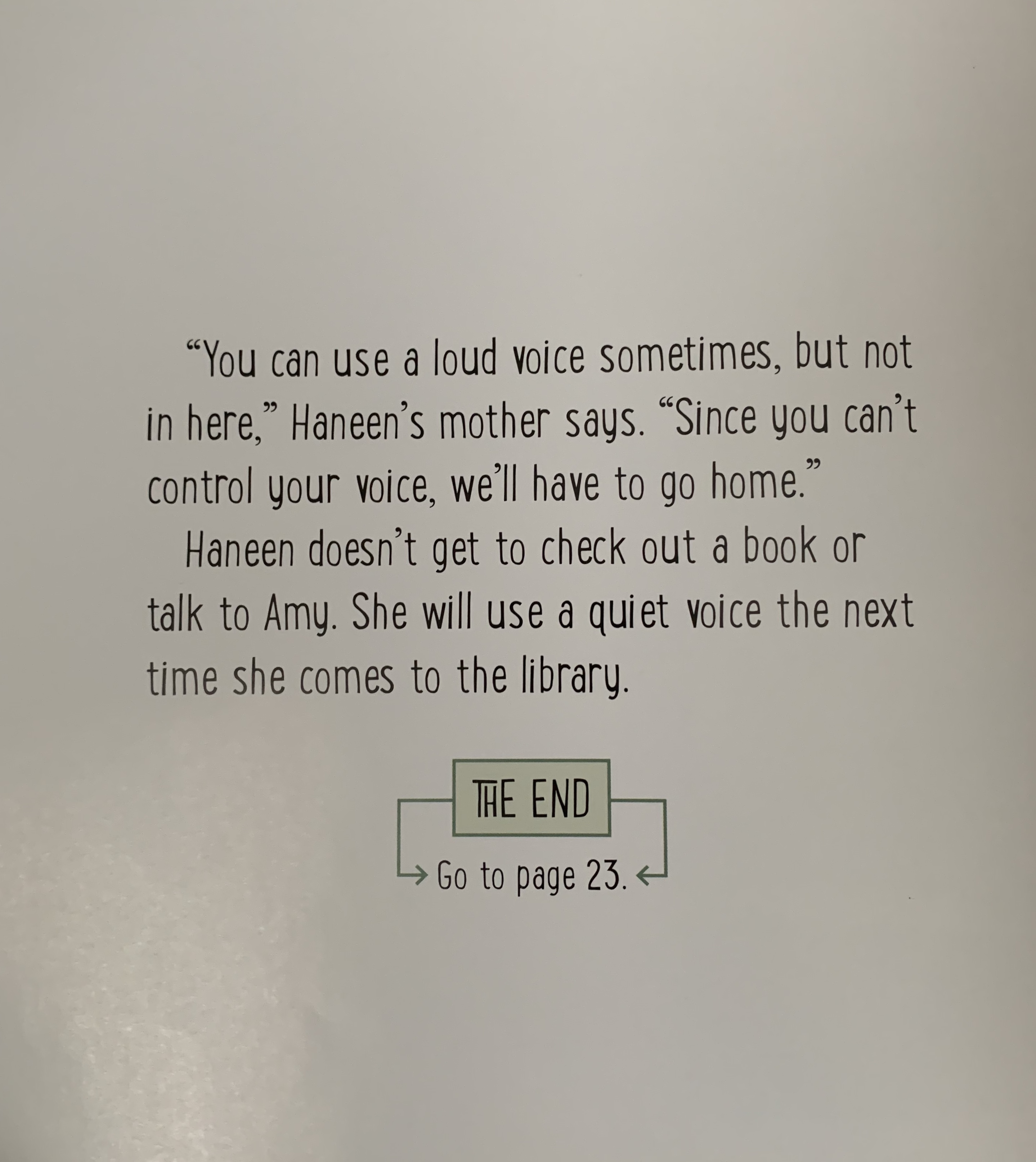
Haneen and her mom are at the library, and Haneen finds a book about fairies and cannot contain her excitement.  Immediately the reader has to choose what Haneen does next.  If she stays loud, the story ends rather quickly, but if she tries to keep her voice down, she might get to stay at the library a little longer.

9E7FC801-D531-42AA-9542-81C4BAF75364

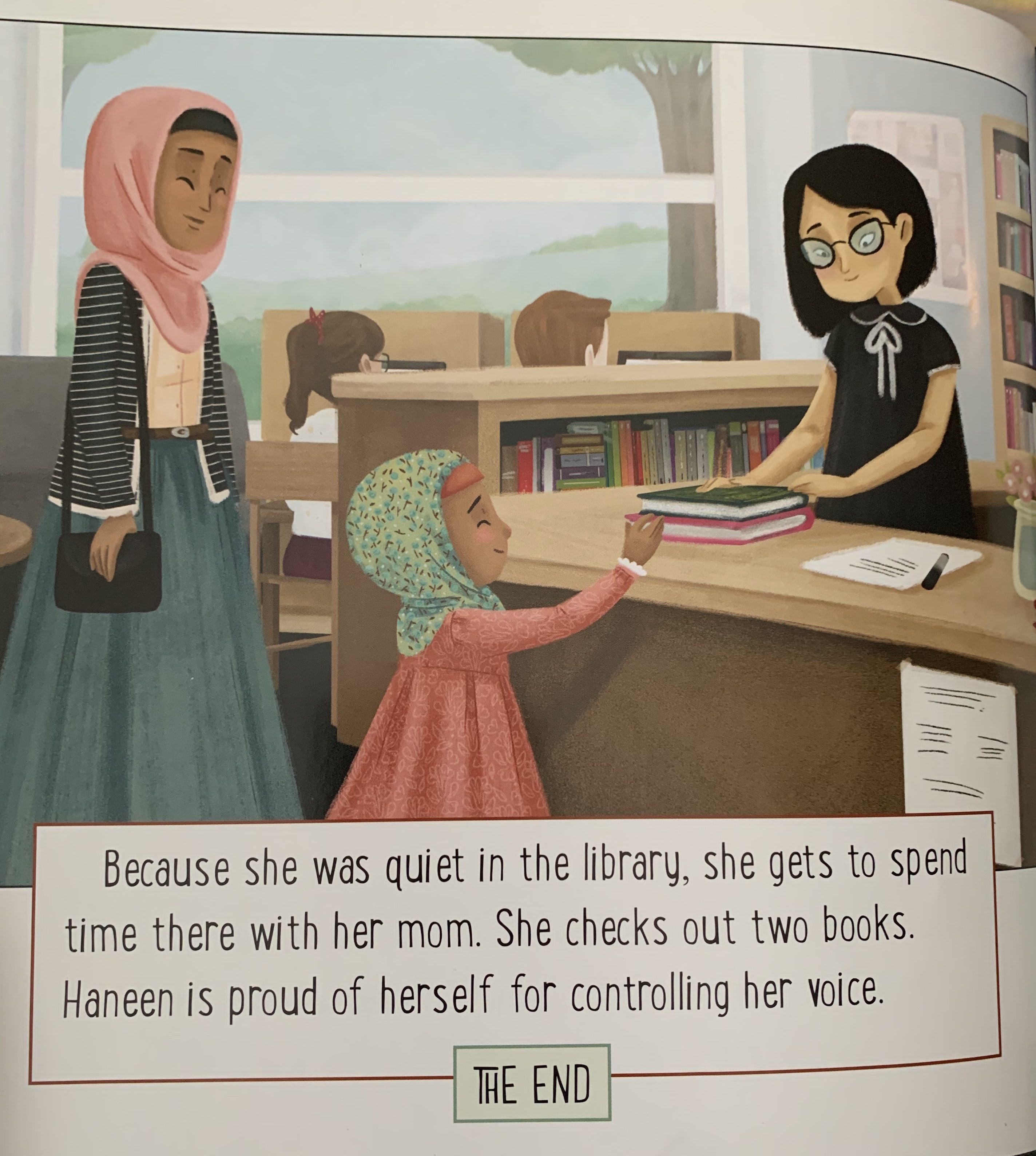
There is a big test when she sees a friend, and disturbs a gentlemen working on the computer, but if you make good choices Haneen gets to check out two books.  If your choices aren’t ideal you might have to just get the fairy book and get out, and if you really struggle to know how loud or quiet to be, you’ll have to come back another day and try again.

C00E287A-E463-427B-9AC4-C748681CC0F5

At the end of the book are some things to think about, to drive the point home.  I love the line, “We are all free to make choices, but choices have consequences.”  A great lesson for little ones, and a great reminder for older readers too.

3EF9066A-60F4-4A31-9E1C-19F228A0D7F4

The book is 9×8 and the expressions on the characters faces make the book a great option for circle time, story time, bedtime, and just to have on hands for kids to thumb through and enjoy.  Well done!

90F0B566-EE2F-490B-8D8C-3AD148BC0CE5