Tag Archives: color

What Color is My Hijab? by Hudda Ibrahim illustrated by Meenal Patel

Standard
What Color is My Hijab? by Hudda Ibrahim illustrated by Meenal Patel

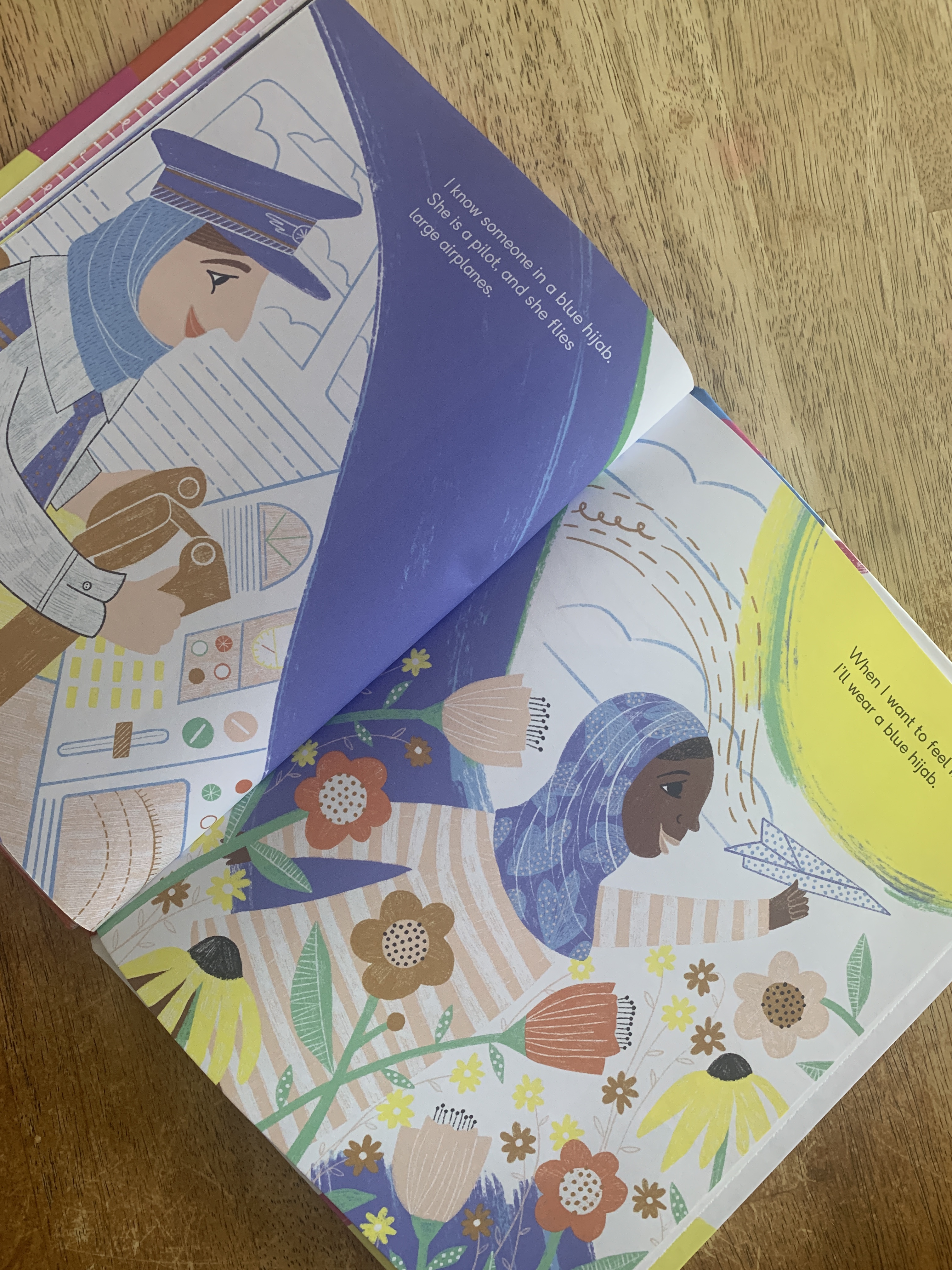
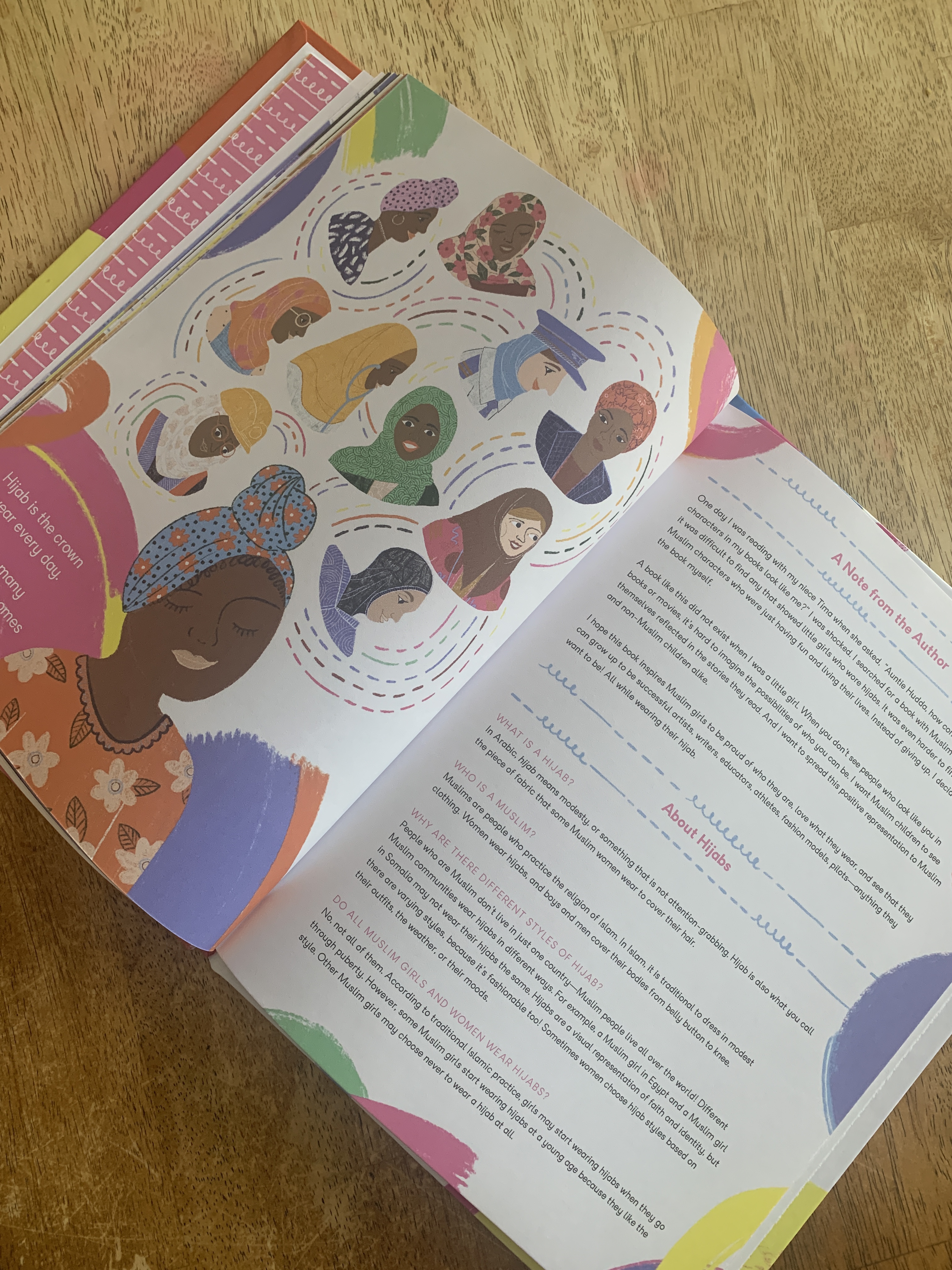
When this book arrived I flipped through it and loved that it tied hijab colors to careers, when I asked my seven your old to read it to my three year old and I overheard snippets, I was impressed that positive characteristics associated with the professions were articulated and embodied by the main character to inspire young girls everywhere.  When I finally sat down to read the book my self, I enjoyed the joy, diversity, and backmatter, but unfortunately felt like a page was missing at the end.  Over 32 pages the book introduces a color as seen on someone the narrator knows hijab, and identifies the woman’s job and a couple of characteristics.  The facing page highlights that when the girl wants to have strength or show kindness she too will wear that color hijab.  The text on the first page and the last page is the same, “Hijab is the crown/I wear every day./It is worn many ways, and it comes in every color.”  I absolutely love the premise of the book, but it seems that the conclusion should perhaps broaden that we can be anything and everything no matter the color we wear.  The blurb on the back of the book actually uses language of wearing “yellow, ‘like’ my doctor’s hijab, brown ‘like’ my teacher’s hijab,” etc.  that allows for a more interpretive and less literal view of I have to wear this color or that to be a leader or athlete or loving. I know I know, I’m probably overthinking it, but I’ve read the book so many times, and each time I just feel like the conclusion tying it together is missing and makes the book primarily a color book and thus preventing it from transcending into being more.

The book text is like a poem with the opening and conclusion reading the same.  The patterned body of the book works very well in establishing the links between hijab, color, occupation, empowerment, characteristics and implementation.  The pictures also allow the reader/listener to broaden their knowledge about various careers and see what they look like in action and what attributes they draw upon.

At times the wording gets a little loose with “give kindness” and “show wisdom” but the overall tone conveys the sentiment and allows for the stronger, “get results” and “be a leader” to balance out the flow of the book.  The illustrations amplify the color being presented, but it is worth pointing out that the hijab’s are all patterned and could be a little confusing to little readers.  Similarly, the yellow hijabs appear more orange and the purple more pink.

I love that the book is authored by a Somali woman and that the illustrations show diversity (skin color, mobility, body shape), but focus on strong black women inspiring the young protagonist.  The backmatter hints that it is the author’s niece and also explains hijab, and hijab styles.

I purchased mine from Book Depository, but they are going out of business, you can also purchase it on Amazon, here.

You are the Color by Rifk Ebeid illustrated by Noor Alshalabi

Standard
You are the Color by Rifk Ebeid illustrated by Noor Alshalabi

you are the color

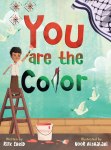
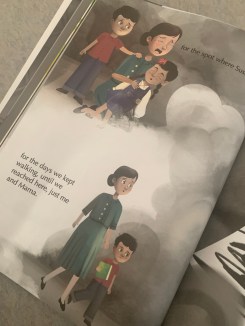
Books like this are hard for me to review, and I have gone back and forth on whether I should post anything or not.  On the one hand, we need books that are unapologetically Palestinian written by Palestinians.  They need to be celebrated and elevated and I want to offer my support to the stories, to the voices, to the authors, illustrators, everyone involved.  On the other hand, if I didn’t love it, why should I shy away from saying so, when I have purchased the book (pre-ordered and changed the shipping address even, to have it delivered to me on vacation because I didn’t want to wait to read it).  The book is emotional, but the last six pages unraveled the whole book for me, and in a picture book particularly of this nature, when you finish- if you don’t have a cathartic pull, you start to find holes in the story as you feel deflated.  The book, I would go out on a limb to say, needs to be discussed and given context even if you are Palestinian.  As someone who is not, I recognize my arrogance in such a statement and am happy to be corrected, but from a literary reviewer standpoint the book needs discussion and additional context.  The Nakba is only articulated in one paragraph in the author’s note.  In the story itself there is no indication that what happened to Thaer happened to so many Palestinians in 1948.  The use of color and how it is depicted in the illustrations is tangible and powerful, but as odd as it is to say, the words got in the way of the story.

img_0713

The book starts with Thaer trudging to school in dull sepia filled pages to begrudgingly sit at a desk and begin an art lesson.  He is glad the spitballs are just spitballs and not real explosions, but the tone is still melancholy.  When he sees boys playing soccer he recalls the last time he played soccer, and the memory comes alive in color.  He was in Yafa, it was the day before the Zionists came and took his family’s home.

img_0714

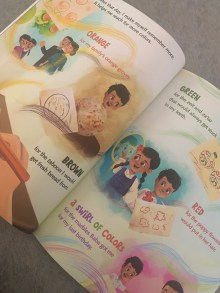
The teacher, back in muted tones, asks him to draw what has made him smile, and Thaer gives it a try.  Blue for the color of the sea, green for zeit and za’tar, brown for taboon to get fresh bread, etc..  When he takes the drawings home to his mother, she is not impressed.  Drawings are silly and colors aren’t going to bring Baba and Susu back.

img_0716

Defeated, the next day in class, Thaer recalls the men pounding down the door and Baba being shoved in a truck and Susu falling.  The next day at school they hang up some of their pictures and Thaer talks about his sister.  (SPOILER) On the way home Thaer paints the alleyway and brings color to his and his mom’s world.  His mama says that he is the color, and when the following day’s prompt is to draw what you want to be when you grow up it shows Thaer (presumably) on the beach as an adult painting.

img_0715

The disconnect for me occurred with the painting of the alleyway.  I was incredibly invested in the story, my heartstrings were being tugged, I was breaking for this character and his experiences, and it all came to a screeching halt because I couldn’t understand where the paint and the alleyway and the mama’s change of heart all manifested from.  As for the ending, I think I know what the author was going for, but it didn’t connect with any of my kids aged 2-15 nor my mother, a 40+ year early elementary veteran teacher.  I wish I could have taken a picture of their faces as she read the book to them.  The frozen expressions of huh and confusion at the end, until my 11 year old to broke the awkward silence to ask if the boy wants to be a painter or a father or an adult?  Those facets coupled with the often advanced vocabulary, makes the book an important one, but one that needs a lot of outside commentary to connect with the readers and to further the conversation about Zionism, al-Nakba, the occupation, and the continued oppression of Palestine.

There are flags of loss, kidnapping, sorrow, violence, etc., that parents will have to gauge if their children can handle. I’m not sure what age group is the best fit, the murder of a young girl, the forced displacement from one’s home, the removal of the father are all heavy themes.  I appreciate that it isn’t “watered down” for a western gaze so to speak, but I wish there was more about what happened to the dad, is there hope he is alive? I wish there was something about this not being an isolated reality for the protagonist and his family.  I wish there was some conversation or connection between the mother and son, because the loss of continuity really derailed the story.

As for the idea of the story, and the use of the illustrations to physically show two worlds I think is a great idea, it just sadly fell apart for me at the end: the faltering conclusion and the loss of emotional buildup that the first two thirds of the story worked so hard to create.

Furthermore by Tahereh Mafi

Standard
Furthermore by Tahereh Mafi

furthermore.jpg

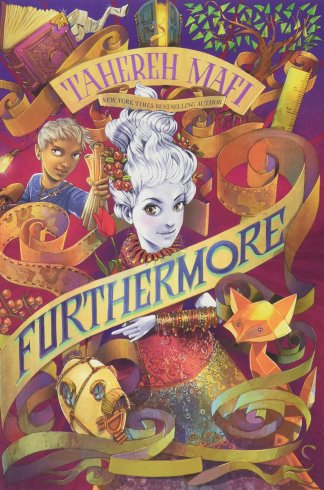
I put off reading this book (I read the companion, Whichwood, first) because I had heard that the audio book was great and I wanted to listen to it with my kids.  Read by Bronson Pinchot, Cousin Balki from Perfect Strangers, the audio book takes 8 hours to cover the 401 page book, and it is delightful.  While Mafi’s circular repetitive world building, takes some slowing down to get used to, listening to it made the story move along when a physical book may have been abandoned.  An AR 5.5 the book is clean, but not gripping until about two-thirds of the way through.  As the main character grows in maturity, the story gets better and better, a mix between Alice and Wonderland and A Wrinkle in Time.  The book will require some determination to get through, but the journey will be worth it in the end.

SYNOPSIS:

Alice Alexis Queensmeadow is missing her father who left 3 years ago with only a ruler in his pocket, and hasn’t been seen or heard from since.  Her life is a bit messy as she is being homeschooled by a mother who she doesn’t really think likes her and thus spends most of her days outside eating flowers and trying to avoid wearing clothes.  Alice lives in a world of magic and color, but Alice has no color, at least not externally, her magic, which she must learn to accept is to add and manipulate color to the world, to anything and everything, except herself.  As a 12-year-old she must surrender her magic and be given a task to prove her place in her world.  She thinks her best gift is dance and her surrender goes terribly wrong.  With no where to go after her humiliating performance, she decides to take Oliver Newbanks up on his offer to go with him to help him on his task, he is 13 years old, and find her father.  Their unlikely assistance to one another is fraught with mistrust and bickering as they journey to a world Alice didn’t even know existed, Furthermore.

In the land of Furthermore, magic is used very differently then in Ferenwood, and on their journey where up is down and paper foxes rip limbs off, and Time is actually a person.  The two companions will have to learn to be honest with one another as well as themselves in order to survive, let alone to find Alice’s dad.  With the threat of death and being eaten constantly plaguing them, they journey from village to village where the rules are different and the laws of logic ever changing, with the hopes of completing the task and reuniting a family.

WHY I LIKE IT:

The details in the story are luscious and beautiful, and once you fall into it, you really do want to stay and look around a while.  There were times when listening to it, that the kids would get bored, yet now that we have finished it, all have mentioned that maybe we should get the book so they can reread parts again.  Mafi’s writing style is very thick that you don’t feel like you are making any progress, yet when you start to digest what you know, you realize in fact you have.  

At the beginning Alice is very annoying, and she stays that way for a while.  Her whiney nature isn’t sympathy evoking, but rather gets you irritated with Oliver as well, that he doesn’t just tell her stuff.  Both combined need to be bopped on the head.  Seriously, a bit of communication would really have taken out a lot of the unnecessary frustration the readers feel for the characters, and let the personal stuff they were hesitant to share with each other have more value.  It is a middle grades book, the empathy of understanding Alice and Oliver’s own fears and reticent in opening themselves up is a great lesson to explore through fictional characters, but because the kids have such poor communication skills about anything, their own fears lose potency.  The pacing of the story, is just as random as the villages they pass through as well, while they always seem in a rush, some of the places they stop they could chat at, rather than while they are running to save their lives, or while they are walking they could talk to give description through their eyes, to build up the characters, not just the world they are in.

Like in Whichwood, the narrator talks to the reader which is fun, and provides information that otherwise couldn’t be shared.  The characters names in each of the villages are clever and while the story could be mapped pretty straightforward, girl journeys to a new world to find her father with the help of a boy, who will become her friend, the twists and details, make the book memorable and worth the strain to get to the climax. 

I know this review sounds back and forth, and I think a lot of it stems from what you expect from the story before you begin.  I had tried to read the book and got a little discouraged, but I had a good feeling the audio book wouldn’t disappoint, so I plugged through and found myself enjoying and loving the story.  If you are expecting an action packed fully fleshed out rational story, you will be let down.  If you can just enjoy the whimsy on the surface and let the little tidbits of the larger story come at different times to complete the larger puzzle, you will love Alice and Oliver’s magical world and the fantastic journey that they go on.

FLAGS:

The book is clean.  A bit disturbing is that the people of Furthermore want to eat Alice and Oliver to absorb their magic.  It isn’t vulger, but it is silly that Alice doesn’t like wearing clothes.  While one could be nervous that Alice and Oliver develop a romantic relationship, rest assured they do not, they become friends and are 13 and 12 years old, so phew.

TOOLS FOR LEADING THE DISCUSSION:

I can see me doing this as a book club selection, although I’d probably lean more to Whichwood, in an Islamic School environment because of the names. I think young Either one though, I’m positive Muslim kids will enjoy seeing a hijab wearing Muslimah pictured on the back flap and seeing that she can write a mainstream engaging fantasy novel about whatever she likes.

Author’s website: http://www.taherehbooks.com/book/furthermore/