Tag Archives: advice

The Boldest White: A Story of Hijab and Community by Ibtikhaj Muhammad and S.K. Ali illustrated by Hatem Aly

Standard
The Boldest White: A Story of Hijab and Community by Ibtikhaj Muhammad and S.K. Ali illustrated by Hatem Aly

The third and final book in the standalone series is finally out and I absolutely love that Islam, salat, and the masjid are front and center. Faizah is once again brought to life through the incredible illustrations that provide all the emotional beats and make the book memorable.  The story though is only just ok, to be honest, it is clunky and disjointed.  I have read the book a half a dozen times to myself and twice aloud and I do not understand the Eid story line.  I doesn’t fit the themes of fitting in, being a leader, being bold, it just seemed to be there to motivate a white hijab being purchased, and it was very distracting to the cadence and continuity of the story. Every time Faizah is self reflecting on her fear, suddenly a conversation about Eid with a friend named Sophie disrupts the story. Even the refrain that “Bravery grows in your mind.  But its roots are in your heart,” sounds lovely, but is never explained or developed, so what are you to water it with? What are the right reasons?  I’m sure most will be fine with the concepts and presentation and not be bothered, but this book is an auto buy for Muslims and non Muslims alike, and while I appreciate the packaging, I wish the story itself was more, well “Bold.”

The book starts with Faizah going to Jummah with her mom and sister, and loving being part of the crowd, she then goes to fencing and loves being part of the crowd, “it feels right.  I feel right,” she says.  But then the coach calls her name and she starts to worry.  She doesn’t like when people stare at her, she worries she did something wrong. The coach has already reminded her to “saber first, then move forward,” so I’m not sure why she worries after if she did something wrong, it is a class, reminders and corrections are what happen in a class.

Then on Sunday, the trio is back at the masjid for salat before Asiya’s fencing lesson.  The coach asks Faizah if she wants to come in for extra practice before the tournament.  Faizah isn’t planning on participating in the tournament though and would rather think about Eid.  Thinking about getting together in the future with Sophie to pick out Eid clothes, is more fun than fencing.  The reader doesn’t know when Eid is, or why Faizah seemed to break into a day dream when asked about fencing.  Furthermore the reader doesn’t feel the worry of being in a competition because Faizah is not shown to be worried.

Later that night Asiya teaches Faizah the moves she learned and Faizah practices alone.  There is then a two page spread that I do not understand, on one page she is saying, “When no one is watching, I ‘m the best fencer in the world,” three lines later it says Even when others are watching, I can do it.  I can be the best.”  What happened in between? I get the following line, “but it’s hard to be my best when I have to stand out to do it,” but the the line in the middle makes no sense.  What is the point of the book if she can do it and knows it at the mid point?  And no, I’m not reading an arc, I checked out this copy from the library.

The family is back at the masjid on Friday and reassuring Faizah as they head to fencing, that she can do it even when people are watching, that bravery will come.  She hasn’t been nervous at class before, and hasn’t signed up for the tournament, so why is she suddenly uncomfortable, when at the start she loved fencing class as she felt she fit in.

Then it is Saturday, and Sophie finally comes, but not to prepare for Eid, just to discuss, how they will prepare for Eid.  At least now we know it will be next week. The next Friday, I know I feel like a calendar should have been included, it is fencing class again and Faizah is called up to demonstrate.  She finds her strength and she is shy, but realizes they are not just looking at her, but looking at what she can do.  She is leading, she is helping, she is being brave.

Finally it is Sunday, and Sophie and Faizah are at the hijab shop, and Faizah picks a white hijab because it matches the fencing clothes, and she is going to the tournament.

Yeah, sorry I spoiled it, I just really am sad that the book wasn’t as great as it could have been.  It connected the dots eventually, but not in a memorable way, and for the team responsible for this book, it really could and should have been amazing.

Allah and My Heart by Humera Malik illustrated by Basmah Syadza

Standard
Allah and My Heart by Humera Malik illustrated by Basmah Syadza

img_7583

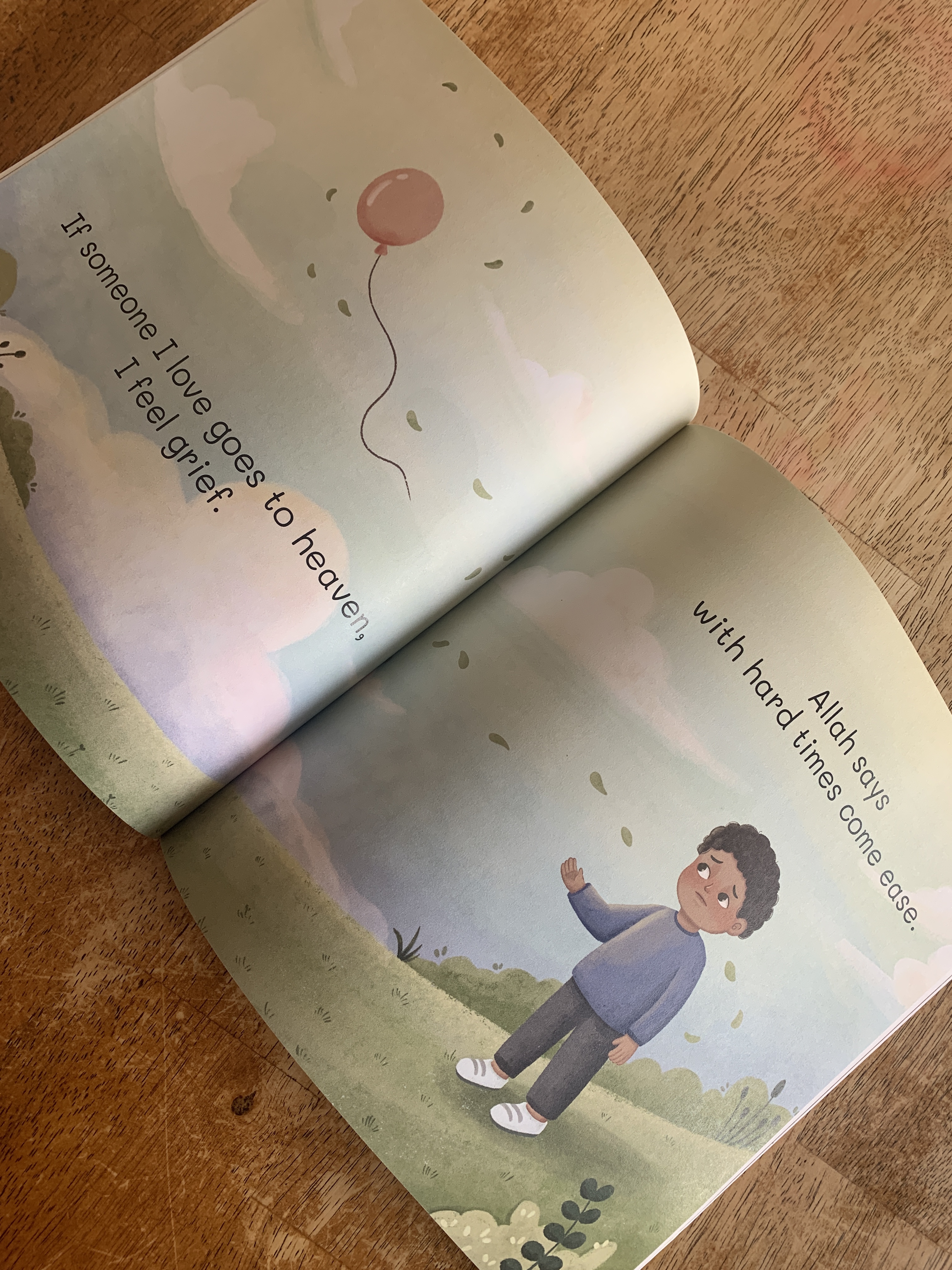
This 47 page book of feelings and reassurances shows Muslim kids that they are not alone and that Allah swt is always there for them providing love.  The book is not a story, and at times it might sit unopened on a shelf, but when it comes out as a needed tool, I think the resource it provides will be much appreciated, powerful, and useful.  The book offers scenarios with emotions: fear, excitement, anger, sadness, and then reassures the reader with Allah’s promises, and then with what we can do or say.  There are only a few words on each page, with a simple illustration that changes with each scenario and is reflective and inclusive to skin colors and abilities.  The book if rushed, will just seem like a list, it really needs to be discussed and shared with children in a way that leads to internalization, application to their own life, and appreciation that Allah swt is aware of everything.  The book is not sourced, but the sentiments are familiar.

img_7584

Here are a few samples of how the book is tied together: “When it is dark outside, I feel scared, Allah says don’t be scared I am with you.  I can say ‘Allah is my protector,’ and read the last three surahs of the Quran.” This plays out over four pages. “When I have too much to do, I feel overwhelmed.  Allah says He does not give me more than I can handle.  I can say ‘Allah I am overcome, help me’ and I can do dhikr to calm my body.

img_7586

I like that the book is well done for what it is.  The repetitive format and Islamic centering make it is a useful tool and the guidance gentle on a child’s level.  If nothing else knowing that what you are feeling is normal and common and accounted for in our deen is a tremendous reassurance in feeling big emotions.  The reasonable price and the Islamic centering makes me hope this book is shared and shelved in places that little Muslims will have access to with adults to help facilitate the messaging.

img_7588

The book can be purchased here from Amazon or from Crescent Moon Store here if you use my initial ISL (Islamic School Librarian) at checkout you will save 10%.

img_7587

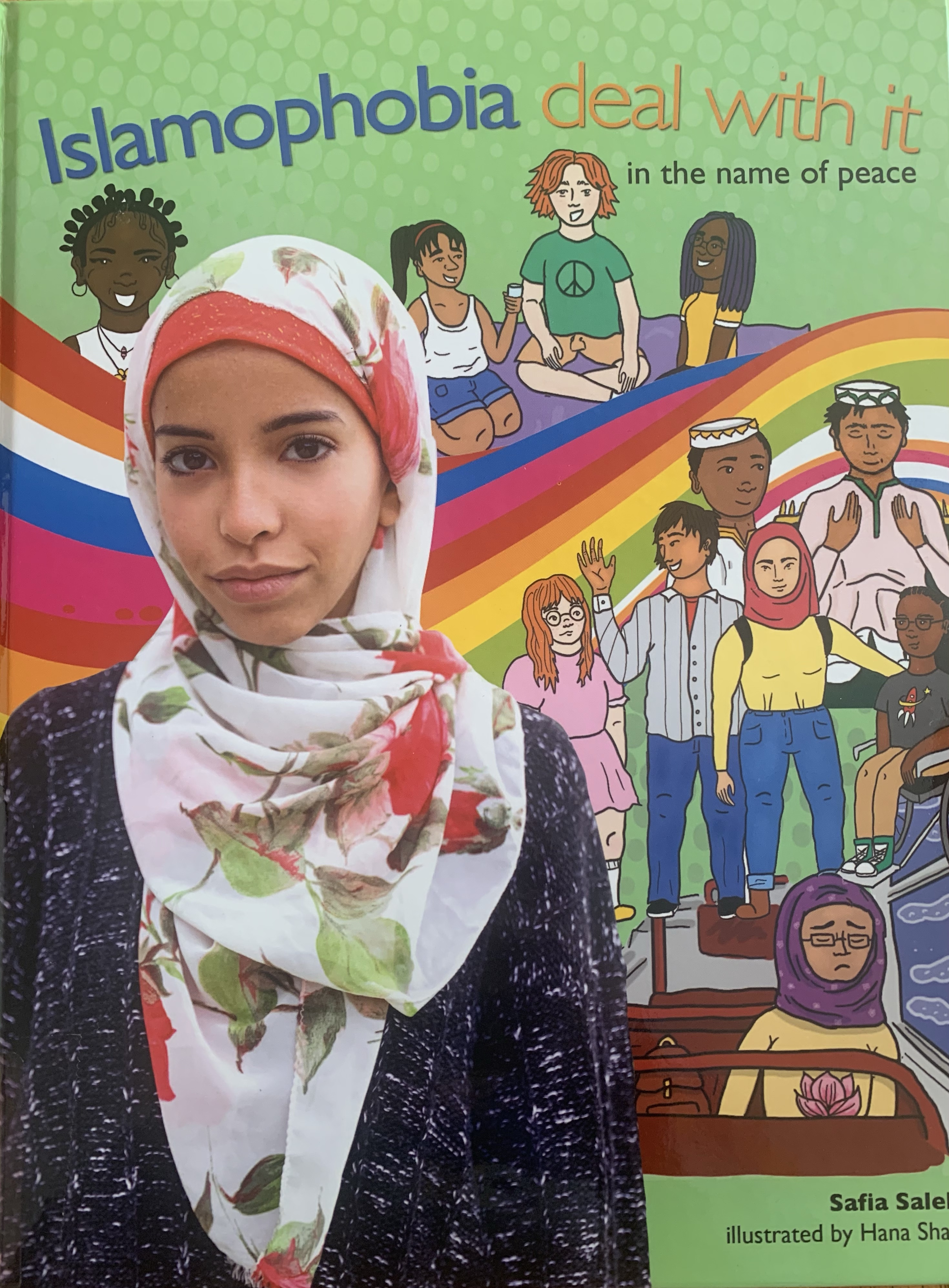
Islamaphobia deal with it in the name of peace by Safia Saleh illustrated by Hana Shafi

Standard
Islamaphobia deal with it in the name of peace by Safia Saleh illustrated by Hana Shafi

img_9893

This nonfiction book has given me pause.  The information, the approach, the presentation, the importance, is all really well done, I just can’t really grasp how to use the book.  It is broken up in to four sections:  Islamophobia 101, The Believer, The Intolerant, and The Bystander. In each sections it has scenarios, comic strips, quizzes, infographics, advice columns and so much more spread out over 32 pages.  After it explains what Islamophobia is, it offers believers (Muslims) ways to see if what they are facing is classified as Islamophobia.  It has quizzes and questions and advice for people that are intolerant, and then if you are just around Muslims and intolerant folk what you can and should be aware of and do.  I think in a classroom all sections could be gone over, but I’m not sure in which grade and in what context.  In an Islamic youth group I think it could be really thought provoking to look at different sides and encourage the members to share their personal experiences, but I don’t know.  If you are a bully, would some quizzes and graphics be enough for you to recognize your own bias, could it make you change your attitude? I’d love to hear from others that have read this book, I checked mine out from the library.  It says it is for ages nine and up and other books in the series cover topics such as: consent, homophobia, transphobia, anxiey, racism, and freedom of expression.

img_9897

The first section: Islamophobia 101 starts off with a scenario of a girls first day of school after the summer and her first day wearing hijab.  No one really says anything, but there are whispers, her best friend asks if everything is ok at home.  It defines Islamophobia as “a kind of intolerance, or a refusal to accept and respect ideas and views that are different from your own.  It is the belief that Muslims, or people who follow the religion of Islam, are a group to be fearful of.”  It goes on to explain in examples what Islamophobia is while giving facts about Islam and things to think about. There are graphic comic type scenarios showing what Islamophobia can look like based on ignorance, stereotypes, then assumptions, and finally fear.  The section then offers a 10 question quiz, followed by questions and answers to a fictitious counselor in an advice column format. Finally there are myths and a Did You Know Section.

img_9899

The next section: The Believer, starts with a scenario of a Muslim holding their breath while watching the news.  Of being proud of your family and faith, but being tired of convincing people you are a Muslim and a good person.  An advice column about handling halal food, terrorism, hijab and sports is next followed by tips to not feel alone and an infographic on dos and don’ts to not be overwhelmed by your experiences.

img_9901

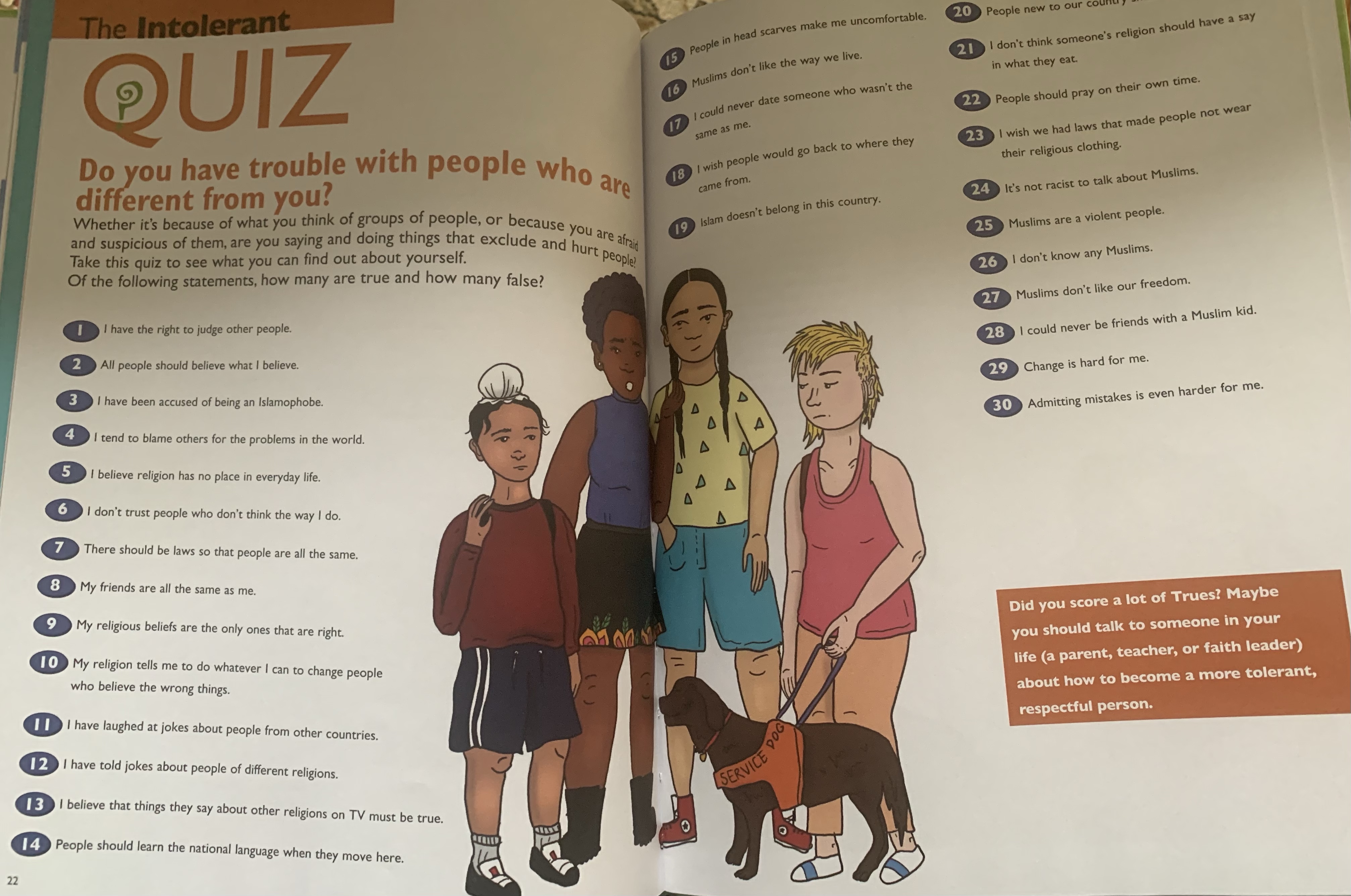
The third section is The Intolerant which asks if other people’s religions bother you, or if you question why religion has to be part of daily life and not kept personal.  There is a a 30 question true and false quiz, then a challenge to be part of the problem or part of the solution, with information on what you can do.  There is a sidebar about the role of social media as well as some highlights of current Muslim sports figures.

img_9900

The Bystander section asks if you’ve seen someone bullied or harassed for being Muslim, if it bothers you to hear people talk about immigrants and refugees as a threat, and what you can do to speak up. There are dos and don’ts a 10 question quiz, some more Islam facts and some direction to get more information.

img_9902

Overall the book is well done, and I had my kids look through it to see a way to facilitate anything they experience and how to articulate how they are treated and might treat others.  

img_9896