Category Archives: YA FICTION

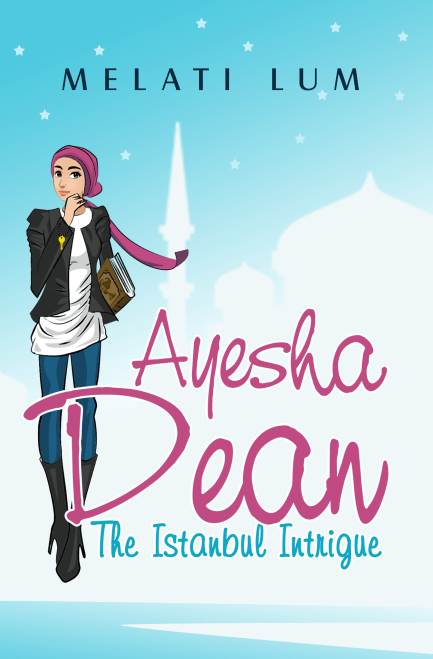
Ayesha Dean: The Istanbul Intrigue by Melati Lum

Standard
Ayesha Dean: The Istanbul Intrigue by Melati Lum

ayesha dean.png

I’ve tried numerous times to get my preteen daughter to read a Nancy Drew book with little success, yet she devoured this mystery and is eagerly waiting for more.  The protagonist is relevant, resourceful, fun, and a practicing Muslimah too.  At 240 pages, the spacing and large font make the book easily accessible, and tempting to dive in to.  The pacing is pretty good, and while there are a few hiccups with storytelling style, the book overall is worth adding to yours and your child’s reading list.

SYNOPSIS:

Ayesha’s parents are deceased, but her Uncle Dave has raised her as a Muslim following her parent’s wishes.  Having graduated high school she is off on a celebratory trip with her two closes friends: Jess and Sara, her uncle and her friend’s dad to Istanbul, Turkey.  The adults have a business conference and the girls are hoping to explore and enjoy all the sights of the Turkish Bazar, the Hagia Sophia, the Blue Mosque and more.  While looking for a book to gift Uncle Dave, Ayesha and her friends discover a secret message sewn into an old book of maps and set off to collect clues and solve a 100-year-old ibn-Arabi mystery.  Obviously, I don’t want to give too much away but there are villains, and shady characters, and dear friends, and lots of yummy food.

WHY I LIKE IT:

I love that the heroine is a hijab wearing, salat praying, Tae Kwon Do trained, fashionable, kind, young lady.  She has integrity and resourcefulness, that make the reader want to cheer her on.  Her friends are significantly less developed, I really couldn’t tell you much about them, and honestly had to look back to recall their names.  I understand why they are in the story for Ayesha to play off of, but I’m hoping that they will have a bit more substance in future novels.  Other side characters had more depth than Sara and Jess did, and even getting them out of the way for the climax seemed to further diminish their roles and importance.

I loved learning about Turkey through the characters, the history, architecture, the food.  The author really shined when talking about Islamic history as well.  When Ayesha and Emre explore the Sultan’s Privy Chambers at the Topkapi Palace, and look at Prophet Muhamad’s (saw) sword and bow, the excitement and reflection is palpable.  In other places however, I felt like the narrator’s voice was completely jarring and distracting to the engaging story at hand.  In the midst of pursuing a lead, the story comes to an almost standstill to say, “the friends chatted amiably as they walked, admiring the city as they went (69).”  The majority of the descriptions are so vivid that the few places where they cease are noticeable and awkward.

I also loved the diversity of the friends, even Ayesha’s own personal makeup adds some depth and appreciation that she has chosen to practice Islam.  Ayesha prays and tries to make sure she is not alone with a boy, she is conscious of her hijab and notes the Islamic elements in her own life and in her environment.  Obviously the book takes place in Turkey and she is unraveling an Islamic mystery of sorts, but I think the book works well for Muslim and non Muslim middle schoolers alike.  The book is not preachy, and the translations of prayers and poetry are framed in a historical or inspiring, not doctrine manner.  Similarily, I think you might be able to get boys to read it too.  It inspires girls who perhaps can identify with the main character, but I think even boys will be impressed with what Ayesha can accomplish.

FLAGS:

The book is fairly clean, there is some intense moments with kidnapping and having guns drawn, but nothing too haunting.  Ayesha obviously makes a good “friend” but nothing happens or is even detailed as wanting to happen between her and Emre.  Just Emre’s dad regularly teasing them as he looks for a wife for his son.  The only real flag for me was the exploring of the harem at the palace and the mention of concubines, and eunuchs.  A lot of detail is not given just that the women must have felt trapped, but it is a heads up if your child asks you about it, to be ready to answer.

TOOLS FOR LEADING THE DISCUSSION:

I think this would be a fun book club book to explore deeper some of the sites and history of Turkey.  I would have to explain the harem before hand I think, but I think it can be done factually to avoid to much over thinking for the young readers.  I think to track the clues and “map” out the trail in a group completely with pictures of the real places would really bring the story to reality.

Interview with the author: http://mvslim.com/meet-melati-lum-criminal-lawyer-who-also-has-a-passion-for-writing/

Why we need more heroines like Ayesha Dean: http://www.muslimkidsguide.com/why-do-we-need-more-muslim-heroines-like-ayesha-dean/
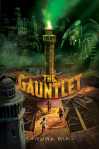
 

The Gauntlet by Karuna Riazi

Standard
The Gauntlet by Karuna Riazi

the gauntlet

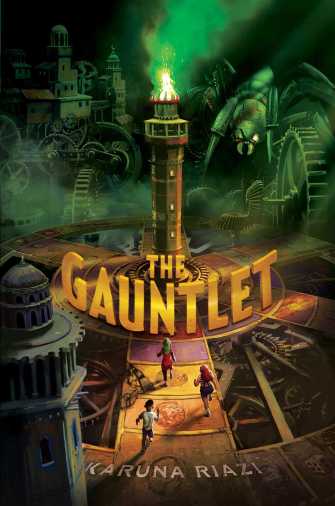
Take Jumanji, turn it into a chapter book, flavor it with steam punk, set it in a Middle Eastern inspired marketplace, and have the protagonist be a Bengali-American, hijab wearing Muslim on a quest to save her little brother with her two BFFs from New York. Bam, you now have a 298 page AR 5.4 reading level booked called The Gauntlet.  

Published by Salaam Reads (Amina’s Voice) this book is written for all kids, the main character’s religion and culture just add depth and a connection to the game they have fallen in to.  I found this book on Scholastic, and when I got it, I handed it to my daughter to screen for me.  I asked her once she finished if it had any Muslims in it and how were they presented, to which she gaped at me and said, “umm mom the whole thing is about a Muslim girl and it is awesome!” So naturally I moved it higher up in the “to be read pile” and while I agree with her assessment, the book is more plot than character driven, and there isn’t a lot of theology in it, just a race against time to get out of the game alive.

SYNOPSIS:

It is Farah Mirza’s 12th birthday and while she should be downstairs visiting with her guests from her new school, she is holed up in her bedroom with her little brother Ahmad and her best friends from the old neighborhood, Essie and Alex, playing board games, the Mirza family’s favorite pastime .  When Aunt Zohra tries to coax them from the room she mentions a gift for the birthday girl is in her room, and the kids sneak off to get it.  Only it isn’t the book she brought to give Farah that they find, it is a bewitched game called the Gauntlet of Blood and Sand that lures kids in, and keeps them if they cannot out play the Architect.  When Ahmed falls in, the trio has no choice but to follow him in to try and rescue him and escape, before time runs out.

Once inside the game, they are in a city called Paheli. It resembles an old Middle Eastern city with large souks, market places, even a small masjid, surrounded by sand and levels absolutely breathtaking in both their beauty and in their threat to the children.  The inhabitants are those that played the game and lost. The challenges the kids must face range from a life size game of mancala to a taste test of Bengali/Indian sweets.  As they rush from challenge to challenge they meet a kind tea shop owner, giant lizards, spies and police of the architect and see fairly detailed descriptions of different parts of Paheli. The gamemaker/designer known only as the Architect senses that the kids will win, so he starts to cheat, and then feels bad and arranges to meet the players.  When the children meet him, and hear his story, they feel some sympathy for him, but not for the Jinn that holds the ultimate power over the game.  Obviously they do escape, but I won’t spoil the fun the process is, nor the sweet surprise of the reunion.  

WHY I LIKE IT:

I like that at the core, the story is driven by love for a sibling and requires the teamwork and cooperation of friends.  The rest is just frills from this central and clear message that is woven throughout the book.  While it is idealistic, there are hints that it isn’t overly so.  Yes Ahmad with his ADHD is a lot to handle at times, and the friends do have their squabbles, but ultimately both friends and family are worth risking it all.  I love that Farah is Bengali, many of the foods are Indian, and they are set in the Middle East, but yet somehow it seems interchangeable, this made me laugh, and while in other instances might have annoyed me, I liked how connected it made everyone seem, more alike than different.  Essie and Alex know some of the foods and cultural lexicon from growing up in New York.  They don’t find things different, they had lots of kids in school that wore hijab. Readers unfamiliar with some of the words and names found in the subcontinent and Islamic history might be put off a bit by the regular use of these words and the lacking glossary, but if you identify with any of it, you will celebrate seeing yourself in this book, just as Farah relished in seeing something of familiarity in Paheli.  

The book is fast paced and the detail given to the setting and cultural aspects are fun, but I really don’t feel like I connected much with the characters as a result.  There is very little character development and I actually had to look back in the book for some of the names to write this review.  There also isn’t much religion in terms of belief or practice.  The buildings and the food and the tone all hint at Islam, but I would have loved to hear an athan, or even her pausing to pray.  Not even that is there.  She wears hijab and that is about it in terms of religion.  

Ultimately I love that it is a mainstream book, with a strong storyline that is action packed and fun for older elementary and early middle schoolers that is clean and familiarizes and thus normalizes a culture not often seen in young adult fiction.  

FLAGS:

None, it is clean, at times possibly a bit scary with human bones, but not anything overly haunting.

TOOLS FOR LEADING THE DISCUSSION:

This would be an amazing book for a book club, and I would play the games that they play in the gauntlet at the meeting.  There isn’t a ton to discuss in terms of introspection and growth, but there is enough, and it is fun.  Plus, there aren’t a lot of books like this for Muslim kids to see themselves in, that I think it would be a blast for them to read, and enjoyable for the adults to watch them get swept away.

Interview with the Author: http://ew.com/books/2017/03/27/karuna-riazi-gauntlet-jumanji/


Wishtree by Katherine Applegate

Standard
Wishtree by Katherine Applegate

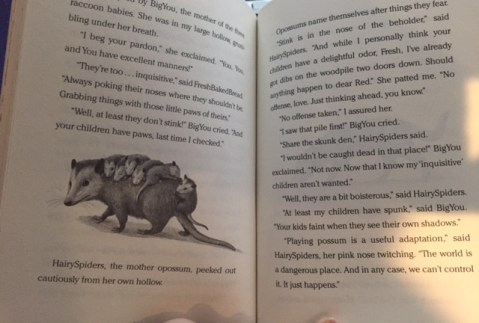
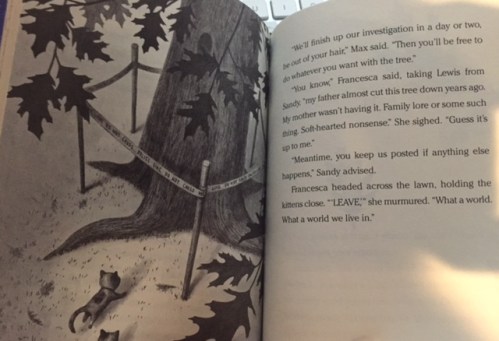
wishtreeI saw this book on Scholastic when I searched for “Muslim” on the website, a regular endeavor of mine, and was surprised to see it pop it since the synopsis on the back doesn’t mention Muslims or Islam.  So I researched it a bit, and sure enough the discrimination of a Muslim family in this tree’s neighborhood is the catalyst of this giant Oak Tree, sharing her story and enlightening the characters and readers with her wisdom.  At 215 pages, this slow and thoughtful book is a short read on an AR 4.2 level.  The pages are well spaced and the black and white drawings keep the reader engaged. And while I bought the beautiful hardback book, I didn’t read it, I listened to the two and a half hour audiobook version, and it was fabulous as well.

FullSizeRender (40)

SYNOPSIS:

Aside from maybe Shel Silverstein’s The Giving Tree, I can’t recall too many books being narrated by a tree, but like The Giving Tree, the lessons and wisdom come through loud and clear and stay with you long after the story has ended. Red, is an old Oak Tree that has been around for over 200 years.  She has many stories that she shares with her inhabitants: the possums, the raccoons, the skunks, the birds, her best friend a Raven named Bongo, but never humans, for they must not hear her speak, that is kind of a rule.  But when 10-year-old Samar’s family moves in and people don’t respond well to the new Muslim neighbors, the tree considers getting involved.  Samar spends a lot of time near the tree, and the animals enjoy her presence, while most people tie wishes to the wishing tree on May 1st (Wishing Day), trees are good listeners and Samar tells Red that she wishes for a friend.  This coupled with the act of vandalism someone commits against Red by carving “LEAVE” into her trunk, pushes the tree to ponder what makes people friends and how can she help Samar.  When the owner of the home who’s land Red resides on decides to have her cut down, Red throws caution to the wind and speaks.  Hoping to bring two kids together that need one another, and by extension their families and the whole neighborhood, Red has her work cut out for her.  Luckily she isn’t alone, her animal friends are up for the challenge and the lucky reader gets to laugh with the funny animals, ponder roots, and inclusion, and friendship, and diversity through the loving gentle manner of a tree.  It may be written for fourth graders, but I think everyone can draw upon the lessons, the depth, and the compassion needed to help Samar, to save Red, and to learn to be better to one another.  

FullSizeRender (43)

WHY I LIKE IT:

It flows like prose, the deliberate manner in which the story is told, grabs hold of you and halts time.  I love the relevance of inclusion and differences, there isn’t a magic wand, that makes everyone like everyone at the end, but there is hope.  And sometimes that is more powerful.  I listened to the book with my daughter, a 6th grader, and it was nice to chat about it with her after.  What makes people friends? How do people become friends? We move a lot, so she was really insightful about how sometimes friends are just friends because of proximity or because their parents are friends, she really had to think about what has kept certain people in her life, and I loved that this book gave us a starting point to have such a meaningful dialogue.  There isn’t much about Islam in the book other than that the Samar’s family is Muslim and that her mom wears hijab.  

FullSizeRender (42)

FLAGS:

None. It’s clean.

FullSizeRender (41)

TOOLS FOR LEADING THE DISCUSSION:

I would absolutely do this for a 3rd to 5th grade Book Club.  It has so many lessons presented in a non preachy way that the students would add themselves so naturally and effortlessly into the narrative and grow from it.  The book has won numerous awards, and the author is well known, so it also will encourage children to read other books of hers.

Author’s website: http://wishtreebook.com/

Teacher’s Guide: https://images.macmillan.com/folio-assets/teachers-guides/9781250043221TG.pdf


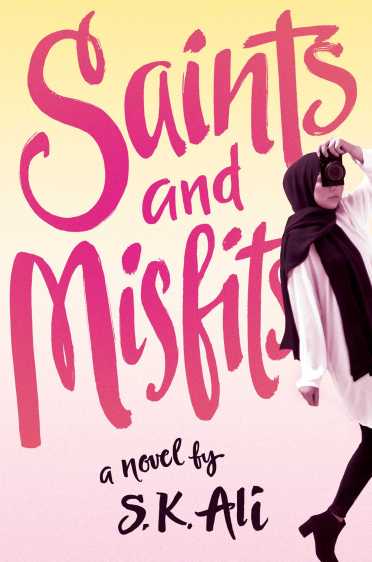
Saints and Misfits by S.K. Ali

Standard
Saints and Misfits by S.K. Ali

saints-and-misfits-9781481499248_hr.jpg

I enjoyed this book a lot. I had a bag of halal gummy bears, a rainstorm raging outside, and an excuse to snuggle in bed with a book, and I couldn’t put it down, even when I ran out of gummy bears.  I think mature 16 year olds and up could read it, and probably should, it is an important book, but I don’t know that I could recommend it to a young adult Muslim. Maybe, but probably college and up.  Not because high school students don’t read a lot about heavy stuff in English class. I mean Scarlet Letter, I Know Why the Caged Bird Sings or anything by Toni Morrison or Shakespeare are heavy, but they are removed from most Muslim teens.  They are old books, or about people from a different time and place. This book is real, and relevant, and relatable, and in 325 pages you feel connected to the characters as if you know them, or knew them, or more importantly for me, a 36-year-old Muslim American born and raised in America, as if they knew me.

SYNOPSIS:

Jannah Yusuf is 15 and in the opening chapter, less than 5 pages, she has to defend her choice to wear a burkini to her father, who assumes his ex-wife, her mom, has forced it upon her.  In the second chapter, we see that she has gone to visit her father to get away from a monster, her friend’s hafiz cousin Farooq, who attempted to rape her.  From there Jannah pursues a relationship with her crush, Jeremy, with the help of her best friend at school, Tats.  This pursuit involves intentionally having Jeremy see her without her hijab in gym class, and sneaking off to meet him.  Throw in the fact that he too is friends with the monster, Farooq, and the tension, anxiety, guilt, and shame that Jannah feels about her suddenly drama filled life is palpable.  Feeling increasingly isolated from her very amazing friends and family, she finds strength and support from a group of kids she is on an Islamic Quiz competition team with and an elderly Hindu man she helps once a week.  Eventually finding her voice, and reclaiming her strength to face her attacker is like a caterpillar coming out of her cocoon and you hope she soars and flourishes in reaching new heights and happiness.  The message of standing up against such acts and standing by those victimized by sexual predators helps puts the blame and shame where it should be, on the attacker, not the victim.

WHY I LIKE IT:

I like that it shows everyone in shades of gray. No one is good or bad or right or wrong, everyone is somewhere in the middle.  Even the most religious can be scum, and friends can both surprise you for good or for heartache.  At one place, Jannah considers telling her non-Muslim friend Tats about what is going on. “Almost.  The 60 percent reason that I hold back has to do with something I’m 100 percent sure of: I can’t handle people thinking I come from a messed up community.  I’d rather close the hamper lid on that one.” I think this is kind of where we are right now in real life and in literature. We want to be seen as complex characters, we aren’t a monolith, but we don’t want to celebrate our failures either.  This book does this really well, most of the time.  There is a girl who has memorized the Quran and wears niqab (a face veil) and has a vlog of stirring up stereotypes.  She helps Jannah get her revenge, and it doesn’t work, but at the same time she is never really nice.  Her friend Fizz, Farooq’s cousin, seems almost like family, but when told what has occurred, doesn’t believe her lifelong friend, and becomes rather disappointing and shallow.  Some of the friends, seem pretty stereotypical for the genre, the great non muslim side kick that supports and celebrates the protagonist, the endearing, yet annoying brother, the friend turned romantic interest when the dust settles, the Asian girl good at math, and the elderly neighbor who is wise, etc.. Yet, somehow I really wanted to know what happened to all of them.  I understand that for literary reason’s the book ended where it did, and there isn’t an epilogue, but from a reader point of view, I would like to know if Jannah’s brother got married, if her mom did, what course of action Jannah took against her assailant, what happened between her and Fizz, and if Jeremey and her became friends.

I think it is important to note, that Jeremy was awesome, like really a great respectful guy who knows about Islam and even that the hotdogs should be halal.  Jannah is figuring out who she is, and what direction to go in, which reinforces the female empowerment, but I think his attitude also deserves some credit in not taking her story and control away from her. The story doesn’t wrap up in a nice and tidy way, but I’d like to think they remain friends.  The reason the book gives that they can’t be more than that, is that he isn’t Muslim. It is echoed throughout that if he were Muslim, it would somehow magically be ok.  So, when at the end she realizes her feelings for the funny supportive friend Nuh, everyone seems ok with it.  Well, I’m not, yes I get that in real life people date and marry on their own and often people of different faith backgrounds. But, she is a Sophomore, who obviously isn’t looking to get married. She prays and covers, and seems to be an active and intentional Muslim. So, again, I get that it is more the norm than not, in the real world, but this is where I feel nervous about suggesting a teen to read it.  Muslims still are not regularly represented in print, and when you see an active and engaged Muslim doing so much, I feel like that does subconsciously form a connection to a reader and the line between right and wrong is blurred as a result.  Yes, I realize this contradicts the whole, we are not a singular entity, but I don’t know that many Muslim parents would encourage dating to their high school daughters as long as the boy is Muslim, despite it happening often.  I think we still want to see good idealistic messages from fictional Muslim characters in books that we suggest our children read.  And while we would want them to be inspired by Jannah’s strength to speak out against the crime commited against her, we may not want to give the message that we would also want them to be doing some of the other things she does.  Yes she is fictional, yes, most YA novels don’t have a moral theme, but like Jannah, I still want to keep the hamper lid on it all, even though I know that isn’t realistic.

There are a few plot inconsistancies, like how Jannah’s dad cuts the funding for her brother’s education, but when they are in Chicago visiting, their doesn’t seem to be any tension.  Saint Sarah’s background and motivation for change seemed a little choppy to me and the mom could have been fleshed out a bit more.  Overall though, even the visitors to the Mosque’s Open House ring relatable and comically true.  You can tell the author knows what she is writing about because it is familiar and funny, yet not judgemental.  I love that her characters are flawed and that it doesn’t define them wholey.  I love the way the author sneaks bits of practical Islam into the website updates Jannah does for her uncle and I love how the friends at school don’t read like an after school special.  Some attempts at getting people to change work, and others don’t, furthering the relatabilty of the book and keeping the preachiness at bay.

The book would work for Muslims and non Muslims and is a good entertaining read. There isn’t a religious or moral agenda that the author is trying to convince the reader of, but rather it is about reclaiming your voice when someone has tried to take it.  A message that never gets old.

FLAGS:

There is profanity, sexual assault, boy girl relationships, lying, mention of drugs and alcolhol, and bullying.  Its got it all.

TOOLS FOR LEADING THE DISCUSSION:

I wouldn’t do it as a book club read, not a youth one any way, adult one possibly.  But if a teen read it and wanted to discuss it, I would jump at the opportunity.  I think the book speaks pretty well for itself, but I’d love to speak to a teen to know it through their eyes.  To see what they found believable or far fetched, what they could relate to, how they process the crime and the recourse, what they would have done in a similar situation, what kind of friend they would have been, and ultimately what stereotypes the book forced them to confront.

I read something the other day that the way Muslims judge other Muslims on hijab is so inconsistent with our thoughts on praying or fasting or any other act of worship. If someone messes up we encourage them to try again, or ask for forgiveness or say it is none of our business and we will pray for them, but why with hijab do we feel justified in criticizing if they “try it out” or change their mind? For me, this book really drove the point home.  She is 15 and she lets a boy see her hair, I was bothered, and had to realize that, that really said more about me, than the fictional character I was reading about.  I like books that challenge my thoughts.  Like I said, I’d reserve suggesting someone read it, but I hope they find it and read it none-the-less, and then contact me so we can tear open a bag of gummy bears and discuss.

The Magic Horse by Idries Shah illustrated by Julie Freeman

Standard
The Magic Horse by Idries Shah illustrated by Julie Freeman

the magic horse

I didn’t get it.  I read it to my kids they did’t get it. I know it is written on an AR 5.8, but even with that, we didn’t get it.  I had to google it to see what the deeper meaning of the story was and all I found is that it is a teaching tale of two princes and how one found his heart’s desire in a fish and the other in a horse.  Which, I did get, but didn’t really get more than that.  The details in the story seem to wander and meander around to no point and not in an entertaining way. I never felt a connection to the characters, so their side stories didn’t appeal to me.  It is possible that I would have viewed it more favorably as a short story rather than as a really long picture book, but its hard to say.  I guess I feel like if forced, I could write an essay explaining all the small lessons, and moral guidance, but as a children’s book, I don’t want to dig so deep or spend hours at bed time trying to convince my children that the story made sense.  Ideally the book should have been shorter and more streamlined, or longer and fleshed out.

horse1

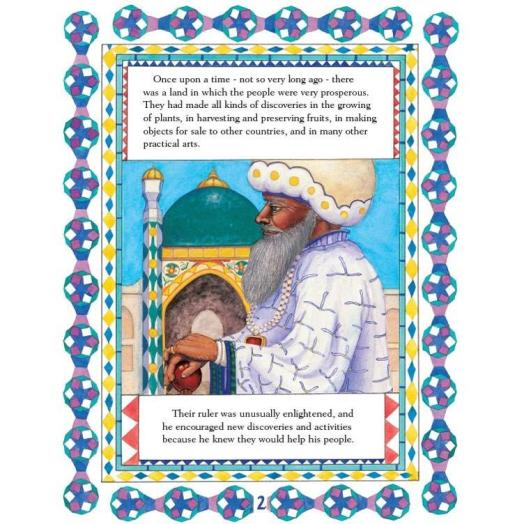
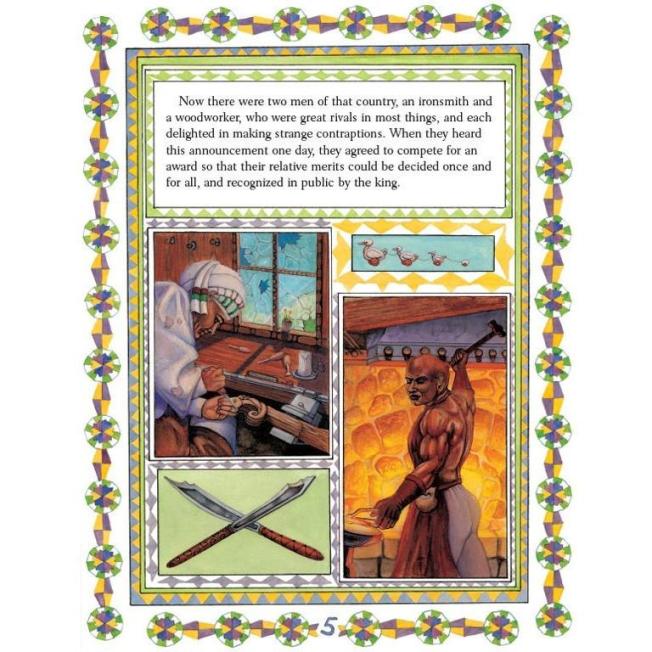
It starts out with an enlightened king encouraging his subjects to make new discoveries to promote quality of life, wealth and knowledge. He has two sons, one is an expert in strange devises and one is a dreamer.  The king puts out a call to have something new made, and an ironsmith makes a fish out of metal than can fly and swim and carry things.  A woodworker makes a magic horse that interprets the desire of the rider and carries the rider toward it.  The king suddenly becomes cruel and finding this a waste of time has the woodworker tied up.

horse

The dreaming Prince Tambal rides the horse on many adventures, which kind of disjoints the story and makes it like a fairy tale about Tambal falling in love and trying to persuade a king to let him marry his daughter, and in turn having to trick the intended suitor instead. Along the way there are poisonous fruits, turning into a beast, and eventually returning home to prove that, “Those who want fish can achieve much through fish, and those who do not know their heart’s desire may first have to hear the story of the wooden horse.” Huh? Exactly.

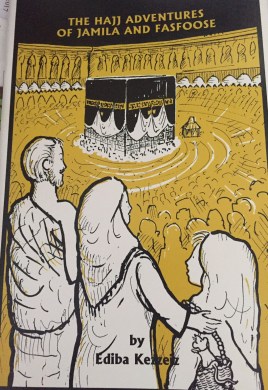
The Hajj Adventures of Jamila and Fasfoose by Ediba Kezzeiz illustrated by Abd al-Hayy Moore

Standard
The Hajj Adventures of Jamila and Fasfoose by Ediba Kezzeiz illustrated by Abd al-Hayy Moore

FullSizeRender (13)

The book isn’t much to look at with its black and white, with yellow thrown in cover, and its 40 pages bound with a staple, but for independent readers between 2nd and 4th grade or so, the book is good.  In many ways it is an older kids version of Zaahir and Jamel, adding a fictional story to the learning about the steps of Hajj.  

SYNOPSIS:

The setting is Hajj and all of its different rituals, but the story is that Jamila and her pet mouse Fasfoose get lost in Mecca.  Along the way to finding Jamila’s parents and performing the requirements of Tawaf, Sai, Arafah, Mina, Muzdalifa, Jamrah, and Eid, a few duaas are thrown in, friendship with people of different nationalities and lessons in patience, speaking with your heart and finding your internal compass of wrong and right all come to light.

WHY I LIKE IT:

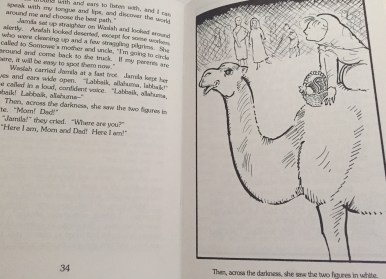
I like the target audience, and how it doesn’t ever feel preachy or like a How-to-perform-Hajj manual.  If a child is familiar with the rituals of Hajj the story gently reminds them of what they already know and the story takes center stage.  If they are unfamiliar, the book doesn’t talk down to them, and may prompt them to want to learn more.  Strong lessons of being kind and not hurting anyone or anything while in ihram are strong, as are the  beauty of multiple cultures speaking from their heart to find common threads.  There are illustrations to break up the text and not overwhelm the young reader, and the story is divided into seven chapters.  The font and size are all age inviting and even older middle school kids would probably pick it up if they saw it, read it in about 20 minutes and be glad that they did.

FullSizeRender (14)

FLAGS:

None, alhumdulillah

TOOLS FOR LEADING THE DISCUSSION:

The book is fun, probably not long enough for a book club selection, but a great read -a-loud. The length of the chapters make it a short read that ideally could be read the week before Hajj or Eid.  My 3rd grader read it and is enjoying listening to me read it to my 2nd grader.

FullSizeRender (15)

Watched by Marina Budhos

Standard
Watched by Marina Budhos

Watched-

This book is so incredibly timely that it feels like it could be real, granted its been timely since 911 and homeland security took to watching people more aggressively and openly.  But, New York police have been in the news about their methods regarding watching muslims and mosques, and this fiction book does a great job of getting inside a boy’s mind as he explores both being watched and being the watcher.  The book is 265 pages and is written on an AR level of fourth grade, but content wise I would not recommend it for anyone younger than high school.  The concepts and themes need to be put in perspective to appreciate the book.  And at the same time, being able to understand how terrorist recruit and how police aren’t always ethical, creates some gray area that require a certain level of maturity to make it resonate.  It isn’t a black and white story with good pitted against bad or legal verse illegal, the nuances in between are where the action takes place.

SYNOPSIS:

Immigrant. Muslim. Teenager. Screw-up. Lots of labels for high school senior Naeem Rahman.  Born in Bangladesh, he moves to Queens in New York, after his mother dies and his father has remarried in America and sends for him.  While there is a gap in his relationship with his father, the story doesn’t focus on issues at home.  He has a very strong relationship with his step mom, and his younger brother, making him very likable and endearing.  He has problems elsewhere, however, that stress his family and get him in to trouble.  His grades are poor and he learns he will not be able to graduate, which further distances Naeem from his small shop owning father.  And his friends have dwindled to a single friend, Ibrahim,  that enjoys weaving tales mixed with truth and fantasy and dreams, that gives Naeem a taste for living on the edge and running fluidly around the city.  When an adventure with Ibrahim goes bad, and Naeem gets stuck holding stolen goods, it is a deal with some cops that comprises the bulk of the story, and forces Naeem to decide if he can go from being watched, to being a watcher, an informant for the police.

With a prior run in with the law, some marijuana in his backpack, a working class family, and not wanting jail time, the police officers know that they can pretty much ask anything from Naeem and he will comply.  Naeem starts spying on his community online and by going to the masjid for prayers, volunteering with MSA’s, helping out with summer schools for Muslim kids, all things he and his family had stopped doing after 9/11 when cameras started going up on poles outside of mosques, and fellow worshippers started eavesdropping on each other to report back to the police.  But, now that Naeem is on the inside, he finds power and strength in what he is doing, a confidence he has never had before.  He starts helping neighbors, helping the family income, fasting in Ramadan, but all with a guilty conscience.  His foundation is deceptive.  When the story comes full circle and Naeem realizes the path he is on, he has to find a way to get out and own up to the choices he has made both to his community and to the police.

WHY I LIKE IT:

The story has moments of action and intensity, but it is also poetic and introspective.  Budhos really gets inside Naeem’s head and shares that with the readers.  Obviously, the book is for Muslims and non Muslims, it is a companion story to her book Ask Me No Questions, but I think the reason it resonated so much with me is because it is something I am familiar with.  So the poetic musings made Naeem more likeable to me, I didn’t see them as speed bumps in a book billed as a thriller.  I was glad that Naeem was charming and fleshed out.  His relationship with his little brother and with his step mom, really show that he has layers and isn’t just one label or another.  There is a lot of diversity in the Muslims presented and their backgrounds that make them who they are.  There are also a lot of cultures presented in this immigrant neighborhood that make the details solid.  There is no doubt that the author knows what she is talking about, that she is perhaps lived it in some capacity, the authenticity is definitely present.

FLAGS:

Aside from the arcing themes that raise flags for the younger, more sheltered readers. There are a lot of things mentioned, although not explicit or celebrated, they are presented in passing to create understanding of an environment.  There is drug use, kissing, violence and some profanity.  In a story like this there is obviously a lot of lying, stealing, talk of homegrown terrorism.

TOOLS FOR LEADING THE DISCUSSION:

The author’s website: http://www.marinabudhos.com/books/watched

Author interview with NBC news: http://www.nbcnews.com/news/asian-america/immigrant-teen-gets-swept-nypd-surveillance-marina-budhos-watched-n661171

The Complete Persepolis by Marjane Satrapi

Standard

Persepolis cover.jpg

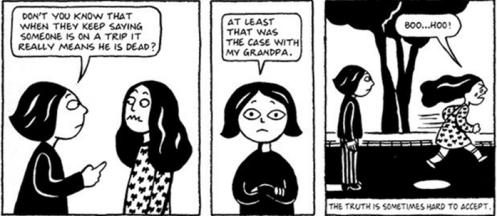
The Complete Persepolis is both Satrapi’s volume one and two of her memoir about growing up in Iran during the revolution.  At 341 pages of black and white graphic novel intense story telling I was fascinated by its 3.3 AR level for volume 1 and 3.9 for volume 2. Clearly this is once again a loophole in the AR system rating a book for word and sentence difficulty and not content.  The book is for high school and above, despite the simplistic style it is presented in.  The content of multiple wars and coming of age,  provides detailed political commentary not tempting to many elementary and middle school children, and her coming of age narrative is no way appropriate for third or fourth graders.

SYNOPSIS:

Marjane is an only child in Iran growing up with a loving liberal family in a time of change.  She comes across as being very entitled, very financially well off, and very deeply engaged even as a child.  As her society changes and becomes more religious with the revolution, she shows the contradiction in people and their attitudes as they use religion as a power and political tool.  Her retelling of the torture and horrors family and friends go through, is kept light by her universal coming of age musings and struggles.  She is encouraged to be vocal and outspoken about social issues, with her parents boundless support for whatever consequences her actions bring on.  In the second volume Marjane has gone to Austria for school to get away from the confinements of Iran.  Here she finds different struggles as she finds it hard to fit in, hard to conform, and hard to be away from home.  She experiments with drugs, and boys, and ideologies, but alas returns home after she finds herself homeless, friendless, and in poor health.  Back in Iran she finds she has now joined the contradictory world she left behind, and being back in school and married to a man she doesn’t love forces her once again to leave her homeland, and take all her life lessons to rebuild herself as someone she wants to be.

persepolis-1

WHY I LIKE IT:

I like that it is a graphic novel. In many ways it makes the political influence of her country on her life easier to understand.  Iran’s political history is complex and to take a reader unfamiliar with it and use it as a narrative in shaping her and her thought process, it works surprisingly well.

I primarily wanted to read the book to see how Islam is presented.  Obviously it would be a major factor in the book, and obviously the author is not a practicing Muslim in favor of the revolution.  So, I was equal parts nervous and curious to see how such a popular book would show such a religious society.  And to be honest, I feel like she handled it in a very secular way.  She never seemed to attack the doctrine of the faith, but more its presentation as a tool to oppress or control Iranians.  Her rebellion in clothing and alcohol and drugs and promiscuity is presented as a rebellion against a society that is using Islam and the contradictions people have with it in public as opposed as to behind closed doors. For example she doesn’t support the veil or hijab, but it didn’t seem that she was opposed to someone wanting to wear it, she was opposed to it being forced upon women, and she pointed out the hypocrisy of people not wearing it one day then wearing it and policing other woman’s manner of wearing it the next.  I felt this was made a bit clear when she meets a religious man, who passes her on her ideology test.  She refers to him as a “true religious man” who respects her honesty.  In my mind I saw this as her not being a religious person and not being surrounded by people who were religious for the sake of belief, but rather for their own personal gain and agenda.  When she critiques her country’s laws about boys and girls being together, or consumption of alcohol she doesn’t go into the verses in the Quran or hadith, but rather how she is able to skirt the law with a fine or deceit.  She doesn’t pray, but also makes clear she doesn’t know how to pray, she doesn’t know how to read Arabic, etc.. Thus the idea of being Muslim is foreign to her, she simply lives in a country that claims to enforce Islamic rules.  By her then going to Austria and having “freedom” but not finding happiness I also found it made the nuances of what is religion and what is culture and what is politics a little bit easier to see.  Ultimately it is a girl finding her self and defining her self irregardless of what country she is in and what religion that culture follows.  Whether people learning of Iran of Islam for the first time would see the shades of gray within the novel I don’t know, but I truly don’t believe Satrapi based on this book hates Islam or is trying to get others to view the faith as a whole negatively.  And even despite her feeling confined in Iran I think she has a deep love of her country and her people.

732c8f4f6e49237b963aee4bbe0faee3

FLAGS:

Violence, language (lots), sex, drugs, alcohol.

TOOLS FOR LEADING THE DISCUSSION:

I would never use this book as a book club book at an Islamic school.  The themes are just too mature to justify the coming of age story aspect of it, or even as a historical supplement to Iranian culture.  That being said, I personally as an adult would love to be in a book club with this book.  I know a lot of Iranian and Iranian Americans who are religious, but I have never inquired as to their personal political views, and vice versa. I know even more secular Persians, many with disdain for Islam, but again not for practicing Muslims, and never have dared ask how their political and socio-economic status may have influenced them and their views.  I think it would be fascinating, both to hear their stories and to solidify my own views on such a contentious issue.

The Treasure at Bayan Bluffs by Farah Zaman illustrated by Kim Zaman

Standard
The Treasure at Bayan Bluffs by Farah Zaman illustrated by Kim Zaman

img_2961

At 231 pages this book claims to be for ages 9 to 18 and that’s a pretty large spread for a mystery, yet alone an Islamic fiction one by a first time author.   In a tone reminiscent of Nancy Drew and the Hardy Boys,  it should really should just say 9 and up, I was hooked!

SYNOPSIS:

Adam and Layla along with their younger twin brothers Hassan and Hakeem from America are visiting their family home of Bayan Bluffs in Midan for the summer.  Their grandfather and great aunt and a few long time servants aren’t much entertainment for the children, so their parents arrange for their college friends kids’ Zaid and Zahra from Crescent City, a few hours away, on the other side of Midan to join them.  The children get along right away and decide to try and solve a mystery of a hidden treasure that they have heard bits and pieces of over the years.  Their search for the Moon of Masarrah starts innocently enough, but quickly escalates as they learn they aren’t the only ones searching for the missing gem.  As they learn more about the jewel and the circumstances of its disappearance the gem and the murder of Adam and Layla’s great grandfather get further entwined.  With a few of the suspects still alive and many of their family members still in the city, the children soon find they themselves in danger as well.

WHY I LIKE IT:

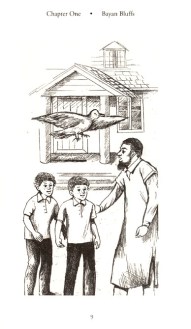
The biggest reason I like it, is it is well written.  There aren’t confusing passages, or too many characters or boring preachy paragraphs.  The plot is good, the dialogue believable and the fact that they are Muslim children, just depth to the story.  They plan to meet after asr or before Jummah, and they say inshaAllah and mashaAllah, and its just a really good balance of who they are, but not all they are.  In retrospect, maybe they all get a long a little too well, but it isn’t syrupy and they have some minor annoyances, so it doesn’t hinder the story.  The only thing I caught myself looking back on was the age of the twins.  At times they seem like toddlers and at other times much, much older.  Even the author says they are “about six years old,” and having a six year old myself, I do believed that they can vacillate to both extremes in any given moment and thus I accepted their antics and let it go.  Additionally I wish she included a map.  It isn’t confusing, but it would have been great to look back upon as the action speeds up, and would definitely help younger readers visualize the details.  The terrain vocabulary for anyone younger than nine might need some explanation.  There is a glossary at the end for some of the Arabic words, and for some of the specific ships and weapons mentioned.  Their are a few illustrations that I think help the younger readers, they aren’t needed for the story, but they don’t impede it either.  I wasn’t crazy about them within the story, but I did appreciate that they show the girls in hijab and the illustrator clearly put a lot of work in to them.

bayan.jpeg

I wish that the cover was more appealing, for a story that was so good, I wish it begged to be picked up.  InshaAllah word of mouth will carry the book, so that more like it are written and published.

FLAGS:

None, mashaAllah it is clean and wholesome.  There are good and bad Muslims and no judgement is put in a religious context.  There is some violence, but it is nothing even a seven year old would find offensive.  Alhumdulillah.

TOOLS FOR LEADING THE DISCUSSION:

I would love to do this as a Book Club book for 5th through 8th grade.  The writing quality and the different characters the students would be able to identify with, would make it a lot of fun.  There isn’t any deep or though provoking discussion points to accompany the book, but I think the genre is hard to come by and Muslim kids seeing Muslim kids solving a crime and going on a treasure hunt, is just exciting.  I couldn’t find any study guides or even much information on the book or author, but none is needed to enjoy the story.  Farah Zaman if somehow you see this review, know that I hope you keep writing, and I thoroughly enjoyed your book!  Happy Reading Everyone!


Umar and the Bully by Shabana Mir illustrated by Asiya Clarke

Standard

Umar and the Bully.jpg

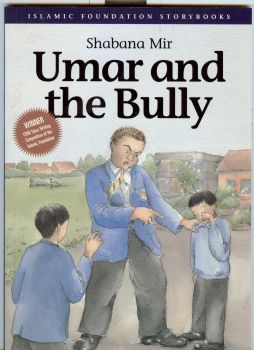
With it being October and Bullying Prevention Month, I thought to review a book that has been on my bookshelf for a long, long time.  It won the Islamic Foundation Story Writing Competition in 1996 and is just as relevant today.  At 44 pages, the story, the layout, and writing style appeal to children on a second or third grade level.

SYNOPSIS:

Umar stumbles across some older kids plotting something covertly in the school yard and some money being exchanged.  He then encounters a younger student upset.  Being a kind person, Umar gets Asad to confide in him what the bullies, Harith and David, are up to, and vows to keep Asad safe.  While all that seems simple enough, the true battle begins within Umar,  as he has to figure out what is he going to do, and how is he going to stop the bullying.

WHY I LIKE IT:

I love the length and the target audience.  My six-year-old son summed it up perfectly when he finished.  “Woah, that was a good book, I didn’t expect it would give me so much to think about.”  The author follows the bullying strategy of telling an adult, or a teacher, but gives some depth when that teacher doesn’t care or take the time to help.  It also shows a variety of people that you can go to for help and characteristics you should look for when deciding who a good person to talk to would be.  Umar decides to talk to a good friend of his about what is happening to Asad and devise a plan to help.  Mohammad is kind and trustworthy.  He also gets some advice and encouragement to be brave from Mohammad’s older sister and brother.  All this is done within an Islamic context of asking Allah swt for help, of finding inspiration from stories of his namesake Syedina Umar Al-Farooq. It also, as we get in Umar’s head, reveals how he himself is scared of facing the bully.  This is great because it shows that it can be scary to confront someone even if you are not the victim.  Umar feels he shouldn’t be scared because he is a Muslim, which I really don’t understand, but he turns to Allah swt asking for bravery to do what is right and to be strong.  And beautifully, after it undoubtedly raps up in a happily ever after children’s story way, he does remember to thank Allah (swt) for being there for him and gives credit to Allah for giving him strength.  The book shows the responsibility we have to do what is right even if it isn’t being done directly to us.  It also shows one or two children can make a difference.  I really like that the point of view is from Umar, not the one doing the bullying or receiving it.  Allowing the reader to see how empathetic he is to another person is a wonderful lesson in and of itself.

The book also has mostly Muslim characters, but a few names sprinkled through out as victims and perpetrators could suggest non muslims as well. This is great in showing that bullies are everywhere and that perhaps being in an Islamic school or in a majority Muslim school does not mean bullying doesn’t exist.  Similarly it is good to see that bullying isn’t just non Muslims disliking Muslims, as often time books about bullying for Muslims would suggest.  I think the book could be for Muslims and non Muslims alike, but with the religious reliance, it is geared more for Muslim readers.

FLAGS:

The book is clean, it mentions that the bullies are violent, and possibly smoking.  The children being bullied obviously are lying but it is clear that it is done out of fear, not because they are deceitful by nature.

TOOLS FOR LEADING THE DISCUSSION:

There aren’t any reading guides or activities to accompany the book that I could find online, but I think the natural discussion that would follow make it a great option to read as a book club book, or in small groups.  There are a lot of very easy places to ask children what they would do, if Umar made a good decision, and how they would feel as the story unfolds.