Never Say A Mean Word Again: A Tale from Medieval Spain by Jacqueline Jules illustrated by Durga Yael Bernhard

Standard

scan0019_487d580c-5aa9-45f2-b4c1-87e328c94b7e.jpg

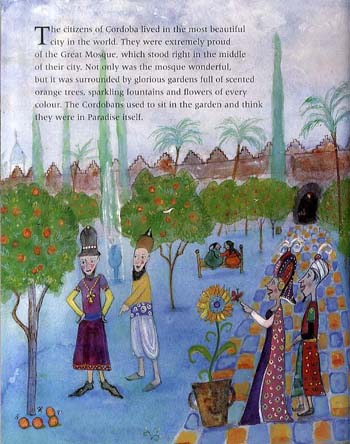
I love when tales from the past provide timeless lessons in relevant ways.  Inspired by a medieval legend about the Jewish poet Samuel Ha-Nagid, a royal advisor in Muslim Grenada, Jules creates a story that works for children of all ages and backgrounds.

The Grand Vizier’s son, Samuel, bumps into the tax collector’s son, Hamza, and the boys don’t rub each other the right way.  Later that day, Samuel spills his drink on Hamza and can’t convince him both were accidents.  Hamza calls Samuel some mean names and storms off.  Samuel and his father think the name calling is uncalled for, but the vizier does not solve his son’s problem and instead assigns him to “make sure Hamza never says a mean word to you again.”  Samuel imagines ways to teach Hamza a lesson or punish him, but some ideas are too complicated and some just silly.  This is proving to be a hard task.  The next day Samuel shows up to Hamza’s house with a lemon.  He thinks forcing Hamza to eat it is a good punishment for a mean mouth, however Hamza thinks the lemon is to help with the stain that ruined his clothes, and tells him his mother already tried that.  Caught off guard by Hamza’s reaction, the two somehow end up playing catch with the lemon and enjoying the afternoon together.  The next day he shows up to Hamza’s house with ink and paper thinking he will make Hamza write him an apology.  Hamza however, thought Samuel showed up to draw, and once again the boys enjoy an afternoon together.  This carries on until the boys are so used to seeing each other and having fun together, they become friends.  Samuel fears that he disobeyed his father and did not handle Hamza only to realize that by befriending his “enemy” he did in fact make sure Hamza never said a mean word again.

idea

The book is 32 pages with an Author’s Note about the real life events that the story draws upon.  The book is not AR, but the large bold typeface and the warm simple pictures make this book work great for story time with young children.  It compliments themes about bullying and making friends as well as being silly.  It works well for third graders and older ones too, as they might understand people of different faiths struggling to get along or people of different socio-economic classes, or even just imaging how they would solve a problem without their parents doing it for them.  I was pleasantly surprised by the book and how it handled the Muslim/Jew staging of the characters.  Especially right now in today’s world, this story has a poignant lesson for us all. If we all spent time together having fun, we too could end up being friends, or at least getting along.  I think the story and its lessons have merit and relevance, and thus a place on the bookshelf.


Samira and the Skeletons by Camilla Kuhn

Standard
Samira and the Skeletons by Camilla Kuhn

samira.jpg

Quite possibly there is nothing Islamic about this book, but the main character’s name, Samira, is traditionally an Islamic name and thus it caught my attention.  I also think one could argue that the mom in one of the pictures (see picture below) is possibly wearing a hijab.  So, probably I shouldn’t include it on the blog, but the book is so disturbingly creepy, in a fantastical way, that I thought, why not.

img_3063

Samira learns that everyone has a skeleton and bones one day at school, and it frightens her.  She starts seeing everyone’s skulls instead of their outward body parts and she refuses to accept that she has such morbid parts or that her friend Frida does too.  Knowing that she is chewing with teeth, skeleton parts poking through, at lunch is too much and she can’t even be near Frida.  When she gets home she tells her mom she wants to be free of her skeleton, and her mom agrees.  Yes, agrees! They resolve the tooth fairy will be delighted to get a whole skeleton, not just a few teeth.  So the mom, gets some tools and preps a table to perform the surgery required to remove her skeleton.  Luckily Samira runs for it and finds Frida, and alas the girls accept that they have skeletons and use humor to diffuse the fears they have of what lurks beneath their skin.  That is of course until the next day at school comes, and they learn that they have muscles, just like steak.

samira-spread-classroom

The imagination of the girls is quite remarkable.  I love that it starts with a lesson and that information about skeletons and animals, such as jelly fish that don’t have them exist, is sprinkled through out.  I also like the approach, its weird, but in a delightfully fun way.  It also lends itself well to a discussion of how we are more alike than different.  Our outward appearance doesn’t define us when we are all made up of bones and muscles.  The story doesn’t address it, but some kids might infer it or connect the dots with a little prodding.    img_3064

The book is not AR, but I think most 5 year olds and up can read it or follow along giggling all the way through.  It probably isn’t for every child, but those with a darker sense of humor will enjoy all 34 pages.

Nasreen’s Secret School: A True Story From Afghanistan by Jeanette Winter

Standard

nasreens secret school.jpg

It is widely written about, even amongst children’s literature, that in parts of the world, girls are not allowed to go to school, but that many find ways to do so anyway.  What sets this book apart is that it is based on a true story, and while there is some hope for Nasreen, overall it is a really melancholy tale without a happy ending.  At 40 pages, author Jeanette Winter once again conveys a story that shows compassion instead of judgement and undeniable admiration for her characters.  Written on a 4.2 level, the story packs a lot into small, simple sentences, and her illustrations do not shy away from the realities of Afghanistan.  While I was surprised to see that twice the book was challenged, in 2014 and 2016, for showing Muslims praying and for violence, I was glad that it was never banned.   The strength and determination of Afghani women should not be silenced, it should be shared and celebrated.


The story is told from the point of view of Nasreen’s grandmother.  She is heartbroken that her granddaughter is not allowed to attend school and practice the arts as she was, and even her daughter-in-law, were able to do as children.  Since the Taliban has come things are dark.  Things get worse when one night soldiers come and take Nasreen’s father with no explanation.  When he doesn’t return, Nasreen’s mother leaves to find him, displaying her own strength to independently take on a society that doesn’t permit her to go out alone.  Unfortunately she does not return either, and Nasreen stops speaking.  Grandma learns of a secret school for girls.  Determined that Nasreen should know of the outside world, great risks are taken for many girls to learn in a private home a few doors down.  Dodging Taliban soldiers and neighborhood boys helping keep their school a distraction starts to pay off as Nasreen finds a friend and starts to open her heart.  The book ends with mom and dad still missing, but hope for Nasreen to see through the window education has opened for her, inshaAllah.

secret2


Malcolm Little: The Boy Who Grew Up to Become Malcolm X by Ilyasah Shabazz illustrated by AG Ford

Standard
Malcolm Little: The Boy Who Grew Up to Become Malcolm X by Ilyasah Shabazz illustrated by AG Ford

malcolm-little-9781442412163_hr.jpg

I had hoped to have a handful of selections to review for Black History Month, but alas I started too late in collecting titles, inshaAllah next year I will be better organized.  I did want to share this beautiful book though, as a great story of hope and love, that I don’t think is often included when we study Malcolm X or talk about him today.  This is the story of his parents and the philosophy of equality they tried to raise him in before hatred and bigotry destroyed his family, before he went to prison, before he became “Detroit Red,” a member of the Nation of Islam, before he became a civil rights leader, a Muslim, before he became Malcolm X.  This is a story, based on love, written by his daughter to give children of all ages something to think about.

malcolm-louise-300x300

The story of Malcolm Little, is a story that I feel cannot be rushed, it is very heavy in text and at 48 pages, the warm beautiful pictures make it accessible in pieces to younger children, but it is written on an AR 6.5 level (sixth grade fifth month).  The book tells about how his mother and father met, believed in universal equality and justice, and started a family where these values took center stage.  The family suffered for their beliefs and their home was burnt down, but they rebuilt and the family continued to find strength and see the power of possibility.  The books shows the lessons taught in everyday activities such as raising a garden, doing laundry, reading books, doing homework, and even fishing.

When Malcolm’s father was killed, however, and his mother taken away, the family was forced to separate and Malcolm to deal with an unwelcoming world, more or less alone.  The book ends with Malcolm in 7th grade so, to young readers who have maybe only heard his name in passing the book is full of hope and roots for the man he would become.  It is almost a fairytale start to a man who would be cut down in his prime years later.  They will understand how unfair society treated his family, how warm and educated and strong his mother, Louise was, and how inspiring his father as a preacher was. The takeaway will be how Malcolm’s upbringing and personality allowed for him to rise up and refuse to stay down during horrific events in his life.

malcolmx.jpg

For older elementary and middle schoolers it is a story of possibility, of how quickly things can change, and the effect of hate.  They should also see how institutionalized and normative the oppression of African Americans was and how it really wasn’t that long ago.  When Malcolm’s English teacher Mr. Ostrowski tells Malcolm that he as an African American should not have such high expectations, readers should realize that the acts of the Ku Klux Klan may be viewed as “extreme” but society as a whole was systematically enabling such bigoted acts.  The lessons passed on to Malcolm by his parents are universal themes of hope and love and equality that still have to be stood up for today, and even young listeners can grasp that, and also grasp that because of their skin color alone they were seen as second class citizens.

The book shows depth to a historical character that gives some insight to what made him so dynamic.  Many young readers will be surprised at how quickly Malcolm’s world unraveled, and some of the reasons why, while empathizing with the injustice of it.  The Author’s Note at the end is also fascinating as it details the family members and their stories about the characters in the book.   I liked the softness of the book and the smaller lessons for children that it presented.  It didn’t shy away from the violence and prejudice that the Little family faced, but presented it through a lens of optimism to hopefully inspire children to carry on with the social activism that still needs to be done.


The Complete Persepolis by Marjane Satrapi

Standard

Persepolis cover.jpg

The Complete Persepolis is both Satrapi’s volume one and two of her memoir about growing up in Iran during the revolution.  At 341 pages of black and white graphic novel intense story telling I was fascinated by its 3.3 AR level for volume 1 and 3.9 for volume 2. Clearly this is once again a loophole in the AR system rating a book for word and sentence difficulty and not content.  The book is for high school and above, despite the simplistic style it is presented in.  The content of multiple wars and coming of age,  provides detailed political commentary not tempting to many elementary and middle school children, and her coming of age narrative is no way appropriate for third or fourth graders.

SYNOPSIS:

Marjane is an only child in Iran growing up with a loving liberal family in a time of change.  She comes across as being very entitled, very financially well off, and very deeply engaged even as a child.  As her society changes and becomes more religious with the revolution, she shows the contradiction in people and their attitudes as they use religion as a power and political tool.  Her retelling of the torture and horrors family and friends go through, is kept light by her universal coming of age musings and struggles.  She is encouraged to be vocal and outspoken about social issues, with her parents boundless support for whatever consequences her actions bring on.  In the second volume Marjane has gone to Austria for school to get away from the confinements of Iran.  Here she finds different struggles as she finds it hard to fit in, hard to conform, and hard to be away from home.  She experiments with drugs, and boys, and ideologies, but alas returns home after she finds herself homeless, friendless, and in poor health.  Back in Iran she finds she has now joined the contradictory world she left behind, and being back in school and married to a man she doesn’t love forces her once again to leave her homeland, and take all her life lessons to rebuild herself as someone she wants to be.

persepolis-1

WHY I LIKE IT:

I like that it is a graphic novel. In many ways it makes the political influence of her country on her life easier to understand.  Iran’s political history is complex and to take a reader unfamiliar with it and use it as a narrative in shaping her and her thought process, it works surprisingly well.

I primarily wanted to read the book to see how Islam is presented.  Obviously it would be a major factor in the book, and obviously the author is not a practicing Muslim in favor of the revolution.  So, I was equal parts nervous and curious to see how such a popular book would show such a religious society.  And to be honest, I feel like she handled it in a very secular way.  She never seemed to attack the doctrine of the faith, but more its presentation as a tool to oppress or control Iranians.  Her rebellion in clothing and alcohol and drugs and promiscuity is presented as a rebellion against a society that is using Islam and the contradictions people have with it in public as opposed as to behind closed doors. For example she doesn’t support the veil or hijab, but it didn’t seem that she was opposed to someone wanting to wear it, she was opposed to it being forced upon women, and she pointed out the hypocrisy of people not wearing it one day then wearing it and policing other woman’s manner of wearing it the next.  I felt this was made a bit clear when she meets a religious man, who passes her on her ideology test.  She refers to him as a “true religious man” who respects her honesty.  In my mind I saw this as her not being a religious person and not being surrounded by people who were religious for the sake of belief, but rather for their own personal gain and agenda.  When she critiques her country’s laws about boys and girls being together, or consumption of alcohol she doesn’t go into the verses in the Quran or hadith, but rather how she is able to skirt the law with a fine or deceit.  She doesn’t pray, but also makes clear she doesn’t know how to pray, she doesn’t know how to read Arabic, etc.. Thus the idea of being Muslim is foreign to her, she simply lives in a country that claims to enforce Islamic rules.  By her then going to Austria and having “freedom” but not finding happiness I also found it made the nuances of what is religion and what is culture and what is politics a little bit easier to see.  Ultimately it is a girl finding her self and defining her self irregardless of what country she is in and what religion that culture follows.  Whether people learning of Iran of Islam for the first time would see the shades of gray within the novel I don’t know, but I truly don’t believe Satrapi based on this book hates Islam or is trying to get others to view the faith as a whole negatively.  And even despite her feeling confined in Iran I think she has a deep love of her country and her people.

732c8f4f6e49237b963aee4bbe0faee3

FLAGS:

Violence, language (lots), sex, drugs, alcohol.

TOOLS FOR LEADING THE DISCUSSION:

I would never use this book as a book club book at an Islamic school.  The themes are just too mature to justify the coming of age story aspect of it, or even as a historical supplement to Iranian culture.  That being said, I personally as an adult would love to be in a book club with this book.  I know a lot of Iranian and Iranian Americans who are religious, but I have never inquired as to their personal political views, and vice versa. I know even more secular Persians, many with disdain for Islam, but again not for practicing Muslims, and never have dared ask how their political and socio-economic status may have influenced them and their views.  I think it would be fascinating, both to hear their stories and to solidify my own views on such a contentious issue.

A Tale from Turkey The Hungry Coat by Demi

Standard
A Tale from Turkey The Hungry Coat by Demi

the hunger coat.jpg

It really bothered me that I didn’t love the version I read of  The Parrot and the Turkey about Nasreddin Hodja, especially after finding out how entwined he is in Turkish culture, and reading some of his tales online.  So, when I found that Demi had also rewritten and illustrated a tale from his collection I was anxious to check it out.

hungry-coat

The  Hungry Coat is a charming story and Demi does a great job of bringing it to life with her pictures and storytelling abilities.  The book is 36 pages and a 4.1 on AR.  The text isn’t overwhelming in volume, but to read it definitely requires a bit of an older child’s vocabulary.  Words like caravansary, hostel, banquet, frisky, and commotion are scattered through out.  However, to listen to the story and to understand the message Nasrettin Hoca (an alternate spelling) is conveying, is easily enjoyed by children four and up.  The story flows very smoothly and the catch line of “Eat, coat! Eat!” makes the story absolutely delightful.

hungry-coat1

Nasrettin Hoca always keeps an apple in his pocket for any goats he might pass while he is out and about.  One day he helps round-up a goat that has gotten lost, and in all the commotion had become quite a mess and lost too much time to go home and change his clothes before heading to a friend’s house for dinner.  Deciding to go in his patchy, smelly clothes, Nasrettin soon finds that none at the dinner party will sit by him, or even sit facing him.  He slips out quietly from the gathering and has an idea.  He goes home and preens himself, and returns to the party where he is greeted with attention and kindness.  At dinner he begins placing the food in his coat, rather than eating it.  Each time he opens his coat he commands it to eat.  After he fills his coat he pats his belly to the bemusement of all around him as they ask him what he is doing.  He makes his point that when he came in his old coat he wasn’t fed, but when he came dressed so beautifully he was, and thus clearly the coat was invited to dinner, not him.  Everyone cheered and learned the lesson.

“A coat may be fine, but a coat does not make a man.”

The illustrations are rich and detailed, but I did find myself a little put off when Nasrettin seemed to go from looking like an old little man, to being very effeminate.  The inconsistency bothered me a bit, which surprised me for a Demi illustration.  Also, it is worth noting that there is mention of wine in the story, that many may find off for a children’s book, particularly one about Muslims (Nasrettin was an Imam and a Dervish, so he may have drunk, I’m just saying it surprised me).  The last two pages of the book are an afterword about Nasrettin Hoca in real life and the influence of his folk tales and lessons.

Snow White: An Islamic tale by Fawzia Gilani illustrated by Shireen Adams

Standard
Snow White: An Islamic tale by Fawzia Gilani illustrated by Shireen Adams

snow-white_cov

A lot of the twists that I was surprised by and endeared to in Fawzia Gilani’s Cinderella, seemed lacking in her re-telling of Snow White.  Perhaps it is the mere fact that Cinderella has a legacy of being re-told from different cultural perspectives and in different time periods, where Snow White doesn’t, that made this book stumble where her other sailed much more smoothly.

The basic premise of this Snow White version is naturally the classic tale.  Snow White is the envy of her stepmother, in this case however, it isn’t a magic mirror, but a jinn who answers her questions. Once the huntsman is convinced not to kill her, and a boar’s heart and liver are taken instead,  Snow White finds the companionship and shelter of the dwarves.  In this re-telling, it is a female crew with countless skills that they are happy to pass on to their newest friend.  When the evil stepmother finds out Snow White still lives she concocts poisonous dates to present in disguise to Snow White who is awaiting the appointed iftaar time.  The dwarves arrive home too late to save Snow, but see who has done the evil deed.  The Prince makes his brief appearance as he arrives at the cottage, makes dua’a for Snow and then sends his mother to nurse her back to health.  In fairy tale tradition a wedding soon follows, but the evil step mother has one more trick up her sleeve, she poisons a comb that Snow is surely to use as she prepares for the big day.  The dwarves cannot thwart the stepmother and Snow is only saved when the stepmother in all her vanity accidentally picks up the comb to fix her own hair.  Over time she recovers and Snow forgives her and they all presumably live happily ever after.

snowwhiteanislamictalepage2

Perhaps it isn’t fair to compare the two books, but I would imagine they are often purchased together and I feel like there are some notable differences that are worth mentioning.  In Cinderella, the setting is Andalusia and they are all about the same skin tone.  Snow White seems to resort back to old stereotypes and the stepmother seems to be the only one with a darker complexion with all the others being more fair.  Granted her name is Snow White, but it is established on the first page that her mother prays for a child with a “heart as pure as snow,” so really that doesn’t hold up.  Also, where I felt that Cinderella could work for Muslims and non Muslims alike, I think this one would be a hard sell for non Muslims.  There are a lot of references to dua’as of Noah and Job, there is Ramadan, the role of the jinn, she even does tayammum at one point and readers may be confused why sometimes she is in hijab, and when home with the women she is not.

Like Gilani’s Cinderella, the book is very thorough in being Islamically appropriate.  The sisterhood is a nice twist and the Prince has a really small part.

snow-white-1-300x286

The illustrator is the same, yet for some reason the pictures seem a bit dull in this book.  The bottle of poison is shimmery, but the other illustrations seem muted and almost rushed.  The book is 41 pages with a glossary and Reference for Quran in the back, and is very text heavy.  Probably 3rd or 4th grade level with some assistance on the Islamic concepts.

Cinderella: An Islamic Tale by Fawzia Gilani illustrated by Shireen Adams

Standard

cinderella

I’ve seen this book countless times online and honestly have never given it a second glance.  I mean Cinderella is a classic fairytale and I have a few different versions from around the world, but an Islamic one? It seemed like it would be awkward or overly preachy and forced.  I should have given Fawzia Gilani’s version a chance though, she has surprised me with her other re-tellings of Eid Kareem Ameer Saab and Nabeel’s New Pants. And, mashaAllah, to her credit she manages to weave a decent story full of Islamic tenants, void of magic, and more feminist than the Disney or Grimm versions.

I’m not going to summarize such a familiar tale, but I will point out major twists.  Zahra is a practicing Muslim who is very devout in her prayers, fasting, and reading of the Quran. Her step-sisters nickname her Cinderella after some cinders from the fire burn holes in her clothes.  A bit of a stretch, from Zahra, but I think even the youngest readers will know the original Cinderella story and be ok with it.

cinderella3.jpg

Cinderella is constantly remembering to be patient despite the treatment of her step family through various duaas, ayats in the quran, and fasting on the day of Arafah.  When an invitation to an Eid Party at the palace comes, she naturally is forbidden from going unless she completes all her chores.  Luckily her Grandmother returns from Hajj with servants to help clean the house and a new abaya to wear to the party.  At the palace the women and men are in different rooms, but Cinderella catches the King, the Queen, and Prince Bilal’s attention when passing in the hallway for being in full hijab.  She continues to impress the Queen, when she remains quiet during the athan, prays in jammat, and shows grace in her manners and speech. After winning over the mom, the slipper and happily ever after follow the traditional script, however, like the story of Yusuf (as) and how he forgives his brothers, Zahra forgives her step-family as well.

cinderella-text

The 41 page story is heavy on the text and is not AR.  I would imagine that it would be on a third grade level for Muslim children familiar with the vocabulary, and fourth grade for those that are not.  There is a glossary at the back, but not all of the Arabic words are included, and I’m not sure that the context would allow for them in some cases to be understood.  This book would be hard to do in a story time setting because of the length, at bedtime, however, the pictures are detailed and rich enough that one-on-one could hold a five or six year olds’ attention.

Overall the story doesn’t feel forced, and you’ll find your self smiling at some of the “islamicifaction” of the plot.  Most of it flows really well.  I love that it isn’t focused on her appearance alone.  I also like that she isn’t helplessly waiting to be saved or alleviated from her burdens.  By and large it doesn’t feel like a love story, Prince Bilal is pretty much a minor story point.  The book works for Muslims and non-Muslims alike.  It isn’t preachy, but it definitely is strong in it’s moral messages. I think non Muslims will find the Islamic version just as fun as the hundreds of other “twists” on Cinderella and Muslim children will love to see someone like them living happily ever after as well, inshaAllah.


The Treasure at Bayan Bluffs by Farah Zaman illustrated by Kim Zaman

Standard
The Treasure at Bayan Bluffs by Farah Zaman illustrated by Kim Zaman

img_2961

At 231 pages this book claims to be for ages 9 to 18 and that’s a pretty large spread for a mystery, yet alone an Islamic fiction one by a first time author.   In a tone reminiscent of Nancy Drew and the Hardy Boys,  it should really should just say 9 and up, I was hooked!

SYNOPSIS:

Adam and Layla along with their younger twin brothers Hassan and Hakeem from America are visiting their family home of Bayan Bluffs in Midan for the summer.  Their grandfather and great aunt and a few long time servants aren’t much entertainment for the children, so their parents arrange for their college friends kids’ Zaid and Zahra from Crescent City, a few hours away, on the other side of Midan to join them.  The children get along right away and decide to try and solve a mystery of a hidden treasure that they have heard bits and pieces of over the years.  Their search for the Moon of Masarrah starts innocently enough, but quickly escalates as they learn they aren’t the only ones searching for the missing gem.  As they learn more about the jewel and the circumstances of its disappearance the gem and the murder of Adam and Layla’s great grandfather get further entwined.  With a few of the suspects still alive and many of their family members still in the city, the children soon find they themselves in danger as well.

WHY I LIKE IT:

The biggest reason I like it, is it is well written.  There aren’t confusing passages, or too many characters or boring preachy paragraphs.  The plot is good, the dialogue believable and the fact that they are Muslim children, just depth to the story.  They plan to meet after asr or before Jummah, and they say inshaAllah and mashaAllah, and its just a really good balance of who they are, but not all they are.  In retrospect, maybe they all get a long a little too well, but it isn’t syrupy and they have some minor annoyances, so it doesn’t hinder the story.  The only thing I caught myself looking back on was the age of the twins.  At times they seem like toddlers and at other times much, much older.  Even the author says they are “about six years old,” and having a six year old myself, I do believed that they can vacillate to both extremes in any given moment and thus I accepted their antics and let it go.  Additionally I wish she included a map.  It isn’t confusing, but it would have been great to look back upon as the action speeds up, and would definitely help younger readers visualize the details.  The terrain vocabulary for anyone younger than nine might need some explanation.  There is a glossary at the end for some of the Arabic words, and for some of the specific ships and weapons mentioned.  Their are a few illustrations that I think help the younger readers, they aren’t needed for the story, but they don’t impede it either.  I wasn’t crazy about them within the story, but I did appreciate that they show the girls in hijab and the illustrator clearly put a lot of work in to them.

bayan.jpeg

I wish that the cover was more appealing, for a story that was so good, I wish it begged to be picked up.  InshaAllah word of mouth will carry the book, so that more like it are written and published.

FLAGS:

None, mashaAllah it is clean and wholesome.  There are good and bad Muslims and no judgement is put in a religious context.  There is some violence, but it is nothing even a seven year old would find offensive.  Alhumdulillah.

TOOLS FOR LEADING THE DISCUSSION:

I would love to do this as a Book Club book for 5th through 8th grade.  The writing quality and the different characters the students would be able to identify with, would make it a lot of fun.  There isn’t any deep or though provoking discussion points to accompany the book, but I think the genre is hard to come by and Muslim kids seeing Muslim kids solving a crime and going on a treasure hunt, is just exciting.  I couldn’t find any study guides or even much information on the book or author, but none is needed to enjoy the story.  Farah Zaman if somehow you see this review, know that I hope you keep writing, and I thoroughly enjoyed your book!  Happy Reading Everyone!


Silent Music: A Story of Baghdad by James Rumford

Standard
Silent Music: A Story of Baghdad by James Rumford

silent-music

A children’s book about Arabic calligraphy, war, and a boy in Iraq, I would imagine doesn’t appeal to a large population of readers.  Written on an AR level 3.8 and 32 pages long, I wish it did.  For the children, and adults that do take the time to find the rhythm in the simple words, and pause to get lost in the intricately detailed pictures, the book is a gift.

silentmusicrumsford-3

Ali, like kids the world over, loves soccer and music and friends.  But most of all he loves calligraphy and secretly admires his hero, Yakut, a calligrapher from Baghdad who lived 800 years ago.  When the bombs start to fall he finds solace in the silent music of creating something beautiful instead.

silentmusicrumsford-2

The way the calligraphy is described is poetry in action, “Writing a long sentence is like watching a soccer player in slow motion as he kicks the ball across the field.”  And poignantly he shares with the reader that war is so much easier than peace, by showing how much easier the word HARB (war) flows from his pen, compared to the stubborn shaped letters in the word SALAM (peace).

war-and-peace-web-copy

The book does not detail the war or the atrocities over the years the people of Baghdad have endured.  But by mentioning war and the need to escape, will hopefully allow discussion to flow about Iraq, about Islam, about calligraphy and ultimately about peace. There is an author’s note at the end that helps facilitate this further discussion.

silentmusicrumsford-5