Tag Archives: Pakistan

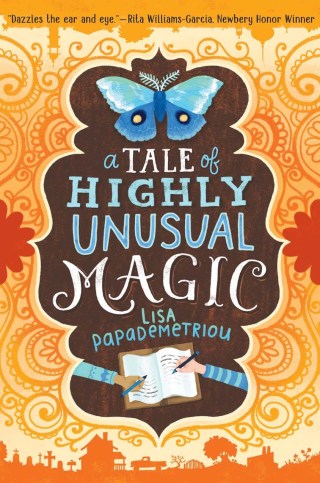
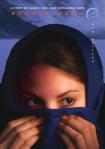
A Tale of Highly Unusual Magic by Lisa Papademetriou

Standard
A Tale of Highly Unusual Magic by Lisa Papademetriou

a-tale-of-highly-unusual-magic-L.jpg

For a book about magic, featuring a girl who admittedly knows very little about Islam, a surprising number of tidbits sneak through and work to introduce Islam and Pakistani culture to those unfamiliar, while similarly exciting Muslims readers who can see a major climax point a mile away and get to feel “in” on the unavoidable “aha” moment.  Written on a 4.9 level this 297 page book, is clean and engaging, a rare combination, especially for advanced readers who are having a hard time finding books that are content appropriate.  I’m fairly confident that anyone, of any age, who reads this will learn something, whether it be about lepidopterology, violins, occupation and partition of the subcontinent, Rudyard Kipling, caskets, friendship, Islam, and finding a place to belong.

SYNOPSIS:

There are three main storylines in the book, Leila’s, Kai’s and The Exquisite Corpses’.  Leila is a Pakistani-American girl growing up in America who decides to visit her Pakistani dad’s family in Lahore for the summer.  Unfamiliar with the language and customs, she has a good attitude of learning as much as she can, and absorbing new things.  Her dad’s family speaks English, is not very religious, is wealthy, and pretty modern.  They have servants, and drivers, and while she gets to go to museums and landmarks, the lifestyle is partially simplified for reader understanding, and partially to not take away from the real point of the story: Leila moving out of her sister’s shadow, and finding comfort in her own multi-cultural skin.  

Kai is spending her summer with a great paternal Aunt in Texas that she has never met.  Her father passed away and her mom has recently lost her job, so a change of scene is what she is presented with.  Her Aunt is a character in and of herself, but by and large leaves Kai to her own devices and supports her adventures from a distance.  The real story for Kai is a budding friendship with the neighbor girl, Doodle who is determined to find and save a rare moth no longer found in the area.  Nervous to make friends Kai learns sometimes the value of things isn’t in the winning, or being the best, but in doing something because you enjoy it and it is the right thing to do.

The two girls story is tied together by them finding two parts of a magic book, The Exquisite Corpse.  The old book tells the story of Ralph T. Flabbergast and Edwina Pickle, in bits prompted by the girls’ own writings.  Like the game of writing a few sentences, folding over the page and having the next person add to the story, the book connects the girls and the readers in a tale that is as much about the two long ago sweethearts, as it is about families, overcoming obstacles, and believing in happy endings.

WHY I LIKE IT:

I like that it is told from various voices, and as much as the story is plot driven, I truly felt connected to the main characters.  The only magic is the book, so the realism is very critical to gaining the readers interest and thankfully once you read about 70 pages or so I feel like the book does suck you in and take you for a fun ride.  The first few chapters are a bit confusing and I wasn’t sure where the story was going, Finally, at my 11-year-old daughter’s prompting I had to just barrel through without asking and wondering too much.  You don’t find out about Kai’s mom and dad or how Rudyard Kipling and “Kim” tie in to it all, almost until the end.  I like that the author doesn’t talk down to the reader, and as a result I learned a bit about so many things.  The twists and interweaving of stories and characters, and things as random as moths and music and saurkraut, remind me of well written adult novels that often aren’t found in books for fourth graders.  

Their isn’t much religion in a doctrine or even practicing sense, but through culture some is learned and shared, and I like that it isn’t completely washed out or removed.  The main character’s father says that he wasn’t religious in Pakistan so when he came to America he wasn’t about to start.  Leila mentions that her mom wants him to take the girls to the mosque or to see Eid, but again, they don’t, but do celebrate Christmas.  So, when she is in Pakistan and sees masjids, and fakirs, and people feeding birds as a sadaqa it is a nice inclusion.  Especially because the vocabulary is used and explained.  She mentions that her extended family goes for Jummah, yet doesn’t pray five times a day, she also touches on Ramadan as being a time of fasting but doesn’t know that there are two Eids.  As she learns, the reader does too.  It definitely isn’t how any practicing Muslim would want Islam portrayed, but it isn’t disrespectful and it is realistic.  Again, because the author doesn’t seem to talk down through her characters, there doesn’t seem much judgement and thus, hopefully also shows most readers some diveresity to the Pakistani stereotypes in the media.

FLAGS:

None, the book is clean, the love story between Ralph and Edwina, is just that they love each other. Nothing more than a sweet sentiment.

TOOLS FOR LEADING THE DISCUSSION:

I would definitely use this book as a Book Club selection because I think there is so much to connect to and discuss.  It would be fun to do as an interfaith book club with kids for the same reason.  While the main characters are girls, I think boys would enjoy it as well, there is some spying, sleuthing, action, and a whole goat debacle, that I think would be a blast to explore with students.

I don’t see any online reading guides, but there is so much to discuss it won’t be a problem.  Enjoy!

Ticket to India by N.H. Senzai

Standard

In terms of plot and and believability, this 274 page 6.3 reading level book has moments of unrealistic twists, but the historical flashbacks and context make up for it as it delves into Pakistan, India partition without getting overly bogged down in politics and bitterness.  You can tell that the author writes from a place of love and warmth, as she talks about all sides involved: Pakistan, India, Great Britain.   The stories, fictional and historical, that weave through the novel make it informative and entertaining irregardless of one’s prior knowledge.

SYNOPSIS:

Maya is 12, and a little shy, especially compared to her older sister Zara.  The book starts with her writing a journal entry about her visit to Pakistan in an airplane somewhere over the ocean.  Maya, her older sister Zara, and their mother are heading to Karachi from America because of the death of Maya’s beloved grandfather.  Frequent visitors to Pakistan, Maya is familiar with the sights, traditions, and language.  As other family members arrive, Maya and Zara overhear their elderly grandmother planning to runaway to India to retrieve family heirlooms that were left during partition.  The plan had been in the works for the whole family to go, visas were already obtained, but with the unexpected death, the urgency is amplified.  Grandma wants to find a ring to bury with her husband.  In Islamic custom burials happen very very quickly, often the same day, so the delay and sending the body to America, is something you just have to go with as the reader.  Rather than convince Grandma to stay, the girls threaten to tell their mother if she doesn’t take them along, and the next thing you know the trio are off to India and on a treasure hunt.  There is a map at the beginning of the book, which is very helpful.  However, the adventure isn’t straightforward, not only in the trio’s adventures, but in that grandma ends up in the hospital, Zara and Maya decide to pursue the lost items on their own, and then Zara and Maya get separated.  Twelve-year-old Maya then is forced out of her shell as she is kidnapped, and running for her life, trying to keep her promises, and also in desperately trying to save her family from having to pay a ransom to save her.  A lot happens, and the intensity amplifies as it starts out as a elementary aged family story and turns into a middle school adventure.  A long the way are beautiful passages about the scenery, amazingly simplified, but factually and emotionally accurate explanations about partition and ultimately, through Maya, about finding your voice. 

WHY I LIKE IT:

The framing of the fictional story and the historical context is wonderful.  Partition, is such a pivotal moment for those that lived through it, but has less and less relevance to today’s generation that lives abroad.  So, to find a book that makes the gist of the events come through, is why I love using fiction to connect people and ideas.  I am making my daughter read this tomorrow, no question. She needs to know what her own grandmother endured, what decisions her family had to wrestle with, and this book allows us to have those discussions in an informed way.  I’m sure many would disagree and say that the reader should know about partition before reading the book, but I think the tidbits and delicate way the author convey the horrors, the agony, the manipulation, and the struggles in todays time, is far better than I could do to a sixth grader. 

Maya’s abilities seem to grow overnight, so while she was an ok protagonist, she might annoy some.  I actually had to google in the middle of reading how old Maya is, at times she seems like she is eight or nine and at other times like she is 15.  I do like that Maya constantly remarks how alike India and Pakistan are, a reality that today’s generation definitely agrees with, but is often afraid to voice to their parents.  I also like that there are good and bad everywhere, a theme that doesn’t get old, especially in books that deal with cultural and religious elements as presented to a wide audience.

There isn’t much religion in the book, the characters don’t stop and pray or wear hijab, but the setting does allow for mention of masjids, and a kind Imam back in California, the characters identify as Muslim and they discuss Muslims as a minority and political entity regularly.  One of the treasures the grandma is looking to retrieve is an old Qur’an with the family tree drawn within.  The book talks about how intertwined the two countries and many religions of India are, and Maya’s name articulates many of these crossroads.  In the end, perhaps the best lesson from the book, is how much alike we all really are.

There is a wonderful Author’s note in the back, along with a glossary.

FLAGS:

The book has some violent images as it discusses trains coming from India to Pakistan with only a few living aboard and vice versa.  The intensity as Maya is robbed, and then kidnapped, and then held hostage, could also be jarring for some younger readers. 

TOOLS FOR LEADING THE DISCUSSION:

Like all her other books, I would absolutely include this in a Book Club, there is a lot to discuss, lots to understand, and lots to enjoy.

Author’s website: http://www.nhsenzai.com/ticket-to-india/

Reading Group Guide: http://www.nhsenzai.com/wp-content/uploads/2017/09/Ticket-to-India_ReadingGuidePDF.pdf

YouTube book trailer:

A Long Pitch Home by Natalie Dias Lorenzi

Standard
A Long Pitch Home by Natalie Dias Lorenzi

a long pitch

The correlation between baseball and cricket provides the foundation for detailing the relationship of  Bilal’s first year in America after having to leave Pakistan in a hurry: the same, but different.  This 248 page book written on an AR 4.6 pivots around sports, but has a lot of heart as themes of family, friendship, and longing, take center stage.  Throw in a whole new culture, the English language, Ramadan and prom and you have a whole lot to cover in this well crafted story.

SYNOPSIS:

Bilal has a good life in Karachi, Pakistan.  He is the oldest of three kids and at 10 years old, his world pretty much involves Cricket, friends, and his dad.  When his father disappears things get frantic, and when his father returns, the family decides to move to America.  Unfortunately Bilal’s dad can’t come.  As Bilal, his mom, his younger sister Hira and younger brother Humza, board a plan to Virginia, everything Bilal knows is left behind.

Virginia is home to Bilal’s maternal Uncle, his wife, and their teenage son, Jalaal.  Jalaal plays baseball and arranges to have Bilal join him at baseball camp for the summer.  Learning the new sport, and a new language, and the nuances of life in a new land are frustrating and often comical as Bilal points out how confusing navigating American life can be.  He also keeps an ongoing list of new things in America to share with his dad over Skype, as they swap memories of an old life in preparation for a new one.  The supporting characters on the field are generally kind and accepting of Bilal, because they have a bigger problem then a foreign boy, there is a girl on the team, Jordan.  Jordan is new too, and the coaches niece at that, naturally they become friends, but its not easy, Bilal has to learn what being a friend really means.

The majority of the book stems from the tension of waiting to hear from Bilal’s father, and to see if he can come to America.  The passing of time with baseball games and school are anecdotal to the larger arc that sets the pace of the book.  Will Baba be able to come, and if so, when?

WHY I LIKE IT:

Interestingly religion has a pretty big role in Bilal’s life and the author does explain some tenants in Islam.  He wakes up for fajr (although he does miss it occasionally), he only eats halal zabiha, the family fasts in Ramadan, and they celebrate Eid.  Bilal wants to fast, but him mom tells him he is too young when they are coming to America, and the following year he doesn’t because of baseball, which is unfortunate, because a lot of kids fast and play sports all over the world.  They go to the mosque on Eid only, and it mentions that the women in his family do not wear hijab like some of the women at the mosque.  His older cousin Jalaal wants to take the neighbor girl, Olivia, to prom, which the family explains awkwardly as something that Muslims don’t really do until they are older, or at least that is how Bilal understands it.  In the end, they let Jalaal go with Olivia and a group of friends, and the whole family Skype’s the family in Pakistan and sees them off.  Even more funny is that they don’t join their friends for dinner before the dance, because Jalaal is fasting and can’t eat until later.  I don’t know if this will confuse 4th and 5th grade readers, but as an adult I found it hysterical, because these cultural contradictions are more common than not.  I did like that nothing was done behind the parent’s backs.  Things were discussed and worked out instead of lied about.

Another thing that I found interesting, but since finishing the book, I have come to appreciate, is that there is no Islamaphobia in the story, or even xenophobia.  The kids are accepting of Bilal’s faith and culture.  He is far more self conscious about being different or not understanding than those around him are.  Its idealistic perhaps, but at the same time, I think it would distract from the core of the story.

While the book focuses on sports, I think even non sports fans will be able to enjoy the story.  The author doesn’t get too technical and it moves steadily with mini climaxes and triumphs through out.  Girls and boys will enjoy the book, Muslims and non Muslims too, the readers might even learn something about baseball or cricket or Pakistan, or even about themselves along the way.

FLAGS:

The book is remarkably clean and what you would expect for a good quality, solid 4th grade and up story.  There is the “prom” issue, but there is no hugging, kissing, longing etc.  They “like” each other, but it isn’t more explicit than that.

TOOLS FOR LEADING THE DISCUSSION:

I don’t know if I would use this for a Book Club.  One could, but I think it would require a lot of coaxing to get kids to give a book about baseball/cricket a try.  I have no doubt if they started it, they would finish it, but it might be a tough sell.  The confusion in American life would make for an awesome discussion after being read, because everyone can relate to some of the oddities of the English language, and challenges of learning a new language and culture.  I think how Islam is handled would also make for some good discussion in addressing how each family handles things differently as they arise.  Although written on a 4.6 level if I were to do it in a school setting, I would probably do it for middle school kids who could articulate their own life parallels to the story.

An interview with the author:

http://wordspelunking.blogspot.com/2016/09/a-long-pitch-home-blog-tour-interview.html

Overall a solid decent book about an immigrant Muslim boy making his way in America, while not losing or giving up on who he is, alhumdulillah.


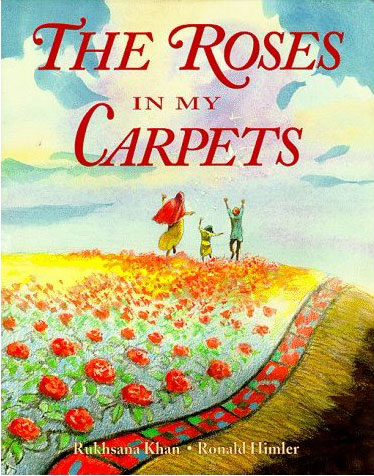
The Roses in My Carpet by Rukhsana Khan illustrated by Ronald Himler

Standard

roses-cover

The concept of “refugees” is not a new one, but with the pervasiveness of the term in the news right now, children are starting to need some understanding of what it means to be a refugee, and how to empathize with what their classmates and friends may have endured.  Books like One Green Apple, The Red Pencil, and Four Feet Two Sandals are great, and I excitedly hoped this one would be a great addition to the theme.

roses-2

The book is leveled as an AR 3.2, but I don’t know that many eight and nine year olds would be able to grasp some of the content unassisted.  This is a good example of the limitations of Accelerated Reader.  Yes, diction and sentence length are third grade level, but content is a bit heavy in this 32 page water-color illustrated book.

roses-1

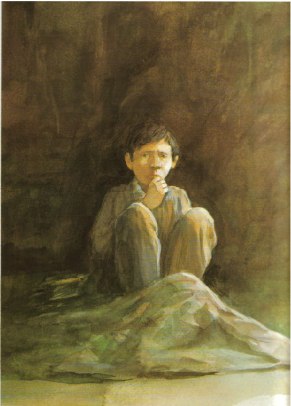
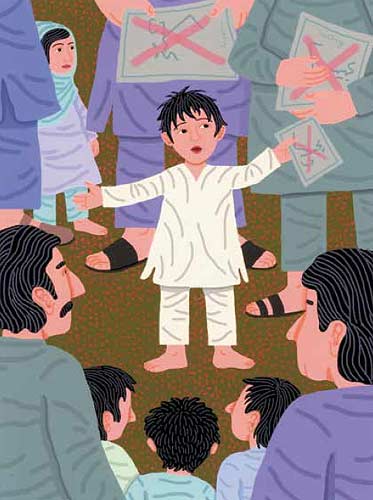
A young boy is telling the story of his life in a refugee camp in Pakistan.  The nightmares of jets dropping bombs opens the story and sets the tone of a very frightening reality that this boy, his mom, and his sister Maha face.  His father, a farmer, had been killed, and I think the author does a good job of showing readers that although the characters are now in a refugee camp, food and safety are still not a given.  I think we as westerners tend to think, ok they had to leave their home, and that is sad, but now they are taken care of, and this book clearly shows that, that is not the case. The boy mentions that someone has sponsored him and helps them with money, something his father wouldn’t have accepted, and I’m not sure why this is included.  Perhaps to show that people still can help and need to, or to show that affluent people donate as a way to ease their conscious without working to fix what caused the problem in the first place? I don’t know. It would lead to some good discussions with older children, perhaps fifth grade and up, as the author doesn’t make it a good or a bad thing, but does introduce it none the less.

The environment is drab, “Here, the walls are mud, the floor is mud, the courtyard is mud, too” and the day-to-day chores monotonous, lining up for water, for food, going to the mosque to pray, and going to school.  For some reason, not sufficiently explained in my mind, the little boy hates school.  A sharp contrast to stories that show how appreciative many children in other parts of the world are at the opportunity to study and learn. The boy rather, loves weaving.  He looks forward to escaping his reality and getting lost daydreaming in the weaving of beautiful colorful images where the bombs can not get him.

The characters are clearly Muslim, as they pray and wear hijab and go to the mosque.  They trust Allah when they are faced with challenges, but no details of belief are conveyed and it simply describes the characters. The book does not come across as whiney to me, and while there is some hope that radiates through when the boy is weaving, it really is a sad book.  It is made more depressing when Maha is hit by a truck, she thankfully survives with broken legs, and by the thought that although the boy wants to use his weaving to provide for his family, the future doesn’t seem bright.  In the end perhaps running free on a rose filled carpet where the bombs cannot get them only exists in his dreams, a sobbering thought for the characters and readers alike.

roses_in_my_carpet_p30-31

Broken Moon by Kim Antieau

Standard
Broken Moon by Kim Antieau

Broken Moon.jpg

I didn’t initially think the premise of the book was terribly original: a poor scarred girl in Pakistan working as a servant, cuts her hair to look like a boy and be free to move about and rescue her brother.  But the weaving in of the One Thousand and One Arabian Nights stories into the larger story, and the plot of kidnapping children to be camel jockeys in the Middle East, made the story good.  Really good, but not the book.  I really struggled with the format of the book.  It is written as letters by the main character Nadira to her young brother Umar.  The information seems too forced in this style, she is telling him how old he is, or retelling him things he said a few days ago.  Once they are together she has to clarify that now she is writing it to their mother, and then again alter it to be writing to those following her story.  It presents too many characters, that are awkwardly introduced because presumably he knows who they are, the reader does not, and bridging that gap makes the book halt the reader from diving head first into a really compelling story.  I feel like the book’s editors let the characters down, it would have been an easy fix to tell the story as Nadira told it to the Sheikha, and then when the story caught up with the present to continue it from there as written, without the guise of it being shared in letters or a diary format.  But, alas no one asked me.  Luckily the book is only 183 pages and written on a AR 4.2 level so it is a speedy read.  Do not let the fourth grade level, however, trick you into thinking it is content appropriate for a 10 year old. There is a lot of abuse, in every sub category of the word.

SYNOPSIS:

When Nadira was 12 years old she was attacked by a group of men seeking to avenge an alleged crime Nadira’s older brother committed against their daughter.  By this girl’s reputation allegedly being ruined by Nadira’s brother, the village decides that a female in his family should in exchange be ruined.  Nadira manages to fight and ends up with some external scarring, including a moon shaped scar on her face, a lot of internal scarring, but the book points out quite often that she got away from being sexually abused.  In her culture she is assumed to be ruined, and will never be married.  She begins to work as a servant to help the family financially as her older brothers have more or less disappeared and no longer are of any help to her family.  When her father dies, her mother and younger brother, Umar, rely on Uncle Rubel who is a horrible man who covertly sells Umar to the smugglers to become a camel jockey.  The family that Nadira works for seem kind, they stick to the norms and don’t include her in their fun and frivolity, but they don’t abuse or belittle her either.  They offer her, her mother, and Umar a place to live on the property, and assist her in finding someone to locate her brother.  Nadira, however, is strong and determined and takes matters into her own hands by cutting her hair to look like a boy, finding the smugglers, and convincing them to take her.  Once in the camp she wins over all the boys, by becoming Sherazad and telling a story to delay her being beat.  Her wit, tenacity, and perseverance is infectious and you find yourself cheering her on.  As she prepares for the races and to broaden her access to camps to find her brother at, she meets a western vet, a Sheikha who essentially owns her, and discovers that all the boys she lives with know she is a girl and love and respect her.  The climax involves her racing in the Sheikha’s Race where the winner is granted a wish by the Sheikha.  Can Nadira win? Can she find her brother? Can she save all the boys at the camp that she has taken in as her brothers? I won’t spoil it this time.  You’ll have to read it.

WHY I LIKE IT:

I like that the author did not cast judgement on a group of people.  Not all Pakistanis are bad, not all women are helpless, not all men are oppressive, not all employers are abusive, etc..  similarly, there is a western character, but she doesn’t swoop in and save the day, in fact I read her to be complacent in what she knew were obvious human rights violations.  I loved the relationship that Nadira had with her father.  The love of learning and love of his daughter is so sincere and beautiful that I think readers can see that the stereotype of daughters not being prized jewels in a family as being false.  I wish the mother would have been further developed.  She seems defiant, but not fleshed out, which is unfortunate. I also like the subplot of the gardener boy, Saliq.  A boy who completed some of his education in England, only to be made crippled by a horse, and sent back to be a servant.  He’s role and respect of Nadira furthers the notion that her scar does not define her, as he proposes marriage and pledges to support her in her efforts to continue rehabilitating kidnapped children and stopping the cycle.  I also like that the author doesn’t share her response, as if to emphasize that she is liberated and with or without a husband she is a complete person.

The characters are Muslim by culture, but there is no real mention of Islam or Islamic practices.  Before Nadira cuts her hair she wears a scarf, but that is neither her nor there.

FLAGS:

The premise of the book is an accusation of a sexual crime.  One of the stories she tells at the  camel camp to delay the beatings,  is the story of the lady who traps a merchant, a king, a carpenter, and a Kazi to free her lover.  She offers her body to the men and traps them in a cabinet naked after obtaining their signatures.  There is some kissing and some innuendos and references to sexual acts.  There are also references to the sexual abuse at the camps as well as descriptions of the physical ones that take place.  Not for the faint of heart or young and innocent. The boys at camp also discover that Nadira bleeds like their sisters, as a clue to them figuring out she is a girl, but compared to the sexual crimes, menstruation seems hardly like a flag, and I only mention it because the AR level is so low, not because there is any reason for shame or shyness in discussing an act all women endure.

TOOLS FOR LEADING THE DISCUSSION:

I think high school students could handle the book, and would allow a plethora of discussion options from child labor, civic responsibility, abuse, justice and the power of literature as a coping mechanism.  I wish the author would have included some information on camel racing and how they are regulated and jockeys are obtained, and maybe thrown in a recipe for masala chai as well.

There are no online websites or guides that I could find to accompany the book.

King For A Day by Rukhsana Khan illustrated by Christiane Krome

Standard

King-for-a-Day1.jpg

Its time for Basant, the Lahore, Pakistan kite flying festival, and Malik and his siblings are ready.  Ready to launch Falcon into the sky, ready to set other kites free, and ready to put the bully next door in his place.  While some kids have huge kites, and some have many, Malik has just Falcon, a speedy little kite that Malik prays can get the job done.

King for a day inside

Once again Rukhsana Khan does a remarkable job of taking a universal theme, adding some culture, and finding artists to empower minorities without making it an issue, all in a 32 page children’s book.  Written on an AR level of third grade ninth month, readers see characters handling a bully by beating him “on the court” so to speak, a character having confidence in his abilities, yet still asking Allah swt for help, and a boy in a wheel chair celebrating a fun spring time festival with his family.

king 1

The illustrations are rich with texture and angles, which contrasts the font and text presentation.  Little kids probably won’t be tempted to pick this book up, but as a read-a-loud first and second graders will enjoy the story and the kite flying action.  Third and fourth graders will enjoy reading the book independently, and find themselves cheering for Malik, appreciating his kindness, and wanting to pick up a kite and head out themselves.  The author includes a note at the back which provides more information about Basant and how it is celebrated.  Although it takes place in Pakistan and is a festival not celebrated in America, there isn’t a “foreign” feeling to the book, as kids can relate to bullies, wanting to be the best and the satisfaction of succeeding and feeling like a “king for a day.”

king2

Silly Chicken by Rukhsana Khan illustrated by Yunmee Kyong

Standard

silly chicken

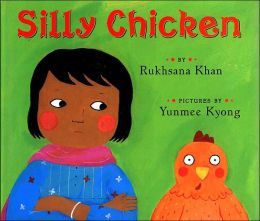
Silly Chicken is a story about sibling rivalry, except there isn’t a sibling, there is a chicken.  Rani feels that her mom, Ami, loves a chicken, Bibi, more than she loves her.  Rani is jealous of the attention Bibi receives and finds the chicken in general, silly.  One day when Rani and Ami leave their home by tonga to visit her father’s grave, a dog gets in and when they return, Bibi is no more.  Ami is devastated and Rani is sure she closed the gate.  It isn’t until Bibi’s egg hatches by surprise, that the story comes full circle and Rani responds to Ami’s chiding that she loves the baby chick more than her mother, that the reader and Rani realize how silly that would be.

I really liked this 32-page, brightly and playfully illustrated book.  It is written on a AR 2.3 level and is fun out loud or at bed time.  The story takes place in Pakistan and a lot of reviews online remark that it is a good book about Pakistan or for showing Pakistani culture, critiques that I both agree and disagree with.  Every kid, everywhere, through out time, can probably relate to being jealous of something or someone occupying their mother’s attention.  The concept of a pet and loving it and being sad and feeling guilty, are all universal themes.  That being said, both the author and illustrator do a remarkable job of breaking stereotypes without drawing attention to them.  Ami and Rani are relatable and are clearly Pakistani, subtly removing an us and them stance.   Rani’s dad has passed away, but Ami and Rani seem to be doing well.  Ami seems very self-sufficient in daily activities and brave when they think a burglar may be present.  The two chat with neighbors and travel independently breaking down the erroneous stereotype that women cannot go out or be recognized without a male.  The mother wears hijab and traditional Pakistani clothes while Rani being young obviously does not cover.  Their clothes are bright and colorful and their expressions relatable and inviting.  The way that Bibi’s death is handled is age appropriate and a child could possibly think she simply was run off rather than killed, either interpretation would allow the reader empathy for Ami and be a great topic to explore with a child.  Enjoy!


Malala: A Brave Girl from Pakistan/Iqbal: A Brave Boy from Pakistan by Jeanette Winters

Standard

Malala Iqbal

Again I break from my fiction preference to review another book about these two remarkable individuals: Malala and Iqbal.  In this beautiful book linking two brave children from Pakistan, Jeanette Winter’s brings their stories to a young audience in a powerfully simplistic way.  Written on an AR 3.6 level, each story is 20 pages and presented in a flip book format.  Before each story there is a brief Author’s Note about each character in a broader view, for context to be given as needed to the adults to share with the children listening to the book, or for older children to read and deepen their understanding and appreciation.  The sentences are short and the font and presentation is inviting to even early readers.  The pictures are wonderful and do a tremendous job showing the intensity of the environment Malala and Iqbal face, while not frightening the reader.

The Malala portion of the book starts with the Taliban asking for her on the bus and like her biography, then takes the reader to the threats and deterrents they made to girls in school, but on an audience appropriate level.  It tells how they stopped wearing uniforms so that they could be harder to identify and how even burning the girls school didn’t stop them. It then returns to her being shot and going from the hospital in Swat to one in England.  It concludes with her speaking to the U.N. on her 16th birthday.

Malala

The story of Iqbal is a bit harder I think for children to understand as they may not know what a loom is or have ever thought about who makes carpets.  Also the words bondage, Peshgi, outlawed, and mourners are not in their vocabulary .  They should understand that he is sold for an unpaid $12 debt, but that too may need to be stressed and explained. If the kids can grasp this, I really think children as young as kindergarten can appreciate his story.  I love that the author didn’t shy away from the fact that he was shot and killed.   Even if they do not understand all the facets that make Iqbal’s work so incredible.  They will feel inspired that someone so young was so brave.  Iqbal


Nadia’s Hands by Karen English illustrated by Jonathon Weiner

Standard

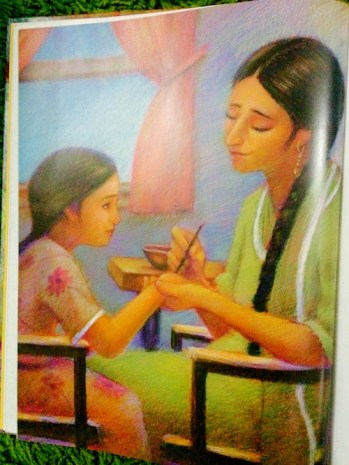
nadia's hands.jpegNadia’s aunt is getting married and she gets to be the flower girl in the Pakistani-American wedding.  She also will get mehndi put on her hands for the big event.  Her cousins warn her that she might mess up and even in the midst of her excitement she begins to worry what the kids at school will say when they see her hands on Monday.  As her aunt prepares the mehndi and the application process begins, various uncles peek in on her and her aunt gifts her a beautiful ring.  The mehndi has to sit on the skin for a while to set and as Nadia practices sabr, patience, I couldn’t help but think something seemed off in the story.  I’ve been at, in, and around a lot of Pakistani and Pakistani-American weddings, and this story didn’t seem to reflect the tone of such occasions.  The book doesn’t reflect the hustle and bustle and near chaos, it doesn’t sound like the tinkle of jewelry and laughter as the women sit around chatting and getting mehndi put on together, the pots on the stove are referenced but not described so that the reader can smell the sauces thickening and hear the pans crashing and taste the deep rich flavors.  It is lonely.  Nadia is lonely and filled with anxiety about Monday.  Durring the wedding she is walking down the aisle and suddenly freezes when she looks down and doesn’t recognize her hands.  Her cousins seem to show unsupportive “I-told-you-so” expressions as she searches for some comforting encouragement to continue on.  When she finishes her flower girl duties, her grandma asks if she understands why looking at her hands makes her feel like she is “looking at my past and future at the same time.” Nadia doesn’t understand and the author doesn’t explain.  At the end she is ready to embrace that her hands are in fact hers and that she will show her friends on Monday.  But the reader has no idea how it goes, or what exactly the significance of her painted hands are.  The book fails to give any insight or excitement for a culture bursting with tradition at a time of marriage.
 nadia's hands inside

There is a glossary at the beginning for the few Urdu words sprinkled in the book.  There is no further explanation however, of  mehndi, or weddings, of the brides clothes etc.  The illustrations are adequate, but because the text doesn’t offer much warmth or vibrance, they seem a little drab, and raise more questions about what some of the traditional items depicted are.  The book is a standard 32 page picture book and is written on an AR 3.8 level, which I think is a little high.  Granted my children are familiar with mehndi, but my first grader read it to me with little assistance.  There isn’t any mention of Islam and could probably be argued that the story reflects any wedding from the subcontinent background performed in the west.  The bride has a duputta on her head in the picture, but that is neither here nor there, and no one in the audience appears religiously covered.  I would assume they are Muslim because of the minor characters’ names: Omar, Saleha, Amina, Abdul Raheem.  Also, the word Sabr, an Arabic word, suggests that they are Muslim.  Plus they eat kabobs which the glossary defines as mincemeat, so probably not Hindu.  Overall the book is not, “bad” or “wrong,” I just wish there were more to it.


Ruler of the Courtyard by Rukhsana Khan illustrated by R. Gregory Christie

Standard

RulerOfTheCourtyard

Set in Pakistan, Saba has to cross the courtyard to get to the bathhouse.  Fearful of the chickens that seem to have it in for her, she braves the distance in a dashing sprint and slams the door to relish in the safety of a chicken free patch of space.  However, today as she searches for courage to face the chickens after her shower she spots a snake near the door.  She is afraid, and wants to scream for her grandma, her Nani, but worries that the snake will bite anyone that comes through the door.  Realizing she must face this fear and solve the problem on her own, not only empowers her, but puts the chickens in to perspective.

This 32 page picture book written on an AR 2.6 level is a good book when discussing overcoming fear.  It reads aloud well, as the short sentences from Saba’s perspective convey her trembling fear, her determined resolve, and her elation and freedom after she faces the snake.  The illustrations on first glance, and even after the first reading seemed off.  They didn’t seem to compliment the story smoothly, however, after revisiting this book, I think I have grown to appreciate the exaggerated features of the girls face, and the simplistic blurred images of her surroundings.  I think it shows her focus and skewed view when faced with such a fear.

The Author’s website & teaching guide