Tag Archives: muslim in the illustrations

Music of the Mountains: A Story in Pakistan by Sabrina Shah illustrated by Manal Mirza

Standard
Music of the Mountains: A Story in Pakistan by Sabrina Shah illustrated by Manal Mirza

Set around an Eid concert in the North-West Frontier in Pakistan, a young girl must find her courage to play the rabab in front of an audience, even though she is still learning her first song. The beautiful illustrations of Manal Mirza and focusing on an under represented population, made me hopeful that this book would transcend the musical focus and weave in Islam and culture. Sadly, though, the book falls victim to cliche lines that mean nothing, and a story that doesn’t make a lot of sense once you move past the superficial attraction. The backmatter infographics about the rabab, where it can be heard, details about the Pathan/Pashtun people, What Eid is, the traditional clothing, and a Pashto Glossary, add to the vibe of the book, but still fail to offer any specific “hospitality, courage, and rich traditions,” that are only ever referenced in generalized terms and statements.

The book starts with Roohi’s favorite time of day, the sun is settling behind the snow capped mountains and her family is gathering around to listen to her grandfather, Neeka Baba, play the rabab. No they aren’t praying maghrib, or breaking their fast, so presumably it is not Ramadan.  When Neeka Baba plays, “songs full of rhythm echo through the cherry blossom hills.  Songs from long ago tell stories of folklore, heroes, and love. . . songs of Roohi’s ancestors.” A beautiful sentiment, but it is not a thesis statement or main idea of the book as we, the reader, never learn about her ancestors, or folklore, or about the culture.” We are just told they all had courage, and she needs to channel that strength.

She will need strength to play the rabab at her school concert, except remember “she hasn’t even learned a whole song yet.” She also worries she won’t be as good as her grandfather, but presumably he has been playing longer and she is just starting, so I never connected why she felt she should be as good as him.  No one in the story compares them, or says she should be as good as him, or even strive to be as good as him.  There is nothing that hints that this is even a part of the characters development other than the repetitive refrain that she must “play with the courage of those who came before her.” So the cathartic release of being told “to play like yourself” also seems forcefully contrived and not a natural arc of growth and understanding.

As Eid creeps closer, Roohi has lessons with her grandfather on the rabab, and then Neeka Baba coughs and is in the hospital. The reader has no idea how this man falls ill, or recovers, if it was sudden or a known affliction, but he is no longer the focus, the rabab is, and so the story continues.

At the school concert, Roohi is introduced as playing music from the North-West Frontier Province.  Hold up, yes I thought I skipped a page.  They live in the North-West Frontier, don’t they, this is a school concert? What an odd introduction, did they travel? At the end there is a “smile as wide as the lush valleys back home.”  When did they leave home? And why a silent prayer, why not a “bismillah.” Isn’t the point of OWN voice to have the little details and the voice that can’t be imitated by researched work?

I am going to spoil the ending, she freezes, Mama and Neeka Baba help her find her beat in the audience and she steals the show so to speak. The ending is sweet, but not anywhere near as heartfelt as it should have been if the audience would have been shown the strength and courage of the Pashtun culture, not just repeatedly told it, felt the warmth of their hospitality, the rich ancestral values that would be threads that manifest in the music that she is hoping to share with others. Sadly we are just expected to know that they all exist and cheer for Roohi to succeed.

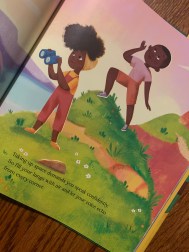
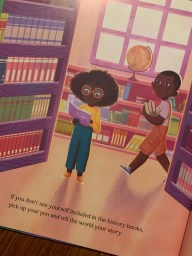
Disappointing, considering how fantastic the illustrations are, sigh.
Ali the Great and the Market Mishap by Saadia Faruqi illustrated by Debby Rahmalia

Standard
Ali the Great and the Market Mishap by Saadia Faruqi illustrated by Debby Rahmalia

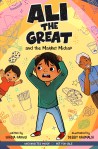
Akin to her beloved Yasmin series, author Saadia Faruqi offers up a new set of books similarly rich with culture, family mishaps, problem solving, and fun for early readers.  This is the first book in the series, with three more announced that follow the Pakistani American family, and seem to perhaps even connect to Yasmin (based on the cover pictures).  The books are not religious, Ali’s mom wears hijab, and there is an Eid title in the series, but having only seen this particular book I’m not sure if it is faith detailed or not.  Over three chapters and 32 brightly illustrated pages, second grader Ali Tahir, along with his little brother and Dada head to the South Asian store to find some snacks and ends up having to find little Fateh.  With a family portrait and Urdu words defined at the start, the story concludes with some jokes, some details about traditional desi snacks, questions to consider and info about the Muslim author and Muslim illustrator.

It has finally stopped raining and Dada needs snacks, so he puts Fateh in the stroller and the three of them head off to the market.  Dada is from Pakistan and he and Dadi live with Ali’s family.  Once they make their way to the store, they take in the sights and start looking for Dada’s favorite chips.   Ali has to let go of Fateh’s hand to catch a spicy chips display from falling over, and that quickly Fateh disappears.?

I love that the Yasmin series is such a staple and so widely beloved that a similar series with a boy protagonist is now going to grace our classroom, school and public libraries.  This particular book might only have a #Muslimintheillustrations, but it normalizes religious garb, cultural traditions, and larger themes that unite us all in a fun, age appropriate book that will get early readers smiling and brown Muslim kids glad that yet another mirror exists for them and a window for those around them.

Eleven Words for Love: A Journey Through Arabic Expressions of Love by Randa Abdel-Fatteh illustrated by Maxine Beneba Clarke

Standard
Eleven Words for Love: A Journey Through Arabic Expressions of Love by Randa Abdel-Fatteh illustrated by Maxine Beneba Clarke

img_7491

It has been a long time since I took Arabic in college, so I read the book, then read it again, then wrote down all the Arabic words and realized that there are 11 words in addition to “al Hob” the word for love, and that al Hob is mentioned three times in the manner of a poetic refrain.  I also didn’t grasp the first time that the book is a journey of a refugee family and the types of love are them in different phases of their journey.  Once I got it, I’m not sure how I missed it, but I think the layers that the book allows for actually widens the appeal to a larger audience.  I know for many Muslims seeing a 40 page picture book about love will raise some eye brows and wonder about what relationships are shown.  There are a few phrases that imply romantic love most illustrated abstractly, one shows a bride and groom on their wedding day (al-Ishq), there are also an elderly hetero couple in front of the Dome of the Rock (Showq). The story follows one family and their suitcase is rainbow colored and when depicting loving one’s neighbors (al-Mahabba), there are rainbow stripes on the fence, if a rainbow means or doesn’t mean something to you I simply share what is there. There is friendship love (al-Wud) and familial relationship love, and love from pets (al- Walaa’) and love felt for those gone too soon (al-Haneen).  The Arabic script for each word of love and the lyrical English string together the concept of different forms of love with the illustrations telling the story.  There is nothing particularly Islamic in the book, but there are visible Muslims in the illustrations and the masjid in Palestine.

I’m obviously not an Arab speaker, so if I misunderstood a term, forgive me, I don’t want to list all the terms, because that would give away too much of the book, but as a non Arab the book is heartfelt and moving and I’m sure for Arab speakers the feelings would be amplified.

The book was released in Australia in 2022 you can purchase it from Book Depository and will be released in America in 2023, you can preorder it here.

Dear Black Child by Rahma Rodaah illustrated by Lydia Mba

Standard
Dear Black Child by Rahma Rodaah illustrated by Lydia Mba

dear black child

This beautiful 32-page picture book by Muslim author Rahma Rodaah radiates joy through the text and illustrations.  The powerful and lyrical words on the page inspire confidence to take up space and encourage celebration through their messaging and tone.  My three-year-old enjoyed me reading it aloud, it kept his focus and his interest, and my seven-year-old read it over my shoulder and then numerous time on his own.  The sway and images painted by the text are so well refined that you could truly read this book a dozen times and still be moved by the passages.  The illustrations compliment the author’s message in their reflection of Black children of all shapes, sizes, shades, and mobility.  There is even a visibly Muslim woman in hijab (#muslimintheillustration) that looks like the author herself.

img_3431

I look forward to sharing this book with various story times in the community, in my children’s classes, and in regular rotation at my own home.  Framed as a letter to a beautiful Black child, the book speaks to “you.”  It starts with encouraging you to stand in your own light, take up space, say your name proudly, and proclaim your native tongue.

img_3430

It inspires the Black child to speak confidently, roam freely, to be rooted, yet move swiftly. To write the books and tell the stories that only they can tell, and to trust their inner compass.  It also reassures them that they are not alone, that there are those that will always help, always cheer them on, and remind them of their glory.

img_3432

The book is as powerful as it is beautiful and I hope it finds a home on every classroom, library, and home bookshelf.  I purchased mine here.

img_3434