Tag Archives: Muslim Character

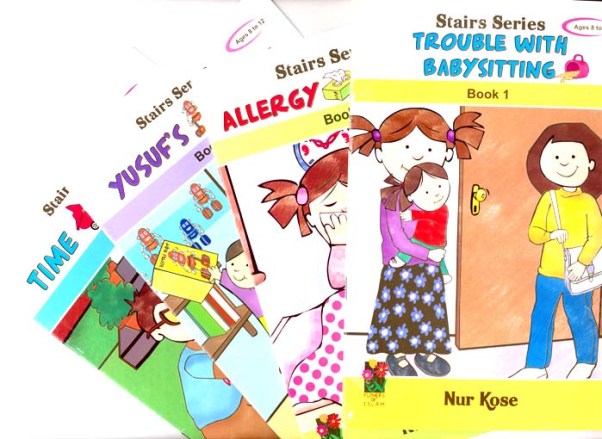
Stairs Series: Trouble with Babysitting, Allergy Attack, Yusuf’s Robot & Time Travel by Nur Kose illustrated by Shaista Asad and Ayesha Khatib

Standard
Stairs Series: Trouble with Babysitting, Allergy Attack, Yusuf’s Robot & Time Travel by Nur Kose illustrated by Shaista Asad and Ayesha Khatib

stairs series

This set of books claim to be for children ages 8 to 12, but I think they work better for 7 to 10 year olds.  They look like leveled readers, and resemble them in their simple linear story lines.  They are broken up in to chapters, that really are not necessary, but because of the volume of text on each page, allows for a young reader to take a break.  All four books in the series are connected chronologically and contain the same characters.  They more or less present a problem, bring over their friends, have one of the friends offer some advice tied to a hadith or ayat from the Quran, and the advice is tested, and then shared once more.  They are about 20 pages and have activities at the end that range from solving clues to writing paragraphs.  The sentences and vocabulary are about a second grade level, with translations of Arabic and Turkish words, along with references to the Quran and Hadith appearing in the footnotes on the page they are mentioned on.

stairs series characters

The best part of the books is that they are written by an 8th Grader, mashaAllah.  I think they teach a lesson in a simple way, and while not terribly suspenseful or comical, they do succeed in showing Islamic lessons in relatable situations for kids.  Some of the details seem excesses or meandering, but again, the fact that it is written by a kid, will inspire readers to listen differently to lessons about patience, accepting Allah’s will, recognizing one’s own limitations, and putting Allah (swt) above all else.

stairs inside

The pictures are colorful and simple.  They appear every few pages in the book and provide a nice break from the text.  They are sweet and not detailed, but sufficient for the story and level.

stairs pictute

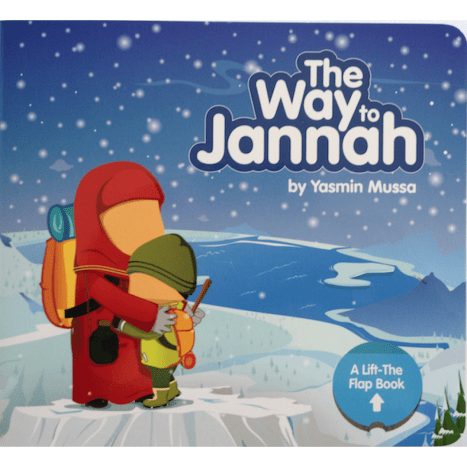
The Way to Jannah by Yasmin Mussa

Standard

the way to jannah.png

Somehow between child number one and child number four I had forgotten the utter impracticality of toddler board books with flaps to lift.  It is great and all to find a book that is solidly constructed to withstand tantrums, hunger, teething, and jumping on, but then to add thin delicate flaps to engage the child renders the book readable for about three days.  Ok, the time it takes for any given toddler to systematically tear off every flap is unique for each child, but my 18 month old handles his siblings chapter books with more care than he can muster for the overpowering temptation of a slightly raised flap of paper begging to be tugged on.  Needless to say, all 16 pages of the book are no longer in pristine condition, alhumdulillah.

waytojannahpic2

Also, Alhumdulillah that is a decent book of introducing islamic phrases to small children and hence the repetition of the book means that even with the missing flaps and torn off words, the book can still be figured out and read.  A boy and his mom journey up a snow covered mountain as the little boy tries to learn what to say to go to Jannah (heaven).  As he says islamic phrases like AstagfirAllah, SubhanAllah, and JazakAllah Khayr, his mother tells him when those phrases are used and what they mean, until the boy figures out he must say and believe the Shahada (there is only one God, and the last Prophet is Prophet Muhammad (as)).  The sayings are written in Arabic script, and English script under the flap, and the back of the book has a glossary of the Islamic words. The language is simple and encouraging for small children and a good way to reinforce the words we say to remember Allah throughout our day.  The characters have no faces and with a snow filled landscape the pictures aren’t overly engaging, but what is there, is done well, and allows the text to take center stage in the story. Those flaps though….

jannah3


The Most Magnificent Mosque by Ann Jungman illustrated by Shelley Fowles

Standard
The Most Magnificent Mosque by Ann Jungman illustrated by Shelley Fowles

Most-Magnificent-Mosque

Three very naughty boys harass visitors to Cordoba’s Great Mosque in Spain.  Rashid, a Muslim, Samuel, a Jew, and Miguel, a Christian, run through the fountains, destroy the flowerbeds and throw oranges at people leaving their prayers.  Most days the boys can out run the gardeners, but one day they pelt the Caliph himself with a rotten orange.  The punishment from the Caliph is three months of hard labor working with the gardeners everyday on the mosque grounds.  On their breaks the boys explore the mosque and marvel at its beauty.  By the end of their sentence, the boys have such a love for the mosque and one another that they are forever bound.  As the boys grow and make their way in the world, they don’t keep in touch much.  However, when Cordoba is defeated in battle by the Christian king Fernando, it will be up to these three boys to convince the new king, that the Mosque shouldn’t be torn down.  And that the it is the pride of all people in Cordoba, Muslim, Jewish, and Christian alike.

magnificent mosque 1

The book is 32 pages and an AR 4.0.  It does a good job of showing the three faith communities coming together to save something they all value.  It also shows a kind, yet purposeful punishment from the Caliph to the three boys.  While younger kids in story time will enjoy the concept of people working together, the book really finds its strength with students learning or familiar with Spain, particularly prior to the Inquisition.  There isn’t a lot of detail regarding the structure of the mosque, or the doctrine of each faith, that knowledge would have to come from outside the book, in order for it to be appreciated. There are some plot holes in the story and the book itself doesn’t make it clear what parts of the story are historically accurate and which are fiction.

magnificent mosque

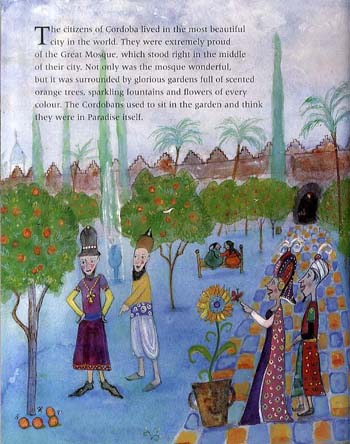
The illustrations are charming in their own way.  The watercolors do a good job bringing to life the mosque and gardens, and battle, but for me fall a little flat in depicting the three boys.  I don’t know if the text or illustrations are at fault for me not connecting to the story or finding an emotional resonance to what should be a very inspiring story. Perhaps it is a combination of the two.  I feel it is desperately in need of an author’s note detailing the factual origins of the tale,  Something to uplift and give hope to people of different faiths coming together in a peaceful way, that can be put into real world actions.

magnifectn

Yaffa and Fatima: Shalom, Salaam by Fawzia Gilani-Williams illustrated by Chiara Fedele

Standard
Yaffa and Fatima: Shalom, Salaam by Fawzia Gilani-Williams illustrated by Chiara Fedele

Yaffa and Fatima cover.jpg

Oh how full my heart is after reading this book, and wiping a tear from my eye.  When the daily news angers and frustrates, a story as sweet as two friends helping and worrying about each other gives hope to the future of the world. I know that is probably over reaching the impact of a children’s book, but sometimes it really is just one person helping another person, just finding similarities instead of differences, and above all having a big heart.

Yaffa and Fatima are neighbors and both grow dates.  The two women, one Jewish and one Muslim, share a lot of similarities they both fast, pray, celebrate, and help others. They often sell their dates next to each other in the market and then share their food and customs with each other.  During one growing season, rain is scarce, and each woman begins to worry about if the other has enough- not just to sell, but to eat as well.  Secretly they both help each other and prove the power of friendship and kindness is universal and powerful.

Dino-Wresting

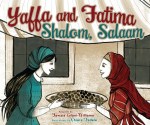
The illustrations are smartly done.  This isn’t the book for bright and colorful or overly cartoonish depictions.  The simplicity of the words introduce the reader to Islamic traditions and Jewish traditions, but the purpose is to show their similarities and the illustrations mimic that sentiment beautifully.  The contrast of red and blue show the differences with the larger muted tones being the same. The warmth in the characters faces mirror the warmth of their actions and the detail is balanced with intriguing the reader without distracting from the text.  The illustrator does a good job of also showing the women covering their hair in public, albeit differently, but not within their homes. And of also showing the different ways the women worship without the words having to do so.

Dino-Wresting

The author has a note at the beginning acknowledging the roots of the story as a tale about two brothers in both Jewish and Arab traditions.  And at 24 pages it works for children of all faiths and all ages, two years old and up.  The book was recommended by a woman, who I hope to meet next week, when she and her Jewish community join us at the mosque for our monthly story time.  With a theme of friendship, this book will be the focus of what bridges and connections we can all make in our personal lives to make the wold a little better.  I can’t wait to share it with our children of both faiths!


Amina’s Voice by Hena Khan

Standard
Amina’s Voice by Hena Khan

amina voice

This book really marked a shift in Islamic fiction for me and the genre.  First of all I was waiting for the book to come out.  I didn’t stumble upon it or hear about it from someone else.  I knew when it was going to be released, and I knew I wanted to read it. Additionally it was the first books published by Salaam Reads, an imprint of Simon and Schuster. Which according to their website was “founded in 2016, Salaam Reads is an imprint that aims to introduce readers of all faiths and backgrounds to a wide variety of Muslim children and families, and offer Muslim kids an opportunity to see themselves reflected positively in published works.”  This is big, huge in fact.  The bar has been raised, and a platform has been given, no more excuses.

Alhumdulillah, Amina’s Voice is a beautiful 197 page book for children ages 8-12.  The book is not AR, but probably will be in a few weeks.  I think it is spot on for 3rd through 5th grade in terms of content, message, and appeal.  The book caters to females and Muslims, but naturally is not limited to those two demographics exclusively.  There are characters of a variety of ethnic and religious backgrounds in the novel that play significant roles in saving the day and keeping the book powerfully optimistic and inspiring.

SYNOPSIS:

Amina is starting middle school and everything is changing for Amina. Her friends are acting different, her older brother is skirting with trouble and her religious uncle is coming to visit from Pakistan.  Internally, she doesn’t like the spotlight but desperately wants to get out from behind the piano to sing.  All of this combines in a climax that pivots around the destruction of the mosque she attends and her having to find her voice, and use it to take center stage in her own life.

WHY I LIKE IT:

There is a lot going on in the book, but it doesn’t get over whelming with Amina’s voice keeping the reader focused on her and her view of the events around her.  The author does a good job of getting inside a 12 year-old girls head without being condescending or heartless.  The reader feels her stress that she is losing her best friend, Soojin to Emily, a girl who used to torment the two “ethnic” girls, without belittling her concerns.  You also feel her love of Islam and struggle to understand if music and singing is permissible within Islamic rules.  The book is realistic fiction with school, friendships, and family guiding the story.  Everything from the ups and downs of group projects, inside jokes between siblings, and trying to pronounce the big HAA in Arabic.  The macro of middle elementary years combined with the micro facets of culture, religion, and current events, and you speak to a section of readers that will connect with Amina and what she goes through in a very authentic, relatable story.

The only points that gave me pause is the premise and music in the book.  It is a point of disagreement amongst nearly every group of Muslims, so to have the Imam sitting and listening to her play the piano, is a bit hard for me to accept as the norm, no matter how cool Imam Malik is.  Additionally, I wish that Amina’s mom had some depth, and the relationship between Amina and her uncle, Thaya Jaan, was fleshed out just a tad more.  In both cases I felt something was lacking, and I wanted more.

FLAGS:

Nothing major, but a few minor issues, that a parent may want to be aware of for younger readers.  Mustafa, Amina’s brother, is seeing skipping Sunday school class and reeking of cigarette smoke.  He denies it, and the issue is definitely not glorified.  There is also crushes discussed amongst Amina’s friends and when Amina spills a secret, she has to own up to it and work it out to maintain her friendships.  The destruction of the mosque could also be upsetting to younger readers.  It isn’t graphic, but her emotional response and the intensity of it, is the climax, and a very real part of our world sadly. For parents, this fictional vandalization could possibly be a great place to start a discussion from if your children are somehow unaware of the current status of Islam in the west.  It also shows that people are good, as the whole larger community, comes together to show unity, love, and respect are values to us all, alhumdulillah.

TOOLS FOR LEADING THE DISCUSSION:

This book would be perfect for a 3rd through 5th book club.  If I was starting a new book club I would start with this book.  It has it all. It has real issues, religious issues, universal issues, and heart.  All while staying on age level and all in a realistic fiction safe space to have an opinion about objectively.  The discussions after the book is read will flow naturally, but just in case:

Reading Group Guide:  http://www.simonandschuster.com/books/Aminas-Voice/Hena-Khan/9781481492065/reading_group_guide

Author’s Page: https://www.henakhan.com/


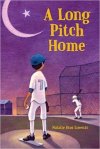
A Long Pitch Home by Natalie Dias Lorenzi

Standard
A Long Pitch Home by Natalie Dias Lorenzi

a long pitch

The correlation between baseball and cricket provides the foundation for detailing the relationship of  Bilal’s first year in America after having to leave Pakistan in a hurry: the same, but different.  This 248 page book written on an AR 4.6 pivots around sports, but has a lot of heart as themes of family, friendship, and longing, take center stage.  Throw in a whole new culture, the English language, Ramadan and prom and you have a whole lot to cover in this well crafted story.

SYNOPSIS:

Bilal has a good life in Karachi, Pakistan.  He is the oldest of three kids and at 10 years old, his world pretty much involves Cricket, friends, and his dad.  When his father disappears things get frantic, and when his father returns, the family decides to move to America.  Unfortunately Bilal’s dad can’t come.  As Bilal, his mom, his younger sister Hira and younger brother Humza, board a plan to Virginia, everything Bilal knows is left behind.

Virginia is home to Bilal’s maternal Uncle, his wife, and their teenage son, Jalaal.  Jalaal plays baseball and arranges to have Bilal join him at baseball camp for the summer.  Learning the new sport, and a new language, and the nuances of life in a new land are frustrating and often comical as Bilal points out how confusing navigating American life can be.  He also keeps an ongoing list of new things in America to share with his dad over Skype, as they swap memories of an old life in preparation for a new one.  The supporting characters on the field are generally kind and accepting of Bilal, because they have a bigger problem then a foreign boy, there is a girl on the team, Jordan.  Jordan is new too, and the coaches niece at that, naturally they become friends, but its not easy, Bilal has to learn what being a friend really means.

The majority of the book stems from the tension of waiting to hear from Bilal’s father, and to see if he can come to America.  The passing of time with baseball games and school are anecdotal to the larger arc that sets the pace of the book.  Will Baba be able to come, and if so, when?

WHY I LIKE IT:

Interestingly religion has a pretty big role in Bilal’s life and the author does explain some tenants in Islam.  He wakes up for fajr (although he does miss it occasionally), he only eats halal zabiha, the family fasts in Ramadan, and they celebrate Eid.  Bilal wants to fast, but him mom tells him he is too young when they are coming to America, and the following year he doesn’t because of baseball, which is unfortunate, because a lot of kids fast and play sports all over the world.  They go to the mosque on Eid only, and it mentions that the women in his family do not wear hijab like some of the women at the mosque.  His older cousin Jalaal wants to take the neighbor girl, Olivia, to prom, which the family explains awkwardly as something that Muslims don’t really do until they are older, or at least that is how Bilal understands it.  In the end, they let Jalaal go with Olivia and a group of friends, and the whole family Skype’s the family in Pakistan and sees them off.  Even more funny is that they don’t join their friends for dinner before the dance, because Jalaal is fasting and can’t eat until later.  I don’t know if this will confuse 4th and 5th grade readers, but as an adult I found it hysterical, because these cultural contradictions are more common than not.  I did like that nothing was done behind the parent’s backs.  Things were discussed and worked out instead of lied about.

Another thing that I found interesting, but since finishing the book, I have come to appreciate, is that there is no Islamaphobia in the story, or even xenophobia.  The kids are accepting of Bilal’s faith and culture.  He is far more self conscious about being different or not understanding than those around him are.  Its idealistic perhaps, but at the same time, I think it would distract from the core of the story.

While the book focuses on sports, I think even non sports fans will be able to enjoy the story.  The author doesn’t get too technical and it moves steadily with mini climaxes and triumphs through out.  Girls and boys will enjoy the book, Muslims and non Muslims too, the readers might even learn something about baseball or cricket or Pakistan, or even about themselves along the way.

FLAGS:

The book is remarkably clean and what you would expect for a good quality, solid 4th grade and up story.  There is the “prom” issue, but there is no hugging, kissing, longing etc.  They “like” each other, but it isn’t more explicit than that.

TOOLS FOR LEADING THE DISCUSSION:

I don’t know if I would use this for a Book Club.  One could, but I think it would require a lot of coaxing to get kids to give a book about baseball/cricket a try.  I have no doubt if they started it, they would finish it, but it might be a tough sell.  The confusion in American life would make for an awesome discussion after being read, because everyone can relate to some of the oddities of the English language, and challenges of learning a new language and culture.  I think how Islam is handled would also make for some good discussion in addressing how each family handles things differently as they arise.  Although written on a 4.6 level if I were to do it in a school setting, I would probably do it for middle school kids who could articulate their own life parallels to the story.

An interview with the author:

http://wordspelunking.blogspot.com/2016/09/a-long-pitch-home-blog-tour-interview.html

Overall a solid decent book about an immigrant Muslim boy making his way in America, while not losing or giving up on who he is, alhumdulillah.

 

Never Say A Mean Word Again: A Tale from Medieval Spain by Jacqueline Jules illustrated by Durga Yael Bernhard

Standard

scan0019_487d580c-5aa9-45f2-b4c1-87e328c94b7e.jpg

I love when tales from the past provide timeless lessons in relevant ways.  Inspired by a medieval legend about the Jewish poet Samuel Ha-Nagid, a royal advisor in Muslim Grenada, Jules creates a story that works for children of all ages and backgrounds.

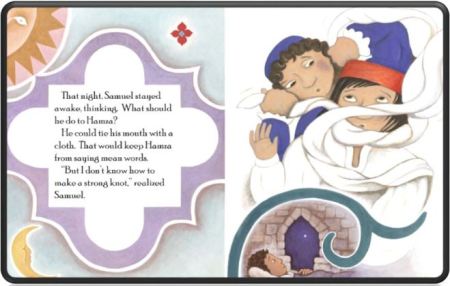
The Grand Vizier’s son, Samuel, bumps into the tax collector’s son, Hamza, and the boys don’t rub each other the right way.  Later that day, Samuel spills his drink on Hamza and can’t convince him both were accidents.  Hamza calls Samuel some mean names and storms off.  Samuel and his father think the name calling is uncalled for, but the vizier does not solve his son’s problem and instead assigns him to “make sure Hamza never says a mean word to you again.”  Samuel imagines ways to teach Hamza a lesson or punish him, but some ideas are too complicated and some just silly.  This is proving to be a hard task.  The next day Samuel shows up to Hamza’s house with a lemon.  He thinks forcing Hamza to eat it is a good punishment for a mean mouth, however Hamza thinks the lemon is to help with the stain that ruined his clothes, and tells him his mother already tried that.  Caught off guard by Hamza’s reaction, the two somehow end up playing catch with the lemon and enjoying the afternoon together.  The next day he shows up to Hamza’s house with ink and paper thinking he will make Hamza write him an apology.  Hamza however, thought Samuel showed up to draw, and once again the boys enjoy an afternoon together.  This carries on until the boys are so used to seeing each other and having fun together, they become friends.  Samuel fears that he disobeyed his father and did not handle Hamza only to realize that by befriending his “enemy” he did in fact make sure Hamza never said a mean word again.

idea

The book is 32 pages with an Author’s Note about the real life events that the story draws upon.  The book is not AR, but the large bold typeface and the warm simple pictures make this book work great for story time with young children.  It compliments themes about bullying and making friends as well as being silly.  It works well for third graders and older ones too, as they might understand people of different faiths struggling to get along or people of different socio-economic classes, or even just imaging how they would solve a problem without their parents doing it for them.  I was pleasantly surprised by the book and how it handled the Muslim/Jew staging of the characters.  Especially right now in today’s world, this story has a poignant lesson for us all. If we all spent time together having fun, we too could end up being friends, or at least getting along.  I think the story and its lessons have merit and relevance, and thus a place on the bookshelf.


Samira and the Skeletons by Camilla Kuhn

Standard
Samira and the Skeletons by Camilla Kuhn

samira.jpg

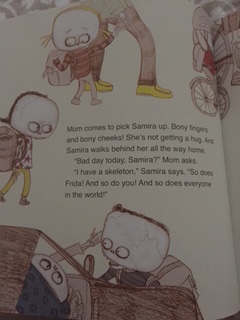
Quite possibly there is nothing Islamic about this book, but the main character’s name, Samira, is traditionally an Islamic name and thus it caught my attention.  I also think one could argue that the mom in one of the pictures (see picture below) is possibly wearing a hijab.  So, probably I shouldn’t include it on the blog, but the book is so disturbingly creepy, in a fantastical way, that I thought, why not.

img_3063

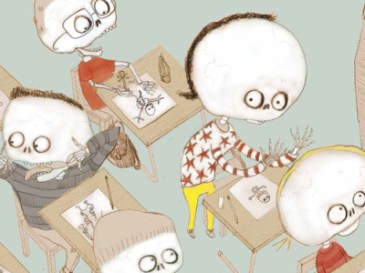
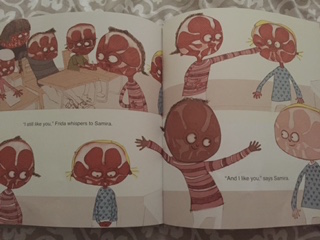
Samira learns that everyone has a skeleton and bones one day at school, and it frightens her.  She starts seeing everyone’s skulls instead of their outward body parts and she refuses to accept that she has such morbid parts or that her friend Frida does too.  Knowing that she is chewing with teeth, skeleton parts poking through, at lunch is too much and she can’t even be near Frida.  When she gets home she tells her mom she wants to be free of her skeleton, and her mom agrees.  Yes, agrees! They resolve the tooth fairy will be delighted to get a whole skeleton, not just a few teeth.  So the mom, gets some tools and preps a table to perform the surgery required to remove her skeleton.  Luckily Samira runs for it and finds Frida, and alas the girls accept that they have skeletons and use humor to diffuse the fears they have of what lurks beneath their skin.  That is of course until the next day at school comes, and they learn that they have muscles, just like steak.

samira-spread-classroom

The imagination of the girls is quite remarkable.  I love that it starts with a lesson and that information about skeletons and animals, such as jelly fish that don’t have them exist, is sprinkled through out.  I also like the approach, its weird, but in a delightfully fun way.  It also lends itself well to a discussion of how we are more alike than different.  Our outward appearance doesn’t define us when we are all made up of bones and muscles.  The story doesn’t address it, but some kids might infer it or connect the dots with a little prodding.    img_3064

The book is not AR, but I think most 5 year olds and up can read it or follow along giggling all the way through.  It probably isn’t for every child, but those with a darker sense of humor will enjoy all 34 pages.

One Hundred Ice Creams by Sumayyah Hussein illustrated by Derry Maulana

Standard

one-hundred-ice-creams

This book on my first reading reminded me a lot of Amira’s Totally Chocolate World in that it takes a religious idea, in this case Jannah or heaven, and uses a child’s excitement for a favorite food to explore it.  Not a bad technique, and alhumdulillah the author was able to stay on the idea of heaven and add some additional information then just the silliness of having all the ice cream you could imagine.  The book is 36 pages and can probably be read by a first or second grader independently and appeal to story time ages of preschool 4 and up.  The book unfortunately takes a while to get going. I struggled with the first few pages, which I found really wordy, and puzzling.  The kids seem to be about 6 years old in the illustrations and in their mannerisms, but they start off the book complaining about homework and needing a break from it, which even my own children found confusing and remarked on it.  There also seems to be some unnecessary description too, in setting the stage: the day, the vehicle, the season, that it’s their favorite park, that they haven’t been there in a while, that they took a breath of fresh air, that they waited 10 minutes, etc..

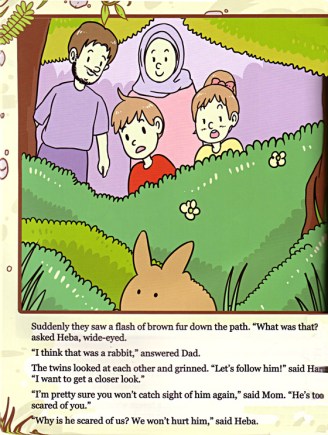
Thankfully I think once the reader’s get that the park is crowded, that the kids couldn’t enjoy the swings and slide and decide to explore the nearby woods, the story finds its rhythm and engages the reader quite well.  A few minor hiccups throughout the book are again, the abundance of details that don’t further the story and aren’t developed. The river is described when they cross the bridge, and then there is another one, or possibly the same one, as this one is now rushing, and it jars the story as there seems to be a lot of rivers in this park.   There is also a rabbit that pops up and excites the kids and then shows up at the end again, which is cute and brings the story to a happy close, but I don’t really love how the parents dismissed it.  Why not let the kids see that he is scared of them and figure out that he doesn’t know they won’t hurt him/her,  rather than have mom tell them they won’t see him again and dad quickly steering them in another direction. Granted this is my personal preference, but I like when kids figure stuff out in books and solve things themselves, rather than how perhaps it is in real life, with mom and dad constantly calling the shots.ice-creams1I really like how when discussing Jannah, they talk about the rivers of milk and honey, and I absolutely loved how they talk about Grandpa (hopefully) being in Jannah and being young and strong.  I couldn’t figure out why when in the woods and marveling at nature the characters didn’t use Islamic expressions like, mashaAllah, subhanAllah, and inshaAllah, and when I read it aloud I had to add them when we got to the pages about Grandpa.  It seemed awkward not too.  The book is clearly for Muslim children, there is a reference page in the back with the ayats from the Quran and hadeeth that tell us about Paradise, and the characters are discussing an Islamic concept, so I’m not sure why their language isn’t reflective of that.ice-creams-2
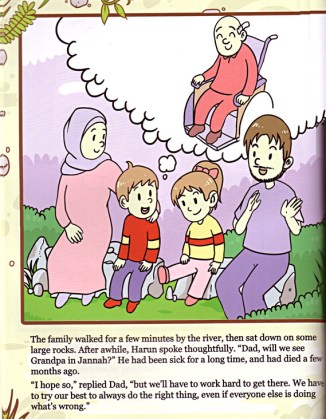
The illustrations are simple and colorful and complimentary to the story.  I don’t know why the color of the character’s skin is yellowish green.  It seems to match the ice cream and on some pages seemed more noticeable then others.  Dad’s face when he is swatting the fly is a little angry and the color of the skin makes him look mean.  Not sure why the flies are mentioned. And the illustration is not reflective of his personality in the rest of the book.
cream.JPG

Overall the book has a good message, I think I have just loved all the books at Ruqaya’s Bookshelf so much, that my expectations may have been a little too high.  I’ve never written a book and I have no idea what the publishing process for this book was, but I feel like a a few minor adjustments from an editor or proofer would have made this book absolutely phenomenal.  That is not to say it isn’t a good book,  children undoubtedly, will get a tangible understanding of Jannah after reading the story.  An additional plus is that it is on their level in both content and in perspective, meaning that there is lots to chat about after.  Concepts that the children can discuss based on what they understood from the story with little prodding from an adult.  Points from how the kids are treated at the playground, to adding what they would want they are in Jannah, and ultimately steps we can take to increase our chances of getting there, inshaAllah.

Laila and Pesto the Fly by Rania Marwan illustrated by Fatima Asheala Moore Jewel Series Story #1 Cheating

Standard

laila-and-pesto-the-fly

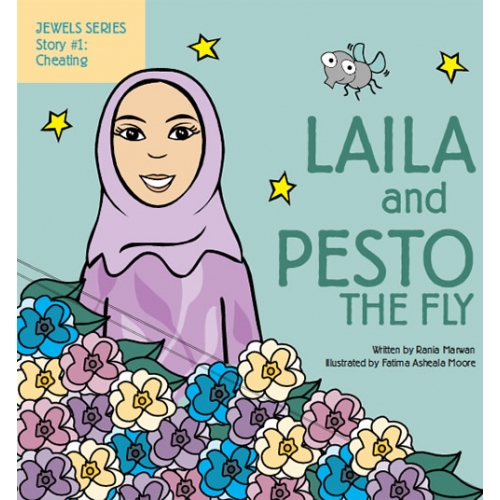
I ordered this book with the hopes that it would be the first book of a wonderful series teaching values in an Islamic context.   It says that it is book #1 in the Jewels Series and it focuses on cheating.  However, the book was published in 2009 and I can’t find any other books in the series.  Sadly, I can possibly see why.  The book is not great.  The illustrations make it so tempting even if all the girls are gorgeous and the illustrations simple, they would seemingly work well with a book aimed at 4 to 8 year olds, and just 24 pages long.

laila1

Unfortunately the text is lacking and doesn’t create a story worth reading more than once. The sentences are repetitive. And the same words are used over and over.  The first page alone says the word “play” four times in three sentences.  It is about 4th grade girls that play, watch cartoons and essentially hold lessons/ book clubs for each other once a week.  A lot going on for a book that on the second page says the word “flies” three times in three sentences.  Needless to say the repetition makes it hard for a story time selection, and the run on sentences hard for young readers.  The first page features a font that is probably about a size 20 and the next page it drops down to one that is about 11, the third page is about a 14 and the trend of the ever-changing font size continues throughout the book.

laila-text

Example of repetitiveness from Laila and Pesto the Fly

The story idea is a good one at its core.  A girl teaches her friends about flies.  Then the fly talks about Laila and how she is kind and honest. Then the next sections returns to Laila not being ready for a math test and she is tempted to cheat when Pesto, the fly, distracts her and writes a message for her in glitter.  I’m not sure how the glitter stays on the page, but, the message is received by Laila and emphasized by the author sharing a hadith, “He that deceives us is not one of us.” The last page of the book is a bulleted list emphasizing the harms of cheating, and how to overcome the temptation as the girls urge you to join their Cheat Deceit Foundation.

Overall, the book is awkward and doesn’t work for me.  There are a lot of better books out there.  That being said, if the author wrote another book, I may give her another chance, it isn’t hopeless. It just needs some tweaks. The fly is a silly likeable character, but the group of friends are a monolith and have no individual roles.  The message is clear and important, and we need books like this, but alhumdulillah the standards have gone up, way up, and the writing quality isn’t where it needs to be to attract Muslim children or their parents.