Tag Archives: Muslim Author

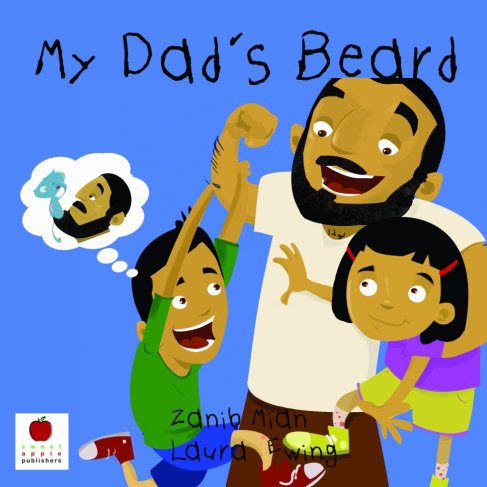
My Dad’s Beard by Zanib Mian & Laura Ewing

Standard
My Dad’s Beard by Zanib Mian & Laura Ewing

cover-my-dads-beard

I honestly don’t think this 11×11, 32 page book could be any sweeter.  With just a few words on each page the simple sentences convey such love and warmth from a boy to his dad, by way of his beard.

MyDadsBeard3


The boy articulates that his father’s beard is different from his uncle’s and his grandfather’s and that his kisses tickle because of it.  He knows his sister loves his dad’s beard too because she holds it when she is scared.  Grandma says it makes him look like a real man, and the way it looks in the morning, is just silly.

dad's beard

The author is Muslim, but there is no overt Islamic content or depiction except for the one page that any Muslim would take to reference Prophet Muhammad (saw), see picture below.  Which is a great segue to talking about Rasulullah and his sunnah.

beardThe large bold pictures and simple words make this story perfect for kids a year old and up.  The book definitely deserves a place on every bearded baba’s book shelf.  I challenge you to read this book and not smile, I am confident it will win you over, no matter how many times your little one asks you to read it.

My-Dads-Beard-book1

My only complaint, is that given the size of the book, and how perfect it is for little kids and in story time, the soft pages flop over.  It is impossible to hold the book, read it, and show the pictures in one go, you have to juggle a bit more than one would want. Additionally something to note, is that on the pages where the boy talks about his uncle and granddad, the diction is clearly more British than English. My older kids remarked, but it definitely wasn’t a problem.

Here is a link for the book trailer: https://www.youtube.com/watch?v=Uf7tbvJ5aSw


Zachariah’s Perfect Day by Farrah Qazi illustrated by Durre Waseem

Standard
Zachariah’s Perfect Day by Farrah Qazi illustrated by Durre Waseem

IMG_4757I was really excited to learn about this book from the author, as it seemed to be a book that would stand out in a very crowded genre and work for both Muslim and non Muslim kids.  When I tore off the package however, the face on the cover seemed a bit off for my taste, the glossary is on the back cover and while the pages are full size and full color, the book starts on the first page and somehow seemed more “home done” than “professional.”  Which isn’t a bad thing, and I’m happy to support local writers, but alas I do often judge books by their covers and format, and my first impression had to be stuffed away so I could give the book a fair chance.

The book is 20 pages with the 20th page being recipes.   I would guess children 5 and up would be considered the target audience.  It basically is a book telling about Ramadan with the author trying to blend in a story, that for me, sometimes worked and sometimes really didn’t.
FullSizeRender (3)

It starts with Zachariah, a 12 year-old-boy waiting for his mom to wake him up to fast, a day he has been waiting his whole life for.  Why he had to wait to fast at age 12 is not clear to me or made clear in the story.  His 10 year-old-sister only does half days, but in the illustrations she seems to only look about 3 years old, so I’m not sure where the arbitrary age requirements for fasting come from.  There is also a third sibling in the pictures that is never mentioned, not sure why, my kids and I speculated a lot more on that than we probably should have.  It isn’t told from Zachariah’s point of view but he is the focus as his day gets started.

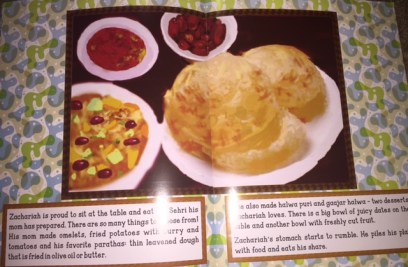
The characters are undoubtedly desi as the book is very steeped in subcontinent cultural over tones.  Sehri, the pre dawn meal, is described in abundance of detail, “His mom made omelets, fried potatoes, with curry and tomatoes and his favorite parathas: thin leavened dough that is friend in olive oil or butter”  It’s a bit detailed of how the items are prepared for a kid’s book, and that is just page one of two pages dedicated to detailing the food on the table for breakfast.  Iftar the meal to break the fast is also two pages of description and cooking methods, but about double the amount of text.

FullSizeRender

Culture is often food, and Ramadan has its own food traditions, but there is a lot of space dedicated to food in this book,  and it kind of takes away from the message of fasting, and moderation, and not going in excess.  Later in the book the mom does pack up some of the food to take to the less fortunate which is great, but she does it while the rest of the family is breaking their fast.  Not sure why she couldn’t have done it before or after and joined them.

After sehri is presented the family talks about Ramadan and what it means and what they like best about it.  There is a bit of dialogue that is actually sweet and funny, and gives some warmth to the story.  It is clear the author is just trying to flesh out the facts about Ramadan, but for a kid’s book, I think getting the facts in and presenting them in a fictionalized setting is a useful tool.
FullSizeRender (2)

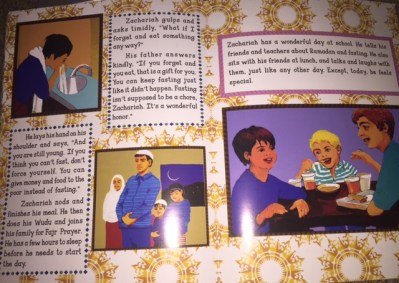
The story seems a bit lopsided when it shrinks Zachariah’s day at school to one five line paragraph saying it was wonderful and then moves on saying “Later, he helps his mom.”  After spending 10 pages on the predawn meal, I would have liked to know a bit more how school went for him, it is his perfect day after all.  Also, the lapse in time by the narrator seemed a bit off to me in the sequential flow of the story, as it was following him in real time so to speak, and then fast forwards the bulk of the day only touching on lunch time, and

FullSizeRender (1)

Alhumdulillah, the family is sweet and excited for Ramadan. They pray together and are seen with smiling faces.  There isn’t much diversity in the pictures, the family has darker skin, the friends at lunch are more fair.  The mom wears hijab and is in the kitchen, dad doesn’t seem to be, but Zachariah helps his mom.

The book is colorful, and busy.  I’m not sure if the pictures are meant to be a stylized reality or look computer generated, but they seem a little blurry in places.  The font and backgrounds are nice.  There is a verse from the Quran in English and Arabic, as well as the athan and some Islamic calligraphy.

Overall, there is nothing “wrong” with the book, it just isn’t memorable.  There are some really good Ramadan books out there, and this one does it’s job of explaining Ramadan, but lacks the characters to leave an impression.  I definitely don’t regret buying it, but I don’t know that my kids or I will read it again this Ramadan, it doesn’t create that reaction.  It will probably stay on the shelf until next year, when we can’t recall many of the details and give it another go.

IMG_4748 (1)


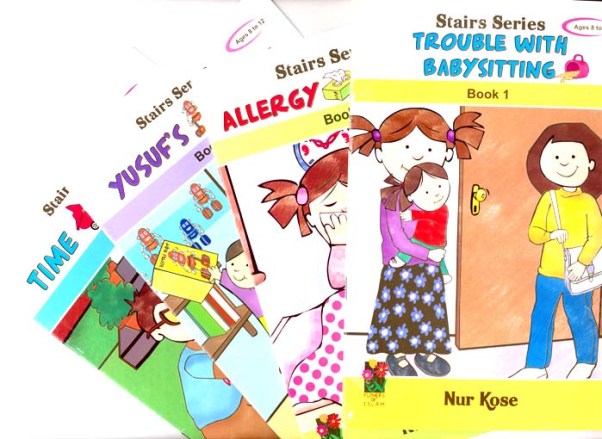
Stairs Series: Trouble with Babysitting, Allergy Attack, Yusuf’s Robot & Time Travel by Nur Kose illustrated by Shaista Asad and Ayesha Khatib

Standard
Stairs Series: Trouble with Babysitting, Allergy Attack, Yusuf’s Robot & Time Travel by Nur Kose illustrated by Shaista Asad and Ayesha Khatib

stairs series

This set of books claim to be for children ages 8 to 12, but I think they work better for 7 to 10 year olds.  They look like leveled readers, and resemble them in their simple linear story lines.  They are broken up in to chapters, that really are not necessary, but because of the volume of text on each page, allows for a young reader to take a break.  All four books in the series are connected chronologically and contain the same characters.  They more or less present a problem, bring over their friends, have one of the friends offer some advice tied to a hadith or ayat from the Quran, and the advice is tested, and then shared once more.  They are about 20 pages and have activities at the end that range from solving clues to writing paragraphs.  The sentences and vocabulary are about a second grade level, with translations of Arabic and Turkish words, along with references to the Quran and Hadith appearing in the footnotes on the page they are mentioned on.

stairs series characters

The best part of the books is that they are written by an 8th Grader, mashaAllah.  I think they teach a lesson in a simple way, and while not terribly suspenseful or comical, they do succeed in showing Islamic lessons in relatable situations for kids.  Some of the details seem excesses or meandering, but again, the fact that it is written by a kid, will inspire readers to listen differently to lessons about patience, accepting Allah’s will, recognizing one’s own limitations, and putting Allah (swt) above all else.

stairs inside

The pictures are colorful and simple.  They appear every few pages in the book and provide a nice break from the text.  They are sweet and not detailed, but sufficient for the story and level.

stairs pictute

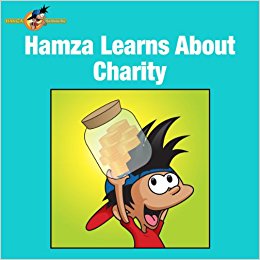
Hamza Learns about Charity by Ameena Chaudhry

Standard
Hamza Learns about Charity by Ameena Chaudhry

hamza learns about charity

It is hard to believe I haven’t reviewed any of the seven Hamza books in the series.  They are perfect for 2-6 year olds (older kids will enjoy them too), and all are both informative and silly.  This book is 20 pages and is seven and half inch square in shape.

In Hamza Learns About Charity.  Hamza learns what the word charity means as his mom is packing up his old toys to donate to the less fortunate.  He also learns you can give money and how donating and taking care of the poor is required in Islam.  Hamza’s mom tells how Prophet Muhammad (saw) lived a simple life and was very generous with whatever he had.  Hamza also learns the word for charity in Arabic.  When his mom leaves to take the stuff, Hamza decides to show that he understands and is ready to give everything away and live a simple life.  Alhumdulillah, mom returns in time to shoo the neighbors away and convince them that the house, and car, and household items are not for sale.  Thus, Hamza also learns that we aren’t required to give everything away, and when making big decisions we should get our parents’ permission first.

The illustrations are cute and colorful.  They are not overly detailed, but Hamza’s facial expressions are engaging and expressive.  The book works well for story time and bedtime and seems to be geared for Muslim children.

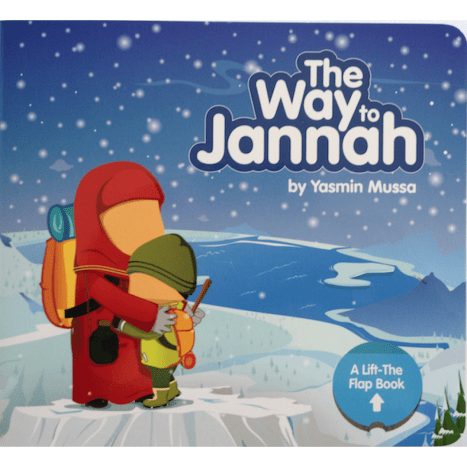
The Way to Jannah by Yasmin Mussa

Standard

the way to jannah.png

Somehow between child number one and child number four I had forgotten the utter impracticality of toddler board books with flaps to lift.  It is great and all to find a book that is solidly constructed to withstand tantrums, hunger, teething, and jumping on, but then to add thin delicate flaps to engage the child renders the book readable for about three days.  Ok, the time it takes for any given toddler to systematically tear off every flap is unique for each child, but my 18 month old handles his siblings chapter books with more care than he can muster for the overpowering temptation of a slightly raised flap of paper begging to be tugged on.  Needless to say, all 16 pages of the book are no longer in pristine condition, alhumdulillah.

waytojannahpic2

Also, Alhumdulillah that is a decent book of introducing islamic phrases to small children and hence the repetition of the book means that even with the missing flaps and torn off words, the book can still be figured out and read.  A boy and his mom journey up a snow covered mountain as the little boy tries to learn what to say to go to Jannah (heaven).  As he says islamic phrases like AstagfirAllah, SubhanAllah, and JazakAllah Khayr, his mother tells him when those phrases are used and what they mean, until the boy figures out he must say and believe the Shahada (there is only one God, and the last Prophet is Prophet Muhammad (as)).  The sayings are written in Arabic script, and English script under the flap, and the back of the book has a glossary of the Islamic words. The language is simple and encouraging for small children and a good way to reinforce the words we say to remember Allah throughout our day.  The characters have no faces and with a snow filled landscape the pictures aren’t overly engaging, but what is there, is done well, and allows the text to take center stage in the story. Those flaps though….

jannah3


Bedtime Ba-a-alk by Rukhsana Khan illustrated by Kristi Frost

Standard
Bedtime Ba-a-alk by Rukhsana Khan illustrated by Kristi Frost

bbaaalkcover

I know, I know another book by Rukhsana Khan, but really how great is she.  She writes books with religious references sometimes, cultural ties sometimes, and sometimes just fun books. I love that kids of all backgrounds associate her with good stories, and that she hasn’t limited herself to just one demographic.  img_1893

Bedtime Ba-a-a-lk has no religious or cultural connections and is just about a girl dealing with rogue sheep in her mind that don’t want to be counted.  The AR level is 2.6 but I don’t know that 2nd graders and below would really “get” the story.  The vocabulary is great, with a little assistance: balk, conjuring, deliberate, snub, mutiny, haunches, eider-down, furrowed, etc..  And the concept of a girl creating her imaginary dream world and conversing with the characters in it, is grand, but I look forward to testing out which age groups grasp it, and which ones just think it is a funny story with an obstinate ram.

img_1894

The book is 30 pages and beautifully, playfully illustrated.  The pictures are just “fuzzy” enough to give a sleepy feel, and bold enough to stretch the imagination.  The lines do not rhyme, but flow easily.  The font is large and inviting, and well placed on the page.  The book is clean, and the girl in her pleading with the sheep uses “please” and good manners in her firm demands.   It does use the word, stupidly and darn, once each, but overall a silly fun read.


Laila and Pesto the Fly by Rania Marwan illustrated by Fatima Asheala Moore Jewel Series Story #1 Cheating

Standard

laila-and-pesto-the-fly

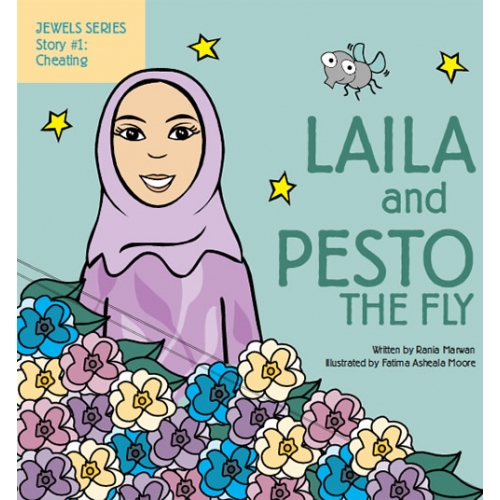
I ordered this book with the hopes that it would be the first book of a wonderful series teaching values in an Islamic context.   It says that it is book #1 in the Jewels Series and it focuses on cheating.  However, the book was published in 2009 and I can’t find any other books in the series.  Sadly, I can possibly see why.  The book is not great.  The illustrations make it so tempting even if all the girls are gorgeous and the illustrations simple, they would seemingly work well with a book aimed at 4 to 8 year olds, and just 24 pages long.

laila1

Unfortunately the text is lacking and doesn’t create a story worth reading more than once. The sentences are repetitive. And the same words are used over and over.  The first page alone says the word “play” four times in three sentences.  It is about 4th grade girls that play, watch cartoons and essentially hold lessons/ book clubs for each other once a week.  A lot going on for a book that on the second page says the word “flies” three times in three sentences.  Needless to say the repetition makes it hard for a story time selection, and the run on sentences hard for young readers.  The first page features a font that is probably about a size 20 and the next page it drops down to one that is about 11, the third page is about a 14 and the trend of the ever-changing font size continues throughout the book.

laila-text

Example of repetitiveness from Laila and Pesto the Fly

The story idea is a good one at its core.  A girl teaches her friends about flies.  Then the fly talks about Laila and how she is kind and honest. Then the next sections returns to Laila not being ready for a math test and she is tempted to cheat when Pesto, the fly, distracts her and writes a message for her in glitter.  I’m not sure how the glitter stays on the page, but, the message is received by Laila and emphasized by the author sharing a hadith, “He that deceives us is not one of us.” The last page of the book is a bulleted list emphasizing the harms of cheating, and how to overcome the temptation as the girls urge you to join their Cheat Deceit Foundation.

Overall, the book is awkward and doesn’t work for me.  There are a lot of better books out there.  That being said, if the author wrote another book, I may give her another chance, it isn’t hopeless. It just needs some tweaks. The fly is a silly likeable character, but the group of friends are a monolith and have no individual roles.  The message is clear and important, and we need books like this, but alhumdulillah the standards have gone up, way up, and the writing quality isn’t where it needs to be to attract Muslim children or their parents.


Nusaiba and the 5th Grade Bullies by Asmaa Hussein illustrated by Zul Lee

Standard

Nusaiba.png

As someone who deals a lot with reading and comprehension, I really misread the description of this book and assumed erroneously that it was a chapter book targeting 5th graders.  Oops, alhumdulillah, my confusion and slight disappointment didn’t last long as I got swept up in Nusaiba’s spunky imagination and endearing personality.  The message of the book is powerful.  Not only does Nusaiba have to deal with bullies, but she has to wrangle with accepting herself, even if that means being different.

nuaiba2

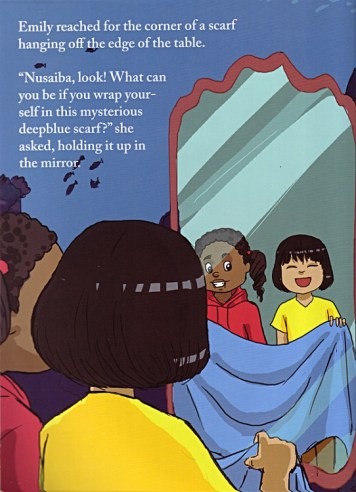
Nusaiba is almost to school when she overhears some 5th grade boys making fun of her mom and what she is wearing.  Nusaiba’s mom is wearing a hijab, and the story is set up to imply that that is what they find “weird.”  This morning encounter bothers Nusaiba all day, and while she doesn’t talk to her teacher about it when asked, she does spill the beans to her best friend Emily.  The next day Nusaiba distances herself from her mom and asks to walk to the school gate alone.  The bullies don’t say anything, but Nusaiba feels guilty about leaving her mom like that. Later that day when Mom picks Nusaiba and Emily up from soccer they swing by a local hijab shop for some clothes shopping.  I don’t know why, but I found the premise for taking the girls clothes shopping a little forced.  It seemed too words of a setup, and I couldn’t help but wonder why Emily would be dragged along.  As mom tries on skirts for work, the girls in their boredom get swept up in using the scarves as costumes and transforming themselves from queens, to underwater divers, to fisherwomen, to mountain climbers, to fantastic cleaners ready to clean up all the scarves on the display.  Her mom lets her pick one to buy, and she decides to wear it to school the next day.  It is noteworthy that Emily doesn’t try on any of the scarves.  She is an amazingly supportive friend, and even in make-believe is right there with Nusaiba, but she doesn’t put one on, and I kind of want to know the author’s reasoning or purpose as to why.  So the next day at school, Nusaiba asks her mom to again walk with her, and when the 5th grade boys call her mom an “odd-ball.” Nusaiba finds her courage to confront them.  Nusaiba and the reader discover the boys are making fun of Nusaiba’s mom, but it isn’t for her hijab.  Nusaiba and her mom set the boys straight and giggle in the process, as Nusaiba realizes she can be anything she dreams.

nusaiba1

The book is 44 pages and probably about a second grade mid year reading level.  The pictures are big and bold and beautiful making it a great option for story time to ages 4 and up.  The pictures do an amazing job complementing the story and going back through to look at them after the “twist” at the end was even more delightful.  The illustrator draws you into Nusaiba’s world and you really do cheer her on when she stands up for herself. The book easily lends itself to discussion, and there is also a question guide at the end, incase you get stumped. It reads more like a school assignment, but it could obviously be re-worded to engage a child at bedtime or in a read-a-loud environment.  The font is a nice size, however, I found it distracting. On some pages it is white on others black, on some it has a shadow and on others it does not.  I’m certain most people would not notice, but for some reason it was jarring to me.  Alhumdulillah, alhumdulillah, if that is the only negative in a book, I think everyone who reads it will be glad to have a copy of their own to read again and again and again and again and….


King For A Day by Rukhsana Khan illustrated by Christiane Krome

Standard

King-for-a-Day1.jpg

Its time for Basant, the Lahore, Pakistan kite flying festival, and Malik and his siblings are ready.  Ready to launch Falcon into the sky, ready to set other kites free, and ready to put the bully next door in his place.  While some kids have huge kites, and some have many, Malik has just Falcon, a speedy little kite that Malik prays can get the job done.

King for a day inside

Once again Rukhsana Khan does a remarkable job of taking a universal theme, adding some culture, and finding artists to empower minorities without making it an issue, all in a 32 page children’s book.  Written on an AR level of third grade ninth month, readers see characters handling a bully by beating him “on the court” so to speak, a character having confidence in his abilities, yet still asking Allah swt for help, and a boy in a wheel chair celebrating a fun spring time festival with his family.

king 1

The illustrations are rich with texture and angles, which contrasts the font and text presentation.  Little kids probably won’t be tempted to pick this book up, but as a read-a-loud first and second graders will enjoy the story and the kite flying action.  Third and fourth graders will enjoy reading the book independently, and find themselves cheering for Malik, appreciating his kindness, and wanting to pick up a kite and head out themselves.  The author includes a note at the back which provides more information about Basant and how it is celebrated.  Although it takes place in Pakistan and is a festival not celebrated in America, there isn’t a “foreign” feeling to the book, as kids can relate to bullies, wanting to be the best and the satisfaction of succeeding and feeling like a “king for a day.”

king2

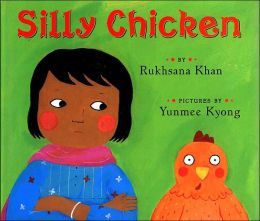
Silly Chicken by Rukhsana Khan illustrated by Yunmee Kyong

Standard

silly chicken

Silly Chicken is a story about sibling rivalry, except there isn’t a sibling, there is a chicken.  Rani feels that her mom, Ami, loves a chicken, Bibi, more than she loves her.  Rani is jealous of the attention Bibi receives and finds the chicken in general, silly.  One day when Rani and Ami leave their home by tonga to visit her father’s grave, a dog gets in and when they return, Bibi is no more.  Ami is devastated and Rani is sure she closed the gate.  It isn’t until Bibi’s egg hatches by surprise, that the story comes full circle and Rani responds to Ami’s chiding that she loves the baby chick more than her mother, that the reader and Rani realize how silly that would be.

I really liked this 32-page, brightly and playfully illustrated book.  It is written on a AR 2.3 level and is fun out loud or at bed time.  The story takes place in Pakistan and a lot of reviews online remark that it is a good book about Pakistan or for showing Pakistani culture, critiques that I both agree and disagree with.  Every kid, everywhere, through out time, can probably relate to being jealous of something or someone occupying their mother’s attention.  The concept of a pet and loving it and being sad and feeling guilty, are all universal themes.  That being said, both the author and illustrator do a remarkable job of breaking stereotypes without drawing attention to them.  Ami and Rani are relatable and are clearly Pakistani, subtly removing an us and them stance.   Rani’s dad has passed away, but Ami and Rani seem to be doing well.  Ami seems very self-sufficient in daily activities and brave when they think a burglar may be present.  The two chat with neighbors and travel independently breaking down the erroneous stereotype that women cannot go out or be recognized without a male.  The mother wears hijab and traditional Pakistani clothes while Rani being young obviously does not cover.  Their clothes are bright and colorful and their expressions relatable and inviting.  The way that Bibi’s death is handled is age appropriate and a child could possibly think she simply was run off rather than killed, either interpretation would allow the reader empathy for Ami and be a great topic to explore with a child.  Enjoy!