Tag Archives: Morals

The Monkey, The Cow, and the Wolf (The Song Book) by Zain Bhikha illustrated by Amir Al-Zubi and Azra Momin

Standard
The Monkey, The Cow, and the Wolf (The Song Book) by Zain Bhikha illustrated by Amir Al-Zubi and Azra Momin

I was wondering when the book version of this song was going to be released.  It is a beloved at our house, and when the book arrived, I don’t know if the 4 year old or 13 year old was more excited.  Either way, none of us were able to read the book, we all, by about page two, were singing at full volume the story of the monkey, the cow, and the wolf.  If upon seeing this cover you didn’t immediately start humming the beloved kid’s song, then you are in for a treat with this book as three stories about animals teaching timeless lessons are shared.  The book is simply the lyrics of the song, so a parent might need to explain a bit, but the fun illustrations, and rhyming lines will make it a favorite for toddlers and preschoolers to sing and flip pages to, alhumdulillah.

The song/book is organized with a statement, a chorus highlighting the moral after each story and then repeating the opening framing statement.  The first story is about a business man who would cheat his customers, Allah swt sent him a monkey, and the monkey purified his wealth by disposing of half of it in the sea. The moral being that “Allah hates cheating, Allah hates lies, so give what’s due and receive what’s right.”

The next story is about a farmer and his cow.  The farmer works his animals way too hard, so Allah allows the cow to speak and tell his owner not to abuse him or the other animals.  The moral being that “Allah made animals, Allah made man, to all living creatures be kind and fair.”

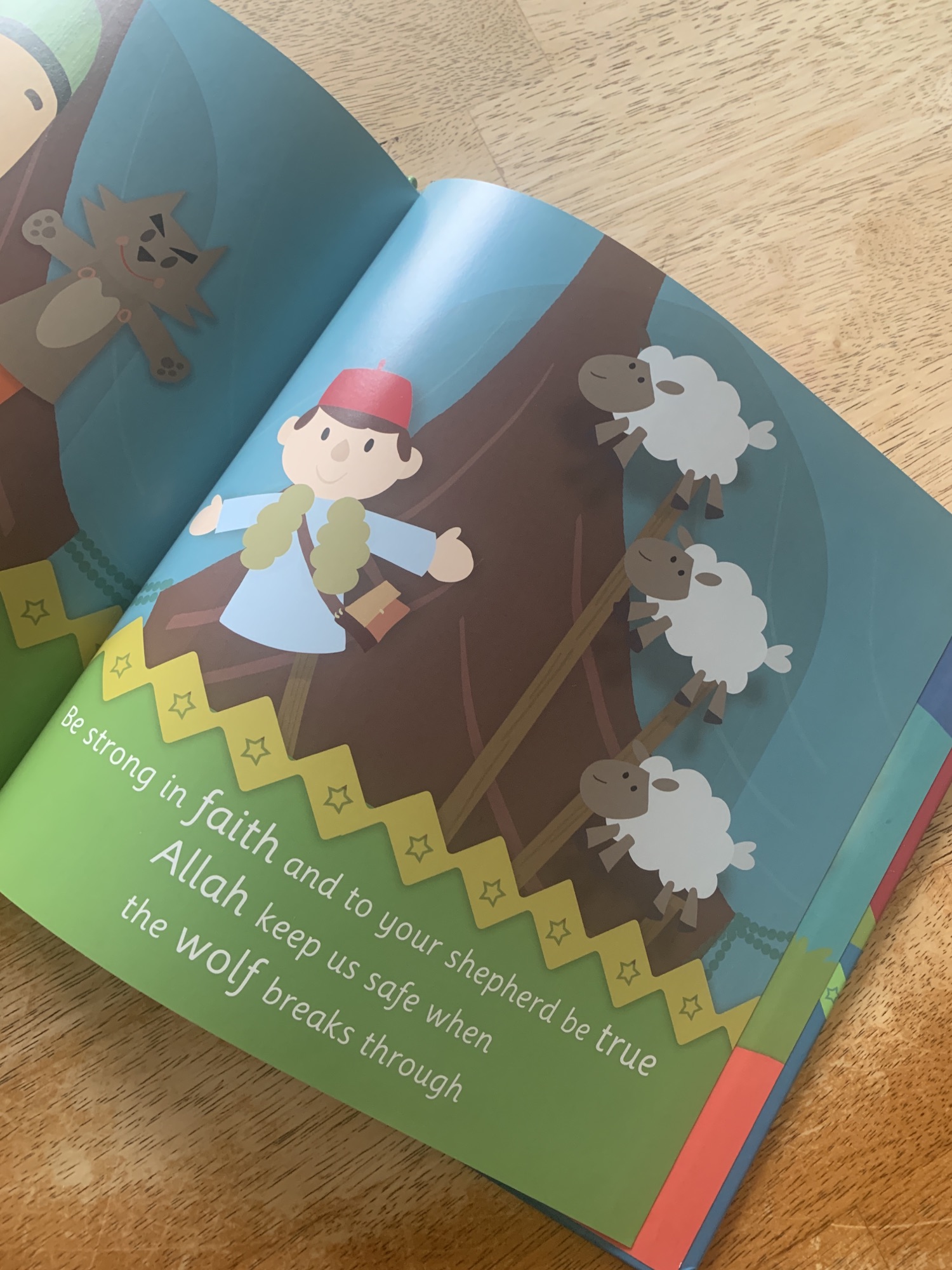
The final story is about the wolf trying to steal the sheep and the shepherd protecting them.  The warning is that the sheep must be strong in faith for the wolf will always be trying to take you.

The book and song are catchy and fun, and provide stories and morals to discuss with kids at story time and bedtime.  The only slightly odd thing about the book is that the last page is the inside back cover.  I’m sure it was a binding decision but it seems it could have balanced the title pages at the beginning to make it feel symmetrical.
Available to order HERE
Lala Comics: The Hilarious encounters of a Muslim Woman Learning Her Religion by Umm Sulayman

Standard
Lala Comics: The Hilarious encounters of a Muslim Woman Learning Her Religion by Umm Sulayman

Lala

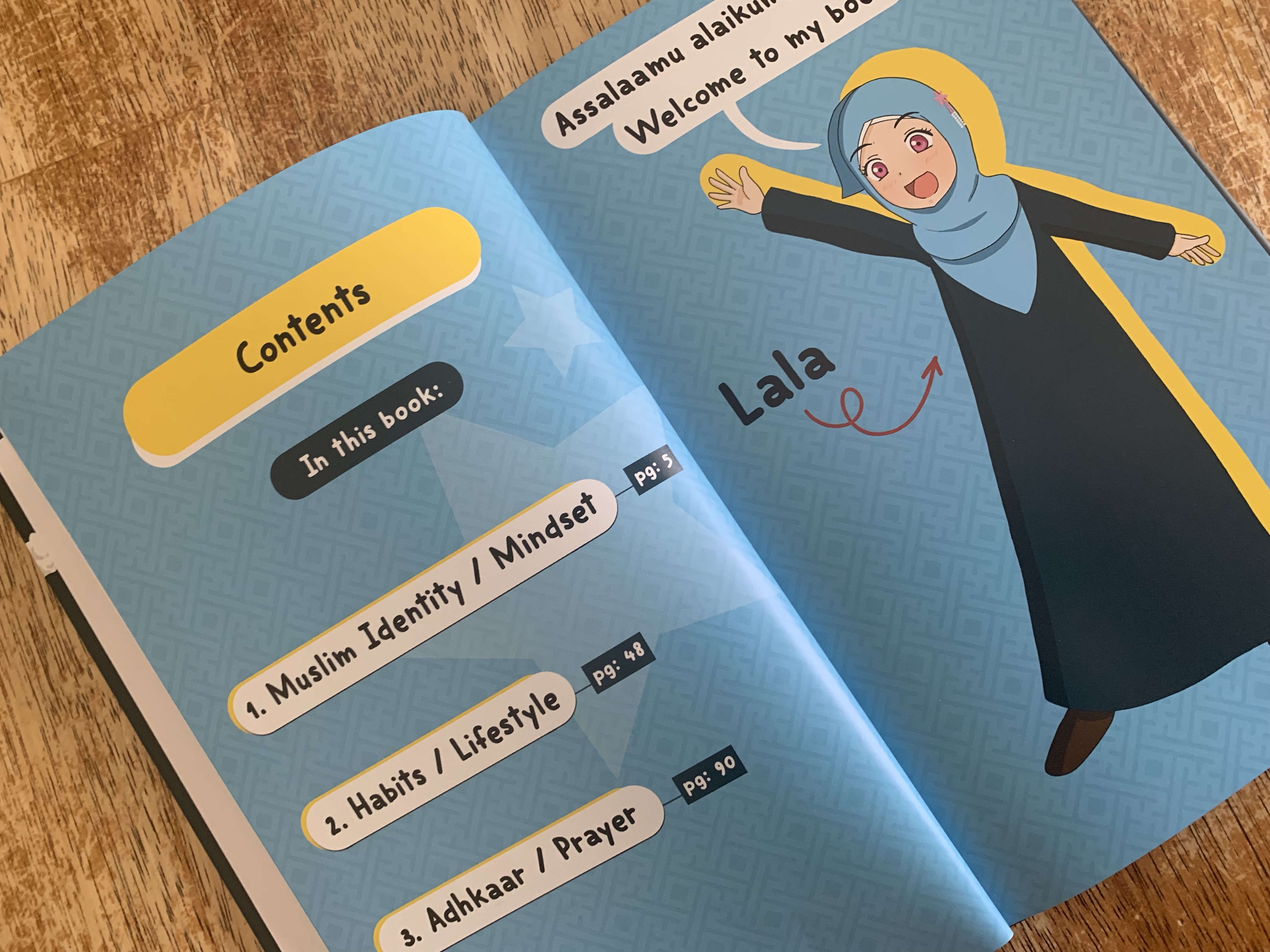
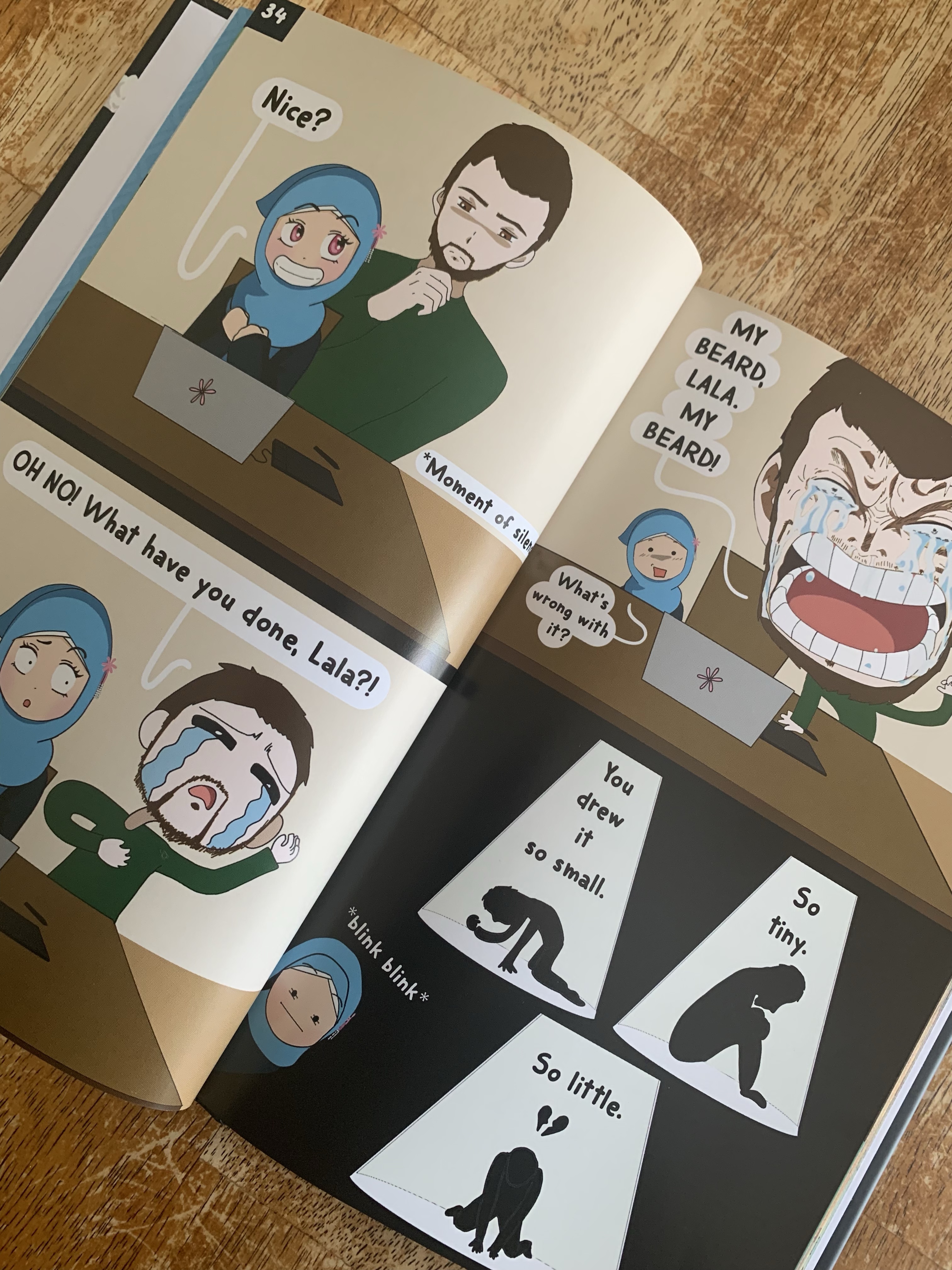
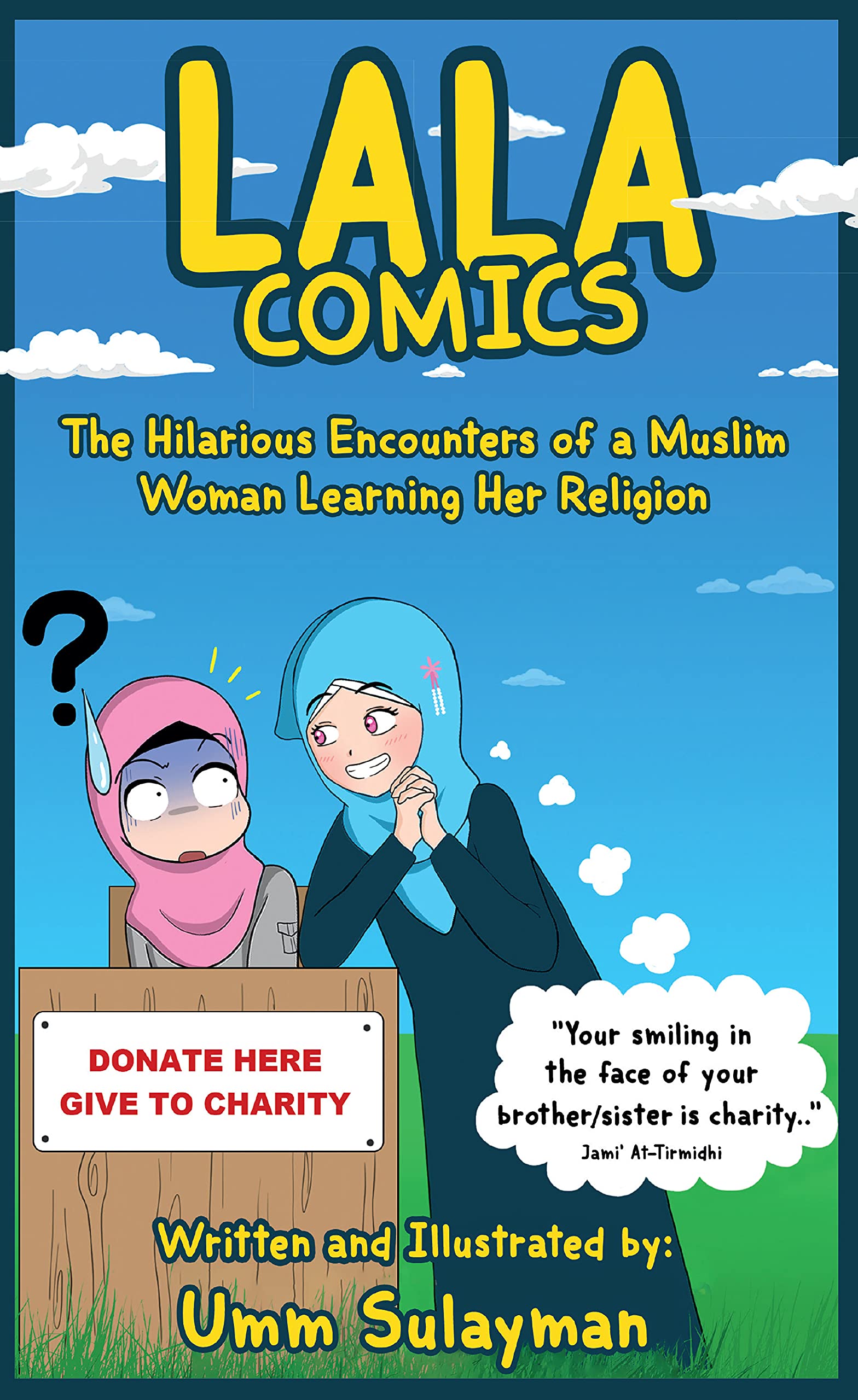
A mix of information and entertainment, this 124 page comic book is divided into thematic sections which further break down in to mini-episodes or comic strips that feature a situation, an Islamic advice often based on a Hadeeth or Quranic ayat that is noted, and a misinterpretation taken to a comical extreme. The book is a great way to remind ourselves and children, middle grades and up, aspects of our faith that we might know, or introduce us to specifics that we should know, by showing the concept in exaggerated action. Because the examples are relatable and come from everyday life, the humor is that much more enjoyable, and as a result makes the “lessons” that much more memorable.

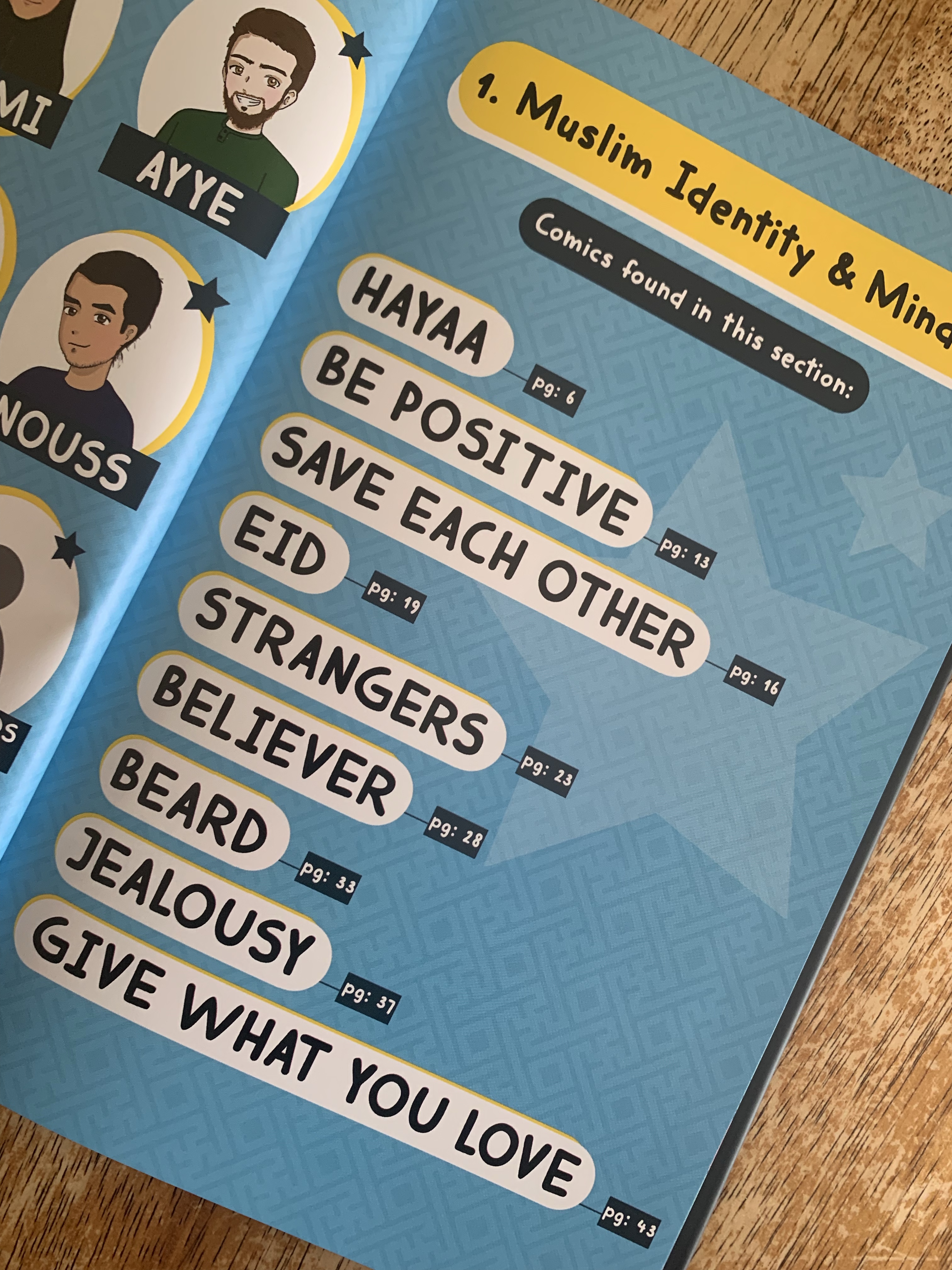
The three sections cover topics included in 1: Muslim Identity/Mindset, 2: Habits/Lifestyle, and 3: Adhkaar/Prayer, after an introduction of the characters, and the magic of the ‘Aalim Hat are explained, the stories begin. They are not sequential and can be read in any order, and are about four to 10 pages each. The book surprisingly does a good job of not getting overly predictable. Even though you know something is going to be taken incorrectly or to the extreme, it doesn’t drag on or get redundant. At times Ayye, is overly preachy, ok, all the time, but the persona is intentional and reads intentional, as his grounding of events is actually the point of the book.

The illustrations are clear and enjoyable. They are expressive and easy to follow. The glossy pages and full color print help keep the readers, especially the younger ones, tuned in to what the lesson is, and what silliness is ensuing. The hardbound 6 x 9 book is great to have around where it can be picked up and thumbed through. I read the entire thing in one setting, as did my 12 and 14 year old, and all of us have subsequently picked it up and flipped through it to muse over sections once again. A few of the pages seem to bleed into the binding and require some effort to see the cut off text, hopefully the book will have multiple reprints and this can be rectified. If you don’t follow the author on Instagram you should @LalaArtwork.

It is important to note that I am not a scholar, or anywhere remotely qualified to opine on the authenticity or interpretation of the points given in the book. The hadeeth are sourced, stating if it is a Saheeh hadith or found in Bukhari or Muslim for example or who narrated it. And ayats from the Quran tell the surah and verse. They are sourced when stated, there is not a bibliography at the end.

Potential concerns in the book: it does show a Muslim celebrating halloween and birthdays in a comic about Eid. In an episode about being strangers in this duniya, it mentions drinking and clubbing and nudity, boyfriends, etc. as things to avoid in this world. There is hyperbole and revenge, and bad judgement, but it is all in fun to make clear Islamic points and I think children nine and up will have no trouble understanding what is real and what is exaggerated, inshaAllah.

Ahmed and the Very Stuck Teapot by Sarah Musa illustrated by Rania Hassan

Standard
Ahmed and the Very Stuck Teapot by Sarah Musa illustrated by Rania Hassan

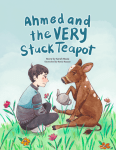
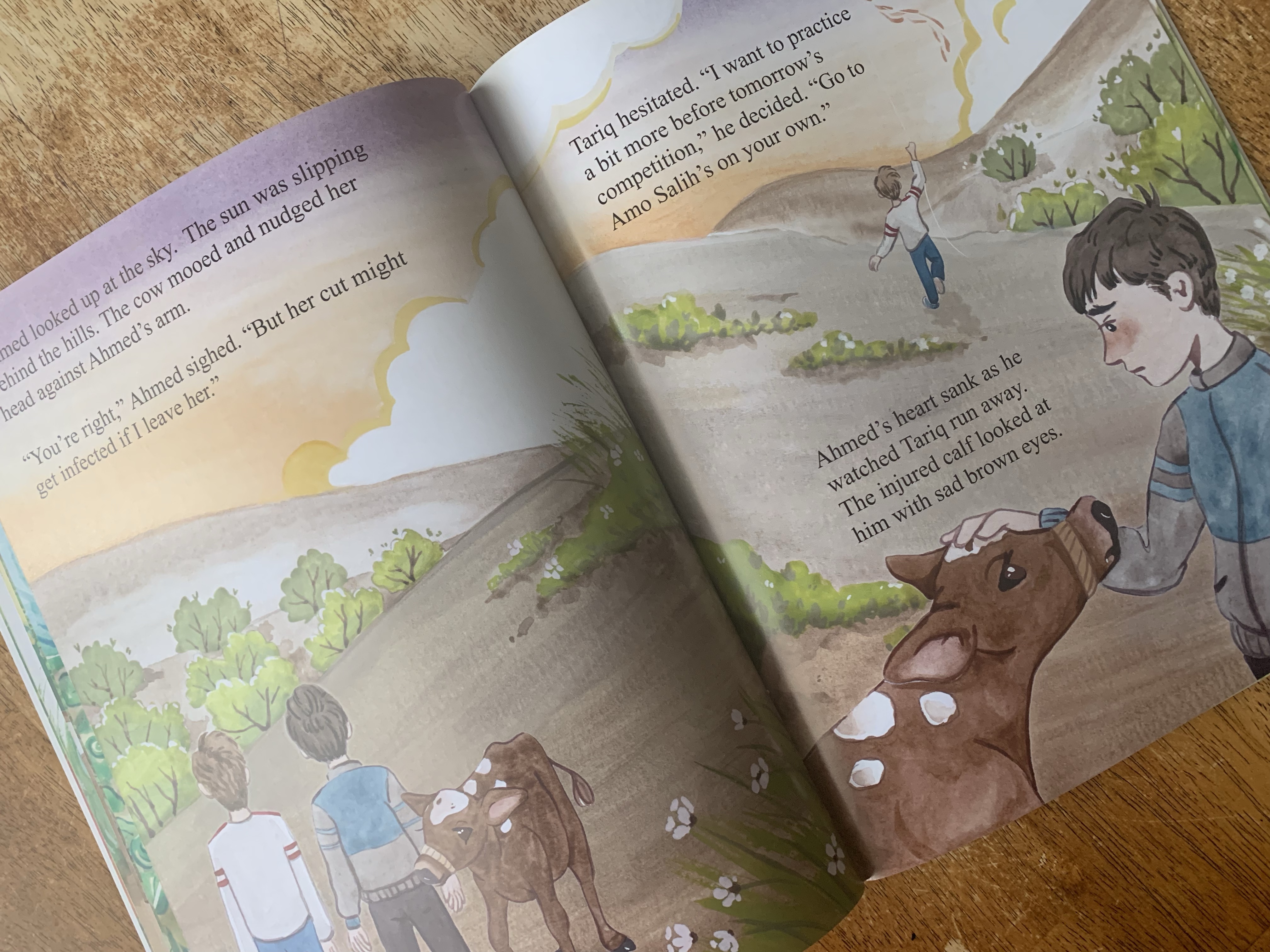
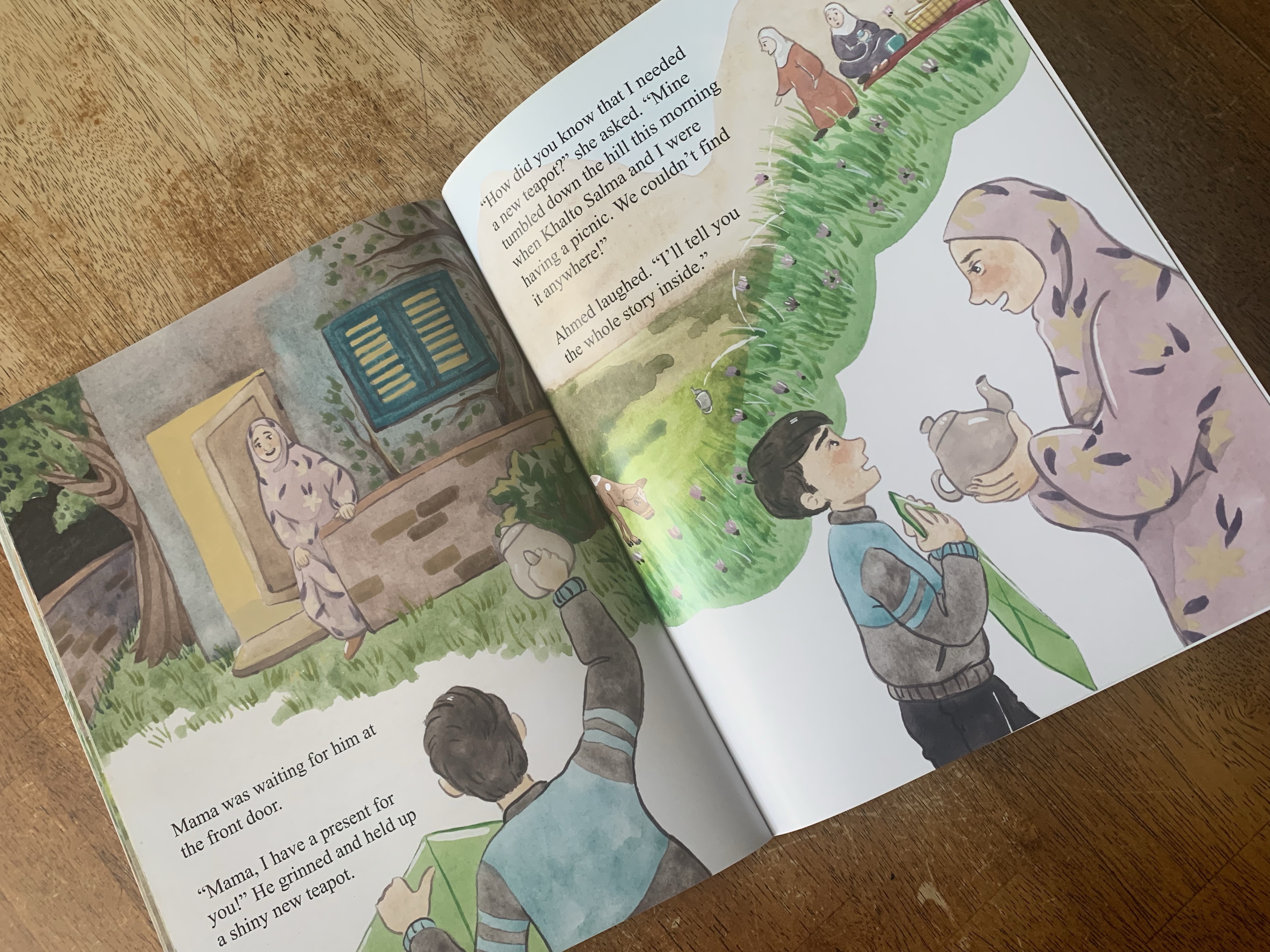
This 36 page early elementary book is packed full of choices and lessons packaged in a sweet story that kids and adults will enjoy reading and discussing over and over. My only real critique is the title. I’ve had this book sitting on my shelf for nearly a year thinking it was just a silly book about a calf with a teapot on her hoof that is stuck and would probably involve different people and methods and attempts to get it off. But the teapot is off by the tenth page, and the story is really just getting started. Like all Ruqaya’s Bookshelf picture books, the large thick shiny pages with a stiff soft cover binding make the story a great choice for storytime and bedtime alike. There are Islamic threads and references, but the story overall is universal.

Ahmed and his friend Tariq are practicing their kite flying skills for tomorrow’s annual competition, when Ahmed’s kite gets destroyed in a tree. Heartbroken Tariq suggests he hurry to buy a new one before the store closes at Maghrib. As the boys rush off they come across a brown calf with a teapot on her hoof. Ahmad recognizes the teapot as his mother’s and feels like he should help the poor animal. Tariq keeps reminding him that the shop will close, but Ahmed decides to take the cow to Amo Waseem’s to get help.

Amo Waseem, is able to help the cow get free, but in the process, the cow get’s hurt. The cow needs help from a shepard, Amo Salih, but Amo Waseem can’t go, and Tariq wants to practice more. Ahmed knows the cow can’t be left untreated, and takes the little cow to get help. The cow then needs to get to his owner, and the story continues until the shop is closed, and Ahmed realizes he won’t have a kite for the competition. He goes to the mosque for salat and starts to feel better, he knows that he did the right thing, and inshaAllah Allah will reward him in some other way. His reward comes quickly, however, much to Ahmed’s surprise and in gratitude he also manages to find a way to help his mother.

I love the gentleness of the lessons of doing what needs to be done, even when you don’t really want to, and your friends are not supporting you. Ahmed had chances to walk away, but he didn’t and he was at peace with the outcome. His friend wasn’t mean or bad, he just made different choices. There are discussion questions at the end as well. I think this book would foster great conversation with even the littlest listeners, and I can’t wait to share it at our masjid’s storytime.

Burcu: No One Wants to Play with Me! by Nursen Sirin illustrated by Nese Inan

Standard
Burcu: No One Wants to Play with Me! by Nursen Sirin illustrated by Nese Inan

IMG_2348

This 32 page, 9×12 story book, for ages five and up, focuses on character education and is meant to be a relatable story with clear lessons about how to behave and deal with situations in life.  The opening page bullets all the lessons readers should learn from the story and the end of the book offers directions to make a balloon craft.  

IMG_2354

I don’t mind books with lessons and morals so clearly delineated, and I like that the morals come from such an adorable character with a whole cast of supporters, and a number of books to her series.  

IMG_2353

My problem is more the story itself, for a lesson on how to make new friends, and dealing with the universal struggle of moving and feeling like ‘no one wants to play with me.”  The book spends nearly seven pages on Burcu making a surprise breakfast for her family before hearing the news that she is moving because the landlord says they should.

IMG_2352

They pack and move seemingly the same day, and then the point of the book gets going.  Burcu has to say goodbye to her friends and doesn’t feel like even going out at the new house to make new ones.

IMG_2351

Her brother, Alper, has no problem making new friends, and finally Burcu gives it a try.  Only a little girl attempts to get to know her and Burcu dismisses her because she is so young.  She tries to be included with the other children, but they don’t know her and aren’t willing to let her play.

IMG_2350

Burcu finally confides in her dad, that she can’t get anyone except the little girl to play with her.  Her dad encourages her to give the little girl a chance.  Burcu does and finds out they are the same age, she just looks really young, and then all the kids are friends and happy.

IMG_2349

The real hero to me is the little girl, Katherine, who didn’t give up on an ageist Burcu that didn’t want to play with her.  Seems odd that Burcu wanted a friend, and then was arrogant to complain about the one she got.  Plus, I would imagine kids who have moved and don’t have friends, would turn to a book like this for tips and hints, and ways to feel less alone.  The book offers none of that.  It doesn’t tell how finally Burcu makes friends, or gets included, other than it took time.  Which is great, but not exactly helpful if you are five and crying everyday because no one will play with you.

The writing is very dry.  I think it has been translated from Turkish, many of the sentences are passive voice, and the sentences choppy.  The book doesn’t have any glaring errors, it just seems like it would work as a story time, or as part of a lesson, and  maybe once as a bedtime story, but not a book that kids will clamor to hear over and over again.

IMG_2355

There is nothing Islamic in the story, but most of the major online Islamic bookshops carry the Burcu series, so I would imagine the authors, and publishers are Muslim.

Overall, the book sets off to teach a great lesson, but falls a bit short.  The illustrations are adorable and the large size and playful font are very well done, the diction, not so much.  The books are reasonably priced and if you see a title that works for a lesson, or theme you are discussing, I think you can make the books work.  If you are looking for a book to read over and over to your kids, you might, however, be disappointed.


The Apple Tree by Mariam Al-Kalby, Illustrated by Yee Von Chan

Standard

appletree

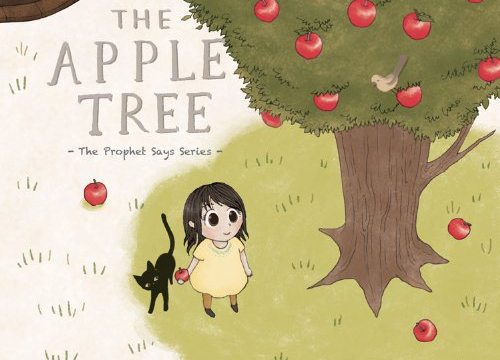
I have been looking forward to obtaining this book for a while (it was back ordered on Amazon) and over all it was worth the price $16, and worth the wait.  The illustrations are absolutely beautiful.  At story time the kids constantly urge me to take my time in turning the page.  They aren’t incredibly detailed, just very whimsical and engaging, that you want to take a peek and stay a while to play with little Shaima.

The book’s moral comes from two hadiths (sayings of Prophet Muhammad (p.b.u.h.)) “When a Muslim plants a tree, whatever is eaten from it is charity from him, and whatever stolen is charity, and whatever is subtracted from it is charity” (Sahih Muslim), and ” There is no Muslim who plants a tree or sows seeds and then a bird, or a person, or an animal eats from it except that it is regarded as charity for him” (Sahih Bukhari).

The main character, Shaima, wakes up one morning at fajr to find her Baba planting an apple tree.  The two discuss what “reward of charity” means and the value of sharing.  Time presumably passes, although the tree does seem to grow and produce incredibly fast.  Once the apples are ready to be picked, Shaima finds everyone taking her apples: a little boy, a squirrel and her babies, some birds, what can she do?  The solution is both a lesson and inspiration for the character and the reader and makes for a fun book to get the discussion rolling on a wide variety of topics: patience, charity, sharing, generosity, humility and more, alhumdulillah.

The book is not AR, but is relevant to 4 year old children and up.  The book is hardcover and 32 pages. There are six Arabic words which are explained in the glossary and do not impede the story in any way.