Tag Archives: friendship

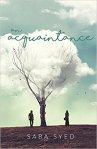
An Acquaintance by Saba Syed

Standard
An Acquaintance by Saba Syed

acquaintance.jpg

A young adult Islamic fiction romance novel, yes its a genre, albeit small one. I braced myself for stereotypes, cheesiness, over simplifications, sweeping condemnation, and preachy reprimands.  They never came.  I think this book is different, because from what I felt while reading it, and from what I’ve read the author say, this book is written for us: Muslim females, raised in the west, devout, strong, involved, and vulnerable.  It isn’t trying to convince anyone of Islam, or prove our place in America.  It isn’t trying to justify relationships or make us hide in our houses, rather it is taking us up to the line, showing us our strengths and weaknesses, and leaving us there to think.  In 282 pages, I saw myself crystal clear in the protagonist, the vilifying community, the determined best friend, and the steady parent.  It is easy to judge, but this book gets the nuances, the temptation, the justification, the internal battles, and it does it all without resorting to extremes that would make it inappropriate for upper middle and high schoolers. Yay!

SYNOPSIS:

Sarah Ali has grown up in small town Wickley, Pennsylvania, her whole life.  Her dad owns the local hangout, she is well known and well liked ,and very involved at school and in the masjid that her father helped start.  She has a best friend who is Muslim and although her mother has passed away, her home life with her dad and older brother is solid and supportive.  Senior year, however, is where the book takes place, and with Islamaphobes protesting and a new boy, Jason, in town coming to her rescue, the stage is set for her to have to decide how much their “friendship” crosses her internal boundaries of right and wrong, and when feelings are on the table, what choices she will make.

Throughout the book, there are numerous supporting characters that have their own roles in shining light on the situation from the outside and adding context to the world that Sarah lives in.  But this is ultimately Sarah’s story, told from her perspective, and the internal conflicts are believable because they are hers, the reader can see a mile a way what is going on and what will happen, but to see it unfold within her is at times a little naive, but considering her age, plausible.  It is her denial and acceptance of the situation at hand and what her role and hopes are that make the story very hard to put down.

The book in many ways is subtle, I don’t want to give to much of the plot away because it is obvious, it is a love story between two teenagers that can’t have a future based on the fact that she is Muslim and not willing to compromise that.  But that doesn’t mean there aren’t real feelings involved and real consequences to the choices that are made.  Throw in the gossip mongers at the masjid, an older brother who is concerned, an ever patient father, and a handful of others and the book feels incredibly real. 

WHY I LIKE IT:

Things are never black and white in real life, nor does reality prevent emotions and desires from breaking out.  There is no shaming in their tale (other than by the judgemental aunties), but there are consequences that are also given their time and spotlight.  From a parenting perspective it shows how a few questionable decisions can really get you in a heap of trouble and heartache, even if on the outside you can argue you did nothing wrong.  Even in the book Sarah remarks that they didn’t do anything, but yet, they did so much, this understanding is really powerful, and so needed for the teenage demographic. The book does not celebrate Sarah and Jason’s relationship, although I must admit I did kind of cheer for them at some points (I know, haram).  It shows that they are good people, but that there is a bigger picture.  It also shows there is life and hope, and forgiveness after, in the healing.

I love that Sarah’s dad is awesome and that his ultimate weapon is dua.  Not the stereotypical immigrant father trope, he is awesome.  I also love that Sarah’s best friend, Jasmine, is a person of color, so diversity gets a bit of a shout out.  The masjid politics is spot on, and the hypocritical aunties are as annoying in the book as they are in real life.  Yes, there are times where the dialogue is a little syrupy and long-winded, but overall, this book is calm and reflective and so, so important for high school and college girls to read.

Islam is the religion practiced, from praying, to how they talk, to how they dress, the subtlties there are brilliant as well.  You can tell the author is Muslim because it is natural and real, not researched and blotched.  The message is ultimately that Allah knows all, and that we do things for His sake alone.

FLAGS:

Truly the most Jason and Sarah do is hold hands, but the masjid ladies constrew that they do a lot more, and that Sarah ends up pregnant and gets an abortion. All untrue, but this revelation, that this is the gossip going around, is explored at the end of the book.

TOOLS FOR LEADING THE DISCUSSION:

Oh how great would this book be as a book club for high school or even college age girls.  But, alas I’m not involved in anything like that so I will have to just recommend this book to anyone that meets that criteria looking for a good book. 

Having said that, part of me really thinks this book doesn’t need to be discussed.  Saints and Misfits was a book that needs to be read and discussed with our youth, this book, I kind of like it to stir and fester within each reader.  The lessons are there, and are clear, and some days I could see a girl really feeling one way and switching another.  Like the father in the book, our kids, inshaAllah, have been taught right and wrong, we have to see what they do when tested.  And this book can really speak to them, and offer them a bit of conciousness when faced with a seemingly small decision that could have big consequences.  This book will stay with a reader, and that’s a good thing.  I just don’t know if it will manifest the same with everyone, and I think that is a great thing.


Book trailer: https://www.youtube.com/watch?v=fraVJZI1xNU

From the Author: https://muslimmatters.org/2017/11/10/an-acquaintance-a-young-adult-novel/
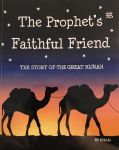
 

The Prophet’s Faithful Friend: The Story of the Great Hijrah by RS Khan illustrated by A Saha

Standard
The Prophet’s Faithful Friend: The Story of the Great Hijrah by RS Khan illustrated by A Saha

prophets faithful friend.jpg

This book is written in verse, and while some of the 32 pages are overly heavy in text, it does for the most part stick to appealing to younger children, 4 years old and up.  I had hoped the book would be more about Abu Bakr as Sadeeq, but it really is just a simplified retelling of a part of the Hijrah.  There is nothing wrong with that, I just had hoped for more about their friendship.

FullSizeRender (58)

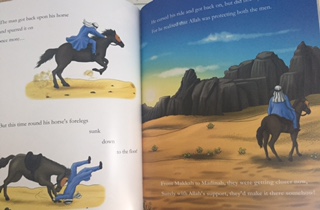
The only real specifics of the Hijrah are that of Suraaqah, and the inability he and his horse faced while trying to get close to the Prophet and his friend.

FullSizeRender (61)

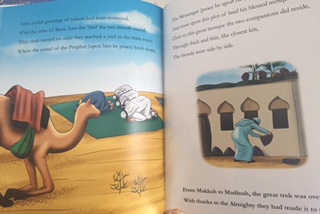
The book is meant for Muslim children as it shows some of the fears that RasulAllah faced, ways Allah swt protected him, and gets children excited as the two reach Madinah safely.  There are Islamic and Arabic words sprinkled through out, without a glossary and children might night some help understanding Quraysh, migration, hastened, suspense, and companion.

FullSizeRender (59)

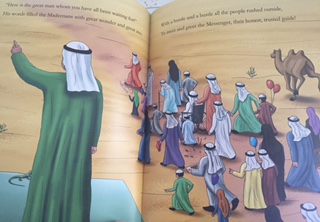
The pictures are bright and the book is printed on thick glossy paper.  There are no faces detailed, and Prophet Muhammad  and Abu Bakr are not pictured.  The pictures seem to get a little ahead of themselves as they show people holding balloons and in wheelchairs, not sure that they were invented or common yet, but perhaps.

FullSizeRender (60)

I know I have mentioned it before that there are surprisingly few stand alone books about Prophet Muhammad (AS) for younger children, so while this book isn’t the greatest book ever, it is pretty good amongst few other options.

A Tale of Highly Unusual Magic by Lisa Papademetriou

Standard
A Tale of Highly Unusual Magic by Lisa Papademetriou

a-tale-of-highly-unusual-magic-L.jpg

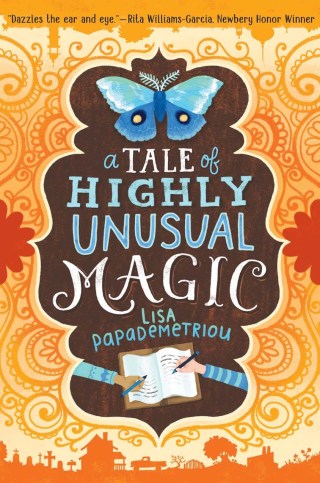
For a book about magic, featuring a girl who admittedly knows very little about Islam, a surprising number of tidbits sneak through and work to introduce Islam and Pakistani culture to those unfamiliar, while similarly exciting Muslims readers who can see a major climax point a mile away and get to feel “in” on the unavoidable “aha” moment.  Written on a 4.9 level this 297 page book, is clean and engaging, a rare combination, especially for advanced readers who are having a hard time finding books that are content appropriate.  I’m fairly confident that anyone, of any age, who reads this will learn something, whether it be about lepidopterology, violins, occupation and partition of the subcontinent, Rudyard Kipling, caskets, friendship, Islam, and finding a place to belong.

SYNOPSIS:

There are three main storylines in the book, Leila’s, Kai’s and The Exquisite Corpses’.  Leila is a Pakistani-American girl growing up in America who decides to visit her Pakistani dad’s family in Lahore for the summer.  Unfamiliar with the language and customs, she has a good attitude of learning as much as she can, and absorbing new things.  Her dad’s family speaks English, is not very religious, is wealthy, and pretty modern.  They have servants, and drivers, and while she gets to go to museums and landmarks, the lifestyle is partially simplified for reader understanding, and partially to not take away from the real point of the story: Leila moving out of her sister’s shadow, and finding comfort in her own multi-cultural skin.  

Kai is spending her summer with a great paternal Aunt in Texas that she has never met.  Her father passed away and her mom has recently lost her job, so a change of scene is what she is presented with.  Her Aunt is a character in and of herself, but by and large leaves Kai to her own devices and supports her adventures from a distance.  The real story for Kai is a budding friendship with the neighbor girl, Doodle who is determined to find and save a rare moth no longer found in the area.  Nervous to make friends Kai learns sometimes the value of things isn’t in the winning, or being the best, but in doing something because you enjoy it and it is the right thing to do.

The two girls story is tied together by them finding two parts of a magic book, The Exquisite Corpse.  The old book tells the story of Ralph T. Flabbergast and Edwina Pickle, in bits prompted by the girls’ own writings.  Like the game of writing a few sentences, folding over the page and having the next person add to the story, the book connects the girls and the readers in a tale that is as much about the two long ago sweethearts, as it is about families, overcoming obstacles, and believing in happy endings.

WHY I LIKE IT:

I like that it is told from various voices, and as much as the story is plot driven, I truly felt connected to the main characters.  The only magic is the book, so the realism is very critical to gaining the readers interest and thankfully once you read about 70 pages or so I feel like the book does suck you in and take you for a fun ride.  The first few chapters are a bit confusing and I wasn’t sure where the story was going, Finally, at my 11-year-old daughter’s prompting I had to just barrel through without asking and wondering too much.  You don’t find out about Kai’s mom and dad or how Rudyard Kipling and “Kim” tie in to it all, almost until the end.  I like that the author doesn’t talk down to the reader, and as a result I learned a bit about so many things.  The twists and interweaving of stories and characters, and things as random as moths and music and saurkraut, remind me of well written adult novels that often aren’t found in books for fourth graders.  

Their isn’t much religion in a doctrine or even practicing sense, but through culture some is learned and shared, and I like that it isn’t completely washed out or removed.  The main character’s father says that he wasn’t religious in Pakistan so when he came to America he wasn’t about to start.  Leila mentions that her mom wants him to take the girls to the mosque or to see Eid, but again, they don’t, but do celebrate Christmas.  So, when she is in Pakistan and sees masjids, and fakirs, and people feeding birds as a sadaqa it is a nice inclusion.  Especially because the vocabulary is used and explained.  She mentions that her extended family goes for Jummah, yet doesn’t pray five times a day, she also touches on Ramadan as being a time of fasting but doesn’t know that there are two Eids.  As she learns, the reader does too.  It definitely isn’t how any practicing Muslim would want Islam portrayed, but it isn’t disrespectful and it is realistic.  Again, because the author doesn’t seem to talk down through her characters, there doesn’t seem much judgement and thus, hopefully also shows most readers some diveresity to the Pakistani stereotypes in the media.

FLAGS:

None, the book is clean, the love story between Ralph and Edwina, is just that they love each other. Nothing more than a sweet sentiment.

TOOLS FOR LEADING THE DISCUSSION:

I would definitely use this book as a Book Club selection because I think there is so much to connect to and discuss.  It would be fun to do as an interfaith book club with kids for the same reason.  While the main characters are girls, I think boys would enjoy it as well, there is some spying, sleuthing, action, and a whole goat debacle, that I think would be a blast to explore with students.

I don’t see any online reading guides, but there is so much to discuss it won’t be a problem.  Enjoy!

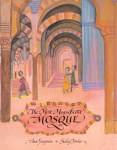
The Most Magnificent Mosque by Ann Jungman illustrated by Shelley Fowles

Standard
The Most Magnificent Mosque by Ann Jungman illustrated by Shelley Fowles

Most-Magnificent-Mosque

Three very naughty boys harass visitors to Cordoba’s Great Mosque in Spain.  Rashid, a Muslim, Samuel, a Jew, and Miguel, a Christian, run through the fountains, destroy the flowerbeds and throw oranges at people leaving their prayers.  Most days the boys can out run the gardeners, but one day they pelt the Caliph himself with a rotten orange.  The punishment from the Caliph is three months of hard labor working with the gardeners everyday on the mosque grounds.  On their breaks the boys explore the mosque and marvel at its beauty.  By the end of their sentence, the boys have such a love for the mosque and one another that they are forever bound.  As the boys grow and make their way in the world, they don’t keep in touch much.  However, when Cordoba is defeated in battle by the Christian king Fernando, it will be up to these three boys to convince the new king, that the Mosque shouldn’t be torn down.  And that the it is the pride of all people in Cordoba, Muslim, Jewish, and Christian alike.

magnificent mosque 1

The book is 32 pages and an AR 4.0.  It does a good job of showing the three faith communities coming together to save something they all value.  It also shows a kind, yet purposeful punishment from the Caliph to the three boys.  While younger kids in story time will enjoy the concept of people working together, the book really finds its strength with students learning or familiar with Spain, particularly prior to the Inquisition.  There isn’t a lot of detail regarding the structure of the mosque, or the doctrine of each faith, that knowledge would have to come from outside the book, in order for it to be appreciated. There are some plot holes in the story and the book itself doesn’t make it clear what parts of the story are historically accurate and which are fiction.

magnificent mosque

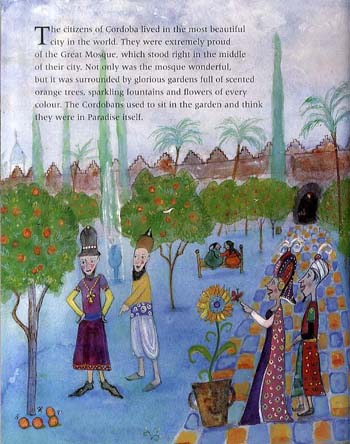
The illustrations are charming in their own way.  The watercolors do a good job bringing to life the mosque and gardens, and battle, but for me fall a little flat in depicting the three boys.  I don’t know if the text or illustrations are at fault for me not connecting to the story or finding an emotional resonance to what should be a very inspiring story. Perhaps it is a combination of the two.  I feel it is desperately in need of an author’s note detailing the factual origins of the tale,  Something to uplift and give hope to people of different faiths coming together in a peaceful way, that can be put into real world actions.

magnifectn

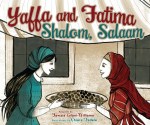
Yaffa and Fatima: Shalom, Salaam by Fawzia Gilani-Williams illustrated by Chiara Fedele

Standard
Yaffa and Fatima: Shalom, Salaam by Fawzia Gilani-Williams illustrated by Chiara Fedele

Yaffa and Fatima cover.jpg

Oh how full my heart is after reading this book, and wiping a tear from my eye.  When the daily news angers and frustrates, a story as sweet as two friends helping and worrying about each other gives hope to the future of the world. I know that is probably over reaching the impact of a children’s book, but sometimes it really is just one person helping another person, just finding similarities instead of differences, and above all having a big heart.

Yaffa and Fatima are neighbors and both grow dates.  The two women, one Jewish and one Muslim, share a lot of similarities they both fast, pray, celebrate, and help others. They often sell their dates next to each other in the market and then share their food and customs with each other.  During one growing season, rain is scarce, and each woman begins to worry about if the other has enough- not just to sell, but to eat as well.  Secretly they both help each other and prove the power of friendship and kindness is universal and powerful.

Dino-Wresting

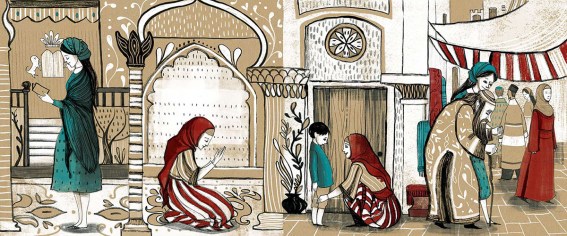
The illustrations are smartly done.  This isn’t the book for bright and colorful or overly cartoonish depictions.  The simplicity of the words introduce the reader to Islamic traditions and Jewish traditions, but the purpose is to show their similarities and the illustrations mimic that sentiment beautifully.  The contrast of red and blue show the differences with the larger muted tones being the same. The warmth in the characters faces mirror the warmth of their actions and the detail is balanced with intriguing the reader without distracting from the text.  The illustrator does a good job of also showing the women covering their hair in public, albeit differently, but not within their homes. And of also showing the different ways the women worship without the words having to do so.

Dino-Wresting

The author has a note at the beginning acknowledging the roots of the story as a tale about two brothers in both Jewish and Arab traditions.  And at 24 pages it works for children of all faiths and all ages, two years old and up.  The book was recommended by a woman, who I hope to meet next week, when she and her Jewish community join us at the mosque for our monthly story time.  With a theme of friendship, this book will be the focus of what bridges and connections we can all make in our personal lives to make the wold a little better.  I can’t wait to share it with our children of both faiths!


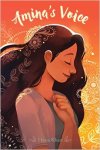
Amina’s Voice by Hena Khan

Standard
Amina’s Voice by Hena Khan

amina voice

This book really marked a shift in Islamic fiction for me and the genre.  First of all I was waiting for the book to come out.  I didn’t stumble upon it or hear about it from someone else.  I knew when it was going to be released, and I knew I wanted to read it. Additionally it was the first books published by Salaam Reads, an imprint of Simon and Schuster. Which according to their website was “founded in 2016, Salaam Reads is an imprint that aims to introduce readers of all faiths and backgrounds to a wide variety of Muslim children and families, and offer Muslim kids an opportunity to see themselves reflected positively in published works.”  This is big, huge in fact.  The bar has been raised, and a platform has been given, no more excuses.

Alhumdulillah, Amina’s Voice is a beautiful 197 page book for children ages 8-12.  The book is not AR, but probably will be in a few weeks.  I think it is spot on for 3rd through 5th grade in terms of content, message, and appeal.  The book caters to females and Muslims, but naturally is not limited to those two demographics exclusively.  There are characters of a variety of ethnic and religious backgrounds in the novel that play significant roles in saving the day and keeping the book powerfully optimistic and inspiring.

SYNOPSIS:

Amina is starting middle school and everything is changing for Amina. Her friends are acting different, her older brother is skirting with trouble and her religious uncle is coming to visit from Pakistan.  Internally, she doesn’t like the spotlight but desperately wants to get out from behind the piano to sing.  All of this combines in a climax that pivots around the destruction of the mosque she attends and her having to find her voice, and use it to take center stage in her own life.

WHY I LIKE IT:

There is a lot going on in the book, but it doesn’t get over whelming with Amina’s voice keeping the reader focused on her and her view of the events around her.  The author does a good job of getting inside a 12 year-old girls head without being condescending or heartless.  The reader feels her stress that she is losing her best friend, Soojin to Emily, a girl who used to torment the two “ethnic” girls, without belittling her concerns.  You also feel her love of Islam and struggle to understand if music and singing is permissible within Islamic rules.  The book is realistic fiction with school, friendships, and family guiding the story.  Everything from the ups and downs of group projects, inside jokes between siblings, and trying to pronounce the big HAA in Arabic.  The macro of middle elementary years combined with the micro facets of culture, religion, and current events, and you speak to a section of readers that will connect with Amina and what she goes through in a very authentic, relatable story.

The only points that gave me pause is the premise and music in the book.  It is a point of disagreement amongst nearly every group of Muslims, so to have the Imam sitting and listening to her play the piano, is a bit hard for me to accept as the norm, no matter how cool Imam Malik is.  Additionally, I wish that Amina’s mom had some depth, and the relationship between Amina and her uncle, Thaya Jaan, was fleshed out just a tad more.  In both cases I felt something was lacking, and I wanted more.

FLAGS:

Nothing major, but a few minor issues, that a parent may want to be aware of for younger readers.  Mustafa, Amina’s brother, is seeing skipping Sunday school class and reeking of cigarette smoke.  He denies it, and the issue is definitely not glorified.  There is also crushes discussed amongst Amina’s friends and when Amina spills a secret, she has to own up to it and work it out to maintain her friendships.  The destruction of the mosque could also be upsetting to younger readers.  It isn’t graphic, but her emotional response and the intensity of it, is the climax, and a very real part of our world sadly. For parents, this fictional vandalization could possibly be a great place to start a discussion from if your children are somehow unaware of the current status of Islam in the west.  It also shows that people are good, as the whole larger community, comes together to show unity, love, and respect are values to us all, alhumdulillah.

TOOLS FOR LEADING THE DISCUSSION:

This book would be perfect for a 3rd through 5th book club.  If I was starting a new book club I would start with this book.  It has it all. It has real issues, religious issues, universal issues, and heart.  All while staying on age level and all in a realistic fiction safe space to have an opinion about objectively.  The discussions after the book is read will flow naturally, but just in case:

Reading Group Guide:  http://www.simonandschuster.com/books/Aminas-Voice/Hena-Khan/9781481492065/reading_group_guide

Author’s Page: https://www.henakhan.com/


Never Say A Mean Word Again: A Tale from Medieval Spain by Jacqueline Jules illustrated by Durga Yael Bernhard

Standard

scan0019_487d580c-5aa9-45f2-b4c1-87e328c94b7e.jpg

I love when tales from the past provide timeless lessons in relevant ways.  Inspired by a medieval legend about the Jewish poet Samuel Ha-Nagid, a royal advisor in Muslim Grenada, Jules creates a story that works for children of all ages and backgrounds.

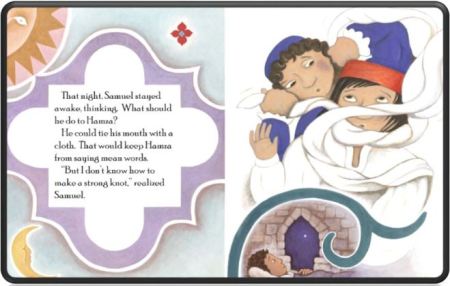
The Grand Vizier’s son, Samuel, bumps into the tax collector’s son, Hamza, and the boys don’t rub each other the right way.  Later that day, Samuel spills his drink on Hamza and can’t convince him both were accidents.  Hamza calls Samuel some mean names and storms off.  Samuel and his father think the name calling is uncalled for, but the vizier does not solve his son’s problem and instead assigns him to “make sure Hamza never says a mean word to you again.”  Samuel imagines ways to teach Hamza a lesson or punish him, but some ideas are too complicated and some just silly.  This is proving to be a hard task.  The next day Samuel shows up to Hamza’s house with a lemon.  He thinks forcing Hamza to eat it is a good punishment for a mean mouth, however Hamza thinks the lemon is to help with the stain that ruined his clothes, and tells him his mother already tried that.  Caught off guard by Hamza’s reaction, the two somehow end up playing catch with the lemon and enjoying the afternoon together.  The next day he shows up to Hamza’s house with ink and paper thinking he will make Hamza write him an apology.  Hamza however, thought Samuel showed up to draw, and once again the boys enjoy an afternoon together.  This carries on until the boys are so used to seeing each other and having fun together, they become friends.  Samuel fears that he disobeyed his father and did not handle Hamza only to realize that by befriending his “enemy” he did in fact make sure Hamza never said a mean word again.

idea

The book is 32 pages with an Author’s Note about the real life events that the story draws upon.  The book is not AR, but the large bold typeface and the warm simple pictures make this book work great for story time with young children.  It compliments themes about bullying and making friends as well as being silly.  It works well for third graders and older ones too, as they might understand people of different faiths struggling to get along or people of different socio-economic classes, or even just imaging how they would solve a problem without their parents doing it for them.  I was pleasantly surprised by the book and how it handled the Muslim/Jew staging of the characters.  Especially right now in today’s world, this story has a poignant lesson for us all. If we all spent time together having fun, we too could end up being friends, or at least getting along.  I think the story and its lessons have merit and relevance, and thus a place on the bookshelf.


Four Feet Two Sandals by Karen Lynn Williams & Khadra Mohammed Illustrated by Doug Chayka

Standard

four feet

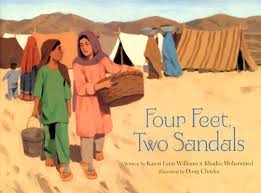
A beautiful hardback picture book I picked up at the Scholastic Warehouse sale, at 32 pages long and an AR level 3.2, Four Feet, Two Sandals, works well as both a story time selection to younger students and as independent reading for up to 5th grade.  The story is about two refugee girls that come to know each other when relief workers throw donated clothes for the people and Lina and Feroza each end up with one sandal each of a beautiful pair.  Rather than fighting or being ungrateful, the girls work out a plan so that they can both enjoy the sandals and in the process, become friends.  The girls share their stories with one another, and thus the reader, about how their families have been affected by war and how they came to be at this refugee camp in Peshawar, Pakistan.  The girls dream of school and their futures and show the readers a bit of their daily struggles getting water and doing chores.  When Lina’s name shows up on a list to go to America, and Feroza’s does not, the friends must part and decide who gets the sandals.

While it probably bothers some that America is seen as the saving grace to sweep Lina to a better life and pander to an American audience. I think it makes sense seeing as the book was co-authored by the executive director of the Pittsburgh Refugee Center and was inspired by a refugee girl who asked “why there were no books about children like her.”  Clearly refugees do get a chance at a new life when other countries open their borders and stories like this that give our children insight into the world they have left behind, with the hopes of fostering compassion, is something that I definitely want to share with my own children and students.

The author’s website and reading guide: http://www.karenlynnwilliams.com/files/sandals_guide.pdf

The Friendship Matchmaker Goes Undercover

Standard

friendship

I’m posting yet another Randa Abdel-Fattah book that my mom stumbled upon and sent me 10 copies to do for our Book Club. I didn’t love the book, but it is clean and brings up the issue of bullying, friendship and honesty.  So, I’ve decided to do a 3rd- 5th grade Jr. Book Club and use it as a starting point to discuss this critical social realms that they are facing.  The book is a 4.4 Accelerated Reader level and has no Muslim characters or themes.

SYNOPSIS:

This book is the second in the series, and, thankfully, having not read the first book, The Friendship Matchmaker, didn’t hinder my understanding.  Told from the perspective of Lara Zany, a former friendship matchmaker of Potts Middle School, the reader gets to know the major characters at the school and their problems.  Lara now has a best friend and has retired from the matchmaking business, but old habits are hard to kick, and as a new student from Somali out plays the school bully in soccer, Lara is forced to go undercover to help her classmates.

WHY I LIKE IT:

The book doesn’t stand out in the genre, but it is fun because I think 3rd through 5th graders deal with everything in the book, every day.  The book shows restraint where a lot of books over do it.  The characters show growth, they aren’t disrespectful and they aren’t all painted with a simplistic brush stroke.  The bully has redeeming qualities and no one is perfect or hopeless.

FLAGS:

The book is clean in regards to violence, relationships, and language.  The only concern I have is there are two major instances where the characters lie, and there are no consequences.  The smaller breaches of honesty the characters in some way or another must own up to, but there are two scenarios: a forged field trip signature, and an untruthful excuse given for being late to class, that rubbed me the wrong way.  Before allowing students to check it out for the purposes of Book Club, I sent a note to the parents with these two concerns and left it to them to encourage or discourage their student’s from checking it out.  My goal is to discuss why the author included these in the book, and realistic alternatives that would promote honesty, but still allow for a happy ending.