Tag Archives: friends

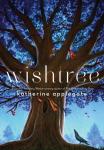
Wishtree by Katherine Applegate

Standard
Wishtree by Katherine Applegate

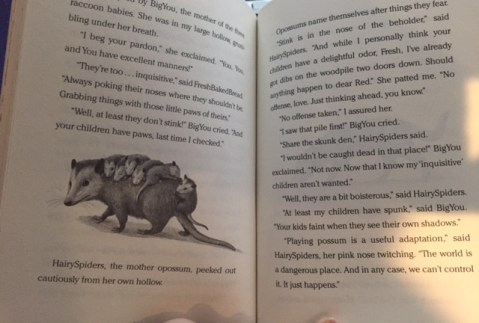
wishtreeI saw this book on Scholastic when I searched for “Muslim” on the website, a regular endeavor of mine, and was surprised to see it pop it since the synopsis on the back doesn’t mention Muslims or Islam.  So I researched it a bit, and sure enough the discrimination of a Muslim family in this tree’s neighborhood is the catalyst of this giant Oak Tree, sharing her story and enlightening the characters and readers with her wisdom.  At 215 pages, this slow and thoughtful book is a short read on an AR 4.2 level.  The pages are well spaced and the black and white drawings keep the reader engaged. And while I bought the beautiful hardback book, I didn’t read it, I listened to the two and a half hour audiobook version, and it was fabulous as well.

FullSizeRender (40)

SYNOPSIS:

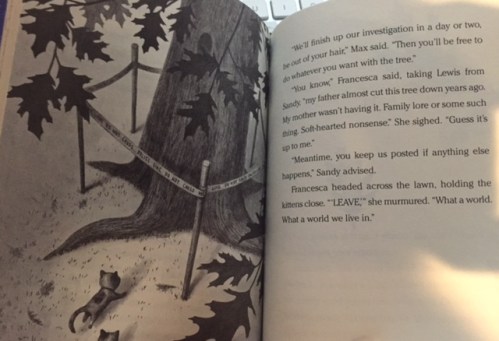
Aside from maybe Shel Silverstein’s The Giving Tree, I can’t recall too many books being narrated by a tree, but like The Giving Tree, the lessons and wisdom come through loud and clear and stay with you long after the story has ended. Red, is an old Oak Tree that has been around for over 200 years.  She has many stories that she shares with her inhabitants: the possums, the raccoons, the skunks, the birds, her best friend a Raven named Bongo, but never humans, for they must not hear her speak, that is kind of a rule.  But when 10-year-old Samar’s family moves in and people don’t respond well to the new Muslim neighbors, the tree considers getting involved.  Samar spends a lot of time near the tree, and the animals enjoy her presence, while most people tie wishes to the wishing tree on May 1st (Wishing Day), trees are good listeners and Samar tells Red that she wishes for a friend.  This coupled with the act of vandalism someone commits against Red by carving “LEAVE” into her trunk, pushes the tree to ponder what makes people friends and how can she help Samar.  When the owner of the home who’s land Red resides on decides to have her cut down, Red throws caution to the wind and speaks.  Hoping to bring two kids together that need one another, and by extension their families and the whole neighborhood, Red has her work cut out for her.  Luckily she isn’t alone, her animal friends are up for the challenge and the lucky reader gets to laugh with the funny animals, ponder roots, and inclusion, and friendship, and diversity through the loving gentle manner of a tree.  It may be written for fourth graders, but I think everyone can draw upon the lessons, the depth, and the compassion needed to help Samar, to save Red, and to learn to be better to one another.  

FullSizeRender (43)

WHY I LIKE IT:

It flows like prose, the deliberate manner in which the story is told, grabs hold of you and halts time.  I love the relevance of inclusion and differences, there isn’t a magic wand, that makes everyone like everyone at the end, but there is hope.  And sometimes that is more powerful.  I listened to the book with my daughter, a 6th grader, and it was nice to chat about it with her after.  What makes people friends? How do people become friends? We move a lot, so she was really insightful about how sometimes friends are just friends because of proximity or because their parents are friends, she really had to think about what has kept certain people in her life, and I loved that this book gave us a starting point to have such a meaningful dialogue.  There isn’t much about Islam in the book other than that the Samar’s family is Muslim and that her mom wears hijab.  

FullSizeRender (42)

FLAGS:

None. It’s clean.

FullSizeRender (41)

TOOLS FOR LEADING THE DISCUSSION:

I would absolutely do this for a 3rd to 5th grade Book Club.  It has so many lessons presented in a non preachy way that the students would add themselves so naturally and effortlessly into the narrative and grow from it.  The book has won numerous awards, and the author is well known, so it also will encourage children to read other books of hers.

Author’s website: http://wishtreebook.com/

Teacher’s Guide: https://images.macmillan.com/folio-assets/teachers-guides/9781250043221TG.pdf


Museum Mysteries by Steve Brezenoff illustrated by Lisa K. Weber

Standard
Museum Mysteries by Steve Brezenoff illustrated by Lisa K. Weber

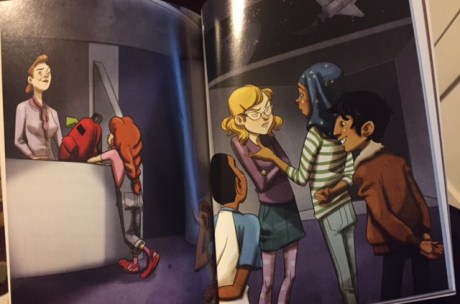
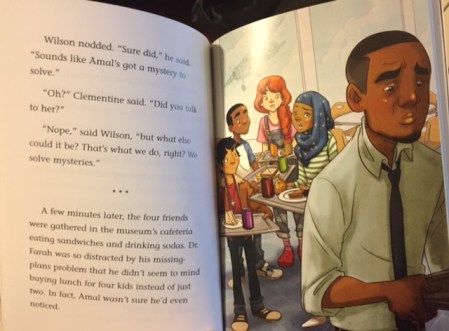
I’m going to review two of the eight books in the Museum Mysteries Series that have Amal on the cover:  The Case of the Missing Museum Archives and The Case of the Stolen Space Suit.  The series focuses on four characters of diverse backgrounds who have a parent that works in one of four Capital City museums.  Amal Farah is Somali American and her dad works at the Museum of Air and Space, Raining Sam is Native American and loves the American History Museum his mom works at, Clementine Wim’s mom works at the Art Museum, and Wilson Kipper’s favorite is the Museum of Natural History.  The kids solve mysteries and introduce the readers to real facts and tidbits of real information.  The AR level is 4.0 and 4.1 respectively, but I feel like they really are on a 2nd-4th grade level.  When a child is done with Ron Roy (A-Z Mysteries & Capital Mysteries) and Magic Treehouse, they are ready for these.  Much like those series, readers are similarly introduced to new vocabulary, but not overwhelmed with back story, detail, explanation, or much character development.

FullSizeRender (29)

SYNOPSIS:

In The Case of the Missing Archives, (the second in the Museum Mysteries Series), eleven-year-old Amal and her friends have to figure out who stole the plans for the German “Bat Wing” Plane, and fast.  If they don’t Amal’s father, Dr. Ahmed Farah, a museum archivist, is going to lose his job.  Luckily in 117 pages the kids suspect and rule out a “friend,” identify a mystery subject, and finally solve the case by piecing together the security guards clues and being perceptive.  Along the way you learn a bit about the characters, but nothing substantial.  You don’t feel a connection to the characters, and are only slightly annoyed when Clementine kind of takes over. 

IMG_7532

The second book where the Museum of Air and Space, and thus Amal are leading the plot is The Case of the Stolen Space Suit (#6 in the series).  I didn’t like this book as much as the earlier one because while yes, I learned about Sally Ride and how women in space are often over looked, I felt like the culprit was let off the hook with little reprimand for stealing Sally Ride’s space suit.  Once again the four kids come together to solve a mystery this time it involves two of the museums: Air and Space and American History Museum.  There is a bit more blatant lying in this book, which is normal in this genre as the kids have to snoop around and not get caught, but they seem a little less apologetic this time around.  The red herrings aren’t as believable, and the real culprit is only spotted by chance, no real sleuthing.  

FullSizeRender (31)

WHY I LIKE IT:

Obviously I like that a Muslim girl is included in this very diverse foursome.  She wears hijab, has a muslim name, tucks her phone in her hijab to go hands free, and is of Somali heritage.  Her father is educated and not over bearing or stereotypical, and her background is just detail.  Her group of friends seem to appreciate each other’s cultures and talents as well as their passions and hobbies.  The kids vary in age from 10 to 13 with two girls and two boys.  The only lack of diversity is perhaps that they seem to all be middle class and fully able bodied.  Faith, family structure, culture, all run the gambut.  

There is no religious reference at all.  The book mentions her scarf only as a hands free life saver, and we learn her favorite hijab is blue with little stars on it.

I like that all the books are full color about 120 pages.  There is factual information at the begining and at the end.  There is also a summary on each kid at the begining.  The story concludes with a glossary,  writing prompts, discussion questions, and information about the author and illustrator.

I love the covers.


FullSizeRender (30)

FLAGS:

There is lying, but the rest is clean.

TOOLS FOR LEADING THE DISCUSSION:

I probably wouldn’t use this book as a book club selection because there isn’t really much to discuss.  I would definitely have this series in the classroom or recommend it to other early chapter book readers.  Like Brezenoff’s other series the book is satisfying in its simplicity and a good book to build interest in a variety of things while feeling accomplished at reading a book.


nine, ten: A September 11 Story by Nora Raleigh Baskin

Standard
nine, ten: A September 11 Story by Nora Raleigh Baskin

nine, ten.jpg

I still struggle with the fact that 9/11/2001 is taught as history, it seems so current and fresh in my mind, that I really struggle with how works of fiction (and non fiction too) try to tell me about the pulse and the mood and the impact of something that I lived through and recall so clearly.  I suppose this isn’t a unique predicament, but because of the magnitude, one that I still wrestle with.  The author of nine, ten glosses over the big picture and in a lot of ways, the events of 9/11, but instead tries to show the paradigm shift that occurred and the division drawn as life before and life after.  She attempts to do this on an AR 4.8 and in 197 pages.  No easy feat, but one that definitely has some hits, and for me at least,  a few misses too.

SYNOPSIS:

Told from four different perspectives that intersect at the opening and at the close, the reader meets the characters two days leading up to 9/11, spends some of September 11 with them, and then peeks in on them again a year later.  The characters all cross paths at Chicago’s O’Hare Airport.

The first character is Will.  A middle school boy struggling to come to terms with how his father died helping someone on the side of the road.  Often more responsible and mature for his age as he helps his mom with his younger siblings, he lives in Shanksville, Pennsylvania and finds healing with helping those affected by the plane that goes down there.

Next we meet Aimee, who has just moved to California and is starting a new school.  Her daily drama is more missing her mom who travels a lot to New York for business, but is relatable as she tries to make new friends, fit in, and find her place in a new environment.  Her mom is in New York during the duration of the book, and has a meeting in one of the Twin Towers on the 11th.

Sergio lives in Brooklyn, New York and is a math wiz who gets a special award and recognition for his achievements.  He lives with his loving grandma, but it is the stressful encounter with his deadbeat father that sets him on a fateful subway trip that introduces him to Gideon, a New York fire fighter.

Naheed is the fourth character, and is an Iranian American Muslim girl, who is struggling to handle friends, and new questions about the hijab she wears.  Her friend drama consumes her, until 9/11 happens and she has to now prove her love of America at every turn.

The characters each take chapters divided by dates and while short, they do form a connection in their snapshots.  You feel like you get to know the characters and you do feel a tinge of stress knowing how they are all related geographical to what will transpire on the 11th. But in the afterward, the author explains why she intentionally keeps the carnage at bay to show how connected we all are, especially children, at the forefront of her fictionally retelling, and to show how much we all were affected that day.

WHY I LIKE IT:

I like that breaking up of the story, it adds some dimension to the book.  I know some reviews feel it is over done, but I think it is deliberate, and highlights how we all are inter connected and for late elementary, early middle school readers, I think the choppiness it allows, keeps the book on their level.  I like that each character has their own struggles, it isn’t that life was rosy and then 9/11 ruined everything, these kids have their own issues and stresses and realistic personalities before and after.  I also like that the Muslim character is not from the Middle East, it further shows how groups get lumped together for different reasons giving the book a bit more for readers to consider.

There are however, some real issues in how they present Naheed, which seems odd, since the book is so politically correct, and given the topic, you’d think the author and editors would work overtime to get the islamic parts correct.  But alas at one point Naheed’s visiting Uncle wants to know why Naheed doesn’t pray the mid day prayer, thuhr, at school, to which the mom replies, “she makes up her prayers at third prayer.” What? Yes I laughed out loud, no one calls the prayers by their numbers! I have never used numbers to describe our prayers, they have names, and we use their timings to describe them to others, not numbers. At one point, Naheed is making wudu, ablution, and the author gets it wrong. “And lastly, feet.  Right foot with right hand. Left foot with left.  Toes to ankles.” Left hand for both feet.  I also take some issue with Naheed having to wear hijab at age nine.  Hijab becomes required at puberty, so yes it could have been when it became required of her, but it seems a little young for her, and it seemed a bit forced.

In terms of plot, I would have liked a day or two after 9/11 to juxtapose the differences in priorities and the lens of how we got to a year later, or two years later, or 15.  Also, how they all went to New York on the anniversary to tie the story together made for a nice ending, but why they all went was a bit of a stretch, ok a big stretch.

FLAGS:

For a book about 9/11 there is relatively no violence.  The only death is in talking about Will’s father and the only blood is when Sergio helps a man on the subway.  There is some hate speech at the end, but even that is minimal.  Will does kiss a girl he likes. And both Will and Sergio skip school.  Aimee worries if her mom is having an affair (implied) and if her parents are getting divorced, but it isn’t explicit.

TOOLS FOR LEADING THE DISCUSSION:

I think this would be a good book for a younger book club.  With its overt commitment to political correctness and breaking down stereotypes, it reinforces how similar we all are through strengthening bonds of humanity, rather than being divided by our skin color, or religion.  I think it would also lead so easily into faccilitating discussion of today’s kids putting themselves in the story.  What in their lives wouldn’t matter any more or what would matter more. There is a Reading Group Guide at the end of the book, along with an Author’s Note and Acknowledgement, that easily lend themselves to more discussion ideas.

Curriculum Guide: http://www.norabaskin.com/nine-ten-curriculum-guide/


The Hajj Adventures of Jamila and Fasfoose by Ediba Kezzeiz illustrated by Abd al-Hayy Moore

Standard
The Hajj Adventures of Jamila and Fasfoose by Ediba Kezzeiz illustrated by Abd al-Hayy Moore

FullSizeRender (13)

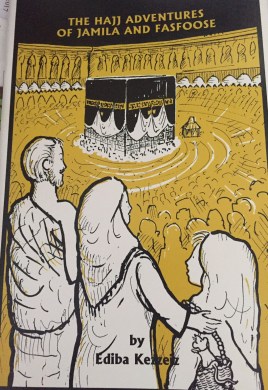
The book isn’t much to look at with its black and white, with yellow thrown in cover, and its 40 pages bound with a staple, but for independent readers between 2nd and 4th grade or so, the book is good.  In many ways it is an older kids version of Zaahir and Jamel, adding a fictional story to the learning about the steps of Hajj.  

SYNOPSIS:

The setting is Hajj and all of its different rituals, but the story is that Jamila and her pet mouse Fasfoose get lost in Mecca.  Along the way to finding Jamila’s parents and performing the requirements of Tawaf, Sai, Arafah, Mina, Muzdalifa, Jamrah, and Eid, a few duaas are thrown in, friendship with people of different nationalities and lessons in patience, speaking with your heart and finding your internal compass of wrong and right all come to light.

WHY I LIKE IT:

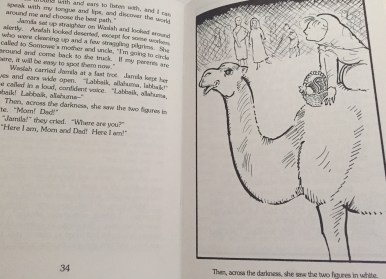
I like the target audience, and how it doesn’t ever feel preachy or like a How-to-perform-Hajj manual.  If a child is familiar with the rituals of Hajj the story gently reminds them of what they already know and the story takes center stage.  If they are unfamiliar, the book doesn’t talk down to them, and may prompt them to want to learn more.  Strong lessons of being kind and not hurting anyone or anything while in ihram are strong, as are the  beauty of multiple cultures speaking from their heart to find common threads.  There are illustrations to break up the text and not overwhelm the young reader, and the story is divided into seven chapters.  The font and size are all age inviting and even older middle school kids would probably pick it up if they saw it, read it in about 20 minutes and be glad that they did.

FullSizeRender (14)

FLAGS:

None, alhumdulillah

TOOLS FOR LEADING THE DISCUSSION:

The book is fun, probably not long enough for a book club selection, but a great read -a-loud. The length of the chapters make it a short read that ideally could be read the week before Hajj or Eid.  My 3rd grader read it and is enjoying listening to me read it to my 2nd grader.

FullSizeRender (15)

The Most Magnificent Mosque by Ann Jungman illustrated by Shelley Fowles

Standard
The Most Magnificent Mosque by Ann Jungman illustrated by Shelley Fowles

Most-Magnificent-Mosque

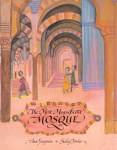
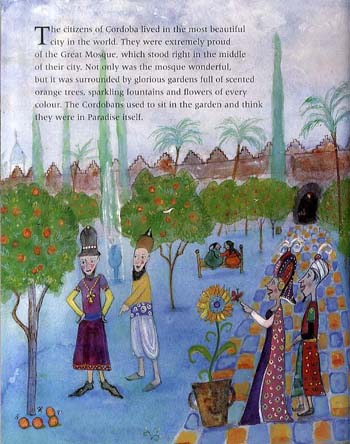
Three very naughty boys harass visitors to Cordoba’s Great Mosque in Spain.  Rashid, a Muslim, Samuel, a Jew, and Miguel, a Christian, run through the fountains, destroy the flowerbeds and throw oranges at people leaving their prayers.  Most days the boys can out run the gardeners, but one day they pelt the Caliph himself with a rotten orange.  The punishment from the Caliph is three months of hard labor working with the gardeners everyday on the mosque grounds.  On their breaks the boys explore the mosque and marvel at its beauty.  By the end of their sentence, the boys have such a love for the mosque and one another that they are forever bound.  As the boys grow and make their way in the world, they don’t keep in touch much.  However, when Cordoba is defeated in battle by the Christian king Fernando, it will be up to these three boys to convince the new king, that the Mosque shouldn’t be torn down.  And that the it is the pride of all people in Cordoba, Muslim, Jewish, and Christian alike.

magnificent mosque 1

The book is 32 pages and an AR 4.0.  It does a good job of showing the three faith communities coming together to save something they all value.  It also shows a kind, yet purposeful punishment from the Caliph to the three boys.  While younger kids in story time will enjoy the concept of people working together, the book really finds its strength with students learning or familiar with Spain, particularly prior to the Inquisition.  There isn’t a lot of detail regarding the structure of the mosque, or the doctrine of each faith, that knowledge would have to come from outside the book, in order for it to be appreciated. There are some plot holes in the story and the book itself doesn’t make it clear what parts of the story are historically accurate and which are fiction.

magnificent mosque

The illustrations are charming in their own way.  The watercolors do a good job bringing to life the mosque and gardens, and battle, but for me fall a little flat in depicting the three boys.  I don’t know if the text or illustrations are at fault for me not connecting to the story or finding an emotional resonance to what should be a very inspiring story. Perhaps it is a combination of the two.  I feel it is desperately in need of an author’s note detailing the factual origins of the tale,  Something to uplift and give hope to people of different faiths coming together in a peaceful way, that can be put into real world actions.

magnifectn

Amina’s Voice by Hena Khan

Standard
Amina’s Voice by Hena Khan

amina voice

This book really marked a shift in Islamic fiction for me and the genre.  First of all I was waiting for the book to come out.  I didn’t stumble upon it or hear about it from someone else.  I knew when it was going to be released, and I knew I wanted to read it. Additionally it was the first books published by Salaam Reads, an imprint of Simon and Schuster. Which according to their website was “founded in 2016, Salaam Reads is an imprint that aims to introduce readers of all faiths and backgrounds to a wide variety of Muslim children and families, and offer Muslim kids an opportunity to see themselves reflected positively in published works.”  This is big, huge in fact.  The bar has been raised, and a platform has been given, no more excuses.

Alhumdulillah, Amina’s Voice is a beautiful 197 page book for children ages 8-12.  The book is not AR, but probably will be in a few weeks.  I think it is spot on for 3rd through 5th grade in terms of content, message, and appeal.  The book caters to females and Muslims, but naturally is not limited to those two demographics exclusively.  There are characters of a variety of ethnic and religious backgrounds in the novel that play significant roles in saving the day and keeping the book powerfully optimistic and inspiring.

SYNOPSIS:

Amina is starting middle school and everything is changing for Amina. Her friends are acting different, her older brother is skirting with trouble and her religious uncle is coming to visit from Pakistan.  Internally, she doesn’t like the spotlight but desperately wants to get out from behind the piano to sing.  All of this combines in a climax that pivots around the destruction of the mosque she attends and her having to find her voice, and use it to take center stage in her own life.

WHY I LIKE IT:

There is a lot going on in the book, but it doesn’t get over whelming with Amina’s voice keeping the reader focused on her and her view of the events around her.  The author does a good job of getting inside a 12 year-old girls head without being condescending or heartless.  The reader feels her stress that she is losing her best friend, Soojin to Emily, a girl who used to torment the two “ethnic” girls, without belittling her concerns.  You also feel her love of Islam and struggle to understand if music and singing is permissible within Islamic rules.  The book is realistic fiction with school, friendships, and family guiding the story.  Everything from the ups and downs of group projects, inside jokes between siblings, and trying to pronounce the big HAA in Arabic.  The macro of middle elementary years combined with the micro facets of culture, religion, and current events, and you speak to a section of readers that will connect with Amina and what she goes through in a very authentic, relatable story.

The only points that gave me pause is the premise and music in the book.  It is a point of disagreement amongst nearly every group of Muslims, so to have the Imam sitting and listening to her play the piano, is a bit hard for me to accept as the norm, no matter how cool Imam Malik is.  Additionally, I wish that Amina’s mom had some depth, and the relationship between Amina and her uncle, Thaya Jaan, was fleshed out just a tad more.  In both cases I felt something was lacking, and I wanted more.

FLAGS:

Nothing major, but a few minor issues, that a parent may want to be aware of for younger readers.  Mustafa, Amina’s brother, is seeing skipping Sunday school class and reeking of cigarette smoke.  He denies it, and the issue is definitely not glorified.  There is also crushes discussed amongst Amina’s friends and when Amina spills a secret, she has to own up to it and work it out to maintain her friendships.  The destruction of the mosque could also be upsetting to younger readers.  It isn’t graphic, but her emotional response and the intensity of it, is the climax, and a very real part of our world sadly. For parents, this fictional vandalization could possibly be a great place to start a discussion from if your children are somehow unaware of the current status of Islam in the west.  It also shows that people are good, as the whole larger community, comes together to show unity, love, and respect are values to us all, alhumdulillah.

TOOLS FOR LEADING THE DISCUSSION:

This book would be perfect for a 3rd through 5th book club.  If I was starting a new book club I would start with this book.  It has it all. It has real issues, religious issues, universal issues, and heart.  All while staying on age level and all in a realistic fiction safe space to have an opinion about objectively.  The discussions after the book is read will flow naturally, but just in case:

Reading Group Guide:  http://www.simonandschuster.com/books/Aminas-Voice/Hena-Khan/9781481492065/reading_group_guide

Author’s Page: https://www.henakhan.com/


A Long Pitch Home by Natalie Dias Lorenzi

Standard
A Long Pitch Home by Natalie Dias Lorenzi

a long pitch

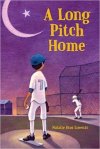
The correlation between baseball and cricket provides the foundation for detailing the relationship of  Bilal’s first year in America after having to leave Pakistan in a hurry: the same, but different.  This 248 page book written on an AR 4.6 pivots around sports, but has a lot of heart as themes of family, friendship, and longing, take center stage.  Throw in a whole new culture, the English language, Ramadan and prom and you have a whole lot to cover in this well crafted story.

SYNOPSIS:

Bilal has a good life in Karachi, Pakistan.  He is the oldest of three kids and at 10 years old, his world pretty much involves Cricket, friends, and his dad.  When his father disappears things get frantic, and when his father returns, the family decides to move to America.  Unfortunately Bilal’s dad can’t come.  As Bilal, his mom, his younger sister Hira and younger brother Humza, board a plan to Virginia, everything Bilal knows is left behind.

Virginia is home to Bilal’s maternal Uncle, his wife, and their teenage son, Jalaal.  Jalaal plays baseball and arranges to have Bilal join him at baseball camp for the summer.  Learning the new sport, and a new language, and the nuances of life in a new land are frustrating and often comical as Bilal points out how confusing navigating American life can be.  He also keeps an ongoing list of new things in America to share with his dad over Skype, as they swap memories of an old life in preparation for a new one.  The supporting characters on the field are generally kind and accepting of Bilal, because they have a bigger problem then a foreign boy, there is a girl on the team, Jordan.  Jordan is new too, and the coaches niece at that, naturally they become friends, but its not easy, Bilal has to learn what being a friend really means.

The majority of the book stems from the tension of waiting to hear from Bilal’s father, and to see if he can come to America.  The passing of time with baseball games and school are anecdotal to the larger arc that sets the pace of the book.  Will Baba be able to come, and if so, when?

WHY I LIKE IT:

Interestingly religion has a pretty big role in Bilal’s life and the author does explain some tenants in Islam.  He wakes up for fajr (although he does miss it occasionally), he only eats halal zabiha, the family fasts in Ramadan, and they celebrate Eid.  Bilal wants to fast, but him mom tells him he is too young when they are coming to America, and the following year he doesn’t because of baseball, which is unfortunate, because a lot of kids fast and play sports all over the world.  They go to the mosque on Eid only, and it mentions that the women in his family do not wear hijab like some of the women at the mosque.  His older cousin Jalaal wants to take the neighbor girl, Olivia, to prom, which the family explains awkwardly as something that Muslims don’t really do until they are older, or at least that is how Bilal understands it.  In the end, they let Jalaal go with Olivia and a group of friends, and the whole family Skype’s the family in Pakistan and sees them off.  Even more funny is that they don’t join their friends for dinner before the dance, because Jalaal is fasting and can’t eat until later.  I don’t know if this will confuse 4th and 5th grade readers, but as an adult I found it hysterical, because these cultural contradictions are more common than not.  I did like that nothing was done behind the parent’s backs.  Things were discussed and worked out instead of lied about.

Another thing that I found interesting, but since finishing the book, I have come to appreciate, is that there is no Islamaphobia in the story, or even xenophobia.  The kids are accepting of Bilal’s faith and culture.  He is far more self conscious about being different or not understanding than those around him are.  Its idealistic perhaps, but at the same time, I think it would distract from the core of the story.

While the book focuses on sports, I think even non sports fans will be able to enjoy the story.  The author doesn’t get too technical and it moves steadily with mini climaxes and triumphs through out.  Girls and boys will enjoy the book, Muslims and non Muslims too, the readers might even learn something about baseball or cricket or Pakistan, or even about themselves along the way.

FLAGS:

The book is remarkably clean and what you would expect for a good quality, solid 4th grade and up story.  There is the “prom” issue, but there is no hugging, kissing, longing etc.  They “like” each other, but it isn’t more explicit than that.

TOOLS FOR LEADING THE DISCUSSION:

I don’t know if I would use this for a Book Club.  One could, but I think it would require a lot of coaxing to get kids to give a book about baseball/cricket a try.  I have no doubt if they started it, they would finish it, but it might be a tough sell.  The confusion in American life would make for an awesome discussion after being read, because everyone can relate to some of the oddities of the English language, and challenges of learning a new language and culture.  I think how Islam is handled would also make for some good discussion in addressing how each family handles things differently as they arise.  Although written on a 4.6 level if I were to do it in a school setting, I would probably do it for middle school kids who could articulate their own life parallels to the story.

An interview with the author:

http://wordspelunking.blogspot.com/2016/09/a-long-pitch-home-blog-tour-interview.html

Overall a solid decent book about an immigrant Muslim boy making his way in America, while not losing or giving up on who he is, alhumdulillah.


What Does a Muslim Look Like? by Mohamed Abdel-Kader illustrated by Abdullah Badawy

Standard
What Does a Muslim Look Like? by Mohamed Abdel-Kader illustrated by Abdullah Badawy

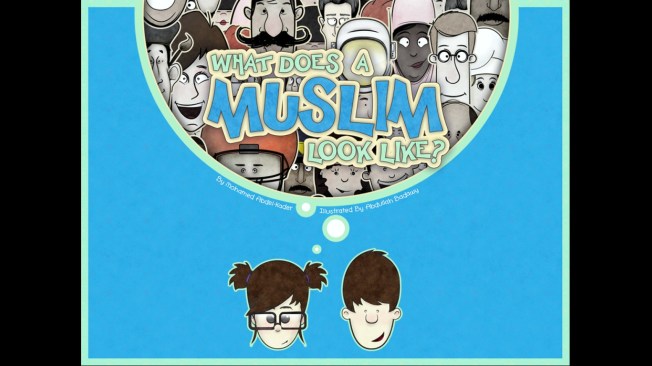
what does a muslim look like.jpeg This 22 page, simplistic book written in rhyming couplets, is such a timely and necessary book.  Much like Owl and Cat: What Islam Is… this book has value that extends far beyond its audience level (not AR but, I’d say three years and up), as the content breaks down stereotypes while being framed in a positive, non condescending way.
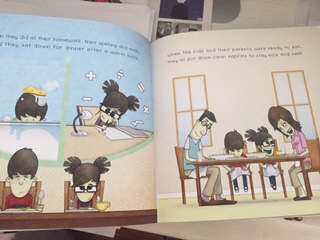
IMG_3160

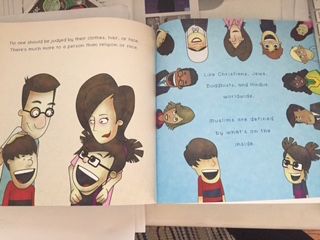
A brother and sister pair, Jack and Jane, go about their day when at dinner Jack remarks that he learned that two of his classmates are Muslim and they look like them.  Thus arises the question, what do Muslims look like?  The book then goes on to break down stereotypes and broaden views in the same rhyming manner that keeps the book light and child friendly.  The conclusion is that like people of other faiths, everyone is different, and that no one should be judged on what is on the outside.

IMG_3161

The book appears to have been started on Kickstarter in 2012 and Alhumdulillah it got the needed funding to get published.  I got my copy through the public library system, and I am beyond thrilled that I found it where hopefully a lot of people can get their hands on it.  Reading the author’s campaign on where the concept came from, he would have had no idea how much more timely the book is now, then when it was first published.  I get asked quite regularly from old school friends, how they can introduce Islam or get the ball rolling  to talk to their kids about Muslims, and this book would be a great start.  Told from non Muslim kids perspectives, with very hip parents, the book does not discuss any tenants of faith or belief, it just identifies the many shapes and sizes and colors that Muslims come in.  It would work well to show that Muslims are everywhere not just in the news, without overwhelming even the youngest of readers.

IMG_3162

The pictures in the book are absolutely perfect in complimenting the story. They are not only silly, but also diverse as the book’s text would require.  Interestingly there are ladies with hijab and those without, and scarves are not mentioned in the text, and also noteworthy is there are no bearded men in the pictures.  Overall, a wonderful book that I would love to have on my shelf with extras to hand out.

Jennah’s New Friends By: Suzy Ismail

Standard

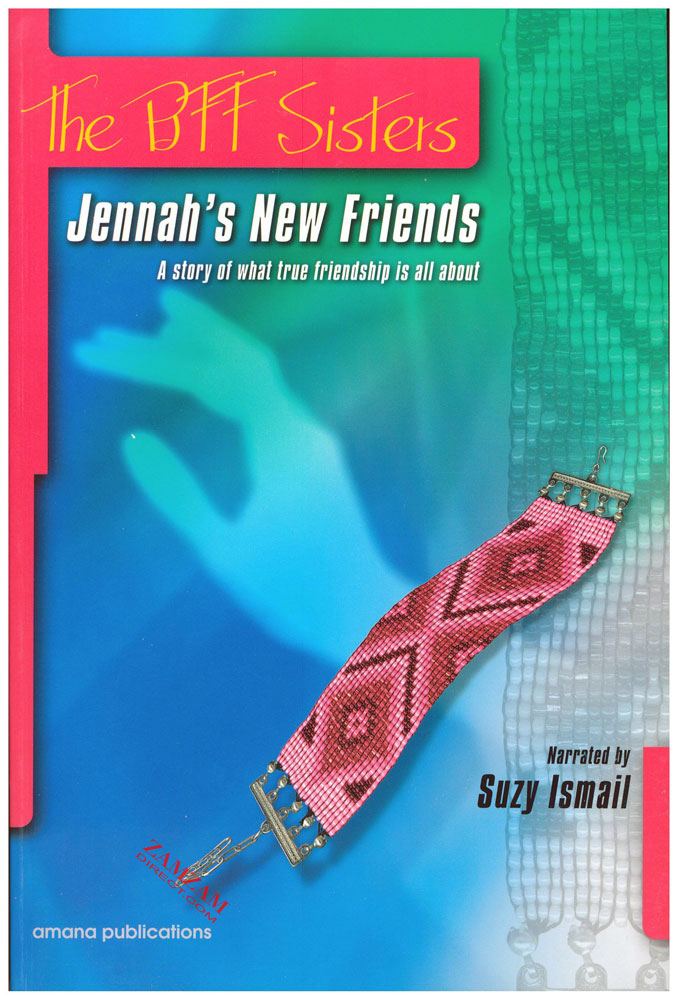
ImageThis book is presumably book one of the BFF SISTERS series, however, the author’s website doesn’t list any other books in the series and it was published in 2001, so it is unknown if more books are in the works.  At 64 pages, the intended audience is girls between ages 7 and 12, but I would note that there are no illustrations and while it is broken into chapters (on average about 10 pages long) the text and layout would be daunting to the average 2nd and possibly 3rd grade student. 

SYNOPSIS: 

Jennah lives in a neighborhood with lots of Muslims and lots of friends, but when a new girl moves in, Jennah is afraid that her best friend Yasmeen would rather be best friends with the new girl, Mariam.  Jennah not only is afraid of losing her friend, but there is a lot going on at home too, her mom is about to have a baby, her younger sister is always bothering her, and her dad is constantly away on business.  Alhumdulilah, Jennah is surrounded by supportive adults, forgiving and generous friends, and an Islamic foundation that allows her to sort out her feelings and create a Hadeeth club with All her new friends.

WHY I LIKE IT:

I love that it is a clean book for the elementary age group, the girls do not have boyfriends and while hijab is mentioned in passing, the girls are a group of kids that are dealing with the constant struggle of all girls that age: friends.  Each girl in the BFF club is from a different background, Arab, Pakistani, African American, one’s parents are converts, and at the end a non-Muslim joins the group, truly someone for every reader to identify with.  I think most every girl reading this book can relate to the struggles amongst friends, being the new kid, having younger siblings, trying to fit in, and jealousy, all topics touched on, however the book is an awkward read.  I can’t decide if the book is a short story that got too long, or a novel that wasn’t fleshed out.  The beginning drags on as the foundation of who all the characters are is established, and at times Jennah seems very whiney and immature with problems that wrap-up with little explanation or insight.  Everything often seems too “perfect” and Jennah’s problems petty when all the surrounding characters are so over the top forgiving and generous.  The book left me wanting to know more about the backgrounds of the supporting characters, and more about how Jennah felt.  I think readers may get lost with all the characters, but if they can sort it out, I think they will see themselves and their friends in the pages dealing with the same issues they deal with every day.

FLAGS:

Clean

TEACHING THIS BOOK:

I probably wouldn’t teach this book for the intended audience, or share it as a book club, however, one-on-one the book would be a great starting point for a discussion with a girl having problems with friends.