Tag Archives: Family

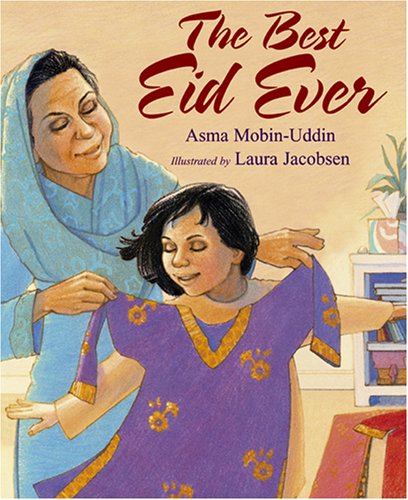
The Best Eid Ever by Asma Mobin-Uddin Illustrated by Laura Jacobsen

Standard

best eid ever

For some this book may have a lot going on it’s 32 pages: Eid ul Adha, parents at Hajj, refugees, charity, Pakistani culture, but if you are reading this book to Muslim children (or they are reading it independently, it has an AR level of 3.8) i think it is delightful.

Aneesa wakes up on Eid morning missing her parents who are in Saudi Arabia performing Hajj. Her grandma, Nonni, surprises her with three new outfits complete with bangles and shoes for each of the days of Eid and is preparing her favorite dinner, lamb korma, for them to eat after Eid prayers.  At Eid prayers Aneesa meets some refugee girls and wants to do something to make their Eid a little brighter.  Nonni and Aneesa come up with a plan and the result is “the best Eid ever!”

I love that it has morals and plot and sparks dialogue.  The message is so simple yet beautiful, that it stays with the reader, adult and child alike.  The illustrations are beautiful and warm providing a nice balance to the long passages.  There is an author’s note and Glossary in the back, but I think this book is really intended for a Muslim audience familiar with Hajj, Eid, and Paksitani culture.  It wouldn’t be lost on someone new to the vocabulary and customs, but definitely wouldn’t be as magical or memorable.

My 3rd grader loved the book and we were able to talk about it and reflect upon it long after the initial reading.  My younger boys enjoyed it, but didn’t get as much out of it.  I think this book works better in smaller groups rather than story time, or simply to have on the shelf to sweep the reader up and allow them to draw their own conclusions on what it means to do something for someone else.

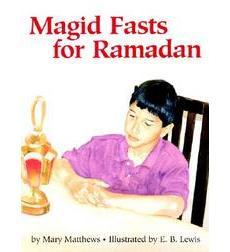
Magid Fasts for Ramadan by Mary Matthews illustrated by E. B. Lewis

Standard
Magid Fasts for Ramadan by Mary Matthews illustrated by E. B. Lewis

Magid Fasts for Ramadan

The intent of this 48 page chapter book is good, however, a few things rubbed me the wrong way about how Ramadan and Islam are presented.

Nearly eight-year-old Magid wants to fast on the first day of Ramadan, but everyone says he is much to young.  He decides to deceive everyone and fast anyway.  I’m actually okay with this main story line, as I could genuinely see a child wanting to do it so much they would lie about it.  The author even has the family sit down after the truth comes out and discuss how honesty is important and this is not how Ramadan should be celebrated.  Lesson learned for Magid and the reader, right? Nope, the author kind of blows it and takes it to the other extreme.

Magid’s sister Aisha is twelve and is “forced” to fast so she isn’t the only girl not fasting at her all girl’s school in Egypt.  What a sad reason to fast, The whole reason Magid wants to fast is to be a “truly obedient Muslim” which sounds great on the surface, but it get’s repeated so often that Magid at one point is judging a classmate who isn’t fasting and isn’t always at Jummah (Friday) prayers.  The parents decide at the end to let Aisha fast until school is out, hence shortening the day for appearance purposes, and Magid can fast til lunch.   He is told he can fast full days when the days are shorter.  Again a really odd reason to wait when fasting has been prescribed for us, to make it an issue of convenience.

So aside from the very negative view of Ramadan and the kids rejoicing at the end that they don’t “have” to fast, the lying, the disobeying your mother, and the judgmental laden diction of being truly obedient, the book does cover a lot of ground well.  The book shows the characters doing wudu and praying, it shows them trying to be kind to one another, it talks about how the Quran was revealed in the month of Ramadan and it does have a plot.

The water color illustrations are nice, and I also like how it showed a bit of Egyptian culture with the lanterns, singing, and food.  Interestingly the author says it is harder for Muslim’s in America to fast, but elsewhere says that Aisha has to watch the girls at school not fasting, eat lunch.

I really wouldn’t recommend this book, for the intended audience of 3rd through fifth graders I think it would do more harm than good in promoting Islamic values in Muslim children and in showing non-Muslims what Ramadan means to Muslims.

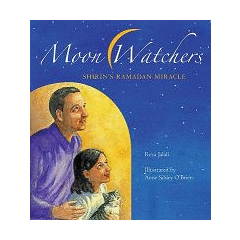
Moon Watchers Shirin’s Ramadan Miracle By Reza Jalali Illustrated by Anne Sibley O’Brien

Standard

moon watchers


This book is similar to Night of the Moon By Hena Khan as it focuses on a young girl experiencing the month of Ramadan and Eid, through the waxing and waning of the moon.  This is an AR book 3.5 and the text is driven by dialogue between nine-year-old Shirin and her Persian American family.

Too young to fast Shirin is feeling left out of the blessed month of Ramadan, her older brother Ali and her bicker until her Grandma encourages her to do “part-time fasts.”  Facts about Islam and Ramadan are slightly peppered in to the story, primarily through vocabulary, and the characters do discuss hijab and why Shirin’s mother doesn’t wear it.  It is important to note that the tale is told from a Shia perspective that is made clear as it explains how the family prays, touching the prayer stone, and kissing it three times.  The illustration here is more peculiar as it shows Shirin praying next to her dad and her brother, mom, and grandma in the row behind.

The pictures show a happy family that most readers or listeners would probably be able to identify with, along with the sibling bickering and excitement felt with the blessed month.  Persian culture is represented in the foods and sweets they prepare as a family and the henna Shirin gets on her hands.  The family prays together, spends time together and they discuss doing good deeds, not just fasting in Ramadan.

The book is beautifully done, but I think because of the brushing aside of hijab being a cultural practice, not a religious one and the presentation of prayer, I don’t know if I would give the book without discussion to a third grader in a Sunni school to read independently.  As for story time, I might simply omit those few sentences, but I’m not sure, it would depend on my audience.

If your children are aware of the differences between Sunni and Shia or you are Shia, this book is wonderful.  If your children would be greatly confused or get hung up on a few lines in a 32 page book, then it would be better to hold off.


Night of the Moon By Hena Khan Illustrated by Julie Paschkis

Standard

night of the moon

Night of the Moon is a beautiful book both visually and content wise.  The pictures are bright and inviting and consume the entire page, keeping even the youngest of listeners engaged.  The book has an AR level of 4.1 and has 32 pages, making it work great for story time and well for independent readers too.

The book tells of seven-year-old Yasmeen, a Pakistani-American girl experiencing Ramadan. The story is moved along by the ever changing phases of the moon. While this book is adequately called a Muslim Holiday Story, it is very cultural.  The characters go to the mosque, but the focus of the story is not why we fast, the revelation of the Qur’an to Prophet Muhammad (peace be upon him), or even manners.  The story focuses on going to iftar parties, having henna painted on your hands, presents, and the very Pakistani-tradition of celebrating chand-raat, the night of the moon.

I like that this book shows Yasmeen talking about Eid at school with classmates of other backgrounds, I even like that her grandma wears hijab and her mother does not.  I also like that they eat a variety of foods, from kebobs to cupcakes.  Thus far, so many of the Ramadan and Eid books I’ve read contain the same information in a fictionalized setting, this one is definitely different, instead of focusing on what Ramadan is, it shows how it is celebrated.  The book works well for Muslim and non Muslim children from all around the world.  If your audience lives in American and has ties to the Asian subcontinent they will see them selves in this book, and even if they don’t, they will probably want to join Yasmeen and her family is celebrating Ramadan and the Night of the Moon.

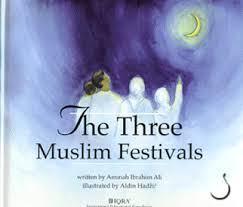
The Three Muslim Festivals By Aminah Ibrahim Ali Illustrated By Aldin Hadzic

Standard

Image

The Three Muslim Festivals is a very informative book about Ramadan, Id al-Fitr, and Id al-Adha, at over 60 pages however, it is a bit long for story time or smaller children.  Broken up into three parts, each told from a different character, the book would work well for second through fourth grade students.  It reads like a very basic chapter book, with information mixed in with a simple story.  The morals are clear, hadith, ayats and dua’as are shared and the illustrations help support the fictionalized portions.  The pictures aren’t engaging, but they do show a variety of ethnic groups and happy families.  The book is content, not character driven, but the families are supportive of the children, there are actively involved moms and dads, grandparents, and siblings.  The mom in one story is a physician and the dads help in the kitchen and around the house, showing some diversity. I like how it serves as both a review of basic Islamic principals while reinforcing elements that a child may not know or may have forgotten in a non condescending manner.  I would imagine the average seven year old could read it independently and comprehend it without being bored.  It isn’t the best written story out there, but it should be engaging enough to convey a lot of good information to an elementary aged reader.  Based on the style it is probably more intended for Muslim readers, but there is a three page glossary of terms in the back.

Jennah’s New Friends By: Suzy Ismail

Standard

ImageThis book is presumably book one of the BFF SISTERS series, however, the author’s website doesn’t list any other books in the series and it was published in 2001, so it is unknown if more books are in the works.  At 64 pages, the intended audience is girls between ages 7 and 12, but I would note that there are no illustrations and while it is broken into chapters (on average about 10 pages long) the text and layout would be daunting to the average 2nd and possibly 3rd grade student. 

SYNOPSIS: 

Jennah lives in a neighborhood with lots of Muslims and lots of friends, but when a new girl moves in, Jennah is afraid that her best friend Yasmeen would rather be best friends with the new girl, Mariam.  Jennah not only is afraid of losing her friend, but there is a lot going on at home too, her mom is about to have a baby, her younger sister is always bothering her, and her dad is constantly away on business.  Alhumdulilah, Jennah is surrounded by supportive adults, forgiving and generous friends, and an Islamic foundation that allows her to sort out her feelings and create a Hadeeth club with All her new friends.

WHY I LIKE IT:

I love that it is a clean book for the elementary age group, the girls do not have boyfriends and while hijab is mentioned in passing, the girls are a group of kids that are dealing with the constant struggle of all girls that age: friends.  Each girl in the BFF club is from a different background, Arab, Pakistani, African American, one’s parents are converts, and at the end a non-Muslim joins the group, truly someone for every reader to identify with.  I think most every girl reading this book can relate to the struggles amongst friends, being the new kid, having younger siblings, trying to fit in, and jealousy, all topics touched on, however the book is an awkward read.  I can’t decide if the book is a short story that got too long, or a novel that wasn’t fleshed out.  The beginning drags on as the foundation of who all the characters are is established, and at times Jennah seems very whiney and immature with problems that wrap-up with little explanation or insight.  Everything often seems too “perfect” and Jennah’s problems petty when all the surrounding characters are so over the top forgiving and generous.  The book left me wanting to know more about the backgrounds of the supporting characters, and more about how Jennah felt.  I think readers may get lost with all the characters, but if they can sort it out, I think they will see themselves and their friends in the pages dealing with the same issues they deal with every day.

FLAGS:

Clean

TEACHING THIS BOOK:

I probably wouldn’t teach this book for the intended audience, or share it as a book club, however, one-on-one the book would be a great starting point for a discussion with a girl having problems with friends. 

The Hundredth Name By Shulamith Levey Oppenheim

Standard

hundredth

The Hundredth Name is a heartwarming story of a boy named Salah, his father, and his camel named Qadiim, Ancient One.  Salah is concerned that his best friend Qadiim is sad, and this in turn makes Salah said.  As Salah’s father gently and patiently teaches Salah about the power of prayer, the mercy of Allah and how we only know 99 names of Allah, the hundredth name is not known to us, Salah finds a way to make Qadiim happy.  Through beautiful pictures and prose like paragraphs, the reader is inspired to trust Allah with all matters, big and small.

The book has 32 pages and is an Accelerated Reader level 3.7.  I think Kindergarten would enjoy this book during story time, but the younger ones, Daycare through Pre-k,  may not truly understand the beauty and the message.

I am Malala By Malala Yousafzai and Christina Lamb

Standard

malala pic big

Naturally we all have heard Malala’s story and while some are inspired by it, some seem to have major hostility toward her and her approach.  Chosing to take her at face value and be inspired by her, I was generally looking forward to reading her story before I ever entertained thoughts of using it as a teaching tool in a school.  It is an AR reading level of 7.1 so once I obtained the book I rushed to read it before the end of the school year to see if perhaps our 7th and 8th grade students could read it and leave for the summer realizing the blessing that an education can be from someone who has had to risk it all, just for the chance to learn.  However upon completion I think that the dates, and history of Pakistan would ultimately drag the book on for the majority of Middle-Schoolers and her message and inspiration would be lost.  For adults looking for a book club book however, I would highly recommend it.  As a half Pakistani-American growing up spending my summers in Pakistan, I could relate and recall so much of what she wrote about.  I think most adults of any background would similarly be able to recall major news events, and be able to follow along.  I think anyone younger would find it incredibly difficult and possibly dull to get through.  I think that students would benefit from learning about her story and then only reading excerpts from the book.  There are some very moving sections that I think the average middle schooler would be impacted by, and the included pictures amongst the 327 pages would give them a glimpse into her world.   I on the other hand, couldn’t put it down, the book reads very quickly and bounces around all over the place, which actually didn’t bother me, I enjoyed her descriptions of her town and family and friends.  While Malala wrote it with an author, I think the tone is very much that of a young girl and thus the style works for me.  Political views aside the book made me smile, made me cry, and makes me feel better off having read it.

SYNOPSIS:

Malala is a Pashtun girl in the Swat Valley in Pakistan.  In a culture that keeps females behind doors and cloth, her father is the anomaly and encourages her to be educated, free, and vocal.  As 9/11 occurs, the Taliban sets in, the west wages war on Afghanistan, Osama bin Laden is killed, governments change in Pakistan, floods and earthquakes destroy the land, Malala and her family struggle to survive, improve their community, and advocate for the right of women to be educated.  All this climaxes in the Taliban boarding her school van and shooting her in the face at point-blank range.  She is then rushed to various hospitals before being taken to Birmingham, England. 

WHY I LIKE IT: 

It gives hope and shows that there are people making a differences and despite the risks, do want to change things in the world.  It is a great example that one person can make a difference.  Her family and her are active Muslims, that reflect on the Quran and try to understand where the Taliban is wrong in their interpretation.  Religion is a defining factor in every aspect from personal to culturally to government, and presents just how different each person seems to manipulate religion to their own benefit.   It might seem odd for some that she is writing this memoir of sorts when she has barely lived a long enough life to reflect back upon.  It also is perhaps overly optimistic as the story is ongoing, what she will do now is unanswered because it is not yet been given a chance to unfold.  I think the story is strong enough to cut through the criticism, and can be very powerful from both a child’s point of view, and from her parents.  Most readers if they can get through the intermingling of her story and that of her country will be affected by her plight.

FLAGS:

Violence, but done in a newscast style, not overly sensationalized, but details are given.


Ibrahim Khan and the Mystery of the Roaring Lion by Farheen Khan

Standard

Image

Perhaps it was timing, or maybe the book just lacks a lot, but having just read Rashid and the Missing Body, did not do this book any favors. This book also features an elementary boy working to solve neighborhood crimes,. who just happens to be Muslim.  The target audience would probably be any 2nd to 4th grade student, girl or boy, as it is a quick, clean 45 pages.  The book is beautiful from the outside, the font and pictures inside are spot on, the story itself isn’t half bad, but the rationale for the crime and the conclusion, just seem  weak and forced.

SYNOPSIS:  

Ibrahim Khan and his cousin Zayn are third graders that solve crimes in their part time.  One day they get a call from Yusuf that there are lions in his backyard, he can hear them, but can’t find them.  The Khan boys are on the case and with support from parents picking and dropping them off at each other’s homes around salat times, and their trusty brown bag, they figure out what is really in Yusuf’s backyard.  

WHY I LIKE IT:

The book is clean, it is perfect for a young or struggling reader in terms of presentation and writing style, and is a decent foray into Islamic fiction for elementary aged students. There is no unnecessary religious, or family, or boy/girl drama, but the reason for the perpetrators scaring Yusuf is very, very unbelievable and weak.  Without giving it all away, it may work to talk to your child at the end about the moral, but I think any student in a school setting would find the ending a bit disappointing.

FLAGS: 

None. Clean and framed well to give the reader a sense that Ibrahim comes from an Islamic family and environment, he is a Muslim, and at the same time he has friends and adventures just like any other character in any other book.


Rashid and the Missing Body By Hassan Radwan

Standard

Image

I picked this up in my school library and started to read the small and uninviting text (it looks like an essay) and was quickly swallowed up by the kid detective story of not only who-done-it, but how.  At 80 pages, the book is both compelling and charming, in its simplicity and ability to bounce around.  The back of the book suggests the book for ages 11 to 15, but I think it would appeal to anyone seven and up, particularly boys. The book is not AR, but I plan to make a quick 10 question quiz so that students can read the book and get class credit by logging in, taking the test, and hopefully passing.

SYNOPSIS:

Rashid and his new (non-Muslim) friends are playing a simple enough game of cops and robbers when they stumble upon a dead body in a shed at the park.  The rush home to call the police, but by the time they return, the body is gone.  The story is the adventures of the boys trying to figure out what happened and how to make sure the culprit doesn’t get away with his crime.  The backdrop of Rashid’s family, his Muslim and non Muslim friends, a few bullies, is all beautifully woven into a moral and uplifting story where the characters are practicing Muslims, and the supporting characters are respectful to the point that Rashid’s religion is a non-issue, just a strong defining characteristic.

WHY I LIKE IT:

Superficially the book appeals to a hard to inspire boy demographic, that alone prompted me to pick up the book.  I love that the book doesn’t get bogged down in preaching, it truly comes from a Muslim perspective of handling Islamic events in your daily life, and in this case solving the case.  When scared Rashid asks Allah for help, he prays, he fasts in Ramadan, he helps his brother, the author has Rashid’s sister get married and has Rashid’s annoying cousins come over; there is no over the top drama in the home life, the suspense and climax of the book is the dead body, not who Rashid is and what he believes.  I think to see a character so like themselves tracking down suspects and having such a grand adventure will be a big hit with our students.  I don’t think it lends itself well to a book club book, but I can’t wait to recommend the book to individuals.

FLAGS: 

Clean.  As the back of the book says “It brings into play life-enriching Islamic values of standing up for truth, a strong sense of duty and bond of sincere friendship.  The story throws light on Muslim family life, their morals and manners and outlook on life.”