Tag Archives: Family

Lailah’s Lunchbox: A Ramadan Story by Reem Faruqi illustrated by Lea Lyon

Standard

Lailah's Lunchbox

Another standout in a crowded field of Ramadan picture books, mashaAllah, Lailah’s Lunchbox works well even outside of Ramadan for Muslim and Muslim children alike.  In 32 pages, the reader gets to know Lailah and understand how hard it has been for her to move to America from Abu Dhabi, make new friends, how nerovus she is to be identified as different, as well as how excited she is that her mother has finally agreed to let her fast this Ramadan.

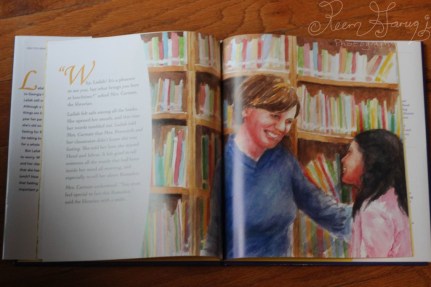
Lailah is excited to wake up and have sehri with her family before heading to her new school, fasting for the first time.  Her mother has written a note for her teacher, but on the bus, Lailah reads the note and suddenly worries if her teacher will even know what Ramadan is ,and decides not to give it to her teacher.  Lunchtime arrives, and when the teacher asks Lailah if she forgot her lunch, her voice fails her, and her classmates offer to share their lunch with her.  Lailah decides to leave the cafeteria and finds herself in the library spilling all her worries and stresses and fears to a kind librarian.  (Yes the librarian is the hero, and really no one should be surprised, right!?) With the librarian’s urging and Lailah’s determination, she writes a note to the teacher explaining that she is Muslim, and fasting, and even includes a poem.  She leaves the note on her teacher’s desk at the end of the day.  The following day, the teacher has written her back and the reader, along with Lailah, know that having courage and staying true to one’s self can often be scary, but also wonderful too.

lilah inside

While the story is billed a Ramadan Story, it really just is the back drop for a lot of really good messages.  I think 2nd and 3rd graders to early middle schoolers could really benefit from the book.  It is semi autobiographical and I think the authenticity of the emotion woven in, makes the book very relatable and powerful.  I plan to discuss it with my daughter going in to 5th grade, who is also a bit shy on occasion: the way Lailah worked out the problem, the way she found someone to trust and talk to that was patient with her, to point out to her that the kids in her class were very kind and that most of her fear and anxiety was with herself, not them.  I also really like the message that she was so excited to fast, and how her nerves took that excitement away, but having the courage to face her fear, brought back her happiness and enthusiasm.

The end of the book has an Author’s note, telling how the story came about and a bit more about Ramadan. It also tells the definition of Sehri and Iftar, the only two “foreign” words in the book.  I found it interesting that the word Sehri, an Urdu word, was used instead of Suhoor, if they are coming from Abu Dhabi, but perhaps the author is of subcontinent heritage.  The illustrations are colorful and realistic, complementing the story and tying in the range of emotions and events Lailah is experiencing.

I was pleasantly surprised at the book, and even more excited to see that it is available in the public library system.  Here is the link to the author’s blog I hope she plans to write more, as her style and message resonate with Muslim American kids, and their parents, alhumdulillah.


It’s Ramadan Curious George by Hena Khan illustrated by Mary O’Keefe Young

Standard

It' Ramadan Curious George

This highly anticipated book came with a lot of expectations and hope for many of us born and raised in America.  Alhumdulillah, Hena Khan did a great job and everyone’s favorite monkey learns and enjoys Ramadan and Eid.

The 14 page rhyming board book is festive and inviting as the tabbed ends head different aspects of Ramadan and Eid  The first tab is George helping his friend Kareem and his family get ready for Ramadan while explaining to the reader how Kareem is going to try and fast all day.  The pictures show Kareem’s mom in hijab and dad helping in the kitchen.  A banner they are hanging says Ramadan Mubarak, but there is no mention of religion or Muslims or Islam.

Curious GeorgeThe next tab has George helping Kareem get up for a predawn meal, keeping his mind off food and keeping him busy.  Not the normal mischievous George in this book, but rather a very helpful one.
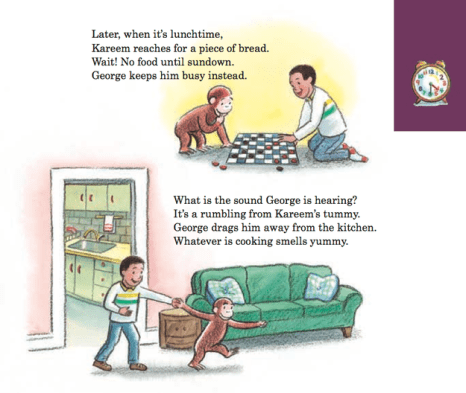
 curious george 3

The next tab talks about dates and breaking the fast and the sounds of prayer, but  again no specific mention of religion or belief.  The pictures show men and women of different skin colors, veiled and un veiled, visiting together.  The next tab is all about food, in all of its diverse glory.  The next tab has Kareem inviting George to the mosque to make food baskets for those in need.  George gets a little silly, and inspires the imam to add a clothing drive next year.  The final tabs are spotting the moon and celebrating Eid.  Gifts are given to George and the man in the yellow hat. Kareem and George are sad the month is over, but George enjoyed celebrating his first Ramadan with his friend.

curious george 1

Overall the book is great for Muslim kids, non Muslim kids, and also notably for non Muslim kids with Muslim friends.  The book does not label and discuss belief or even spirituality, but rather shows how Muslims celebrate Ramadan and Eid in its most basic way, and shows that it is a part of American culture.  For as excited as my family (and myself) were to see Curious George enjoying Ramadan and doing things we do, I can see many of my neighbors and kid’s friends also identifying that they know what George is doing too because of their Muslim friends, and getting excited.  The book works for all ages, to be read independently or aloud.

MashaAllah, don’t judge it by its size, it accomplishes a lot in just a few pages, a lot like a curious little monkey!

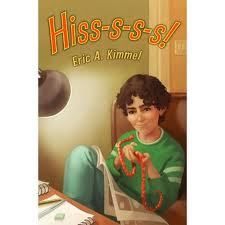
Hiss-s-s-s! by Eric Kimmel

Standard
Hiss-s-s-s! by Eric Kimmel

Hiss-s-s-s!

So um ya, its a book about a boy who wants a pet snake. Very linear, very simple, often more instructional than story, but somehow I really enjoyed it and read it in one sitting, as did my 9-year-old daughter and 7-year-old son. The book is 154 pages (including the author’s note) and is written on an AR 3.7 level.

SYNOPSIS:

Omar is an American Muslim who wants a snake.  His dad, Ahmed, supports the idea, but his mother, Hoda, is terrified of snakes, and begrudgingly gives her permission.  The rules are pretty simple, Omar will have to take care of the pet, and it is never to leave his room.  His mother basically doesn’t want to know that there is a snake under the same roof.  Little sister Zara is just excited.  The majority of the book is Omar learning about corn snakes, and everything involved in their care.  There are a lot of lists, and passages about him researching and taking notes. His friend Philip, nicknamed Samkatt-short for Samurai Cat, is the comical sidekick, who in this case also is the brains in the group, keeps the plot moving along. The author sprinkles in some anecdotes and history giving the characters depth.  We learn Ahmed’s dad is from Pakistan and while he grew up in the city he spent time in the country and with snakes.  He retells a fictional story about how snakes kept the rodent population down, and thus allowed the farmers in his family to have higher grain yields.  He also tells Omar tidbits about his time in college working in a biology lab with snakes.  Omar’s mom is an accomplished artist that often incorporates her Lebanese culture into her work and gallery shows.  The banter between her and Samkatt keep the story light and entertaining.  (SPOILER ALERT) At the climax, the snake gets loose, and Omar learns where his mother’s phobia comes from in her childhood.  During one of Lebanon’s many wars, a man with a snake tattoo beat her father extensively while she was forced to watch.  This somehow over time developed in to Ophidiophobia, the fear of snakes.  When the snake pops up, mayhem ensues, resulting in Hoda going to the hospital and Omar having to decide what to do with his snake, Arrow.

WHY I LIKE IT:

It is such a simple story, yet the warmth of the characters at the beginning and end really made it enjoyable.  I truly applaud the author for stretching a very simple idea into a full fledged YA novel.  The characters and family are Muslim, but it isn’t really discussed or made an issue.  There is nothing religious talked about or detailed.  In some ways, it would have been nice to throw a little more cultural or religious depth in to the story to connect with the characters, but being as the author is not Muslim it is kind of impressive that he presented them as just a regular American family.  Culturally there are only a few references outside of the anecdotes the parents share: Omar can’t come up with an example of when he was bullied, some of the foods served or eaten, the mother’s art work.

FLAGS:

None. Even if you don’t like snakes, the book should not make you squeamish.

TOOLS FOR TEACHING THE DISCUSSION:

There is not much to discuss with the book, and thus I wouldn’t choose it for a book club pick.  I think 2nd or 3rd graders, however,would do well with the book in small groups.  There is just a tinge of foreshadowing, symbolism, and interpretation that wouldn’t overwhelm the student, but would boost their confidence when they connect the dots so to speak.  Plus, some discussion could come from how he had to persuade his family, the responsibility he had to show, and the sequencing of events. The worksheets and questions would practically write themselves.

Author Eric Kimmel’s blog about the book http://ericakimmel.com/2012/02/h-i-s-s-s-s-s/

The White Nights of Ramadan by Maha Addasi illustrated by Ned Gannon

Standard

the white nights of ramadan

I love learning about people’s Ramadan traditions, and am slightly embarrassed to admit that I never knew about this Gulf tradition of Girgian.  My kids and I enjoyed reading this book during the middle of Ramadan, when the moon is full and bright, and thus known as the white nights of Ramadan.  Written on an AR 3.6 level the story does a good job of blending the concepts of Ramadan, Girgian, Islam in a 32 page fiction story format for Muslim and non-Muslim children alike.  There is an Author’s note and Glossary in the back as well.

A young girl, Noor, excitedly waits and prepares for Girgian.  She explains the activites to her two younger brothers, Sam and Dan, how they will walk the streets with lanterns (fanouses) and get treats from neighbors for three nights.  But before night falls, they first have a lot to do to prepare, and with the help of their parents and grandparents, the children make and wrap the candy, decorate bags to keep the candy in, and get dressed in fancy traditional clothes.  In the process the book also explains Ramadan, and shows Noor praying and reading Quran.  Arabic and islamic words are tossed in and well explained: iftar, fanous, suhoor, dishdashas, musaher, etc.. Noor in all the excitement shares a tender moment with her grandma where they discuss how fun Ramadan is, but that the “true meaning of Ramadan is spending time with family and sharing with those less fortunate.” A religious scholar may add more to what Ramadan is, but for a children’s book, the message is beautiful and perfect.  The story concludes with Noor and her grandfather taking a basket of food to the mosque to give to the poor.

The book has a slow melancholy type feel to it and the pictures definitely help set that tone.  They are detailed and well done, but maybe not overly inviting to younger readers.

IMG_9586

white nights of ramadan

The book made me want to learn more about the tradition, and talk to people that may have celebrated it to see how it has evolved over time.  My kids liked the idea of having a musaher, a drummer walking the streets waking people up for suhoor.  As a mom of four, I can see why something fun in the middle of the month, especially when the days are so long, is a great way to re-energize the children about the fun and blessings of Ramadan.

The Red Pencil by Andrea Davis Pinkney illustrated by Shane W. Evans

Standard

The Red Pencil.jpg

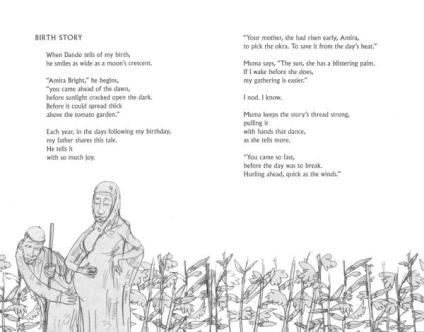
I didn’t realize the book was written in prose until I opened it up to read, and immediately taken-aback I rechecked the AR level and sure enough, this 309 page book that is written in prose and covers the genocide in Darfur, is written on a 4.2 level. And it is amazing. I forced myself to stop reading at one point so as to not rush the depth and soul of the simple words from being lost in haste.  It is truly, in my opinion, a beautifully remarkable feat to convey such horrific atrocities with such hope and integrity to young adults in a palatable and inspiring way.

“Allah is the light,” he says.

I ask,

“How do you find Allah’s light?”

Old Anwar says,

“Take the path that shines the brightest.”

SUMMARY:

Amira’s life on her family’s farm is by no means easy, but she has loving parents, a little sister, her beloved sheep, and a dream of going to school.  Her father advocates for her, but her mother, steeped in tradition, sees education only as a waste of time.  The illustrations and sparse words manage to convey fairly solid understanding of Amira’s life, optimism, and relationships with those closest to her.  Although warned of the dangers the Janjaweed could cause, Amira remains fairly unconcerned about the mounting political unrest around her, until it is too late.  When death and the destruction of her home force the surviving members of her family and neighbors to seek refuge in a camp many miles away, the reader sees how truly horrific her experiences have been.  She refuses to speak or rather cannot, when a chance encounter with an aid worker brings her the prospect of getting her voice back, through the empowerment of a red pencil.  With restored determination she convinces an elder neighbor to teach her, but it is not enough for Amira Bright.  Her sparrow needs to soar free.

WHY I LIKE IT:

You expect a book written in verse to have a lot of imagery and symbolism, and The Red Pencil does a good job of balancing the story and the description, to keep the book on track.  The linear story line remains focused on telling the story at hand, making it attainable for elementary and middle school children.  The Darfur conflict is complicated at best, and using verse to convey it from a young girl’s voice allows a lot of the politics and dirtiness of war to be side-stepped without dismissing it.  Amira’s optimism and hope is at times naive, but more as a reflection of her personality then out of ignorance. She sees things, and feels things, and must deal with things, no child should, but her spirit shines through and keeps the book from being depressing, while still being sad.

Today the red pencil does more

than beg for my hand.

It makes me a promise.

It tells me to try.

The characters are Muslim and they rely on Allah, and pray, yet Amira’s thirst for knowledge includes that of learning the Koran (Qur’an) as that knowledge too, has not been readily available to her  There is a lot to discuss in the book, both what is written and what the reader brings to it.  I look forward to teaching the book, and re-reading it once again to savor in the rich images.

Here,

Muma stoops.

Here,

she has nothing to reach for.

FLAGS:

Their is violence when the Janjaweed attack her family.  But I think it is conveyed in a manner suitable for 3rd grade and up.  It is not celebrated or glorified, it is traumatic and has repercussions that are respectfully conveyed.  There is also mention of a child bride, but not in so many words, that in all honesty I doubt most young readers will be as bothered by it as perhaps they should.

TOOLS FOR LEADING THE DISCUSSION:

There is a discussion guide in the back of the book along with an Author’s Note, Acknowledgements, Glossary/Pronunciation Guide, Character/Location Pronunciations, and Important Terms that Appear in the Book.

An Educators Guide: http://media.hdp.hbgusa.com/titles/assets/reading_group_guide/9780316247801/EG_9780316247801.pdf

A study guide and quiz: http://www.bookrags.com/studyguide-the-red-pencil/free-quiz.html#gsc.tab=0

The Red Pencil 1

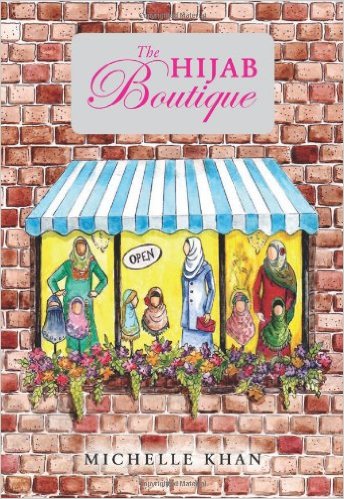
The Hijab Boutique by Michelle Khan

Standard

The Hijab Boutique

I was really hoping this book would help out the sparsely populated early chapter book section.  And it should, at just 52 pages with beautiful full page pencil style drawings, it just somehow seemed confused instead.  The content is much more young adult in story line, but because of the short length, the characters seem flat and underdeveloped.  My fourth grader read it in less than a half an hour. Yet, I don’t think a 1st or 2nd grader would get much out of the book.  I don’t know what kind of editing process the Islamic Foundation puts its books through, but back when I was a teacher, I would have told the student they have a wonderful, wonderful rough draft with so much potential, they just need to flesh it out and add more detail so the reader connects with the characters. The back of the  book suggests the book for ages 10 and up and content wise that is fine, but it also has a list price of $7.95 and for something that can be read in less than a half an hour, it seems a little steep. If it didn’t have so much potential, perhaps I wouldn’t be so bothered, I just feel like if she stretched it out to being 200 pages, it could be so powerful.

Farah is a fifth grader at an all girls art school.  She has a best friend, who’s mom is a soap opera star, but some popular girls still make  her nervous.  When her Social Studies teacher assigns the girls to bring in something representing her mother, she can’t find anything to share about her mother that she doesn’t think is boring.  Farah’s father passed away two years prior and with money tight, Farah’s mom is opening up a Hijab Boutique.  No real details are given about her family life with her father or the impact his death had on her, which is unfortunate.  The story discusses why the mom started wearing hijab and why it is important, but makes it seem like Farah knows so little about her mother.  Again a hole that if explored would make the book that much more interesting. Not to mention that it could prod young girls to talk to their own mothers about such things.  To no one’s surprise Farah brings in some hijabs to represent her mother and Alhumdulillah the book ends on a positive note with little fanfare, catharsis or drama.

Farah and her mom are practicing Muslims who are an active part of their western community.  It would seem Farah is the only Muslim in her school and it doesn’t seem to be an issue.  They are all upper class and a bit snobbish, but there are no flags.  If your library has the book, reading it is by no means a waste of time.  I don’t know that you’d read it more than once if you purchased it, but 4th through 6th graders might enjoy the short read, and be inspired by fashionably fabulous hijabs while furthering their understanding about why Muslimah’s are required to cover.


Zak and His Good Intentions by J. Samia Mair illustrated by Omar Burgess

Standard

Zak and his good intentions

Zak  and his sister Hana compete to do good deeds, but nothing goes as Zak intends.  Each time he sets off to help someone or do something kind, he is thwarted by something unexpected.  As frustration mounts with each failure, his mom steps in to reassure him that, “Prophet Muhammad (saw) said that whoever intends to do a good deed, but does not do it, still gets a good deed for his or her intention.” With his spirits restored Zak appreciates Allah’s mercy and accepts that even when we try and plan, it is Allah’s plan that ultimately prevails.

The beauty of the book is in its simple message that is reiterated four times and brought to life with simple straightforward text and detailed, but not overwhelming illustrations.  The book is written on about a second grade level and would appeal to ages 4 to about 8.  It has 32 pages and contains discussion points at the end.  The book is fun and funny and conveys a message and moral in a relevant non preachy way.  Young kids can definitely relate to the character’s desire to do good, disappointment when he fails, and comfort in knowing that Allah swt knows all and is the most just.

Overall a good book with a strong message that can be read more than once and referenced often in both the home and school setting.


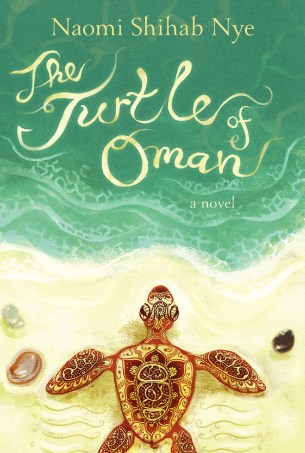
The Turtle of Oman by Naomi Shihab Nye

Standard

The Turtle of Oman

This slow, aimless, subtle, quiet prose-like book, is unexpectedly charming and endearing, and so not like most every young adult book out there.   I truly want to make all 4th through 8th graders read it, absorb it and ruminate in the love shared between a nine-year-old boy, his grandfather, and their home.  The easy 299 pages flow by on a 4.6 reading level and make you long for a kind grandfather to help you see the amazing in the ordinary, and provide you with gentle strength when facing life changing events .  The Turtle of Oman has no climax and no conclusion, yet it offers hope and warmth in a reassuring manner that makes you feel better for having read it.

SUMMARY:

Aref is moving from Oman to Ann Arbor Michigan for three years while his parents pursue their education.  To say he is dreading the move is an understatement.  Lucky for him, and the reader, Aref’s grandfather Sidi, helps him create some memories to take with him to America.  While they spend time together, travel around the country, and talk, the reader is drawn into a world where Aref and Sidi, finish each other’s sentences, and blur the lines of fact and make believe with their stories.  Their love and ease with one another is so seamless that not only are they best friends, and relatives, but they are so intertwined the thought of their separation is heartbreaking.

“Aref kept thinking that no matter what you say, there is something more inside that you can’t say.  You talk around it in a circle, like stirring water with a stick, when ripples swirl out from the center.  You say something that isn’t quite right and that’s worse.  Then you want to say, sorry!  But no one knows what you mean.

He wished he could tell Sidi, you are the king of my heart forever, I don’t care who else I meet, I don’t care about traveling and new friends and different flavored yogurts, I only care about how nice you are and how much I cannot stand the thought of being far from you, ever, ever, ever.

But he could never say this.”

Sidi has passed his love of rocks on to Aref and each adventure involves Sidi slipping a rock to Aref as a token for him to remember their adventures and each other.  From exploring the beach, camping in the deserts, sleeping on the roof, and going out on a fishing boat, the duo relishes in the details of everyday life that make life worth living.  Along the way Aref keeps lists of interesting facts and the reader learns about animals, Oman, Michigan and so much more.  But no matter how much prodding and reassurance Sidi and Aref’s mom try and impart on him ,the book pivots around the inevitable need for Aref to pack his suitcase.  As much as packing a suitcase can be a climax or a conclusion, that is what the author gives, and the reader must be content to understand that like Aref’s beloved turtles, he will have to find his way to the ocean only to return once more to Oman.

WHY I LIKE IT:

I love that it meanders and cannot be rushed.  I love the cultural warmth and the emotional depth.  While the setting is Islamic, there is no religion mentioned other than the call to prayer heard in the market place.  Quiet books usually border on boring for young adult readers, but I feel like this one doesn’t.  I am leaning toward doing it for the Junior Book Club to see if it has the emotional appeal that I think it will.  The main character is scared and unsure about the big move, feelings many children have felt.  But his way of handling it, while childish and whiny in his stubbornness to pack, also offers nuanced hope.  Aref is allowed to work through his thoughts and feelings, and while some characters rush him, his time with Sidi doesn’t feel rushed and forced.  His time with Sidi is reassuring and patient, a fictional soft place for the scary unknown.

“Talking with Sidi felt like a sky of floating words,” Aref explains. “You could say anything.”

FLAGS:

None, the book is completely clean.

TOOLS FOR LEADING THE DISCUSSION:

Interview with the author:  http://www.hbook.com/2014/12/talks-with-roger/naomi-shihab-nye-talks-with-roger/#_

https://www.readingtokids.org/Books/BookView.php?pag=5&bookID=00001192


Sana’s Startling Sneeze by Sumaiya Noori illustrated by Ridwaan Naik

Standard

Sana's Startling Sneeze

I got this book at the same time as Sajaad is Sick, and thought they would go together nicely.  They did, Alhumdulillah, but I was honestly a little underwhelmed by this book.

For the most part. the pictures are detailed and fun, but they have the appearance of being done with either crayon or colored pencils and don’t pop off the page and grab the reader’s attention.  If they were a little brighter and bolder, it would definitely help the overall story, especially since the illustrator is clearly talented.

The story itself is clever and funny, but kind of unresolved at the end.  Once the Pre-k 3 through KG students were done laughing, they wanted to know why her sneeze was tiny.  Was it because she put both hands over her mouth or because it was just a little sneeze? They got a little annoyed that I didn’t know the answer and that there was no moral, or lesson, or conclusion.  I think after so many sneezes and so much repetition they were a bit unsettled that she would again resume her out of control startling sneezes, with no more hope of containing them.

Something else that struck me as being odd about the book is that the main character and her family are visibly Muslim in a diverse environment, yet Sana never says “Alhumdulillah” and her family never says “yarhamukum Allah” following her sneezes.  I added it in when I read it aloud, since that is basic Islamic etiquette, but a few of the Kindergartner’s in the first row caught on that it was missing and wanted to know why.  Again I had no answer.

A layout criticism I have of the book is the inside margin. It is too small and when reading aloud to a group, I could not see the last word of the line without moving my head or the book, and thus blocking the students from seeing the illustrations.  The font and text and overall book size is adequate, but the first few readings, until I practically memorized the book, were a little cumbersome.


Yasmine’s Belly Button by Asmaa Hussein illustrated by Charity Russell

Standard

Yasmine's Belly Button

This book is fun, fun, fun.  The mere mention of the word belly button to little kids gets them giggling, and the words and pictures in the book kept them engaged and happy through out.

The story is a simple dialogue between 4 year-old Yasmine and her mother about belly buttons as she heads off for her first day of school full of butterflies.  We learn that everyone has a belly button, even cats! And the students have a fun time following along with Yasmine’s confusion of why it is called a button, to her understanding that it allowed her to receive food while in her mother’s tummy.  yasmine2The illustrations are bright and colorful and have a lot going on.  The expressions on the character’s faces compliment and complete the text seamlessly to tell a well thought out story.  They keep the audience’s attention even after the text is read, with the kids telling me to “wait” so that they could soak it all in before I turned each page.  The mom and teacher’s expressions on the last page amused the daycare through Kindergarten students and made them feel like they were in on the silliness.

A lot is conveyed even with just a few words on its 28 pages.  The reader sees what she thinks, they see the mom without hijab at home and with hijab when she goes out, they see a diverse classroom, a patient mom, and a way to deal with being nervous in a new situation.

I read this book to many students at school and to my own children at home, and can tell it will be an often requested book in both settings, mashaAllah, I highly recommend it.