Tag Archives: Family

King For A Day by Rukhsana Khan illustrated by Christiane Krome

Standard

King-for-a-Day1.jpg

Its time for Basant, the Lahore, Pakistan kite flying festival, and Malik and his siblings are ready.  Ready to launch Falcon into the sky, ready to set other kites free, and ready to put the bully next door in his place.  While some kids have huge kites, and some have many, Malik has just Falcon, a speedy little kite that Malik prays can get the job done.

King for a day inside

Once again Rukhsana Khan does a remarkable job of taking a universal theme, adding some culture, and finding artists to empower minorities without making it an issue, all in a 32 page children’s book.  Written on an AR level of third grade ninth month, readers see characters handling a bully by beating him “on the court” so to speak, a character having confidence in his abilities, yet still asking Allah swt for help, and a boy in a wheel chair celebrating a fun spring time festival with his family.

king 1

The illustrations are rich with texture and angles, which contrasts the font and text presentation.  Little kids probably won’t be tempted to pick this book up, but as a read-a-loud first and second graders will enjoy the story and the kite flying action.  Third and fourth graders will enjoy reading the book independently, and find themselves cheering for Malik, appreciating his kindness, and wanting to pick up a kite and head out themselves.  The author includes a note at the back which provides more information about Basant and how it is celebrated.  Although it takes place in Pakistan and is a festival not celebrated in America, there isn’t a “foreign” feeling to the book, as kids can relate to bullies, wanting to be the best and the satisfaction of succeeding and feeling like a “king for a day.”

king2

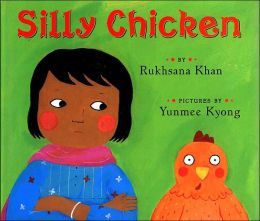
Silly Chicken by Rukhsana Khan illustrated by Yunmee Kyong

Standard

silly chicken

Silly Chicken is a story about sibling rivalry, except there isn’t a sibling, there is a chicken.  Rani feels that her mom, Ami, loves a chicken, Bibi, more than she loves her.  Rani is jealous of the attention Bibi receives and finds the chicken in general, silly.  One day when Rani and Ami leave their home by tonga to visit her father’s grave, a dog gets in and when they return, Bibi is no more.  Ami is devastated and Rani is sure she closed the gate.  It isn’t until Bibi’s egg hatches by surprise, that the story comes full circle and Rani responds to Ami’s chiding that she loves the baby chick more than her mother, that the reader and Rani realize how silly that would be.

I really liked this 32-page, brightly and playfully illustrated book.  It is written on a AR 2.3 level and is fun out loud or at bed time.  The story takes place in Pakistan and a lot of reviews online remark that it is a good book about Pakistan or for showing Pakistani culture, critiques that I both agree and disagree with.  Every kid, everywhere, through out time, can probably relate to being jealous of something or someone occupying their mother’s attention.  The concept of a pet and loving it and being sad and feeling guilty, are all universal themes.  That being said, both the author and illustrator do a remarkable job of breaking stereotypes without drawing attention to them.  Ami and Rani are relatable and are clearly Pakistani, subtly removing an us and them stance.   Rani’s dad has passed away, but Ami and Rani seem to be doing well.  Ami seems very self-sufficient in daily activities and brave when they think a burglar may be present.  The two chat with neighbors and travel independently breaking down the erroneous stereotype that women cannot go out or be recognized without a male.  The mother wears hijab and traditional Pakistani clothes while Rani being young obviously does not cover.  Their clothes are bright and colorful and their expressions relatable and inviting.  The way that Bibi’s death is handled is age appropriate and a child could possibly think she simply was run off rather than killed, either interpretation would allow the reader empathy for Ami and be a great topic to explore with a child.  Enjoy!


Nadia’s Hands by Karen English illustrated by Jonathon Weiner

Standard

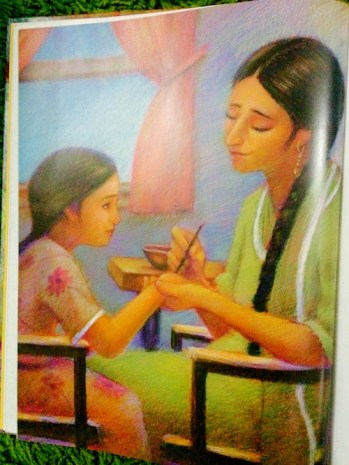
nadia's hands.jpegNadia’s aunt is getting married and she gets to be the flower girl in the Pakistani-American wedding.  She also will get mehndi put on her hands for the big event.  Her cousins warn her that she might mess up and even in the midst of her excitement she begins to worry what the kids at school will say when they see her hands on Monday.  As her aunt prepares the mehndi and the application process begins, various uncles peek in on her and her aunt gifts her a beautiful ring.  The mehndi has to sit on the skin for a while to set and as Nadia practices sabr, patience, I couldn’t help but think something seemed off in the story.  I’ve been at, in, and around a lot of Pakistani and Pakistani-American weddings, and this story didn’t seem to reflect the tone of such occasions.  The book doesn’t reflect the hustle and bustle and near chaos, it doesn’t sound like the tinkle of jewelry and laughter as the women sit around chatting and getting mehndi put on together, the pots on the stove are referenced but not described so that the reader can smell the sauces thickening and hear the pans crashing and taste the deep rich flavors.  It is lonely.  Nadia is lonely and filled with anxiety about Monday.  Durring the wedding she is walking down the aisle and suddenly freezes when she looks down and doesn’t recognize her hands.  Her cousins seem to show unsupportive “I-told-you-so” expressions as she searches for some comforting encouragement to continue on.  When she finishes her flower girl duties, her grandma asks if she understands why looking at her hands makes her feel like she is “looking at my past and future at the same time.” Nadia doesn’t understand and the author doesn’t explain.  At the end she is ready to embrace that her hands are in fact hers and that she will show her friends on Monday.  But the reader has no idea how it goes, or what exactly the significance of her painted hands are.  The book fails to give any insight or excitement for a culture bursting with tradition at a time of marriage.
 nadia's hands inside

There is a glossary at the beginning for the few Urdu words sprinkled in the book.  There is no further explanation however, of  mehndi, or weddings, of the brides clothes etc.  The illustrations are adequate, but because the text doesn’t offer much warmth or vibrance, they seem a little drab, and raise more questions about what some of the traditional items depicted are.  The book is a standard 32 page picture book and is written on an AR 3.8 level, which I think is a little high.  Granted my children are familiar with mehndi, but my first grader read it to me with little assistance.  There isn’t any mention of Islam and could probably be argued that the story reflects any wedding from the subcontinent background performed in the west.  The bride has a duputta on her head in the picture, but that is neither here nor there, and no one in the audience appears religiously covered.  I would assume they are Muslim because of the minor characters’ names: Omar, Saleha, Amina, Abdul Raheem.  Also, the word Sabr, an Arabic word, suggests that they are Muslim.  Plus they eat kabobs which the glossary defines as mincemeat, so probably not Hindu.  Overall the book is not, “bad” or “wrong,” I just wish there were more to it.


Ten Things I hate About Me by Randa Abdel-Fattah

Standard

Ten Things I Hate About Me

I’ve read and reviewed a few Randa Abdel-Fattah books and read and reviewed even more cheesy West-meets-East-and-my-parents-are-so-strict-so-I-will-rebel books, that with such a flimsy title referencing a movie which references Shakespeare, I didn’t expect much.  With such minimal standards, the book didn’t disappoint and the surprising warmth of many of the characters actually left a pleasant smile on my face.  I’ve had this book on my to-read list since it came out in 2006, and for some reason it is a bit hard to find now a days.  There seems to be a few covers out there, and I don’t know if they differ, but the one pictured above is the one I read, and it is 297 pages and written on an AR 4.8 level, but probably would appeal and be more content appropriate as a light read to 9th through 12 graders.

SYNOPSIS:

Jamilah Towfeek leads a double life.  At home she is a proud Lebanese Australian that goes to Madrassa, plays the darbuka drums in an Arab band, and identifies as Muslim.  She has recently dyed her hair blond and wears contacts to hide her Arab heritage and doesn’t allow her sister who wears hijab to pick her up from school where she is known as an all Australian girl, Jamie.  Her mother has passed away and her father is pretty strict about who she goes out with and her curfew.  They even have a contract posted on the fridge. Despite this, Jamilah and her dad seem to have an ok relationship and it is definitely something they both are fighting to improve.  Jamilah’s older brother is a bit of a rebel and goes out with girls to bars and the book definitely discusses the double standard.  He however, isn’t painted as “bad” or as presented as an outcast, he just does things differently, and must wage his own path to build a relationship with their father.  At school Jamilah has acquaintances more than friends, as she is constantly pushing people away.  The stage is set that she has to keep lying to her friends, but it is more in her head than in reality.  She doesn’t open up to her friends, nor they to her.  As a result the Jamie at school amongst her peers are presented as incredibly shallow, which is partially intentional I think, and partially, under developed.  She makes up excuses to not attend parties and it isn’t a big deal until the most popular guy at school starts to take an interest in her.  In frustration she starts opening up to someone who has started e-mailing her.  Her user name is Ten_Things_I_Hate_About_Me and the dialogues between her and Rage_Against_The_Machine reveal a lot about how she sees the world.  There is some tension with immigrants in Australian and Jamilah starts to realize that her silence is consent to the bigotry and bullying around her, and that there is no way to stay neutral.  There really aren’t any major plot twists, you can see a mile away who the mystery email boy is, and that he likes her, you can see that her friend Amy will come through, and that she will have to reconcile her two identities.  There are a few minor ones with her dad getting remarried and thankfully with her opting to not “hookup” with anyone in the end despite a climatic kiss in order to stay honest with her father.

WHY I LIKE IT:

I’m obviously older than the target audience and the characters, as is the author, but compared to a lot of the other books of similar content, I feel like this book stays the most grounded.  There are some pop cultural references, and obviously the kids are naive, but there are some universal truths and experiences brushed upon that I think a lot of high schoolers can relate to, not just immigrant Muslim ones.  The idea of having to be two different people at home and at school, family relationships, cultural identity, being true to yourself, dealing with the loss of a parent, taking a stand when you see something wrong, etc.. All that being said there is a huge gaping plot hole.  How her friends that have known her from elementary school when her mom brought Arab food suddenly don’t know she is Arab, or don’t pick up on her ethnic last name is beyond even a 5th grader to over look.  If you can tune out your internal sense of logic for the premise, the book is much more enjoyable, but it really is a stumbling point.

I wish that Jamilah was a bit religious.  She identifies as Muslim and clearly her sister is, but pretty much all of her actions and gripes come more from her culture than from her faith.  Many of her father’s friends drink, as they are either not religious, or Christian, which is fine, but part of me really wanted her to live up to the picture on the cover of the book and discover her religious stance alongside her owning up to her cultural one.  I love that at it’s core it is a book about a girl’s relationship with her dad and being true to her self, but somewhere her religion fizzled out of the narrative and I wish it hadn’t.  I Would have loved that she turned down the prospect of a boyfriend because it wasn’t Islamically permissible, in addition to her wanting to be honest with her father.  But, alas the author didn’t pursue that.  She did however, do a good job of not making it a judgement of culture or faith, just as attributes of her characters.

FLAGS:

There are racial slurs, drinking, dating, and kissing.

TOOLS FOR LEADING THE DISCUSSION:

Surprisingly I wouldn’t completely disregard this book for a Book Club selection.  It would be for older kids, ideally upper High School.  But I think especially in an Islamic School setting the discussion would be so much better than the book.  Many send their children to Islamic Schools to reduce the need for dual identities and I would love to see how the kids view the effectiveness of it.  I would also enjoy hearing students’ perspectives on going to formal dances with siblings or a group of girls, the double standards of boys in girls, and dealing with Uncle’s and Aunty’s constant opinions.

Author’s Website 


Snow in Jerusalem by Deborah da Costa illustrated by Cornelius Van Wright & Ying-Hwa Hu

Standard

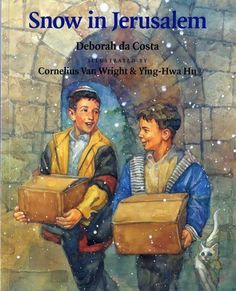
Snow in Jerusalem

The world is always in need of kindness for animals and for one another, so when I saw this book written in 2001 about two boys who live in different quarters of Jerusalem coming together when they learn they are caring for the same stray cat, I was definitely excited to dive in.

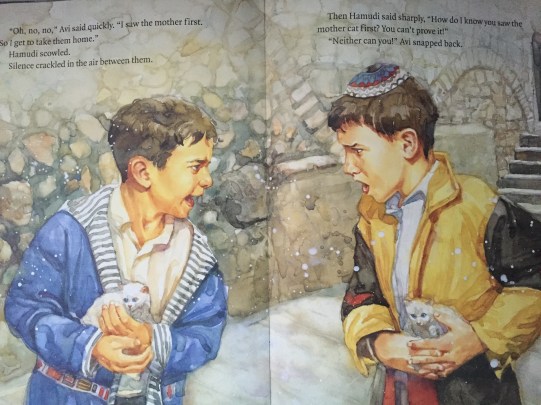
The book starts with a Jewish boy, Avi, caring for a fluffy white stray cat and his mom teasing him for caring for him.  He begins to wonder where the cat goes and resolves next time he comes around to follow him.  The reader then sees the cat journey through a market place and have the exact same interaction with Hamudi, a Muslim boy.  Both boys go days without seeing their beloved cat and when they begin to look for her, they find each other.  The boys fight over her as it begins to snow and the cat takes them to see where she has been, with her new kittens.

Again the boys fight and ultimately resolve to divide up the kittens to care for them and let the mama cat go back and forth to feed them.  Needless to say, I was a little let down by the book, I had hoped the boys would bond or see how similar they are. Instead they simply work out a solution for this one situation.  I can’t help but thinking the kitty family getting broken up and the poor mom having to go back in forth is rather selfish on the boys behalf.

IMG_0326

The book is 32 pages and written on an AR level 3.1.  Third grade and up can probably understand the similarities of the boys and how they come together to care for the cat and appreciate it with a simplistic understanding of Jerusalem’s complexities. Kindergarten and 1st graders could probably handle it as a story time selection, and understand working together to help a cat.  I’m sure fifth graders and up however, will be a little concerned for the mama cat and disappointed in the boys at a lost opportunity to provide hope in a troubled region.

There is an Author’s note and Glossary of Arabic and Hebrew words at the end, and a simple, yet valuable map of the Old City at the beginning.


Written in the Stars by Aisha Saeed

Standard

written in the stars.jpg

It has definitely been done before in books dealing with the crossing of desi and the west with a female lead, that there must be: forbidden love, physical and or sexual abuse, a a sympathetic side kick, and evil parents or in-laws.  So, perhaps this book just assembles the ingredients in a new way, or my deliberate hiatus from said genre softened my heart with time.  But, either way Written in the Stars was an enjoyable read that didn’t get caught up in the dichotomous rhetoric of good vs. bad, us vs. them, right vs. wrong, and I found that refreshing.  It is in the AR database as a level 4.1 book, but there are sexual references and rape, so while it is written very simply and linearly, I would not let an elementary student read the book.  The protagonist is 17, so really the story line is more high school relevant.

SYNOPIS:

Naila is a senior at a Florida high school with scholarships and dreams to be a doctor. She has friends and stability at home. However, she also has a boyfriend, a big no-no to her conservative Pakistani immigrant parents.  When she sneaks out to prom and gets caught her parents drag her to Pakistan and secretly work to marry her off.  The premise isn’t very original, but the author keeps it interesting by having the boyfriend also of subcontinent descent, and Naila being naively clueless about what her parents and extended family are doing to her.  As she begins to realize what her parents’ end goal is, she gets desperate to return home, putting her against her family.  The story is quick and Naila is definitely a girl of action as she tries to escape, as she gets drugged, gets married and pregnant.  And remarkably she doesn’t spend too much time bemoaning her situation, which is nice as the book is only 284 pages with the Author’s Note, Glossary, Resources, and Acknowledgements.  A long the way you meet some kind characters and minor villains, you see a bit of the culture and Naila’s determination.  The parents are underdeveloped and I wish they were fleshed out so that the reader could see their perspective.  They are presented as pretty vile and cold and nothing more than that unfortunately.

WHY I LIKE IT:

At first I found it odd that religion was not in the book, like at all.  Her rules regarding boyfriends and male friends are presented as being cultural.  While in Pakistan and being shown around a cousin points out a mosque, tells Naila her father is in there, and if she wants to see inside they can come back when it isn’t pray time. That is it. So, the characters are Muslim, but Islam is not mentioned.  The author on the jacket flap states that she is Muslim and had a good arranged marriage.  So as I’ve reflected back on the book, I think I kind of like how she left religion out of it.  Albeit leaving a gap in the narrative, it allows the book to be seen in a character driven way more than a “that’s how they do it” sort of way and thus opening it up to a wider audience.  Also, seeing both good and bad in the same cultural population removes the idea that different is bad, which is often lacking in these “cultural” novels.  I really want to meet the author and see what her reasoning is, but I think it was deliberate and thus I’m growing to appreciate her restraint on bringing the religious tinge into the book.  I wish it was written a little more complexly.  In addition to more about the parents, I wanted to know more about Saif, the boyfriend, I wanted to know about the future of her cousin Selma, who was her confidant, and about the aunt that never married, just to name a few.

FLAGS:

There is kissing, and while not detailed, Naila is raped by her husband and it is implied and reflected on. There is some additional physical violence as well.

TOOLS FOR LEADING THE DISCUSSION:

I would consider this for a selection if I did a high school book club. Definitely not middle or elementary.  I would possibly suggest the book to older middle school if they could handle it.  There are lots of talking points, and some girls are so drawn to the romance genre that at least this one isn’t too over the top.

Curriculum Discussion Guide

Author’s Blog 

The Lost Ring: An Eid Story by Fawzia Gilani-Williams illustrated by Kulthum Burgess

Standard

The Lost Ring.jpg

This is a good little story about Eid ul-Adha for 2nd through 4th graders.  It is not AR and at 29 pages it balances information about Islam and Eid with a simple little story that keeps the target demographic interested.  It isn’t great, but for a book that would probably be a level reader equivalent of a three, it suffices in being a bit of a mystery, a bit of a comedy, and bit of a lesson on why and how we celebrate Eid.

Rahma’s Grandma and cousin, Muslimah, are visiting for Eid. The girls start off the story trying on their beautiful dresses and feeling like princesses.  The girls and Grandma then get to work on making samosas for Eid.  Rahma sees her grandmother’s ring next to the bowl of dough and tries it on. The story moves fluidly and the girls take turns helping  with the folding of the samosas.  Some more adults come in and add tidbits to the story about giving gifts on Eid and getting ready for Salat and depicting a typical practicing family.

The story shifts to dad asking the kids what they remember about Eid-ul-Adha and what they know about Eid-ul-Fitr, the Festival of Sacrifice. On the day of Arafat the children fast, visit the hospital and take gifts to people in the community and the neighbors.  After Salat-ul-Maghrib dad reviews some of the sunnah acts for Eid as well.  It doesn’t get too preachy, or overly detailed, it is more highlights and brief summary revisions.

Eid day is fun and exciting, but when night falls and the family prepares for people to come over, Grandma can’t find her ring.  The kids want to be detectives, but Rahma suddenly realizes that the ring must be IN one of the samosas. So the children decide to eat them all to check. When the ring doesn’t turn up, Rahma and her cousins recite Ayat-ul Kursi, ask Allah for help and decide to tell Grandma the truth.  Just then Mum yells and the ring is found in her samosa, the truth is revealed and they all enjoy a good laugh and resolve to “always remember this as the Samosa Eid.”

The Lost Ring inside

There is a lot of text on the page, and a fair amount of “foreign” words that I think the book is probably meant for Muslim children, or those familiar with the basics of Eid.  There is a Glossary in the back, but it still might be a bit too much for non Muslim children to grasp without someone to answer their questions. The illustrations have the elder females with hijab and the girls uncovered when not praying.  The small pictures are detailed and complimentary, but the younger readers will wish they were a bit more engaging.  Overall, a good book to have in a classroom, and a great one to check out from the library to encourage young readers, or just to enjoy before Eid-ul-Adha.

Better Than a Thousand Months: An American Muslim Family Celebration by Hassaun Ali Jones-Bey

Standard
Better Than a Thousand Months: An American Muslim Family Celebration by Hassaun Ali Jones-Bey

Better Than a Thousand Months.jpg

To be honest, I didn’t get the book.  I mean I understand that it was derived from stories the author told his children, and I’m guessing it was written to show similarities between Muslims and Christians, but I don’t understand how the 168 pages with lots of photographs and text from the Qur’an got published as a book.  That is not to say it isn’t without merit, it just leaves a lot to be desired.  The teacher in me really, really, really, wanted to pull out a purple pen and start editing.  I checked twice to see if I had an advanced copy or uncorrected proof, I even Googled the book to see what I was missing.  It doesn’t work for me as a completed book.  To me, however, it is a wonderful outline that is desperately wanting to be fleshed out.

SYNOPSIS:

A man in San Fransisco is sitting on the train when there is an earth quake, thus delaying his trip home.  As he dozes off he imagines interactions with his children that share his knowledge of Islam with them, and thus the reader.  The first interaction is with him and his young daughter discussing Christmas, and how Muslims view Jesus and the power of Allah the creator of all.  They jump in the “time machine” truck and drive through the hills of San Francisco reflecting on the concept of patience.  As Ramadan comes and the narrator dreams we get bits of how Muslims in America celebrate Ramadan, and some of the tenants of faith.  When he is awake we get some story about his family, how he came to Islam and his Grandma passing away.  But nothing is explained or even connected.  I have no idea how many children he has, what the story is with the step children and the confusion from having two daughters with the same name.  The story goes back and forth with his dreams being more “real” then his awake time, and both kind of moving in the same direction of explaining how Islam is practiced as a family in America (praying together, waking up for suhoor), the questions that arise from the children (how to pray at school, why Ramadan decorations don’t decorate the city), and how we are all more alike than different (same Prophets, similar stories).  The final dream sequence is sweet with the father and daughter showing, not just talking, about giving and charity, that I really want to send the author back to finish writing the book.  There are so many tangents that would give it depth that are stated in a few sentence paragraph that could so easily be developed in to whole chapters.  Unfortunately, as is, the reader is just left disjointed and confused.

WHY I LIKE IT:

I really like the premise, I like the literary flip of telling the story in the dream.  The ideas are just not presented smoothly.  I don’t think that a tween would get it, and the choppiness of the ideas bouncing around from short paragraph to short paragraph would dissuade even the most seasoned middle school reader.  The book has some good tidbits, but they are lost in the short glimpses of story and long passages of meaning of the translations from the Quran.  The Arabic Calligraphy is nice, but it isn’t stop in your tracks beautiful, and the font of the English translations are difficult to read.

FLAGS:

None, the book is clean.

TOOLS FOR LEADING THE DISCUSSION:

I tried to get my daughter to read it, but she was so lost and even asked if it was a collection of stories or a chapter book, that I couldn’t force her to finish.  If you can get through it, one could discuss how to “fix” some of the struggles the book has, thus emphasizing what the reader liked and imagining the back story for all the questions that arise but are ultimately not answered.

Bestest. Ramadan. Ever. by Medeia Sharif

Standard
Bestest. Ramadan. Ever. by Medeia Sharif

Bestest.-Ramadan.-Ever.-by-Medeia-Sharif

This book fails on so many levels: the writing quality, the title, the representation of Islam and Ramadan, messages about weight and beauty, and female self-worth to name a few.  This 299 page 5.0 AR book looked great as I was skimming through the library book catalog.  I knew it was young adult romance and saw that it would involve crushes and boys, and “typical” teenage stuff, but really this book has so few redeeming qualities for any demographic, I’m not sure why it was written, why it was published, and why the library shelves it.

SYNOPSIS:

Almira is a 15-year-old girl of Persian-Syrian descent living an all American life in Florida. She has good friends, is a good student, and is financially well off.  She is Muslim, but doesn’t really know what Islam is, “I’ve been to a mosque exactly twice in my life” she says.  She doesn’t pray, her parents only do on occasion, yet she feels “different.”  This over stretch is the first of many plot holes, that make the tone of the book more whiney and shallow, than the premise requires.  Having tried fasting the year before and been found cheating by her culturally strict grandfather, Almira is determined to fast this Ramadan to lose weight and prove she has willpower.  There is a glimmer that her shallowness will fade, but the weight issue is mentioned every few paragraphs and thus there is no pushing it away.  The author presents Ramadan as one giant weight loss program.  There is no mention that Ramadan as a spiritual time or reflective time.  Nope.  She is fasting to lose weight, and everyone around her is supporting it, by constantly commenting at how much better her size 8 is looking as the month progresses.  The biggest storyline in the book is that Almira wants a boyfriend.  Again, this is contrary to Islamic practices, but naturally crushes and crossing rules is a reality.  However, even to girls not faced with a religion that forbids boyfriends, the messages in this book regarding boys is pretty pathetic.  Almira changes her self to impress the boy, pretending to have interests that she doesn’t have.  She is willing to sacrifice her best friend since Kindergarten to get said boy, and while they mention that everyone treats them superficial based on their looks, they too treat each other the same way.  Almira and her friends get so much of their self worth and confidence from how boys ogle them that I found myself often cringing with disappointment.  Now, granted it is a YA book, and 15-year-old romances probably are pretty shallow, but again the whininess just starts to be too much.  There is a brief glimmer of hope when the family goes to the mosque and prays and breaks fast together, but it is short lived as Almira finally gets the boy, finishes Ramadan, and celebrates in a bikini on the beach, “And look at us, half naked on Eid,” she says to her Muslim friend, Shakira, as if that is the epitome of making it in America.

I don’t expect all books to have a message, but if you are going to have a moral message in a book, I would hope that a book written on a 5th grade level would have a good one.  This book’s lesson is to lie and lead a double life.  And no that is not me over simplifying and putting my own bias on the author’s storyline choices.  “I’ll sneak out with Peter whenever I can, while I show my parents a goody-two-shoes facade that will be impenetrable.  I can keep this secret,” thinks Almira as the book concludes (page 287) and everything is right in her world. She feels a tinge of guilt that she can’t talk to her parents, not guilt at her actions, which is really the epitome of my confusion to why the book has an Islamic implied title.  Ok I get maybe she wants a bit of cultural layers to add depth to the characters, but why structure the book on religion when religion is made to be such a joke by failing to give it any substance? Had she made it more cultural and the characters culturally are Muslim, even that would have worked better.  But, they aren’t.  The parents are really really one dimensional.  Mom is “hot” and even when the family is talking she is in the corner doing crunches.  She loves karaoke and doesn’t like grandpa is about all we know about her.  Nothing about her dreams, her family, her life growing up, her fears, her education.  Dad similarly is pretty flat.  He is a dentist and just looks at people’s teeth. He goes from being uber mellow and cool, to deleting pictures on her computer and yelling at her that she can’t date.  Neither trait seem to define him, and make an already shaky premise, more awkward.  Almira whines and complains about her parents, but they overall seem supportive and kind, again a plot hole that makes the book lose traction.  Grandpa is the scary old-world stereotypical character, that calls everyone a prostitute that doesn’t dress modestly, but goest out of his way to teach Almira to drive.  The grandma fades into the back ground, but oddly enough the author takes time to mention that recently she started wearing a scarf and used to wear heels and make-up, so did grandpa call her a prostitute? Again things don’t line up and once again the female characters are defined by their looks, and the males as being hot tempered and judgemental.  It is unfortunate that the foundation of the book is so weak.   Additionally, all the pop culture references, already start to date the book (it was written in 2011), most 15 year olds today probably are not obsessed with Robert Pattinson and Angelina Jolie. The author tries really  hard to sound like a teenager, that at times it seems overly forced.

WHY I LIKE IT:

Obviously I’m not a big fan of the book, so finding things I like is a bit of a stretch.  I have more hope that girls can be strong and independent and not completely boy and appearance obsessed.  And while I know that is wishful thinking, this book just validates the sad idea that self worth is tied to looking good in a swimsuit and having a boyfriend.  I feel like our daughters deserve more, are capable of more.  I like that Almira is willing to try new things, like fasting and going to the mosque. And I do like that she more or less puts up with her grandfather in a kind manner, even though they disagree about most everything.  In terms of the “romance” aspect at least the author didn’t go overboard.  The characters kiss and hold hands, it does stay within the PG-13 guidelines. So, Alhumdulillah, if a young Muslima picks it up thinking she might actually read about an amazing, spiritual Ramadan experience, she will be terribly disappointed, but at least she wont be exposed to something R-rated.

FLAGS:

The flags are with content, presentation, and writing style. There is no language.  The idea of violence, if her grandfather caught her with her boyfriend stoning her, seems out of place and not a realistic threat.  There is nothing negative per se about Islam, as there really is no Islam in it. I doubt even someone with no Islamic knowledge would equate anything in the book with Muslims.  They may wonder if in fact we lose weight during Ramadan, but that is about it.

TOOLS FOR LEADING THE DISCUSSION:

There isn’t much to discuss in the book, just criticize unfortunately. The author’s blog reveals that Islam and cultural characters seem to be a common back drop in her books, but I doubt I’ll muster up the desire to read any other novels of hers to see if they ever serve more than that.

Max Celebrates Ramadan by Adria F. Worsham illustrated b y Mernie Gallagher-Cole

Standard

Max Celebrates Ramadan

Max is a character in a series of leveled readers that explores familiar topics to build reading confidence (Max Goes to the Doctor, Max Goes to School, etc.), and introduces new ideas as the reader’s skills build (Max Celebrates Cinco de Mayo, Max Learns Sign Language, etc.).  I love that Ramadan was included and this 24 page AR 2.0 book is spot on, in what a new reader can handle without getting frustrated or bored in terms of content, and ability.

max

Max goes to his friend Omar’s house to celebrate Ramadan.  He learns a little about the month, what the Quran is and about Eid al Fitr too.  The foreign words are explained in the text and there is no explanation of belief or doctrine.  There are just simplified, age appropriate, descriptions of what a Muslim does and what you might see during Ramadan.  Very level appropriate for Muslim and non Muslim children.  Omar’s family is inviting and kind, and the illustrations show them to probably be of Indian decent as the mother and other females are wearing saris.  None of the women cover, but the males all wear kufis.max1

The book doesn’t stand out in any way, but most leveled readers, in my opinion, don’t.  If you have young readers check and see if your library has the book, the kids will enjoy it.  It works ok in small groups, but not for story time so well, as it is rather repetitive in a dry, not predictive way.  If you are a kindergarten through 3rd grade teacher, I think this book would be a great addition to your book shelf, as well as the others in the series as a way to learn about other people in an independent way.  My son going in to first grade read it by himself fluently and enjoyed the pictures.  Someone new to the concept of Ramadan, i think, would also be able to grasp the concepts without much outside help.