Tag Archives: Family

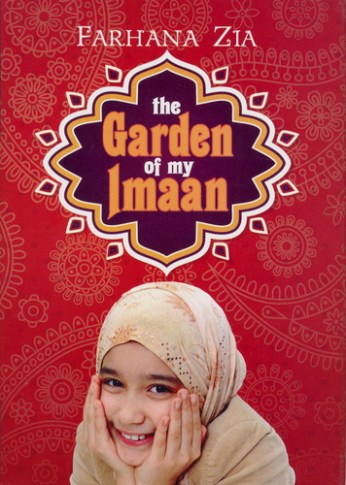
The Garden of My Imaan By Farhana Zia

Standard

Image

I really, really wanted to love this book, I saw it in last month’s Scholastic catalog and without even reading it I ordered a copy for me and two classroom six packs (total of 13 books).  I was so excited, a 3.6 AR reading level, 226 pages, a sweet hijabi girl on the cover, a Muslim author, good reviews online, I was waiting to be swept away.  Nuts, perhaps it was over anticipation or perhaps the book just fell short.  Either way we will not be using this in our current book club, nor will I kick off a 3rd grade book club with this book, sorry parents.   As I type this my printer is spewing out the return label to send the classroom copies back. 

SYNOPSIS:

Aliya is a fifth grader dealing with typical pre-teen issues of friends, family, and school.  The book starts with her at religious Sunday school surrounded by diverse friends.  Some friends are contemplating wearing hijab full-time, some preoccupied with their new boyfriends, some excited about fasting in Ramadan and others dismissing it completely.  On the way to Sunday school, Aliya’s mom is taunted by stereotypes from an angry motorist that has Aliya rattled and confused.  Immediately the author establishes that Aliya is unsure how to fit in because she is unsure where she stands on many of these issues.  Her home life involves multiple generations of Pakistani immigrants, and US born characters in one home, her great grandmother, grandmother, parents and her brother.  Later a great Aunt comes to visit as well.  At school Aliya has a best friend, Winnie, who is by far the best character in the book, a bully she has to deal with, a girl that Aliya is intimidated by, a boy she has a crush on, and a new student, Marwa. Marwa is Muslim from Moroccan heritage, wears hijab, and while religiously is the same as Aliya, culturally is worlds apart.  Marwa also is confident, strong, and devout; characteristics that Aliya slowly comes to admire and draw strength from as she defines who she is and wants to be in some aspects of her life.

Although there seems to be a lot of characters, there is no problem keeping them straight, the writing is very simplistic and at times weak, but clarity is never a concern. The first 15 pages of the book bring up stereotyping, discrimination, bra sizes, boyfriends, hijab, menses, and fasting.  All told from a very naive, innocent character’s voice which makes for an awkward start in my opinion.  As the book progresses she begins writing letters to Allah (swt), which, while I don’t imagine is wrong, seems odd, but that is probably my own background projecting.  My concerns with the book are that for as open as Aliya is with all the mulit-generations living in her home, there is no moral compass.  No one guiding her to be a better Muslim, to help her develop her internal conscious of what is right or wrong.  They all read her letters and no one discusses her infatuation with a boy? Seems a bit odd to me.  She tries to fast, against her families protest then breaks her fast with pepperoni pizza (she took it off) isn’t that a learning moment? I’m not saying the book should have become preachy, but the lack of basic parent-child interactions make it seem that everything she does is basic common sense, and I cannot with a good conscience encourage my little 3rd and 4th graders to read the book.  They will think I’m supporting Aliya’s actions and frame of mind.  Had the author opened the door to discussion or even had Aliya’s conscious question her actions, as a teacher/librarian the students and I could discuss the issue, but there is no pause, the story just states it and moves on.  Same goes for the fact that her father doesn’t fast regularly because he has important business decisions to make.  A concept so contrary to what we teach our kids, we teach them to fast when they have a big decision to make. Once again had the author taken just a few sentences to explain that the dad travels for work and that travelers are not required to fast, readers would get a more accurate view of what Islam teaches, not that fasting in Ramadan is optional.  

The one character that is presented as religious is described as being OCD, belligerent, rude, uneducated and a nuisance.  The character eats only halal, religiously raised and slaughtered meat, and the family essentially refuses to accommodate her, lies about what they feed her, and bully her.  Seemed to me the same treatment they are whining about receiving from society as a whole, they were projecting onto their great aunt within their home.   Finally the tipping point was when this same great aunt started praying/asking Bibi Sayeda for help, a saintly person who helps people find lost things…what? Islam is pretty clear we pray to Allah swt and only Allah.

WHY I LIKE IT:

I like that the book shows diversity within the religion, it isn’t preachy, and it shows the balance that non-Muslim kids often have to balance.  I think if my daughter picked this book up at the public library and we read it together we might be able to talk our way through it.  I think students in public school who have to face more of Aliya’s struggles or students that have non-Muslim family members will see themselves at some point in the book and find comfort in it.  But again, because of the reading level, I can’t justify handing it to a Islamic school student to read without numerous warnings and disclaimers.

I like that the characters do discuss their different view points on hijab, and that Aliya forms her own opinion on it.  And while it takes awhile to make the point and does involve Aliya yelling and insulting the bullies, she does find a way to handle them by being kind, which for this age level is a nice, albeit optimistic, message. 

FLAGS: 

Questionable basic Islamic facts, minor characters with boyfriends discussing kissing.
 

Does My Head Look Big in This? By Randa Abdel-Fattah

Standard
Does My Head Look Big in This? By Randa Abdel-Fattah

Image

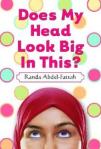
I think I have purchased this book at least twice before and have never gotten around to reading before loaning it off to someone, that is until we were snowed in a few days ago.  Similarly bizarre, whenever I’ve asked someone who has read it what they thought of it, I’d nearly always get a a smirk, a shrug a nod of the head, and a vague response.  So when the book came in the mail and the snow hit the roads, I decided to put an end to all this none sense.  Needless to say I’m very tempted to make a video of me shrugging, smirking, and shaking my head instead of writing a synopsis, ya, it’s got a lot going on.

According to Accelerated Reader it is a 4.9, so fourth grade ninth month reading level, however, I wouldn’t encourage anyone that young to read it, you would need to be at least a junior or senior in high school for content.  It has 360 pages that fly by and is one of those books that if you put it down you could pick it up a month later and not miss anything, or you could read it in one sitting and not find it to be a daunting task.  I akin it to empty calories, a half hour sitcom, or books like Janet Evanovich’s Plum novels or Sophie Kinsella’s Shopoholic books; entertaining, light, and with a happy ending.

SYNOPSIS:

Australian born Amal Mohamaed Narullag Abdel-Hakim is considering wearing hijab and as she makes the decision, she is forced to handle obstacles in every relationship her sixteen-year-old life contains.  The only child of her Palestinian born parents, her mother is a dentist, her father a doctor, Amal seems to have it all: a few close Muslim friends from her days in an Islamic School, a few close friends at her current prep school, an amazing relationship with her parents, brains, looks, opportunity.  There is really no climax as she navigates all this other than the fact that she is a teenager and doesn’t often know what she wants.  Additionally she is Muslim and as various terrorist plots occur she is challenged with coping at school, deciding if she can achieve her goals and cover her head, if she can have male friends and go to parties, and if she can win over her critical elderly neighbor.  This book honestly has it all: Islam vs. culture, boy girl issues, gender roles, immigrant and assimilation, extremism vs liberal, weight and self esteem issues, Ramadan, cousins and family members who make things difficult, female circumcision, terrorism, drug and alcohol use, smoking, racism and bigotry,  and even at times a poignant moment or two.

But, to cram all that in to a YA book is really just too much that it gets lost and ultimately doesn’t leave a memorable place in the reader’s head or heart.

Never really getting into Amal’s head about why she wants to cover, the book stays superficial with her infatuation with Adam and her poor choices regarding her relationship with him.  A constant struggle she has is wondering if she can ever get a job and be taken serious as a professional while wearing a hijab, which seems really silly since her mom is a successful dentist who covers, but that never even is addressed.  Amal fights with her Principal, fights with classmates and at times even her parents regarding her decision to cover, and while yes you cheer for her, it seems to almost contradict how flighty she is in other capacities of her life.  The other main story line is with Amal’s Muslim friend Leila who’s parents are “cultural” and not very religious and thus oppressive in letting Leila practice Islam.  A worthwhile story line, however it almost makes Amal’s family in contrast seem “too perfect” which after a while just seems unrealistic.  The character fasts and prays and does many of the prescribed aspects of faith, but Amal seems in many regards to lack spirituality or enthusiasm or even a deeper connection for Islam.  She is a character who is Muslim, but not necessarily defined internally by her love of Allah, she just wears it on her head.

WHY I LIKE IT:

Many reviews of the book remark that it is a book that “needed to be written and needs to be read,” and I think yes, if you are an avid reader that is looking for a quick entertaining read about a Muslim, by a Muslim, go for it.  I don’t foresee me using this as a book club selection, but i think in a few years there are some students that I would recommend picking it up and reading it.  To some non-Muslims I think it would show that Muslim’s have the same everyday problems that everyone has, and in fact we are not all extremists.

FLAGS:

There is a little cursing in the book, girl/boy issues of dating, kissing,  mentioning of porn and prostitution, there is alcohol, drug use by a minor character, smoking, and lying to parents as a norm.

TOOLS FOR LEADING THE DISCUSSION:

Click to access RA-DMHLBITNotes.pdf

A little about the author and why she wrote the book:

http://www.randaabdelfattah.com/index.asp


The Meat Eating Vegetarian by Caroline Maryam Ward

Standard

ImageA quick read even for the 2nd through 4th grade age group with 44 pages, lots of pictures, and generous spacing.  I  feel it could have been done as a picture book, but for the age group and the fact that it is hardback, the book does sit nice on a shelf and encourage a budding reader to open it up and not feel intimidated.  The book is written in British English, so my daughter had a few questions regarding terminology and spelling, which alhumdulillah, gave us a chance to talk about a different culture (albeit a different one than the book was targeting).

SYNOPSIS:

British born of Pakistani heritage, Tasneem starts a new school in the fall, she quickly becomes friends with Yvonne and Lisa.  After a play-date at Tasneem’s house however, Lisa and Yvonne feel Tasneem has been lying to them about wearing a scarf and eating vegetarian lunches every day in the cafeteria.  Their teacher helps facilitate a dialog and the girls learn about zabiha, rules of hijab, and the importance of communication in a friendship.

WHY I LIKE IT:  

The book is not preachy, Tasneem is Muslim, the other girls are very nice, it is a simple story that helps a Muslim reader see that one can be true to themselves in any environment and succeed.  In terms of identity building it is great to see mixed characters with open minds, but at the same time not present it as trouble free, which is something it often is not.  The only hesitation in recommending this book that I can foresee, is within the Muslim community there is division on Zabiha/Halal.  Tasneem does tell her friends that because she is still young, the hijab is not mandated for her, but the meat issue will either be amazingly relative to a student, or incredibly off putting, depending on their background.

FLAGS: none, completely clean, Alhumdulillah


Extra Credit by Andrew Clements

Standard
Extra Credit by Andrew Clements

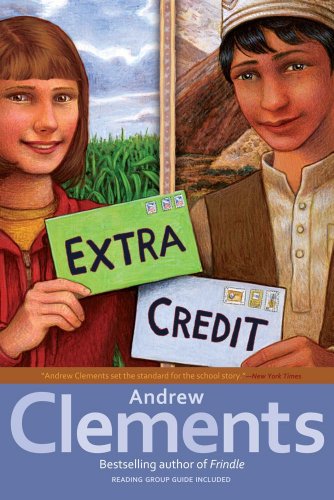
ImageHaving seen this book a million times, I never paid close enough attention to realize that the boy on the cover is an Afghani boy and that half of the story is told from an American girl’s perspective and half from young Sadeed.  My trusted librarian friend advised that the book is best taught through a discussion on what rules exist in Islam regarding gender roles, and why they exist.  And after reading it, I quite agree.  The story is very straight forward and predictable, and I really doubt most kids would find this to be Clements best work, however, I think if the students could be directed to critically evaluate WHY Sadeed’s community doesn’t want him communicating directly with American Abby, they might realize more about their parents own rules and reasoning, and be able to talk about them objectively.  The book is 183 pages and an Accelerated Reader Level 5.3.

SYNOPSIS:

Sixth grader Abby is in danger of being held back if she doesn’t keep up on her homework and do extra credit.  The extra credit assignment is to do a pen-pal project with a student in Afghanistan, unfortunately Sadeed, is the most qualified, but the village elders don’t think it appropriate for a girl and a boy to communicate.  As a result, Sadeed’s younger sister, Amira,  is selected to write back to Abby with Sadeed’s help.  Sadeed is annoyed by the process and begins writing to Abby independently, until events force him to reconsider.  The book is meant to show how people are universally the same, even when they seem so different.  Abby loves to rock climb and doesn’t like school, Sadeed loves school and has never thought to climb a mountain. Through their letters they realize they have more in common than originally thought.

WHY I LIKE IT:

The book discusses the Taliban and how fortunate Amira is to attend school.  It talks about Afghan culture in a fair light, and doesn’t paint all in Sadeed’s village with one stroke.  His parents, the village elders, the principal, all are seen as different individuals, with different thoughts and in a positive light.  If anything Abby’s world is seen as more bland and presented with a broad stroke of uncaring characters.  Sadeed and his family practice Islam and it shapes their moral conduct as well as their every day lives.  Islam is not what the book is about, but it does define the characters and their environment.  I like that it is age appropriate in dealing with complex topics of gender roles, and societal customs, I think our students can relate to both Abby and Sadeed (and even Amira), however I think that the characters would soon be forgotten.  While the book has a lot going for it, it seems to come up a little short.  If I do this as a book club discussion I would keep it 4th through 6th graders, I think the older students would be bored by it.  I think that the discussion would be more fruitful than the book alone.  InshaAllah, if one can get through the tediousness of, if Abby will get to go to seventh grade, and reach the top of the rock wall, there is a sweet story of building bridges and trying to see the world from other people’s perspectives; as well as opening the door to understanding why religiously and culturally our parents set up the boundaries that they do.

FLAGS:

The younger sister teases her older brother that he has a crush on her pen pal, and one could argue either way that he does, but, it is clean in terms of language, violence, and anything clearly objectionable.

TOOLS FOR LEADING THE DISCUSSION:

The discussion guide is found in the back of some editions, if not you can see it here:

http://books.simonandschuster.com/Extra-Credit/Andrew-Clements/9781416949312/reading_group_guide

Ask Me No Questions By Marina Budhos

Standard
Ask Me No Questions By Marina Budhos

Image

Before posting my thoughts of Ask Me No Questions, by Marina Budhos, I re-read the book. Luckily at only 162 pages and an Accelerated Reader Level of 4.8, the fast paced plot made for a quick read.  Having read it in 2007, when it first came out, I recall having liked it, and could recall the basic plot, but absolutely nothing else.  In hopes of finding a Book Club book I reread the novel to refresh my memory.  With the passing of time, the book drastically lost it’s relevance.  Although I know people that face the fear of deportation at every moment, I know people that registered and left as part of post 9/11 Muslim Registration Act, and still have been able to reapply and be reunited with their families on American soil; I think the young adults that once might have found themselves in this book have all grown up, and the new demographic as a whole doesn’t relate.  And, unfortunately, because of the lacking depth of character and plot development, most students I doubt will find much to relate to in the book.

SYNOPSIS:

A Bengali family living in New York on expired visas seek asylum in Canada after 9/11.  Told from Nadira, a fourteen-year-old girl’s perspective, the book details life as Nadira’s father gets detained at the Canadian border, her mother stays at a near-by shelter, and Aisha, Nadira’s older sister, and Nadira head home to New York to resume life, and carry on as if everything is the same.  The premise of how to live with the constant fear of being found out, especially at a time when people were “disappearing” for no reason and without cause is a compelling story line.  As the back of the book says “Suddenly being Muslim means you are dangerous- a suspected terrorist.”  However, the characters don’t act or practice anything Islamic, perhaps that on some level makes the book more ironic that they are targeted for having come from an Islamic country and having Muslim names, but for me, it just made the characters seem that much more shallow.  I never connected with the characters, any of them, and there are a lot of them.  There are so many side characters that do nothing to develop the main characters, nothing to move the plot, and really take away from the bonding with the turmoil that Aisha and Nadira are feeling.  One minor character is presented as religious and mosque going, and by default that the dad had given him some money to keep, implies the dad went to the mosque, but religion only shapes their lives in that they feel that is why they are being targeted.  On the other hand, they don’t seem very “cultural” either, yes they live among many Bangladeshi families, but you don’t see their identity developed there either.  Rebels to the norm are presented, but not articulated to reflect on who Nadira is and provide some resonance to her with the reader.  The characters seem isolated even within their cultural and religious community, which doesn’t fit , perhaps had the immigration situation isolated them it could be overlooked and understood, but rather it just makes Aisha seem petty and whiny and Nadira clueless, one dimensional attributes that leave the characters flat on the page.

By the end of the book, the title of the book starts to feel  like a cruel joke.  I had so many questions, why did they leave Bangladesh, why didn’t that father stay working in Saudi Arabia, why did they feel living illegally was alright, what happened to various friends that disappeared, not because of deportation, they just stopped being mentioned, where did the mom get her strength from and what is her background story?

FLAGS: 

By and large the book is clean, a cousin has a boyfriend that she is regularly sneaking off with, but nothing romantic is described, they are sneaking off to do political activist work.  Another character, a thug type, is shown to be able to acquire things illegally, and Nadira’s helps her friend Lily, discover that Lily’s dad is having an affair and has another family.

WHY I LIKE IT:

If I wasn’t look for a book to present to students, I probably would not have been bothered by a lot of the critiques in this post.  But because, my hope is to find something the students can identify with and take pride in, I was harsh with my view on the story.  There are redeeming qualities however, as immigration reform is still a hot topic, students need to be able to put their feet in someone else’s shoes to better understand an issue, and this book, for the age level, can provide that.  As a story of two sisters having to put their differences aside to help each other and their parents, this book gives some insight.  And naturally if I know of a student who has gone through a similar situation, I think they would benefit reading it, not in that they would agree or be inspired, but at least in feeling less alone.

TOOLS FOR LEADING THE DISCUSSION:

At the moment I don’t see me discussing the book, but I will definitely keep it on the book shelf in the library.  If things change, the following websites are useful:

An article about immigration by the author, Marina Budhos

http://www.huffingtonpost.com/marina-budhos/were-ready-for-immigration_b_2617581.html

The first chapter of the book:

http://www.marinabudhos.com/ask_me_no_questions.html


When Wings Expand By Mehded Maryam Sinclair

Standard

Image

When Wings Expand, by Mehded Maryam Sinclair, was loaned to me by a friend who knew I was looking for books that might appeal, positively to 7th and 8th grade Muslim girls.  While this book would definitely appeal to that demographic it would not be limited to such a small population.  I plan to open it up to all the girls 5th – 8th grade for the Book Club, and recommend it to parents with older daughters to read together.  While the book is an easy read in terms of grammar, vocabulary and style, (150 pages written as journal entries), the content is emotional and religious.  The book is not AR, so I will have to make a quiz, but I would assume it would be about a 5th grade reading level.

SYNOPSIS:

Canadian teenager Nur, chronicles her mother’s onset of cancer, her death, and life after the loss of her mother through journal entries.  Using simple symbolism of a butterfly’s life cycle, Sinclair shows how Nur must not only grieve and accept her mother’s death, but also reaffirm her faith and trust in Allah (swt) and His plan.

WHY I LIKE IT:

I love that at it’s center the book is about two relationships; a young girl and Allah (swt), as well as a young girl and her Mother, both dear to her heart, neither tangible.  Any one with a heart can imagine the immense pain in losing one’s mother.  Teenage girls particularly need to be reminded that while they may constantly butt heads with their mothers, to lose their mom would be devastating; the book makes that point abundantly clear.  Nur and her mother seem to have a “perfect” relationship, at least in that Sinclair doesn’t detail any strain between the two of them, but I think the readers can supply their own baggage and imagination and still be able to connect with the character.  I like that Nur’s mom is Turkish and that her Father is a convert, I think that so many youth today are from mixed backgrounds and the juggling and sorting of customs is something they can relate to as well.  The book is clean of boy/girl issues, language, violence etc.  In some areas it is a bit too “perfect” so to speak, in how understanding Nur’s father always is with her and her brother and how readily their uncle swoops in to take them hiking or on a picnic, but it some ways the simplicity of it all is also it’s charm.  As the book progresses Nur, must help a cancer patient with some of her own faltering faith issues, and with strong Quranic examples, seerah examples, prayer, and love, the reader is able to reflect on the message, rather then getting caught up in some fast passed action sequence.  I think the book has a place, and I hope that it reminds the girls how short this life is, the value of their mothers,  the pain associated with loss, strength of family, and Allah’s mercy.

TOOLS FOR LEADING THE DISCUSSION:

A box of tissues

Honestly because the cycle from sadness, to anger to acceptance to peace is fairly universal, I plan to simply let the students talk about the book, to see it through their perspective.  I don’t think much prodding will be needed.