Tag Archives: Eid

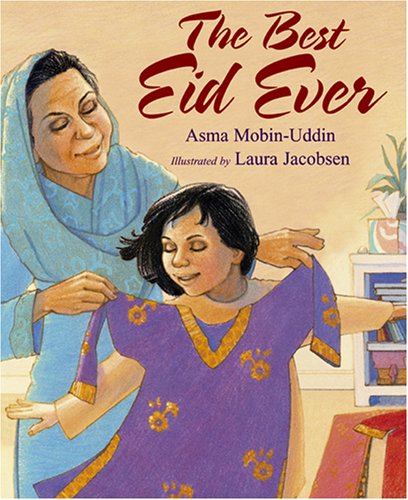
The Best Eid Ever by Asma Mobin-Uddin Illustrated by Laura Jacobsen

Standard

best eid ever

For some this book may have a lot going on it’s 32 pages: Eid ul Adha, parents at Hajj, refugees, charity, Pakistani culture, but if you are reading this book to Muslim children (or they are reading it independently, it has an AR level of 3.8) i think it is delightful.

Aneesa wakes up on Eid morning missing her parents who are in Saudi Arabia performing Hajj. Her grandma, Nonni, surprises her with three new outfits complete with bangles and shoes for each of the days of Eid and is preparing her favorite dinner, lamb korma, for them to eat after Eid prayers.  At Eid prayers Aneesa meets some refugee girls and wants to do something to make their Eid a little brighter.  Nonni and Aneesa come up with a plan and the result is “the best Eid ever!”

I love that it has morals and plot and sparks dialogue.  The message is so simple yet beautiful, that it stays with the reader, adult and child alike.  The illustrations are beautiful and warm providing a nice balance to the long passages.  There is an author’s note and Glossary in the back, but I think this book is really intended for a Muslim audience familiar with Hajj, Eid, and Paksitani culture.  It wouldn’t be lost on someone new to the vocabulary and customs, but definitely wouldn’t be as magical or memorable.

My 3rd grader loved the book and we were able to talk about it and reflect upon it long after the initial reading.  My younger boys enjoyed it, but didn’t get as much out of it.  I think this book works better in smaller groups rather than story time, or simply to have on the shelf to sweep the reader up and allow them to draw their own conclusions on what it means to do something for someone else.

Magid Fasts for Ramadan by Mary Matthews illustrated by E. B. Lewis

Standard
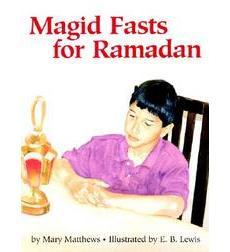
Magid Fasts for Ramadan by Mary Matthews illustrated by E. B. Lewis

Magid Fasts for Ramadan

The intent of this 48 page chapter book is good, however, a few things rubbed me the wrong way about how Ramadan and Islam are presented.

Nearly eight-year-old Magid wants to fast on the first day of Ramadan, but everyone says he is much to young.  He decides to deceive everyone and fast anyway.  I’m actually okay with this main story line, as I could genuinely see a child wanting to do it so much they would lie about it.  The author even has the family sit down after the truth comes out and discuss how honesty is important and this is not how Ramadan should be celebrated.  Lesson learned for Magid and the reader, right? Nope, the author kind of blows it and takes it to the other extreme.

Magid’s sister Aisha is twelve and is “forced” to fast so she isn’t the only girl not fasting at her all girl’s school in Egypt.  What a sad reason to fast, The whole reason Magid wants to fast is to be a “truly obedient Muslim” which sounds great on the surface, but it get’s repeated so often that Magid at one point is judging a classmate who isn’t fasting and isn’t always at Jummah (Friday) prayers.  The parents decide at the end to let Aisha fast until school is out, hence shortening the day for appearance purposes, and Magid can fast til lunch.   He is told he can fast full days when the days are shorter.  Again a really odd reason to wait when fasting has been prescribed for us, to make it an issue of convenience.

So aside from the very negative view of Ramadan and the kids rejoicing at the end that they don’t “have” to fast, the lying, the disobeying your mother, and the judgmental laden diction of being truly obedient, the book does cover a lot of ground well.  The book shows the characters doing wudu and praying, it shows them trying to be kind to one another, it talks about how the Quran was revealed in the month of Ramadan and it does have a plot.

The water color illustrations are nice, and I also like how it showed a bit of Egyptian culture with the lanterns, singing, and food.  Interestingly the author says it is harder for Muslim’s in America to fast, but elsewhere says that Aisha has to watch the girls at school not fasting, eat lunch.

I really wouldn’t recommend this book, for the intended audience of 3rd through fifth graders I think it would do more harm than good in promoting Islamic values in Muslim children and in showing non-Muslims what Ramadan means to Muslims.

Ramadan by Susan L. Douglass Illustrated by Jeni Reeves

Standard

ramadanThis is a non Fiction book about Ramadan that is thorough and accessible.  It has an AR level of 3.7 (third grade, seventh month), and with the short sentences and well-spaced text, I wanted to include this book so that those looking for an informative book for their independent readers (second grade and up) would consider this one.  At 48 pages, the book isn’t divided up into chapters but there are headings that keep the book flowing from one topic to the next. The illustrations supplement the text giving them context and there is a list of “New Words” in the back making this book appropriate for Muslim and non Muslims alike.  

Overall a good read for those looking to learn more about Muslims and Ramadan, or for those looking to see themselves in a book that isn’t too childish. The book is clean and factual, and keeps a nice balance between giving solid information and overwhelming the reader with details.  The book also includes examples of Ramadan in other countries as well as students fasting in America.  We have this book in our school library and the students that have stumbled upon it are excited to check it out, and when they ace the AR test they are absolutely beaming.  


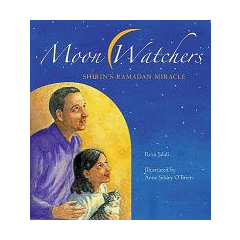
Moon Watchers Shirin’s Ramadan Miracle By Reza Jalali Illustrated by Anne Sibley O’Brien

Standard

moon watchers


This book is similar to Night of the Moon By Hena Khan as it focuses on a young girl experiencing the month of Ramadan and Eid, through the waxing and waning of the moon.  This is an AR book 3.5 and the text is driven by dialogue between nine-year-old Shirin and her Persian American family.

Too young to fast Shirin is feeling left out of the blessed month of Ramadan, her older brother Ali and her bicker until her Grandma encourages her to do “part-time fasts.”  Facts about Islam and Ramadan are slightly peppered in to the story, primarily through vocabulary, and the characters do discuss hijab and why Shirin’s mother doesn’t wear it.  It is important to note that the tale is told from a Shia perspective that is made clear as it explains how the family prays, touching the prayer stone, and kissing it three times.  The illustration here is more peculiar as it shows Shirin praying next to her dad and her brother, mom, and grandma in the row behind.

The pictures show a happy family that most readers or listeners would probably be able to identify with, along with the sibling bickering and excitement felt with the blessed month.  Persian culture is represented in the foods and sweets they prepare as a family and the henna Shirin gets on her hands.  The family prays together, spends time together and they discuss doing good deeds, not just fasting in Ramadan.

The book is beautifully done, but I think because of the brushing aside of hijab being a cultural practice, not a religious one and the presentation of prayer, I don’t know if I would give the book without discussion to a third grader in a Sunni school to read independently.  As for story time, I might simply omit those few sentences, but I’m not sure, it would depend on my audience.

If your children are aware of the differences between Sunni and Shia or you are Shia, this book is wonderful.  If your children would be greatly confused or get hung up on a few lines in a 32 page book, then it would be better to hold off.


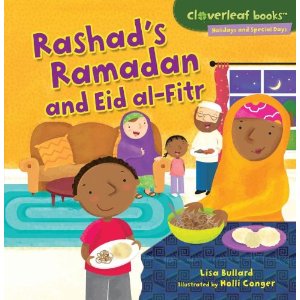
Rashad’s Ramadan and Eid al-Fitr by Lisa Bullard Ilustrated by Holli Conger

Standard

rashads ramadan

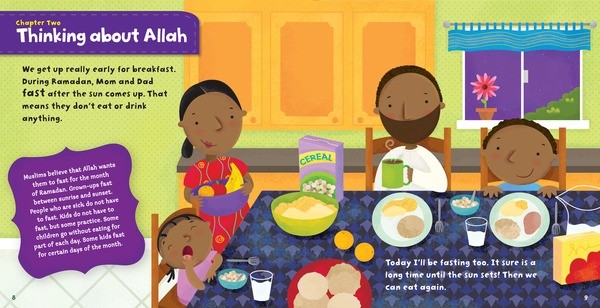
This is a non fiction picture book that tells a very basic story about Ramadan through Rashad’s young voice, with informative sidebars giving facts and details about Islam, Ramadan, and Eid. Broken into four chapters the book is very concise at just 24 pages, highlighting the key aspects of Ramadan: Where’s the Moon, Thinking About Allah, Thinking About Others, and  A Big Celebration.

?????

With an AR level of 2.7 this book is perfect to read along with your child, Muslim or non, letting them read the story, and you adding the information and answering any questions they may have about Ramadan.  There is a glossary in the back, as well as a page of “Resource Information” to learn more.  It may seem a bit “childish” for some, but it is a great introduction, and/or a good review of the basics for toddlers to third grade.

The pictures are bright and colorful, yet simple enough to not overwhelm the information being conveyed.  They definitely make you smile to see the little smiling faces and convey the excitement of the holiday.

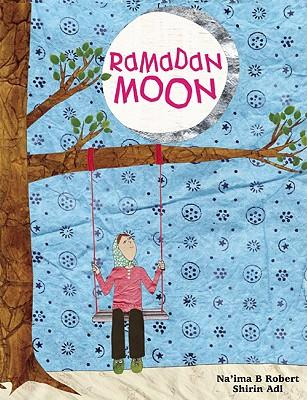
Ramadan Moon by Na’ima B. Robert Illustrated by Shirin Adl

Standard

ramadan-moon

This book is fantastic and one of my children’s favorite.  The text is lyrical and simple and the pictures are charming and sweet.  I wait for the day I can read this to a larger group of children than just my own, but until then I have no problem reading this one over and over again.  It has an AR level of 4.6 and is 28 pages.

Told from a child’s perspective and voice, the free verse poetry lilts around in a playful way conveying what Ramadan is, what fasting is like, going to the mosque, what Muslim prayers entail, giving charity, being kind, and celebrating Eid.  While it would work for both Muslim and non-Muslim children, the vocabulary isn’t well defined and there really isn’t a story it is more of an overview.  Muslim children will enjoy it because they are familiar and probably have experienced most everything presented, however, if that connection isn’t made, the story may fall a bit flat.  That being said a brief explanation can easily erase that obstacle and make it a fun book for all kids pre-school and up.

I’m learning about Eid-ul-Fitr By Saniyasnain Khan Illustrated by Pulak Biswas

Standard

i'm learning about eid ul fitr

I’m learning about Eid-Ul-Fitr is a really dry book.  It is written as fiction, but it is more educational, than entertaining in nature.  Siblings Farah and Faisal are fasting, then celebrating Eid.  The story is told about them, but not really from their perspective.  They are just secondary vehicles to convey the main components of Ramadan and Eid.  The language is choppy and unimaginative.  My guess is that the story was translated from another language as grammatically it is awkward to read.  A few examples: “Maria’s parents belonged to Kuala Lumpur in Malaysia” and later, “Everyone was in his best clothes.”  The illustrations are adequate, with the exception of the pictures of a couple of Mosques from Delhi, Lahore, Kuala Lumpur, and Samarqand, which are quite nice.  Overall the book is sufficient.  If it is the only book your children have access to, there is nothing wrong with it, there are just a lot better, more engaging picture books, fiction and nonfiction, about Ramadan and Eid out there.


Night of the Moon By Hena Khan Illustrated by Julie Paschkis

Standard

night of the moon

Night of the Moon is a beautiful book both visually and content wise.  The pictures are bright and inviting and consume the entire page, keeping even the youngest of listeners engaged.  The book has an AR level of 4.1 and has 32 pages, making it work great for story time and well for independent readers too.

The book tells of seven-year-old Yasmeen, a Pakistani-American girl experiencing Ramadan. The story is moved along by the ever changing phases of the moon. While this book is adequately called a Muslim Holiday Story, it is very cultural.  The characters go to the mosque, but the focus of the story is not why we fast, the revelation of the Qur’an to Prophet Muhammad (peace be upon him), or even manners.  The story focuses on going to iftar parties, having henna painted on your hands, presents, and the very Pakistani-tradition of celebrating chand-raat, the night of the moon.

I like that this book shows Yasmeen talking about Eid at school with classmates of other backgrounds, I even like that her grandma wears hijab and her mother does not.  I also like that they eat a variety of foods, from kebobs to cupcakes.  Thus far, so many of the Ramadan and Eid books I’ve read contain the same information in a fictionalized setting, this one is definitely different, instead of focusing on what Ramadan is, it shows how it is celebrated.  The book works well for Muslim and non Muslim children from all around the world.  If your audience lives in American and has ties to the Asian subcontinent they will see them selves in this book, and even if they don’t, they will probably want to join Yasmeen and her family is celebrating Ramadan and the Night of the Moon.

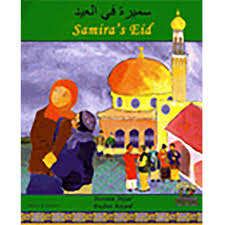
Samira’s Eid By Nasreen Aktar Illustrated By Enebor Attard

Standard

samiras eid

Samira’s Eid is a dual language story (my copy is English and Arabic, other languages are prevalent online as well) about Samira and Hassan, siblings enjoying Ramadan.  It is Hassan’s first time fasting and he is afraid fasting may hurt,  Samira and their mom explain that it won’t and continue to walk him through each step of a Ramadan day as he experiences them.  This point of view allows the reader to see what  Ramadan is like, how it feels, and what it means. The story carries on through Eid and explains as well as shows how Eid ul-Fitr is celebrated by Samira and her family.   The story concludes with a lovely surprise ending involving an Eid Card and Samira’s Nani (grandma), that adds to the book’s appeal at bedtime or story time.

The story is sweet, and level appropriate, it doesn’t get preachy and the dialogue doesn’t seem forced.  It is story driven and would be engaging to both Muslim and non- Muslim children with a little discussion.  The pictures are mediocre. They are colorful and for the most part a good accessory to the story. There are a few pictures however, where the faces are a bit “droopy” and jarring.  Particularly the one of Samira’s teacher, Mrs. Qadir.

It is unclear where the story takes place exactly, presumably the Asian subcontinent as Samira receives a shalwar-kameez to wear for Eid and the use of the term Nani. The author makes a point of following  the moon sighting for Saudi Arabia that may need to be discussed based on personal and community views and practices.

Overall a good story and at 22 pages a nice read-out-loud selection.


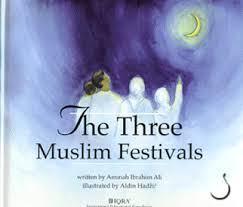
The Three Muslim Festivals By Aminah Ibrahim Ali Illustrated By Aldin Hadzic

Standard

Image

The Three Muslim Festivals is a very informative book about Ramadan, Id al-Fitr, and Id al-Adha, at over 60 pages however, it is a bit long for story time or smaller children.  Broken up into three parts, each told from a different character, the book would work well for second through fourth grade students.  It reads like a very basic chapter book, with information mixed in with a simple story.  The morals are clear, hadith, ayats and dua’as are shared and the illustrations help support the fictionalized portions.  The pictures aren’t engaging, but they do show a variety of ethnic groups and happy families.  The book is content, not character driven, but the families are supportive of the children, there are actively involved moms and dads, grandparents, and siblings.  The mom in one story is a physician and the dads help in the kitchen and around the house, showing some diversity. I like how it serves as both a review of basic Islamic principals while reinforcing elements that a child may not know or may have forgotten in a non condescending manner.  I would imagine the average seven year old could read it independently and comprehend it without being bored.  It isn’t the best written story out there, but it should be engaging enough to convey a lot of good information to an elementary aged reader.  Based on the style it is probably more intended for Muslim readers, but there is a three page glossary of terms in the back.