Tag Archives: Dupatta

Awe-Samosas! by Marzieh Abbas illustrated by Bhagya Madanasighe

Standard
Awe-Samosas! by Marzieh Abbas illustrated by Bhagya Madanasighe

img_4196-1

I was really enjoying this book about a determined young girl and her dad making samosas for friends, missing Dadijan, adapting and problem solving, an encouraging Urdu speaking parrot, a reference to Ramadan, and incredible illustrations… and then I froze.  On page 32 of the 40 page book it says the word “pepperoni” clearly affirming that the Muslim girl who’s dupatta wearing Dadijan wakes up at fajr to call her, has made pepperoni pizza samosas for her friends.  Perhaps I’m over reacting, it is one word, but I truly cannot get past it.  The first time I recall asserting myself as Muslim was in preschool making pizzas and me telling my teacher at three and half years old that I cannot eat pepperoni.  Sure as a middle aged adult, I know you can get beef or turkey or faux pepperoni, but the standard is pork, and this book does not clarify that it is not pork.  The word is intentional, the story would be exactly the same if it were just a cheesy pizza samosa, yet it articulates it as a peperoni pizza samosa. And I truly cannot fathom why.  Classrooms and libraries will shelve this book, teachers and librarians will read this book, little Muslim kids that look like Noor, are going to shrink when they get to that line: either they will question if we can have pepperoni (why else was it in Noor’s home), or have to now convince adults and classmates that the book is wrong in addition to explaining that Muslims do not eat pork, a big task for the intended audience of preschool to third grade.  If you omit that one word, the book is wonderful, layered, joyful, and a lot of fun.

Noor’s friends are coming over, two girls and a boy, for the first time and Noor wants to make samosas to eat with them.  It is too early to call Dadijaan in Pakistan, and Noor thinks she remembers how to make them.  Abbu offers to order pizza, but Noor is determined, even when she discovers they don’t have the necessary ingredients.  She puts on Dadijaan’s kitchen dupatta, and with her parrot, Mithoo, encouraging her every time she gets stuck with “Sab theek hai. Sab theek Hoga! Everything’s great, everything’s going to be okay!” Noor heads to plan B, Awe-Samosas, samosas with unique fillings.

img_4197-1

Noor gets Abbu onboard and helping and when her friends arrive, the turmeric colored pastries are ready for eating.  Some are apple-cinnamon filled, and remind Kaitlin of her grandma’s Fourth of July apple-pie, some are stuffed with honey and pistachio like baklava according to Layla, and Jonathan finds the cheesy peperoni samosa genius.  When Dadijaan sees the pictures Abbu has sent at fajr, she calls and praises Noor with the friends hoping to have another samosa party when she is visiting next.

The book concludes with Dadijaan’s Special Samosa Recipe, and a Glossary.  The book is widely available, including here on Amazon.

img_4200-1

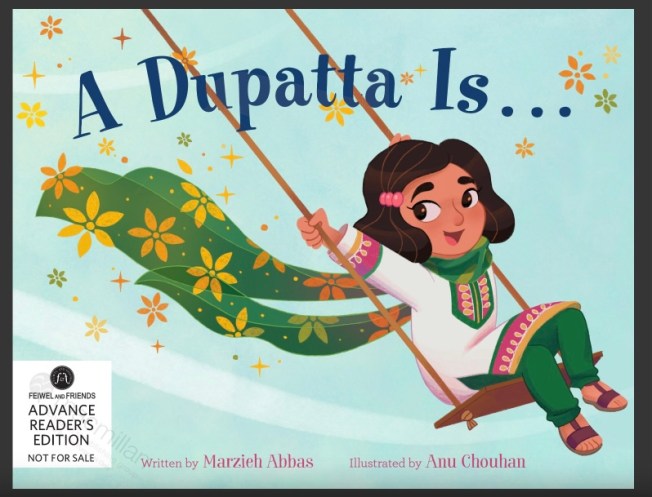
A Dupatta Is…by Marzieh Abbas illustrated by Anu Chouhan

Standard
A Dupatta Is…by Marzieh Abbas illustrated by Anu Chouhan

img_6073

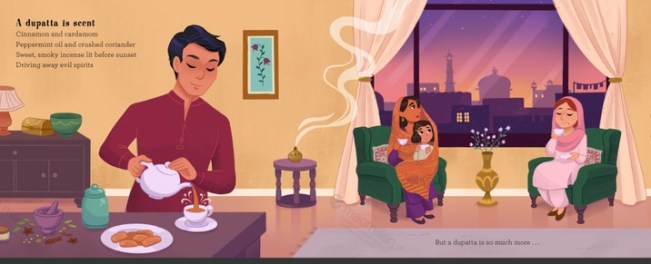
I read this 30 page early elementary book a few times before writing this review and honestly my cheeks hurt because I cannot stop smiling.  The lyrical writing radiates warmth and pride, culture and tradition, legacy and identity, while acknowledging both the playfulness and solemnness of a piece of fabric.  My heart breathed with the clarity and articulation that is felt and contained within the fabric that perhaps all Pakistanis feel, but cannot convey so poetically.  The book may be meant for children four to eight years old, but all readers will appreciate the text and illustrations that seamlessly flow like a favorite dupatta grabbed while running out the door. I struggled with picking only a few images to share, as every page became my new favorite as the book progressed.  Admittedly though, one page did give me pause as it conflated incense burning with getting rid of evil spirits which comes across as a religious belief, but is a cultural practice.

img_6074

The book starts out with the actual physical description of what a dupatta is and how it is adorned.  It then moves on to describing the color, the sound, the smell, the place, the function, the art, the beauty, the fun, the faith, the legacy, and the identity.  Each spread ends with the words, “but a dupatta is so much more…” seamlessly weaving so many facets of what a dupatta is together to create a true understanding of it from a tangible, to cultural, to practical perspective.

img_6076

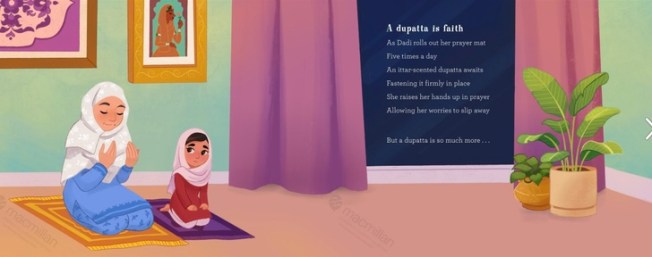
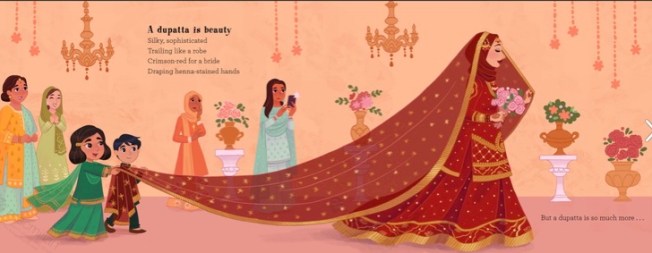
I love that there is a page about faith, and praying five times a day with a dupatta being worn, it is a little odd that there is a portrait decorating the wall behind the two characters making dua, but at least it is clearly behind them.  I absolutely loved that so often the wearer of the dupatta was also wearing a hijab, particularly the bride picture- which is absolutely gorgeous.  It signals without words that a dupatta can be worn to cover a Muslim woman’s head, but it is also often not.  The backmatter further details that it was once worn as part of the national dress and as a form of modesty, but now is often worn as an accessory.

img_6077

One summer in Pakistan, a friend and some cousins and I started trying to formulate 101 Things to do with a dupatta (wipe noses, pull things out of the oven, catch fish), it was the year of net dupattas so clearly covering your head was not one of them.  Sure we were being silly, but to see the book also highlight wiping sticky hands, and wrapping it up like a sari, and using it as a cradle to rock a baby was very, very accurate and heartwarming.

img_6079

Please pre order this book, it signals to publishers that these books are in demand and is a way to show what type of books we want to see.  I preordered  mine here.