Tag Archives: clean

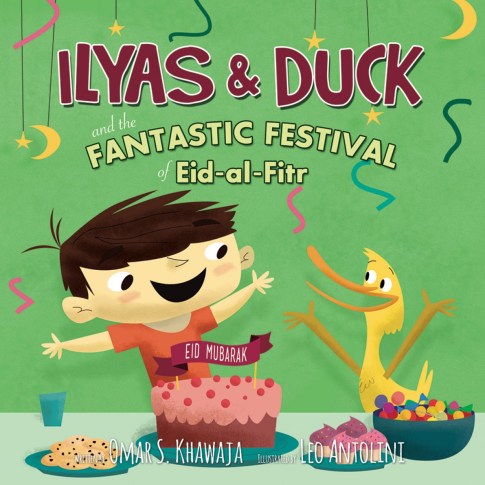
Ilyas & Duck and the Fantastic Festival of Eid-al-Fitr by Omar S. Khawaja illustrated by Leo Antolini

Standard
Ilyas & Duck and the Fantastic Festival of Eid-al-Fitr by Omar S. Khawaja illustrated by Leo Antolini

Ilyas & Duck and the Fantastic Festival of Eid-al-Fitr


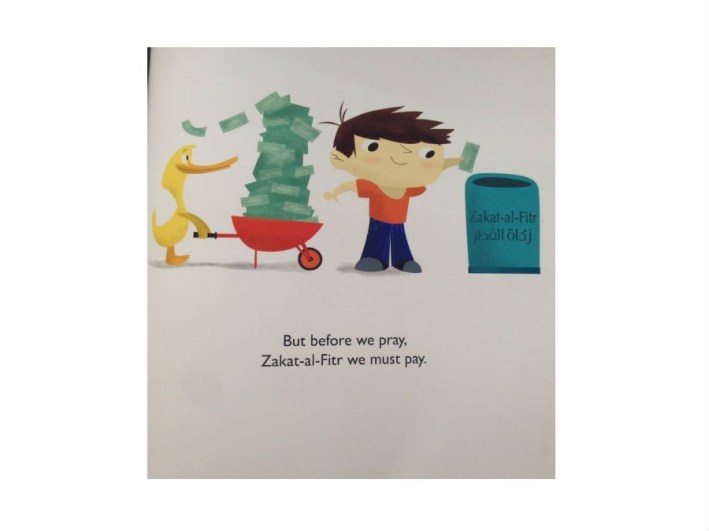
In the world of Islamic fiction, there are a lot of Eid books out there for children, but this one is definitely more fun than most, especially for the younger crowd.  The presentation of a big, bright, hardback book is aimed at 3 to 6 year olds, and reads well out loud, however, the book is very, very inviting, and older kids with happily pick it up and thumb through the 32 pages of rhyming lines as well.

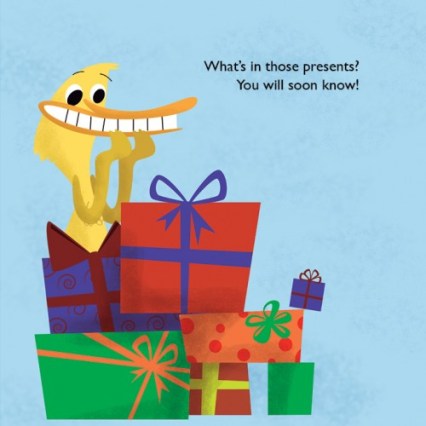
The book starts with Ilyas watching the sky to see if Ramadan is over and if Eid is here.  Duck in all his silliness doesn’t know what Eid is and rushes out to get decorations to celebrate.  he returns with a Christmas tree and ornaments.  Ilyas non judgmentally explains that those are for our Chrisitian neighbors for their holiday.  Duck then runs out again and returns with a menorah and dreidel and once again Ilyas explains that those are for our Jewish friends celebrating Hanukkah.  Ilyas and Duck then fly away in their hot air balloon to the Masjid to learn about Eid.

Ilyas and Duck2Ilayas and duck

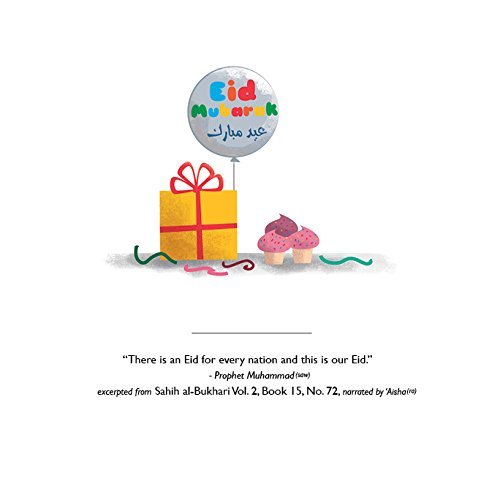
The book works for Muslim children to understand what others celebrate and works for non Muslims to see what we celebrate.  It is all done in a matter of fact way of celebration, not of doctrine.  It is built on the idea that, “There is an Eid for every nation ant his is our Eid.”ilyas and duck eid

Much like the first Ilyas and Duck book, this one is great to have around and read again and again!

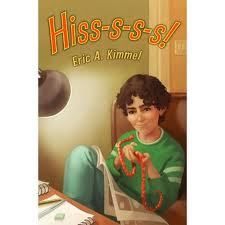
Hiss-s-s-s! by Eric Kimmel

Standard
Hiss-s-s-s! by Eric Kimmel

Hiss-s-s-s!

So um ya, its a book about a boy who wants a pet snake. Very linear, very simple, often more instructional than story, but somehow I really enjoyed it and read it in one sitting, as did my 9-year-old daughter and 7-year-old son. The book is 154 pages (including the author’s note) and is written on an AR 3.7 level.

SYNOPSIS:

Omar is an American Muslim who wants a snake.  His dad, Ahmed, supports the idea, but his mother, Hoda, is terrified of snakes, and begrudgingly gives her permission.  The rules are pretty simple, Omar will have to take care of the pet, and it is never to leave his room.  His mother basically doesn’t want to know that there is a snake under the same roof.  Little sister Zara is just excited.  The majority of the book is Omar learning about corn snakes, and everything involved in their care.  There are a lot of lists, and passages about him researching and taking notes. His friend Philip, nicknamed Samkatt-short for Samurai Cat, is the comical sidekick, who in this case also is the brains in the group, keeps the plot moving along. The author sprinkles in some anecdotes and history giving the characters depth.  We learn Ahmed’s dad is from Pakistan and while he grew up in the city he spent time in the country and with snakes.  He retells a fictional story about how snakes kept the rodent population down, and thus allowed the farmers in his family to have higher grain yields.  He also tells Omar tidbits about his time in college working in a biology lab with snakes.  Omar’s mom is an accomplished artist that often incorporates her Lebanese culture into her work and gallery shows.  The banter between her and Samkatt keep the story light and entertaining.  (SPOILER ALERT) At the climax, the snake gets loose, and Omar learns where his mother’s phobia comes from in her childhood.  During one of Lebanon’s many wars, a man with a snake tattoo beat her father extensively while she was forced to watch.  This somehow over time developed in to Ophidiophobia, the fear of snakes.  When the snake pops up, mayhem ensues, resulting in Hoda going to the hospital and Omar having to decide what to do with his snake, Arrow.

WHY I LIKE IT:

It is such a simple story, yet the warmth of the characters at the beginning and end really made it enjoyable.  I truly applaud the author for stretching a very simple idea into a full fledged YA novel.  The characters and family are Muslim, but it isn’t really discussed or made an issue.  There is nothing religious talked about or detailed.  In some ways, it would have been nice to throw a little more cultural or religious depth in to the story to connect with the characters, but being as the author is not Muslim it is kind of impressive that he presented them as just a regular American family.  Culturally there are only a few references outside of the anecdotes the parents share: Omar can’t come up with an example of when he was bullied, some of the foods served or eaten, the mother’s art work.

FLAGS:

None. Even if you don’t like snakes, the book should not make you squeamish.

TOOLS FOR TEACHING THE DISCUSSION:

There is not much to discuss with the book, and thus I wouldn’t choose it for a book club pick.  I think 2nd or 3rd graders, however,would do well with the book in small groups.  There is just a tinge of foreshadowing, symbolism, and interpretation that wouldn’t overwhelm the student, but would boost their confidence when they connect the dots so to speak.  Plus, some discussion could come from how he had to persuade his family, the responsibility he had to show, and the sequencing of events. The worksheets and questions would practically write themselves.

Author Eric Kimmel’s blog about the book http://ericakimmel.com/2012/02/h-i-s-s-s-s-s/

Muslim All-Stars Helping the Polonskys by Khaleel Muhammad

Standard

Muslim All Stars

A mishmash of young teen characters come together to form the Muslim All-Stars, the first book in a new series that will hopefully stick with the same set of characters doing good deeds in their community.    With only 67 pages and colorful illustrations of a variety of sizes scattered through out, the book is enticing, but not memorable.  I never bonded with any of the characters, and really couldn’t even list them all or identify them in the pictures.  Hopefully the series will continue and their individual personalities will take shape.   There are a few plot holes: how did Leila have a note from her parents if she just read the advert, how did none of the kids know each other or recognize each other if they all went to the same school, why would something done outside of school warrant recognition in school? And some random unresolved ideas: the Polonsky’s harbored a burglar or was it a rumor, why did Mr. Polonsky call Leila three times just to tell her to go?  Despite it all however, it is overall a fun book for both girls and boys in grades 2 through 4.

SYNOPSIS:

Mr. Polonsky’s wife is coming home after having surgery and their home is a mess. Overwhelmed by the prospect of cleaning it, he gets the brilliant idea of hiring kids to do it, for cheap.  A handful of kids, all Muslim, show up to do the work.  But even overcoming Mr. Polonsky’s rotten attitude, the mountains of rubbish, the menagerie of critters that have taken up residence in the home, and a crazy washing machine, is not enough to prove themselves in the face of Mrs. Polonsky’s anger when she gets home.

WHY I LIKE IT:

I love that within the Muslim group there are kids of different ethnic and cultural backgrounds and abilities; one kid is a convert, one is Pakistani, one is good with machines, one has Aspergers, one seems to get in trouble a lot.  They all answer the advert for different reasons, but after some convincing of sorts, they all agree to help the Polonskys because it is the right thing to do.  MashaAllah the girls wear hijab, they break for salat as a group, verify the food is halal, and generally just work well together.

FLAGS:

Clean alhumdulillah

TOOLS FOR LEADING THE DISCUSSION:

There is nothing online.  It is a book that if you recommend it to a child you simply would want to follow up with them by asking about what they thought about how the kids were treated, what they would do if Mr. Polonsky treated them that way, if they were surprised by the ending etc..

The book is written in British English and American kids shouldn’t have trouble understanding what is going on, but might need some help figuring out some of the words, such as rubbish, bin liners, skip, etc..

The Red Pencil by Andrea Davis Pinkney illustrated by Shane W. Evans

Standard

The Red Pencil.jpg

I didn’t realize the book was written in prose until I opened it up to read, and immediately taken-aback I rechecked the AR level and sure enough, this 309 page book that is written in prose and covers the genocide in Darfur, is written on a 4.2 level. And it is amazing. I forced myself to stop reading at one point so as to not rush the depth and soul of the simple words from being lost in haste.  It is truly, in my opinion, a beautifully remarkable feat to convey such horrific atrocities with such hope and integrity to young adults in a palatable and inspiring way.

“Allah is the light,” he says.

I ask,

“How do you find Allah’s light?”

Old Anwar says,

“Take the path that shines the brightest.”

SUMMARY:

Amira’s life on her family’s farm is by no means easy, but she has loving parents, a little sister, her beloved sheep, and a dream of going to school.  Her father advocates for her, but her mother, steeped in tradition, sees education only as a waste of time.  The illustrations and sparse words manage to convey fairly solid understanding of Amira’s life, optimism, and relationships with those closest to her.  Although warned of the dangers the Janjaweed could cause, Amira remains fairly unconcerned about the mounting political unrest around her, until it is too late.  When death and the destruction of her home force the surviving members of her family and neighbors to seek refuge in a camp many miles away, the reader sees how truly horrific her experiences have been.  She refuses to speak or rather cannot, when a chance encounter with an aid worker brings her the prospect of getting her voice back, through the empowerment of a red pencil.  With restored determination she convinces an elder neighbor to teach her, but it is not enough for Amira Bright.  Her sparrow needs to soar free.

WHY I LIKE IT:

You expect a book written in verse to have a lot of imagery and symbolism, and The Red Pencil does a good job of balancing the story and the description, to keep the book on track.  The linear story line remains focused on telling the story at hand, making it attainable for elementary and middle school children.  The Darfur conflict is complicated at best, and using verse to convey it from a young girl’s voice allows a lot of the politics and dirtiness of war to be side-stepped without dismissing it.  Amira’s optimism and hope is at times naive, but more as a reflection of her personality then out of ignorance. She sees things, and feels things, and must deal with things, no child should, but her spirit shines through and keeps the book from being depressing, while still being sad.

Today the red pencil does more

than beg for my hand.

It makes me a promise.

It tells me to try.

The characters are Muslim and they rely on Allah, and pray, yet Amira’s thirst for knowledge includes that of learning the Koran (Qur’an) as that knowledge too, has not been readily available to her  There is a lot to discuss in the book, both what is written and what the reader brings to it.  I look forward to teaching the book, and re-reading it once again to savor in the rich images.

Here,

Muma stoops.

Here,

she has nothing to reach for.

FLAGS:

Their is violence when the Janjaweed attack her family.  But I think it is conveyed in a manner suitable for 3rd grade and up.  It is not celebrated or glorified, it is traumatic and has repercussions that are respectfully conveyed.  There is also mention of a child bride, but not in so many words, that in all honesty I doubt most young readers will be as bothered by it as perhaps they should.

TOOLS FOR LEADING THE DISCUSSION:

There is a discussion guide in the back of the book along with an Author’s Note, Acknowledgements, Glossary/Pronunciation Guide, Character/Location Pronunciations, and Important Terms that Appear in the Book.

An Educators Guide: http://media.hdp.hbgusa.com/titles/assets/reading_group_guide/9780316247801/EG_9780316247801.pdf

A study guide and quiz: http://www.bookrags.com/studyguide-the-red-pencil/free-quiz.html#gsc.tab=0
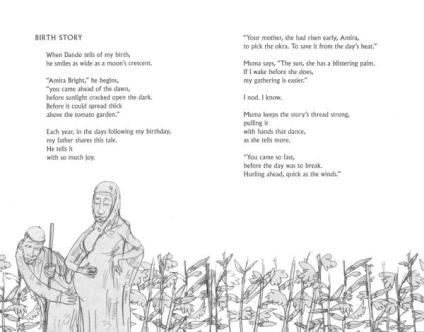
The Red Pencil 1

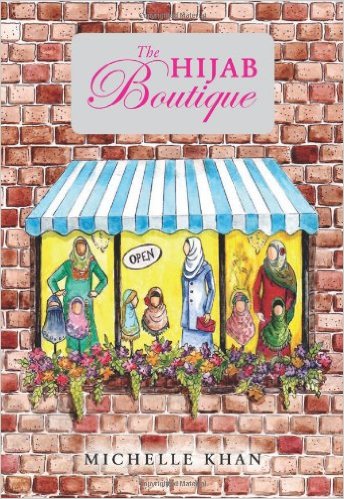
The Hijab Boutique by Michelle Khan

Standard

The Hijab Boutique

I was really hoping this book would help out the sparsely populated early chapter book section.  And it should, at just 52 pages with beautiful full page pencil style drawings, it just somehow seemed confused instead.  The content is much more young adult in story line, but because of the short length, the characters seem flat and underdeveloped.  My fourth grader read it in less than a half an hour. Yet, I don’t think a 1st or 2nd grader would get much out of the book.  I don’t know what kind of editing process the Islamic Foundation puts its books through, but back when I was a teacher, I would have told the student they have a wonderful, wonderful rough draft with so much potential, they just need to flesh it out and add more detail so the reader connects with the characters. The back of the  book suggests the book for ages 10 and up and content wise that is fine, but it also has a list price of $7.95 and for something that can be read in less than a half an hour, it seems a little steep. If it didn’t have so much potential, perhaps I wouldn’t be so bothered, I just feel like if she stretched it out to being 200 pages, it could be so powerful.

Farah is a fifth grader at an all girls art school.  She has a best friend, who’s mom is a soap opera star, but some popular girls still make  her nervous.  When her Social Studies teacher assigns the girls to bring in something representing her mother, she can’t find anything to share about her mother that she doesn’t think is boring.  Farah’s father passed away two years prior and with money tight, Farah’s mom is opening up a Hijab Boutique.  No real details are given about her family life with her father or the impact his death had on her, which is unfortunate.  The story discusses why the mom started wearing hijab and why it is important, but makes it seem like Farah knows so little about her mother.  Again a hole that if explored would make the book that much more interesting. Not to mention that it could prod young girls to talk to their own mothers about such things.  To no one’s surprise Farah brings in some hijabs to represent her mother and Alhumdulillah the book ends on a positive note with little fanfare, catharsis or drama.

Farah and her mom are practicing Muslims who are an active part of their western community.  It would seem Farah is the only Muslim in her school and it doesn’t seem to be an issue.  They are all upper class and a bit snobbish, but there are no flags.  If your library has the book, reading it is by no means a waste of time.  I don’t know that you’d read it more than once if you purchased it, but 4th through 6th graders might enjoy the short read, and be inspired by fashionably fabulous hijabs while furthering their understanding about why Muslimah’s are required to cover.


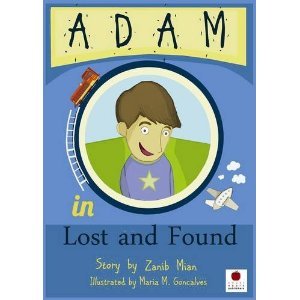
Adam in Lost and Found by Zanib Mian illustrated by Maria M. Goncalves

Standard
Adam in Lost and Found by Zanib Mian illustrated by Maria M. Goncalves

Adam in Lost and Found

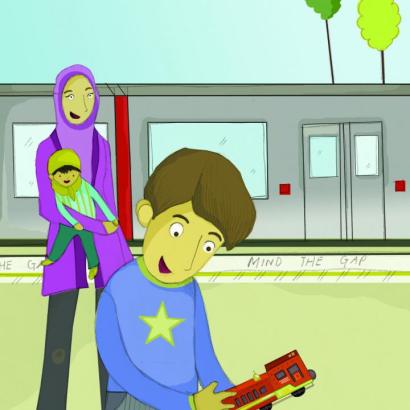
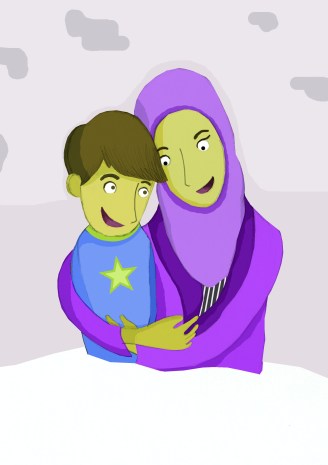
This book resembles kindergarten and 1st grade leveled readers in both appearance (shape and size) and appeal.  It very easily could have been a picture book, with its sparse words and simple linear story, but by making it a smaller size, with a variety of playful fonts, it really excites beginning readers who pick it up and are thrilled to see Muslim characters in an Islamic book on their level.  The book is 32 pages and has nice large age appropriate pictures that work very well, even when reading the book aloud to small groups.

adam 1

The  story explores the concept of “finders keepers losers weepers” in a fulfilling way.  Adam, a young boy on a train with his family, finds a toy train and desperately wants to keep it.  His father kindly explains to him the two options before him and lets him choose.  Adam, Alhumdulillah,  chooses to give the train to the lost and found man and earn Allah’s reward.  Later, Adam realizes after much searching and help from his family, that when he found the train, he left his toy airplane.  The moral is cemented in the readers, as they too hope, with Adam, that whomever found his plane, also did the right thing and gave it to the lost and found. By coming full circle the message is conveyed, and a happy ending is had by all.

The book takes place in Britain and is book two in the Adam series.adam 2


Zak and His Good Intentions by J. Samia Mair illustrated by Omar Burgess

Standard

Zak and his good intentions

Zak  and his sister Hana compete to do good deeds, but nothing goes as Zak intends.  Each time he sets off to help someone or do something kind, he is thwarted by something unexpected.  As frustration mounts with each failure, his mom steps in to reassure him that, “Prophet Muhammad (saw) said that whoever intends to do a good deed, but does not do it, still gets a good deed for his or her intention.” With his spirits restored Zak appreciates Allah’s mercy and accepts that even when we try and plan, it is Allah’s plan that ultimately prevails.

The beauty of the book is in its simple message that is reiterated four times and brought to life with simple straightforward text and detailed, but not overwhelming illustrations.  The book is written on about a second grade level and would appeal to ages 4 to about 8.  It has 32 pages and contains discussion points at the end.  The book is fun and funny and conveys a message and moral in a relevant non preachy way.  Young kids can definitely relate to the character’s desire to do good, disappointment when he fails, and comfort in knowing that Allah swt knows all and is the most just.

Overall a good book with a strong message that can be read more than once and referenced often in both the home and school setting.


Yasmine’s Belly Button by Asmaa Hussein illustrated by Charity Russell

Standard

Yasmine's Belly Button

This book is fun, fun, fun.  The mere mention of the word belly button to little kids gets them giggling, and the words and pictures in the book kept them engaged and happy through out.

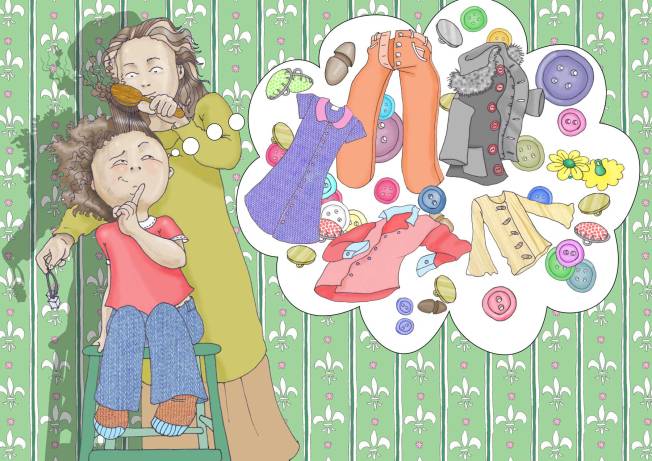
The story is a simple dialogue between 4 year-old Yasmine and her mother about belly buttons as she heads off for her first day of school full of butterflies.  We learn that everyone has a belly button, even cats! And the students have a fun time following along with Yasmine’s confusion of why it is called a button, to her understanding that it allowed her to receive food while in her mother’s tummy.  yasmine2The illustrations are bright and colorful and have a lot going on.  The expressions on the character’s faces compliment and complete the text seamlessly to tell a well thought out story.  They keep the audience’s attention even after the text is read, with the kids telling me to “wait” so that they could soak it all in before I turned each page.  The mom and teacher’s expressions on the last page amused the daycare through Kindergarten students and made them feel like they were in on the silliness.

A lot is conveyed even with just a few words on its 28 pages.  The reader sees what she thinks, they see the mom without hijab at home and with hijab when she goes out, they see a diverse classroom, a patient mom, and a way to deal with being nervous in a new situation.

I read this book to many students at school and to my own children at home, and can tell it will be an often requested book in both settings, mashaAllah, I highly recommend it.


Bismillah Soup by Asmaa Hussein illustrated by Amina Khan

Standard
Bismillah Soup by Asmaa Hussein illustrated by Amina Khan

Bismillah Soup

It is always a cause of giddiness to find a good book, but to have one recommended by a mutual friend of the author, makes it all the better. Bismillah Soup is a spin-off of the Stone Soup folktale, but without the “trickery” of the classic.  Hasan, wants to surprise his mom with a feast, but money is tight and when Hasan is sent to ask the local Imam for some rice, a plan: Bismillah Soup, forms that brings the entire community together.  The story takes place in Somalia and the cultural words that are peppered in to the story add detail and talking points to have with the kids.  As each community member shares something small, the enormous feast that is created is a wonderful example of what can be achieved when we each give our best to help others.  The book is 40 pages with a glossary at the back and is definitely one that can be read over and over to kids of all ages.  Even the littlest ones are able to grasp the beauty of coming together through the colorful and playful pictures.

soup-gallery-img1 (1)The real treat of the book however, is how it all comes together: the words, pictures, sentence structure, font, size, and diction all compliment each other on the same level.  I read a lot of books aloud as a children’s librarian, and while the rhyming ones are great for the littlest listeners, there is often a void of read-out-loud stories for the kindergarten and first grade levels.  And I am talking about all books, not just Islamic ones.  Most picture books in my experience are written on a third grade level, with longer blocks of texts, smaller fonts, a wider range of vocabulary and longer sentences.  These books are often beautiful and very tempting, however when I read them during story time I end up “summarizing” them, and telling the story rather than reading it.  Similarly, early readers often find them frustrating and too difficult to read independently. Bismillah Soup strikes a wonderful balance, mashaAllah.
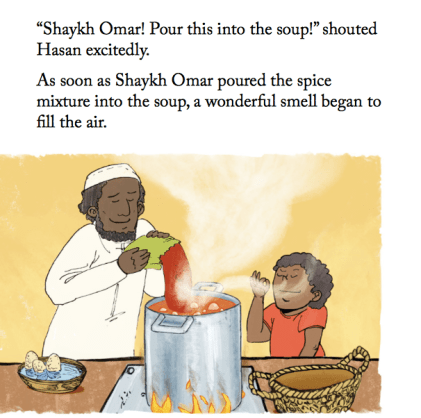
I read the story to my own children who enjoyed it and have found my first grader reading it independently twice this week.  Each time beaming with excitement to tell me something new he has gained from the book.  When I read it aloud to them, my kids marveled at how having a good intention and being so generous could benefit everyone. The first time my son read it independently he was in deep thought about how grateful Hasan was even though they didn’t have much food and how he was a determined problem solver.  The second time I found him reading it, he was so very impressed at the kindness of Shaykh Omar.  He really started to understand the subtle beauty of the character not just in helping Hasan’s family with food, but also supporting and working with the young boy to make the feast happen, alhumdulillah.  Screen-Shot-2015-08-29-at-12.06.00-AM

I highly recommend the book and I can’t wait to read it to my students at school next week, inshaAllah.  For more about the book, the author, and her other work you can go to the author’s website  http://www.ruqayasbookshelf.com

Rashid and the Haupmann Diamond by Hassan Radwan

Standard

haupmann diamond

This is the second and seemingly last book in the Rashid series, which is unfortunate, because like its predecessor Rashid and the Missing Bodythe book is a quick fun read aimed at 3rd through 5th graders with Muslim characters solving a mystery.  At just 110 pages the book reunites friends Rashid, Gary, and Chris, three boys of different religious backgrounds with plenty of respect and understanding to inspire readers of all ages.

SYNOPSIS:

Rashid and his friends hear screaming in the middle of the night and rush outside to see robbers in their neighbor’s house. Once the police come and no evidence of a break in can be found, the boys do their own investigating to see what is going on.  Pieces of information start to come together from the elderly neighbor and her stories of her father, mysterious contacts online, old WWII veterans at retirement homes, and good old fashioned library research, to lead the boys on an adventure to find a lost diamond.  Never a dull moment as the boys are chased by the burglars, family issues at home bring Rashid’s sister and baby into the story, some bullies at school and more.

WHY I LIKE IT:

The book is incredibly fast paced, it hops around from one story-line to the next.  While this format seemed more cohesive in the first book, it was a little jarring for me in this one.  I didn’t mind the side stories at school, or even the soccer matches, but the story of the sister, Huda and her marital problems with her husband Ahmed seemed a bit out of place.  I see what the author’s intent was, but in such a short book aimed at elementary aged boys, it seemed  a heavy story-line to interweave into an adventure story.  The deeper understanding of mixing cultures and expectations I am positive would be lost on all young adult readers.  Once again, the author however, does do a great job of telling a story where the character’s Islam adds to the character, and doesn’t distract from the adventure on hand.  Rashid uses islamic terms, the family prays together, they go to the masjid and laugh with the imam and congregation, they talk about proper ways to correct people and the value of intentions, overall, I’d say they convey a “normal” Muslim family.

FLAGS:

No flags, the book is clean and inspiring, alhumduillah

TOOLS FOR LEADING THE DISCUSSION:

There isn’t a lot out there about the book or the author, nor is the book in the Accelerated Reader database.  I think with its linear story, keeping track of the clues and throwing in some highlights of Islamic manners and morals, however, would make a discussion on the book easy and natural enough for all to enjoy.